Corporate Accounting: Analysis of Recoverable Amount, Value-in-Use

Verified

Added on  2020/05/28

|11
|1707
|61
Report
AI Summary
This report provides a comprehensive analysis of key concepts in corporate accounting, focusing on the calculation and application of recoverable amount, value-in-use, and fair value less cost of disposal. The report explains each concept and their interrelation, emphasizing their importance in asset impairment assessment. Part A defines and explains each term, highlighting the factors that influence their calculation, such as discount rates and future cash flow projections. Part B provides a practical example of impairment loss calculation, including the allocation of impairment loss across different assets. Journal entries are also provided to illustrate the accounting treatment of impairment loss, alongside references to relevant accounting standards and academic literature. The report helps to understand how these concepts are used to determine the value of assets and market valuation.
Document Page
Running head: CORPORATE ACCOUNTING
Corporate Accounting
Name of the Student:
Name of the University:
Author’s Note:
tabler-icon-diamond-filled.svg

Paraphrase This Document

Need a fresh take? Get an instant paraphrase of this document with our AI Paraphraser
Document Page
1
CORPORATE ACCOUNTING
Table of Contents
Part A...............................................................................................................................................2
Part B...............................................................................................................................................7
Reference List..................................................................................................................................9
Document Page
2
CORPORATE ACCOUNTING
Part A
Introduction
This essay has been constructed in order to have an idea about the process that is used in
order to have an understanding of the process that is used in order to calculate the “recoverable
amount”, “value-in-use” and the “fair value less the cost of disposal”. In the current business
world, it is essential to maintain an effective financial statement and accordingly sustain the
operational activities. An understanding of the recoverable amount is essential in order to gain an
idea about the amount that can be recovered and accordingly maintain competitive edge.
Document Page
3
CORPORATE ACCOUNTING
Explanation of the Recoverable Amount, Value-in-Use and Fair Value less cost of disposal
Recoverable Amount
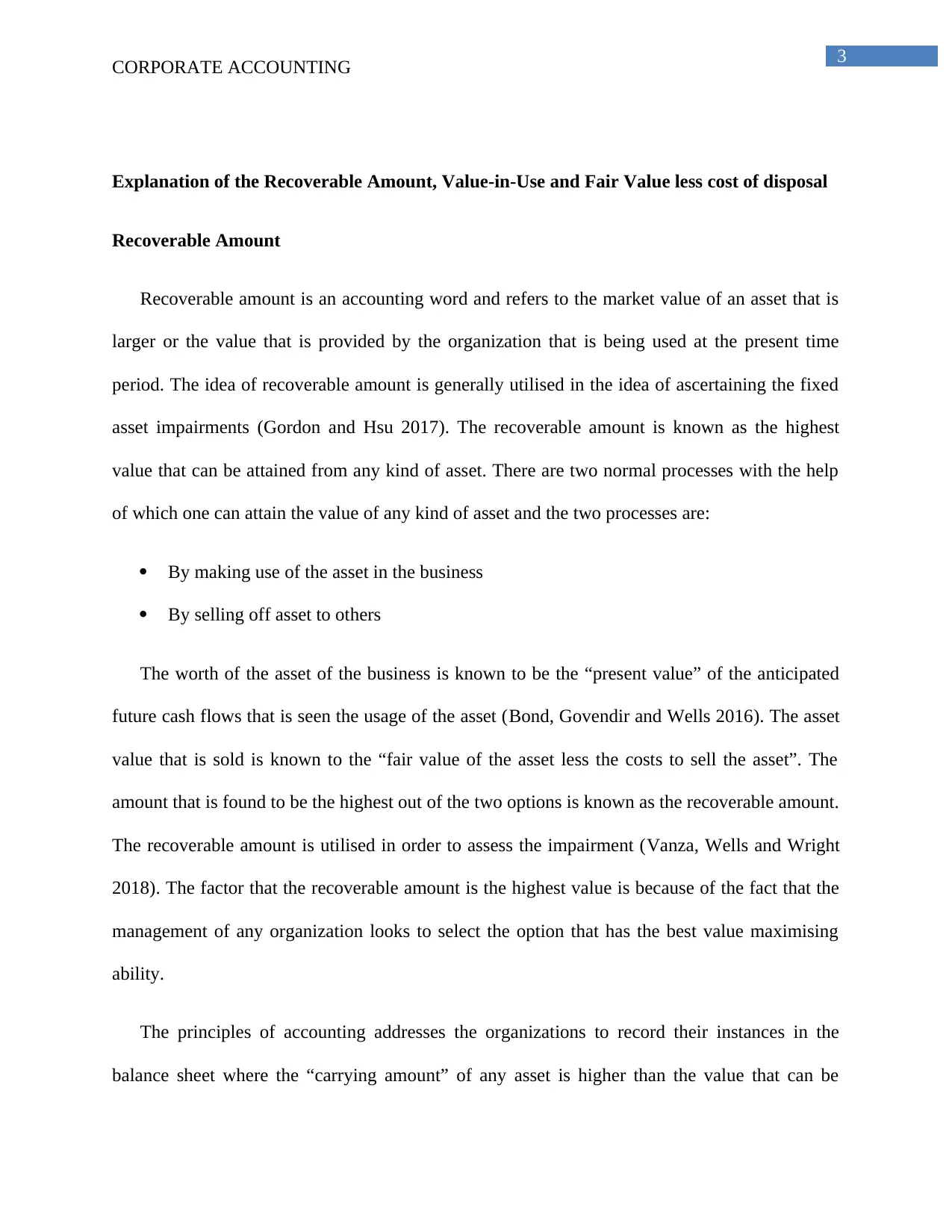
Recoverable amount is an accounting word and refers to the market value of an asset that is
larger or the value that is provided by the organization that is being used at the present time
period. The idea of recoverable amount is generally utilised in the idea of ascertaining the fixed
asset impairments (Gordon and Hsu 2017). The recoverable amount is known as the highest
value that can be attained from any kind of asset. There are two normal processes with the help
of which one can attain the value of any kind of asset and the two processes are:
By making use of the asset in the business
By selling off asset to others
The worth of the asset of the business is known to be the “present value” of the anticipated
future cash flows that is seen the usage of the asset (Bond, Govendir and Wells 2016). The asset
value that is sold is known to the “fair value of the asset less the costs to sell the asset”. The
amount that is found to be the highest out of the two options is known as the recoverable amount.
The recoverable amount is utilised in order to assess the impairment (Vanza, Wells and Wright
2018). The factor that the recoverable amount is the highest value is because of the fact that the
management of any organization looks to select the option that has the best value maximising
ability.
The principles of accounting addresses the organizations to record their instances in the
balance sheet where the “carrying amount” of any asset is higher than the value that can be
tabler-icon-diamond-filled.svg

Paraphrase This Document

Need a fresh take? Get an instant paraphrase of this document with our AI Paraphraser
Document Page
4
CORPORATE ACCOUNTING
recovered (Price 2015). For instance, if the organization has a factor to make an assumption that
the value of the assets is impaired, then the company needs to undertake a official projection of
the “recoverable amount”. This process is very much similar to the idea of reduced cost or in
many circumstances the market value which is applicable to the inventory. It is seen that IAS 36
has disclosed to the accountants with the course line on this aspect and has explained that:
If the fair value of the asset subtracted by the “cost of disposal” cannot be ascertained,
than the “recoverable amount” is equivalent to the value-in-use
If the organization looks to sell off their asset, the “recoverable amount” is corresponding
to their fair value subtracted by the “cost of disposal”.
It has to be noted that if the “fair value” of any asset subtracted by the “cost of disposal or the
value of the asset” that is in used in higher than the carrying amount, then computation of the
recoverable amount is not essential as the asset in this case is not required to be impaired
(Linnenluecke et al. 2015).
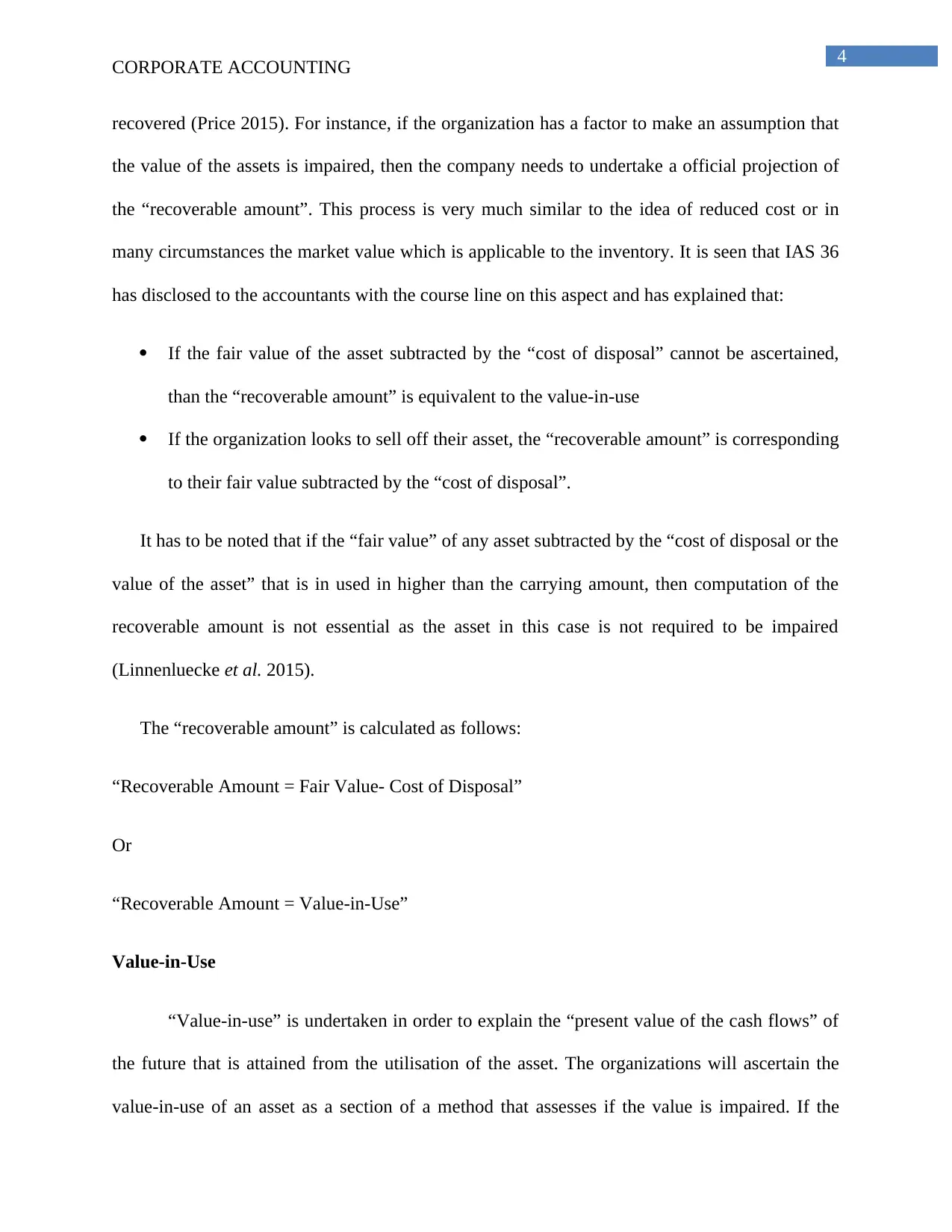
The “recoverable amount” is calculated as follows:
“Recoverable Amount = Fair Value- Cost of Disposal”
Or
“Recoverable Amount = Value-in-Use”
Value-in-Use
“Value-in-use” is undertaken in order to explain the “present value of the cash flows” of
the future that is attained from the utilisation of the asset. The organizations will ascertain the
value-in-use of an asset as a section of a method that assesses if the value is impaired. If the
Document Page
5
CORPORATE ACCOUNTING
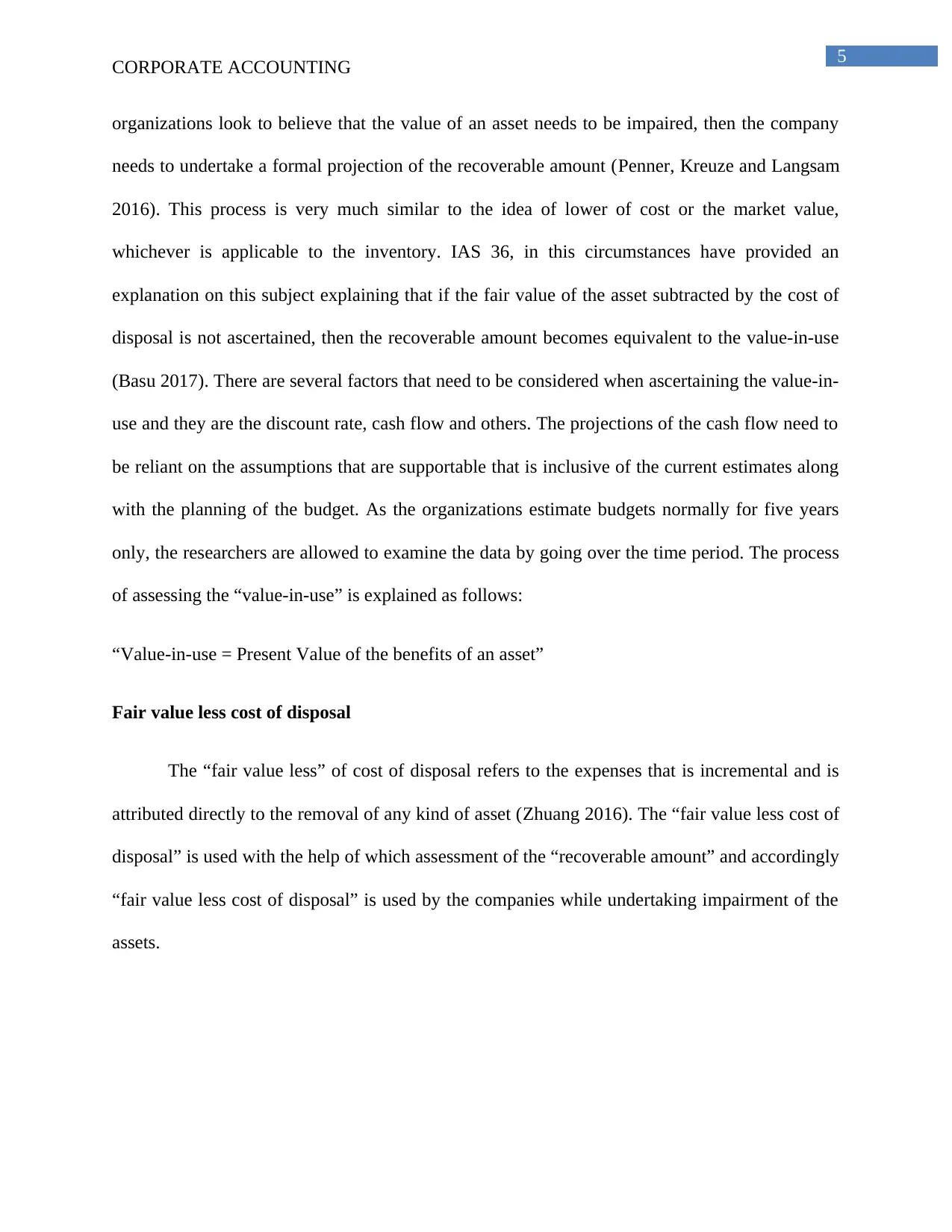
organizations look to believe that the value of an asset needs to be impaired, then the company
needs to undertake a formal projection of the recoverable amount (Penner, Kreuze and Langsam
2016). This process is very much similar to the idea of lower of cost or the market value,
whichever is applicable to the inventory. IAS 36, in this circumstances have provided an
explanation on this subject explaining that if the fair value of the asset subtracted by the cost of
disposal is not ascertained, then the recoverable amount becomes equivalent to the value-in-use
(Basu 2017). There are several factors that need to be considered when ascertaining the value-in-
use and they are the discount rate, cash flow and others. The projections of the cash flow need to
be reliant on the assumptions that are supportable that is inclusive of the current estimates along
with the planning of the budget. As the organizations estimate budgets normally for five years
only, the researchers are allowed to examine the data by going over the time period. The process
of assessing the “value-in-use” is explained as follows:
“Value-in-use = Present Value of the benefits of an asset”
Fair value less cost of disposal
The “fair value less” of cost of disposal refers to the expenses that is incremental and is
attributed directly to the removal of any kind of asset (Zhuang 2016). The “fair value less cost of
disposal” is used with the help of which assessment of the “recoverable amount” and accordingly
“fair value less cost of disposal” is used by the companies while undertaking impairment of the
assets.
Document Page
6
CORPORATE ACCOUNTING
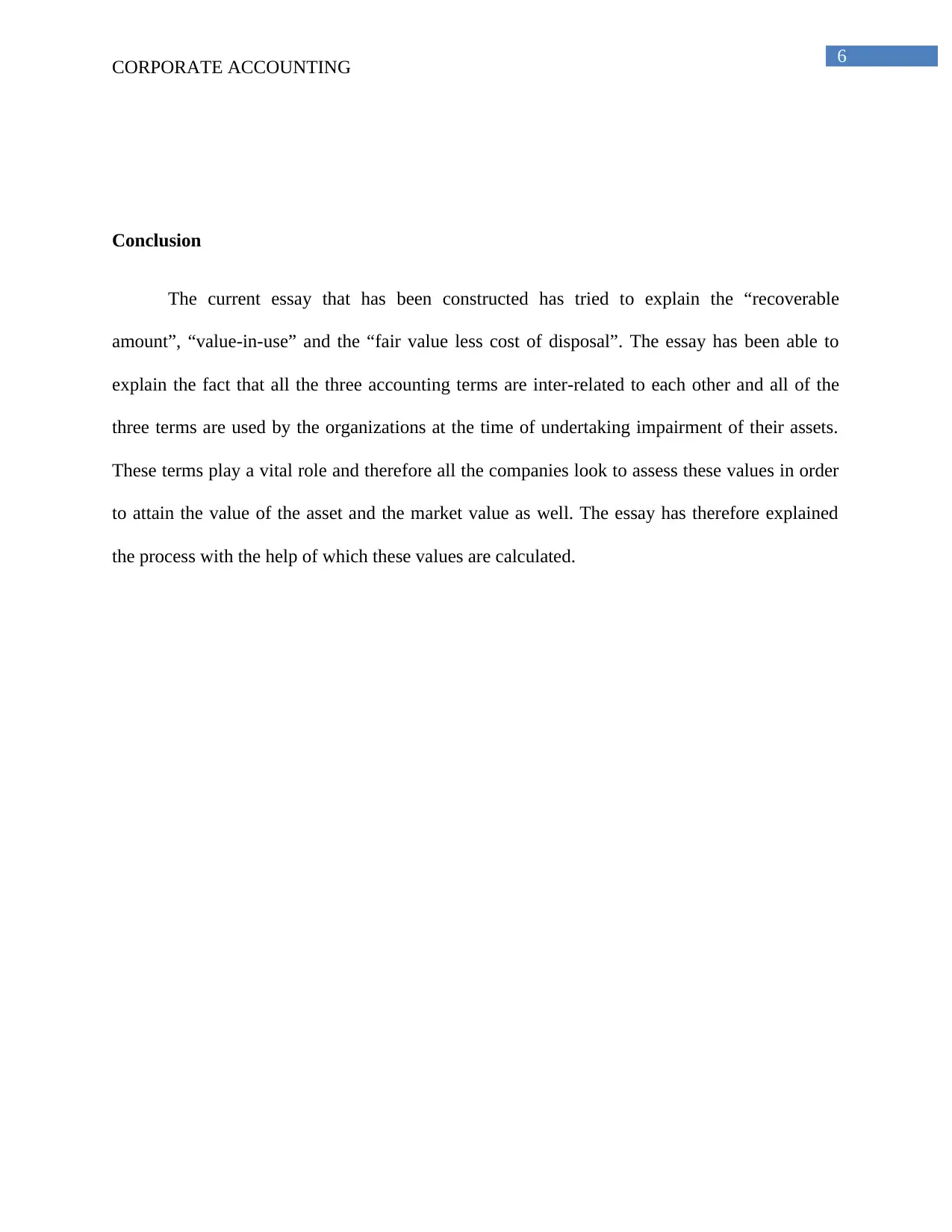
Conclusion
The current essay that has been constructed has tried to explain the “recoverable
amount”, “value-in-use” and the “fair value less cost of disposal”. The essay has been able to
explain the fact that all the three accounting terms are inter-related to each other and all of the
three terms are used by the organizations at the time of undertaking impairment of their assets.
These terms play a vital role and therefore all the companies look to assess these values in order
to attain the value of the asset and the market value as well. The essay has therefore explained
the process with the help of which these values are calculated.
tabler-icon-diamond-filled.svg

Paraphrase This Document

Need a fresh take? Get an instant paraphrase of this document with our AI Paraphraser
Document Page
7
CORPORATE ACCOUNTING
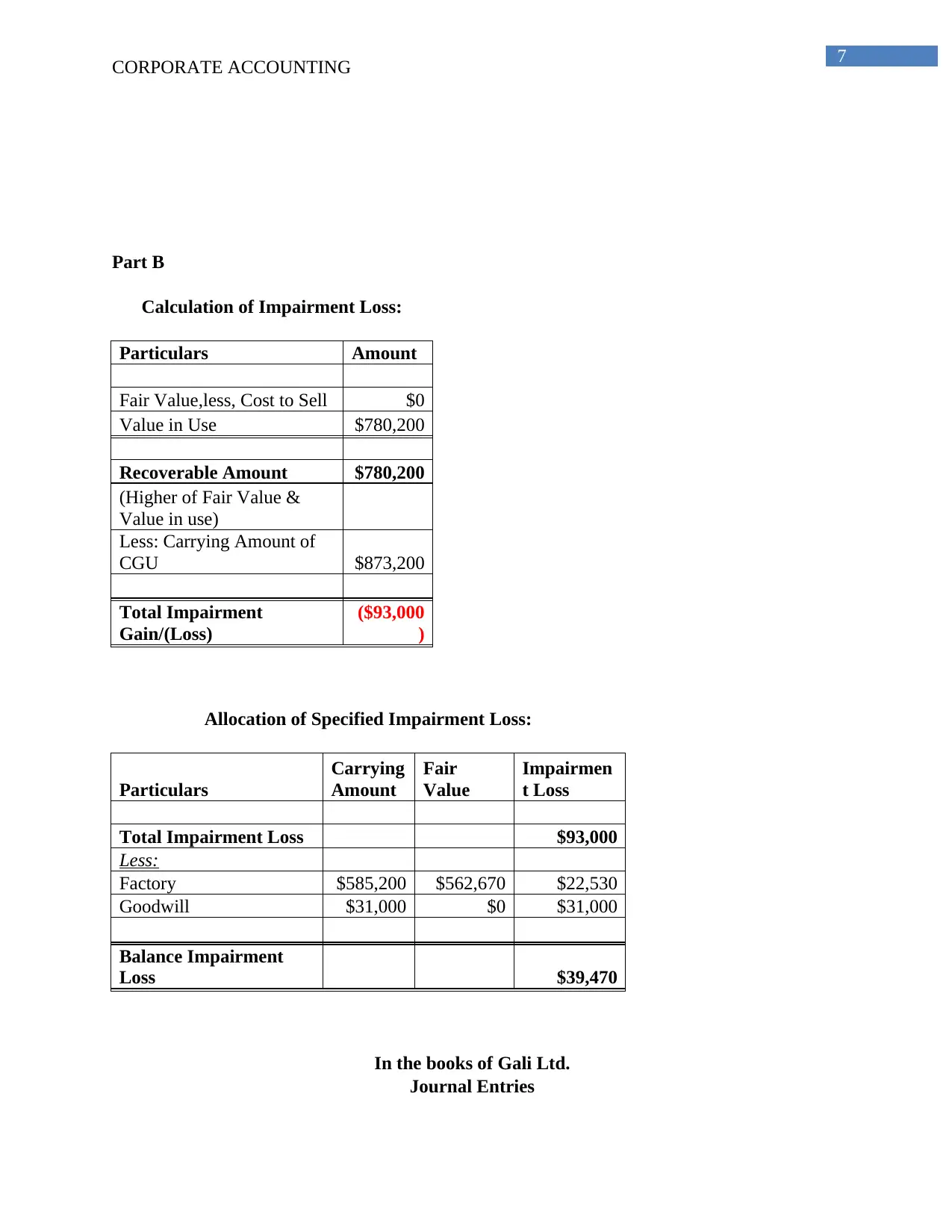
Part B
Calculation of Impairment Loss:
Particulars Amount
Fair Value,less, Cost to Sell $0
Value in Use $780,200
Recoverable Amount $780,200
(Higher of Fair Value &
Value in use)
Less: Carrying Amount of
CGU $873,200
Total Impairment
Gain/(Loss)
($93,000
)
Allocation of Specified Impairment Loss:
Particulars
Carrying
Amount
Fair
Value
Impairmen
t Loss
Total Impairment Loss $93,000
Less:
Factory $585,200 $562,670 $22,530
Goodwill $31,000 $0 $31,000
Balance Impairment
Loss $39,470
In the books of Gali Ltd.
Journal Entries
Document Page
8
CORPORATE ACCOUNTING
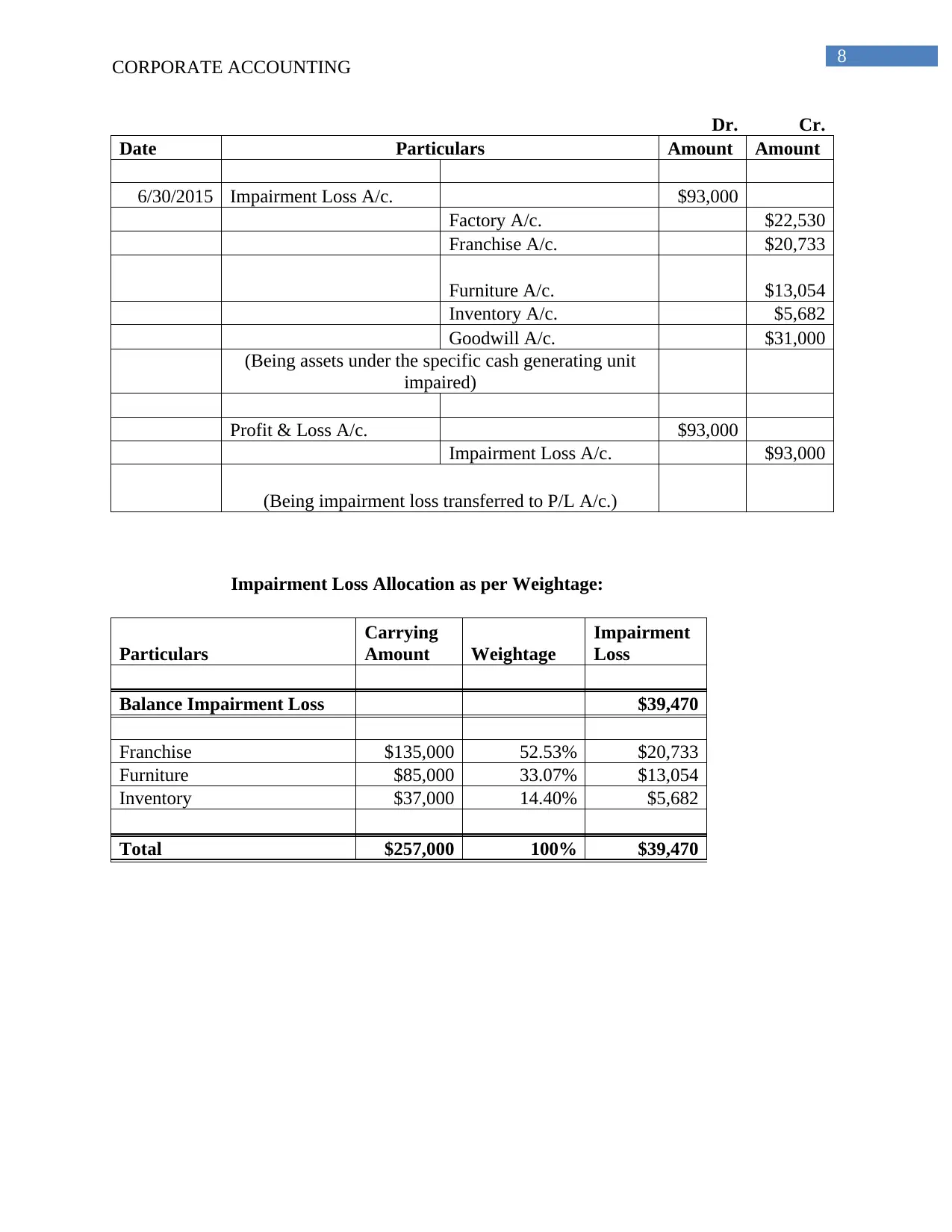
Dr. Cr.
Date Particulars Amount Amount
6/30/2015 Impairment Loss A/c. $93,000
Factory A/c. $22,530
Franchise A/c. $20,733
Furniture A/c. $13,054
Inventory A/c. $5,682
Goodwill A/c. $31,000
(Being assets under the specific cash generating unit
impaired)
Profit & Loss A/c. $93,000
Impairment Loss A/c. $93,000
(Being impairment loss transferred to P/L A/c.)
Impairment Loss Allocation as per Weightage:
Particulars
Carrying
Amount Weightage
Impairment
Loss
Balance Impairment Loss $39,470
Franchise $135,000 52.53% $20,733
Furniture $85,000 33.07% $13,054
Inventory $37,000 14.40% $5,682
Total $257,000 100% $39,470
Document Page
9
CORPORATE ACCOUNTING
Reference List
Basu, A., 2017. Impairment of Intangible Assets-An Effort to Convergence. International
Journal of Engineering and Management Research (IJEMR), 7(5), pp.210-214.
Bond, D., Govendir, B. and Wells, P., 2016. An evaluation of asset impairments by Australian
firms and whether they were impacted by AASB 136. Accounting & Finance, 56(1), pp.259-288.
Gordon, E.A. and Hsu, H.T., 2017. Tangible Long-Lived Asset Impairments and Future
Operating Cash Flows under US GAAP and IFRS. The Accounting Review, 93(1), pp.187-211.
Linnenluecke, M.K., Birt, J., Lyon, J. and Sidhu, B.K., 2015. Planetary boundaries: implications
for asset impairment. Accounting & Finance, 55(4), pp.911-929.
Penner, J.W., Kreuze, J.G. and Langsam, S.A., 2016. INSTRUCTORS'NOTES: IMPAIRMENT
ANALYSIS: COMPARISON OF IMPAIRMENT OF LONG-LIVED ASSETS BETWEEN US
GAAP AND IFRS. Journal of the International Academy for Case Studies, 22(2), p.90.
Price, J., 2015. The regulator: Understanding impairment. Company Director, 31(7), p.12.
Vanza, S., Wells, P. and Wright, A., 2018. Do asset impairments and the associated disclosures
resolve uncertainty about future returns and reduce information asymmetry?. Journal of
Contemporary Accounting & Economics, 14(1), pp.22-40.
Zhuang, Z., 2016. Discussion of ‘An evaluation of asset impairments by Australian firms and
whether they were impacted by AASB 136’. Accounting & Finance, 56(1), pp.289-294.
tabler-icon-diamond-filled.svg

Paraphrase This Document

Need a fresh take? Get an instant paraphrase of this document with our AI Paraphraser
Document Page
10
CORPORATE ACCOUNTING
chevron_up_icon
1 out of 11
circle_padding
hide_on_mobile
zoom_out_icon
[object Object]