Exploring Ethical Dilemmas: Cancel Culture, COVID-19 & Hitler's Fate

Verified

Added on  2023/06/18

|4
|1529
|84
Essay
AI Summary
This essay delves into several complex ethical dilemmas. It discusses the morality of potentially preventing Hitler's rise to power through time travel, arguing that while Hitler's actions were reprehensible, his existence has profoundly shaped history and removing him could have unforeseen consequences. The essay also examines the ethics of mandatory COVID-19 vaccination, acknowledging the violation of individual rights but asserting the government's duty to protect public health during a pandemic. Finally, it addresses the ethical implications of cancel culture, suggesting that while holding individuals accountable for harmful speech is important, cancel culture can stifle open debate and threaten freedom of speech. The essay also touches upon the morality of billionaires retaining vast wealth in a world where many struggle to survive, questioning the balance between individual rights and social responsibility.
Document Page
QUESTION 2
Answer: With respect to the killing of Hitler by going back would be consider a big blunder. This is because
firstly it would not be moral and ethical to make killing of a baby boy. Likewise, as Hitler itself become an
inseparable and important part that in the absence of Hitler, history would not be possible (Plesch, 2017). As all
the wars including World war II and Holocaust would be prevented if there would not be Hitler. Also the role of
Hitler in the ancient time and history was major and no history would be imagined if there would be no Hitler.
This is because Hitler was a singular figure of 20th century and its actions as chancellor of Germany around 1933
and 1945 way incredible and major (Ford, 2015). However, on other side as Hitler was closely related with the
Holocaust so its removal would be considered as important because it has lead a serious impact over the history.
In the same way it is also to be noted that as history and ancient time is taken as a base that would lead to the
learning of the new things and concept and with respect to Hitler the history not only become interesting but at
the same time it has raise its meaning (Longerich, 2019). Similarly, its removal from the history would lead to
removal of political ideologies and social movements so it would be wrong to state that it need to be removed if
the chance of removal will be got through time machine. Thus, it would be right to state that with the use of time
machine and going back would be not be taken as worth and meaningful.
QUESTION 3
Answer: Yes, COVID-19 vaccination need to be mandatory implemented in the system. Although it would not be
ethical that an individual will be forced to act in a specific way and manner because it is considered as violation
of human right (Iyengar, and et.al. 2021). But as rights can’t overlap the duties so it can be right to state that
although mortal and basic human right is violated, but it can’t overlap the duty. As with the outburst of COVID
pandemic millions of people are died including front line workers so it is considered as duty of the government
that it makes vaccination of people without giving them option of not getting vaccinated. As people are getting
careless with regard to COVID pandemic and its side effect towards the human life (Breakey, 2020). So taking of
strict action including lockdown and vaccination at broader scale would be taken as essential and mandatory in
order to save unity and human life although it involve the overlapping of basic human life. Also I was not a new
ideology that the duties come forward and above the human right. As it was a rule that Primum non nocere i.e.
first not to make harm is the major principle of Hippocratic Oath which is taken by doctor (Bufacchi, 2021).
Thus, it would be right to conclude and state that although it would not be taken as ethical but in the preservice of
human life it is mandatory that COVID vaccination would be done without the consideration of moral principle
and human right.
1
tabler-icon-diamond-filled.svg

Paraphrase This Document

Need a fresh take? Get an instant paraphrase of this document with our AI Paraphraser
Document Page
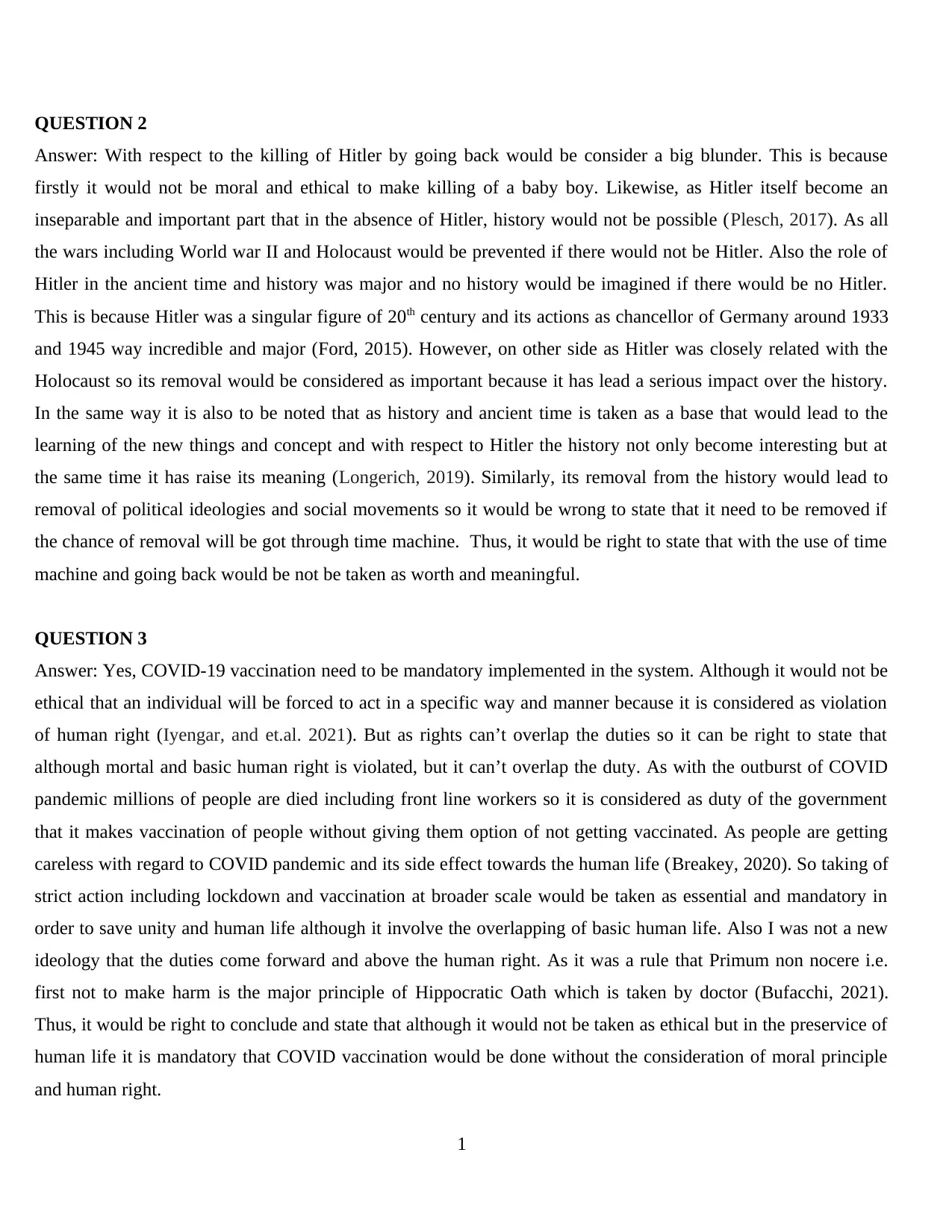
QUESTION 6:
Answer: A cancel culture refers to the modern ostracism in which an individual is thrust out of the social circles
whether online or in person (Norris, 2021). This behaviour is regarded as a social problem. There are various
types of speeches which are beyond the pale of tolerance but viewing the mistaken views as the intolerable speech
can carry ethical costs. These slurs or articles do not deserve careful or active listening and require being called
out and efforts for minimizing the harm they cause. But the Cancel culture has been silencing open debates which
makes the open debates and tolerance of differences under attack. People believe that though their comments on
various twitter campaigns such as cancel culture they are awakening the norms of open debate in the favour of
ideological conformity and coercion (Plieger, 2021). Drerup, states that tolerance towards racial injustice should
be regarded as pivotal democratic virtue which should be cultivated in the eduction system. For example: J.K.
Rowling's controversial comments on the transgender and womanhood were disapproved by many people and the
actor Denial Radcliffe who plays Harry potter himself. People are fired for running controversial papers or books
because they are alleged inauthenticity which can be just a clumsy mistake. Freedom of speech is threatened in a
culture ODF platforming, cancelling and outraging (Breakey, 2020). In the Cancel culture people are not just
called out or are a given the punishments which fits their crimes, but they are demanded to enforce social
ostracism or even worse. So yes, the cancel culture stifle away the freedom of speech.
QUESTION 7
Answer: In a world where many people struggle to survive, billionaire are regarded as immoral persons. Being a
billionaire in this world is impossible to justify (Farrell, 2021). There are lot of public discussions where rich
people are considered to be shameful because they are rich and poises plenty of dollars. The reason behind this
thinking is that many people die because their loved ones cannot afford money to pay for their medical care.
There are a lot of people who sleep on the streets and stay hungry for many days. This can all go away if rich
people give some of their money to those people. This is what society generally thinks (Haugerud, 2020). Many
philosophers have written articles that rich people do not deserve their wealth. But the question here is that how
much a person is morally permitted to retain than how much is he really learning. But wealthy people do not
defend themselves for the statements calling them shameful is rich etc. they believe having wealth is just fine.
Deciding if it is moral to be rich or not is very difficult logical question (Carlson, 2019). Here the question arise
that rich people are obliged to pay the poor people, but they are not obliged to do things that they want with the
money they earned by themselves. However, it is not justifiable to retain billions of dollars because rich people
have the potential to help those who are surviving, but they let them suffer and die.
2
Document Page
REFERENCES
Books and journals
Breakey, H (2020) “Acting selfishly has consequences right now – why ethical decision making
is imperative in the coronavirus crisis” 24 March 2020, The Conversation, accessible via
< https://theconversation.com/acting-selfishly-has-consequences-right-now-why-ethical-
decision-making-is-imperative-in-the-coronavirus-crisis-134350>
Breakey, H (2020), Is “cancel culture” silencing open debate? The perils of shutting down
disagreeable opinions and arguments”, 13 Jul 2020, ABC Religion & Ethics, accessible
via: <https://www.abc.net.au/religion/is-cancel-culture-silencing-open-debate/12449956>
Bufacchi, V (2021) “Coronavirus: do we have a moral duty not to get sick?” 17th of March 2021,
The Conversation, accessible via < https://theconversation.com/coronavirus-do-we-have-
a-moral-duty-not-to-get-sick-148837>.
Carlson, E (2019) “Is Being a Billionaire Ethical? An Inquiry”, 10 Jan 2019, Modern City,
accessible via <https:medium.com/modern-city/is-vbeing-a-billionaire-ethical-an-inquiry-
55c3d4197b15>. [Accessed on 21 September 2021]
Farrell, J., 2021. Billionaire wilderness: The ultra-wealthy and the Remaking of the American
west. Princeton University Press.
Ford, M. (2015) 'The Ethics of Killing Baby Hitler. A moral dilemma is better understood as a
historical one.', The Atlantic, 24th October
2015, https://www.theatlantic.com/international/archive/2015/10/killing- baby-hitler-
ethics/412273/
Haugerud, A., 2020. No billionaire left behind. Stanford University Press.
Iyengar, & et.al. (2021). Should COVID-19 vaccination be made mandatory?. Lung India:
Official Organ of Indian Chest Society. 38(4). 379.
Longerich, P. (2019). Hitler: A Life. Oxford University Press.
Norris, P., 2021. Cancel Culture: Myth or Reality?. Political Studies. p.00323217211037023.
Plesch, D. (2017). Human Rights After Hitler: The Lost History of Prosecuting Axis War Crimes.
Georgetown University Press.
Plieger, F.I., 2021. Discourse in the Age of Cancel Culture(Bachelor's thesis).
1
Document Page
2
chevron_up_icon
1 out of 4
circle_padding
hide_on_mobile
zoom_out_icon
[object Object]