Exploring Ethical Challenges in Healthcare Research: A Case Study
VerifiedAdded on 2023/06/14
|9
|1853
|96
Case Study
AI Summary
This assignment provides a detailed analysis of ethical issues in healthcare research, focusing on a case study involving fraudulent activities in a research project on Parkinson's disease. The analysis covers violations of human rights and dignity, professional codes of conduct, and relevant legislation. The case study highlights issues such as lack of informed consent, monetary incentives compromising voluntariness, and false claims made to insurance companies. The assignment concludes with professional recommendations aimed at improving communication, ensuring adherence to current standards, and obtaining informed consent in healthcare research practices, ultimately advocating for greater transparency and ethical integrity in biomedical research to protect patient well-being. Desklib offers a variety of solved assignments and past papers for students.
Ethical Issues in Healthcare Research
1
1

Paraphrase This Document
Need a fresh take? Get an instant paraphrase of this document with our AI Paraphraser
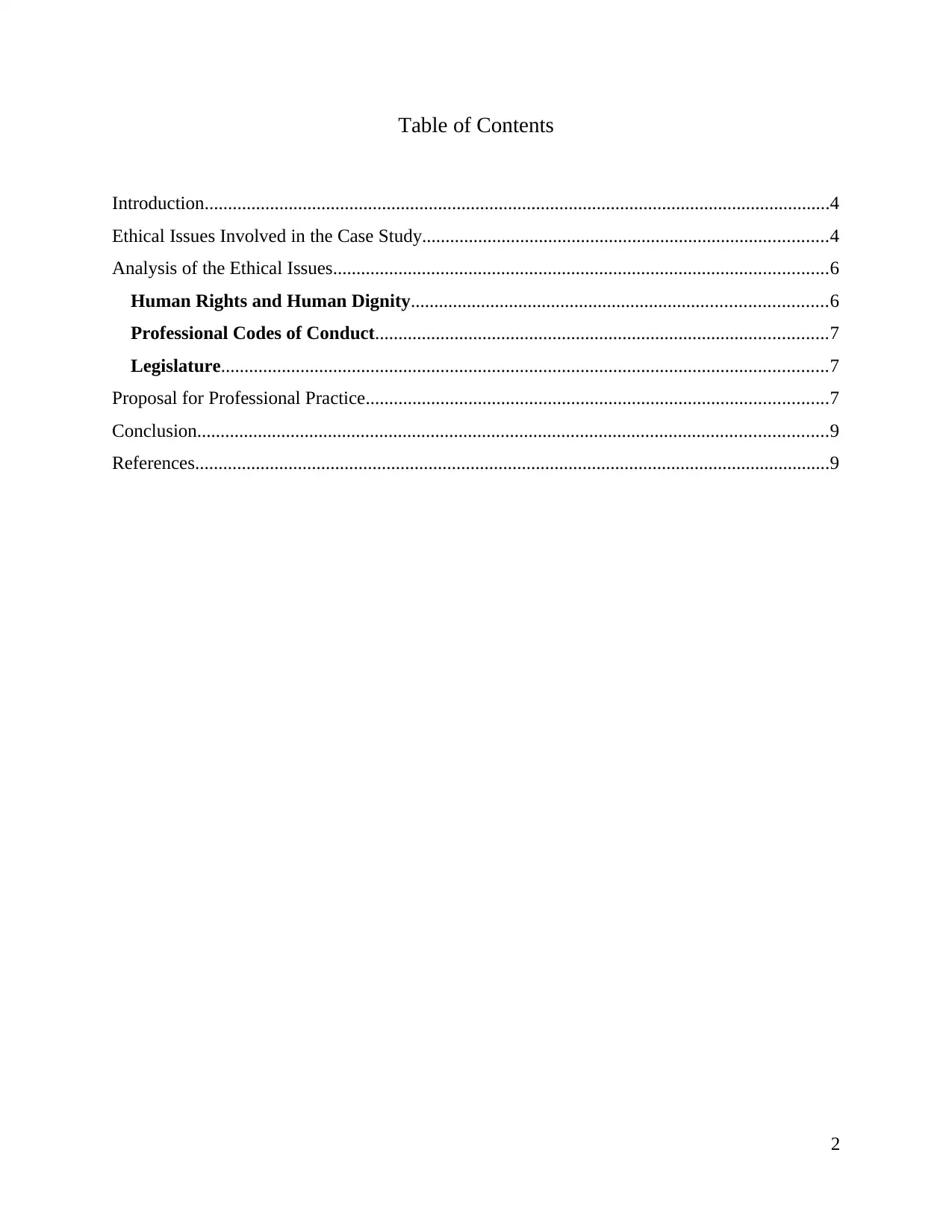
Table of Contents
Introduction......................................................................................................................................4
Ethical Issues Involved in the Case Study.......................................................................................4
Analysis of the Ethical Issues..........................................................................................................6
Human Rights and Human Dignity.........................................................................................6
Professional Codes of Conduct.................................................................................................7
Legislature..................................................................................................................................7
Proposal for Professional Practice...................................................................................................7
Conclusion.......................................................................................................................................9
References........................................................................................................................................9
2
Introduction......................................................................................................................................4
Ethical Issues Involved in the Case Study.......................................................................................4
Analysis of the Ethical Issues..........................................................................................................6
Human Rights and Human Dignity.........................................................................................6
Professional Codes of Conduct.................................................................................................7
Legislature..................................................................................................................................7
Proposal for Professional Practice...................................................................................................7
Conclusion.......................................................................................................................................9
References........................................................................................................................................9
2

3
⊘ This is a preview!⊘
Do you want full access?
Subscribe today to unlock all pages.

Trusted by 1+ million students worldwide
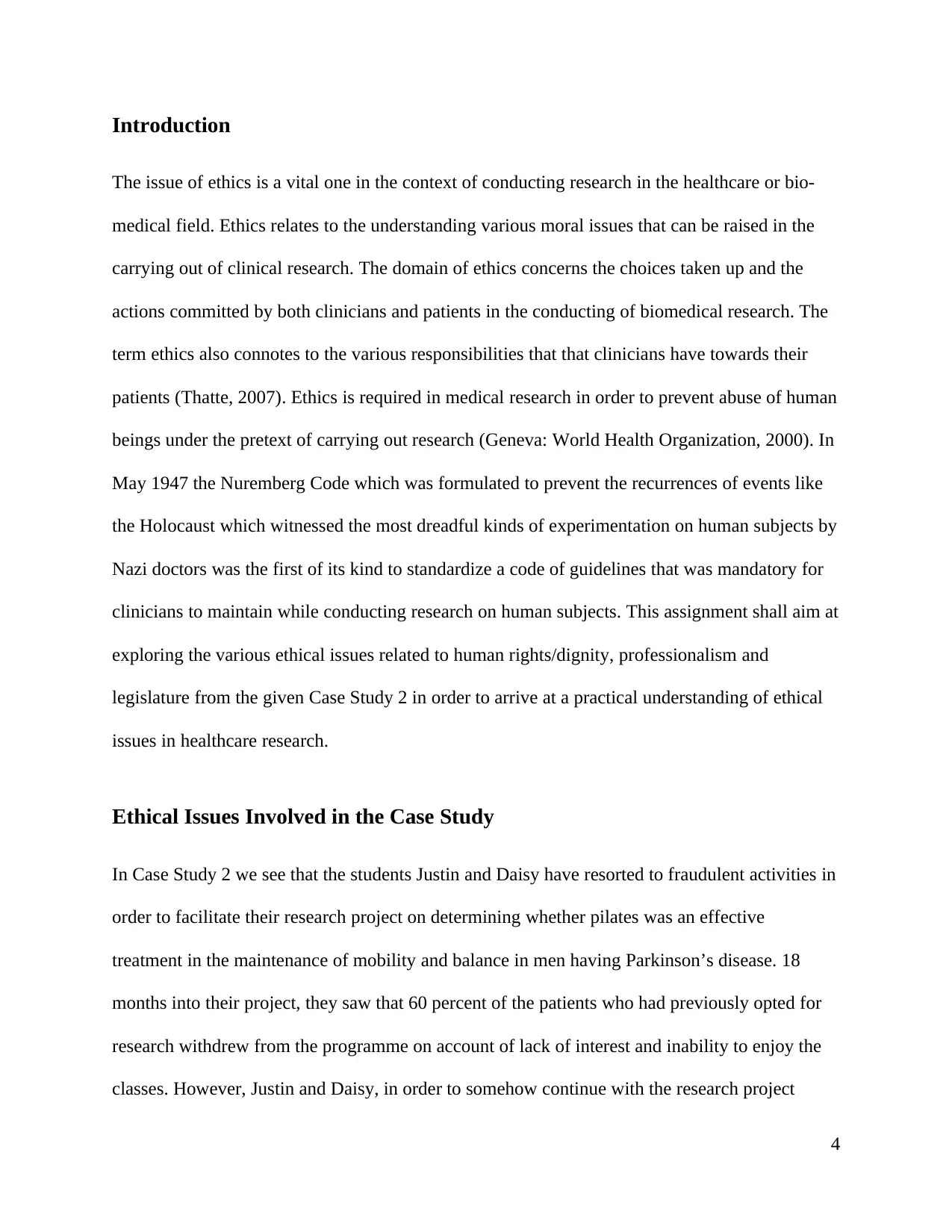
Introduction
The issue of ethics is a vital one in the context of conducting research in the healthcare or bio-
medical field. Ethics relates to the understanding various moral issues that can be raised in the
carrying out of clinical research. The domain of ethics concerns the choices taken up and the
actions committed by both clinicians and patients in the conducting of biomedical research. The
term ethics also connotes to the various responsibilities that that clinicians have towards their
patients (Thatte, 2007). Ethics is required in medical research in order to prevent abuse of human
beings under the pretext of carrying out research (Geneva: World Health Organization, 2000). In
May 1947 the Nuremberg Code which was formulated to prevent the recurrences of events like
the Holocaust which witnessed the most dreadful kinds of experimentation on human subjects by
Nazi doctors was the first of its kind to standardize a code of guidelines that was mandatory for
clinicians to maintain while conducting research on human subjects. This assignment shall aim at
exploring the various ethical issues related to human rights/dignity, professionalism and
legislature from the given Case Study 2 in order to arrive at a practical understanding of ethical
issues in healthcare research.
Ethical Issues Involved in the Case Study
In Case Study 2 we see that the students Justin and Daisy have resorted to fraudulent activities in
order to facilitate their research project on determining whether pilates was an effective
treatment in the maintenance of mobility and balance in men having Parkinson’s disease. 18
months into their project, they saw that 60 percent of the patients who had previously opted for
research withdrew from the programme on account of lack of interest and inability to enjoy the
classes. However, Justin and Daisy, in order to somehow continue with the research project
4
The issue of ethics is a vital one in the context of conducting research in the healthcare or bio-
medical field. Ethics relates to the understanding various moral issues that can be raised in the
carrying out of clinical research. The domain of ethics concerns the choices taken up and the
actions committed by both clinicians and patients in the conducting of biomedical research. The
term ethics also connotes to the various responsibilities that that clinicians have towards their
patients (Thatte, 2007). Ethics is required in medical research in order to prevent abuse of human
beings under the pretext of carrying out research (Geneva: World Health Organization, 2000). In
May 1947 the Nuremberg Code which was formulated to prevent the recurrences of events like
the Holocaust which witnessed the most dreadful kinds of experimentation on human subjects by
Nazi doctors was the first of its kind to standardize a code of guidelines that was mandatory for
clinicians to maintain while conducting research on human subjects. This assignment shall aim at
exploring the various ethical issues related to human rights/dignity, professionalism and
legislature from the given Case Study 2 in order to arrive at a practical understanding of ethical
issues in healthcare research.
Ethical Issues Involved in the Case Study
In Case Study 2 we see that the students Justin and Daisy have resorted to fraudulent activities in
order to facilitate their research project on determining whether pilates was an effective
treatment in the maintenance of mobility and balance in men having Parkinson’s disease. 18
months into their project, they saw that 60 percent of the patients who had previously opted for
research withdrew from the programme on account of lack of interest and inability to enjoy the
classes. However, Justin and Daisy, in order to somehow continue with the research project
4
Paraphrase This Document
Need a fresh take? Get an instant paraphrase of this document with our AI Paraphraser
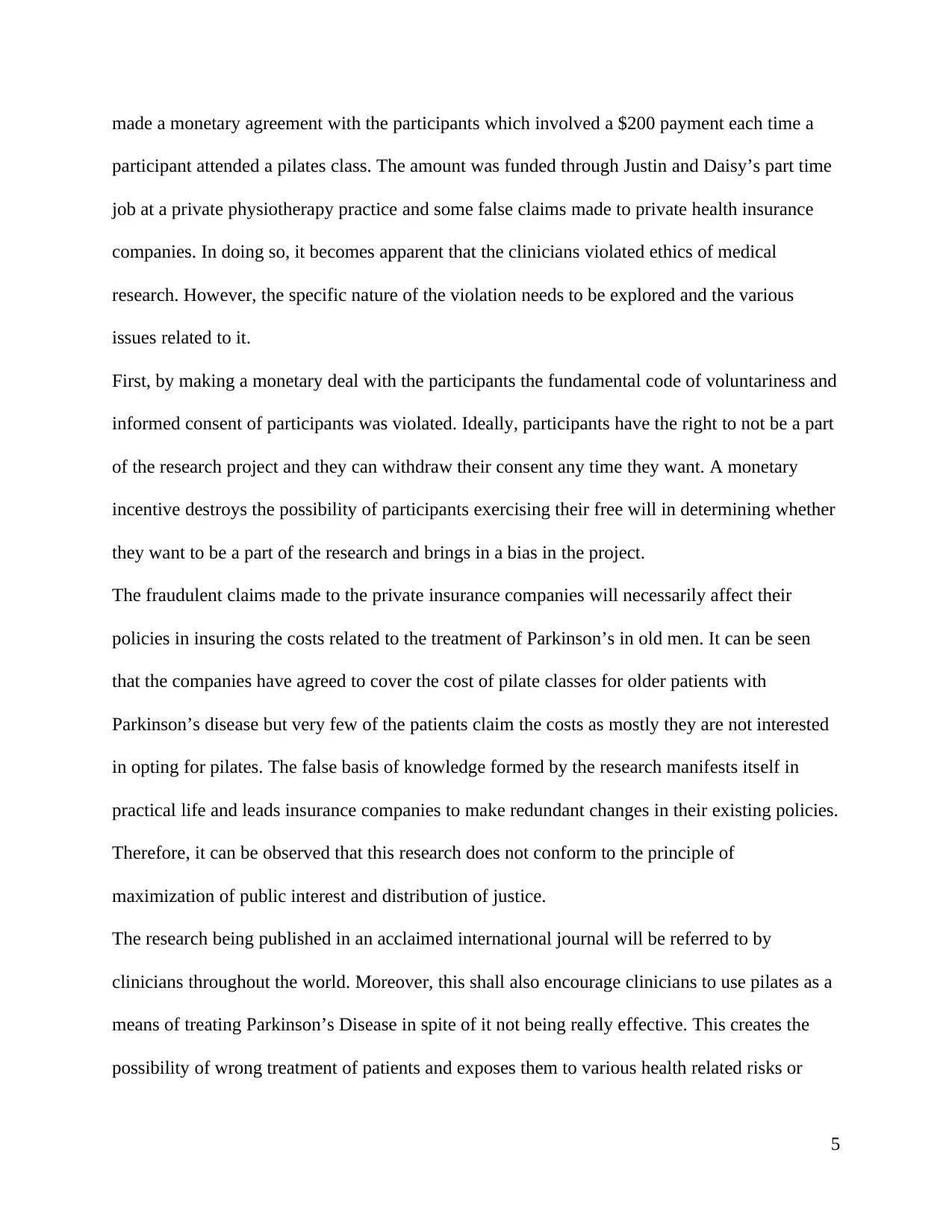
made a monetary agreement with the participants which involved a $200 payment each time a
participant attended a pilates class. The amount was funded through Justin and Daisy’s part time
job at a private physiotherapy practice and some false claims made to private health insurance
companies. In doing so, it becomes apparent that the clinicians violated ethics of medical
research. However, the specific nature of the violation needs to be explored and the various
issues related to it.
First, by making a monetary deal with the participants the fundamental code of voluntariness and
informed consent of participants was violated. Ideally, participants have the right to not be a part
of the research project and they can withdraw their consent any time they want. A monetary
incentive destroys the possibility of participants exercising their free will in determining whether
they want to be a part of the research and brings in a bias in the project.
The fraudulent claims made to the private insurance companies will necessarily affect their
policies in insuring the costs related to the treatment of Parkinson’s in old men. It can be seen
that the companies have agreed to cover the cost of pilate classes for older patients with
Parkinson’s disease but very few of the patients claim the costs as mostly they are not interested
in opting for pilates. The false basis of knowledge formed by the research manifests itself in
practical life and leads insurance companies to make redundant changes in their existing policies.
Therefore, it can be observed that this research does not conform to the principle of
maximization of public interest and distribution of justice.
The research being published in an acclaimed international journal will be referred to by
clinicians throughout the world. Moreover, this shall also encourage clinicians to use pilates as a
means of treating Parkinson’s Disease in spite of it not being really effective. This creates the
possibility of wrong treatment of patients and exposes them to various health related risks or
5
participant attended a pilates class. The amount was funded through Justin and Daisy’s part time
job at a private physiotherapy practice and some false claims made to private health insurance
companies. In doing so, it becomes apparent that the clinicians violated ethics of medical
research. However, the specific nature of the violation needs to be explored and the various
issues related to it.
First, by making a monetary deal with the participants the fundamental code of voluntariness and
informed consent of participants was violated. Ideally, participants have the right to not be a part
of the research project and they can withdraw their consent any time they want. A monetary
incentive destroys the possibility of participants exercising their free will in determining whether
they want to be a part of the research and brings in a bias in the project.
The fraudulent claims made to the private insurance companies will necessarily affect their
policies in insuring the costs related to the treatment of Parkinson’s in old men. It can be seen
that the companies have agreed to cover the cost of pilate classes for older patients with
Parkinson’s disease but very few of the patients claim the costs as mostly they are not interested
in opting for pilates. The false basis of knowledge formed by the research manifests itself in
practical life and leads insurance companies to make redundant changes in their existing policies.
Therefore, it can be observed that this research does not conform to the principle of
maximization of public interest and distribution of justice.
The research being published in an acclaimed international journal will be referred to by
clinicians throughout the world. Moreover, this shall also encourage clinicians to use pilates as a
means of treating Parkinson’s Disease in spite of it not being really effective. This creates the
possibility of wrong treatment of patients and exposes them to various health related risks or
5
vulnerabilities. This stands in conflict with the issue of human rights and dignity as this
experimentation might lead to the harm of patients. Moreover, professionally, healthcare
practitioners cannot accede to something that might have adverse effects on their patients’ well-
being.
Legal issues related to the regulation of healthcare services have to be raised as well. The
research violates a number of laws as it had not been conducted on a voluntary basis. In spite of
the lack of authentic information on the subject, the research makes claims that are not grounded
on reality.
Analysis of the Ethical Issues
Human Rights and Human Dignity
The way that the given research project was conducted stands in opposition to the principles of
human rights and dignity. Biomedical research should only be conducted when the clinicians,
through the extensive application of existing scientific knowledge, can be sure about the need of
the research. The research should also contribute towards the well-being and benefit of the
patients and not make them susceptible to any kind of risks. However, the basic premise of this
research is based upon an unfair activity where the participants were offered money on being a
part of the project. This makes money and not well-being of people the primary motivator of the
project. It must be mentioned that such a project without having authentic and reliable data might
subject people to various risks that might seriously affect their health.
6
experimentation might lead to the harm of patients. Moreover, professionally, healthcare
practitioners cannot accede to something that might have adverse effects on their patients’ well-
being.
Legal issues related to the regulation of healthcare services have to be raised as well. The
research violates a number of laws as it had not been conducted on a voluntary basis. In spite of
the lack of authentic information on the subject, the research makes claims that are not grounded
on reality.
Analysis of the Ethical Issues
Human Rights and Human Dignity
The way that the given research project was conducted stands in opposition to the principles of
human rights and dignity. Biomedical research should only be conducted when the clinicians,
through the extensive application of existing scientific knowledge, can be sure about the need of
the research. The research should also contribute towards the well-being and benefit of the
patients and not make them susceptible to any kind of risks. However, the basic premise of this
research is based upon an unfair activity where the participants were offered money on being a
part of the project. This makes money and not well-being of people the primary motivator of the
project. It must be mentioned that such a project without having authentic and reliable data might
subject people to various risks that might seriously affect their health.
6
⊘ This is a preview!⊘
Do you want full access?
Subscribe today to unlock all pages.
Trusted by 1+ million students worldwide
Professional Codes of Conduct
According to ethics in biomedical research clinicians are strictly forbidden to resort to unfair
means in order to facilitate their research. This is primarily directed towards the prevention of
malpractices in the healthcare sector as healthcare professional have a commitment to fulfil
towards their customers and their practices should always be properly informed through existing
scientific knowledge (Murphy, 2017). In this case, Justin and Daisy does not consider the
importance of their professional codes as healthcare professionals in the carrying out of their
research. Their activity shows that they are not really concerned with the well-being of their
patients as much they are with their own acclaim as clinicians. Such practices are utterly
despicable and conflicts the fundamental principles of healthcare.
Legislature
It is needless to mention that the government has laws that seek to safeguard patients against
such malpractices of clinicians. Moreover, there are laws to prevent such malpractices from
occurring in the first place. Legislations related to offences like these are severe in nature and
might result in the cancellation of licenses of fraudulent professionals. The research lacks
transparency which is a basis legal requirement of any kind of biomedical research (Hall,
Orentlicher & Bobinski, 2018).
Proposal for Professional Practice
As a prospective professional of healthcare services I would like to make certain professional
recommendations that would attempt at alleviating the current standard of healthcare services to
7
According to ethics in biomedical research clinicians are strictly forbidden to resort to unfair
means in order to facilitate their research. This is primarily directed towards the prevention of
malpractices in the healthcare sector as healthcare professional have a commitment to fulfil
towards their customers and their practices should always be properly informed through existing
scientific knowledge (Murphy, 2017). In this case, Justin and Daisy does not consider the
importance of their professional codes as healthcare professionals in the carrying out of their
research. Their activity shows that they are not really concerned with the well-being of their
patients as much they are with their own acclaim as clinicians. Such practices are utterly
despicable and conflicts the fundamental principles of healthcare.
Legislature
It is needless to mention that the government has laws that seek to safeguard patients against
such malpractices of clinicians. Moreover, there are laws to prevent such malpractices from
occurring in the first place. Legislations related to offences like these are severe in nature and
might result in the cancellation of licenses of fraudulent professionals. The research lacks
transparency which is a basis legal requirement of any kind of biomedical research (Hall,
Orentlicher & Bobinski, 2018).
Proposal for Professional Practice
As a prospective professional of healthcare services I would like to make certain professional
recommendations that would attempt at alleviating the current standard of healthcare services to
7
Paraphrase This Document
Need a fresh take? Get an instant paraphrase of this document with our AI Paraphraser
patients by addressing this current situation and arriving at a general understanding of how to
prevent the occurrence of such unfair practices in biomedical research.
Improvement in communication:
Healthcare professionals should be more communicative with their patients. This forms the basis
of quality healthcare. A clinician’s occupation directly relates to the taking care of patients and
therefore, it is every clinicians task to inquire into the needs of their patients. The clinician,
instead of creating friction with patients and imposing his/her ideas upon the patient should
rather align the nature of his/her services with the requirements of the patients and develop
friendly terms with them (Runciman, Merry, & Walton, 2017). Had Justin and Daisy been more
inquisitive about the actual needs of their participants then they would surely have been able to
make their project more interesting.
Knowledge about current standards:
Clinicians should be updated with the latest developments in medical science so that they can
offer the best possible treatment to their patients. This will ensure that professionals make
informed decisions and not work according to their presuppositions (McKie, 2013). In the
context of our case study, the students should have gathered more knowledge regarding their
subject and found a more relevant area of research.
Obtain Informed Consent:
In order to produce authentic and reliable research it is imperative for professionals to obtain
informed consent about their experiments from their prospective participants. They should be
duly informed about the risks and costs that might be associated with the research. They should
also be open towards recommendations from the patients and conduct the research in accordance
with the needs of the patients (Lepping, 2003). This was definitely not the case in our given Case
8
prevent the occurrence of such unfair practices in biomedical research.
Improvement in communication:
Healthcare professionals should be more communicative with their patients. This forms the basis
of quality healthcare. A clinician’s occupation directly relates to the taking care of patients and
therefore, it is every clinicians task to inquire into the needs of their patients. The clinician,
instead of creating friction with patients and imposing his/her ideas upon the patient should
rather align the nature of his/her services with the requirements of the patients and develop
friendly terms with them (Runciman, Merry, & Walton, 2017). Had Justin and Daisy been more
inquisitive about the actual needs of their participants then they would surely have been able to
make their project more interesting.
Knowledge about current standards:
Clinicians should be updated with the latest developments in medical science so that they can
offer the best possible treatment to their patients. This will ensure that professionals make
informed decisions and not work according to their presuppositions (McKie, 2013). In the
context of our case study, the students should have gathered more knowledge regarding their
subject and found a more relevant area of research.
Obtain Informed Consent:
In order to produce authentic and reliable research it is imperative for professionals to obtain
informed consent about their experiments from their prospective participants. They should be
duly informed about the risks and costs that might be associated with the research. They should
also be open towards recommendations from the patients and conduct the research in accordance
with the needs of the patients (Lepping, 2003). This was definitely not the case in our given Case
8
Study. The participants were surely not communicated well-enough about what the pilate
program would involve. Therefore, the patients saw that the program was not quite what they
expected or wanted. Thus, money had to be used to keep them hooked to it.
Conclusion
The assignment highlights the various ethical issues related to biomedical research through the
analysis of the given case study. The various ethical issues that were involved with the case was
taken up and were put to analysis in order to understand how to prevent such malpractices
occurring the domain of healthcare.
References
Runciman, B., Merry, A., & Walton, M. (2017). Safety and ethics in healthcare: a guide to
getting it right. CRC Press.
MCKIE, A. (2013). ETHICS IN HEALTHCARE RESEARCH. The Essentials of Nursing and
Healthcare Research, 229.
Hall, M. A., Orentlicher, D., Bobinski, M. A., Bagley, N., & Cohen, I. G. (2018). Health care
law and ethics. Wolters Kluwer Law & Business.
Thatte U. (2007) Basic Principles of Clinical Research and Methodology.1st ed. New Delhi:
Jaypee Brothers; Ethical issues in Clinical Research; pp. 58–73.
Geneva: World Health Organization. (2000). Operational Guidelines for Ethics Committees that
Review Biomedical Research.
Murphy, E. (2017). Qualitative methods and health policy research. Routledge.
Lepping P. (2003). An ethical review of consent in medicine. Psychiatric Bulletin;27:285–90
9
program would involve. Therefore, the patients saw that the program was not quite what they
expected or wanted. Thus, money had to be used to keep them hooked to it.
Conclusion
The assignment highlights the various ethical issues related to biomedical research through the
analysis of the given case study. The various ethical issues that were involved with the case was
taken up and were put to analysis in order to understand how to prevent such malpractices
occurring the domain of healthcare.
References
Runciman, B., Merry, A., & Walton, M. (2017). Safety and ethics in healthcare: a guide to
getting it right. CRC Press.
MCKIE, A. (2013). ETHICS IN HEALTHCARE RESEARCH. The Essentials of Nursing and
Healthcare Research, 229.
Hall, M. A., Orentlicher, D., Bobinski, M. A., Bagley, N., & Cohen, I. G. (2018). Health care
law and ethics. Wolters Kluwer Law & Business.
Thatte U. (2007) Basic Principles of Clinical Research and Methodology.1st ed. New Delhi:
Jaypee Brothers; Ethical issues in Clinical Research; pp. 58–73.
Geneva: World Health Organization. (2000). Operational Guidelines for Ethics Committees that
Review Biomedical Research.
Murphy, E. (2017). Qualitative methods and health policy research. Routledge.
Lepping P. (2003). An ethical review of consent in medicine. Psychiatric Bulletin;27:285–90
9
⊘ This is a preview!⊘
Do you want full access?
Subscribe today to unlock all pages.
Trusted by 1+ million students worldwide

1 out of 9


Related Documents


Your All-in-One AI-Powered Toolkit for Academic Success.
+13062052269
info@desklib.com
Available 24*7 on WhatsApp / Email
![[object Object]](/_next/static/media/star-bottom.7253800d.svg)
Unlock your academic potential
Copyright © 2020–2025 A2Z Services. All Rights Reserved. Developed and managed by ZUCOL.