SWTP620: Ethical Theories Guiding Social Work Practice Decisions
VerifiedAdded on 2023/06/15
|9
|2872
|330
Essay
AI Summary
This essay analyzes the role of ethical theories, specifically utilitarianism and deontology, in guiding ethical decision-making within contemporary social work practice. It uses a case study of women experiencing violence from male partners to illustrate how these theories influence decisions. Utilitarianism focuses on minimizing harm and maximizing happiness for the greatest number, potentially justifying actions based on their outcomes. Deontology, on the other hand, emphasizes moral responsibilities and obligations, potentially prioritizing adherence to duty even in the face of adverse consequences. The essay demonstrates how these theories offer different perspectives on handling complex ethical dilemmas in social work, particularly concerning vulnerable client groups. Desklib is a platform where students can find this document along with numerous other solved assignments and past papers.

Role of ethical theories in guiding ethical decision making 1
Name:
Course:
Professor:
Date:
Name:
Course:
Professor:
Date:

Paraphrase This Document
Need a fresh take? Get an instant paraphrase of this document with our AI Paraphraser
Role of ethical theories in guiding ethical decision making 2
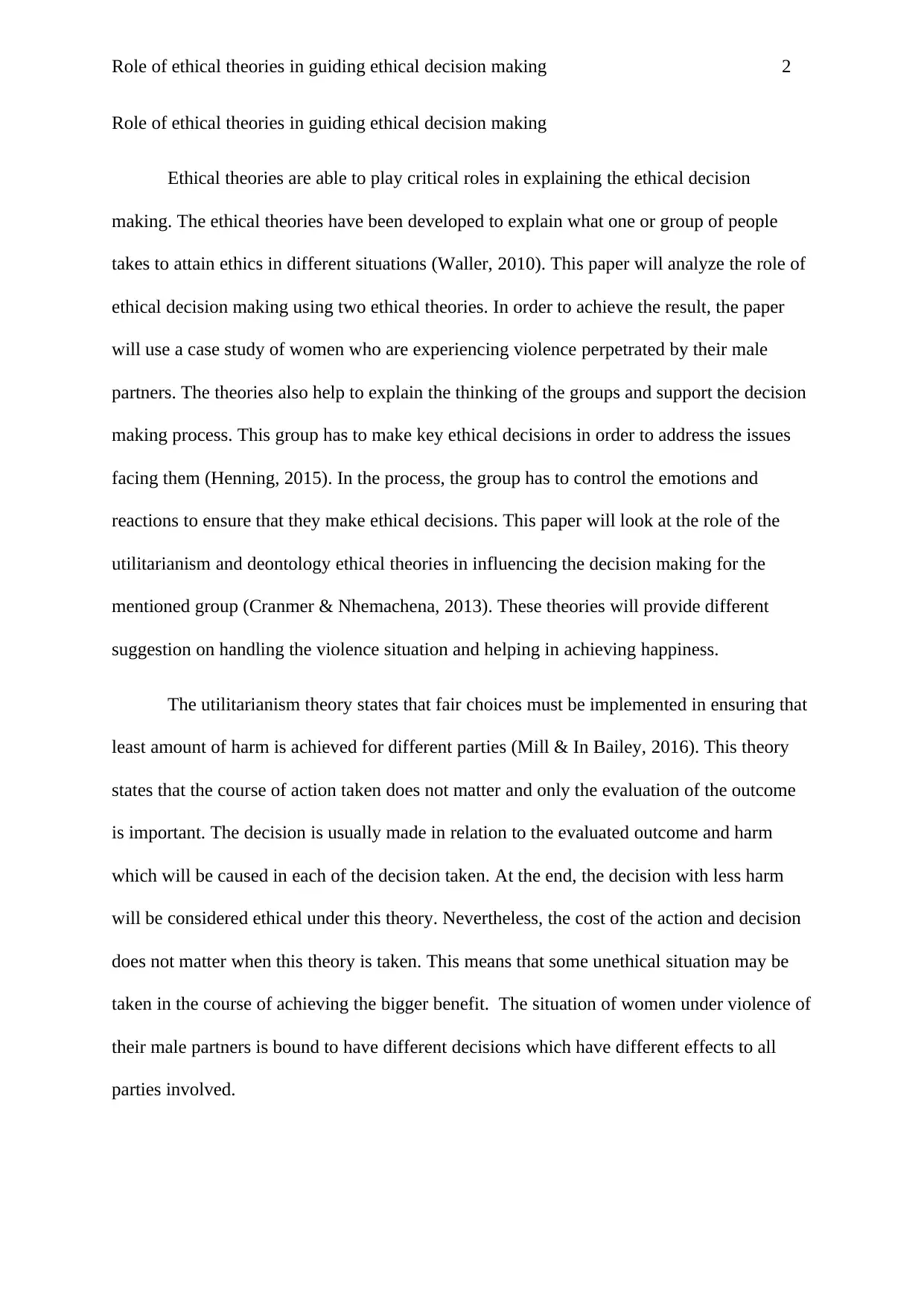
Role of ethical theories in guiding ethical decision making
Ethical theories are able to play critical roles in explaining the ethical decision
making. The ethical theories have been developed to explain what one or group of people
takes to attain ethics in different situations (Waller, 2010). This paper will analyze the role of
ethical decision making using two ethical theories. In order to achieve the result, the paper
will use a case study of women who are experiencing violence perpetrated by their male
partners. The theories also help to explain the thinking of the groups and support the decision
making process. This group has to make key ethical decisions in order to address the issues
facing them (Henning, 2015). In the process, the group has to control the emotions and
reactions to ensure that they make ethical decisions. This paper will look at the role of the
utilitarianism and deontology ethical theories in influencing the decision making for the
mentioned group (Cranmer & Nhemachena, 2013). These theories will provide different
suggestion on handling the violence situation and helping in achieving happiness.
The utilitarianism theory states that fair choices must be implemented in ensuring that
least amount of harm is achieved for different parties (Mill & In Bailey, 2016). This theory
states that the course of action taken does not matter and only the evaluation of the outcome
is important. The decision is usually made in relation to the evaluated outcome and harm
which will be caused in each of the decision taken. At the end, the decision with less harm
will be considered ethical under this theory. Nevertheless, the cost of the action and decision
does not matter when this theory is taken. This means that some unethical situation may be
taken in the course of achieving the bigger benefit. The situation of women under violence of
their male partners is bound to have different decisions which have different effects to all
parties involved.
Role of ethical theories in guiding ethical decision making
Ethical theories are able to play critical roles in explaining the ethical decision
making. The ethical theories have been developed to explain what one or group of people
takes to attain ethics in different situations (Waller, 2010). This paper will analyze the role of
ethical decision making using two ethical theories. In order to achieve the result, the paper
will use a case study of women who are experiencing violence perpetrated by their male
partners. The theories also help to explain the thinking of the groups and support the decision
making process. This group has to make key ethical decisions in order to address the issues
facing them (Henning, 2015). In the process, the group has to control the emotions and
reactions to ensure that they make ethical decisions. This paper will look at the role of the
utilitarianism and deontology ethical theories in influencing the decision making for the
mentioned group (Cranmer & Nhemachena, 2013). These theories will provide different
suggestion on handling the violence situation and helping in achieving happiness.
The utilitarianism theory states that fair choices must be implemented in ensuring that
least amount of harm is achieved for different parties (Mill & In Bailey, 2016). This theory
states that the course of action taken does not matter and only the evaluation of the outcome
is important. The decision is usually made in relation to the evaluated outcome and harm
which will be caused in each of the decision taken. At the end, the decision with less harm
will be considered ethical under this theory. Nevertheless, the cost of the action and decision
does not matter when this theory is taken. This means that some unethical situation may be
taken in the course of achieving the bigger benefit. The situation of women under violence of
their male partners is bound to have different decisions which have different effects to all
parties involved.
Role of ethical theories in guiding ethical decision making 3
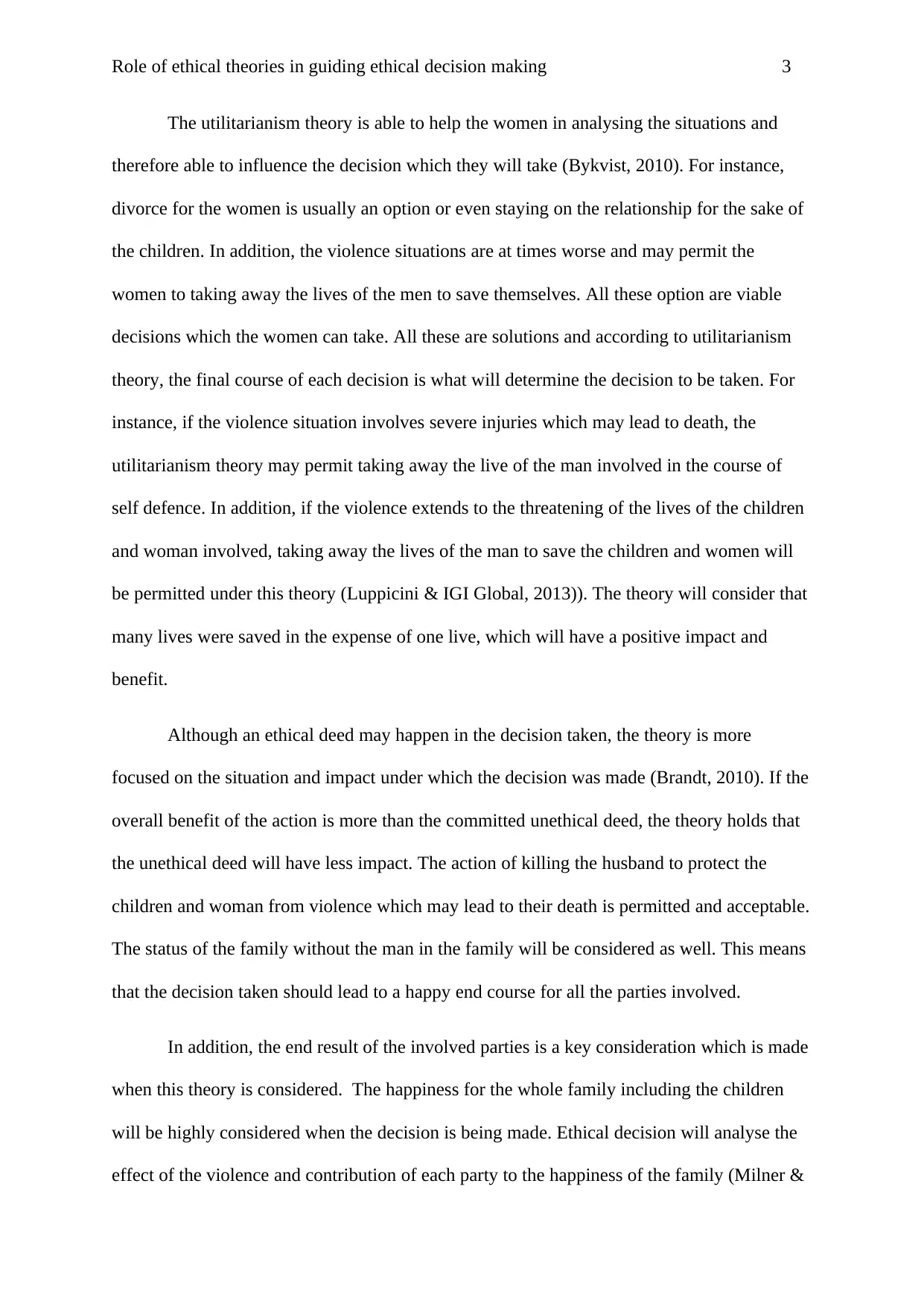
The utilitarianism theory is able to help the women in analysing the situations and
therefore able to influence the decision which they will take (Bykvist, 2010). For instance,
divorce for the women is usually an option or even staying on the relationship for the sake of
the children. In addition, the violence situations are at times worse and may permit the
women to taking away the lives of the men to save themselves. All these option are viable
decisions which the women can take. All these are solutions and according to utilitarianism
theory, the final course of each decision is what will determine the decision to be taken. For
instance, if the violence situation involves severe injuries which may lead to death, the
utilitarianism theory may permit taking away the live of the man involved in the course of
self defence. In addition, if the violence extends to the threatening of the lives of the children
and woman involved, taking away the lives of the man to save the children and women will
be permitted under this theory (Luppicini & IGI Global, 2013)). The theory will consider that
many lives were saved in the expense of one live, which will have a positive impact and
benefit.
Although an ethical deed may happen in the decision taken, the theory is more
focused on the situation and impact under which the decision was made (Brandt, 2010). If the
overall benefit of the action is more than the committed unethical deed, the theory holds that
the unethical deed will have less impact. The action of killing the husband to protect the
children and woman from violence which may lead to their death is permitted and acceptable.
The status of the family without the man in the family will be considered as well. This means
that the decision taken should lead to a happy end course for all the parties involved.
In addition, the end result of the involved parties is a key consideration which is made
when this theory is considered. The happiness for the whole family including the children
will be highly considered when the decision is being made. Ethical decision will analyse the
effect of the violence and contribution of each party to the happiness of the family (Milner &
The utilitarianism theory is able to help the women in analysing the situations and
therefore able to influence the decision which they will take (Bykvist, 2010). For instance,
divorce for the women is usually an option or even staying on the relationship for the sake of
the children. In addition, the violence situations are at times worse and may permit the
women to taking away the lives of the men to save themselves. All these option are viable
decisions which the women can take. All these are solutions and according to utilitarianism
theory, the final course of each decision is what will determine the decision to be taken. For
instance, if the violence situation involves severe injuries which may lead to death, the
utilitarianism theory may permit taking away the live of the man involved in the course of
self defence. In addition, if the violence extends to the threatening of the lives of the children
and woman involved, taking away the lives of the man to save the children and women will
be permitted under this theory (Luppicini & IGI Global, 2013)). The theory will consider that
many lives were saved in the expense of one live, which will have a positive impact and
benefit.
Although an ethical deed may happen in the decision taken, the theory is more
focused on the situation and impact under which the decision was made (Brandt, 2010). If the
overall benefit of the action is more than the committed unethical deed, the theory holds that
the unethical deed will have less impact. The action of killing the husband to protect the
children and woman from violence which may lead to their death is permitted and acceptable.
The status of the family without the man in the family will be considered as well. This means
that the decision taken should lead to a happy end course for all the parties involved.
In addition, the end result of the involved parties is a key consideration which is made
when this theory is considered. The happiness for the whole family including the children
will be highly considered when the decision is being made. Ethical decision will analyse the
effect of the violence and contribution of each party to the happiness of the family (Milner &
⊘ This is a preview!⊘
Do you want full access?
Subscribe today to unlock all pages.

Trusted by 1+ million students worldwide
Role of ethical theories in guiding ethical decision making 4
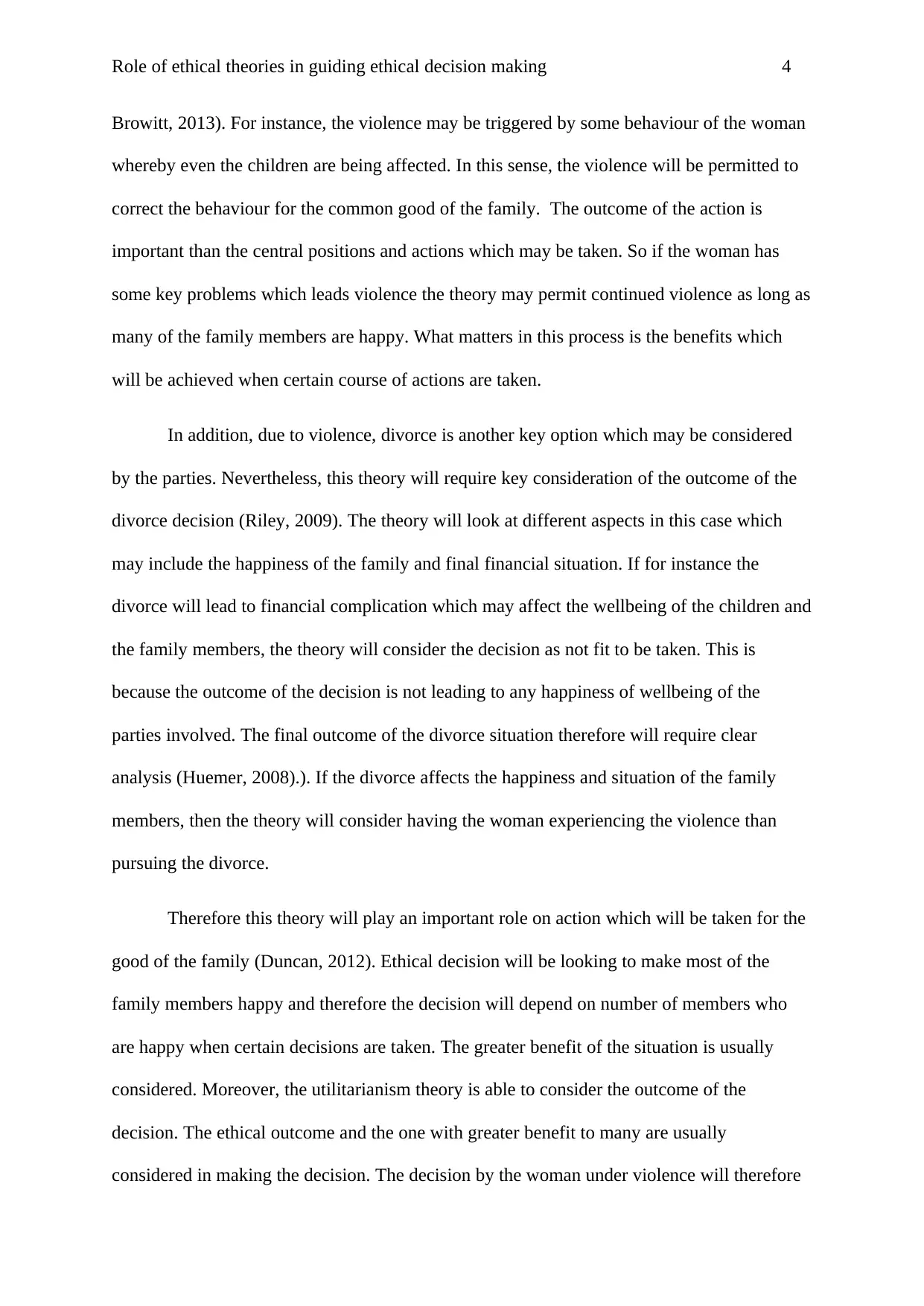
Browitt, 2013). For instance, the violence may be triggered by some behaviour of the woman
whereby even the children are being affected. In this sense, the violence will be permitted to
correct the behaviour for the common good of the family. The outcome of the action is
important than the central positions and actions which may be taken. So if the woman has
some key problems which leads violence the theory may permit continued violence as long as
many of the family members are happy. What matters in this process is the benefits which
will be achieved when certain course of actions are taken.
In addition, due to violence, divorce is another key option which may be considered
by the parties. Nevertheless, this theory will require key consideration of the outcome of the
divorce decision (Riley, 2009). The theory will look at different aspects in this case which
may include the happiness of the family and final financial situation. If for instance the
divorce will lead to financial complication which may affect the wellbeing of the children and
the family members, the theory will consider the decision as not fit to be taken. This is
because the outcome of the decision is not leading to any happiness of wellbeing of the
parties involved. The final outcome of the divorce situation therefore will require clear
analysis (Huemer, 2008).). If the divorce affects the happiness and situation of the family
members, then the theory will consider having the woman experiencing the violence than
pursuing the divorce.
Therefore this theory will play an important role on action which will be taken for the
good of the family (Duncan, 2012). Ethical decision will be looking to make most of the
family members happy and therefore the decision will depend on number of members who
are happy when certain decisions are taken. The greater benefit of the situation is usually
considered. Moreover, the utilitarianism theory is able to consider the outcome of the
decision. The ethical outcome and the one with greater benefit to many are usually
considered in making the decision. The decision by the woman under violence will therefore
Browitt, 2013). For instance, the violence may be triggered by some behaviour of the woman
whereby even the children are being affected. In this sense, the violence will be permitted to
correct the behaviour for the common good of the family. The outcome of the action is
important than the central positions and actions which may be taken. So if the woman has
some key problems which leads violence the theory may permit continued violence as long as
many of the family members are happy. What matters in this process is the benefits which
will be achieved when certain course of actions are taken.
In addition, due to violence, divorce is another key option which may be considered
by the parties. Nevertheless, this theory will require key consideration of the outcome of the
divorce decision (Riley, 2009). The theory will look at different aspects in this case which
may include the happiness of the family and final financial situation. If for instance the
divorce will lead to financial complication which may affect the wellbeing of the children and
the family members, the theory will consider the decision as not fit to be taken. This is
because the outcome of the decision is not leading to any happiness of wellbeing of the
parties involved. The final outcome of the divorce situation therefore will require clear
analysis (Huemer, 2008).). If the divorce affects the happiness and situation of the family
members, then the theory will consider having the woman experiencing the violence than
pursuing the divorce.
Therefore this theory will play an important role on action which will be taken for the
good of the family (Duncan, 2012). Ethical decision will be looking to make most of the
family members happy and therefore the decision will depend on number of members who
are happy when certain decisions are taken. The greater benefit of the situation is usually
considered. Moreover, the utilitarianism theory is able to consider the outcome of the
decision. The ethical outcome and the one with greater benefit to many are usually
considered in making the decision. The decision by the woman under violence will therefore
Paraphrase This Document
Need a fresh take? Get an instant paraphrase of this document with our AI Paraphraser
Role of ethical theories in guiding ethical decision making 5
be influenced by the major benefits which many of the family members will be able to enjoy.
The outcome and benefits which the woman, man and children will be able to enjoy will form
the basis of the ethical decision which has to be taken.
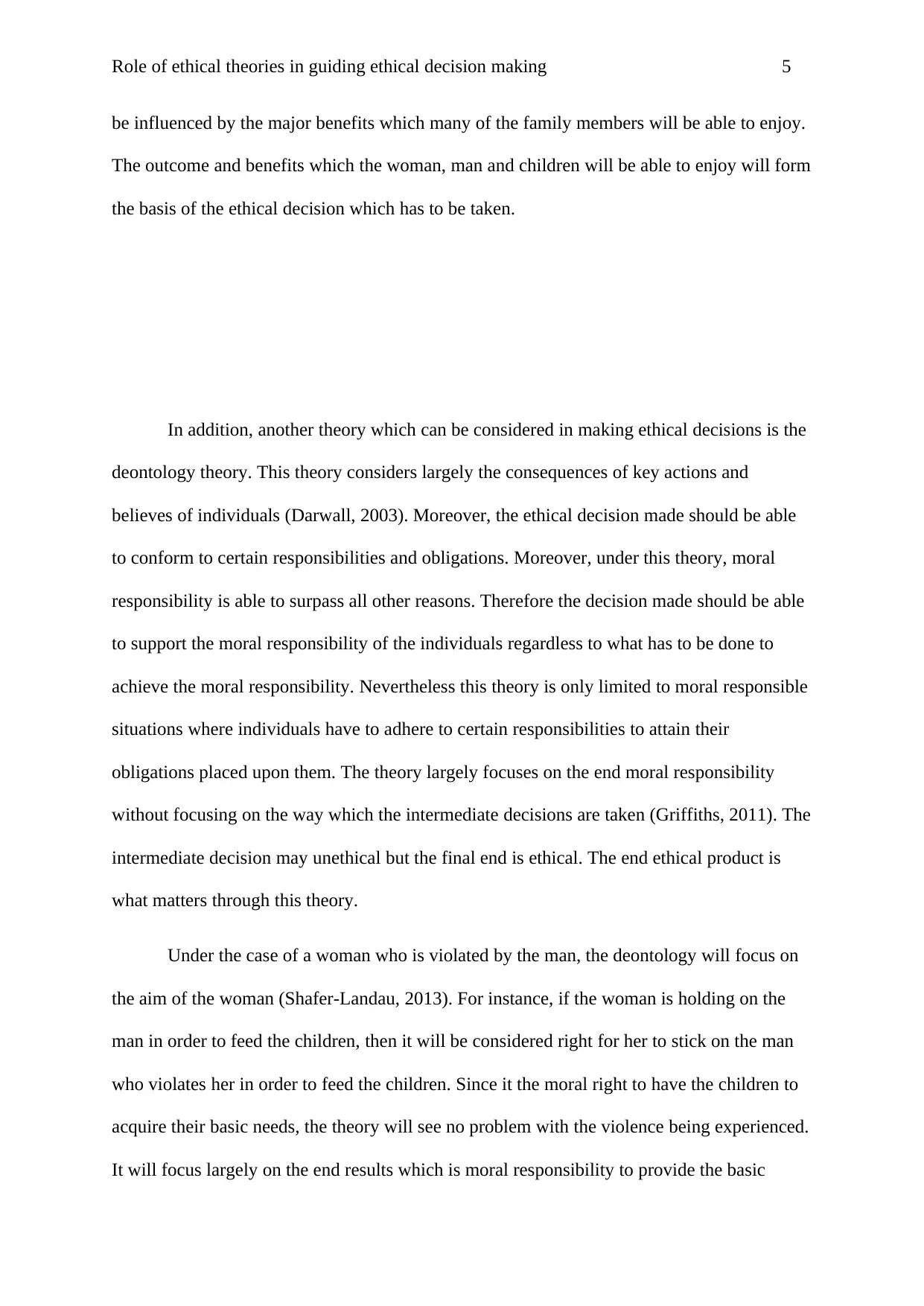
In addition, another theory which can be considered in making ethical decisions is the
deontology theory. This theory considers largely the consequences of key actions and
believes of individuals (Darwall, 2003). Moreover, the ethical decision made should be able
to conform to certain responsibilities and obligations. Moreover, under this theory, moral
responsibility is able to surpass all other reasons. Therefore the decision made should be able
to support the moral responsibility of the individuals regardless to what has to be done to
achieve the moral responsibility. Nevertheless this theory is only limited to moral responsible
situations where individuals have to adhere to certain responsibilities to attain their
obligations placed upon them. The theory largely focuses on the end moral responsibility
without focusing on the way which the intermediate decisions are taken (Griffiths, 2011). The
intermediate decision may unethical but the final end is ethical. The end ethical product is
what matters through this theory.
Under the case of a woman who is violated by the man, the deontology will focus on
the aim of the woman (Shafer-Landau, 2013). For instance, if the woman is holding on the
man in order to feed the children, then it will be considered right for her to stick on the man
who violates her in order to feed the children. Since it the moral right to have the children to
acquire their basic needs, the theory will see no problem with the violence being experienced.
It will focus largely on the end results which is moral responsibility to provide the basic
be influenced by the major benefits which many of the family members will be able to enjoy.
The outcome and benefits which the woman, man and children will be able to enjoy will form
the basis of the ethical decision which has to be taken.
In addition, another theory which can be considered in making ethical decisions is the
deontology theory. This theory considers largely the consequences of key actions and
believes of individuals (Darwall, 2003). Moreover, the ethical decision made should be able
to conform to certain responsibilities and obligations. Moreover, under this theory, moral
responsibility is able to surpass all other reasons. Therefore the decision made should be able
to support the moral responsibility of the individuals regardless to what has to be done to
achieve the moral responsibility. Nevertheless this theory is only limited to moral responsible
situations where individuals have to adhere to certain responsibilities to attain their
obligations placed upon them. The theory largely focuses on the end moral responsibility
without focusing on the way which the intermediate decisions are taken (Griffiths, 2011). The
intermediate decision may unethical but the final end is ethical. The end ethical product is
what matters through this theory.
Under the case of a woman who is violated by the man, the deontology will focus on
the aim of the woman (Shafer-Landau, 2013). For instance, if the woman is holding on the
man in order to feed the children, then it will be considered right for her to stick on the man
who violates her in order to feed the children. Since it the moral right to have the children to
acquire their basic needs, the theory will see no problem with the violence being experienced.
It will focus largely on the end results which is moral responsibility to provide the basic
Role of ethical theories in guiding ethical decision making 6
needs to the children. The provision of the basic needs to the children if placed upon the
woman will be considered ok if the man is the source of such needs (Melden, 2013). It will be
therefore an ethical decision to ensure that the children have the required needs and not only
considering at the means which the needs are being achieved. Therefore under this situation,
the deontology theory will support the man’s action of violence to the woman. If it is the duty
of the woman to provide to her children, then it will be considered that she can keep up with
the male partner who violates her to ensure that she feed her children. The duty is therefore
more important in this theory than the way it is being achieved.
The deontology theory will focus on what need to be attained by the decision
(Russell, Melberg & Pluciennik, 2014). The woman therefore can be able to stick with the
violence in order to attain some key responsibility. The decision on dealing with violence will
depend on the moral responsibilities which may be attained by family due to the violence
available. The theory will not largely focus on the violence but the different results and moral
responsibilities being provided by the different parties. This theory can therefore be able to
support the violence as long as the man is able to hold the moral responsibility to the family.
The theory will therefore consider the woman’s leaving the marriage due to the violence as
individual selfishness. The theory will focus on how large the man is able to honour the
responsibility of feeding the family and what may happen if the man is not available.
Societal rules are able to guide the position of the ethical decision which will be
made. If the woman is sticking with the male partner to meet some key responsibilities, the
violation being perpetuated will be lesser than the moral responsibility considered to be
attained (Hooker, 2012). Therefore in this case, the woman can choose to stay with the male
partner who violates her to meet the moral obligation impose to her. Although, it should be
her moral responsibility to meet the needs, if it is imposed to her then she will have to forgo
the violation and consider the moral responsibility at hand.
needs to the children. The provision of the basic needs to the children if placed upon the
woman will be considered ok if the man is the source of such needs (Melden, 2013). It will be
therefore an ethical decision to ensure that the children have the required needs and not only
considering at the means which the needs are being achieved. Therefore under this situation,
the deontology theory will support the man’s action of violence to the woman. If it is the duty
of the woman to provide to her children, then it will be considered that she can keep up with
the male partner who violates her to ensure that she feed her children. The duty is therefore
more important in this theory than the way it is being achieved.
The deontology theory will focus on what need to be attained by the decision
(Russell, Melberg & Pluciennik, 2014). The woman therefore can be able to stick with the
violence in order to attain some key responsibility. The decision on dealing with violence will
depend on the moral responsibilities which may be attained by family due to the violence
available. The theory will not largely focus on the violence but the different results and moral
responsibilities being provided by the different parties. This theory can therefore be able to
support the violence as long as the man is able to hold the moral responsibility to the family.
The theory will therefore consider the woman’s leaving the marriage due to the violence as
individual selfishness. The theory will focus on how large the man is able to honour the
responsibility of feeding the family and what may happen if the man is not available.
Societal rules are able to guide the position of the ethical decision which will be
made. If the woman is sticking with the male partner to meet some key responsibilities, the
violation being perpetuated will be lesser than the moral responsibility considered to be
attained (Hooker, 2012). Therefore in this case, the woman can choose to stay with the male
partner who violates her to meet the moral obligation impose to her. Although, it should be
her moral responsibility to meet the needs, if it is imposed to her then she will have to forgo
the violation and consider the moral responsibility at hand.
⊘ This is a preview!⊘
Do you want full access?
Subscribe today to unlock all pages.
Trusted by 1+ million students worldwide
Role of ethical theories in guiding ethical decision making 7
Moreover, the theory considers that in order to act and make ethics decisions, people
must be able to hold and observe different responsibilities and meet their obligations (Zaibert,
2016). In addition, the deontologists argue that the action process is not what makes
something and decisions unethical but the motive of the person who carries out the decision.
This means that in the case, if the motive of the man is to discipline the woman, then the
violation is considered to be right as long as the end motive is ethical and right. It is the duty
of the man to discipline the family and if the motive of the man is to discipline the woman,
then the theory considers the action and decision for the violation as ethical. If the duty being
attained is ethical and good, the course under which the duty is carried out does not matter.
Therefore under this case, the theory will support the violence of the man if he needs to
achieve proper discipline in the family due to some mistakes. Moreover, it has to be
considered that the motive of the man is not to be violent but only disciplining the woman.
In conclusion, it is clear that different ethical theories have different ways to attain
ethical decisions. The utilitarianism theory holds that the course of action does not matter but
the outcome which is achieved. If the violation of the woman is intended to create an ethical
outcome, then the violation will be permitted under this theory. The benefits which are
achieved at the end are considered more under the utilitarianism theory. In addition, the
deontology theory is focused on moral responsibility which has to be attained. The theory
states that the course of action does not matter as long as the moral obligation is held by the
individual. Under this theory, the course of attaining the moral responsibility is not important
as long as the obligation is met. The violation of the woman will be considered on what moral
responsibility as to be attained in order to permit the action.
Moreover, the theory considers that in order to act and make ethics decisions, people
must be able to hold and observe different responsibilities and meet their obligations (Zaibert,
2016). In addition, the deontologists argue that the action process is not what makes
something and decisions unethical but the motive of the person who carries out the decision.
This means that in the case, if the motive of the man is to discipline the woman, then the
violation is considered to be right as long as the end motive is ethical and right. It is the duty
of the man to discipline the family and if the motive of the man is to discipline the woman,
then the theory considers the action and decision for the violation as ethical. If the duty being
attained is ethical and good, the course under which the duty is carried out does not matter.
Therefore under this case, the theory will support the violence of the man if he needs to
achieve proper discipline in the family due to some mistakes. Moreover, it has to be
considered that the motive of the man is not to be violent but only disciplining the woman.
In conclusion, it is clear that different ethical theories have different ways to attain
ethical decisions. The utilitarianism theory holds that the course of action does not matter but
the outcome which is achieved. If the violation of the woman is intended to create an ethical
outcome, then the violation will be permitted under this theory. The benefits which are
achieved at the end are considered more under the utilitarianism theory. In addition, the
deontology theory is focused on moral responsibility which has to be attained. The theory
states that the course of action does not matter as long as the moral obligation is held by the
individual. Under this theory, the course of attaining the moral responsibility is not important
as long as the obligation is met. The violation of the woman will be considered on what moral
responsibility as to be attained in order to permit the action.
Paraphrase This Document
Need a fresh take? Get an instant paraphrase of this document with our AI Paraphraser
Role of ethical theories in guiding ethical decision making 8
References
Brandt, R. B. (2010). Morality, utilitarianism, and rights. Cambridge: Cambridge University
Press.
Bykvist, K. (2010). Utilitarianism: A guide for the perplexed. London: Continuum.
Cranmer, P., & Nhemachena, J. (2013). Ethics for nurses: Theory and practice. Maidenhead,
Berkshire: Open University Press.
Darwall, S. L. (2003). Deontology. Malden, MA: Blackwell Pub.
Duncan, A. (2012). The conceptual framework of quantum field theory. Oxford: Oxford
University Press.
Griffiths, M. (2011). Rethinking international relations theory. Houndmills, Basingstoke,
Hampshire, UK: Palgrave Macmillan.
Henning, T., (2015). “From Choice to Chance? Saving People, Fairness, and Lotteries,”
Philosophical Review, 124: 169–206.
Hooker, B. (2012). Developing deontology new essays in ethical theory. Malden, MA, Wiley,
Blackwell.
Huemer, M. (2008). Ethical intuitionism. Basingstoke: Palgrave Macmillan.
Luppicini, R., & IGI Global. (2013). Moral, ethical, and social dilemmas in the age of
technology: Theories and practice. Hershey, Pa: IGI Global (701 E. Chocolate
Avenue, Hershey, Pennsylvania, 17033, USA.
Melden, A. (2013). Ethical Theories. Read Books Ltd. Retrieved from
http://www.myilibrary.com?id=891687.
Mill, J. S., & In Bailey, A. (2016). Utilitarianism. Peterborough, Ontario : Broadview Press.
References
Brandt, R. B. (2010). Morality, utilitarianism, and rights. Cambridge: Cambridge University
Press.
Bykvist, K. (2010). Utilitarianism: A guide for the perplexed. London: Continuum.
Cranmer, P., & Nhemachena, J. (2013). Ethics for nurses: Theory and practice. Maidenhead,
Berkshire: Open University Press.
Darwall, S. L. (2003). Deontology. Malden, MA: Blackwell Pub.
Duncan, A. (2012). The conceptual framework of quantum field theory. Oxford: Oxford
University Press.
Griffiths, M. (2011). Rethinking international relations theory. Houndmills, Basingstoke,
Hampshire, UK: Palgrave Macmillan.
Henning, T., (2015). “From Choice to Chance? Saving People, Fairness, and Lotteries,”
Philosophical Review, 124: 169–206.
Hooker, B. (2012). Developing deontology new essays in ethical theory. Malden, MA, Wiley,
Blackwell.
Huemer, M. (2008). Ethical intuitionism. Basingstoke: Palgrave Macmillan.
Luppicini, R., & IGI Global. (2013). Moral, ethical, and social dilemmas in the age of
technology: Theories and practice. Hershey, Pa: IGI Global (701 E. Chocolate
Avenue, Hershey, Pennsylvania, 17033, USA.
Melden, A. (2013). Ethical Theories. Read Books Ltd. Retrieved from
http://www.myilibrary.com?id=891687.
Mill, J. S., & In Bailey, A. (2016). Utilitarianism. Peterborough, Ontario : Broadview Press.
Role of ethical theories in guiding ethical decision making 9
Milner, A., & Browitt, J. (2013). Contemporary Cultural Theory: An Introduction. Hoboken:
Taylor and Francis.
Riley, J. (2009). Liberal utilitarianism: Social choice theory and J.S. Mill's philosophy.
Cambridge: Cambridge University Press.
Russell, C., Melberg, A., & Pluciennik, J. (2014). Critical Theory and Critical Genres:
Contemporary Perspectives from Poland. Frankfurt, Peter Lang GmbH,
Internationaler Verlag der Wissenschaften. Retrieved from
http://public.eblib.com/choice/publicfullrecord.aspx?p=1710486.
Shafer-Landau, R. (2013). Ethical theory: An anthology. Chichester, West Sussex: Wiley-
Blackwell.
Waller, B. N. (2010). Consider Ethics: Theory, Readings, and Contemporary Issues. New
York: Pearson Longman.
Zaibert, L. (2016). The Theory and Practice of Ontology. London, Macmillan. Retrieved
from http://public.eblib.com/choice/publicfullrecord.aspx?p=4753490.
Milner, A., & Browitt, J. (2013). Contemporary Cultural Theory: An Introduction. Hoboken:
Taylor and Francis.
Riley, J. (2009). Liberal utilitarianism: Social choice theory and J.S. Mill's philosophy.
Cambridge: Cambridge University Press.
Russell, C., Melberg, A., & Pluciennik, J. (2014). Critical Theory and Critical Genres:
Contemporary Perspectives from Poland. Frankfurt, Peter Lang GmbH,
Internationaler Verlag der Wissenschaften. Retrieved from
http://public.eblib.com/choice/publicfullrecord.aspx?p=1710486.
Shafer-Landau, R. (2013). Ethical theory: An anthology. Chichester, West Sussex: Wiley-
Blackwell.
Waller, B. N. (2010). Consider Ethics: Theory, Readings, and Contemporary Issues. New
York: Pearson Longman.
Zaibert, L. (2016). The Theory and Practice of Ontology. London, Macmillan. Retrieved
from http://public.eblib.com/choice/publicfullrecord.aspx?p=4753490.
⊘ This is a preview!⊘
Do you want full access?
Subscribe today to unlock all pages.
Trusted by 1+ million students worldwide

1 out of 9


Related Documents


Your All-in-One AI-Powered Toolkit for Academic Success.
+13062052269
info@desklib.com
Available 24*7 on WhatsApp / Email
![[object Object]](/_next/static/media/star-bottom.7253800d.svg)
Unlock your academic potential
Copyright © 2020–2026 A2Z Services. All Rights Reserved. Developed and managed by ZUCOL.