ETOPS Aircraft: Mechanical System Requirements and Safety Analysis
VerifiedAdded on 2023/06/13
|11
|2825
|175
Report
AI Summary
This report provides a comprehensive overview of the mechanical system requirements for ETOPS (Extended-range Twin-engine Operational Performance Standards) aircraft, focusing on the safety procedures and backup systems necessary for certification. It begins by introducing ETOPS and its evolution into Extended Diversion Time Operations (EDTO), highlighting the importance of mechanical systems in ensuring aircraft safety during extended-range flights. The report details the criteria for ETOPS certification, including compliance with airframe and propulsion system standards, maintenance requirements, and operational considerations. It further analyzes the mechanical backup systems essential for ETOPS aircraft, such as hydraulic, electrical, and pneumatic systems, emphasizing their role in handling in-flight emergencies and ensuring safe diversion. The conclusion underscores the importance of ETOPS certification in maintaining aircraft safety and operational efficiency, referencing the critical thresholds and engine requirements.
Aircraft Engineering- ETOPS
Student Name:
Guide Name:
Student Name:
Guide Name:

Paraphrase This Document
Need a fresh take? Get an instant paraphrase of this document with our AI Paraphraser
Table of Contents
Chapter 1: Introduction............................................................................................................................1
Chapter 2: Overview of Required Criteria for ETOPS Certification...................................................1
2.1 Current Legislations for ETOPS..............................................................................................2
2.2 Mechanical Aircraft System Required for an ETOPS Aircraft.............................................3
2.3 Mechanical Features Required on an ETOPS Aircraft..........................................................5
Chapter 3: Analysis and Evaluation........................................................................................................6
3.1 Mechanical Backup Systems on ETOPS Aircraft...................................................................6
Chapter 4: Conclusion..............................................................................................................................7
References..................................................................................................................................................9
Chapter 1: Introduction............................................................................................................................1
Chapter 2: Overview of Required Criteria for ETOPS Certification...................................................1
2.1 Current Legislations for ETOPS..............................................................................................2
2.2 Mechanical Aircraft System Required for an ETOPS Aircraft.............................................3
2.3 Mechanical Features Required on an ETOPS Aircraft..........................................................5
Chapter 3: Analysis and Evaluation........................................................................................................6
3.1 Mechanical Backup Systems on ETOPS Aircraft...................................................................6
Chapter 4: Conclusion..............................................................................................................................7
References..................................................................................................................................................9
Chapter 1: Introduction
Extended-range Twin-engine Operational Performance Standards is abbreviated as
“ETOPS.” ETOPS is a rule that certifies the twin engine aircraft to fly routes. In 2012, changes
to (Civil Aviation Organization) ICAO Annex-6 Part-1 under the Amendment-36, introduced
Extended Diversion Time Operations (EDTO) regime replacing ETOPS. EDTO regime was
accepted but, the EDTO term was not accepted universally. Thus, the term 'ETOPS' was retained
but its abbreviation was redefined as “ExTended range OPerationS.”
This research aims to understand the Mechanical aircraft system requirements of an
ETOPS aircraft and safety procedure for its development.
This report’s objective is to analyse and evaluate the mechanical back-up systems that are
required on ETOPS aircraft, during in-flight emergency. With respect to this objective,
determination of ETOPS based legislation requirements, certification level in ETOPS, procedure
to obtain ETOPS certification at different levels, management of emergency situation, hydraulic
backup system and other mechanical features for satisfying the ETOPS legislation will be
discussed.
Chapter 2: Overview of Required Criteria for ETOPS Certification
The typical backup system associated with ETOPS certified aircraft is considered in this
section. For the Twin engine aircrafts, which fly over the ocean the FAA (Federal Aviation
Administration) provides certification levels. Generally, they are certified for 180 minutes
ETOPS i.e., in emergency situation the plane should be equipped enough to fly up to 180
minutes for reaching the emergency landing place. Generally, the twin engine aircraft are
permitted to fly over the ocean because of its reliable engines. In case, if one engine fails, the
aircraft should manage to safely land the aircraft with one engine with the left out fuel, for a
fixed amount of time. ETOPS certification is not issued to all the twin engine aircrafts. Only
some of the aircrafts have ETOPS certification, which contains unique modifications and backup
system, to benefit during engine failure. However, the aircrafts with more than three to four
engines don’t require ETOPS certification, because when one engines fails, the other engines to
help (Part 66 Cat. B1 / B2 Module 10 Aviation Legislation, 2017). Therefore, the aircraft and
airline must meet the already set standards to have ETOPS certification.
1
Extended-range Twin-engine Operational Performance Standards is abbreviated as
“ETOPS.” ETOPS is a rule that certifies the twin engine aircraft to fly routes. In 2012, changes
to (Civil Aviation Organization) ICAO Annex-6 Part-1 under the Amendment-36, introduced
Extended Diversion Time Operations (EDTO) regime replacing ETOPS. EDTO regime was
accepted but, the EDTO term was not accepted universally. Thus, the term 'ETOPS' was retained
but its abbreviation was redefined as “ExTended range OPerationS.”
This research aims to understand the Mechanical aircraft system requirements of an
ETOPS aircraft and safety procedure for its development.
This report’s objective is to analyse and evaluate the mechanical back-up systems that are
required on ETOPS aircraft, during in-flight emergency. With respect to this objective,
determination of ETOPS based legislation requirements, certification level in ETOPS, procedure
to obtain ETOPS certification at different levels, management of emergency situation, hydraulic
backup system and other mechanical features for satisfying the ETOPS legislation will be
discussed.
Chapter 2: Overview of Required Criteria for ETOPS Certification
The typical backup system associated with ETOPS certified aircraft is considered in this
section. For the Twin engine aircrafts, which fly over the ocean the FAA (Federal Aviation
Administration) provides certification levels. Generally, they are certified for 180 minutes
ETOPS i.e., in emergency situation the plane should be equipped enough to fly up to 180
minutes for reaching the emergency landing place. Generally, the twin engine aircraft are
permitted to fly over the ocean because of its reliable engines. In case, if one engine fails, the
aircraft should manage to safely land the aircraft with one engine with the left out fuel, for a
fixed amount of time. ETOPS certification is not issued to all the twin engine aircrafts. Only
some of the aircrafts have ETOPS certification, which contains unique modifications and backup
system, to benefit during engine failure. However, the aircrafts with more than three to four
engines don’t require ETOPS certification, because when one engines fails, the other engines to
help (Part 66 Cat. B1 / B2 Module 10 Aviation Legislation, 2017). Therefore, the aircraft and
airline must meet the already set standards to have ETOPS certification.
1
⊘ This is a preview!⊘
Do you want full access?
Subscribe today to unlock all pages.

Trusted by 1+ million students worldwide
The criteria for ETOPS certification are as follows- The Airframe system must comply
with CS 25.1309 and then in AMC, section 7 and 8 of second chapter and Appendix 2. The
propulsion systems must act in accordance with CS 25.901. Agreeing to CS 25.903, the safety of
an uncontained engine failure must be checked. The engine condition must be monitored. For
reliability purpose, the maintenance information must be clearly written and should be easy to
retrieve, from the maintenance document. Even in icing state, the aircraft must operate well and
meet CS 25.1419. Along with the maximum approved diversion time, the cargo capacity can
limit the diversion time. The CS-25 provisions (Subpart J, APU) must be met for APU
(Auxiliary Power Unit) installation. The extended duration, the single-engine operation must not
need any exceptional piloting skills. Adequate fuel quantity information must be made available.
For the aircraft engine, CS 25.951 and 25.955 must be met for its fuel pressure and flow.
The other criteria are, to adapt the criteria of higher threshold or diversion time, for twins.
The fundamental concepts are left unchanged and only the operations were addressed. The Tris
and Quads faced no changes in terms of long range operators, additional maintenance and
certification. Only the time limited system were considered along with weather verification. All
the operations beyond 60 minutes don’t need EDTO approval instead the operations beyond state
established threshold need this approval (Fortunato, 2011).
2.1 Current Legislations for ETOPS
Earlier, the regulations were changed in 2003 and 2007 too, where the new regulations
impacted on the sections of parts 1, 21, 25, 33, 121, and 135. The new ETOPS rules didn’t apply
to Part 121 and part 135 (New ETOPS Regulations, 2003) (New ETOPS Regulations, 2007). In
2011, the 180 minutes Diversion Time in certain areas was included as a new rule. In terms of
ICAO, FAA and EASA (European Aviation Safety Agency) requirements for unlimited ETOPS
decreased the fuel reserves of ETOPS. The ICAO introduced new requirements for Tris and
Quads with respect to Threshold, where, no certification is required for all aps (cargo and pax).
In FAA, greater than 180 minutes, cargo aps dint require certification from 2015 (Fortunato,
2011).
2
with CS 25.1309 and then in AMC, section 7 and 8 of second chapter and Appendix 2. The
propulsion systems must act in accordance with CS 25.901. Agreeing to CS 25.903, the safety of
an uncontained engine failure must be checked. The engine condition must be monitored. For
reliability purpose, the maintenance information must be clearly written and should be easy to
retrieve, from the maintenance document. Even in icing state, the aircraft must operate well and
meet CS 25.1419. Along with the maximum approved diversion time, the cargo capacity can
limit the diversion time. The CS-25 provisions (Subpart J, APU) must be met for APU
(Auxiliary Power Unit) installation. The extended duration, the single-engine operation must not
need any exceptional piloting skills. Adequate fuel quantity information must be made available.
For the aircraft engine, CS 25.951 and 25.955 must be met for its fuel pressure and flow.
The other criteria are, to adapt the criteria of higher threshold or diversion time, for twins.
The fundamental concepts are left unchanged and only the operations were addressed. The Tris
and Quads faced no changes in terms of long range operators, additional maintenance and
certification. Only the time limited system were considered along with weather verification. All
the operations beyond 60 minutes don’t need EDTO approval instead the operations beyond state
established threshold need this approval (Fortunato, 2011).
2.1 Current Legislations for ETOPS
Earlier, the regulations were changed in 2003 and 2007 too, where the new regulations
impacted on the sections of parts 1, 21, 25, 33, 121, and 135. The new ETOPS rules didn’t apply
to Part 121 and part 135 (New ETOPS Regulations, 2003) (New ETOPS Regulations, 2007). In
2011, the 180 minutes Diversion Time in certain areas was included as a new rule. In terms of
ICAO, FAA and EASA (European Aviation Safety Agency) requirements for unlimited ETOPS
decreased the fuel reserves of ETOPS. The ICAO introduced new requirements for Tris and
Quads with respect to Threshold, where, no certification is required for all aps (cargo and pax).
In FAA, greater than 180 minutes, cargo aps dint require certification from 2015 (Fortunato,
2011).
2
Paraphrase This Document
Need a fresh take? Get an instant paraphrase of this document with our AI Paraphraser
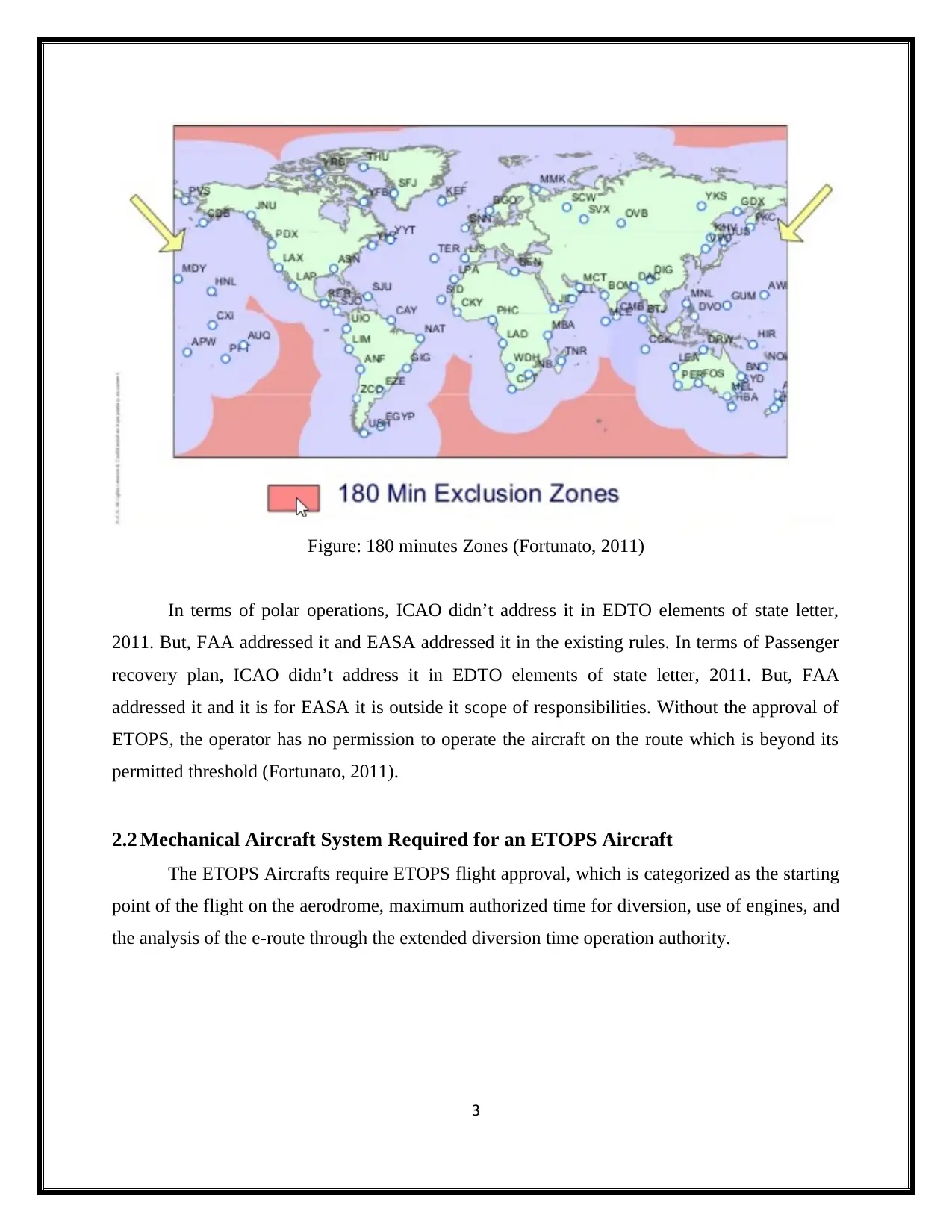
Figure: 180 minutes Zones (Fortunato, 2011)
In terms of polar operations, ICAO didn’t address it in EDTO elements of state letter,
2011. But, FAA addressed it and EASA addressed it in the existing rules. In terms of Passenger
recovery plan, ICAO didn’t address it in EDTO elements of state letter, 2011. But, FAA
addressed it and it is for EASA it is outside it scope of responsibilities. Without the approval of
ETOPS, the operator has no permission to operate the aircraft on the route which is beyond its
permitted threshold (Fortunato, 2011).
2.2 Mechanical Aircraft System Required for an ETOPS Aircraft
The ETOPS Aircrafts require ETOPS flight approval, which is categorized as the starting
point of the flight on the aerodrome, maximum authorized time for diversion, use of engines, and
the analysis of the e-route through the extended diversion time operation authority.
3
In terms of polar operations, ICAO didn’t address it in EDTO elements of state letter,
2011. But, FAA addressed it and EASA addressed it in the existing rules. In terms of Passenger
recovery plan, ICAO didn’t address it in EDTO elements of state letter, 2011. But, FAA
addressed it and it is for EASA it is outside it scope of responsibilities. Without the approval of
ETOPS, the operator has no permission to operate the aircraft on the route which is beyond its
permitted threshold (Fortunato, 2011).
2.2 Mechanical Aircraft System Required for an ETOPS Aircraft
The ETOPS Aircrafts require ETOPS flight approval, which is categorized as the starting
point of the flight on the aerodrome, maximum authorized time for diversion, use of engines, and
the analysis of the e-route through the extended diversion time operation authority.
3
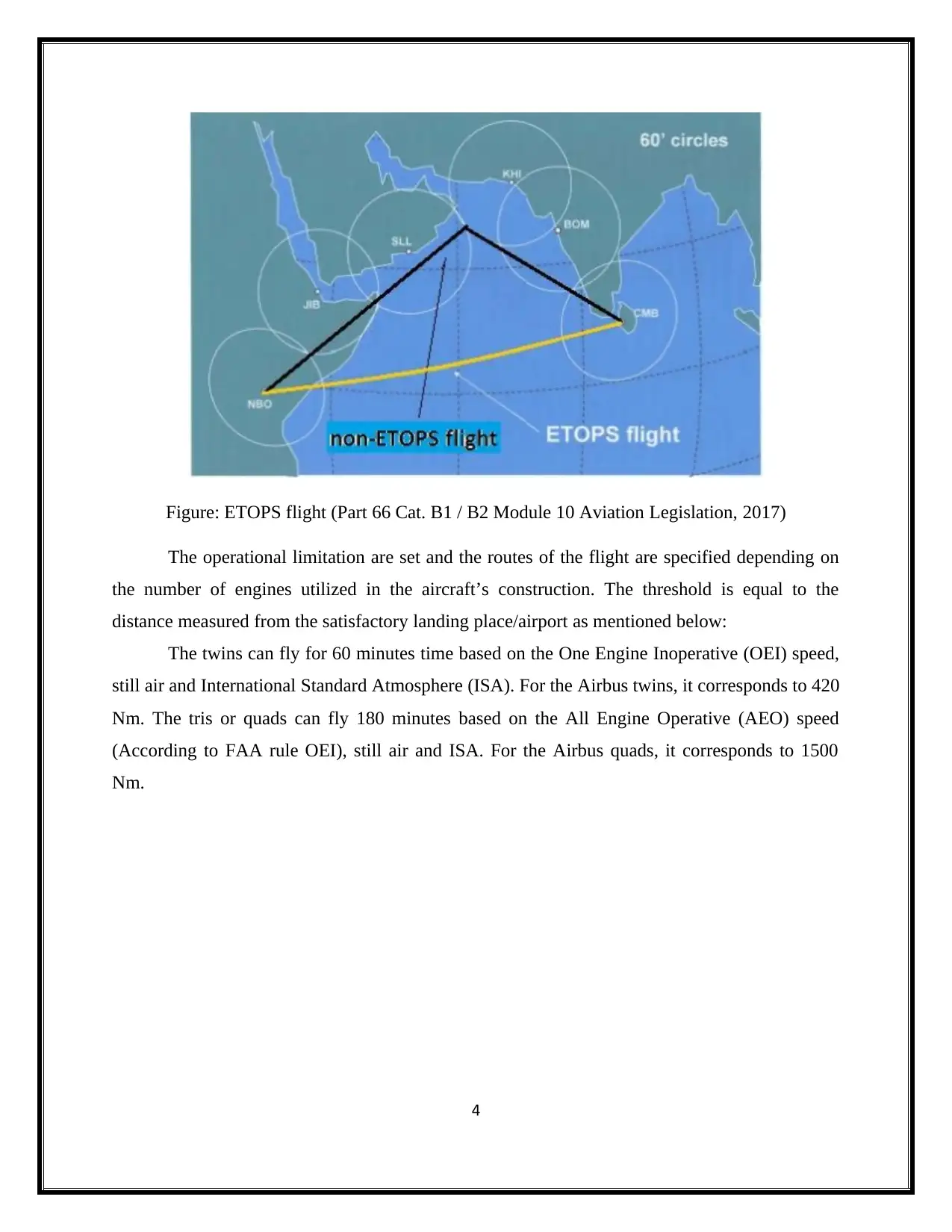
Figure: ETOPS flight (Part 66 Cat. B1 / B2 Module 10 Aviation Legislation, 2017)
The operational limitation are set and the routes of the flight are specified depending on
the number of engines utilized in the aircraft’s construction. The threshold is equal to the
distance measured from the satisfactory landing place/airport as mentioned below:
The twins can fly for 60 minutes time based on the One Engine Inoperative (OEI) speed,
still air and International Standard Atmosphere (ISA). For the Airbus twins, it corresponds to 420
Nm. The tris or quads can fly 180 minutes based on the All Engine Operative (AEO) speed
(According to FAA rule OEI), still air and ISA. For the Airbus quads, it corresponds to 1500
Nm.
4
The operational limitation are set and the routes of the flight are specified depending on
the number of engines utilized in the aircraft’s construction. The threshold is equal to the
distance measured from the satisfactory landing place/airport as mentioned below:
The twins can fly for 60 minutes time based on the One Engine Inoperative (OEI) speed,
still air and International Standard Atmosphere (ISA). For the Airbus twins, it corresponds to 420
Nm. The tris or quads can fly 180 minutes based on the All Engine Operative (AEO) speed
(According to FAA rule OEI), still air and ISA. For the Airbus quads, it corresponds to 1500
Nm.
4
⊘ This is a preview!⊘
Do you want full access?
Subscribe today to unlock all pages.
Trusted by 1+ million students worldwide
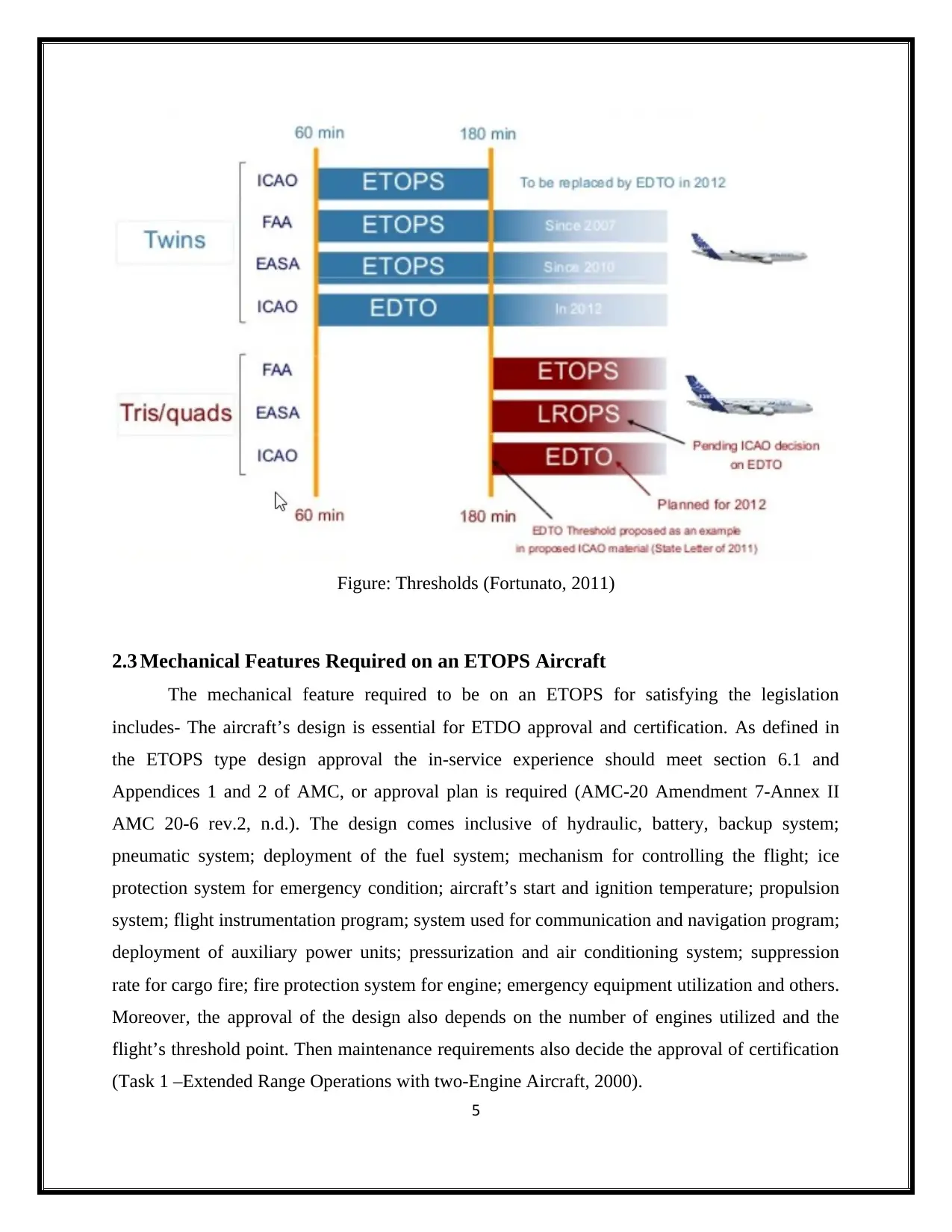
Figure: Thresholds (Fortunato, 2011)
2.3 Mechanical Features Required on an ETOPS Aircraft
The mechanical feature required to be on an ETOPS for satisfying the legislation
includes- The aircraft’s design is essential for ETDO approval and certification. As defined in
the ETOPS type design approval the in-service experience should meet section 6.1 and
Appendices 1 and 2 of AMC, or approval plan is required (AMC-20 Amendment 7-Annex II
AMC 20-6 rev.2, n.d.). The design comes inclusive of hydraulic, battery, backup system;
pneumatic system; deployment of the fuel system; mechanism for controlling the flight; ice
protection system for emergency condition; aircraft’s start and ignition temperature; propulsion
system; flight instrumentation program; system used for communication and navigation program;
deployment of auxiliary power units; pressurization and air conditioning system; suppression
rate for cargo fire; fire protection system for engine; emergency equipment utilization and others.
Moreover, the approval of the design also depends on the number of engines utilized and the
flight’s threshold point. Then maintenance requirements also decide the approval of certification
(Task 1 –Extended Range Operations with two-Engine Aircraft, 2000).
5
2.3 Mechanical Features Required on an ETOPS Aircraft
The mechanical feature required to be on an ETOPS for satisfying the legislation
includes- The aircraft’s design is essential for ETDO approval and certification. As defined in
the ETOPS type design approval the in-service experience should meet section 6.1 and
Appendices 1 and 2 of AMC, or approval plan is required (AMC-20 Amendment 7-Annex II
AMC 20-6 rev.2, n.d.). The design comes inclusive of hydraulic, battery, backup system;
pneumatic system; deployment of the fuel system; mechanism for controlling the flight; ice
protection system for emergency condition; aircraft’s start and ignition temperature; propulsion
system; flight instrumentation program; system used for communication and navigation program;
deployment of auxiliary power units; pressurization and air conditioning system; suppression
rate for cargo fire; fire protection system for engine; emergency equipment utilization and others.
Moreover, the approval of the design also depends on the number of engines utilized and the
flight’s threshold point. Then maintenance requirements also decide the approval of certification
(Task 1 –Extended Range Operations with two-Engine Aircraft, 2000).
5
Paraphrase This Document
Need a fresh take? Get an instant paraphrase of this document with our AI Paraphraser
Chapter 3: Analysis and Evaluation
3.1 Mechanical Backup Systems on ETOPS Aircraft
The mechanical back-up or redundancy systems that are essential for the ETOPS aircraft
during an in-flight emergency are discussed in this section.
The operational program of the ETDO flights requires overall safety program in relation
to the performance of the flight, crew members’ training and development program, and
maintenance of operational plan. The commercial operation of the flight can take place after
obtaining ETDO certification (Downer, 2009). The threshold time is calculated for the flights
with respect to the ETDO certification, where 60 minutes threshold point is allocated for
maximum diversion to the flight which are designed with two engines capacity. 180 minutes
threshold point is allocated for maximum diversion to the flight which are designed with more
than two engines capacity (Young, 2018).
The ETOPS’s system redundancy levels are reflected in Master Minimum Equipment
List (MMEL). For ETOPS proposed operations, the equipment and in-service issues are
distinctive for the operator. For example, when compared to the MMEL, operator’s MEL has
many restrictions. When it comes to safety, the system and equipment play a major role (AMC-
20 Amendment 7-Annex II AMC 20-6 rev.2, n.d.).
The MEL comprises of the following- hydraulic; electrical; pneumatic; warning and
caution systems; flight instrumentation; fuel; ice protection; flight control; navigation and
communications, along with route specific long range navigation and communication equipment;
engine start and ignition; auxiliary power-unit; engine fire protection; propulsion system
instruments; cargo fire suppression; air conditioning and pressurization; emergency equipment;
necessary systems and equipment needed to monitor the engine condition. To help during,
greater than 180 minutes diversion times dispatch operation is necessary which includes-
Auxiliary power unit with electrical and pneumatic supply is required based on its design; Fuel
Quantity Indicating System (FQIS); propeller control system or automatic engine is required; and
for communication, a reliable communication system for the flight crew is very important
(AMC-20 Amendment 7-Annex II AMC 20-6 rev.2, n.d.).
Appendix 3 provides operational limitations, in AMC.
6
3.1 Mechanical Backup Systems on ETOPS Aircraft
The mechanical back-up or redundancy systems that are essential for the ETOPS aircraft
during an in-flight emergency are discussed in this section.
The operational program of the ETDO flights requires overall safety program in relation
to the performance of the flight, crew members’ training and development program, and
maintenance of operational plan. The commercial operation of the flight can take place after
obtaining ETDO certification (Downer, 2009). The threshold time is calculated for the flights
with respect to the ETDO certification, where 60 minutes threshold point is allocated for
maximum diversion to the flight which are designed with two engines capacity. 180 minutes
threshold point is allocated for maximum diversion to the flight which are designed with more
than two engines capacity (Young, 2018).
The ETOPS’s system redundancy levels are reflected in Master Minimum Equipment
List (MMEL). For ETOPS proposed operations, the equipment and in-service issues are
distinctive for the operator. For example, when compared to the MMEL, operator’s MEL has
many restrictions. When it comes to safety, the system and equipment play a major role (AMC-
20 Amendment 7-Annex II AMC 20-6 rev.2, n.d.).
The MEL comprises of the following- hydraulic; electrical; pneumatic; warning and
caution systems; flight instrumentation; fuel; ice protection; flight control; navigation and
communications, along with route specific long range navigation and communication equipment;
engine start and ignition; auxiliary power-unit; engine fire protection; propulsion system
instruments; cargo fire suppression; air conditioning and pressurization; emergency equipment;
necessary systems and equipment needed to monitor the engine condition. To help during,
greater than 180 minutes diversion times dispatch operation is necessary which includes-
Auxiliary power unit with electrical and pneumatic supply is required based on its design; Fuel
Quantity Indicating System (FQIS); propeller control system or automatic engine is required; and
for communication, a reliable communication system for the flight crew is very important
(AMC-20 Amendment 7-Annex II AMC 20-6 rev.2, n.d.).
Appendix 3 provides operational limitations, in AMC.
6
The threshold time for the relevant design aircraft can be determined as follows- With 60
minutes as threshold time, the aircraft should have twin engine capacity i.e., engines more than
twin aircraft are required. Allocation of ETDO certification is provided for the twin engine
aircraft. ETDO threshold certification is provide to the aircraft with more than two engines
(AMC-20 Amendment 7-Annex II AMC 20-6 rev.2, n.d.).
The approval plan to get threshold time has certain criteria as follows- To get approval
for 90 minutes threshold time, the eligibility for the operator is three months operating
experience, the type Design should be ETDO approved and must have Minimum Equipment List
(MEL). To get approval for 120 minutes, the eligibility for the operator is six months experience
as mandatory, followed by the type Design should be ETDO approved and must have MEL. To
get approval for 138 minutes, the eligibility for the operator is minimum three months
experience, then same the type Design should be ETDO approved and must have MEL. To get
approval for 180 minutes, the eligibility for the operator is one year experience, the type Design
should be ETDO approved and must have MEL (AMC-20 Amendment 7-Annex II AMC 20-6
rev.2, n.d.).
To handle the emergency situations in the aircraft, the design of the aircraft must have
ETDO certification. This a type of approval which depends on the number of engine used and
the threshold point of the flight. The ETOPS certification also includes maintenance
requirements in the approval. The appendix 4 of AMC provides In-flight procedures, where the
fuel plan and airborne system are checked with other pilot-in-command information. Then, the
procedure contains guidance in the form of a manual to help during diversion decisions and in
monitoring the en-route weather (AMC-20 Amendment 7-Annex II AMC 20-6 rev.2, n.d.).
The emergency situation requires Brake accumulator / emergency braking system, fire
alert system, then according to provisions of paragraph 10, the fuel quantity and usage of fuel
indications and alerts are required for a safe ETOPS flight. According to the provisions of
paragraph 8, in case of emergency the additional power requirement is fulfilled by the hydraulic
system (AMC-20 Amendment 7-Annex II AMC 20-6 rev.2, n.d.).
7
minutes as threshold time, the aircraft should have twin engine capacity i.e., engines more than
twin aircraft are required. Allocation of ETDO certification is provided for the twin engine
aircraft. ETDO threshold certification is provide to the aircraft with more than two engines
(AMC-20 Amendment 7-Annex II AMC 20-6 rev.2, n.d.).
The approval plan to get threshold time has certain criteria as follows- To get approval
for 90 minutes threshold time, the eligibility for the operator is three months operating
experience, the type Design should be ETDO approved and must have Minimum Equipment List
(MEL). To get approval for 120 minutes, the eligibility for the operator is six months experience
as mandatory, followed by the type Design should be ETDO approved and must have MEL. To
get approval for 138 minutes, the eligibility for the operator is minimum three months
experience, then same the type Design should be ETDO approved and must have MEL. To get
approval for 180 minutes, the eligibility for the operator is one year experience, the type Design
should be ETDO approved and must have MEL (AMC-20 Amendment 7-Annex II AMC 20-6
rev.2, n.d.).
To handle the emergency situations in the aircraft, the design of the aircraft must have
ETDO certification. This a type of approval which depends on the number of engine used and
the threshold point of the flight. The ETOPS certification also includes maintenance
requirements in the approval. The appendix 4 of AMC provides In-flight procedures, where the
fuel plan and airborne system are checked with other pilot-in-command information. Then, the
procedure contains guidance in the form of a manual to help during diversion decisions and in
monitoring the en-route weather (AMC-20 Amendment 7-Annex II AMC 20-6 rev.2, n.d.).
The emergency situation requires Brake accumulator / emergency braking system, fire
alert system, then according to provisions of paragraph 10, the fuel quantity and usage of fuel
indications and alerts are required for a safe ETOPS flight. According to the provisions of
paragraph 8, in case of emergency the additional power requirement is fulfilled by the hydraulic
system (AMC-20 Amendment 7-Annex II AMC 20-6 rev.2, n.d.).
7
⊘ This is a preview!⊘
Do you want full access?
Subscribe today to unlock all pages.
Trusted by 1+ million students worldwide
Chapter 4: Conclusion
A clear understanding of ETOPS certification is represented through this report. The
importance of ETOPS is concluded based on the thresholds and engines. A complete overview of
ETOPS Certification is researched, where the necessary criteria are determined. The current
legislations for ETOPS is highlighted. The development of a safety procedure for the ETOPS
aircraft is determined. The mechanical back-up systems are considered as essential in the ETOPS
aircraft, during in-flight emergency, because of added features in the legislation. It is observed in
AMC-20-6 rev.2 that, the ETOPS certified aircrafts require certain permission for developing the
aircraft, where the diversion time along the route should exceed 180 minutes. Further, the
ETOPS certified aircrafts must have smooth operational capability. The system emergency
generator, APU and so on are required as a backup system, for the safety of the engine
inoperative ETOPS diversion. Such systems provide added redundancy for accommodating the
system missed by the inoperative engine. The certification ensures that the aircrafts have
improved their performance and quality design. Thus, the criteria revolve around integrity,
reliability and back-up system capacity. The mechanical aircraft System required for an ETOPS
Aircraft are studied. The mechanical features required on an ETOPS Aircraft are also
investigated. Further, the ETOPS back-up systems operation in an in-flight emergency situation
and redundancy afforded to the on-board systems is discussed. An example for mechanical
system is represented. The hydraulic system aids in the in-flight emergency, by providing
additional power to the aircraft.
Therefore, the operational criteria, then the reliability, backup system and safety criteria
must be met in the aircraft design, for obtaining ETOPS certification.
8
A clear understanding of ETOPS certification is represented through this report. The
importance of ETOPS is concluded based on the thresholds and engines. A complete overview of
ETOPS Certification is researched, where the necessary criteria are determined. The current
legislations for ETOPS is highlighted. The development of a safety procedure for the ETOPS
aircraft is determined. The mechanical back-up systems are considered as essential in the ETOPS
aircraft, during in-flight emergency, because of added features in the legislation. It is observed in
AMC-20-6 rev.2 that, the ETOPS certified aircrafts require certain permission for developing the
aircraft, where the diversion time along the route should exceed 180 minutes. Further, the
ETOPS certified aircrafts must have smooth operational capability. The system emergency
generator, APU and so on are required as a backup system, for the safety of the engine
inoperative ETOPS diversion. Such systems provide added redundancy for accommodating the
system missed by the inoperative engine. The certification ensures that the aircrafts have
improved their performance and quality design. Thus, the criteria revolve around integrity,
reliability and back-up system capacity. The mechanical aircraft System required for an ETOPS
Aircraft are studied. The mechanical features required on an ETOPS Aircraft are also
investigated. Further, the ETOPS back-up systems operation in an in-flight emergency situation
and redundancy afforded to the on-board systems is discussed. An example for mechanical
system is represented. The hydraulic system aids in the in-flight emergency, by providing
additional power to the aircraft.
Therefore, the operational criteria, then the reliability, backup system and safety criteria
must be met in the aircraft design, for obtaining ETOPS certification.
8
Paraphrase This Document
Need a fresh take? Get an instant paraphrase of this document with our AI Paraphraser
References
AMC-20 Amendment 7-Annex II AMC 20-6 rev.2. (n.d.). [online] Available at:
https://www.easa.europa.eu/sites/default/files/dfu/Annex%20II%20-%20AMC%2020-6.pdf
[Accessed 13 Apr. 2018].
Downer, J. (2009). When Failure is an Option: Redundancy, reliability and regulation in
complex technical systems. [online] Available at:
http://eprints.lse.ac.uk/36537/1/Disspaper53.pdf [Accessed 14 Apr. 2018].
Fortunato, E. (2011). Overview of new ETOPS/LROPS/EDTO rules. ICAO Fourth meeting of
the Regional Aviation safety.
New ETOPS Regulations. (2003). [online] Available at:
http://www.boeing.com/commercial/aeromagazine/aero_22/etops.pdf [Accessed 13 Apr. 2018].
New ETOPS Regulations. (2007). U.S. Department of Transportation Federal Aviation
Administration. [online] Available at:
https://www.faa.gov/other_visit/aviation_industry/airline_operators/airline_safety/info/
all_infos/media/2007/info07004.pdf [Accessed 13 Apr. 2018].
Part 66 Cat. B1 / B2 Module 10 Aviation Legislation. (2017). Category B1/B2 according Part-
66 Appendix 1, (1).
Task 1 –Extended Range Operations with two-Engine Aircraft. (2000). Federal Aviation
Administration. [online] Available at:
https://www.faa.gov/regulations_policies/rulemaking/committees/documents/media/
ACOetopsT1-06142000.pdf [Accessed 14 Apr. 2018].
Young, T. (2018). Performance of the jet transport airplane. 1st ed. USA.
9
AMC-20 Amendment 7-Annex II AMC 20-6 rev.2. (n.d.). [online] Available at:
https://www.easa.europa.eu/sites/default/files/dfu/Annex%20II%20-%20AMC%2020-6.pdf
[Accessed 13 Apr. 2018].
Downer, J. (2009). When Failure is an Option: Redundancy, reliability and regulation in
complex technical systems. [online] Available at:
http://eprints.lse.ac.uk/36537/1/Disspaper53.pdf [Accessed 14 Apr. 2018].
Fortunato, E. (2011). Overview of new ETOPS/LROPS/EDTO rules. ICAO Fourth meeting of
the Regional Aviation safety.
New ETOPS Regulations. (2003). [online] Available at:
http://www.boeing.com/commercial/aeromagazine/aero_22/etops.pdf [Accessed 13 Apr. 2018].
New ETOPS Regulations. (2007). U.S. Department of Transportation Federal Aviation
Administration. [online] Available at:
https://www.faa.gov/other_visit/aviation_industry/airline_operators/airline_safety/info/
all_infos/media/2007/info07004.pdf [Accessed 13 Apr. 2018].
Part 66 Cat. B1 / B2 Module 10 Aviation Legislation. (2017). Category B1/B2 according Part-
66 Appendix 1, (1).
Task 1 –Extended Range Operations with two-Engine Aircraft. (2000). Federal Aviation
Administration. [online] Available at:
https://www.faa.gov/regulations_policies/rulemaking/committees/documents/media/
ACOetopsT1-06142000.pdf [Accessed 14 Apr. 2018].
Young, T. (2018). Performance of the jet transport airplane. 1st ed. USA.
9

1 out of 11


Your All-in-One AI-Powered Toolkit for Academic Success.
+13062052269
info@desklib.com
Available 24*7 on WhatsApp / Email
![[object Object]](/_next/static/media/star-bottom.7253800d.svg)
Unlock your academic potential
Copyright © 2020–2026 A2Z Services. All Rights Reserved. Developed and managed by ZUCOL.