An Eventful Journey of Bollywood: From Silent Films to Global Success

Verified

Added on  2022/12/01

|6
|1538
|60
Essay
AI Summary
This essay provides a comprehensive overview of the eventful journey of Bollywood, the Indian film industry. It begins by tracing the origins of Indian cinema back to the late 19th century, highlighting the contributions of pioneers like the Lumiere Brothers and Dadasaheb Phalke, who made the first full-length feature film 'Raja Harishchandra'. The essay then explores the evolution of Bollywood, including the advent of talkies with 'Alam Ara', the rise of regional cinema, and the impact of the Second World War. It further delves into the golden age of Indian cinema in the 1950s and 60s, the rise of potboiler films in the 70s, and the decline in the 80s. The essay also discusses the economic liberalization of the 1990s, which led to the emergence of 'New Bollywood', and the growing international recognition of Indian cinema. It concludes by emphasizing the unique characteristics of Bollywood, particularly its social messages and the integral role of music and songs, making it distinct from other film industries.
Document Page
EVENTFUL JOURNEY OF BOLLYWOOD
Name of Student
Name of University
Author Note
tabler-icon-diamond-filled.svg

Paraphrase This Document

Need a fresh take? Get an instant paraphrase of this document with our AI Paraphraser
Document Page
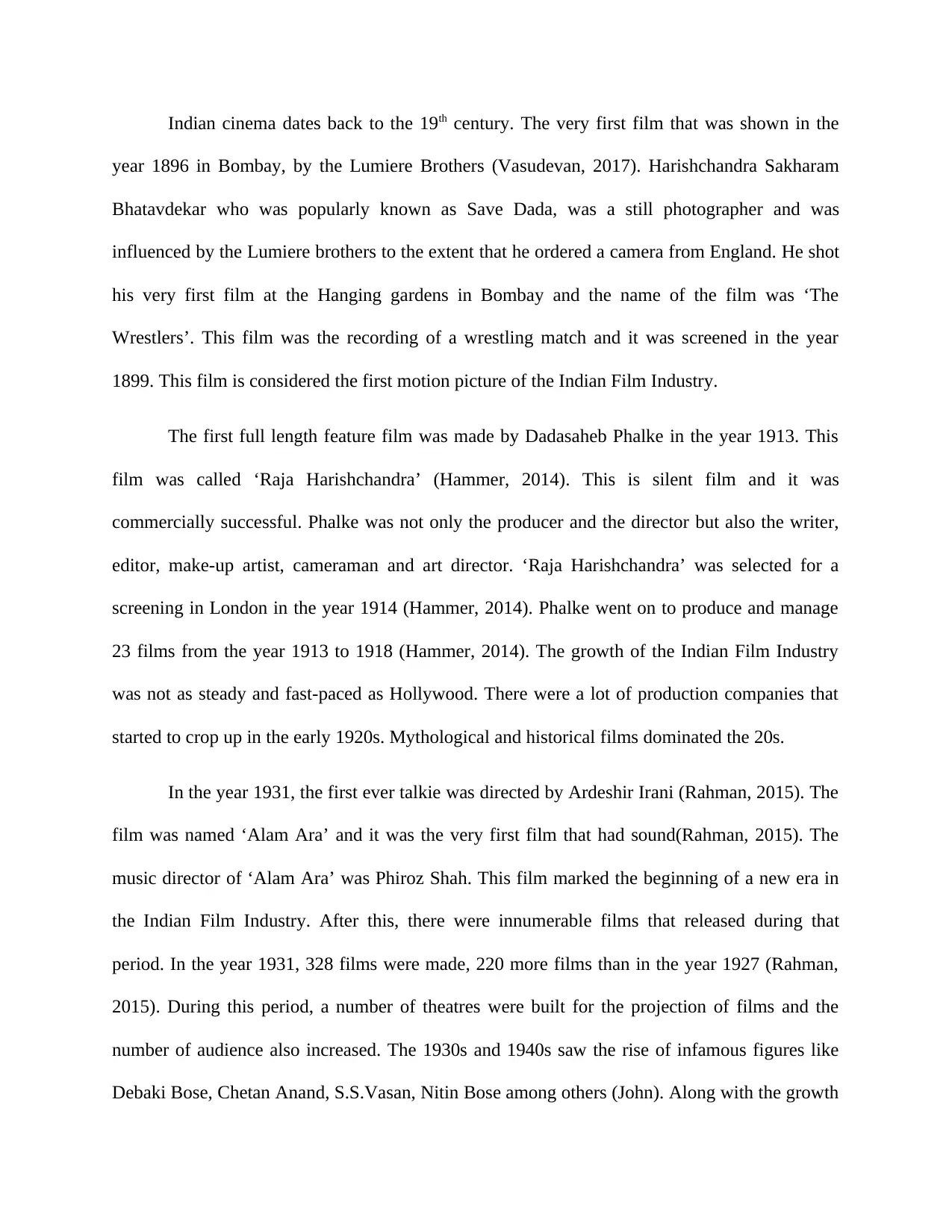
Indian cinema dates back to the 19th century. The very first film that was shown in the
year 1896 in Bombay, by the Lumiere Brothers (Vasudevan, 2017). Harishchandra Sakharam
Bhatavdekar who was popularly known as Save Dada, was a still photographer and was
influenced by the Lumiere brothers to the extent that he ordered a camera from England. He shot
his very first film at the Hanging gardens in Bombay and the name of the film was ‘The
Wrestlers’. This film was the recording of a wrestling match and it was screened in the year
1899. This film is considered the first motion picture of the Indian Film Industry.
The first full length feature film was made by Dadasaheb Phalke in the year 1913. This
film was called ‘Raja Harishchandra’ (Hammer, 2014). This is silent film and it was
commercially successful. Phalke was not only the producer and the director but also the writer,
editor, make-up artist, cameraman and art director. ‘Raja Harishchandra’ was selected for a
screening in London in the year 1914 (Hammer, 2014). Phalke went on to produce and manage
23 films from the year 1913 to 1918 (Hammer, 2014). The growth of the Indian Film Industry
was not as steady and fast-paced as Hollywood. There were a lot of production companies that
started to crop up in the early 1920s. Mythological and historical films dominated the 20s.
In the year 1931, the first ever talkie was directed by Ardeshir Irani (Rahman, 2015). The
film was named ‘Alam Ara’ and it was the very first film that had sound(Rahman, 2015). The
music director of ‘Alam Ara’ was Phiroz Shah. This film marked the beginning of a new era in
the Indian Film Industry. After this, there were innumerable films that released during that
period. In the year 1931, 328 films were made, 220 more films than in the year 1927 (Rahman,
2015). During this period, a number of theatres were built for the projection of films and the
number of audience also increased. The 1930s and 1940s saw the rise of infamous figures like
Debaki Bose, Chetan Anand, S.S.Vasan, Nitin Bose among others (John). Along with the growth
Document Page
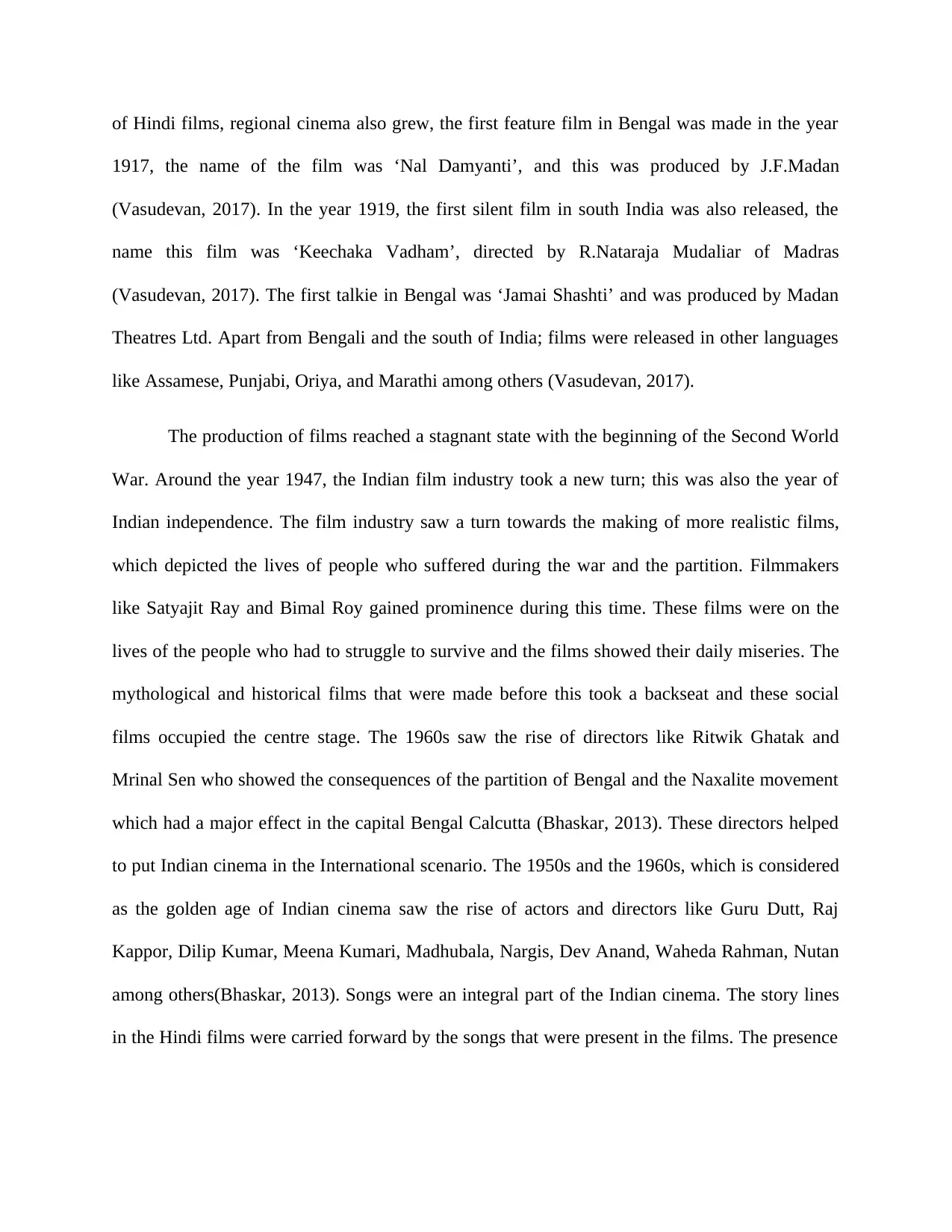
of Hindi films, regional cinema also grew, the first feature film in Bengal was made in the year
1917, the name of the film was ‘Nal Damyanti’, and this was produced by J.F.Madan
(Vasudevan, 2017). In the year 1919, the first silent film in south India was also released, the
name this film was ‘Keechaka Vadham’, directed by R.Nataraja Mudaliar of Madras
(Vasudevan, 2017). The first talkie in Bengal was ‘Jamai Shashti’ and was produced by Madan
Theatres Ltd. Apart from Bengali and the south of India; films were released in other languages
like Assamese, Punjabi, Oriya, and Marathi among others (Vasudevan, 2017).
The production of films reached a stagnant state with the beginning of the Second World
War. Around the year 1947, the Indian film industry took a new turn; this was also the year of
Indian independence. The film industry saw a turn towards the making of more realistic films,
which depicted the lives of people who suffered during the war and the partition. Filmmakers
like Satyajit Ray and Bimal Roy gained prominence during this time. These films were on the
lives of the people who had to struggle to survive and the films showed their daily miseries. The
mythological and historical films that were made before this took a backseat and these social
films occupied the centre stage. The 1960s saw the rise of directors like Ritwik Ghatak and
Mrinal Sen who showed the consequences of the partition of Bengal and the Naxalite movement
which had a major effect in the capital Bengal Calcutta (Bhaskar, 2013). These directors helped
to put Indian cinema in the International scenario. The 1950s and the 1960s, which is considered
as the golden age of Indian cinema saw the rise of actors and directors like Guru Dutt, Raj
Kappor, Dilip Kumar, Meena Kumari, Madhubala, Nargis, Dev Anand, Waheda Rahman, Nutan
among others(Bhaskar, 2013). Songs were an integral part of the Indian cinema. The story lines
in the Hindi films were carried forward by the songs that were present in the films. The presence
Document Page
of these songs gave the films a distinct feature and it was unique to the India films and this made
them different from the films that were made in Hollywood.
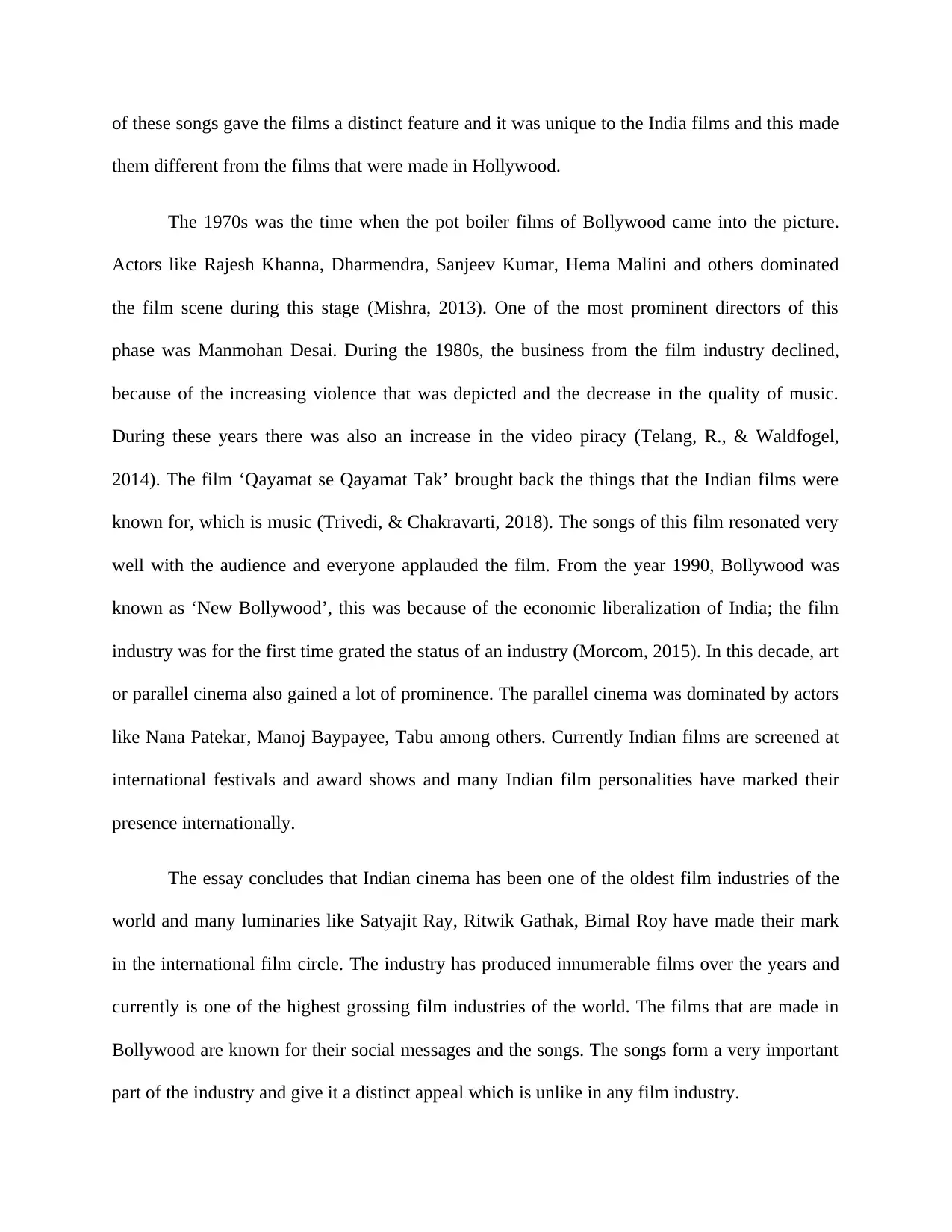
The 1970s was the time when the pot boiler films of Bollywood came into the picture.
Actors like Rajesh Khanna, Dharmendra, Sanjeev Kumar, Hema Malini and others dominated
the film scene during this stage (Mishra, 2013). One of the most prominent directors of this
phase was Manmohan Desai. During the 1980s, the business from the film industry declined,
because of the increasing violence that was depicted and the decrease in the quality of music.
During these years there was also an increase in the video piracy (Telang, R., & Waldfogel,
2014). The film ‘Qayamat se Qayamat Tak’ brought back the things that the Indian films were
known for, which is music (Trivedi, & Chakravarti, 2018). The songs of this film resonated very
well with the audience and everyone applauded the film. From the year 1990, Bollywood was
known as ‘New Bollywood’, this was because of the economic liberalization of India; the film
industry was for the first time grated the status of an industry (Morcom, 2015). In this decade, art
or parallel cinema also gained a lot of prominence. The parallel cinema was dominated by actors
like Nana Patekar, Manoj Baypayee, Tabu among others. Currently Indian films are screened at
international festivals and award shows and many Indian film personalities have marked their
presence internationally.
The essay concludes that Indian cinema has been one of the oldest film industries of the
world and many luminaries like Satyajit Ray, Ritwik Gathak, Bimal Roy have made their mark
in the international film circle. The industry has produced innumerable films over the years and
currently is one of the highest grossing film industries of the world. The films that are made in
Bollywood are known for their social messages and the songs. The songs form a very important
part of the industry and give it a distinct appeal which is unlike in any film industry.
tabler-icon-diamond-filled.svg

Paraphrase This Document

Need a fresh take? Get an instant paraphrase of this document with our AI Paraphraser
Document Page
References
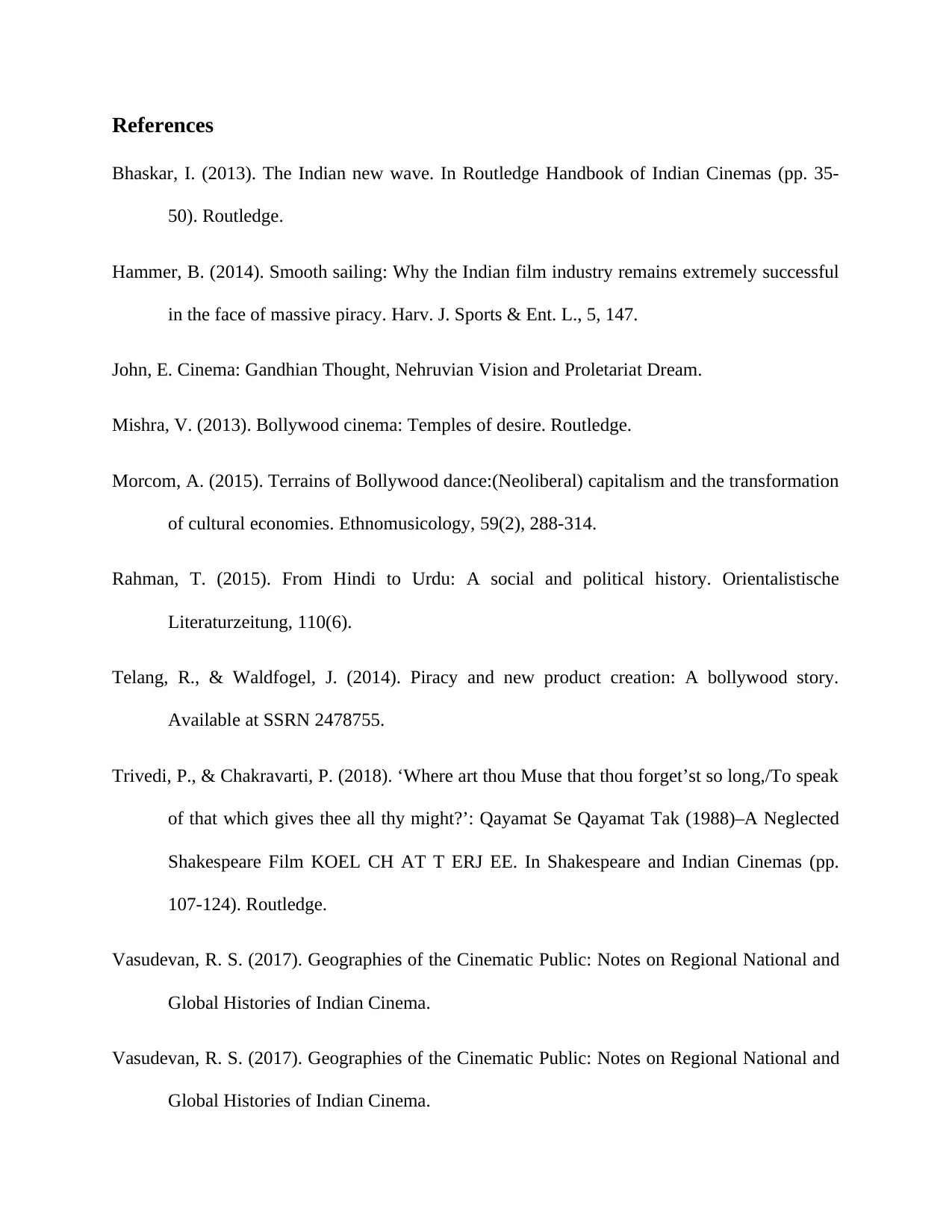
Bhaskar, I. (2013). The Indian new wave. In Routledge Handbook of Indian Cinemas (pp. 35-
50). Routledge.
Hammer, B. (2014). Smooth sailing: Why the Indian film industry remains extremely successful
in the face of massive piracy. Harv. J. Sports & Ent. L., 5, 147.
John, E. Cinema: Gandhian Thought, Nehruvian Vision and Proletariat Dream.
Mishra, V. (2013). Bollywood cinema: Temples of desire. Routledge.
Morcom, A. (2015). Terrains of Bollywood dance:(Neoliberal) capitalism and the transformation
of cultural economies. Ethnomusicology, 59(2), 288-314.
Rahman, T. (2015). From Hindi to Urdu: A social and political history. Orientalistische
Literaturzeitung, 110(6).
Telang, R., & Waldfogel, J. (2014). Piracy and new product creation: A bollywood story.
Available at SSRN 2478755.
Trivedi, P., & Chakravarti, P. (2018). ‘Where art thou Muse that thou forget’st so long,/To speak
of that which gives thee all thy might?’: Qayamat Se Qayamat Tak (1988)–A Neglected
Shakespeare Film KOEL CH AT T ERJ EE. In Shakespeare and Indian Cinemas (pp.
107-124). Routledge.
Vasudevan, R. S. (2017). Geographies of the Cinematic Public: Notes on Regional National and
Global Histories of Indian Cinema.
Vasudevan, R. S. (2017). Geographies of the Cinematic Public: Notes on Regional National and
Global Histories of Indian Cinema.
Document Page
chevron_up_icon
1 out of 6
circle_padding
hide_on_mobile
zoom_out_icon
[object Object]