Evidence-Based Management: Improving Decisions and Driving Change

Verified

Added on  2023/04/12

|6
|287
|356
Essay
AI Summary
This essay provides an overview of evidence-based management (EBMgt), defining it as the practice of making organizational decisions based on critical thinking, scientific principles, ethical considerations, and relevant business facts. It highlights the advantages of EBMgt, including better decision-making, improved expertise, defensible decisions, and enhanced decision quality. The essay also discusses how EBMgt can support change within organizations at local and organizational levels, emphasizing the importance of managing values, maximizing return on investments, reducing risks, and driving innovation. The document concludes with a list of references used in the essay. Desklib provides similar solved assignments and past papers for students.
Document Page
Evidence-based
Management
N a m e o f t h e S t u d e n t :
N a m e o f t h e U n i v e r s i t y :
tabler-icon-diamond-filled.svg

Paraphrase This Document

Need a fresh take? Get an instant paraphrase of this document with our AI Paraphraser
Document Page
FR
What is EBMgt or Evidence based
management?
The practise of making the organisational decisions on the basis of some
conscientious usage of the following:
Critical thinking that is aided by the decision supporters
Principles and knowledge based on science
Ethical considerations like the impacts of the stakeholders
Relevant and valid business and organisational facts (Barends & Rousseau, 2018)
Document Page
FR
Advantages of EBMgt
Better decisions by making use of practices that would work and
avoiding the ones that don’t
Developing in expertise throughout the career
Defensible decisions which stand up towards scrutiny by making use of
best process and best evidence
Improves the quality of decision (Rousseau & Olivas Luján, 2015)
Document Page
4
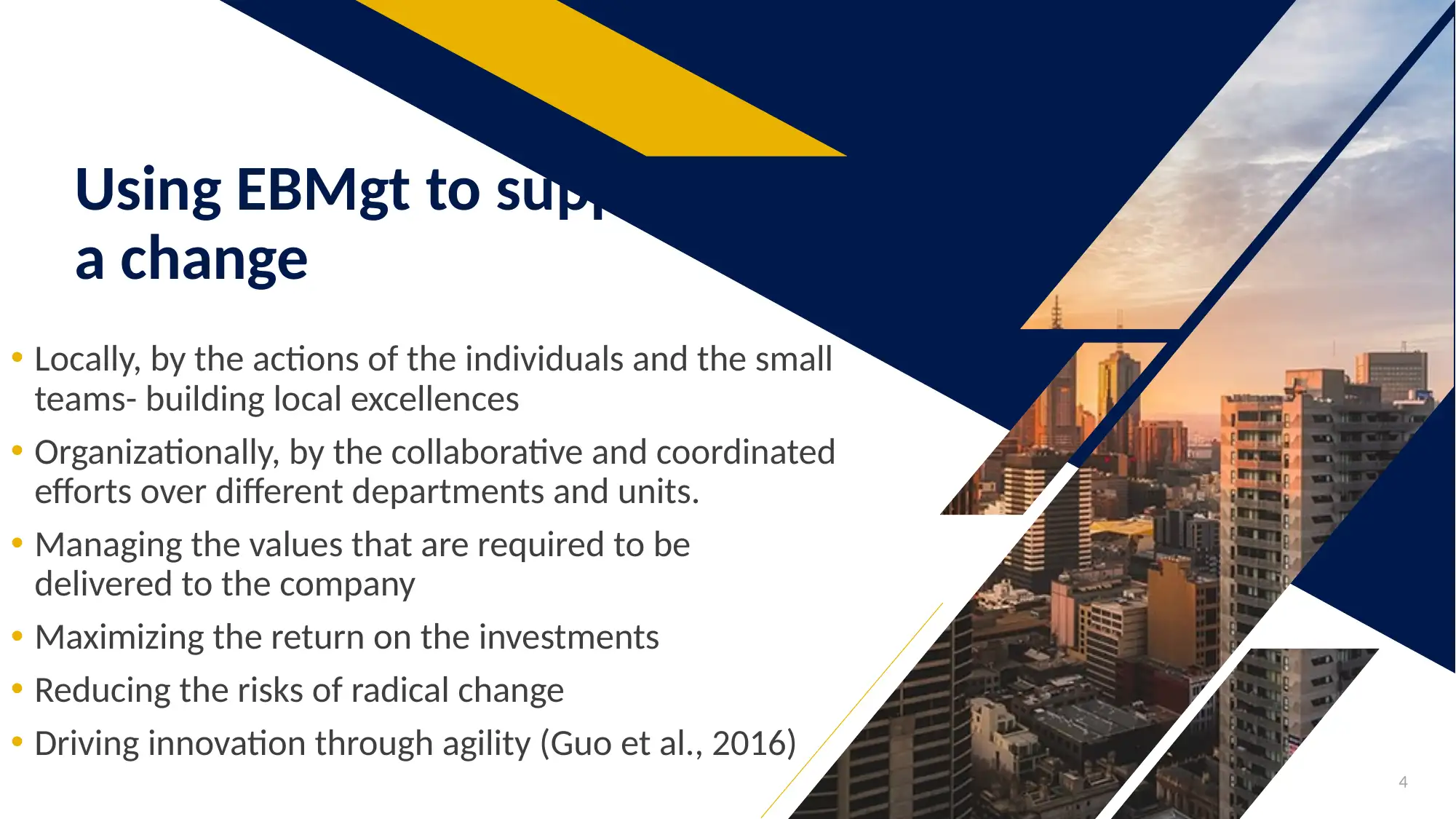
Using EBMgt to support
a change
Locally, by the actions of the individuals and the small
teams- building local excellences
Organizationally, by the collaborative and coordinated
efforts over different departments and units.
Managing the values that are required to be
delivered to the company
Maximizing the return on the investments
Reducing the risks of radical change
Driving innovation through agility (Guo et al., 2016)
tabler-icon-diamond-filled.svg

Paraphrase This Document

Need a fresh take? Get an instant paraphrase of this document with our AI Paraphraser
Document Page
FR
Add a footer 5
References:
Barends, E., & Rousseau, D. M. (2018). Evidence-based management: How to use
evidence to make better organizational decisions. Kogan Page Publishers.
Guo, R., Berkshire, S. D., Fulton, L. V., & Hermanson, P. M. (2016). Application of the
Theory of Planned Behavior to Evidence-based Management. In Academy of
Management Proceedings (Vol. 2016, No. 1, p. 13298). Briarcliff Manor, NY 10510:
Academy of Management.
Rousseau, D. M., & Olivas Luján, M. R. (2015). Evidence Based Management. Wiley
Encyclopedia of Management, 1-3.
Document Page
Thank You
chevron_up_icon
1 out of 6
circle_padding
hide_on_mobile
zoom_out_icon
[object Object]