5ENG: Developing & Delivering Employee Engagement Presentation
VerifiedAdded on 2023/06/17
|10
|3000
|283
Presentation
AI Summary
This presentation provides an analysis of employee engagement, its principal dimensions, components, and its difference from related concepts such as organizational commitment and job satisfaction. It identifies the principal drivers and business benefits of having an engaged workforce, including improved decision-making, cost savings, risk management, and enhanced employee well-being. Furthermore, the presentation outlines major steps organizations can take to create a culture of employee engagement, such as fostering positive communication, building trust, aligning engagement practices with corporate components, and implementing effective HR strategies. Strategies include job design, discretionary behavior encouragement, employee rewards, and diagnostic tools for measuring employee attitude and engagement.
Employment engagement

Paraphrase This Document
Need a fresh take? Get an instant paraphrase of this document with our AI Paraphraser
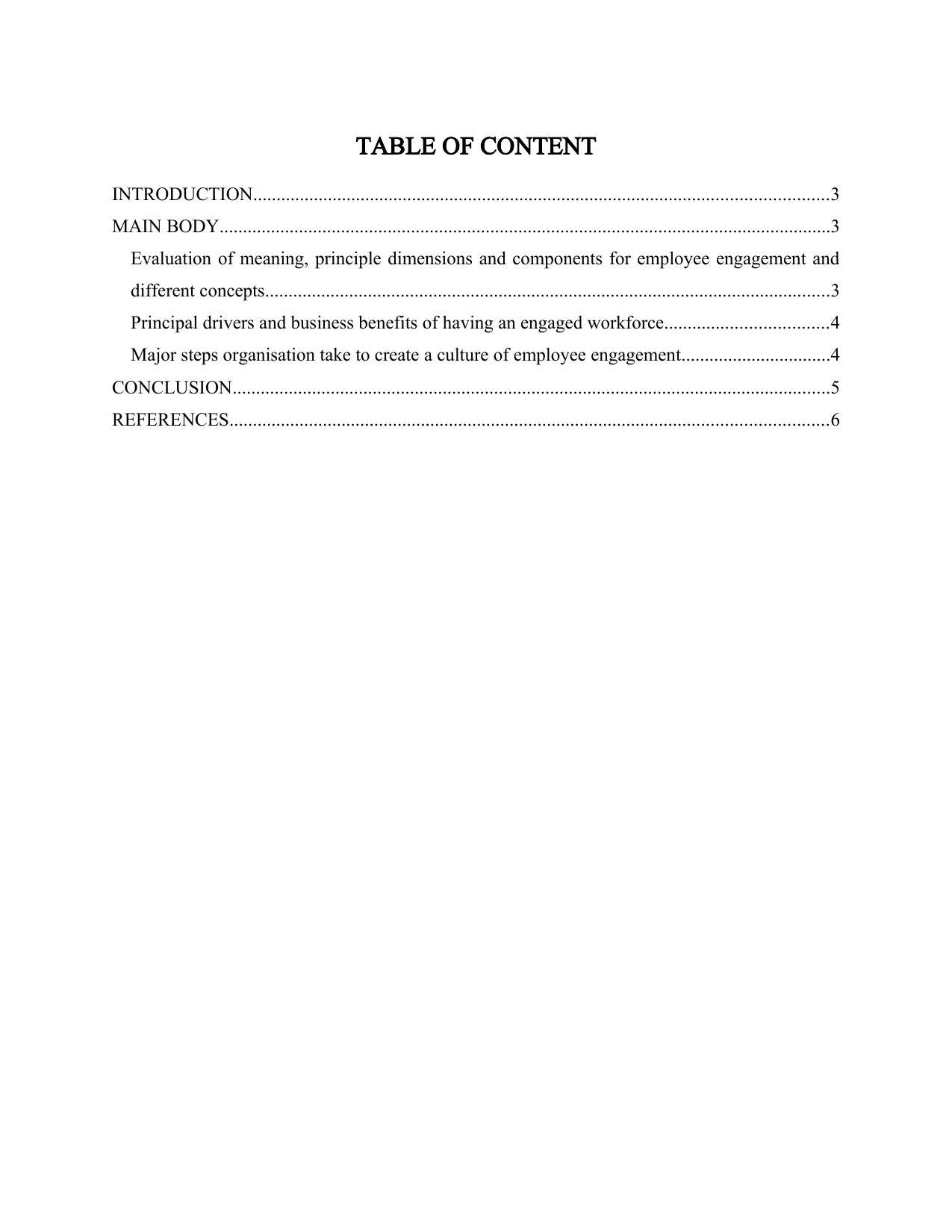
TABLE OF CONTENT
INTRODUCTION...........................................................................................................................3
MAIN BODY...................................................................................................................................3
Evaluation of meaning, principle dimensions and components for employee engagement and
different concepts.........................................................................................................................3
Principal drivers and business benefits of having an engaged workforce...................................4
Major steps organisation take to create a culture of employee engagement................................4
CONCLUSION................................................................................................................................5
REFERENCES................................................................................................................................6
INTRODUCTION...........................................................................................................................3
MAIN BODY...................................................................................................................................3
Evaluation of meaning, principle dimensions and components for employee engagement and
different concepts.........................................................................................................................3
Principal drivers and business benefits of having an engaged workforce...................................4
Major steps organisation take to create a culture of employee engagement................................4
CONCLUSION................................................................................................................................5
REFERENCES................................................................................................................................6
INTRODUCTION
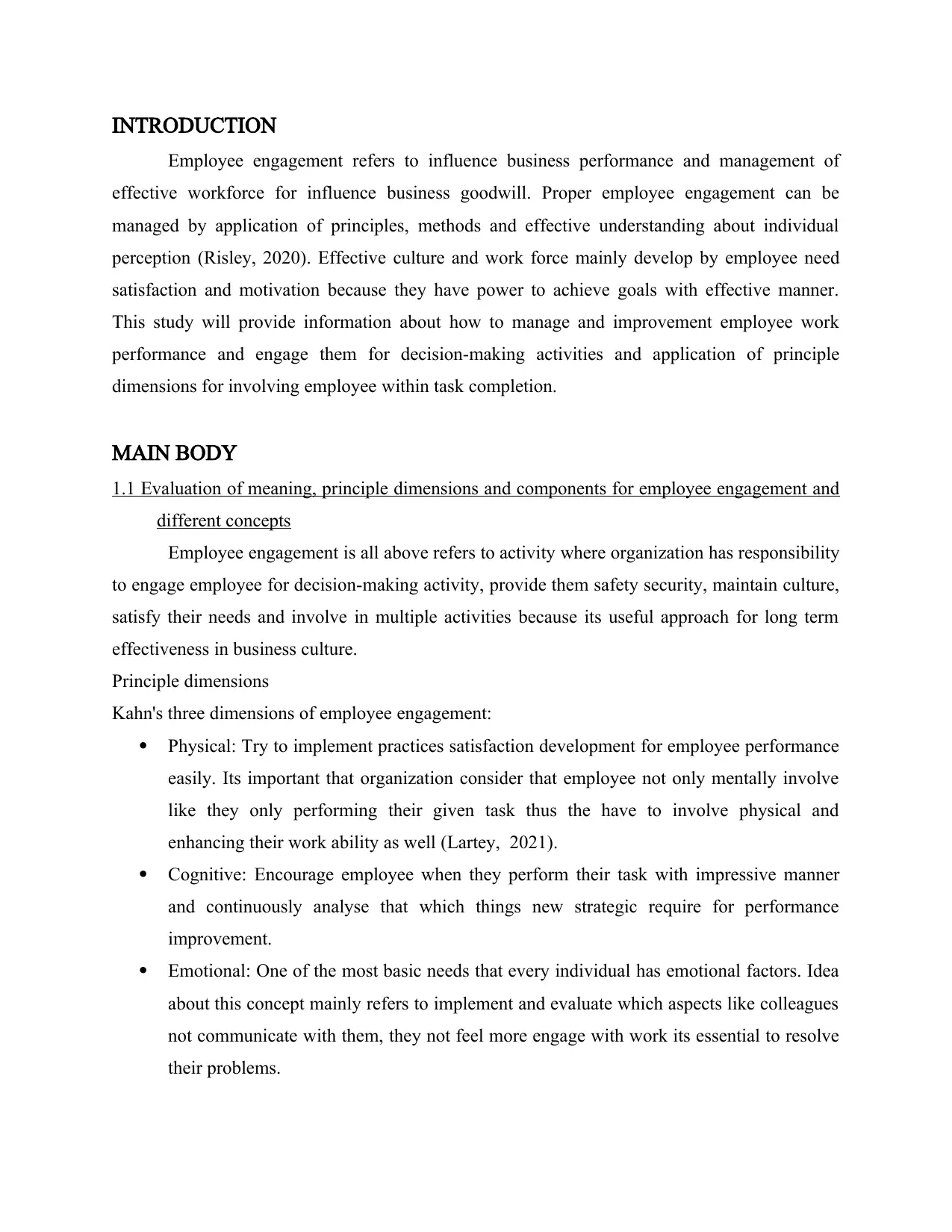
Employee engagement refers to influence business performance and management of
effective workforce for influence business goodwill. Proper employee engagement can be
managed by application of principles, methods and effective understanding about individual
perception (Risley, 2020). Effective culture and work force mainly develop by employee need
satisfaction and motivation because they have power to achieve goals with effective manner.
This study will provide information about how to manage and improvement employee work
performance and engage them for decision-making activities and application of principle
dimensions for involving employee within task completion.
MAIN BODY
1.1 Evaluation of meaning, principle dimensions and components for employee engagement and
different concepts
Employee engagement is all above refers to activity where organization has responsibility
to engage employee for decision-making activity, provide them safety security, maintain culture,
satisfy their needs and involve in multiple activities because its useful approach for long term
effectiveness in business culture.
Principle dimensions
Kahn's three dimensions of employee engagement:
Physical: Try to implement practices satisfaction development for employee performance
easily. Its important that organization consider that employee not only mentally involve
like they only performing their given task thus the have to involve physical and
enhancing their work ability as well (Lartey, 2021).
Cognitive: Encourage employee when they perform their task with impressive manner
and continuously analyse that which things new strategic require for performance
improvement.
Emotional: One of the most basic needs that every individual has emotional factors. Idea
about this concept mainly refers to implement and evaluate which aspects like colleagues
not communicate with them, they not feel more engage with work its essential to resolve
their problems.
Employee engagement refers to influence business performance and management of
effective workforce for influence business goodwill. Proper employee engagement can be
managed by application of principles, methods and effective understanding about individual
perception (Risley, 2020). Effective culture and work force mainly develop by employee need
satisfaction and motivation because they have power to achieve goals with effective manner.
This study will provide information about how to manage and improvement employee work
performance and engage them for decision-making activities and application of principle
dimensions for involving employee within task completion.
MAIN BODY
1.1 Evaluation of meaning, principle dimensions and components for employee engagement and
different concepts
Employee engagement is all above refers to activity where organization has responsibility
to engage employee for decision-making activity, provide them safety security, maintain culture,
satisfy their needs and involve in multiple activities because its useful approach for long term
effectiveness in business culture.
Principle dimensions
Kahn's three dimensions of employee engagement:
Physical: Try to implement practices satisfaction development for employee performance
easily. Its important that organization consider that employee not only mentally involve
like they only performing their given task thus the have to involve physical and
enhancing their work ability as well (Lartey, 2021).
Cognitive: Encourage employee when they perform their task with impressive manner
and continuously analyse that which things new strategic require for performance
improvement.
Emotional: One of the most basic needs that every individual has emotional factors. Idea
about this concept mainly refers to implement and evaluate which aspects like colleagues
not communicate with them, they not feel more engage with work its essential to resolve
their problems.
⊘ This is a preview!⊘
Do you want full access?
Subscribe today to unlock all pages.

Trusted by 1+ million students worldwide
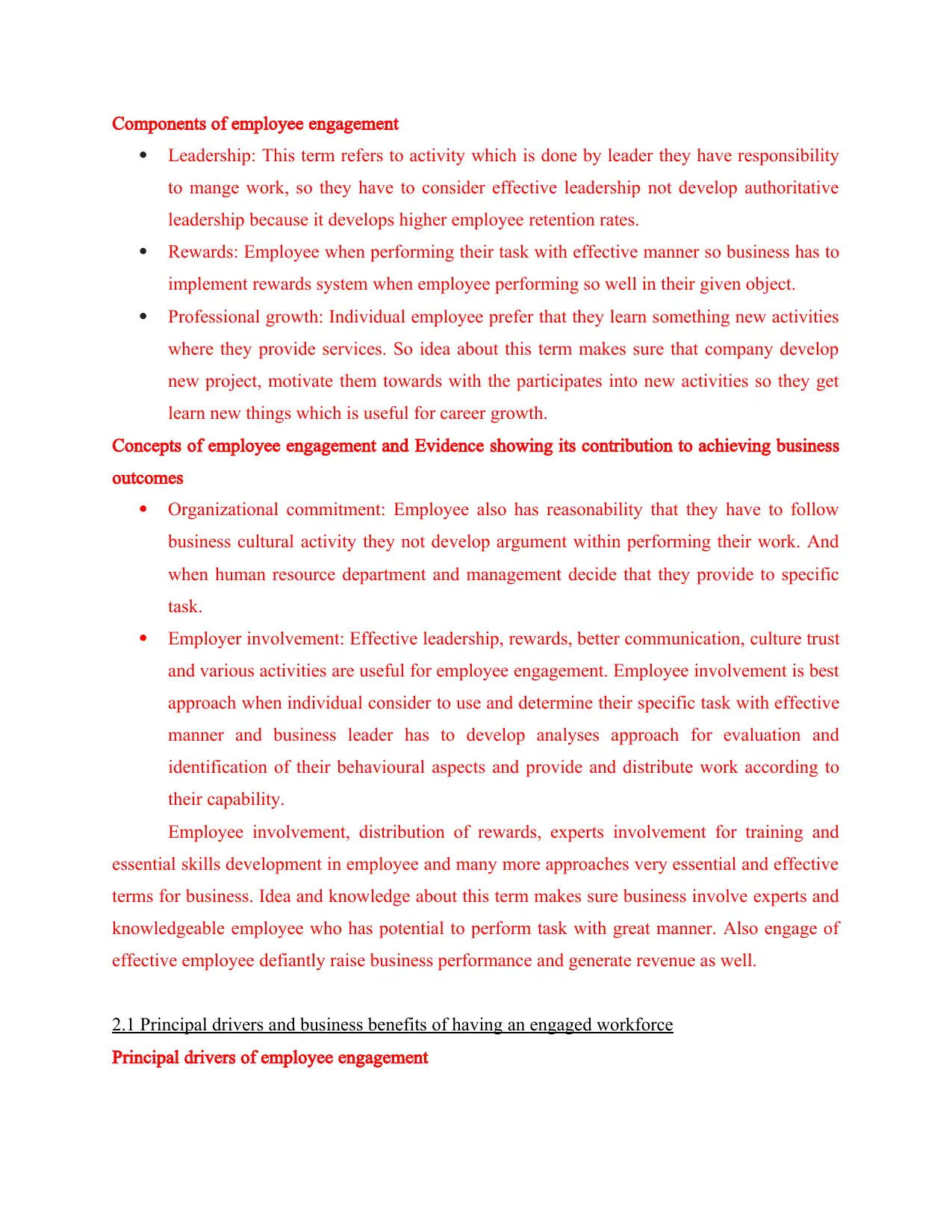
Components of employee engagement
Leadership: This term refers to activity which is done by leader they have responsibility
to mange work, so they have to consider effective leadership not develop authoritative
leadership because it develops higher employee retention rates.
Rewards: Employee when performing their task with effective manner so business has to
implement rewards system when employee performing so well in their given object.
Professional growth: Individual employee prefer that they learn something new activities
where they provide services. So idea about this term makes sure that company develop
new project, motivate them towards with the participates into new activities so they get
learn new things which is useful for career growth.
Concepts of employee engagement and Evidence showing its contribution to achieving business
outcomes
Organizational commitment: Employee also has reasonability that they have to follow
business cultural activity they not develop argument within performing their work. And
when human resource department and management decide that they provide to specific
task.
Employer involvement: Effective leadership, rewards, better communication, culture trust
and various activities are useful for employee engagement. Employee involvement is best
approach when individual consider to use and determine their specific task with effective
manner and business leader has to develop analyses approach for evaluation and
identification of their behavioural aspects and provide and distribute work according to
their capability.
Employee involvement, distribution of rewards, experts involvement for training and
essential skills development in employee and many more approaches very essential and effective
terms for business. Idea and knowledge about this term makes sure business involve experts and
knowledgeable employee who has potential to perform task with great manner. Also engage of
effective employee defiantly raise business performance and generate revenue as well.
2.1 Principal drivers and business benefits of having an engaged workforce
Principal drivers of employee engagement
Leadership: This term refers to activity which is done by leader they have responsibility
to mange work, so they have to consider effective leadership not develop authoritative
leadership because it develops higher employee retention rates.
Rewards: Employee when performing their task with effective manner so business has to
implement rewards system when employee performing so well in their given object.
Professional growth: Individual employee prefer that they learn something new activities
where they provide services. So idea about this term makes sure that company develop
new project, motivate them towards with the participates into new activities so they get
learn new things which is useful for career growth.
Concepts of employee engagement and Evidence showing its contribution to achieving business
outcomes
Organizational commitment: Employee also has reasonability that they have to follow
business cultural activity they not develop argument within performing their work. And
when human resource department and management decide that they provide to specific
task.
Employer involvement: Effective leadership, rewards, better communication, culture trust
and various activities are useful for employee engagement. Employee involvement is best
approach when individual consider to use and determine their specific task with effective
manner and business leader has to develop analyses approach for evaluation and
identification of their behavioural aspects and provide and distribute work according to
their capability.
Employee involvement, distribution of rewards, experts involvement for training and
essential skills development in employee and many more approaches very essential and effective
terms for business. Idea and knowledge about this term makes sure business involve experts and
knowledgeable employee who has potential to perform task with great manner. Also engage of
effective employee defiantly raise business performance and generate revenue as well.
2.1 Principal drivers and business benefits of having an engaged workforce
Principal drivers of employee engagement
Paraphrase This Document
Need a fresh take? Get an instant paraphrase of this document with our AI Paraphraser
Engaging with success: One of the most appropriate and long term useful tool is to engage
employee towards with the project decision-making process, apply their reviews and ideas in
planning and many more. Because its useful for long term success and expansion of employee
attraction towards with the business activities. And one major aspects employee feel more
familiar and connect because they feel that when leader or company managements department
concern they share their view points and application of their view point develop higher
motivation on them as well. Manager and employee coordination is one of the most essential
tools which have power to manage various aspects with great manner.
Evaluate the business benefits for the organisation and different stakeholders
Effective decision-making: Human resource or business management has responsibility to select
right candidates or experts which has proper idea bout factors and specific criteria which require
by organization. Different department experts has proper idea about specific decision-making so
in case business require marketing decision so they do have to engag marketing executive expert
which has proper idea about decision-making in field of marketing.
Cost saving: Engagement of appropriate human resources who has great knowledge in specific
term defiantly reduce cost and it has potential to reduce extra and unwanted expenses with great
manner.
Risk management: Expansion of experts and effective human resources which has great skills
defiantly reduce risk and they do have potential to manage and reduce challenging aspects with
great manner.
Mental and physical well-being: Application of this driver makes higher efficiency because
employee feel more comfortable and when business decision they continuously take reviews
from which factors affects employee behaviour and their performance they can easily explain to
manager or leader for solution development.
Fairness and safety: Stability and fairness development in work culture require consideration of
application of rewards system if they recruit new employee, and they provide information that if
they perform well eh get rewards if the not implement this term I develop higher conflicts.
2.2 Major steps organisation take to create a culture of employee engagement
Create positive intersections: Leader, manager and senior members has to develop impressive
and polite communication when they provide instructions. Its major essential term that individual
employee consider that seniors has position, but they have to use polite conversation so
employee towards with the project decision-making process, apply their reviews and ideas in
planning and many more. Because its useful for long term success and expansion of employee
attraction towards with the business activities. And one major aspects employee feel more
familiar and connect because they feel that when leader or company managements department
concern they share their view points and application of their view point develop higher
motivation on them as well. Manager and employee coordination is one of the most essential
tools which have power to manage various aspects with great manner.
Evaluate the business benefits for the organisation and different stakeholders
Effective decision-making: Human resource or business management has responsibility to select
right candidates or experts which has proper idea bout factors and specific criteria which require
by organization. Different department experts has proper idea about specific decision-making so
in case business require marketing decision so they do have to engag marketing executive expert
which has proper idea about decision-making in field of marketing.
Cost saving: Engagement of appropriate human resources who has great knowledge in specific
term defiantly reduce cost and it has potential to reduce extra and unwanted expenses with great
manner.
Risk management: Expansion of experts and effective human resources which has great skills
defiantly reduce risk and they do have potential to manage and reduce challenging aspects with
great manner.
Mental and physical well-being: Application of this driver makes higher efficiency because
employee feel more comfortable and when business decision they continuously take reviews
from which factors affects employee behaviour and their performance they can easily explain to
manager or leader for solution development.
Fairness and safety: Stability and fairness development in work culture require consideration of
application of rewards system if they recruit new employee, and they provide information that if
they perform well eh get rewards if the not implement this term I develop higher conflicts.
2.2 Major steps organisation take to create a culture of employee engagement
Create positive intersections: Leader, manager and senior members has to develop impressive
and polite communication when they provide instructions. Its major essential term that individual
employee consider that seniors has position, but they have to use polite conversation so
employee can also provide their ideas and reviews. This one is best and effective practice for
employee management.
Create culture of trust: Prepare and develop bond with effective manner and use strategic
approach communication and motivational approach which is very useful for motivation
development in employee, and they feel more effective and employee performance improvement
is best term with good relation and friendly environment development in business. Friendly
environment makes higher effective culture because individual feel that they have potential to
communicate with individual.
1.2 Need for aligning engagement practices with other corporate component
There are number of reasons of aligning engagement practices with corporate components. In
regards to alignment engagement, it can be said that it refers the extent to which employees are
committed with organisation’s mission, vision and objectives by which they can bring energy,
capability and understanding to work each day (Kilbourne and et.al., 2019). It is believed that
when employees are engaged with mission and vision then they are more likely to find value in
their work. In addition, it can also be said that alignment of employees’ engagement with
corporate components like vision and mission make employees smarter and encourage them
towards striving hard and accomplishing goals. Strategic alignment with employees’ engagement
increase knowledge of employees and they have clear idea as what they need to do and how they
need to perform their functions. By engaging with strategies, they find easier in accomplishing
goals and it improves their performance and productivity as well. In addition, it can also be said
that strategic alignment and engagement is the crux of improving relations and performance of
employees and engaging them with goals of companies.
As per the engagement practices, it is important for employees to commit with organisation’s
valued and goals and by doing so, they find easier in meeting goals and contribute in
organizational success (Bouwman, Nikou and de Reuver, 2019). Overall, it can be said that
alignment of engagement practices with other components improves performance and overall
productivity of employees and businesses as well.
2.2 Strategies and steps to create employee engagement
As on the basis of above discussion, it can clearly be said that employment engagement is
important for organisational success but companies are finding difficulties in engaging their
employee management.
Create culture of trust: Prepare and develop bond with effective manner and use strategic
approach communication and motivational approach which is very useful for motivation
development in employee, and they feel more effective and employee performance improvement
is best term with good relation and friendly environment development in business. Friendly
environment makes higher effective culture because individual feel that they have potential to
communicate with individual.
1.2 Need for aligning engagement practices with other corporate component
There are number of reasons of aligning engagement practices with corporate components. In
regards to alignment engagement, it can be said that it refers the extent to which employees are
committed with organisation’s mission, vision and objectives by which they can bring energy,
capability and understanding to work each day (Kilbourne and et.al., 2019). It is believed that
when employees are engaged with mission and vision then they are more likely to find value in
their work. In addition, it can also be said that alignment of employees’ engagement with
corporate components like vision and mission make employees smarter and encourage them
towards striving hard and accomplishing goals. Strategic alignment with employees’ engagement
increase knowledge of employees and they have clear idea as what they need to do and how they
need to perform their functions. By engaging with strategies, they find easier in accomplishing
goals and it improves their performance and productivity as well. In addition, it can also be said
that strategic alignment and engagement is the crux of improving relations and performance of
employees and engaging them with goals of companies.
As per the engagement practices, it is important for employees to commit with organisation’s
valued and goals and by doing so, they find easier in meeting goals and contribute in
organizational success (Bouwman, Nikou and de Reuver, 2019). Overall, it can be said that
alignment of engagement practices with other components improves performance and overall
productivity of employees and businesses as well.
2.2 Strategies and steps to create employee engagement
As on the basis of above discussion, it can clearly be said that employment engagement is
important for organisational success but companies are finding difficulties in engaging their
⊘ This is a preview!⊘
Do you want full access?
Subscribe today to unlock all pages.
Trusted by 1+ million students worldwide
employees with business. There are some strategies that may help businesses in increasing
employees’ engagement such as:
Job design: It refers a document that describes roles and responsibilities of employees. When
employees have clarity as what they are expected to do. It makes easier for them to perform
functions (Daniels and et.al., 2017). The main aim of job designing is to improve coordination,
decrease miscommunication problems and allowing employees to optimise work process
accordingly. So, on this basis, it can be said that employees can be engaged by preparing clear
and effective job design.
Discretionary behaviour: This behaviour can be defined as employees’ behaviour that is not
directly recognised by formal reward system. This behaviour can be improved that can help
employees in performing functions in smooth manner. When employees are being encouraged to
view things in a positive manner then they feel refreshed and energetic. This behaviour makes
them feel valued, motivated and with this behaviour, they find easier in performing functions.
Rewards to employees: It is one of the best techniques by which employers can motivate
employees (Osborne and Hammoud, 2017). When employees are being given financial as well as
non-financial rewards on the basis of their performance then they strive hard. It makes them feel
valued and they are more likely to stay with businesses. Staff retention is directly associated with
staff engagement.
Evaluation of diagnostics tool to measure employee attitude and engagement:
Employee engagement is one of the most important thing for business organization, there
are certain tools to measure employee attitude and engagement such as:
Employee survey: survey are one of the best way to identify the engagement of employee in the
workplace, this an effective tool to measure attitude and behaviour (Garrad and Hyland, 2020).
When the business organization try create survey, they want every employee to actively
participate in the process as this allow business to study their employees and their attitude.
HR tools: in today's digital world, every business organization try to avoid face to face survey as
it take time and affords. They have been using HR tool for the best result, the HR tool means
online platform which help business to conduct employee engagement survey online for
example; when the employee open their profile in office computer, the survey pop up and often
ask employee various questions which engage them to answer.
employees’ engagement such as:
Job design: It refers a document that describes roles and responsibilities of employees. When
employees have clarity as what they are expected to do. It makes easier for them to perform
functions (Daniels and et.al., 2017). The main aim of job designing is to improve coordination,
decrease miscommunication problems and allowing employees to optimise work process
accordingly. So, on this basis, it can be said that employees can be engaged by preparing clear
and effective job design.
Discretionary behaviour: This behaviour can be defined as employees’ behaviour that is not
directly recognised by formal reward system. This behaviour can be improved that can help
employees in performing functions in smooth manner. When employees are being encouraged to
view things in a positive manner then they feel refreshed and energetic. This behaviour makes
them feel valued, motivated and with this behaviour, they find easier in performing functions.
Rewards to employees: It is one of the best techniques by which employers can motivate
employees (Osborne and Hammoud, 2017). When employees are being given financial as well as
non-financial rewards on the basis of their performance then they strive hard. It makes them feel
valued and they are more likely to stay with businesses. Staff retention is directly associated with
staff engagement.
Evaluation of diagnostics tool to measure employee attitude and engagement:
Employee engagement is one of the most important thing for business organization, there
are certain tools to measure employee attitude and engagement such as:
Employee survey: survey are one of the best way to identify the engagement of employee in the
workplace, this an effective tool to measure attitude and behaviour (Garrad and Hyland, 2020).
When the business organization try create survey, they want every employee to actively
participate in the process as this allow business to study their employees and their attitude.
HR tools: in today's digital world, every business organization try to avoid face to face survey as
it take time and affords. They have been using HR tool for the best result, the HR tool means
online platform which help business to conduct employee engagement survey online for
example; when the employee open their profile in office computer, the survey pop up and often
ask employee various questions which engage them to answer.
Paraphrase This Document
Need a fresh take? Get an instant paraphrase of this document with our AI Paraphraser
Social media: social media is one the best way to gather the information about employees
attitude and engagement, here social media means the internal media and communication
platform which a company use to communicate with employees, these internal media understand
the mood and behaviour of employee.
Exit interview: exit interview are more often the best way to understand the engagement but note
this interview is only been done to the best employee and tough questions is been asked. When
the employee feel pressurized to answer such questions, they provide the real level of satisfaction
to the company and later company improve the area where it has been needed.
Employee value proposition:
Employee value proposition means benefits to employee through monetary and non
monetary activities (Mascarenhas, 2019). These benefits are been provided by the business
organization to their employees but these rewards are been provided on the basis of skills,
capabilities and valuable experience of the employee. EVP is the best way to improve the value
and engagement of the employee, a good EVP help organization to promote the engagement of
the employee with basic components such as:
Financial rewards: financial rewards are been provided by the business organization to boost the
performance of the employee. When the business practice to provide rewards, employee feel
value and try to be better at the workplace.
Employee benefits: employee benefits cover health insurance, retire scheme and policies and
various beneficial subscription and membership. Some business organization even provide
holiday trips to their best employees, this help business to create a sense value in the mind of
employees.
Career development: career development plan and training help employee to become more
valuable in the workplace, these trainings and development plan not only help employee to
become more effective but this allows them to learn those skills which are going to be very
beneficial for employee in there career.
Relevant HR strategies to improve level of employee engagement:
HR plays a vital role in increasing employee engagement and value in the workplace,
there are certain HR strategies that help business to build a professional environment to boost the
performance of employee such as;
attitude and engagement, here social media means the internal media and communication
platform which a company use to communicate with employees, these internal media understand
the mood and behaviour of employee.
Exit interview: exit interview are more often the best way to understand the engagement but note
this interview is only been done to the best employee and tough questions is been asked. When
the employee feel pressurized to answer such questions, they provide the real level of satisfaction
to the company and later company improve the area where it has been needed.
Employee value proposition:
Employee value proposition means benefits to employee through monetary and non
monetary activities (Mascarenhas, 2019). These benefits are been provided by the business
organization to their employees but these rewards are been provided on the basis of skills,
capabilities and valuable experience of the employee. EVP is the best way to improve the value
and engagement of the employee, a good EVP help organization to promote the engagement of
the employee with basic components such as:
Financial rewards: financial rewards are been provided by the business organization to boost the
performance of the employee. When the business practice to provide rewards, employee feel
value and try to be better at the workplace.
Employee benefits: employee benefits cover health insurance, retire scheme and policies and
various beneficial subscription and membership. Some business organization even provide
holiday trips to their best employees, this help business to create a sense value in the mind of
employees.
Career development: career development plan and training help employee to become more
valuable in the workplace, these trainings and development plan not only help employee to
become more effective but this allows them to learn those skills which are going to be very
beneficial for employee in there career.
Relevant HR strategies to improve level of employee engagement:
HR plays a vital role in increasing employee engagement and value in the workplace,
there are certain HR strategies that help business to build a professional environment to boost the
performance of employee such as;
communication: communication is one of the most important things in the workplace, effective
communication plays an vital role (Lepak, Jiang and Ployhart, 2017). HR department of the
company try to understand the employee by engaging them in various communication strategies.
Well-being: increasing well-being in the workplace is one of the best practice of HR department,
well-being means helping employee to rise their standard and lifestyle with practising
professionalism in the workplace. Well-being here means engaging employee both, physically
and mentally. Company try to provide physical benefits such as holiday reward whereas mentally
well-being is done by providing support and guidance to the employee.
Empower employee: empowering the right talent at right time means that the business
organization have successfully completed the task of increasing the value of employee in the
workplace. This HR strategies of empowering employee, especially weak one help HR
department to create a sense of support to the employee so that employee should not feel left out.
Recognizing: recognize talent and value of employee is one of the best practice of HR, when the
business try to practice managing the talent, they often place the right talent at right place, this
allows business to segregate and divide employee according to their talent and skills and in result
the productivity of employee tend to increase rapidly and overall boost the growth of the
business organization.
CONCLUSION
It has been summarized form the above reflective study that effective employee
engagement makes higher efficiency in business culture and application of principles dimensions
makes clarity about effective management of workforces. It has been clear that steps for
employee work performance improvement and employee need satisfaction practices is the best
part of employee attraction, and they feel more engage towards with the business activities. From
the overall report study it has been calculated that positive environment, understanding about
employee needs, proper communication, motivation technique methods and various tools
influence work culture efficiency.
communication plays an vital role (Lepak, Jiang and Ployhart, 2017). HR department of the
company try to understand the employee by engaging them in various communication strategies.
Well-being: increasing well-being in the workplace is one of the best practice of HR department,
well-being means helping employee to rise their standard and lifestyle with practising
professionalism in the workplace. Well-being here means engaging employee both, physically
and mentally. Company try to provide physical benefits such as holiday reward whereas mentally
well-being is done by providing support and guidance to the employee.
Empower employee: empowering the right talent at right time means that the business
organization have successfully completed the task of increasing the value of employee in the
workplace. This HR strategies of empowering employee, especially weak one help HR
department to create a sense of support to the employee so that employee should not feel left out.
Recognizing: recognize talent and value of employee is one of the best practice of HR, when the
business try to practice managing the talent, they often place the right talent at right place, this
allows business to segregate and divide employee according to their talent and skills and in result
the productivity of employee tend to increase rapidly and overall boost the growth of the
business organization.
CONCLUSION
It has been summarized form the above reflective study that effective employee
engagement makes higher efficiency in business culture and application of principles dimensions
makes clarity about effective management of workforces. It has been clear that steps for
employee work performance improvement and employee need satisfaction practices is the best
part of employee attraction, and they feel more engage towards with the business activities. From
the overall report study it has been calculated that positive environment, understanding about
employee needs, proper communication, motivation technique methods and various tools
influence work culture efficiency.
⊘ This is a preview!⊘
Do you want full access?
Subscribe today to unlock all pages.
Trusted by 1+ million students worldwide
REFERENCES
Books and Journals
Lartey, F.M., 2021. Impact of career Planning, employee autonomy, and manager recognition on
employee engagement. Journal of Human Resource and Sustainability Studies. 9(02).
p.135.
Risley, C., 2020. Maintaining performance and employee engagement during the COVID-19
pandemic. Journal of Library Administration. 60(6). pp.653-659.
Bouwman, H., Nikou, S. and de Reuver, M., 2019. Digitalization, business models, and SMEs:
How do business model innovation practices improve performance of digitalizing
SMEs?. Telecommunications Policy. 43(9). p.101828.
Daniels, K. and et.al., 2017. Job design, employment practices and well-being: A systematic
review of intervention studies. Ergonomics. 60(9). pp.1177-1196.
Kilbourne, A.M. and et.al., 2019. Quality enhancement research initiative implementation
roadmap: toward sustainability of evidence-based practices in a learning health
system. Medical care. 57(10 Suppl 3). p.S286.
Osborne, S. and Hammoud, M.S., 2017. Effective employee engagement in the workplace. International
Journal of Applied Management and Technology. 16(1). p.4.
Garrad, L.K. and Hyland, P.K., 2020. Employee Survey Research. Employee surveys and sensing:
Challenges and opportunities. p.374.
Mascarenhas, B.G., 2019. Employer branding, employee value proposition, and employee experience:
New approaches for people management in organizations. In Strategic Employee
Communication (pp. 97-103). Palgrave Macmillan, Cham.
Lepak, D., Jiang, K. and Ployhart, R.E., 2017. Hr strategy, structure and architecture. In A research
agenda for human resource management. Edward Elgar Publishing.
Books and Journals
Lartey, F.M., 2021. Impact of career Planning, employee autonomy, and manager recognition on
employee engagement. Journal of Human Resource and Sustainability Studies. 9(02).
p.135.
Risley, C., 2020. Maintaining performance and employee engagement during the COVID-19
pandemic. Journal of Library Administration. 60(6). pp.653-659.
Bouwman, H., Nikou, S. and de Reuver, M., 2019. Digitalization, business models, and SMEs:
How do business model innovation practices improve performance of digitalizing
SMEs?. Telecommunications Policy. 43(9). p.101828.
Daniels, K. and et.al., 2017. Job design, employment practices and well-being: A systematic
review of intervention studies. Ergonomics. 60(9). pp.1177-1196.
Kilbourne, A.M. and et.al., 2019. Quality enhancement research initiative implementation
roadmap: toward sustainability of evidence-based practices in a learning health
system. Medical care. 57(10 Suppl 3). p.S286.
Osborne, S. and Hammoud, M.S., 2017. Effective employee engagement in the workplace. International
Journal of Applied Management and Technology. 16(1). p.4.
Garrad, L.K. and Hyland, P.K., 2020. Employee Survey Research. Employee surveys and sensing:
Challenges and opportunities. p.374.
Mascarenhas, B.G., 2019. Employer branding, employee value proposition, and employee experience:
New approaches for people management in organizations. In Strategic Employee
Communication (pp. 97-103). Palgrave Macmillan, Cham.
Lepak, D., Jiang, K. and Ployhart, R.E., 2017. Hr strategy, structure and architecture. In A research
agenda for human resource management. Edward Elgar Publishing.

1 out of 10


Related Documents


Your All-in-One AI-Powered Toolkit for Academic Success.
+13062052269
info@desklib.com
Available 24*7 on WhatsApp / Email
![[object Object]](/_next/static/media/star-bottom.7253800d.svg)
Unlock your academic potential
Copyright © 2020–2025 A2Z Services. All Rights Reserved. Developed and managed by ZUCOL.