QUT HLN707: Exercise's Role in Adult Diabetes - A Literature Review
VerifiedAdded on 2023/06/04
|11
|2202
|315
Literature Review
AI Summary
This literature review investigates the correlation between exercise and diabetes management in adults, addressing how exercise helps in reducing and controlling type 2 diabetes. Using a qualitative approach with the PRISMA revision model, the review analyzes various journals and sources to establish that consistent exercise helps regulate glucose levels, enhances insulin effectiveness, and prevents long-term complications associated with diabetes. It also highlights the psychological benefits of exercise, such as stress management and improved mood, which are crucial for diabetic individuals. The review concludes that there is a significant correlation between exercise and the reduction and control of diabetes in adults, emphasizing the importance of incorporating exercise routines into diabetes management strategies. Desklib provides students access to similar solved assignments and resources.
Running head: Literature Review 1
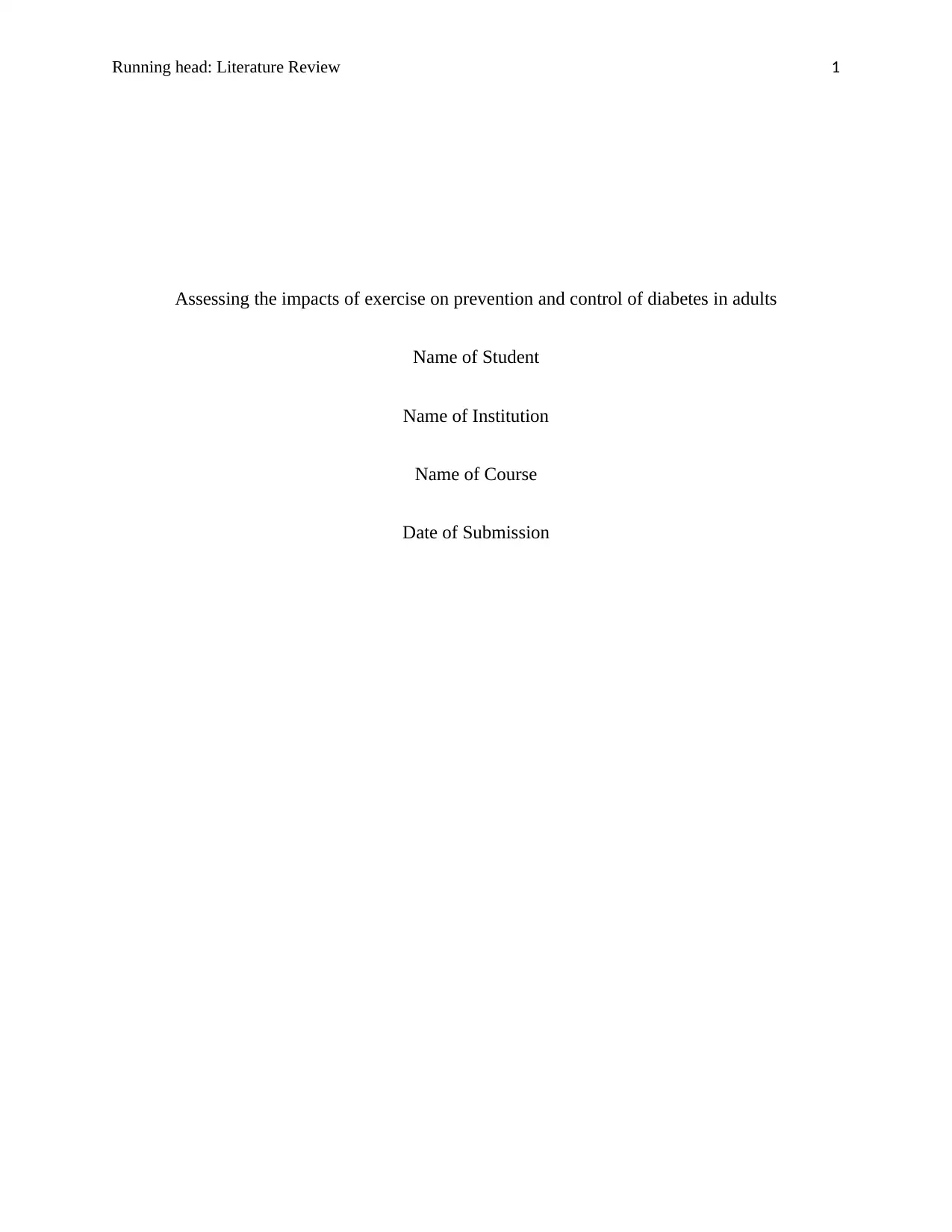
Assessing the impacts of exercise on prevention and control of diabetes in adults
Name of Student
Name of Institution
Name of Course
Date of Submission
Assessing the impacts of exercise on prevention and control of diabetes in adults
Name of Student
Name of Institution
Name of Course
Date of Submission

Paraphrase This Document
Need a fresh take? Get an instant paraphrase of this document with our AI Paraphraser
Literature Review 2
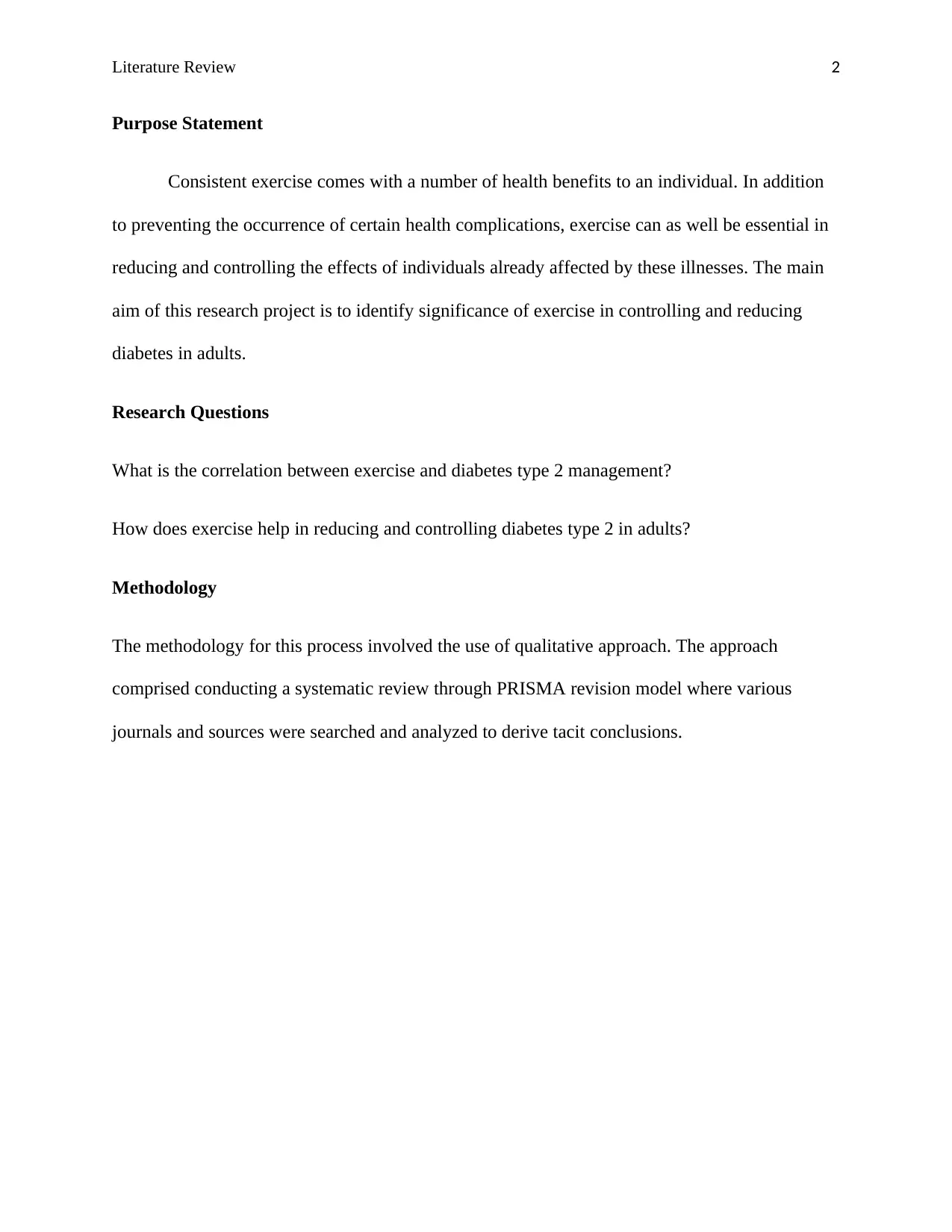
Purpose Statement
Consistent exercise comes with a number of health benefits to an individual. In addition
to preventing the occurrence of certain health complications, exercise can as well be essential in
reducing and controlling the effects of individuals already affected by these illnesses. The main
aim of this research project is to identify significance of exercise in controlling and reducing
diabetes in adults.
Research Questions
What is the correlation between exercise and diabetes type 2 management?
How does exercise help in reducing and controlling diabetes type 2 in adults?
Methodology
The methodology for this process involved the use of qualitative approach. The approach
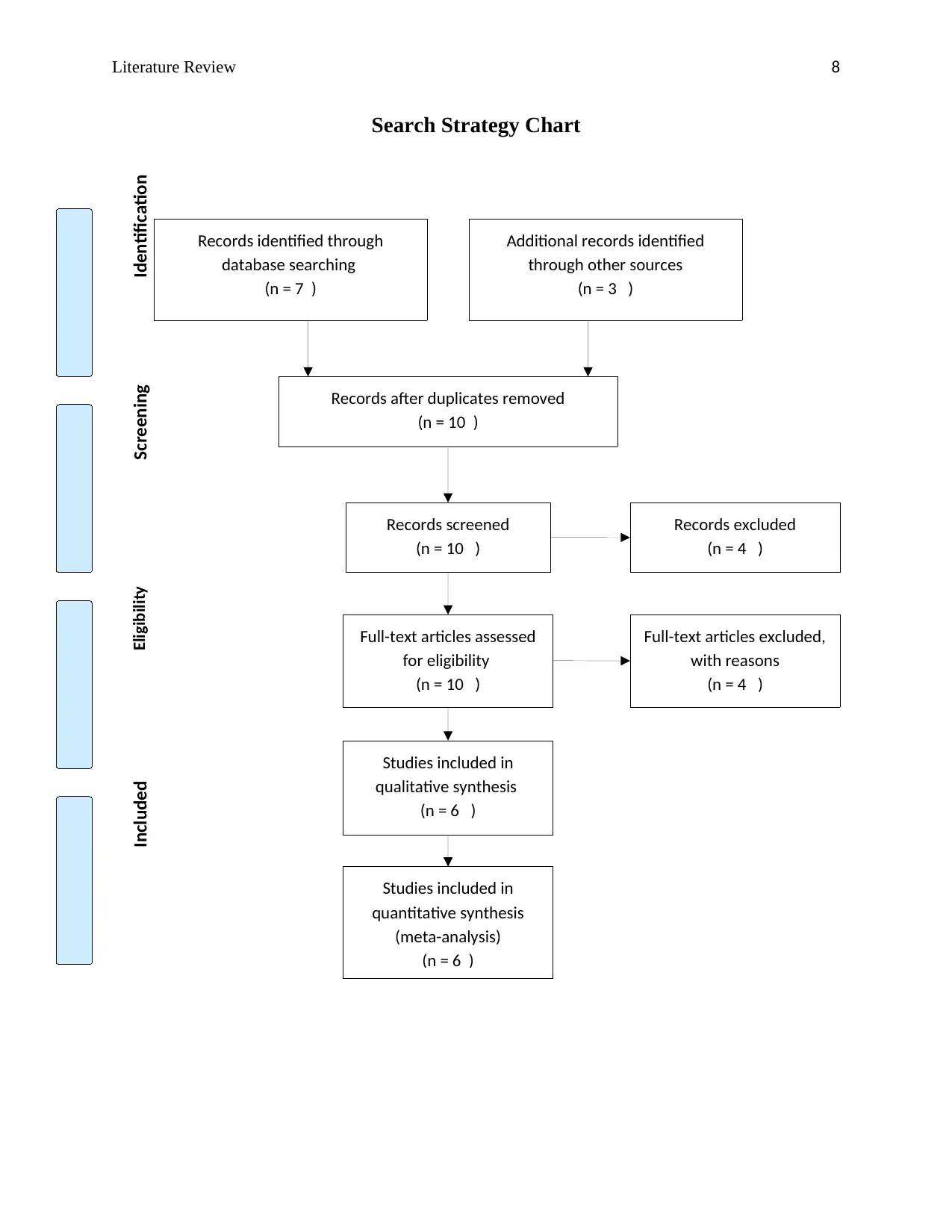
comprised conducting a systematic review through PRISMA revision model where various
journals and sources were searched and analyzed to derive tacit conclusions.
Purpose Statement
Consistent exercise comes with a number of health benefits to an individual. In addition
to preventing the occurrence of certain health complications, exercise can as well be essential in
reducing and controlling the effects of individuals already affected by these illnesses. The main
aim of this research project is to identify significance of exercise in controlling and reducing
diabetes in adults.
Research Questions
What is the correlation between exercise and diabetes type 2 management?
How does exercise help in reducing and controlling diabetes type 2 in adults?
Methodology
The methodology for this process involved the use of qualitative approach. The approach
comprised conducting a systematic review through PRISMA revision model where various
journals and sources were searched and analyzed to derive tacit conclusions.
Literature Review 3
Literature Review
Introduction
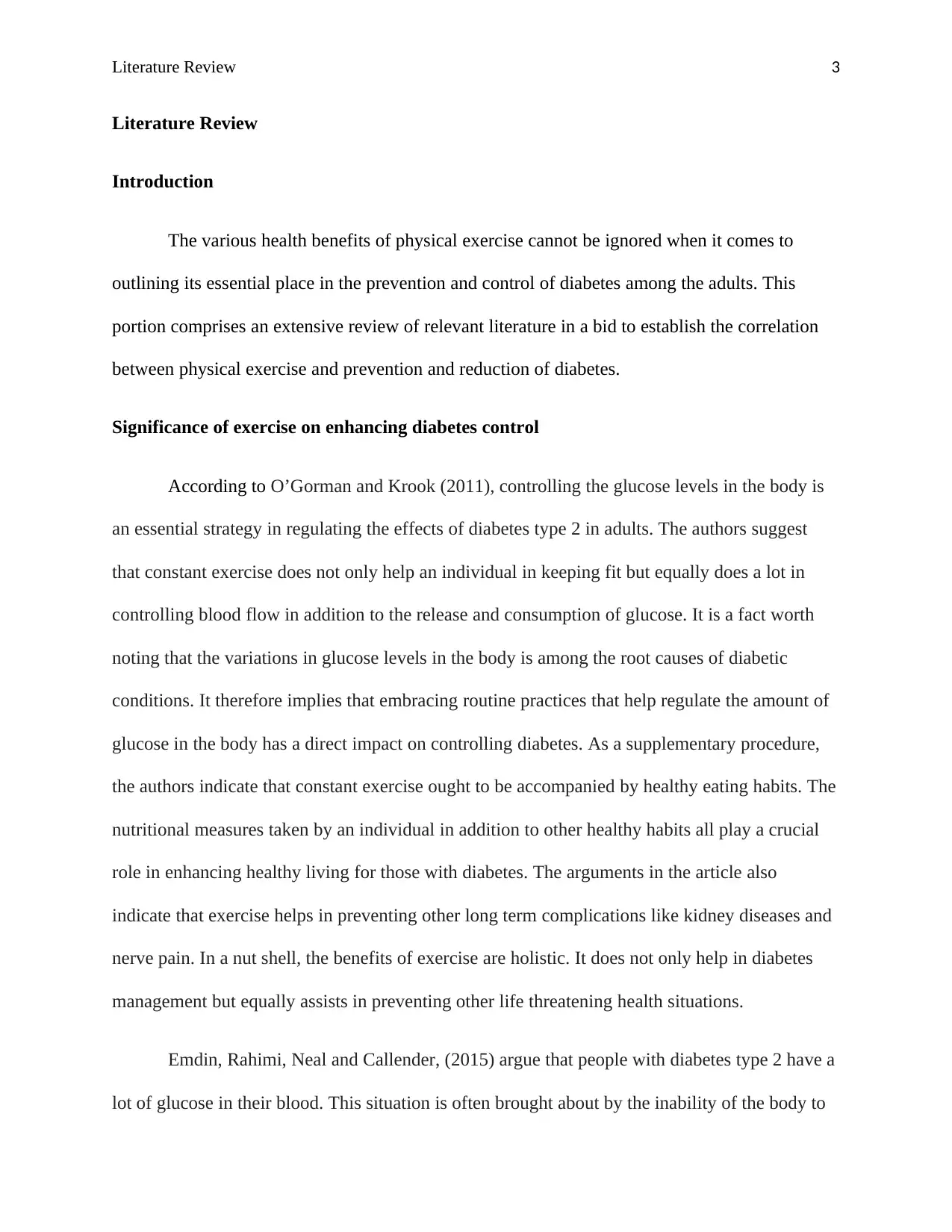
The various health benefits of physical exercise cannot be ignored when it comes to
outlining its essential place in the prevention and control of diabetes among the adults. This
portion comprises an extensive review of relevant literature in a bid to establish the correlation
between physical exercise and prevention and reduction of diabetes.
Significance of exercise on enhancing diabetes control
According to O’Gorman and Krook (2011), controlling the glucose levels in the body is
an essential strategy in regulating the effects of diabetes type 2 in adults. The authors suggest
that constant exercise does not only help an individual in keeping fit but equally does a lot in
controlling blood flow in addition to the release and consumption of glucose. It is a fact worth
noting that the variations in glucose levels in the body is among the root causes of diabetic
conditions. It therefore implies that embracing routine practices that help regulate the amount of
glucose in the body has a direct impact on controlling diabetes. As a supplementary procedure,
the authors indicate that constant exercise ought to be accompanied by healthy eating habits. The
nutritional measures taken by an individual in addition to other healthy habits all play a crucial
role in enhancing healthy living for those with diabetes. The arguments in the article also
indicate that exercise helps in preventing other long term complications like kidney diseases and
nerve pain. In a nut shell, the benefits of exercise are holistic. It does not only help in diabetes
management but equally assists in preventing other life threatening health situations.
Emdin, Rahimi, Neal and Callender, (2015) argue that people with diabetes type 2 have a
lot of glucose in their blood. This situation is often brought about by the inability of the body to
Literature Review
Introduction
The various health benefits of physical exercise cannot be ignored when it comes to
outlining its essential place in the prevention and control of diabetes among the adults. This
portion comprises an extensive review of relevant literature in a bid to establish the correlation
between physical exercise and prevention and reduction of diabetes.
Significance of exercise on enhancing diabetes control
According to O’Gorman and Krook (2011), controlling the glucose levels in the body is
an essential strategy in regulating the effects of diabetes type 2 in adults. The authors suggest
that constant exercise does not only help an individual in keeping fit but equally does a lot in
controlling blood flow in addition to the release and consumption of glucose. It is a fact worth
noting that the variations in glucose levels in the body is among the root causes of diabetic
conditions. It therefore implies that embracing routine practices that help regulate the amount of
glucose in the body has a direct impact on controlling diabetes. As a supplementary procedure,
the authors indicate that constant exercise ought to be accompanied by healthy eating habits. The
nutritional measures taken by an individual in addition to other healthy habits all play a crucial
role in enhancing healthy living for those with diabetes. The arguments in the article also
indicate that exercise helps in preventing other long term complications like kidney diseases and
nerve pain. In a nut shell, the benefits of exercise are holistic. It does not only help in diabetes
management but equally assists in preventing other life threatening health situations.
Emdin, Rahimi, Neal and Callender, (2015) argue that people with diabetes type 2 have a
lot of glucose in their blood. This situation is often brought about by the inability of the body to
⊘ This is a preview!⊘
Do you want full access?
Subscribe today to unlock all pages.

Trusted by 1+ million students worldwide
Literature Review 4
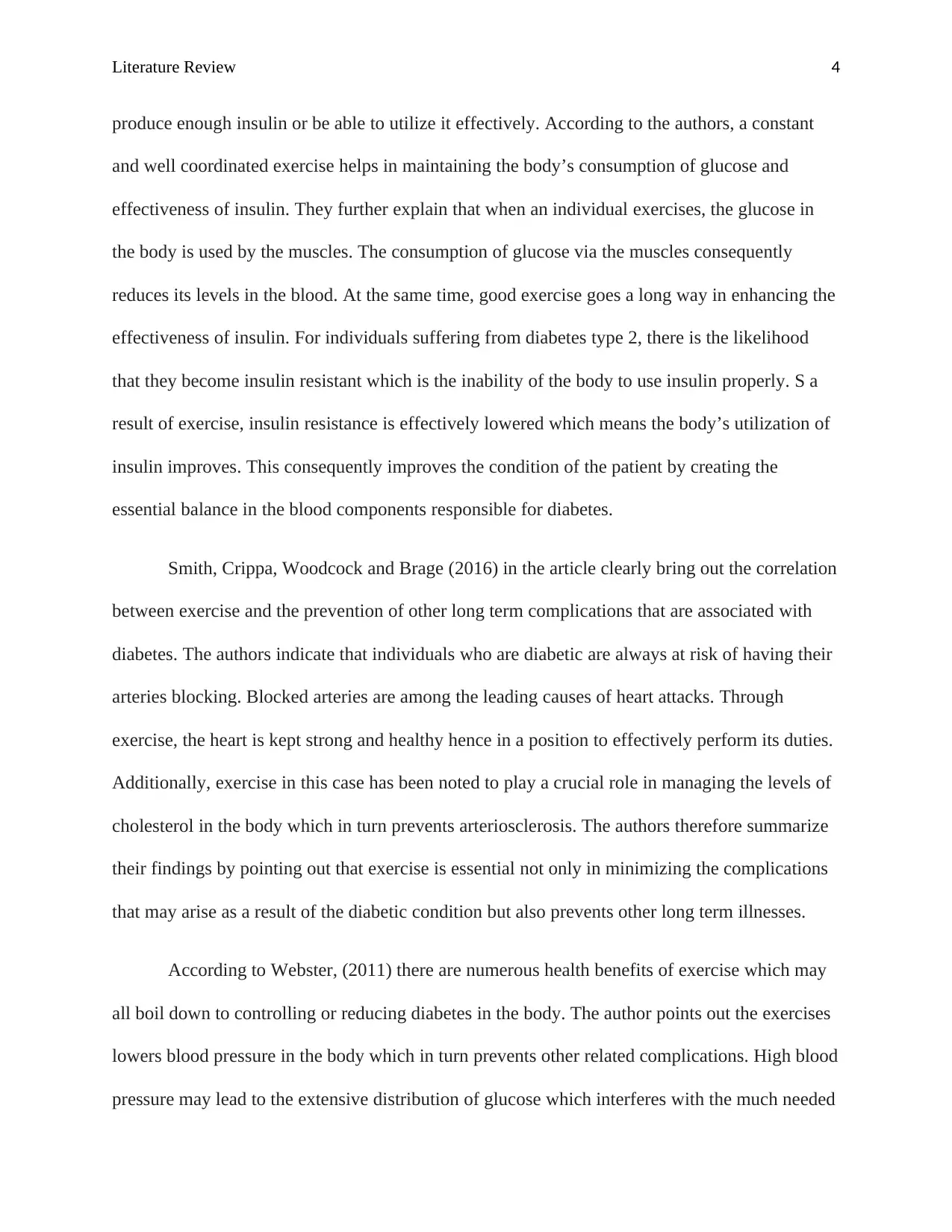
produce enough insulin or be able to utilize it effectively. According to the authors, a constant
and well coordinated exercise helps in maintaining the body’s consumption of glucose and
effectiveness of insulin. They further explain that when an individual exercises, the glucose in
the body is used by the muscles. The consumption of glucose via the muscles consequently
reduces its levels in the blood. At the same time, good exercise goes a long way in enhancing the
effectiveness of insulin. For individuals suffering from diabetes type 2, there is the likelihood
that they become insulin resistant which is the inability of the body to use insulin properly. S a
result of exercise, insulin resistance is effectively lowered which means the body’s utilization of
insulin improves. This consequently improves the condition of the patient by creating the
essential balance in the blood components responsible for diabetes.
Smith, Crippa, Woodcock and Brage (2016) in the article clearly bring out the correlation
between exercise and the prevention of other long term complications that are associated with
diabetes. The authors indicate that individuals who are diabetic are always at risk of having their
arteries blocking. Blocked arteries are among the leading causes of heart attacks. Through
exercise, the heart is kept strong and healthy hence in a position to effectively perform its duties.
Additionally, exercise in this case has been noted to play a crucial role in managing the levels of
cholesterol in the body which in turn prevents arteriosclerosis. The authors therefore summarize
their findings by pointing out that exercise is essential not only in minimizing the complications
that may arise as a result of the diabetic condition but also prevents other long term illnesses.
According to Webster, (2011) there are numerous health benefits of exercise which may
all boil down to controlling or reducing diabetes in the body. The author points out the exercises
lowers blood pressure in the body which in turn prevents other related complications. High blood
pressure may lead to the extensive distribution of glucose which interferes with the much needed
produce enough insulin or be able to utilize it effectively. According to the authors, a constant
and well coordinated exercise helps in maintaining the body’s consumption of glucose and
effectiveness of insulin. They further explain that when an individual exercises, the glucose in
the body is used by the muscles. The consumption of glucose via the muscles consequently
reduces its levels in the blood. At the same time, good exercise goes a long way in enhancing the
effectiveness of insulin. For individuals suffering from diabetes type 2, there is the likelihood
that they become insulin resistant which is the inability of the body to use insulin properly. S a
result of exercise, insulin resistance is effectively lowered which means the body’s utilization of
insulin improves. This consequently improves the condition of the patient by creating the
essential balance in the blood components responsible for diabetes.
Smith, Crippa, Woodcock and Brage (2016) in the article clearly bring out the correlation
between exercise and the prevention of other long term complications that are associated with
diabetes. The authors indicate that individuals who are diabetic are always at risk of having their
arteries blocking. Blocked arteries are among the leading causes of heart attacks. Through
exercise, the heart is kept strong and healthy hence in a position to effectively perform its duties.
Additionally, exercise in this case has been noted to play a crucial role in managing the levels of
cholesterol in the body which in turn prevents arteriosclerosis. The authors therefore summarize
their findings by pointing out that exercise is essential not only in minimizing the complications
that may arise as a result of the diabetic condition but also prevents other long term illnesses.
According to Webster, (2011) there are numerous health benefits of exercise which may
all boil down to controlling or reducing diabetes in the body. The author points out the exercises
lowers blood pressure in the body which in turn prevents other related complications. High blood
pressure may lead to the extensive distribution of glucose which interferes with the much needed
Paraphrase This Document
Need a fresh take? Get an instant paraphrase of this document with our AI Paraphraser
Literature Review 5
balance for diabetic conditions. Exercise also enhances better cholesterol levels in addition to
maintaining the right body weight. Research reveals that individuals with diabetes are prone to
other health conditions like heart attack. It therefore implies that a diabetic individual ought to
remain committed to exercise routines to watch their weight and cholesterol levels and
eventually prevent the occurrence of other related complications.
As noted by Colberg, S. R. (2017), individuals suffering from diabetes just like any other
patient deserve the right experiences. The psychological pain that come with such conditions
may be detrimental if the right measures are not put in place. Through positive life activities and
experiences, the patients are able to maintain a longer and healthy lifestyle. The author suggests
exercise as one of the platforms that a diabetic individual can use to release the stresses related to
illnesses. According to the author, good exercise does not only help in promoting the mood of an
individual but also allows them to have better sleep. An improved mood increases an
individual’s positive approach towards life and specifically the challenges that may be associated
with diabetes. At the same time, enough rest is essential for the effective functioning of the body.
Each of these aspects has a pivotal role in improving the experiences for individuals with
diabetes.
Hamasaki (2016) outlines the various strategies that an individual can put in place to
ensure healthy control measures against diabetes. While pointing out the vital place of exercise
in diabetes reduction and control, the author is keen on highlighting a step by step strategy on
what an individual ought to do. It is important to start the exercise slowly and gradually increase
the rate as the body gets used to the new norm. This idea is necessary especially for the
individuals who are just starting their exercise routines. The author also intimates the need for
frequent uptake of water hydrates the body. Taking a lot of water before and after the exercise
balance for diabetic conditions. Exercise also enhances better cholesterol levels in addition to
maintaining the right body weight. Research reveals that individuals with diabetes are prone to
other health conditions like heart attack. It therefore implies that a diabetic individual ought to
remain committed to exercise routines to watch their weight and cholesterol levels and
eventually prevent the occurrence of other related complications.
As noted by Colberg, S. R. (2017), individuals suffering from diabetes just like any other
patient deserve the right experiences. The psychological pain that come with such conditions
may be detrimental if the right measures are not put in place. Through positive life activities and
experiences, the patients are able to maintain a longer and healthy lifestyle. The author suggests
exercise as one of the platforms that a diabetic individual can use to release the stresses related to
illnesses. According to the author, good exercise does not only help in promoting the mood of an
individual but also allows them to have better sleep. An improved mood increases an
individual’s positive approach towards life and specifically the challenges that may be associated
with diabetes. At the same time, enough rest is essential for the effective functioning of the body.
Each of these aspects has a pivotal role in improving the experiences for individuals with
diabetes.
Hamasaki (2016) outlines the various strategies that an individual can put in place to
ensure healthy control measures against diabetes. While pointing out the vital place of exercise
in diabetes reduction and control, the author is keen on highlighting a step by step strategy on
what an individual ought to do. It is important to start the exercise slowly and gradually increase
the rate as the body gets used to the new norm. This idea is necessary especially for the
individuals who are just starting their exercise routines. The author also intimates the need for
frequent uptake of water hydrates the body. Taking a lot of water before and after the exercise
Literature Review 6
does a lot in maintaining the right balance within body especially due to the fact that exercises
drain an individual. The need to test your glucose levels before and after the exercise is also
suggested here as a measure to ascertain the safety of the glucose levels. This can be efficiently
done using a glucose meter. In addition to the exercise strategies, various types of exercises are
also suggested hence an individual is able to pick on a routine that fits well with their lifestyle
and schedule. One of the exercise types suggested in this case is walking, jogging or running.
These types depend on an individual’s body size and other health conditions. For instance, the
heavier individuals are advised to embrace light exercises such as walks and smalls jogs. These
trends can then be adjusted depending on the body’s response to the new schedule. The author
additionally suggests taking part in sports which may include; tennis, basketball, swimming and
biking just to mention but few.
Conclusion
The literature review above has revealed various advantages of exercise. Based on the
research objective, the review has been essential in bringing out the relationship between proper
exercise and control of diabetes. From the review, it is possible to deduce a few main points.
First of all, exercise helps in controlling the level of glucose in the body which is one of the
elements that cause diabetes. Secondly, exercise helps in lowering insulin resistance hence
improving the way in which the body uses insulin. The third crucial point is the fact that exercise
aids in stress management, enhances good sleep and improves moods each of which positive
impacts have on diabetic individuals. Based on the synthesis above we can extract a hypothesis
that there is a correlation between exercise and reduction and control of diabetes in adults.
does a lot in maintaining the right balance within body especially due to the fact that exercises
drain an individual. The need to test your glucose levels before and after the exercise is also
suggested here as a measure to ascertain the safety of the glucose levels. This can be efficiently
done using a glucose meter. In addition to the exercise strategies, various types of exercises are
also suggested hence an individual is able to pick on a routine that fits well with their lifestyle
and schedule. One of the exercise types suggested in this case is walking, jogging or running.
These types depend on an individual’s body size and other health conditions. For instance, the
heavier individuals are advised to embrace light exercises such as walks and smalls jogs. These
trends can then be adjusted depending on the body’s response to the new schedule. The author
additionally suggests taking part in sports which may include; tennis, basketball, swimming and
biking just to mention but few.
Conclusion
The literature review above has revealed various advantages of exercise. Based on the
research objective, the review has been essential in bringing out the relationship between proper
exercise and control of diabetes. From the review, it is possible to deduce a few main points.
First of all, exercise helps in controlling the level of glucose in the body which is one of the
elements that cause diabetes. Secondly, exercise helps in lowering insulin resistance hence
improving the way in which the body uses insulin. The third crucial point is the fact that exercise
aids in stress management, enhances good sleep and improves moods each of which positive
impacts have on diabetic individuals. Based on the synthesis above we can extract a hypothesis
that there is a correlation between exercise and reduction and control of diabetes in adults.
⊘ This is a preview!⊘
Do you want full access?
Subscribe today to unlock all pages.
Trusted by 1+ million students worldwide
Literature Review 7
References
Colberg, S. (2017). Key Points from the Updated Guidelines on Exercise and Diabetes. Frontiers
in Endocrinology, 8, 33.
O'Gorman, D. & Krook, A. (2011). Exercise and the treatment of diabetes and
obesity. Medical Clinics of North America. 95 (5), pp. 953–69.
Emdin, C., Rahimi, K., Neal, B. & Callender, T. (2015). Blood pressure lowering in type 2
diabetes: a systematic review and meta-analysis. The Journal of the American Medical
Association. 313 (6), pp. 603–15.
Hamasaki, H. (2016). Daily physical activity and type 2 diabetes: A review. World Journal of
Diabetes, 7(12), pp. 243–251.
Smith, A., Crippa, A., Woodcock, J. & Brage, S. (2016). Physical activity and incident type 2
diabetes mellitus: a systematic review and dose-response meta-analysis of prospective
cohort studies. Diabetologia. 59 (12), pp. 2527–45.
Webster, M. (2011). Clinical practice and implications of recent diabetes trials. Current
Opinion in Cardiology. 26 (4): 288–93.
References
Colberg, S. (2017). Key Points from the Updated Guidelines on Exercise and Diabetes. Frontiers
in Endocrinology, 8, 33.
O'Gorman, D. & Krook, A. (2011). Exercise and the treatment of diabetes and
obesity. Medical Clinics of North America. 95 (5), pp. 953–69.
Emdin, C., Rahimi, K., Neal, B. & Callender, T. (2015). Blood pressure lowering in type 2
diabetes: a systematic review and meta-analysis. The Journal of the American Medical
Association. 313 (6), pp. 603–15.
Hamasaki, H. (2016). Daily physical activity and type 2 diabetes: A review. World Journal of
Diabetes, 7(12), pp. 243–251.
Smith, A., Crippa, A., Woodcock, J. & Brage, S. (2016). Physical activity and incident type 2
diabetes mellitus: a systematic review and dose-response meta-analysis of prospective
cohort studies. Diabetologia. 59 (12), pp. 2527–45.
Webster, M. (2011). Clinical practice and implications of recent diabetes trials. Current
Opinion in Cardiology. 26 (4): 288–93.
Paraphrase This Document
Need a fresh take? Get an instant paraphrase of this document with our AI Paraphraser
Literature Review 8
Search Strategy Chart
Records identified through
database searching
(n = 7 )
ScreeningIncluded Eligibility Identification
Additional records identified
through other sources
(n = 3 )
Records after duplicates removed
(n = 10 )
Records screened
(n = 10 )
Records excluded
(n = 4 )
Full-text articles assessed
for eligibility
(n = 10 )
Full-text articles excluded,
with reasons
(n = 4 )
Studies included in
qualitative synthesis
(n = 6 )
Studies included in
quantitative synthesis
(meta-analysis)
(n = 6 )
Search Strategy Chart
Records identified through
database searching
(n = 7 )
ScreeningIncluded Eligibility Identification
Additional records identified
through other sources
(n = 3 )
Records after duplicates removed
(n = 10 )
Records screened
(n = 10 )
Records excluded
(n = 4 )
Full-text articles assessed
for eligibility
(n = 10 )
Full-text articles excluded,
with reasons
(n = 4 )
Studies included in
qualitative synthesis
(n = 6 )
Studies included in
quantitative synthesis
(meta-analysis)
(n = 6 )
Literature Review 9
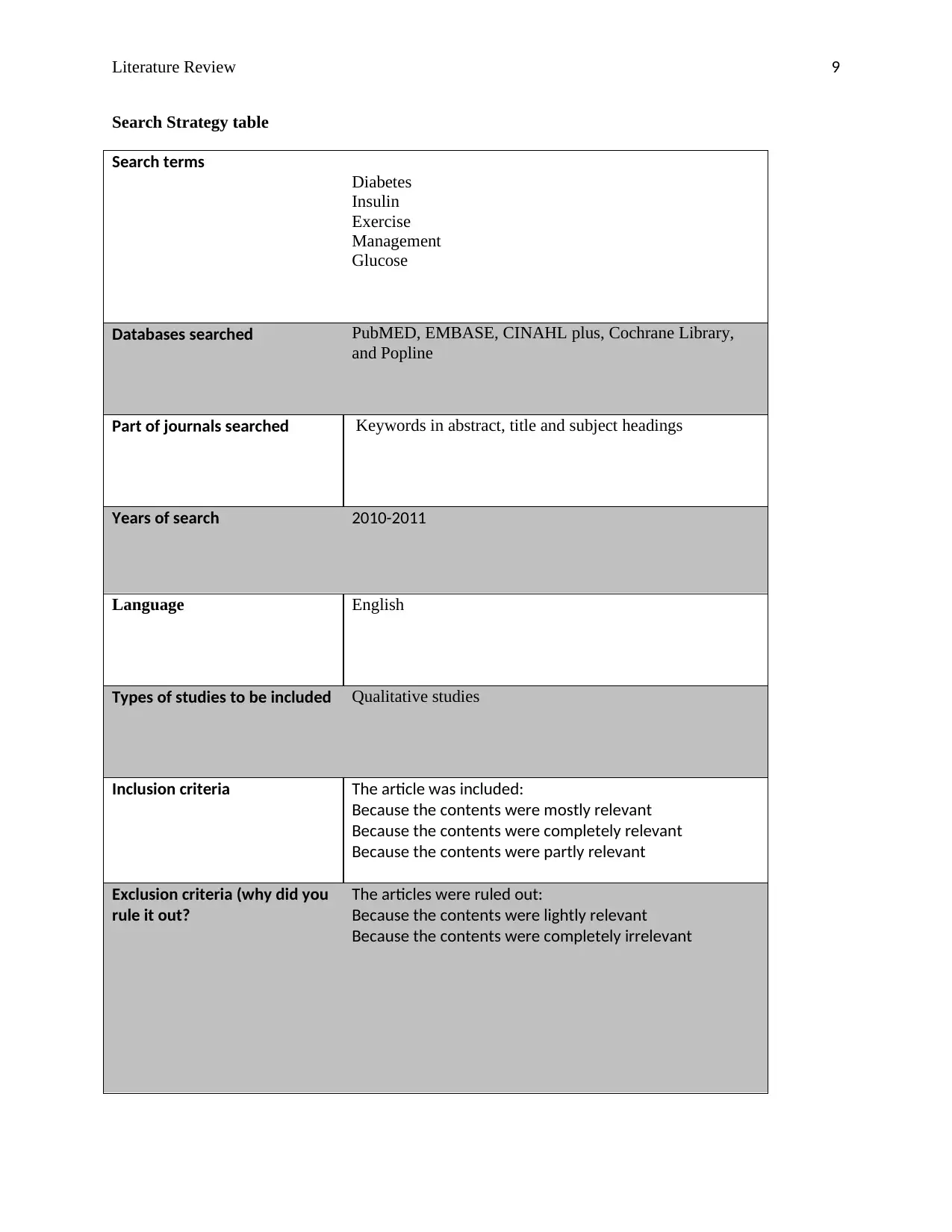
Search Strategy table
Search terms
Diabetes
Insulin
Exercise
Management
Glucose
Databases searched PubMED, EMBASE, CINAHL plus, Cochrane Library,
and Popline
Part of journals searched Keywords in abstract, title and subject headings
Years of search 2010-2011
Language English
Types of studies to be included Qualitative studies
Inclusion criteria The article was included:
Because the contents were mostly relevant
Because the contents were completely relevant
Because the contents were partly relevant
Exclusion criteria (why did you
rule it out?
The articles were ruled out:
Because the contents were lightly relevant
Because the contents were completely irrelevant
Search Strategy table
Search terms
Diabetes
Insulin
Exercise
Management
Glucose
Databases searched PubMED, EMBASE, CINAHL plus, Cochrane Library,
and Popline
Part of journals searched Keywords in abstract, title and subject headings
Years of search 2010-2011
Language English
Types of studies to be included Qualitative studies
Inclusion criteria The article was included:
Because the contents were mostly relevant
Because the contents were completely relevant
Because the contents were partly relevant
Exclusion criteria (why did you
rule it out?
The articles were ruled out:
Because the contents were lightly relevant
Because the contents were completely irrelevant
⊘ This is a preview!⊘
Do you want full access?
Subscribe today to unlock all pages.
Trusted by 1+ million students worldwide
Literature Review 10
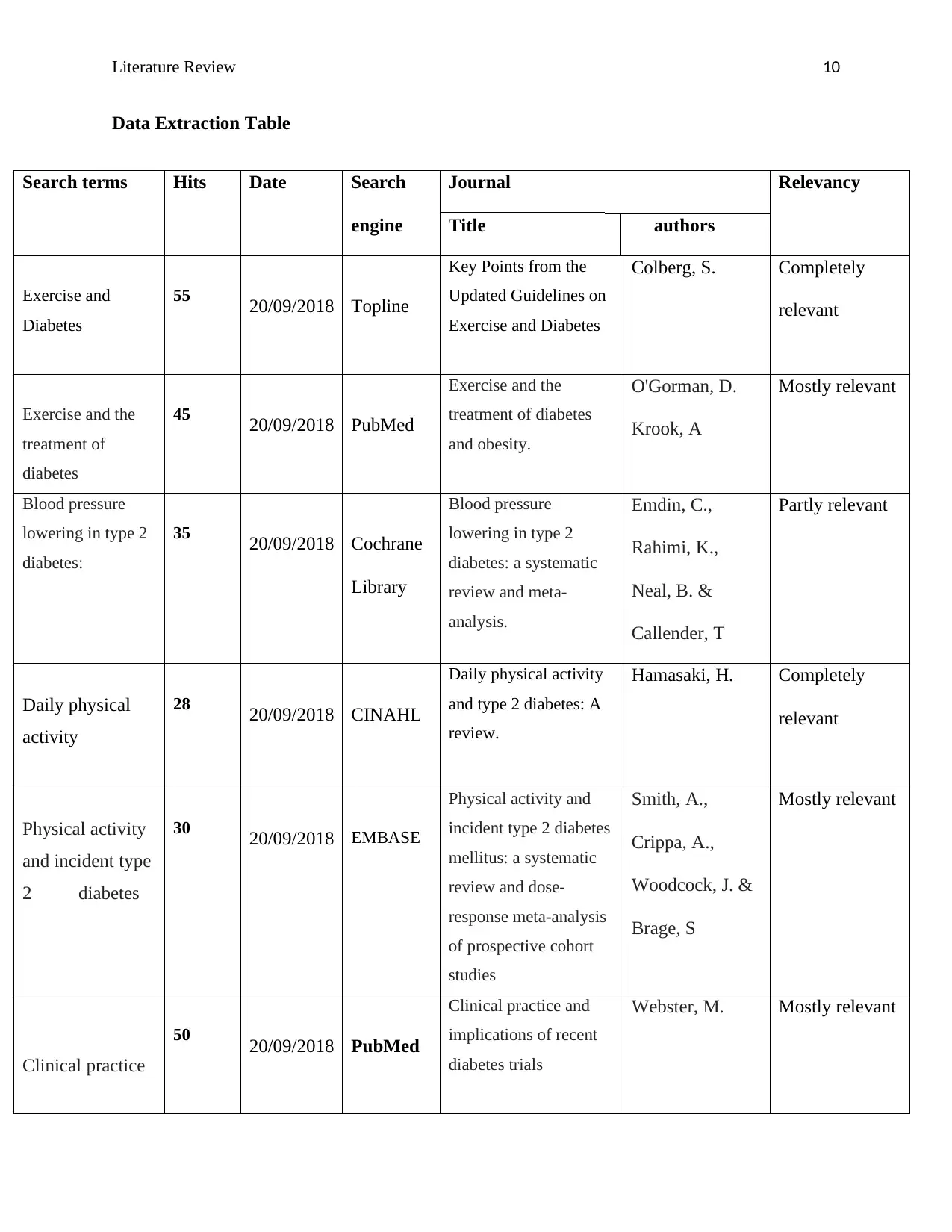
Data Extraction Table
Search terms Hits Date Search
engine
Journal
Title authors
Relevancy
Exercise and
Diabetes
55 20/09/2018 Topline
Key Points from the
Updated Guidelines on
Exercise and Diabetes
Colberg, S. Completely
relevant
Exercise and the
treatment of
diabetes
45 20/09/2018 PubMed
Exercise and the
treatment of diabetes
and obesity.
O'Gorman, D.
Krook, A
Mostly relevant
Blood pressure
lowering in type 2
diabetes:
35 20/09/2018 Cochrane
Library
Blood pressure
lowering in type 2
diabetes: a systematic
review and meta-
analysis.
Emdin, C.,
Rahimi, K.,
Neal, B. &
Callender, T
Partly relevant
Daily physical
activity
28 20/09/2018 CINAHL
Daily physical activity
and type 2 diabetes: A
review.
Hamasaki, H. Completely
relevant
Physical activity
and incident type
2 diabetes
30 20/09/2018 EMBASE
Physical activity and
incident type 2 diabetes
mellitus: a systematic
review and dose-
response meta-analysis
of prospective cohort
studies
Smith, A.,
Crippa, A.,
Woodcock, J. &
Brage, S
Mostly relevant
Clinical practice
50 20/09/2018 PubMed
Clinical practice and
implications of recent
diabetes trials
Webster, M. Mostly relevant
Data Extraction Table
Search terms Hits Date Search
engine
Journal
Title authors
Relevancy
Exercise and
Diabetes
55 20/09/2018 Topline
Key Points from the
Updated Guidelines on
Exercise and Diabetes
Colberg, S. Completely
relevant
Exercise and the
treatment of
diabetes
45 20/09/2018 PubMed
Exercise and the
treatment of diabetes
and obesity.
O'Gorman, D.
Krook, A
Mostly relevant
Blood pressure
lowering in type 2
diabetes:
35 20/09/2018 Cochrane
Library
Blood pressure
lowering in type 2
diabetes: a systematic
review and meta-
analysis.
Emdin, C.,
Rahimi, K.,
Neal, B. &
Callender, T
Partly relevant
Daily physical
activity
28 20/09/2018 CINAHL
Daily physical activity
and type 2 diabetes: A
review.
Hamasaki, H. Completely
relevant
Physical activity
and incident type
2 diabetes
30 20/09/2018 EMBASE
Physical activity and
incident type 2 diabetes
mellitus: a systematic
review and dose-
response meta-analysis
of prospective cohort
studies
Smith, A.,
Crippa, A.,
Woodcock, J. &
Brage, S
Mostly relevant
Clinical practice
50 20/09/2018 PubMed
Clinical practice and
implications of recent
diabetes trials
Webster, M. Mostly relevant
Paraphrase This Document
Need a fresh take? Get an instant paraphrase of this document with our AI Paraphraser

Literature Review 11

1 out of 11


Related Documents


Your All-in-One AI-Powered Toolkit for Academic Success.
+13062052269
info@desklib.com
Available 24*7 on WhatsApp / Email
![[object Object]](/_next/static/media/star-bottom.7253800d.svg)
Unlock your academic potential
Copyright © 2020–2026 A2Z Services. All Rights Reserved. Developed and managed by ZUCOL.