Analysis of a Quasi-Experiment: Cyberbullying Prevention in Taiwan

Verified

Added on  2022/11/23

|4
|567
|84
Report
AI Summary
This report analyzes a quasi-experiment, specifically focusing on a case study concerning cyberbullying prevention in Taiwan. The assignment begins by defining the quasi-experiment and its characteristics, including the absence of random participation and the control of treatment. It then discusses the application of a quasi-experiment in the cyberbullying context, emphasizing its small-scale nature and the implications of not having a random sample. The report explores the comparison between the randomness of figures in the case study with the example of comparing the heights of students, and the process of conducting the experiment. The report also explores the application of a quasi-experiment to the selection of chips and sweet potato. The importance of using random assignment is to ensure that no already existing situation or condition which may end influencing the variables or the participants. Finally, it highlights the difference between a true experiment and a quasi-experiment and their respective roles in research, and the importance of random assignment.

Document Page
Running head: EXPERIMENT
Quasi- experiment
Name
ID
Course
Unit
Lecturer
Date
tabler-icon-diamond-filled.svg

Paraphrase This Document

Need a fresh take? Get an instant paraphrase of this document with our AI Paraphraser
Document Page
EXPERIMENT 2
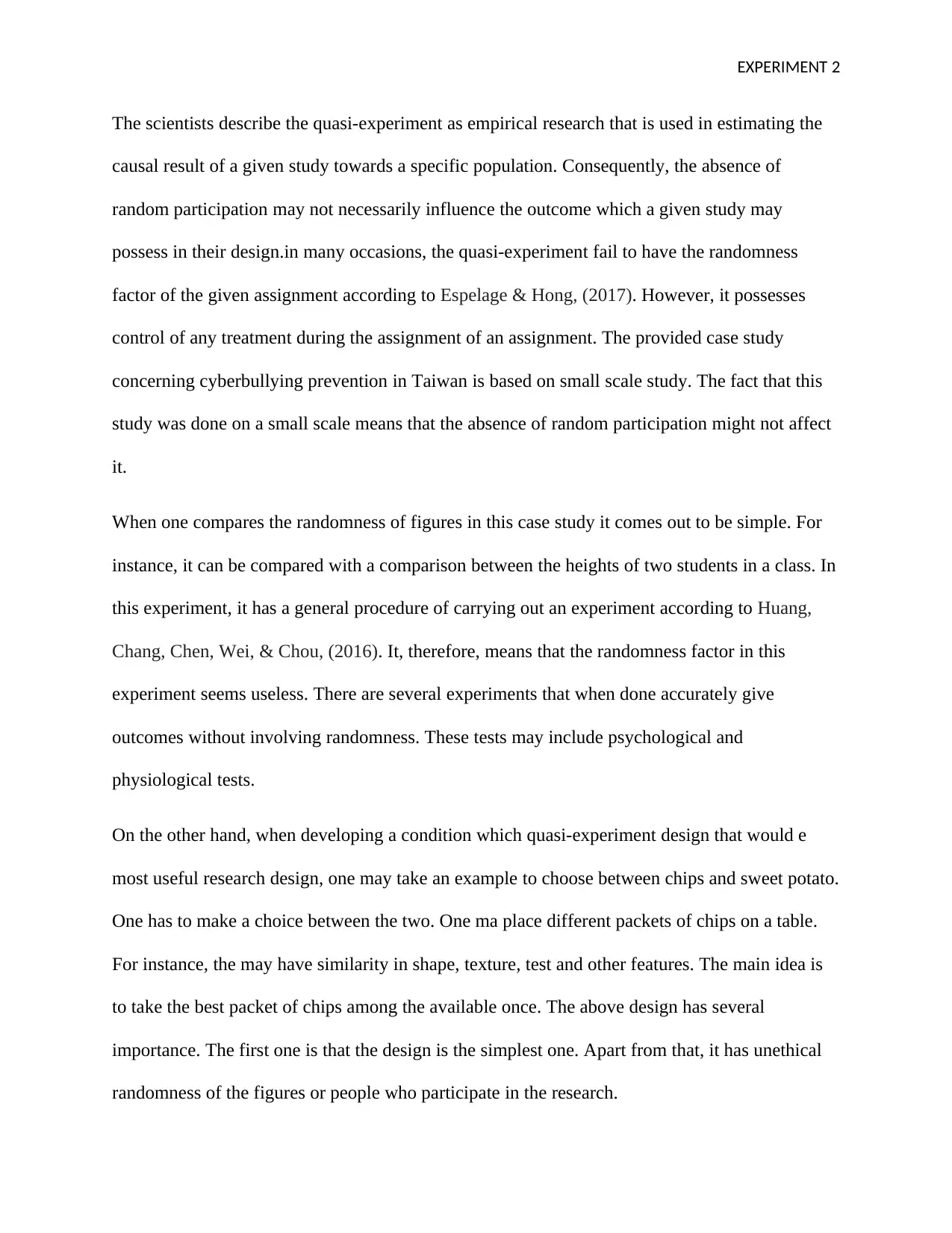
The scientists describe the quasi-experiment as empirical research that is used in estimating the
causal result of a given study towards a specific population. Consequently, the absence of
random participation may not necessarily influence the outcome which a given study may
possess in their design.in many occasions, the quasi-experiment fail to have the randomness
factor of the given assignment according to Espelage & Hong, (2017). However, it possesses
control of any treatment during the assignment of an assignment. The provided case study
concerning cyberbullying prevention in Taiwan is based on small scale study. The fact that this
study was done on a small scale means that the absence of random participation might not affect
it.
When one compares the randomness of figures in this case study it comes out to be simple. For
instance, it can be compared with a comparison between the heights of two students in a class. In
this experiment, it has a general procedure of carrying out an experiment according to Huang,
Chang, Chen, Wei, & Chou, (2016). It, therefore, means that the randomness factor in this
experiment seems useless. There are several experiments that when done accurately give
outcomes without involving randomness. These tests may include psychological and
physiological tests.
On the other hand, when developing a condition which quasi-experiment design that would e
most useful research design, one may take an example to choose between chips and sweet potato.
One has to make a choice between the two. One ma place different packets of chips on a table.
For instance, the may have similarity in shape, texture, test and other features. The main idea is
to take the best packet of chips among the available once. The above design has several
importance. The first one is that the design is the simplest one. Apart from that, it has unethical
randomness of the figures or people who participate in the research.
Document Page
EXPERIMENT 3
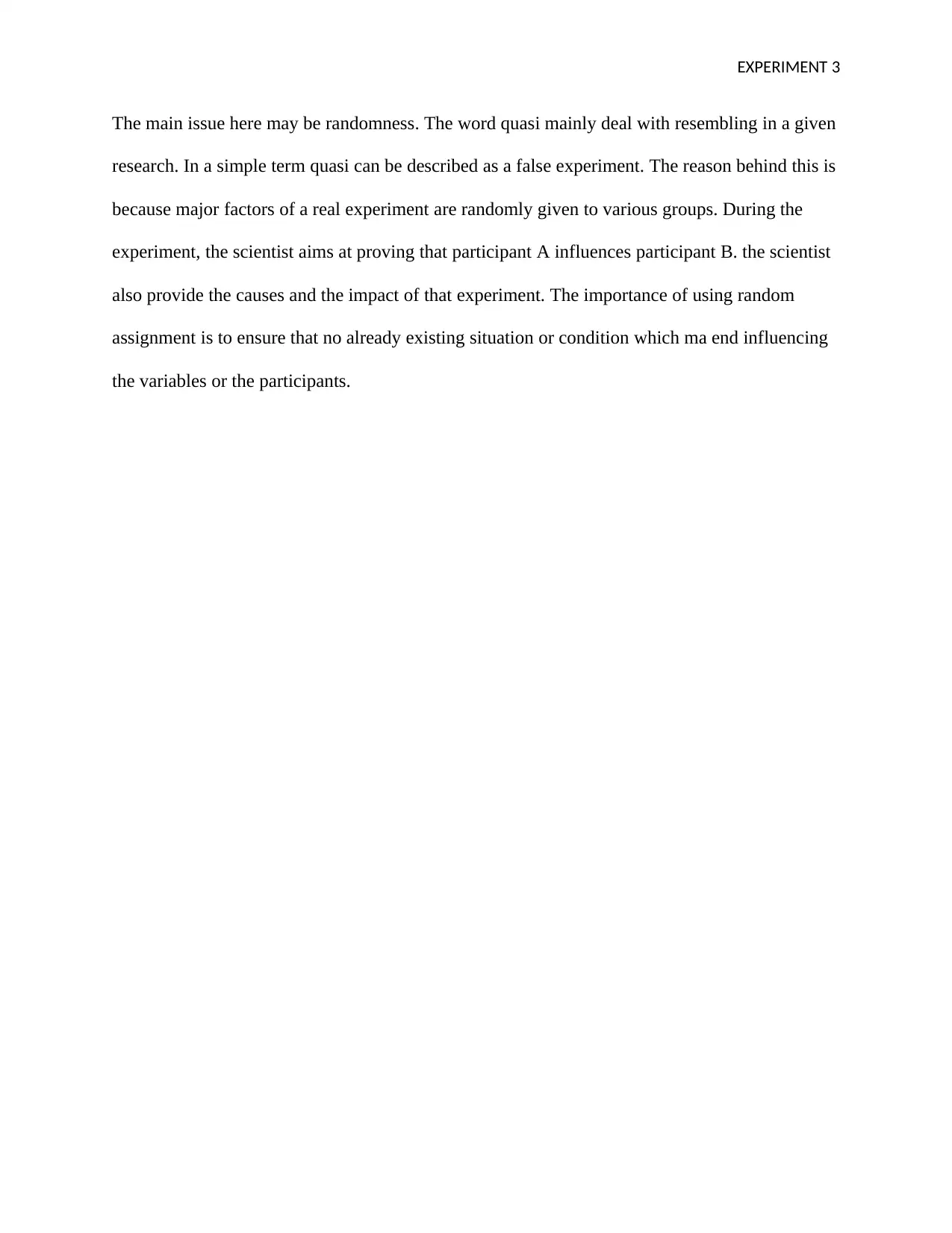
The main issue here may be randomness. The word quasi mainly deal with resembling in a given
research. In a simple term quasi can be described as a false experiment. The reason behind this is
because major factors of a real experiment are randomly given to various groups. During the
experiment, the scientist aims at proving that participant A influences participant B. the scientist
also provide the causes and the impact of that experiment. The importance of using random
assignment is to ensure that no already existing situation or condition which ma end influencing
the variables or the participants.
Document Page
EXPERIMENT 4
References
Espelage, D. L., & Hong, J. S. (2017). Cyberbullying prevention and intervention efforts: current
knowledge and future directions. The Canadian Journal of Psychiatry, 62(6), 374-380.
Huang, Y. Y., Chang, C. M., Chen, Y., Wei, H. C., & Chou, C. (2016). An analysis of adverse
beliefs about cyberbullying among Taiwanese adolescents. Violence and victims, 31(6),
1116-1134.
chevron_up_icon
1 out of 4
circle_padding
hide_on_mobile
zoom_out_icon
[object Object]