Higher National Diploma Business Environment Report: Unit 1 Analysis
VerifiedAdded on 2023/01/12
|9
|2192
|90
Report
AI Summary
This report delves into the intricacies of the business environment, commencing with an exploration of diverse organizational types such as public, private, and voluntary entities, and their respective functions. It further examines the varying sizes and scopes of organizations, categorizing them into micro, small, medium, and large enterprises. The report emphasizes the crucial interrelationship between an organization's functions, objectives, and structure, highlighting the importance of collaboration across departments like marketing, HR, and R&D. A significant portion is dedicated to analyzing the macro environment, dissecting the positive and negative impacts of political, economic, social, technological, legal, and environmental factors (PESTLE) on business operations, particularly within the retail sector. The report then applies a SWOT analysis to assess internal strengths and weaknesses alongside external opportunities and threats, with specific examples. Finally, it concludes by summarizing the key findings and the importance of understanding the business environment for organizational success. This report also highlights the correlation between macro and micro environmental factors, and how businesses can use these factors to gain competitive advantage.
Exploring the Business
Environment
Environment

Paraphrase This Document
Need a fresh take? Get an instant paraphrase of this document with our AI Paraphraser
Table of Content
INTRODUCTION...........................................................................................................................3
LO1..................................................................................................................................................3
P1 Different Types and Functions of a Business Organisations:.................................................3
P2 Different Sizes and Scopes of Organisations..........................................................................4
LO2..................................................................................................................................................4
P3 Relationship Between an Organisation's Functions, Objectives and Structure......................4
LO3..................................................................................................................................................5
P4 Positive and Negative effects of Macro Environment on Business's Operations..................5
P5 SWOT analysis.......................................................................................................................6
P6 Strengths and weakness interrelation with macro environment.............................................8
CONCLUSION................................................................................................................................8
REFERENCES................................................................................................................................9
INTRODUCTION...........................................................................................................................3
LO1..................................................................................................................................................3
P1 Different Types and Functions of a Business Organisations:.................................................3
P2 Different Sizes and Scopes of Organisations..........................................................................4
LO2..................................................................................................................................................4
P3 Relationship Between an Organisation's Functions, Objectives and Structure......................4
LO3..................................................................................................................................................5
P4 Positive and Negative effects of Macro Environment on Business's Operations..................5
P5 SWOT analysis.......................................................................................................................6
P6 Strengths and weakness interrelation with macro environment.............................................8
CONCLUSION................................................................................................................................8
REFERENCES................................................................................................................................9
INTRODUCTION
A business is an economic system or organisation whose operations are based on
manufacturing or selling goods and services to others in the market in exchange of monetary
deposits. Businesses operate in a complex and ever changing business environment, with there
being multiple internal and external factors present that can influence the operations of a given
business (Hamilton and Webster, 2018). Businesses need to be aware of the opportunities and
threats present to them in their operating business environment in order to continue their
successful business functioning.
LO1
P1 Different Types and Functions of a Business Organisations:
There are present primarily 3 distinct types of organizations on which their business's
operations and objectives depend. These are as follows:
Public Organisations: Public organizations operate through providing essential public services
for example, schools, police, hospitals etc. Public organizations are owned by the government of
the country and operates on a non-profit business model. Employee salaries in public
organisations are paid through tax deposited by citizens. Public organizations are structurally
rigid, having set numerous laws and policies to adhere to for their proper functioning (Moullin,
2017). Public businesses provide its employees with better job security and after retirement
pensions and thus suffer from relatively low turnover rates.
Private Organisations: Private organizations are owned privately by individuals or groups and
operate primarily on a for profit model. They are driven by opportunities of growth, expansion
and additional profits. Employment in private organizations is generally considered less secure,
stable but provides employees with better earning and personal development opportunities than
public organisations. Private business's jobs include accountant, engineers, retail workers etc.
Voluntary Organisations: The voluntary or non-profit organizations operate on a non-profit
business model while being owned privately by an individual or a group. These organizations are
distinct from private and public organizations but may choose to collaborate with either forms of
businesses for its operations. Main purpose of voluntary organisations is not to generate profits
but to provide aid to the society in one form or other (Mauger, 2018). For their operations to be
sustained voluntary organisations need to procure enough funding to see through their everyday
operations. For example, various types of charities, NGO's etc.
A business is an economic system or organisation whose operations are based on
manufacturing or selling goods and services to others in the market in exchange of monetary
deposits. Businesses operate in a complex and ever changing business environment, with there
being multiple internal and external factors present that can influence the operations of a given
business (Hamilton and Webster, 2018). Businesses need to be aware of the opportunities and
threats present to them in their operating business environment in order to continue their
successful business functioning.
LO1
P1 Different Types and Functions of a Business Organisations:
There are present primarily 3 distinct types of organizations on which their business's
operations and objectives depend. These are as follows:
Public Organisations: Public organizations operate through providing essential public services
for example, schools, police, hospitals etc. Public organizations are owned by the government of
the country and operates on a non-profit business model. Employee salaries in public
organisations are paid through tax deposited by citizens. Public organizations are structurally
rigid, having set numerous laws and policies to adhere to for their proper functioning (Moullin,
2017). Public businesses provide its employees with better job security and after retirement
pensions and thus suffer from relatively low turnover rates.
Private Organisations: Private organizations are owned privately by individuals or groups and
operate primarily on a for profit model. They are driven by opportunities of growth, expansion
and additional profits. Employment in private organizations is generally considered less secure,
stable but provides employees with better earning and personal development opportunities than
public organisations. Private business's jobs include accountant, engineers, retail workers etc.
Voluntary Organisations: The voluntary or non-profit organizations operate on a non-profit
business model while being owned privately by an individual or a group. These organizations are
distinct from private and public organizations but may choose to collaborate with either forms of
businesses for its operations. Main purpose of voluntary organisations is not to generate profits
but to provide aid to the society in one form or other (Mauger, 2018). For their operations to be
sustained voluntary organisations need to procure enough funding to see through their everyday
operations. For example, various types of charities, NGO's etc.
⊘ This is a preview!⊘
Do you want full access?
Subscribe today to unlock all pages.

Trusted by 1+ million students worldwide
P2 Different Sizes and Scopes of Organisations
Organisations operate on various sizes and scopes in order to efficiently achieve their
target objectives. Organizations can be divided into four subcategories in relation to their sizes:
Micro: Micro sized businesses are tiny businesses with low quantity of employees and minimal
investments made. These generally operate employing less than 10 people and require minimal
input capital.
Small: Small sized businesses are small business operations and do not possess high amount of
products sales or market share (Wijaya, Nurhadi and Kuncoro, 2017). These typically employ
anywhere between 10 and 50 employees in order to facilitate their operations. These generally
operate in domestic and local markets.
Medium: Medium sized businesses employ 50-250 personnels for their operations and emerge
out of the growth and expansion of small sized businesses. Successful medium sized enterprises
can enter global markets to increase their profitability and market share.
Large: Large sized businesses have large scaled operations, market share and sales potentials.
They employ more than 250 employees for their operations and may have entered into and
captured international markets. Large scale organisations make use of principle of economies of
scale to drive their product prices low and increase profitability.
The scope of an organisation depends upon various operational attributes such as the size
of market share organisation has captured in the market, its profitability, expansion and growth
opportunities and the sustainability of their operations. Micro and small businesses have small
market share, sustainability options and limited growth opportunities (Ebitu, Glory and Alfred,
2016). Medium sized enterprises possess good market share and growth opportunities but find it
hard to outcompete larger businesses. Large business posses largest market shares, growth and
sustainability options.
LO2
P3 Relationship Between an Organisation's Functions, Objectives and Structure.
The interrelationship between an organisation's multiple functions and its objectives and
structure is immensely important in order to ensure the business's optimum productivity and
profitability. The structure of the business needs to allow for constant communication between
its different functions in order to achieve set organisational objectives.
Organisations operate on various sizes and scopes in order to efficiently achieve their
target objectives. Organizations can be divided into four subcategories in relation to their sizes:
Micro: Micro sized businesses are tiny businesses with low quantity of employees and minimal
investments made. These generally operate employing less than 10 people and require minimal
input capital.
Small: Small sized businesses are small business operations and do not possess high amount of
products sales or market share (Wijaya, Nurhadi and Kuncoro, 2017). These typically employ
anywhere between 10 and 50 employees in order to facilitate their operations. These generally
operate in domestic and local markets.
Medium: Medium sized businesses employ 50-250 personnels for their operations and emerge
out of the growth and expansion of small sized businesses. Successful medium sized enterprises
can enter global markets to increase their profitability and market share.
Large: Large sized businesses have large scaled operations, market share and sales potentials.
They employ more than 250 employees for their operations and may have entered into and
captured international markets. Large scale organisations make use of principle of economies of
scale to drive their product prices low and increase profitability.
The scope of an organisation depends upon various operational attributes such as the size
of market share organisation has captured in the market, its profitability, expansion and growth
opportunities and the sustainability of their operations. Micro and small businesses have small
market share, sustainability options and limited growth opportunities (Ebitu, Glory and Alfred,
2016). Medium sized enterprises possess good market share and growth opportunities but find it
hard to outcompete larger businesses. Large business posses largest market shares, growth and
sustainability options.
LO2
P3 Relationship Between an Organisation's Functions, Objectives and Structure.
The interrelationship between an organisation's multiple functions and its objectives and
structure is immensely important in order to ensure the business's optimum productivity and
profitability. The structure of the business needs to allow for constant communication between
its different functions in order to achieve set organisational objectives.
Paraphrase This Document
Need a fresh take? Get an instant paraphrase of this document with our AI Paraphraser
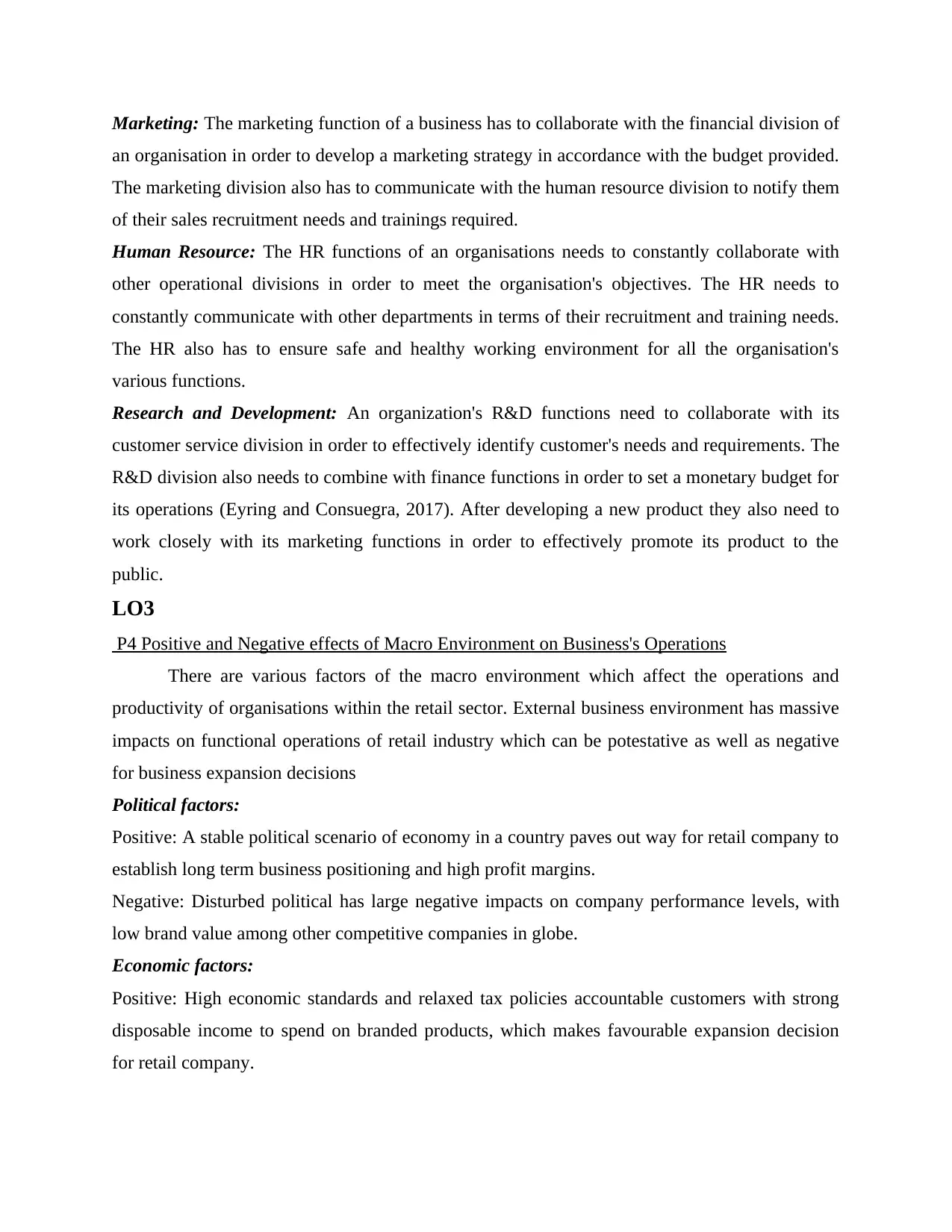
Marketing: The marketing function of a business has to collaborate with the financial division of
an organisation in order to develop a marketing strategy in accordance with the budget provided.
The marketing division also has to communicate with the human resource division to notify them
of their sales recruitment needs and trainings required.
Human Resource: The HR functions of an organisations needs to constantly collaborate with
other operational divisions in order to meet the organisation's objectives. The HR needs to
constantly communicate with other departments in terms of their recruitment and training needs.
The HR also has to ensure safe and healthy working environment for all the organisation's
various functions.
Research and Development: An organization's R&D functions need to collaborate with its
customer service division in order to effectively identify customer's needs and requirements. The
R&D division also needs to combine with finance functions in order to set a monetary budget for
its operations (Eyring and Consuegra, 2017). After developing a new product they also need to
work closely with its marketing functions in order to effectively promote its product to the
public.
LO3
P4 Positive and Negative effects of Macro Environment on Business's Operations
There are various factors of the macro environment which affect the operations and
productivity of organisations within the retail sector. External business environment has massive
impacts on functional operations of retail industry which can be potestative as well as negative
for business expansion decisions
Political factors:
Positive: A stable political scenario of economy in a country paves out way for retail company to
establish long term business positioning and high profit margins.
Negative: Disturbed political has large negative impacts on company performance levels, with
low brand value among other competitive companies in globe.
Economic factors:
Positive: High economic standards and relaxed tax policies accountable customers with strong
disposable income to spend on branded products, which makes favourable expansion decision
for retail company.
an organisation in order to develop a marketing strategy in accordance with the budget provided.
The marketing division also has to communicate with the human resource division to notify them
of their sales recruitment needs and trainings required.
Human Resource: The HR functions of an organisations needs to constantly collaborate with
other operational divisions in order to meet the organisation's objectives. The HR needs to
constantly communicate with other departments in terms of their recruitment and training needs.
The HR also has to ensure safe and healthy working environment for all the organisation's
various functions.
Research and Development: An organization's R&D functions need to collaborate with its
customer service division in order to effectively identify customer's needs and requirements. The
R&D division also needs to combine with finance functions in order to set a monetary budget for
its operations (Eyring and Consuegra, 2017). After developing a new product they also need to
work closely with its marketing functions in order to effectively promote its product to the
public.
LO3
P4 Positive and Negative effects of Macro Environment on Business's Operations
There are various factors of the macro environment which affect the operations and
productivity of organisations within the retail sector. External business environment has massive
impacts on functional operations of retail industry which can be potestative as well as negative
for business expansion decisions
Political factors:
Positive: A stable political scenario of economy in a country paves out way for retail company to
establish long term business positioning and high profit margins.
Negative: Disturbed political has large negative impacts on company performance levels, with
low brand value among other competitive companies in globe.
Economic factors:
Positive: High economic standards and relaxed tax policies accountable customers with strong
disposable income to spend on branded products, which makes favourable expansion decision
for retail company.

Negative: Imbalanced economic situations in country disturbs the disposable income of people
which negatively impacts expansion business strategies for any retail company.
Social factors:
Positive: High social standards among society of people in country is high favourable situation
for retail company in industry as the diverse leads to competitive advantage and edge in
benchmarks of performance goals (Xie, Huo and Zou, 2019).
Negative: Rapidly changing social cultural factors negatively impacts retail company revenue
and expansion strategies extensively.
Technological factors:
Positive: High technology standards in economy leads to positive expansion of retail company
revenue margins which enables high completion in reaching satisfaction among customers.
Negative: It involves huge capital expenditure to implement new technology and production
equipments in retail company where there is massive competitiveness among new brands.
Legal Factors:
Positive factors: High legal factors regulations and laws compliance enables retail company to
position itself as firm company in industry.
Negative factors: The ignorance of legal factors and regulations negatively impacts global brand
image (Culhane, 2019).
Environment factors:
Positive: A retail company by completing CSR activities displays high brand value in industry
by regulating strong environmental friendly acts.
Negative- However it becomes an area of new capital investment and high compliance realted to
changing environment scenario.
P5 SWOT analysis
Swot analysis framework enables detailed explanation on internal working conditions of
company which are highly important to consider for evaluation of business strategies and build
innovation in business patterns.
SWOT Sainsbury ASDA
STRENGTHS Large variety of
products portfolio and
services
High goodwill among
customers in retail
industry
which negatively impacts expansion business strategies for any retail company.
Social factors:
Positive: High social standards among society of people in country is high favourable situation
for retail company in industry as the diverse leads to competitive advantage and edge in
benchmarks of performance goals (Xie, Huo and Zou, 2019).
Negative: Rapidly changing social cultural factors negatively impacts retail company revenue
and expansion strategies extensively.
Technological factors:
Positive: High technology standards in economy leads to positive expansion of retail company
revenue margins which enables high completion in reaching satisfaction among customers.
Negative: It involves huge capital expenditure to implement new technology and production
equipments in retail company where there is massive competitiveness among new brands.
Legal Factors:
Positive factors: High legal factors regulations and laws compliance enables retail company to
position itself as firm company in industry.
Negative factors: The ignorance of legal factors and regulations negatively impacts global brand
image (Culhane, 2019).
Environment factors:
Positive: A retail company by completing CSR activities displays high brand value in industry
by regulating strong environmental friendly acts.
Negative- However it becomes an area of new capital investment and high compliance realted to
changing environment scenario.
P5 SWOT analysis
Swot analysis framework enables detailed explanation on internal working conditions of
company which are highly important to consider for evaluation of business strategies and build
innovation in business patterns.
SWOT Sainsbury ASDA
STRENGTHS Large variety of
products portfolio and
services
High goodwill among
customers in retail
industry
⊘ This is a preview!⊘
Do you want full access?
Subscribe today to unlock all pages.
Trusted by 1+ million students worldwide
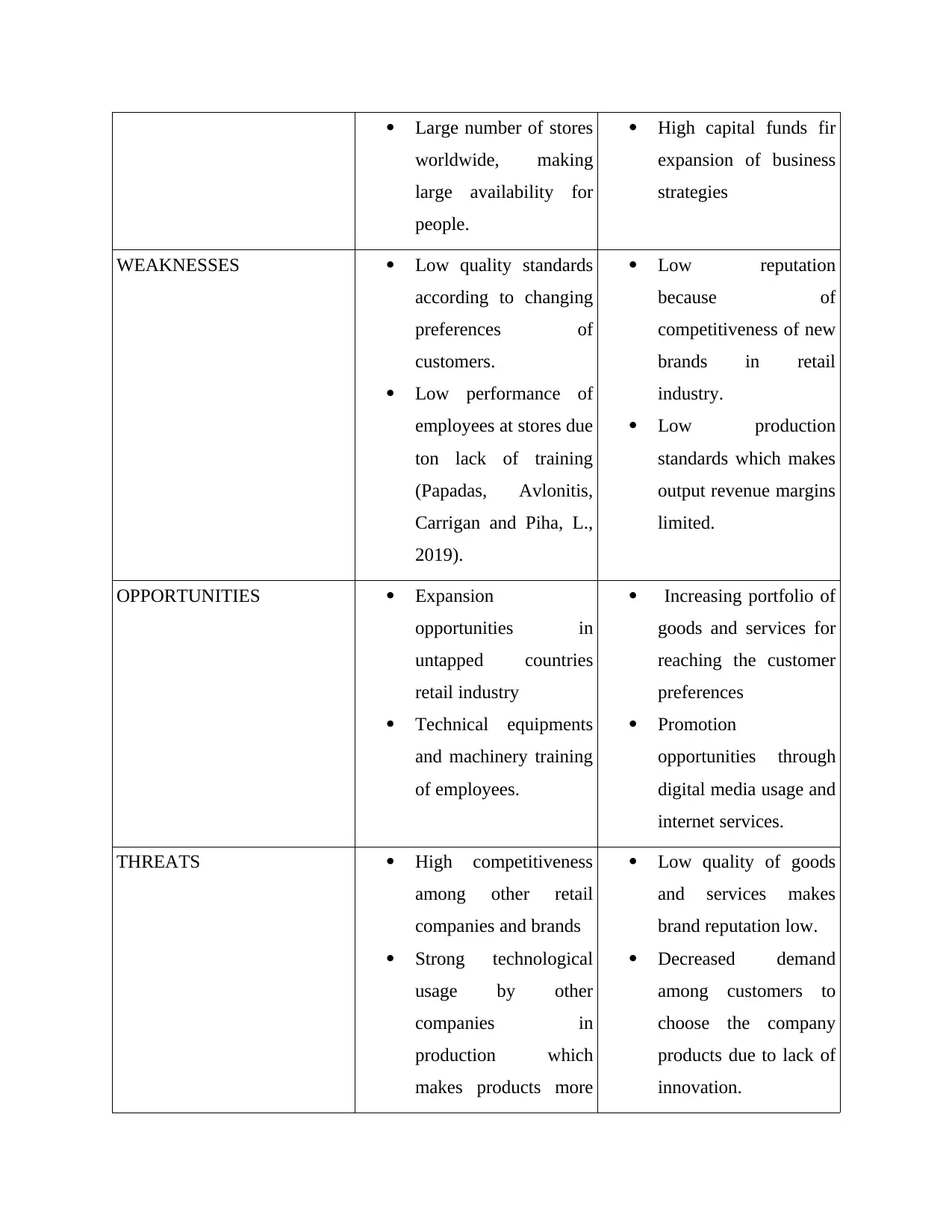
Large number of stores
worldwide, making
large availability for
people.
High capital funds fir
expansion of business
strategies
WEAKNESSES Low quality standards
according to changing
preferences of
customers.
Low performance of
employees at stores due
ton lack of training
(Papadas, Avlonitis,
Carrigan and Piha, L.,
2019).
Low reputation
because of
competitiveness of new
brands in retail
industry.
Low production
standards which makes
output revenue margins
limited.
OPPORTUNITIES Expansion
opportunities in
untapped countries
retail industry
Technical equipments
and machinery training
of employees.
Increasing portfolio of
goods and services for
reaching the customer
preferences
Promotion
opportunities through
digital media usage and
internet services.
THREATS High competitiveness
among other retail
companies and brands
Strong technological
usage by other
companies in
production which
makes products more
Low quality of goods
and services makes
brand reputation low.
Decreased demand
among customers to
choose the company
products due to lack of
innovation.
worldwide, making
large availability for
people.
High capital funds fir
expansion of business
strategies
WEAKNESSES Low quality standards
according to changing
preferences of
customers.
Low performance of
employees at stores due
ton lack of training
(Papadas, Avlonitis,
Carrigan and Piha, L.,
2019).
Low reputation
because of
competitiveness of new
brands in retail
industry.
Low production
standards which makes
output revenue margins
limited.
OPPORTUNITIES Expansion
opportunities in
untapped countries
retail industry
Technical equipments
and machinery training
of employees.
Increasing portfolio of
goods and services for
reaching the customer
preferences
Promotion
opportunities through
digital media usage and
internet services.
THREATS High competitiveness
among other retail
companies and brands
Strong technological
usage by other
companies in
production which
makes products more
Low quality of goods
and services makes
brand reputation low.
Decreased demand
among customers to
choose the company
products due to lack of
innovation.
Paraphrase This Document
Need a fresh take? Get an instant paraphrase of this document with our AI Paraphraser
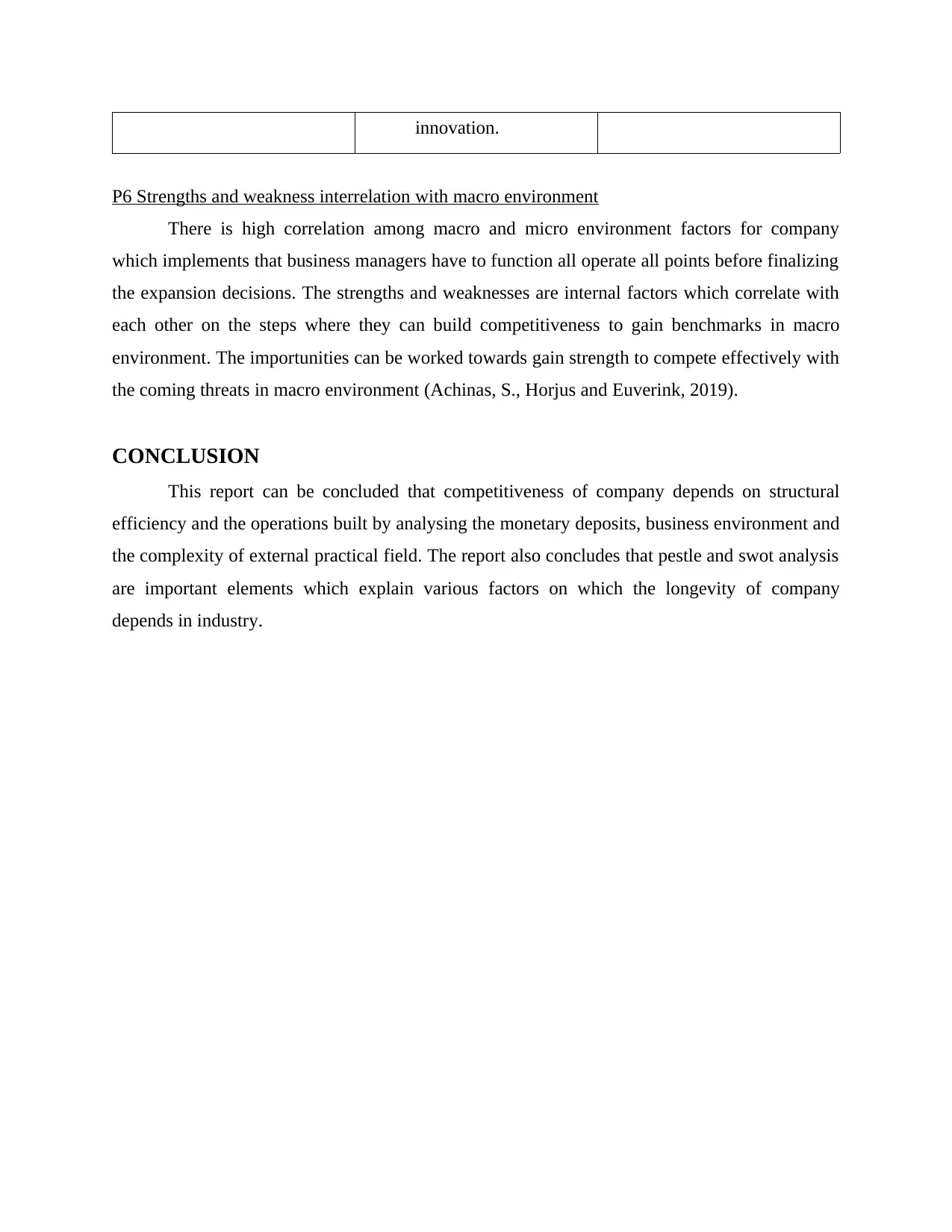
innovation.
P6 Strengths and weakness interrelation with macro environment
There is high correlation among macro and micro environment factors for company
which implements that business managers have to function all operate all points before finalizing
the expansion decisions. The strengths and weaknesses are internal factors which correlate with
each other on the steps where they can build competitiveness to gain benchmarks in macro
environment. The importunities can be worked towards gain strength to compete effectively with
the coming threats in macro environment (Achinas, S., Horjus and Euverink, 2019).
CONCLUSION
This report can be concluded that competitiveness of company depends on structural
efficiency and the operations built by analysing the monetary deposits, business environment and
the complexity of external practical field. The report also concludes that pestle and swot analysis
are important elements which explain various factors on which the longevity of company
depends in industry.
P6 Strengths and weakness interrelation with macro environment
There is high correlation among macro and micro environment factors for company
which implements that business managers have to function all operate all points before finalizing
the expansion decisions. The strengths and weaknesses are internal factors which correlate with
each other on the steps where they can build competitiveness to gain benchmarks in macro
environment. The importunities can be worked towards gain strength to compete effectively with
the coming threats in macro environment (Achinas, S., Horjus and Euverink, 2019).
CONCLUSION
This report can be concluded that competitiveness of company depends on structural
efficiency and the operations built by analysing the monetary deposits, business environment and
the complexity of external practical field. The report also concludes that pestle and swot analysis
are important elements which explain various factors on which the longevity of company
depends in industry.

REFERENCES
Books and Journals
Achinas, S., Horjus, J., Achinas, V. and Euverink, G.J.W., 2019. A PESTLE Analysis of
Biofuels Energy Industry in Europe. Sustainability. 11(21). p.5981.
Culhane, P. J., 2019. Forecasts and environmental decision making: the content and predictive
accuracy of environmental impact statements. CRC Press.
Ebitu, E.T., Glory, B. and Alfred, U.J., 2016. An Appraisal Of Nigeria's Micro, Small And
Medium Enterprises (Msmes): Growth, Challenges And Prospects. British Journal of
Marketing Studies. 4(5). pp.21-36.
Eyring, A. and Consuegra, J., 2017. How HR and Marketing Can Partner for Growth. People &
Strategy. 40(4). pp.14-20.
Hamilton, L. and Webster, P., 2018. The international business environment. Oxford University
Press.
Mauger, A., 2018. The Non-Pauper Insane: Private, Voluntary and State Concerns. In The Cost
of Insanity in Nineteenth-Century Ireland (pp. 27-67). Palgrave Macmillan, Cham.
Moullin, M., 2017. Improving and evaluating performance with the Public Sector Scorecard.
International Journal of Productivity and Performance Management.
Papadas, K. K., Avlonitis, G.J., Carrigan, M. and Piha, L., 2019. The interplay of strategic and
internal green marketing orientation on competitive advantage. Journal of Business
Research.104. pp.632-643.
Wijaya, T., Nurhadi, N. and Kuncoro, A.M., 2017. Exploring the problems faced by practitioners
of micro, small, and medium enterprises (MSMEs) in Yogyakarta. Jurnal Manajemen
dan Kewirausahaan. 19(1). pp.38-45.
Xie, X., Huo, J. and Zou, H., 2019. Green process innovation, green product innovation, and
corporate financial performance: A content analysis method. Journal of Business
Research. 101. pp.697-706.
Books and Journals
Achinas, S., Horjus, J., Achinas, V. and Euverink, G.J.W., 2019. A PESTLE Analysis of
Biofuels Energy Industry in Europe. Sustainability. 11(21). p.5981.
Culhane, P. J., 2019. Forecasts and environmental decision making: the content and predictive
accuracy of environmental impact statements. CRC Press.
Ebitu, E.T., Glory, B. and Alfred, U.J., 2016. An Appraisal Of Nigeria's Micro, Small And
Medium Enterprises (Msmes): Growth, Challenges And Prospects. British Journal of
Marketing Studies. 4(5). pp.21-36.
Eyring, A. and Consuegra, J., 2017. How HR and Marketing Can Partner for Growth. People &
Strategy. 40(4). pp.14-20.
Hamilton, L. and Webster, P., 2018. The international business environment. Oxford University
Press.
Mauger, A., 2018. The Non-Pauper Insane: Private, Voluntary and State Concerns. In The Cost
of Insanity in Nineteenth-Century Ireland (pp. 27-67). Palgrave Macmillan, Cham.
Moullin, M., 2017. Improving and evaluating performance with the Public Sector Scorecard.
International Journal of Productivity and Performance Management.
Papadas, K. K., Avlonitis, G.J., Carrigan, M. and Piha, L., 2019. The interplay of strategic and
internal green marketing orientation on competitive advantage. Journal of Business
Research.104. pp.632-643.
Wijaya, T., Nurhadi, N. and Kuncoro, A.M., 2017. Exploring the problems faced by practitioners
of micro, small, and medium enterprises (MSMEs) in Yogyakarta. Jurnal Manajemen
dan Kewirausahaan. 19(1). pp.38-45.
Xie, X., Huo, J. and Zou, H., 2019. Green process innovation, green product innovation, and
corporate financial performance: A content analysis method. Journal of Business
Research. 101. pp.697-706.
⊘ This is a preview!⊘
Do you want full access?
Subscribe today to unlock all pages.
Trusted by 1+ million students worldwide

1 out of 9


Related Documents


Your All-in-One AI-Powered Toolkit for Academic Success.
+13062052269
info@desklib.com
Available 24*7 on WhatsApp / Email
![[object Object]](/_next/static/media/star-bottom.7253800d.svg)
Unlock your academic potential
Copyright © 2020–2026 A2Z Services. All Rights Reserved. Developed and managed by ZUCOL.