Report: Exploring the Paradigm Wars in Organisation Theory Concepts
VerifiedAdded on 2020/07/23
|10
|2976
|130
Report
AI Summary
This report delves into the core concepts of organisation theory, focusing on the 'paradigm wars' between different theoretical perspectives. It examines three key theories: Resource Dependency Theory, Institutional Theory, and Population Ecology Theory. Resource Dependency Theory emphasizes how organisations depend on external resources and how this dependence influences their behavior and strategic choices. Institutional Theory explores the impact of social and cultural structures, including rules, norms, and routines, on organisational practices and structures, highlighting the role of imitation and isomorphism. Population Ecology Theory analyzes the dynamic changes within organisations, using population-level analysis to understand the birth, mortality, and evolution of ventures within their environment, considering factors like inertia and niche theory. The report discusses how these theories offer different lenses for understanding organisational behavior, strategic decision-making, and adaptation to the external environment, ultimately contributing to a comprehensive view of the complexities within organisations. This report is a valuable resource for students studying management and organisational behavior, offering insights into the interplay of power, resources, and environmental forces.
Exploring the Paradigm
Wars in Organisation
Theory
Wars in Organisation
Theory

Paraphrase This Document
Need a fresh take? Get an instant paraphrase of this document with our AI Paraphraser
TABLE OF CONTENTS
INTRODUCTION...........................................................................................................................1
Resource Dependency Theory................................................................................................1
Institutional theory .................................................................................................................3
Population ecology theory......................................................................................................3
CONCLUSION................................................................................................................................5
INTRODUCTION...........................................................................................................................1
Resource Dependency Theory................................................................................................1
Institutional theory .................................................................................................................3
Population ecology theory......................................................................................................3
CONCLUSION................................................................................................................................5
INTRODUCTION
The field of organisation theory is defined as a fragmented body of information and
knowledge, with many competitive concepts to explain their action. The report includes three
theories that are Resource Dependency Theory, Institutional theory and Population ecology
theory. Each theory has different concept where resource dependence state that one organisation
depend on other for resources. Whereas institutional theory states that institution is the structure,
where organisation need to adopt changes in environment according to their structure and
population ecology states that, the venture which are not able to change themselves according to
the environment will be replaced by any other competitive organisation. The major reason for
selection of this study is that organisation can adopt the changes according to the changing
environment. With help of this study, understanding can gain on the various theories such as
resource dependency theory, institutional theory and population ecology through. These theories
help to the organisation in improving their employees performance.
Resource Dependency Theory
Resource dependency theory is the study by which organisation determine how different
external factors affect behaviour of people in an organisation. It is very significant for the
venture to determine and analyse all the external factors which have great impact over the
operational, tactical and strategical management of the firm. Importance to this theory was not
given till 1970's but after that organisations have found that they are also being affected by
external factors and then this theory had been implemented (Rogers, 2016). Resource
dependence theory has implications regarding the optimal divisional structure of organizations,
recruitment of board members and employees, production strategies, contract structure, external
organizational links, and many other aspects of organizational strategy (Mohr and Fastoso,
2016). In simple words, it can be said that organisation is dependent on the different resources
and that resources are procured from external environment (Resource Dependency Theory,
2017). The external environment, consists of other organisations which need the same resources.
These can be procured on the basis of power; thus, these organisations need to dependent on
each other. The resources which an organization need are land, labour, capital, raw material and
machinery (Seckinelgin and Wong, 2016). With assistance of this resource dependence theory,
strategic choice of the organisation can also understand as with help of this company can
determine how external factor influence the behaviours of the people in the company. Firm
1
The field of organisation theory is defined as a fragmented body of information and
knowledge, with many competitive concepts to explain their action. The report includes three
theories that are Resource Dependency Theory, Institutional theory and Population ecology
theory. Each theory has different concept where resource dependence state that one organisation
depend on other for resources. Whereas institutional theory states that institution is the structure,
where organisation need to adopt changes in environment according to their structure and
population ecology states that, the venture which are not able to change themselves according to
the environment will be replaced by any other competitive organisation. The major reason for
selection of this study is that organisation can adopt the changes according to the changing
environment. With help of this study, understanding can gain on the various theories such as
resource dependency theory, institutional theory and population ecology through. These theories
help to the organisation in improving their employees performance.
Resource Dependency Theory
Resource dependency theory is the study by which organisation determine how different
external factors affect behaviour of people in an organisation. It is very significant for the
venture to determine and analyse all the external factors which have great impact over the
operational, tactical and strategical management of the firm. Importance to this theory was not
given till 1970's but after that organisations have found that they are also being affected by
external factors and then this theory had been implemented (Rogers, 2016). Resource
dependence theory has implications regarding the optimal divisional structure of organizations,
recruitment of board members and employees, production strategies, contract structure, external
organizational links, and many other aspects of organizational strategy (Mohr and Fastoso,
2016). In simple words, it can be said that organisation is dependent on the different resources
and that resources are procured from external environment (Resource Dependency Theory,
2017). The external environment, consists of other organisations which need the same resources.
These can be procured on the basis of power; thus, these organisations need to dependent on
each other. The resources which an organization need are land, labour, capital, raw material and
machinery (Seckinelgin and Wong, 2016). With assistance of this resource dependence theory,
strategic choice of the organisation can also understand as with help of this company can
determine how external factor influence the behaviours of the people in the company. Firm
1
⊘ This is a preview!⊘
Do you want full access?
Subscribe today to unlock all pages.

Trusted by 1+ million students worldwide
strategic decision can also influence by the external factors. Strategic choice can help to the
company in understanding the organisational action because with help of strategic action and
activities, firm can understand the entire objective and target. The contribution of strategic
choice can help in analysing the action of the organisation through which it can deliver right
outcome to employees for attain the long term objective.
Resources dependency theory state relationship between firm and their resources which
they need to operate different task and activities. Resources take many shapes that are workers,
raw material, funds, machinery etc. it also includes symbiotic relationship which state that one
company have to dependent on other company for the resources (Dreyer, 2016). This can happen
when one organisation has more resources than other. In simple words, it can be said that one
company have majority over other company on the basis of resources. When one organisation
has too much dependency over the other firm, then it creates uncertainty and causes risk for the
organisation from the external factors (Smith and Humphries, 2017). There are different external
factors that influence decision making of the organisation, that can be imposed by the other firms
or government. This have significant impact over the different operation of the venture such as
personnel policies, fund raining. This risk can be minimised with the help of strategic alternative
business plans. Resource dependency theory can help to the organisation in taking strategic
choice. On the basis of the resources within the company such as workers, raw material, funds,
machinery, company's strategic choice can also influence because on the basis of the resources
and dependency on them company can take the decision of the strategy in the future.
For example, ABC is security system organisation which deals in technology security.
Their client is XYZ which deals in multimedia. Now ABC is dependent on XYZ in order to earn
revenue. Now the organisation has also dealing with other clients so that they can earn large
revenue (Jajja and Hassan, 2017). This state that if the organisation dependent on one client or
firm, this may cause huge risk to them. In order to lower this risk, the security firm (ABC ltd)
will have to explore other clients to lower the level of dependence on one client. Importance of
the theory was developed by 1970's when two authors Jeffrey Pfeffer and Gerald R. Salancik,
have published ‘The External Control of Organizations’. A Resource Dependence Perspective,
which states their study of dependence originate and power, and how firm may utilise their
power and succeed those that are dependent upon them. Managers always try to get advantage to
2
company in understanding the organisational action because with help of strategic action and
activities, firm can understand the entire objective and target. The contribution of strategic
choice can help in analysing the action of the organisation through which it can deliver right
outcome to employees for attain the long term objective.
Resources dependency theory state relationship between firm and their resources which
they need to operate different task and activities. Resources take many shapes that are workers,
raw material, funds, machinery etc. it also includes symbiotic relationship which state that one
company have to dependent on other company for the resources (Dreyer, 2016). This can happen
when one organisation has more resources than other. In simple words, it can be said that one
company have majority over other company on the basis of resources. When one organisation
has too much dependency over the other firm, then it creates uncertainty and causes risk for the
organisation from the external factors (Smith and Humphries, 2017). There are different external
factors that influence decision making of the organisation, that can be imposed by the other firms
or government. This have significant impact over the different operation of the venture such as
personnel policies, fund raining. This risk can be minimised with the help of strategic alternative
business plans. Resource dependency theory can help to the organisation in taking strategic
choice. On the basis of the resources within the company such as workers, raw material, funds,
machinery, company's strategic choice can also influence because on the basis of the resources
and dependency on them company can take the decision of the strategy in the future.
For example, ABC is security system organisation which deals in technology security.
Their client is XYZ which deals in multimedia. Now ABC is dependent on XYZ in order to earn
revenue. Now the organisation has also dealing with other clients so that they can earn large
revenue (Jajja and Hassan, 2017). This state that if the organisation dependent on one client or
firm, this may cause huge risk to them. In order to lower this risk, the security firm (ABC ltd)
will have to explore other clients to lower the level of dependence on one client. Importance of
the theory was developed by 1970's when two authors Jeffrey Pfeffer and Gerald R. Salancik,
have published ‘The External Control of Organizations’. A Resource Dependence Perspective,
which states their study of dependence originate and power, and how firm may utilise their
power and succeed those that are dependent upon them. Managers always try to get advantage to
2
Paraphrase This Document
Need a fresh take? Get an instant paraphrase of this document with our AI Paraphraser
improve their alliances and partnership with the other organisation in order to strengthen their
organisation (Foster and Kirk, 2016).
RDT is underpinned by the idea that resources are key factor which helps the venture to
gain competitive advantage and ultimately can gain success. The success here linked with the
power and resources that how power can be used by them in order to acquire different resources.
These resources are always controlled by organisation not by their need (Arik and Raffo, 2016).
This state that company should plan those strategies which helps them to acquire resources and
those strategies must be carefully considered in order to maintain open access to resources.
Venture generally created repetitiveness while acquiring the resources so that they can reduce
their reliability of single source of resources. In simple words, it can be said that organisation
start building good relationship with different suppliers so that they can reduce risk of
dependency (Bendicksonand Taylor, 2016). There are three basic factors that are included in this
theory, that are importance of resources, abundance of resources, and the control of resources.
When it comes to the significance of the resources, organisation should put maximum efforts
which help them to acquire them. As well as they should be used by them effectively and
efficiently so that they can reduce wastage of resources. When it is discussed in terms of
abundance of resources, venture should make different strategies to procure them easily when
the resources are scare and hard for the organisation to buy them.
Institutional theory
Institutional theory is the theory which is more resilient and deeper on different aspect of
the social culture. Social culture includes structure of the organisation which consist of schemes,
rules, norms, and routines. These all aspects become guideline for every individual in the venture
in order to behave in social way (Nienhüser, 2017). There are different components that are
included in institutional theory which state that how these elements are diffused, adopted, and
adapted over space and time; and how they fall into decline and disuse. When it is discussed
about the institutional, it is the social structure which have high degree of resilience. They are
made up of different factors such as cultural-cognitive, normative, and regulative. These three
factors are liked with each other with the various activities and resources which serve meaning
and stability to the social life.
3
organisation (Foster and Kirk, 2016).
RDT is underpinned by the idea that resources are key factor which helps the venture to
gain competitive advantage and ultimately can gain success. The success here linked with the
power and resources that how power can be used by them in order to acquire different resources.
These resources are always controlled by organisation not by their need (Arik and Raffo, 2016).
This state that company should plan those strategies which helps them to acquire resources and
those strategies must be carefully considered in order to maintain open access to resources.
Venture generally created repetitiveness while acquiring the resources so that they can reduce
their reliability of single source of resources. In simple words, it can be said that organisation
start building good relationship with different suppliers so that they can reduce risk of
dependency (Bendicksonand Taylor, 2016). There are three basic factors that are included in this
theory, that are importance of resources, abundance of resources, and the control of resources.
When it comes to the significance of the resources, organisation should put maximum efforts
which help them to acquire them. As well as they should be used by them effectively and
efficiently so that they can reduce wastage of resources. When it is discussed in terms of
abundance of resources, venture should make different strategies to procure them easily when
the resources are scare and hard for the organisation to buy them.
Institutional theory
Institutional theory is the theory which is more resilient and deeper on different aspect of
the social culture. Social culture includes structure of the organisation which consist of schemes,
rules, norms, and routines. These all aspects become guideline for every individual in the venture
in order to behave in social way (Nienhüser, 2017). There are different components that are
included in institutional theory which state that how these elements are diffused, adopted, and
adapted over space and time; and how they fall into decline and disuse. When it is discussed
about the institutional, it is the social structure which have high degree of resilience. They are
made up of different factors such as cultural-cognitive, normative, and regulative. These three
factors are liked with each other with the various activities and resources which serve meaning
and stability to the social life.
3
Institutional theory is a widely recognized theoretical attitude, that focuses on rational
myths, isomorphism, and legitimacy. Researcher have stated that this theory is totally dependent
on imitation rather than optimising their structure, decision and practices. (Heathand Waymer,
2017). This includes various rules, practices and structures that set conditions on action. From
this theory, it has been analysed that environment of the organisation gets effected by formal
structure of firm and after that they are influenced by the external factors which consist of
market pressure. Environment generally helps the venture to make their structure innovative so
that they can enhance their technical efficiency (Rogers, 2016).
Ultimately, it states that innovation have reached to the highest level where organisation
cannot afford failure or it seems that failure is negligent and irrational (Seckinelgin and Wong,
2016). At this point it is being stated that new and existing organisation have to adopt innovative
organisation structure, whether it is giving high level of efficiency or not. Institutional theory is
also considered by the organisation in the aspect of strategic choice. It is the theoretical
framework which helps in evaluating the social phenomena of the organisation. This theory
states that social world as comprised with the different institution. Strategic choice of the
company can influence by the theory of institution because rules, practices and structure can
influence the choice of the strategy for business.
Population ecology theory
Population ecology theory is the study of dynamic changes that are taking place in the
organisation. Using population as a base for analysis population ecologists statistically analyses
the birth and mortality of venture (Dreyer, 2016). Most of the venture have such structure which
resist them to accept and adopt change in environment. There are three level by which
population ecology have been analysed that are as follows:
Examining the death and birth rate of the population
Analysing vital rate interaction between the population
Evaluating communities of population which share similar environment.
Organizational ecology uses internal and external insights from economics, biology and
sociology. With the help of statistical analysis, it tries to understand the conditions under which
organizations appear, change, and die. It is being divided into three different parts that are
4
myths, isomorphism, and legitimacy. Researcher have stated that this theory is totally dependent
on imitation rather than optimising their structure, decision and practices. (Heathand Waymer,
2017). This includes various rules, practices and structures that set conditions on action. From
this theory, it has been analysed that environment of the organisation gets effected by formal
structure of firm and after that they are influenced by the external factors which consist of
market pressure. Environment generally helps the venture to make their structure innovative so
that they can enhance their technical efficiency (Rogers, 2016).
Ultimately, it states that innovation have reached to the highest level where organisation
cannot afford failure or it seems that failure is negligent and irrational (Seckinelgin and Wong,
2016). At this point it is being stated that new and existing organisation have to adopt innovative
organisation structure, whether it is giving high level of efficiency or not. Institutional theory is
also considered by the organisation in the aspect of strategic choice. It is the theoretical
framework which helps in evaluating the social phenomena of the organisation. This theory
states that social world as comprised with the different institution. Strategic choice of the
company can influence by the theory of institution because rules, practices and structure can
influence the choice of the strategy for business.
Population ecology theory
Population ecology theory is the study of dynamic changes that are taking place in the
organisation. Using population as a base for analysis population ecologists statistically analyses
the birth and mortality of venture (Dreyer, 2016). Most of the venture have such structure which
resist them to accept and adopt change in environment. There are three level by which
population ecology have been analysed that are as follows:
Examining the death and birth rate of the population
Analysing vital rate interaction between the population
Evaluating communities of population which share similar environment.
Organizational ecology uses internal and external insights from economics, biology and
sociology. With the help of statistical analysis, it tries to understand the conditions under which
organizations appear, change, and die. It is being divided into three different parts that are
4
⊘ This is a preview!⊘
Do you want full access?
Subscribe today to unlock all pages.
Trusted by 1+ million students worldwide
organisation, community and population. Community is the integrated system which
communicate with the population (Smith and Humphries, 2017). The population level is the
venture which are engaged in doing similar activities. Organisation level emphasise on
individual firms which is further divided into individual member (Yilmaz and Flouris, 2017).
This theory states that it is the study which is concerned with interaction of population to
the environment. Ecology is the study of population which is connected with the growth of
people, changes in size of population and interaction of population with the other one. The
ecological approach focuses on environmental choice processes that affect organizations in
several ways (Jajja and Hassan, 2017). Organisation ecology have become most important
aspect in organisational studies. This study is generally based on large scale which includes
several aspects such as organisation mortality, Inertia and change, Niche theory, density
dependence, age dependence. Organisational mortality is the ability of environment to support
organisation with the rate of decline and growth of venture in the external environment. Theories
about inertia and change are central to the research program, which helps in a perfect
understanding of the wide changes in the structure landscape (Foster and Kirk, 2016). Niche
theory state that there is difference between two types of organisations, that are generalists and
specialists. Generalists sometime explore themselves to the environment and do not take large
risk. Whereas specialists always try to explore themselves with the environment and like to take
risk. The major perspective has taken on the determinism under which major three theories
which helps to the company in understand the relationship between power, resource and
dependence on other organisation for resources. On the other hand strategic choice can help to
the organisation in understanding the organisation action because according to the determined
strategy, company can take the decision of the future and attain its determined objective on the
time.
As per these theories of determinism, Resource Dependency Theory is more compelling
and statistic (Arik and Raffo, 2016). This is because resources are the only way which helps the
organisation to implement the plans and strategies which are made by the top-level management.
Resources are the key to success. If human resources are effective and efficient, most of the
activities can be done in appropriate way which helps to reduce wastage of time and effort. Other
than that inventory is the way by which quality goods can be produced to cater needs and wants
of clients, if inventory is available on time and with the good quality then it is good for
5
communicate with the population (Smith and Humphries, 2017). The population level is the
venture which are engaged in doing similar activities. Organisation level emphasise on
individual firms which is further divided into individual member (Yilmaz and Flouris, 2017).
This theory states that it is the study which is concerned with interaction of population to
the environment. Ecology is the study of population which is connected with the growth of
people, changes in size of population and interaction of population with the other one. The
ecological approach focuses on environmental choice processes that affect organizations in
several ways (Jajja and Hassan, 2017). Organisation ecology have become most important
aspect in organisational studies. This study is generally based on large scale which includes
several aspects such as organisation mortality, Inertia and change, Niche theory, density
dependence, age dependence. Organisational mortality is the ability of environment to support
organisation with the rate of decline and growth of venture in the external environment. Theories
about inertia and change are central to the research program, which helps in a perfect
understanding of the wide changes in the structure landscape (Foster and Kirk, 2016). Niche
theory state that there is difference between two types of organisations, that are generalists and
specialists. Generalists sometime explore themselves to the environment and do not take large
risk. Whereas specialists always try to explore themselves with the environment and like to take
risk. The major perspective has taken on the determinism under which major three theories
which helps to the company in understand the relationship between power, resource and
dependence on other organisation for resources. On the other hand strategic choice can help to
the organisation in understanding the organisation action because according to the determined
strategy, company can take the decision of the future and attain its determined objective on the
time.
As per these theories of determinism, Resource Dependency Theory is more compelling
and statistic (Arik and Raffo, 2016). This is because resources are the only way which helps the
organisation to implement the plans and strategies which are made by the top-level management.
Resources are the key to success. If human resources are effective and efficient, most of the
activities can be done in appropriate way which helps to reduce wastage of time and effort. Other
than that inventory is the way by which quality goods can be produced to cater needs and wants
of clients, if inventory is available on time and with the good quality then it is good for
5
Paraphrase This Document
Need a fresh take? Get an instant paraphrase of this document with our AI Paraphraser
organisation’s success. Other than that fund helps the venture to invest in different activities and
if funds are not available, activities and tasks cannot be done in proper way. Thus, resources play
very significant role in success of venture (Bendicksonand Taylor, 2016). organisation need to
have power to acquire resource and gain completive advantage over resources to reduce
environmental risk.
CONCLUSION
It can be concluded from the project report that there are several theories that are
included in the determinism that are Resource Dependency Theory, Institutional theory and
Population ecology theory. These theories have different concept based on organisation internal
and external environment. Resource dependence discuss about relationship between, power,
resource and dependence on other organisation for resources. Institutional theory states that all
the organisation is social venture which consist of three factors that are individual, community
and institution. Population ecology discuss that how the organisations appear, change, and die.
6
if funds are not available, activities and tasks cannot be done in proper way. Thus, resources play
very significant role in success of venture (Bendicksonand Taylor, 2016). organisation need to
have power to acquire resource and gain completive advantage over resources to reduce
environmental risk.
CONCLUSION
It can be concluded from the project report that there are several theories that are
included in the determinism that are Resource Dependency Theory, Institutional theory and
Population ecology theory. These theories have different concept based on organisation internal
and external environment. Resource dependence discuss about relationship between, power,
resource and dependence on other organisation for resources. Institutional theory states that all
the organisation is social venture which consist of three factors that are individual, community
and institution. Population ecology discuss that how the organisations appear, change, and die.
6
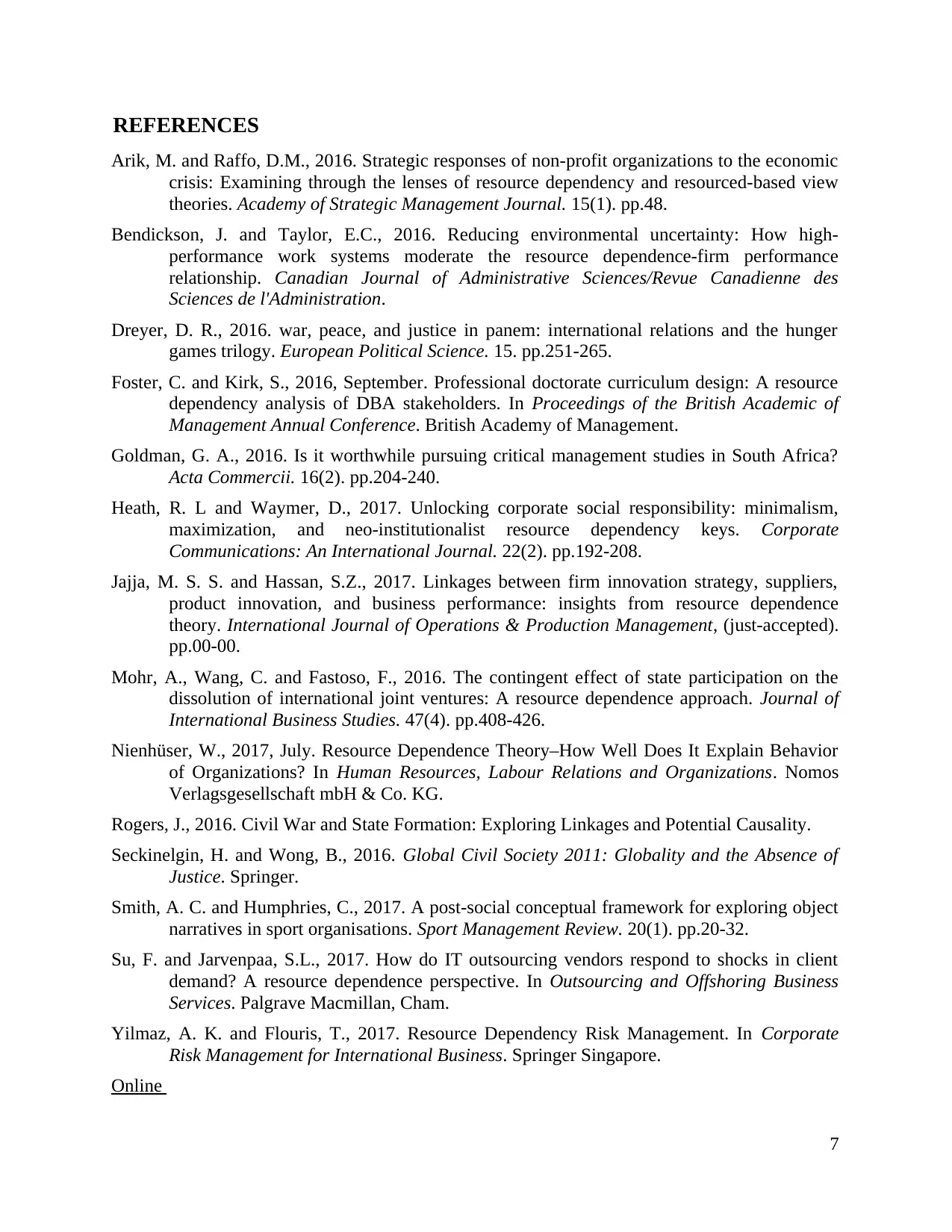
REFERENCES
Arik, M. and Raffo, D.M., 2016. Strategic responses of non-profit organizations to the economic
crisis: Examining through the lenses of resource dependency and resourced-based view
theories. Academy of Strategic Management Journal. 15(1). pp.48.
Bendickson, J. and Taylor, E.C., 2016. Reducing environmental uncertainty: How high-
performance work systems moderate the resource dependence‐firm performance
relationship. Canadian Journal of Administrative Sciences/Revue Canadienne des
Sciences de l'Administration.
Dreyer, D. R., 2016. war, peace, and justice in panem: international relations and the hunger
games trilogy. European Political Science. 15. pp.251-265.
Foster, C. and Kirk, S., 2016, September. Professional doctorate curriculum design: A resource
dependency analysis of DBA stakeholders. In Proceedings of the British Academic of
Management Annual Conference. British Academy of Management.
Goldman, G. A., 2016. Is it worthwhile pursuing critical management studies in South Africa?
Acta Commercii. 16(2). pp.204-240.
Heath, R. L and Waymer, D., 2017. Unlocking corporate social responsibility: minimalism,
maximization, and neo-institutionalist resource dependency keys. Corporate
Communications: An International Journal. 22(2). pp.192-208.
Jajja, M. S. S. and Hassan, S.Z., 2017. Linkages between firm innovation strategy, suppliers,
product innovation, and business performance: insights from resource dependence
theory. International Journal of Operations & Production Management, (just-accepted).
pp.00-00.
Mohr, A., Wang, C. and Fastoso, F., 2016. The contingent effect of state participation on the
dissolution of international joint ventures: A resource dependence approach. Journal of
International Business Studies. 47(4). pp.408-426.
Nienhüser, W., 2017, July. Resource Dependence Theory–How Well Does It Explain Behavior
of Organizations? In Human Resources, Labour Relations and Organizations. Nomos
Verlagsgesellschaft mbH & Co. KG.
Rogers, J., 2016. Civil War and State Formation: Exploring Linkages and Potential Causality.
Seckinelgin, H. and Wong, B., 2016. Global Civil Society 2011: Globality and the Absence of
Justice. Springer.
Smith, A. C. and Humphries, C., 2017. A post-social conceptual framework for exploring object
narratives in sport organisations. Sport Management Review. 20(1). pp.20-32.
Su, F. and Jarvenpaa, S.L., 2017. How do IT outsourcing vendors respond to shocks in client
demand? A resource dependence perspective. In Outsourcing and Offshoring Business
Services. Palgrave Macmillan, Cham.
Yilmaz, A. K. and Flouris, T., 2017. Resource Dependency Risk Management. In Corporate
Risk Management for International Business. Springer Singapore.
Online
7
Arik, M. and Raffo, D.M., 2016. Strategic responses of non-profit organizations to the economic
crisis: Examining through the lenses of resource dependency and resourced-based view
theories. Academy of Strategic Management Journal. 15(1). pp.48.
Bendickson, J. and Taylor, E.C., 2016. Reducing environmental uncertainty: How high-
performance work systems moderate the resource dependence‐firm performance
relationship. Canadian Journal of Administrative Sciences/Revue Canadienne des
Sciences de l'Administration.
Dreyer, D. R., 2016. war, peace, and justice in panem: international relations and the hunger
games trilogy. European Political Science. 15. pp.251-265.
Foster, C. and Kirk, S., 2016, September. Professional doctorate curriculum design: A resource
dependency analysis of DBA stakeholders. In Proceedings of the British Academic of
Management Annual Conference. British Academy of Management.
Goldman, G. A., 2016. Is it worthwhile pursuing critical management studies in South Africa?
Acta Commercii. 16(2). pp.204-240.
Heath, R. L and Waymer, D., 2017. Unlocking corporate social responsibility: minimalism,
maximization, and neo-institutionalist resource dependency keys. Corporate
Communications: An International Journal. 22(2). pp.192-208.
Jajja, M. S. S. and Hassan, S.Z., 2017. Linkages between firm innovation strategy, suppliers,
product innovation, and business performance: insights from resource dependence
theory. International Journal of Operations & Production Management, (just-accepted).
pp.00-00.
Mohr, A., Wang, C. and Fastoso, F., 2016. The contingent effect of state participation on the
dissolution of international joint ventures: A resource dependence approach. Journal of
International Business Studies. 47(4). pp.408-426.
Nienhüser, W., 2017, July. Resource Dependence Theory–How Well Does It Explain Behavior
of Organizations? In Human Resources, Labour Relations and Organizations. Nomos
Verlagsgesellschaft mbH & Co. KG.
Rogers, J., 2016. Civil War and State Formation: Exploring Linkages and Potential Causality.
Seckinelgin, H. and Wong, B., 2016. Global Civil Society 2011: Globality and the Absence of
Justice. Springer.
Smith, A. C. and Humphries, C., 2017. A post-social conceptual framework for exploring object
narratives in sport organisations. Sport Management Review. 20(1). pp.20-32.
Su, F. and Jarvenpaa, S.L., 2017. How do IT outsourcing vendors respond to shocks in client
demand? A resource dependence perspective. In Outsourcing and Offshoring Business
Services. Palgrave Macmillan, Cham.
Yilmaz, A. K. and Flouris, T., 2017. Resource Dependency Risk Management. In Corporate
Risk Management for International Business. Springer Singapore.
Online
7
⊘ This is a preview!⊘
Do you want full access?
Subscribe today to unlock all pages.
Trusted by 1+ million students worldwide

Resource Dependency Theory. 2017. [Online]Available through:<https://www.hrzone.com/hr-
glossary/what-is-resource-dependence-theory-rdt>[Accessed on 27 October 2017]
8
glossary/what-is-resource-dependence-theory-rdt>[Accessed on 27 October 2017]
8

1 out of 10


Related Documents


Your All-in-One AI-Powered Toolkit for Academic Success.
+13062052269
info@desklib.com
Available 24*7 on WhatsApp / Email
![[object Object]](/_next/static/media/star-bottom.7253800d.svg)
Unlock your academic potential
Copyright © 2020–2026 A2Z Services. All Rights Reserved. Developed and managed by ZUCOL.