The Tragic Extinction of Western Black Rhinoceros: A BIO 111 Report

Verified

Added on  2022/09/08

|1
|357
|18
Report
AI Summary
This report details the extinction of the Western Black Rhinoceros (Diceros bicornis longipes). It provides general information about the species, including its biological classification, lifespan, physical characteristics, and habitat, which was primarily semi-desert savannahs, forest woodlands, and wetlands. The report outlines the efforts of organizations like the World Wildlife Fund (WWF) in rhino conservation, highlighting their work in countries such as Kenya, Namibia, and South Africa. The report also traces the extinction history of the rhino, from a population of 850,000 in the 20th century to its official declaration of extinction in 2011, with poaching for their horns being the primary cause. Additional factors such as agriculture and human settlements are also discussed as contributors to habitat loss. The report includes amazing facts about the Western Black Rhinoceros and references relevant sources like IUCN and WWF.
Document Page
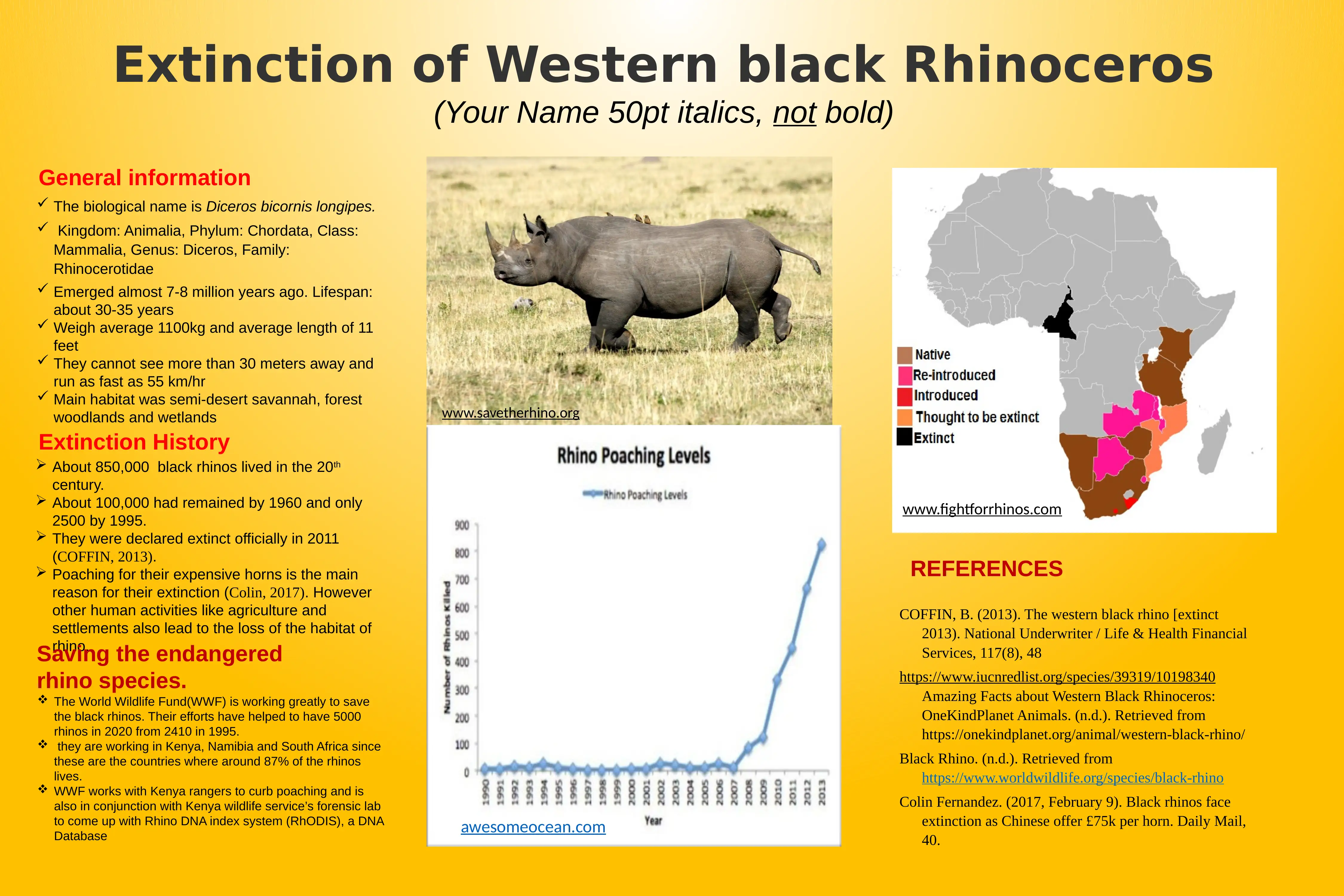
Extinction of Western black Rhinoceros
(Your Name 50pt italics, not bold)
General information
The biological name is Diceros bicornis longipes.
Kingdom: Animalia, Phylum: Chordata, Class:
Mammalia, Genus: Diceros, Family:
Rhinocerotidae
Emerged almost 7-8 million years ago. Lifespan:
about 30-35 years
Weigh average 1100kg and average length of 11
feet
They cannot see more than 30 meters away and
run as fast as 55 km/hr
Main habitat was semi-desert savannah, forest
woodlands and wetlands
The World Wildlife Fund(WWF) is working greatly to save
the black rhinos. Their efforts have helped to have 5000
rhinos in 2020 from 2410 in 1995.
they are working in Kenya, Namibia and South Africa since
these are the countries where around 87% of the rhinos
lives.
WWF works with Kenya rangers to curb poaching and is
also in conjunction with Kenya wildlife service’s forensic lab
to come up with Rhino DNA index system (RhODIS), a DNA
Database
Extinction History
About 850,000 black rhinos lived in the 20th
century.
About 100,000 had remained by 1960 and only
2500 by 1995.
They were declared extinct officially in 2011
(COFFIN, 2013).
Poaching for their expensive horns is the main
reason for their extinction (Colin, 2017). However
other human activities like agriculture and
settlements also lead to the loss of the habitat of
rhino.
Saving the endangered
rhino species.
COFFIN, B. (2013). The western black rhino [extinct
2013). National Underwriter / Life & Health Financial
Services, 117(8), 48
https://www.iucnredlist.org/species/39319/10198340
Amazing Facts about Western Black Rhinoceros:
OneKindPlanet Animals. (n.d.). Retrieved from
https://onekindplanet.org/animal/western-black-rhino/
Black Rhino. (n.d.). Retrieved from
https://www.worldwildlife.org/species/black-rhino
Colin Fernandez. (2017, February 9). Black rhinos face
extinction as Chinese offer £75k per horn. Daily Mail,
40.
REFERENCES
www.savetherhino.org
www.fightforrhinos.com
awesomeocean.com
tabler-icon-diamond-filled.svg

Paraphrase This Document

Need a fresh take? Get an instant paraphrase of this document with our AI Paraphraser
[object Object]