Mechanical Engineering Project: LPG Cylinder Design Analysis

Verified

Added on  2023/03/31

|1
|389
|291
Project
AI Summary
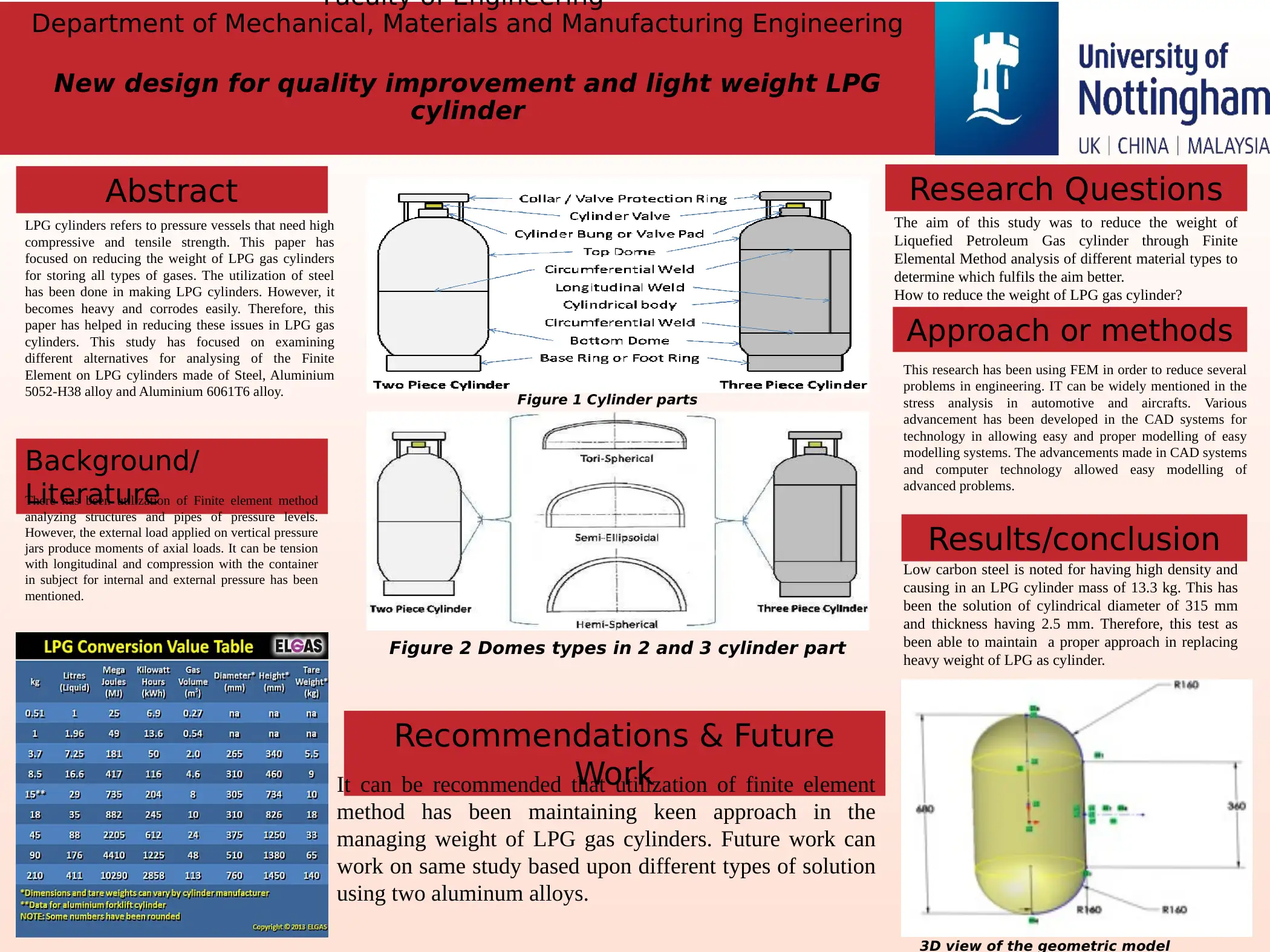
This project investigates the design and weight reduction of Liquefied Petroleum Gas (LPG) cylinders, which are pressure vessels requiring high compressive and tensile strength. The study aims to address the issues of heavy weight and corrosion associated with traditional steel cylinders by exploring alternative materials like Aluminum 5052-H38 and Aluminum 6061T6 alloys. The research employs the Finite Element Method (FEM) analysis to evaluate the performance of cylinders made from steel and aluminum alloys, with the goal of identifying the material that best achieves weight reduction. The project includes a literature review of FEM applications, a discussion of cylinder design, and the analysis of different cylinder parts, such as dome types. The results highlight the high density of low carbon steel and its impact on cylinder mass. The recommendations suggest using FEM for weight management in LPG cylinders and propose future work involving further analysis using aluminum alloys. The project provides a 3D view of the geometric model and a declaration of originality confirming the student's contribution.
Document Page
Faculty of Engineering
Department of Mechanical, Materials and Manufacturing Engineering
New design for quality improvement and light weight LPG
cylinder
Abstract
LPG cylinders refers to pressure vessels that need high
compressive and tensile strength. This paper has
focused on reducing the weight of LPG gas cylinders
for storing all types of gases. The utilization of steel
has been done in making LPG cylinders. However, it
becomes heavy and corrodes easily. Therefore, this
paper has helped in reducing these issues in LPG gas
cylinders. This study has focused on examining
different alternatives for analysing of the Finite
Element on LPG cylinders made of Steel, Aluminium
5052-H38 alloy and Aluminium 6061T6 alloy.
Background/
LiteratureThere has been utilization of Finite element method
analyzing structures and pipes of pressure levels.
However, the external load applied on vertical pressure
jars produce moments of axial loads. It can be tension
with longitudinal and compression with the container
in subject for internal and external pressure has been
mentioned.
Research Questions
The aim of this study was to reduce the weight of
Liquefied Petroleum Gas cylinder through Finite
Elemental Method analysis of different material types to
determine which fulfils the aim better.
How to reduce the weight of LPG gas cylinder?
Approach or methods
Results/conclusion
This research has been using FEM in order to reduce several
problems in engineering. IT can be widely mentioned in the
stress analysis in automotive and aircrafts. Various
advancement has been developed in the CAD systems for
technology in allowing easy and proper modelling of easy
modelling systems. The advancements made in CAD systems
and computer technology allowed easy modelling of
advanced problems.
Low carbon steel is noted for having high density and
causing in an LPG cylinder mass of 13.3 kg. This has
been the solution of cylindrical diameter of 315 mm
and thickness having 2.5 mm. Therefore, this test as
been able to maintain a proper approach in replacing
heavy weight of LPG as cylinder.
Recommendations & Future
WorkIt can be recommended that utilization of finite element
method has been maintaining keen approach in the
managing weight of LPG gas cylinders. Future work can
work on same study based upon different types of solution
using two aluminum alloys.
Figure 1 Cylinder parts
Figure 2 Domes types in 2 and 3 cylinder part
3D view of the geometric model
tabler-icon-diamond-filled.svg

Paraphrase This Document

Need a fresh take? Get an instant paraphrase of this document with our AI Paraphraser
[object Object]