Analysis of Fallacies in Fruit Juice Advertisements and Their Impact

Verified

Added on  2023/06/13

|7
|910
|417
Homework Assignment
AI Summary
This assignment provides an analysis of three advertisements promoting fruit juice, particularly targeting children, and identifies fallacies within these ads. The core issue is the promotion of fruit juice as a healthy and natural dietary choice, with advertisers claiming it's equivalent to whole fruits. The analysis reveals fallacies such as equating fruit juice to whole fruits despite the loss of fiber, minerals, and phytochemicals, and falsely labeling packaged drinks as 100% natural. The high fructose concentration in fruit juice, coupled with the lack of fiber, leads to overconsumption and increased risks of childhood obesity and diabetes. The addition of preservatives further diminishes the 'natural' claim. The assignment concludes that these advertisements are misleading and pose a risk to public health by promoting an unhealthy product as a healthy choice. Desklib provides a platform for students to access similar solved assignments and past papers for academic assistance.
Document Page
Running head: Fallacious advertisements
Fallacious Ads
Name of the Student
Name of the University
Author Note
tabler-icon-diamond-filled.svg

Paraphrase This Document

Need a fresh take? Get an instant paraphrase of this document with our AI Paraphraser
Document Page
1Fallacious advertisements
The following discussion is on 3 selective advertisements that promotes fruit jouce and 100%
natural fruit juice for consumption by children, and marketed as 100% natural and safe diet
choice. The three images below highlights key aspects of the advertisement:
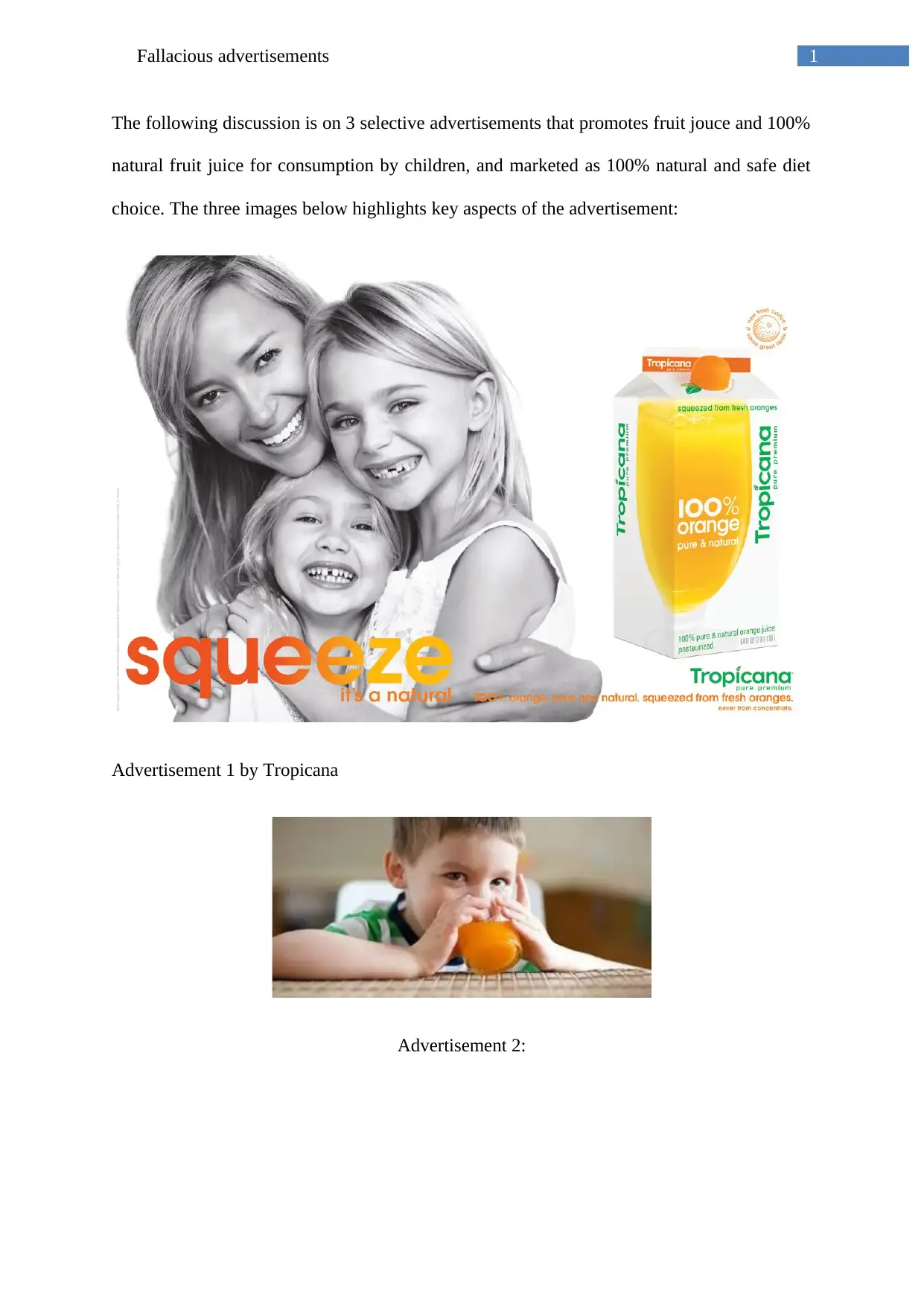
Advertisement 1 by Tropicana
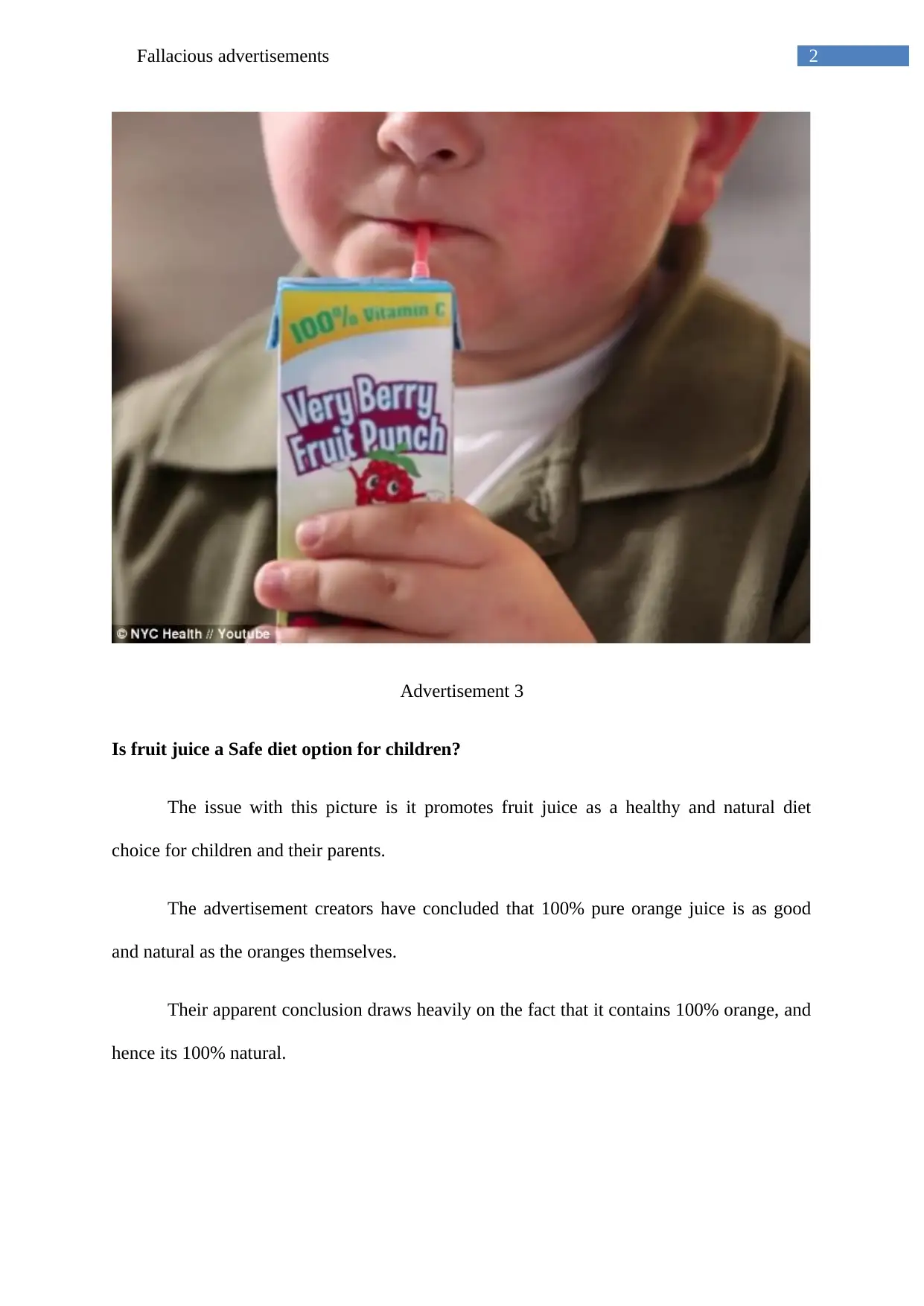
Advertisement 2:
Document Page
2Fallacious advertisements
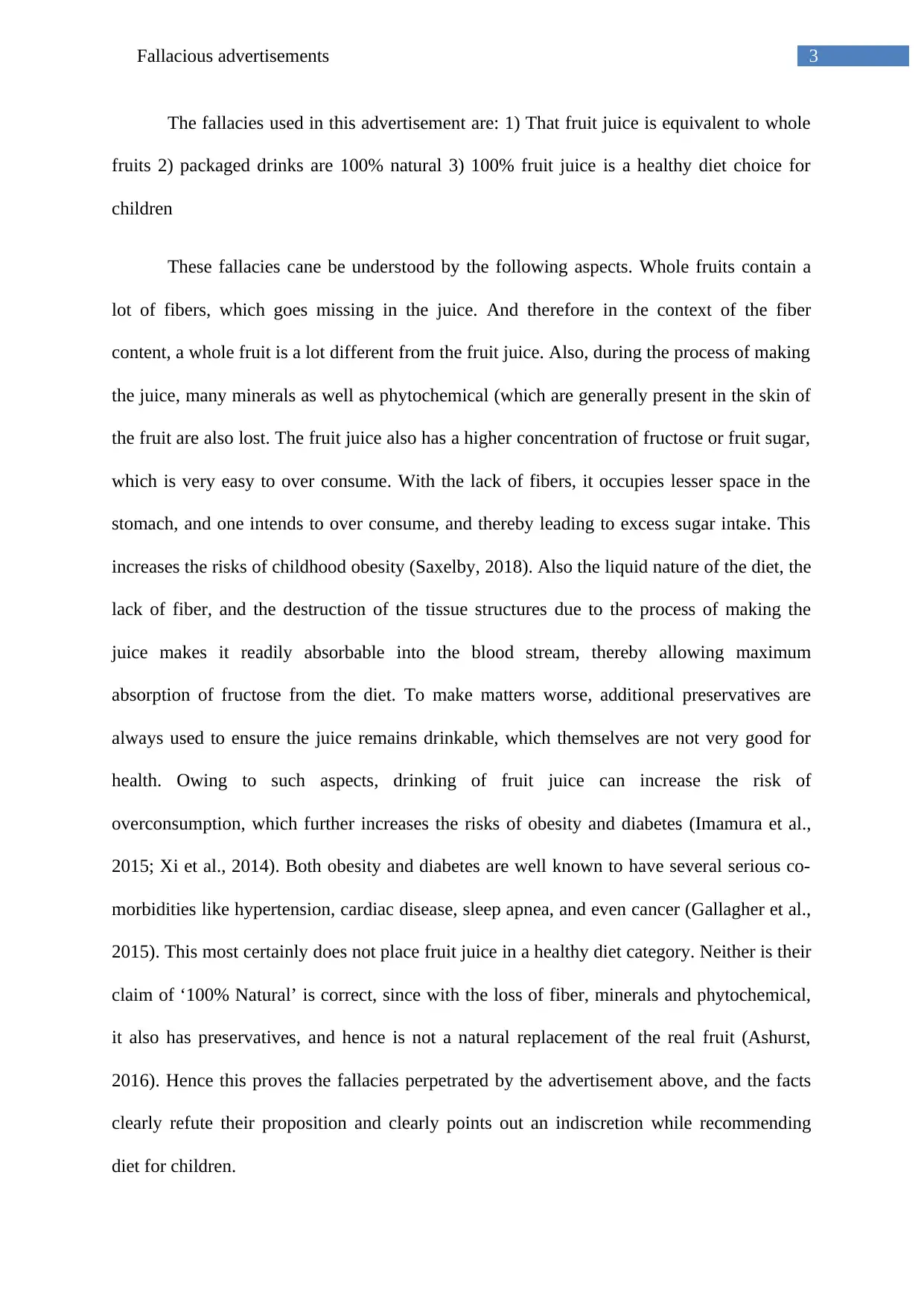
Advertisement 3
Is fruit juice a Safe diet option for children?
The issue with this picture is it promotes fruit juice as a healthy and natural diet
choice for children and their parents.
The advertisement creators have concluded that 100% pure orange juice is as good
and natural as the oranges themselves.
Their apparent conclusion draws heavily on the fact that it contains 100% orange, and
hence its 100% natural.
Document Page
3Fallacious advertisements
The fallacies used in this advertisement are: 1) That fruit juice is equivalent to whole
fruits 2) packaged drinks are 100% natural 3) 100% fruit juice is a healthy diet choice for
children
These fallacies cane be understood by the following aspects. Whole fruits contain a
lot of fibers, which goes missing in the juice. And therefore in the context of the fiber
content, a whole fruit is a lot different from the fruit juice. Also, during the process of making
the juice, many minerals as well as phytochemical (which are generally present in the skin of
the fruit are also lost. The fruit juice also has a higher concentration of fructose or fruit sugar,
which is very easy to over consume. With the lack of fibers, it occupies lesser space in the
stomach, and one intends to over consume, and thereby leading to excess sugar intake. This
increases the risks of childhood obesity (Saxelby, 2018). Also the liquid nature of the diet, the
lack of fiber, and the destruction of the tissue structures due to the process of making the
juice makes it readily absorbable into the blood stream, thereby allowing maximum
absorption of fructose from the diet. To make matters worse, additional preservatives are
always used to ensure the juice remains drinkable, which themselves are not very good for
health. Owing to such aspects, drinking of fruit juice can increase the risk of
overconsumption, which further increases the risks of obesity and diabetes (Imamura et al.,
2015; Xi et al., 2014). Both obesity and diabetes are well known to have several serious co-
morbidities like hypertension, cardiac disease, sleep apnea, and even cancer (Gallagher et al.,
2015). This most certainly does not place fruit juice in a healthy diet category. Neither is their
claim of ‘100% Natural’ is correct, since with the loss of fiber, minerals and phytochemical,
it also has preservatives, and hence is not a natural replacement of the real fruit (Ashurst,
2016). Hence this proves the fallacies perpetrated by the advertisement above, and the facts
clearly refute their proposition and clearly points out an indiscretion while recommending
diet for children.
tabler-icon-diamond-filled.svg

Paraphrase This Document

Need a fresh take? Get an instant paraphrase of this document with our AI Paraphraser
Document Page
4Fallacious advertisements
The depiction of a happy family with the picture of the pack of juice implies that the
100% natural juice is a healthy food option for children. The picture puts across an
unpersuasive argument considering the health effects of drinking fruit juice. Marketing fruit
juice as 100% natural is also completely misleading, and puts at risk the health of the public.
What the picture tries to put across mildly is a food that can lead to several different types of
health conditions, under the guise of a 100% natural food product.
Document Page
5Fallacious advertisements
References:
Ashurst, P. R. (2016). Chemistry and technology of soft drinks and fruit juices. John Wiley &
Sons.
Gallagher, E. J., & LeRoith, D. (2015). Obesity and diabetes: the increased risk of cancer and
cancer-related mortality. Physiological reviews, 95(3), 727-748.
Imamura, F., O’Connor, L., Ye, Z., Mursu, J., Hayashino, Y., Bhupathiraju, S. N., & Forouhi,
N. G. (2015). Consumption of sugar sweetened beverages, artificially sweetened
beverages, and fruit juice and incidence of type 2 diabetes: systematic review, meta-
analysis, and estimation of population attributable fraction. Bmj, 351, h3576.
Saxelby, C. (2018). Juice is NOT the same as whole fruit - Catherine Saxelby's
Foodwatch. Catherine Saxelby's Foodwatch. Retrieved 29 March 2018, from
https://foodwatch.com.au/blog/healthy-eating-for-wellness/item/juice-is-not-the-
same-as-whole-fruit.html
Xi, B., Li, S., Liu, Z., Tian, H., Yin, X., Huai, P., ... & Steffen, L. M. (2014). Intake of fruit
juice and incidence of type 2 diabetes: a systematic review and meta-analysis. PloS
one, 9(3), e93471.
Document Page
6Fallacious advertisements
chevron_up_icon
1 out of 7
circle_padding
hide_on_mobile
zoom_out_icon
[object Object]