Detailed Report on Feedback and Miscommunication Analysis

Verified

Added on  2023/06/15

|7
|1260
|211
Report
AI Summary
This report examines the multifaceted roles of feedback and communication, emphasizing their significance in both professional and personal contexts. It details the importance of various feedback types, including positive, negative, and constructive, and their impact on motivation and performance. The report further investigates the causes of miscommunication, such as language barriers, assumptions, and lack of listening, and proposes remedies to mitigate these issues through clear and patient communication. Ultimately, it concludes that feedback and miscommunication are interrelated concepts that significantly influence interactions and outcomes in various life domains, highlighting the necessity for effective communication strategies.

Document Page
Running head: FEEDBACK AND COMMUICATION
Feedback and Communication
Name of the Student
Name of the University
Author note
tabler-icon-diamond-filled.svg

Paraphrase This Document

Need a fresh take? Get an instant paraphrase of this document with our AI Paraphraser
Document Page
1FEEDBACK AND COMMUNICATION
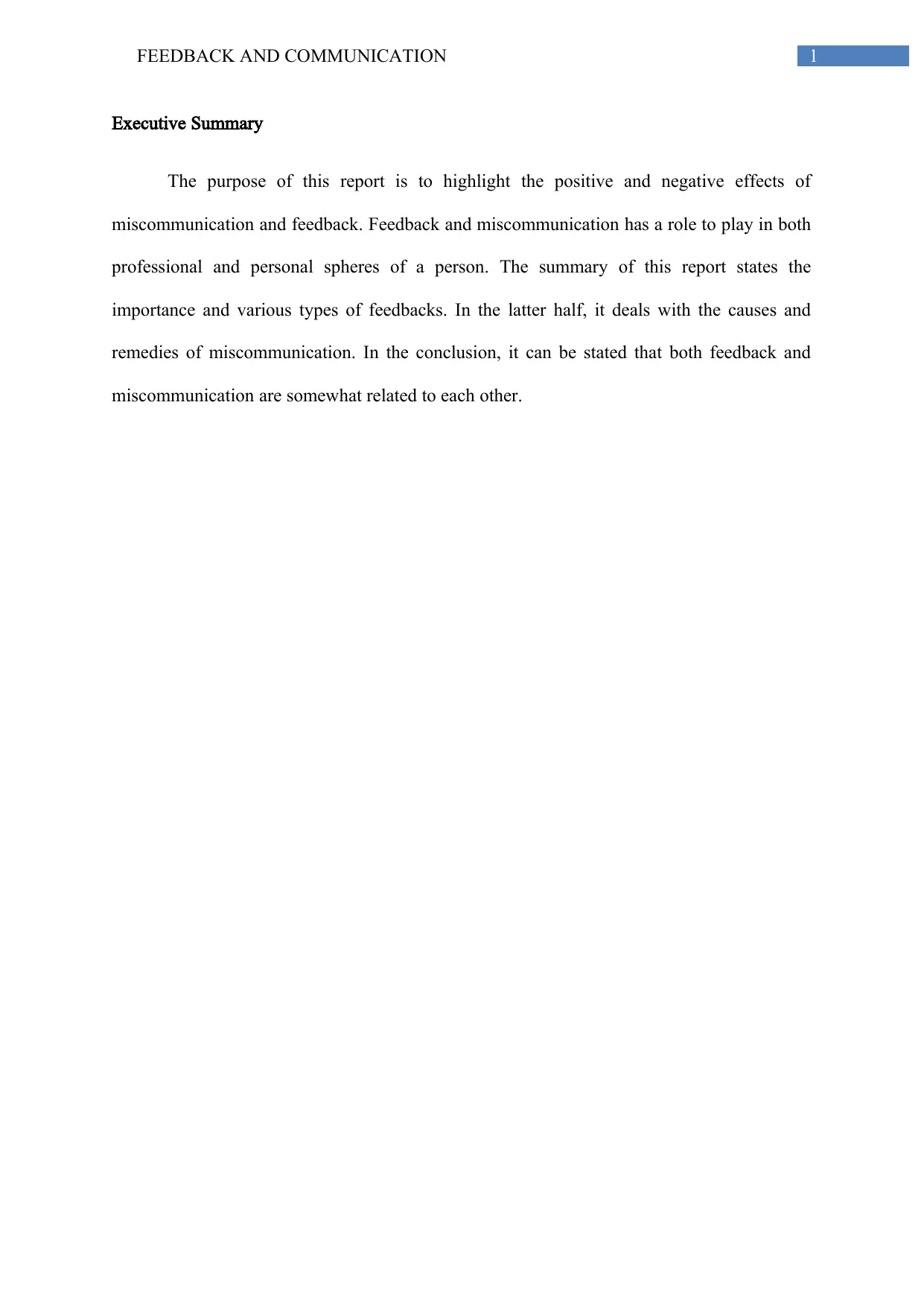
Executive Summary
The purpose of this report is to highlight the positive and negative effects of
miscommunication and feedback. Feedback and miscommunication has a role to play in both
professional and personal spheres of a person. The summary of this report states the
importance and various types of feedbacks. In the latter half, it deals with the causes and
remedies of miscommunication. In the conclusion, it can be stated that both feedback and
miscommunication are somewhat related to each other.
Document Page
2FEEDBACK AND COMMUNICATION
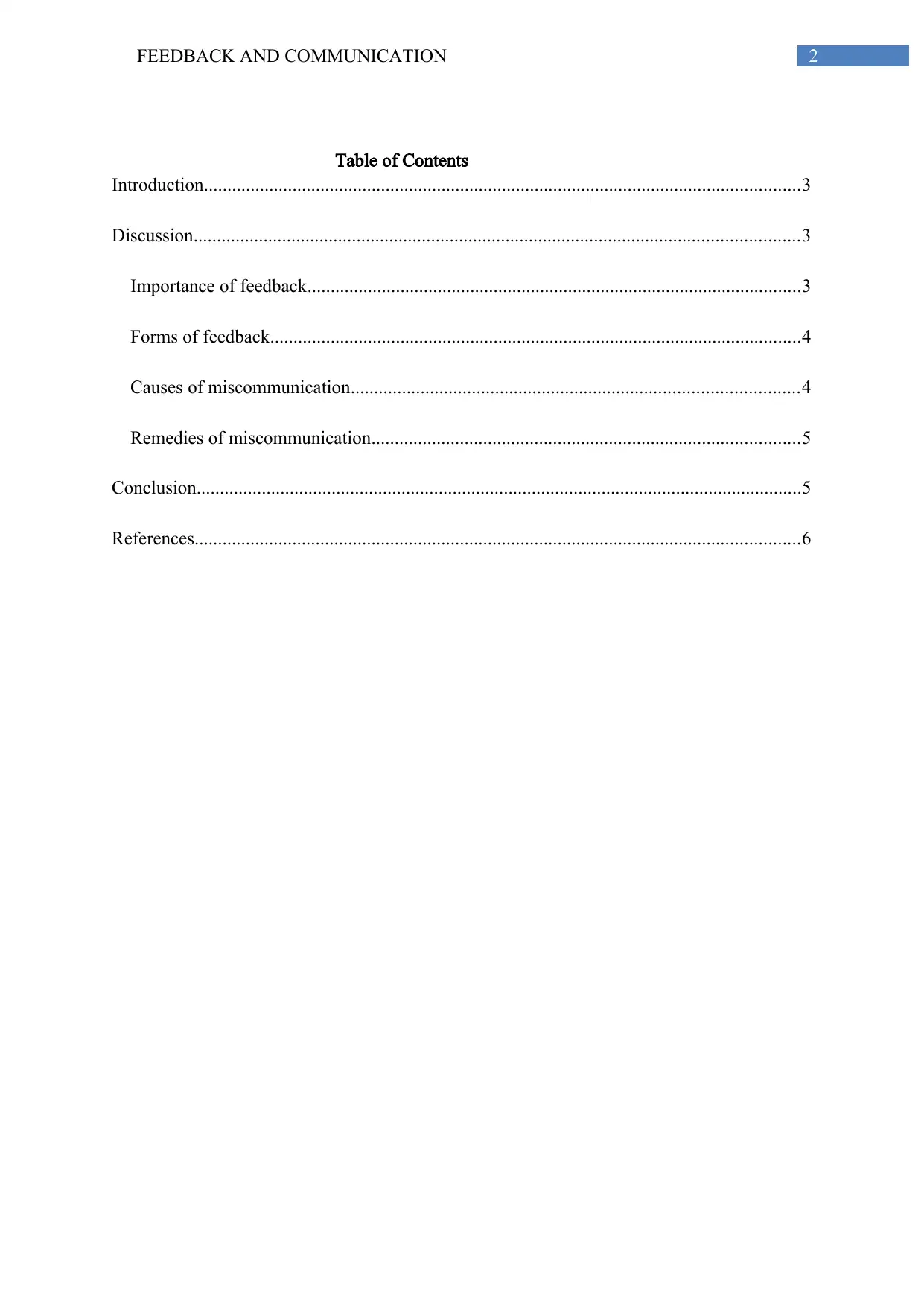
Table of Contents
Introduction................................................................................................................................3
Discussion..................................................................................................................................3
Importance of feedback..........................................................................................................3
Forms of feedback..................................................................................................................4
Causes of miscommunication................................................................................................4
Remedies of miscommunication............................................................................................5
Conclusion..................................................................................................................................5
References..................................................................................................................................6
Document Page
3FEEDBACK AND COMMUNICATION
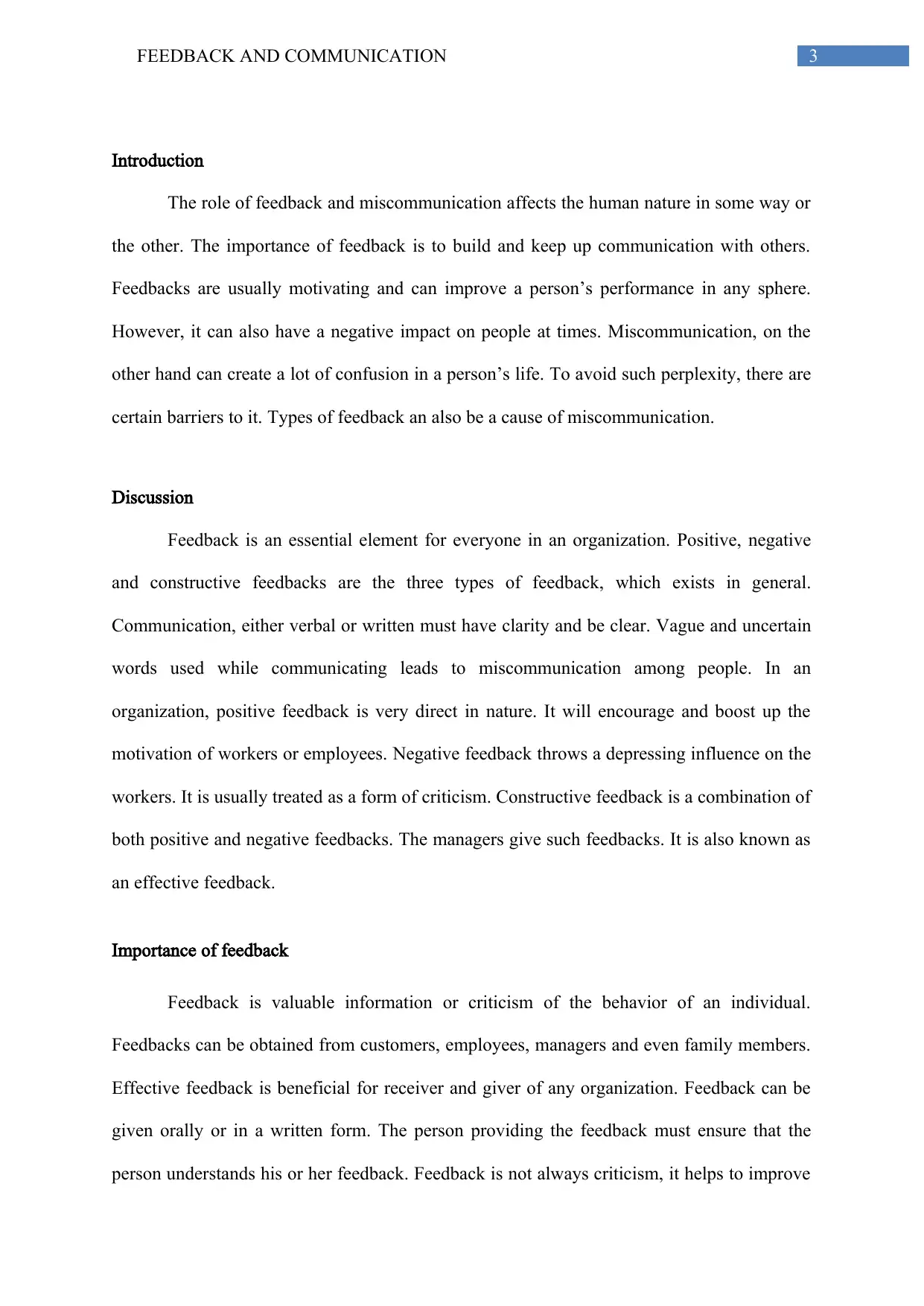
Introduction
The role of feedback and miscommunication affects the human nature in some way or
the other. The importance of feedback is to build and keep up communication with others.
Feedbacks are usually motivating and can improve a person’s performance in any sphere.
However, it can also have a negative impact on people at times. Miscommunication, on the
other hand can create a lot of confusion in a person’s life. To avoid such perplexity, there are
certain barriers to it. Types of feedback an also be a cause of miscommunication.
Discussion
Feedback is an essential element for everyone in an organization. Positive, negative
and constructive feedbacks are the three types of feedback, which exists in general.
Communication, either verbal or written must have clarity and be clear. Vague and uncertain
words used while communicating leads to miscommunication among people. In an
organization, positive feedback is very direct in nature. It will encourage and boost up the
motivation of workers or employees. Negative feedback throws a depressing influence on the
workers. It is usually treated as a form of criticism. Constructive feedback is a combination of
both positive and negative feedbacks. The managers give such feedbacks. It is also known as
an effective feedback.
Importance of feedback
Feedback is valuable information or criticism of the behavior of an individual.
Feedbacks can be obtained from customers, employees, managers and even family members.
Effective feedback is beneficial for receiver and giver of any organization. Feedback can be
given orally or in a written form. The person providing the feedback must ensure that the
person understands his or her feedback. Feedback is not always criticism, it helps to improve
tabler-icon-diamond-filled.svg

Paraphrase This Document

Need a fresh take? Get an instant paraphrase of this document with our AI Paraphraser
Document Page
4FEEDBACK AND COMMUNICATION
and increase the performance of individuals. Employees like to provide feedbacks about their
company or any product because it makes them feel valued and important (Dixon et al.,
2015). It motivates them to some extent.
Forms of feedback
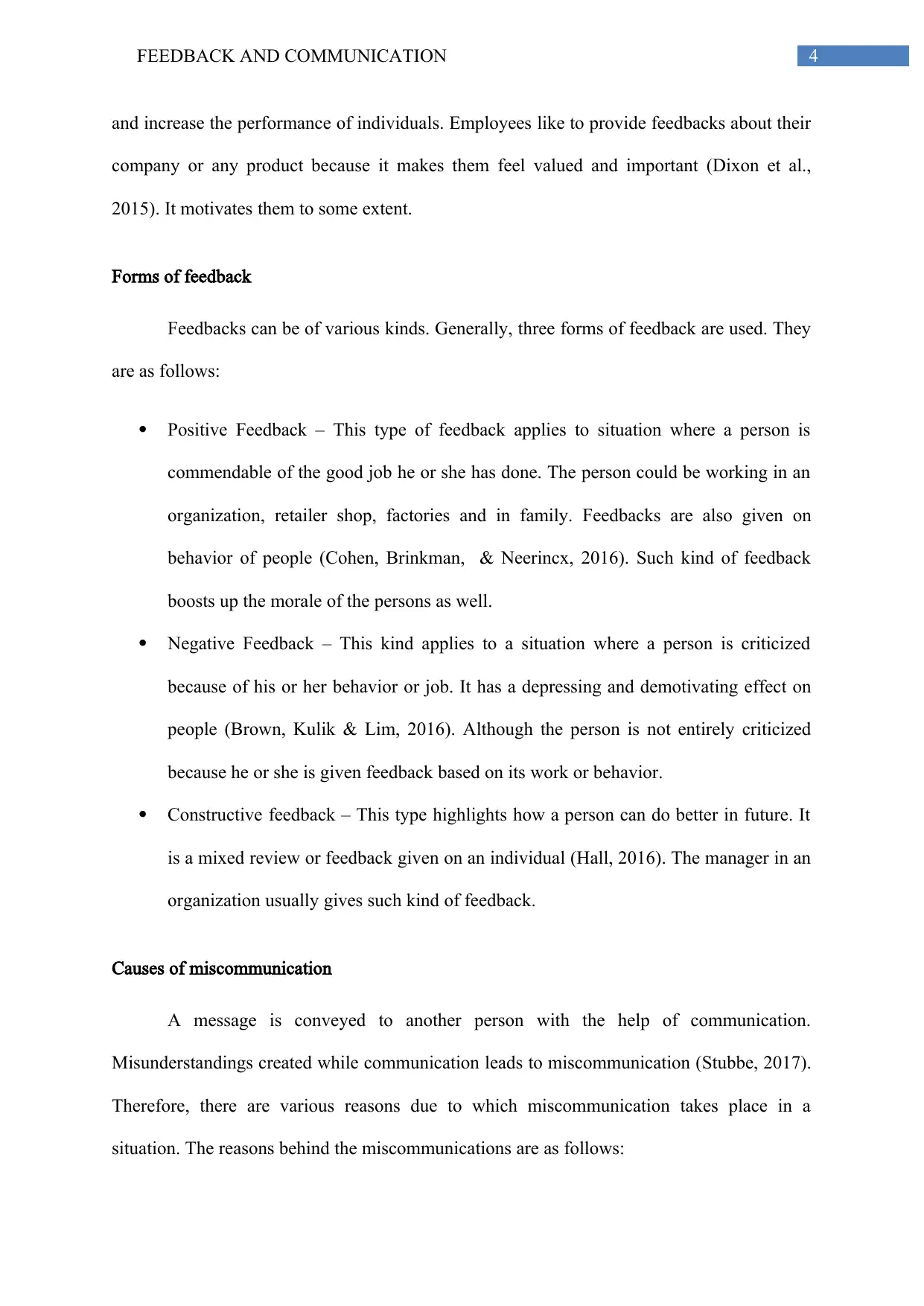
Feedbacks can be of various kinds. Generally, three forms of feedback are used. They
are as follows:
Positive Feedback – This type of feedback applies to situation where a person is
commendable of the good job he or she has done. The person could be working in an
organization, retailer shop, factories and in family. Feedbacks are also given on
behavior of people (Cohen, Brinkman, & Neerincx, 2016). Such kind of feedback
boosts up the morale of the persons as well.
Negative Feedback – This kind applies to a situation where a person is criticized
because of his or her behavior or job. It has a depressing and demotivating effect on
people (Brown, Kulik & Lim, 2016). Although the person is not entirely criticized
because he or she is given feedback based on its work or behavior.
Constructive feedback – This type highlights how a person can do better in future. It
is a mixed review or feedback given on an individual (Hall, 2016). The manager in an
organization usually gives such kind of feedback.
Causes of miscommunication
A message is conveyed to another person with the help of communication.
Misunderstandings created while communication leads to miscommunication (Stubbe, 2017).
Therefore, there are various reasons due to which miscommunication takes place in a
situation. The reasons behind the miscommunications are as follows:
Document Page
5FEEDBACK AND COMMUNICATION
Communication failure takes place due to language barriers. Generally people
misunderstands what the other person is speaking. The person giving the information
and the person receiving the information might not misunderstand.
Assumption is another reason of miscommunication. The communication fails if one
person assumes something out of nowhere. This creates a lot of confusion if it arises
in a meeting or when a contract is formed.
Lack of listening is also a form of miscommunication. When one person fails to listen
to another while communicating it leads to miscommunication. Due to such
miscommunication, important work or deadlines are delayed in a workplace.
Remedies of miscommunication
Miscommunication can be removed or fixed by being patient and a good listener. If
the communication takes place by a mail, it must be read through and written clearly. No
person must communicate by facial expressions (Brewer & Holmes, 2016). This increases
miscommunications among people. Therefore, miscommunications can be reduced by being
clear with the words and having clarity.
Conclusion
This reports focused on feedback and communication. Therefore, it can be concluded
that these two terms are somewhat related to each other to some extent. Type of feedbacks
can lead to miscommunication at times. Both the terms come into action when two or more
parties are communicating. Hence, feedback and miscommunication has a role to play in any
sphere of life.
Document Page
6FEEDBACK AND COMMUNICATION
References:
Brewer, E. C., & Holmes, T. L. (2016). Better Communication= Better Teams: A
Communication Exercise to Improve Team Performance.
IEEE Transactions on
Professional Communication,
59(3), 288-298.
Brown, M., Kulik, C. T., & Lim, V. (2016). Managerial tactics for communicating negative
performance feedback.
Personnel Review,
45(5), 969-987.
Cohen, I., Brinkman, W. P., & Neerincx, M. A. (2016). Effects of different real-time
feedback types on human performance in high-demanding work
conditions.
International Journal of Human-Computer Studies,
91, 1-12.
Dixon, G. N., Deline, M. B., McComas, K., Chambliss, L., & Hoffmann, M. (2015). Using
comparative feedback to influence workplace energy conservation: A case study of a
university campaign.
Environment and Behavior,
47(6), 667-693.
Hall, A. (2016). Exploring the workplace communication preferences of millennials.
Journal
of Organizational Culture, Communication and Conflict,
20, 35.
Stubbe, M. (2017). Miscommunication at Work.
The Routledge Handbook of Language in
the Workplace.
chevron_up_icon
1 out of 7
circle_padding
hide_on_mobile
zoom_out_icon
[object Object]