Detailed Analysis: Consequences of a Felony Criminal Record
VerifiedAdded on 2023/06/10
|10
|2561
|487
Essay
AI Summary
This essay delves into the multifaceted consequences of possessing a felony criminal record, exploring its impact on various aspects of an individual's life and society. The introduction establishes the core issue: the negative repercussions of a criminal background, which extend far beyond immediate punishments. The body of the essay is structured thematically, chronologically, and methodologically, analyzing the lasting effects on employment, business opportunities, and social integration. It references publications and trends, highlighting how criminal records create significant barriers to becoming productive citizens. The essay discusses the chronological progression of these consequences, the publications that document them, and the changing trends in criminal record management. It also addresses thematic elements, methodological approaches, and the current situation, providing a comprehensive overview of the challenges faced by individuals with felony convictions. The conclusion summarizes the key findings, emphasizing the need for understanding and addressing the social, political, and economic factors influencing these outcomes. The essay also highlights the historical context of the criminal justice system and its impact on policy and legislation.
Running head: CONSEQUENCES OF HAVING A FELONY CRIMINAL RECORD
Consequences of having a felony criminal record
Name of the Student
Name of the University
Author note
Consequences of having a felony criminal record
Name of the Student
Name of the University
Author note

Paraphrase This Document
Need a fresh take? Get an instant paraphrase of this document with our AI Paraphraser
1CONSEQUENCES OF HAVING A FELONY CRIMINAL RECORD
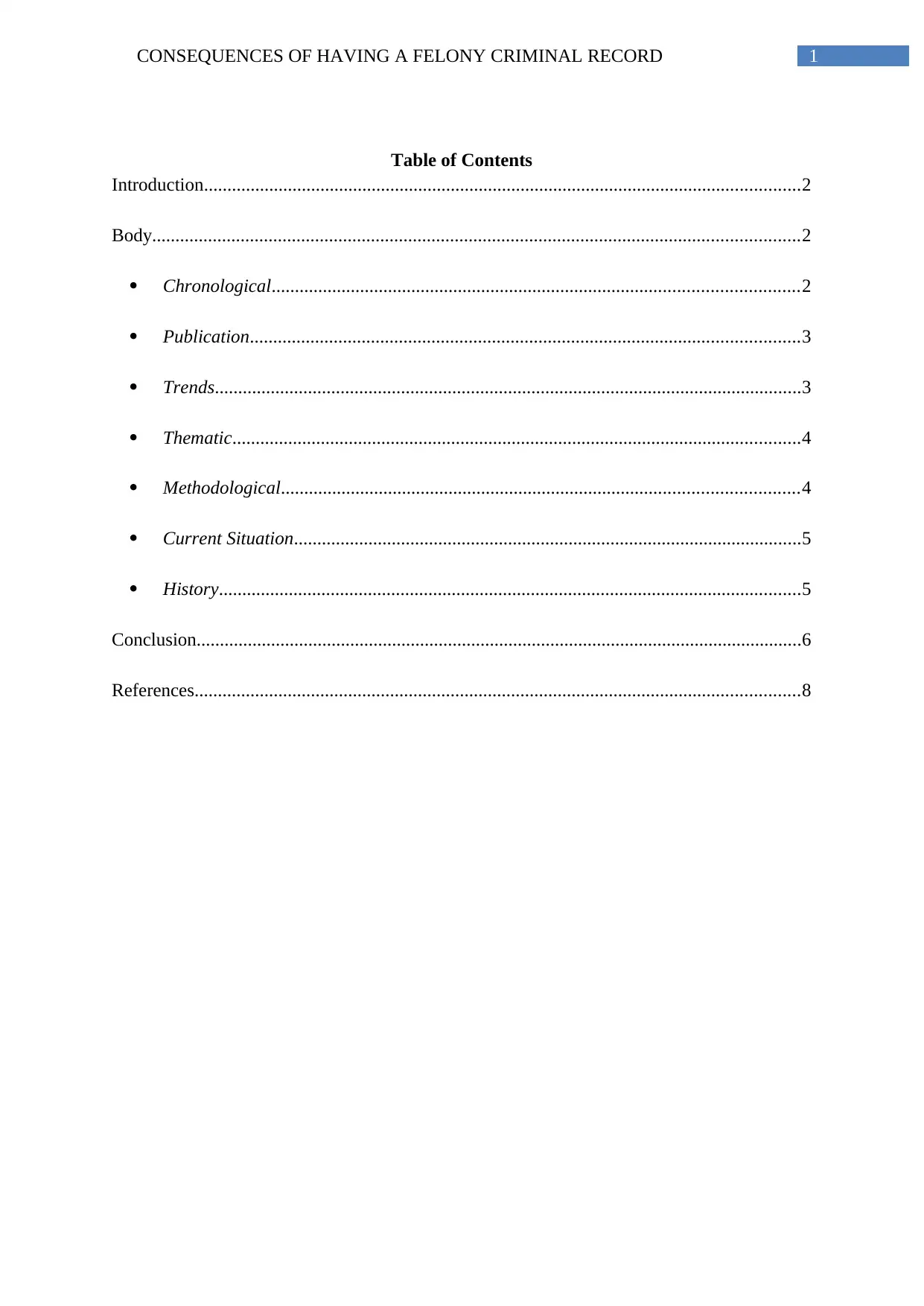
Table of Contents
Introduction................................................................................................................................2
Body...........................................................................................................................................2
Chronological.................................................................................................................2
Publication......................................................................................................................3
Trends..............................................................................................................................3
Thematic..........................................................................................................................4
Methodological...............................................................................................................4
Current Situation.............................................................................................................5
History.............................................................................................................................5
Conclusion..................................................................................................................................6
References..................................................................................................................................8
Table of Contents
Introduction................................................................................................................................2
Body...........................................................................................................................................2
Chronological.................................................................................................................2
Publication......................................................................................................................3
Trends..............................................................................................................................3
Thematic..........................................................................................................................4
Methodological...............................................................................................................4
Current Situation.............................................................................................................5
History.............................................................................................................................5
Conclusion..................................................................................................................................6
References..................................................................................................................................8
2CONSEQUENCES OF HAVING A FELONY CRIMINAL RECORD
Introduction
The general topic or the issue is related to the consequences of having a felony criminal
record. The area of the concern is that if an individual has a criminal record in the
background it will have a negative effect on his character. The issue of concern of this
situation states that any person having a criminal record will not have a positive outcome.
Therefore, criminal conviction helps in bringing a host of sanctions and an amount of
disqualification that can help in placing an unanticipated burden on people who try to enter
the society and lead the lives as productive citizens by not having any kind of criminal
record. Consequences of having a felony record have a habit of lasting for an indefinite
period after a person is being made fully rehabilitated. The trends that have been published in
this research points out and states the conflicts that take place in this theory. It has been
observed in this organization that there have been plenty of collateral consequences after
there have been a convicted individual’s employment and the opportunities of a business. The
mentioned consequences have a profound impact on the lives of the ones that have already
been convicted.
Body
Chronological – As per the criminal records of the American individuals, it has been
observed by one of the authors of the journal that this research was on the fact that
there are existing collateral consequences of the criminal conviction are considered to
be as the additional penalties of the civil state. The statute mandates these, which
attach to those criminal convictions caused by the criminal convictions. Having a
criminal record, will not help that individual in the future, as it will make a negative
impact no matter where they go (Denver, Siwach & Bushway, 2017). They will not be
considered a part of the direct consequences of the criminal convictions including
Introduction
The general topic or the issue is related to the consequences of having a felony criminal
record. The area of the concern is that if an individual has a criminal record in the
background it will have a negative effect on his character. The issue of concern of this
situation states that any person having a criminal record will not have a positive outcome.
Therefore, criminal conviction helps in bringing a host of sanctions and an amount of
disqualification that can help in placing an unanticipated burden on people who try to enter
the society and lead the lives as productive citizens by not having any kind of criminal
record. Consequences of having a felony record have a habit of lasting for an indefinite
period after a person is being made fully rehabilitated. The trends that have been published in
this research points out and states the conflicts that take place in this theory. It has been
observed in this organization that there have been plenty of collateral consequences after
there have been a convicted individual’s employment and the opportunities of a business. The
mentioned consequences have a profound impact on the lives of the ones that have already
been convicted.
Body
Chronological – As per the criminal records of the American individuals, it has been
observed by one of the authors of the journal that this research was on the fact that
there are existing collateral consequences of the criminal conviction are considered to
be as the additional penalties of the civil state. The statute mandates these, which
attach to those criminal convictions caused by the criminal convictions. Having a
criminal record, will not help that individual in the future, as it will make a negative
impact no matter where they go (Denver, Siwach & Bushway, 2017). They will not be
considered a part of the direct consequences of the criminal convictions including
⊘ This is a preview!⊘
Do you want full access?
Subscribe today to unlock all pages.

Trusted by 1+ million students worldwide
3CONSEQUENCES OF HAVING A FELONY CRIMINAL RECORD
fines, prison and the probation period that are faced by the felonies. There is a
criminal justice system, which is found to be in many forms consisting of house arrest
and imprisonment. The resources of the research conduct the process of handling the
individuals who have a criminal record and the consequences that they have to face.
Publication – The resources based on which the research has been made includes the
journals on the existing consequences of having a felony criminal record. The other
sources include all the other theories and journals based on which this has been
published in the non-profit organization. These sources publish the facts of what the
consequences are and how they are made. According to the perspective of modern
scholars, collateral consequences of the criminal conviction are not considered to be
the same as the social consequences of the conviction. This is because, social
consequences consists of the loss of a job or other issues. There is no such criminal
incident or intention associated with the social conviction. A person having a criminal
record will be bound to face the consequences due to the criminal incidents (Dobbie,
Goldin & Yang, 2018). In United States, the judges have the right to consider
collateral consequences during the procedure of sentencing as they impose the
proportionate and other artificial sentences.
Trends – If an individual who does not belong to the country and he or she is
convicted of an offence by carrying a life sentence will be barred from United States
for the rest of his life only if he is released from incarceration. Every state inflict these
certain consequences. In all the jurisdictions of the United States, the judges are not
usually obligated to warn of these collateral consequences for finding of guilt by trial
to the process of admission of the guilt by plea agreement except in case of the
regards of deportation. As per the data provided by the scholars and their opinions, it
can be stated that there have been a drastic change over the years. In the present
fines, prison and the probation period that are faced by the felonies. There is a
criminal justice system, which is found to be in many forms consisting of house arrest
and imprisonment. The resources of the research conduct the process of handling the
individuals who have a criminal record and the consequences that they have to face.
Publication – The resources based on which the research has been made includes the
journals on the existing consequences of having a felony criminal record. The other
sources include all the other theories and journals based on which this has been
published in the non-profit organization. These sources publish the facts of what the
consequences are and how they are made. According to the perspective of modern
scholars, collateral consequences of the criminal conviction are not considered to be
the same as the social consequences of the conviction. This is because, social
consequences consists of the loss of a job or other issues. There is no such criminal
incident or intention associated with the social conviction. A person having a criminal
record will be bound to face the consequences due to the criminal incidents (Dobbie,
Goldin & Yang, 2018). In United States, the judges have the right to consider
collateral consequences during the procedure of sentencing as they impose the
proportionate and other artificial sentences.
Trends – If an individual who does not belong to the country and he or she is
convicted of an offence by carrying a life sentence will be barred from United States
for the rest of his life only if he is released from incarceration. Every state inflict these
certain consequences. In all the jurisdictions of the United States, the judges are not
usually obligated to warn of these collateral consequences for finding of guilt by trial
to the process of admission of the guilt by plea agreement except in case of the
regards of deportation. As per the data provided by the scholars and their opinions, it
can be stated that there have been a drastic change over the years. In the present
Paraphrase This Document
Need a fresh take? Get an instant paraphrase of this document with our AI Paraphraser
4CONSEQUENCES OF HAVING A FELONY CRIMINAL RECORD
change, it can be said that there are ways by which the criminal records of individuals
can be managed. There have been evidence of the data where it was proved that the
rate of crimes have increased over the years. Due to this, having a criminal record is
very common in the present scenario.
Thematic – This organization, however deals with the issues that is related to the
ideas and themes, which helps in controlling the rate of crimes in the recent days. The
purpose is to take care of the situation and dealing with the crimes of the modern
times. It can be stated that there are valid reasons for reviewing the organization for
maintain the organizational structure (Leasure & Martin, 2017). This organization has
been structured in such a way for dealing with the consequences that are faced by
felonies for having a criminal record. A non-profit organization deals with the issues
and causes that are the reasons for forming the policies to handle the individuals who
have a criminal record. The purpose of the literature review is to overview the
resources with the help of which these criminal individuals are dealt with.
Methodological – There are existing groups that have done the research for this
organization, which was being conducted. The purpose of the organization was to
keep a check on the individuals who have a set of such criminal records. The method
chosen was to collect the research information from various sources as discussed by
the authors. As per the regulations and the relevant laws in the United States, it is not
easy to track down the criminal record and comprehend the consequences. Therefore,
the individuals associated with the criminal proceedings will not be able to realize the
entire ramifications of being found guilty or pleading to be guilty for any of the
necessary charges (Widdowson, Siennick & Hay, 2016). The evidence of this research
states that the felons who have committed criminal offences will not have the right to
vote. Felony crimes are considered to be those crimes that have more severe
change, it can be said that there are ways by which the criminal records of individuals
can be managed. There have been evidence of the data where it was proved that the
rate of crimes have increased over the years. Due to this, having a criminal record is
very common in the present scenario.
Thematic – This organization, however deals with the issues that is related to the
ideas and themes, which helps in controlling the rate of crimes in the recent days. The
purpose is to take care of the situation and dealing with the crimes of the modern
times. It can be stated that there are valid reasons for reviewing the organization for
maintain the organizational structure (Leasure & Martin, 2017). This organization has
been structured in such a way for dealing with the consequences that are faced by
felonies for having a criminal record. A non-profit organization deals with the issues
and causes that are the reasons for forming the policies to handle the individuals who
have a criminal record. The purpose of the literature review is to overview the
resources with the help of which these criminal individuals are dealt with.
Methodological – There are existing groups that have done the research for this
organization, which was being conducted. The purpose of the organization was to
keep a check on the individuals who have a set of such criminal records. The method
chosen was to collect the research information from various sources as discussed by
the authors. As per the regulations and the relevant laws in the United States, it is not
easy to track down the criminal record and comprehend the consequences. Therefore,
the individuals associated with the criminal proceedings will not be able to realize the
entire ramifications of being found guilty or pleading to be guilty for any of the
necessary charges (Widdowson, Siennick & Hay, 2016). The evidence of this research
states that the felons who have committed criminal offences will not have the right to
vote. Felony crimes are considered to be those crimes that have more severe
5CONSEQUENCES OF HAVING A FELONY CRIMINAL RECORD
punishment. In this particular organization, there have been theories dealing with the
criminal record of an individual.
Current Situation – The present scenario of criminal records is that there have been
major criminal issues in the country. As observed from the situation, it can be
observed that when an individual is generally charged with a crime, it is necessary for
them to hire criminal attorneys who would defend them in the Courts (Paulson, 2017).
The basic consequences that are faced by these individuals are that they suffer
employment loss and ca n get fired due to this record. An employer can therefore fire
its employees if they have a criminal background. The loss of income faced by them
will make it harder to pay the fines faced by them and difficult to comply with the
terms of the probation where the Court can impose a fine. History - It is worthwhile to refer here that, from the very beginning, history has
played significant role in influencing the development of the consequences of a felony
conviction. It is noteworthy to mention here that, with the development of the penal
system and the high rates of incarceration, a series of policy decisions were
developed. The nature of the policy decisions were such that it was intended to
increase the severity of the sanctions. The social, political, economic and institutional
forces has played significant role in influencing the consequences of felony criminal
record. It is worth mentioning that there was a sudden shift in the practices of criminal
justice system, policies and laws during the post war period that subsequently resulted
in high rates of incarceration. There was a sudden departure, which can be observed
from the historical experiences of the United States prior to the beginning of the
World War II. In this regard, it is worth noting that, the sudden departure was quite
distinct from the experiences faced by the other Western Countries during the second
part of the 20th century. Prior to the World War II, the process of making,
punishment. In this particular organization, there have been theories dealing with the
criminal record of an individual.
Current Situation – The present scenario of criminal records is that there have been
major criminal issues in the country. As observed from the situation, it can be
observed that when an individual is generally charged with a crime, it is necessary for
them to hire criminal attorneys who would defend them in the Courts (Paulson, 2017).
The basic consequences that are faced by these individuals are that they suffer
employment loss and ca n get fired due to this record. An employer can therefore fire
its employees if they have a criminal background. The loss of income faced by them
will make it harder to pay the fines faced by them and difficult to comply with the
terms of the probation where the Court can impose a fine. History - It is worthwhile to refer here that, from the very beginning, history has
played significant role in influencing the development of the consequences of a felony
conviction. It is noteworthy to mention here that, with the development of the penal
system and the high rates of incarceration, a series of policy decisions were
developed. The nature of the policy decisions were such that it was intended to
increase the severity of the sanctions. The social, political, economic and institutional
forces has played significant role in influencing the consequences of felony criminal
record. It is worth mentioning that there was a sudden shift in the practices of criminal
justice system, policies and laws during the post war period that subsequently resulted
in high rates of incarceration. There was a sudden departure, which can be observed
from the historical experiences of the United States prior to the beginning of the
World War II. In this regard, it is worth noting that, the sudden departure was quite
distinct from the experiences faced by the other Western Countries during the second
part of the 20th century. Prior to the World War II, the process of making,
⊘ This is a preview!⊘
Do you want full access?
Subscribe today to unlock all pages.
Trusted by 1+ million students worldwide
6CONSEQUENCES OF HAVING A FELONY CRIMINAL RECORD
implementing and enforcing the criminal justice policy was initiated in the United
States. However, from the beginning, these developments were set within the purview
of various states and local authorities and not within the federal government. At this
stage, various policy makers as well as public officials existing at different levels of
the government from the federal to the state sought to make necessary changes in the
functioning of judicial, policing and the nature of the prosecutorial behavior. As a
result of this, there have been significant changes in criminal justice policy and
legislation as well.
Conclusion
In the conclusion, it can be stated that, with the rise of various crimes, the trends are
being examined in regard to their social, political and institutional manner. However,
the underlying causes of the increase in incarceration rates are still unknown. The
rising of crime rates has been so far experienced by the other Western countries as
well. In spite of all these, the underlying issues prevailing in the social, political and
economical context has not been addressed yet. In this regard, it can be stated that the
other Western countries did not respond to the high rates of increased crime with the
adoption of various policies and laws (Lageson, 2016). It is evident that from the
beginning of the emergence of a new criminal justice system, it has been
characterized by harsh policies, practices and laws which has promoted high
incarceration rates. Various efforts were made on the part of the politicians and the
lawmakers at both state and federal levels for amending the policies of criminal
justice system. Due to which, practices were introduced at national level and in such
process, the growth of federal role was encouraged which played significant role in
the implementation of crime policies. It can be rightly stated that, as a result of these
implementing and enforcing the criminal justice policy was initiated in the United
States. However, from the beginning, these developments were set within the purview
of various states and local authorities and not within the federal government. At this
stage, various policy makers as well as public officials existing at different levels of
the government from the federal to the state sought to make necessary changes in the
functioning of judicial, policing and the nature of the prosecutorial behavior. As a
result of this, there have been significant changes in criminal justice policy and
legislation as well.
Conclusion
In the conclusion, it can be stated that, with the rise of various crimes, the trends are
being examined in regard to their social, political and institutional manner. However,
the underlying causes of the increase in incarceration rates are still unknown. The
rising of crime rates has been so far experienced by the other Western countries as
well. In spite of all these, the underlying issues prevailing in the social, political and
economical context has not been addressed yet. In this regard, it can be stated that the
other Western countries did not respond to the high rates of increased crime with the
adoption of various policies and laws (Lageson, 2016). It is evident that from the
beginning of the emergence of a new criminal justice system, it has been
characterized by harsh policies, practices and laws which has promoted high
incarceration rates. Various efforts were made on the part of the politicians and the
lawmakers at both state and federal levels for amending the policies of criminal
justice system. Due to which, practices were introduced at national level and in such
process, the growth of federal role was encouraged which played significant role in
the implementation of crime policies. It can be rightly stated that, as a result of these
Paraphrase This Document
Need a fresh take? Get an instant paraphrase of this document with our AI Paraphraser
7CONSEQUENCES OF HAVING A FELONY CRIMINAL RECORD
changes, the capacity of the government increased considerably in regard to pursuing
and punishing lawbreakers. However, this practice continued till the beginning of the
1970s and has been marked as a period of sanction of wide range of criminal
activities. Therefore, mention can be made of the concept of criminal justice which
became more persistent rather than acting as a intermittent issue towards the U.S
government. It is evident from the history of the United States that the politicians and
the public officials in the beginning of the 1960s were consistently deployed as a
result of implementation of criminal justice legislation and policies because they
treated the nature of crime as a national and local issue.
changes, the capacity of the government increased considerably in regard to pursuing
and punishing lawbreakers. However, this practice continued till the beginning of the
1970s and has been marked as a period of sanction of wide range of criminal
activities. Therefore, mention can be made of the concept of criminal justice which
became more persistent rather than acting as a intermittent issue towards the U.S
government. It is evident from the history of the United States that the politicians and
the public officials in the beginning of the 1960s were consistently deployed as a
result of implementation of criminal justice legislation and policies because they
treated the nature of crime as a national and local issue.
8CONSEQUENCES OF HAVING A FELONY CRIMINAL RECORD
References:
Adams, E. B., Chen, E. Y., & Chapman, R. (2017). Erasing the mark of a criminal past: Ex-
offenders’ expectations and experiences with record clearance. Punishment &
Society, 19(1), 23-52.
Agan, A., & Starr, S. (2017). The effect of criminal records on access to
employment. American Economic Review, 107(5), 560-64.
Decker, S. H., Ortiz, N., Spohn, C., & Hedberg, E. (2015). Criminal stigma, race, and
ethnicity: The consequences of imprisonment for employment. Journal of Criminal
Justice, 43(2), 108-121.
Denver, M., Siwach, G., & Bushway, S. D. (2017). A new look at the employment and
recidivism relationship through the lens of a criminal background
check. Criminology, 55(1), 174-204.
Dobbie, W., Goldin, J., & Yang, C. S. (2018). The Effects of Pretrial Detention on
Conviction, Future Crime, and Employment: Evidence from Randomly Assigned
Judges. American Economic Review, 108(2), 201-40.
Lageson, S. E. (2016). Found out and opting out: The consequences of online criminal
records for families. The ANNALS of the American Academy of Political and Social
Science, 665(1), 127-141.
Leasure, P., & Martin, T. (2017). Criminal records and housing: an experimental
study. Journal of Experimental Criminology, 13(4), 527-535.
Paulson, J. (2017). Supporting Human Service Students with Criminal Histories: Suggestions
for Effective Practice. In 2016 NOHS National Conference–Tampa, FL (p. 60).
References:
Adams, E. B., Chen, E. Y., & Chapman, R. (2017). Erasing the mark of a criminal past: Ex-
offenders’ expectations and experiences with record clearance. Punishment &
Society, 19(1), 23-52.
Agan, A., & Starr, S. (2017). The effect of criminal records on access to
employment. American Economic Review, 107(5), 560-64.
Decker, S. H., Ortiz, N., Spohn, C., & Hedberg, E. (2015). Criminal stigma, race, and
ethnicity: The consequences of imprisonment for employment. Journal of Criminal
Justice, 43(2), 108-121.
Denver, M., Siwach, G., & Bushway, S. D. (2017). A new look at the employment and
recidivism relationship through the lens of a criminal background
check. Criminology, 55(1), 174-204.
Dobbie, W., Goldin, J., & Yang, C. S. (2018). The Effects of Pretrial Detention on
Conviction, Future Crime, and Employment: Evidence from Randomly Assigned
Judges. American Economic Review, 108(2), 201-40.
Lageson, S. E. (2016). Found out and opting out: The consequences of online criminal
records for families. The ANNALS of the American Academy of Political and Social
Science, 665(1), 127-141.
Leasure, P., & Martin, T. (2017). Criminal records and housing: an experimental
study. Journal of Experimental Criminology, 13(4), 527-535.
Paulson, J. (2017). Supporting Human Service Students with Criminal Histories: Suggestions
for Effective Practice. In 2016 NOHS National Conference–Tampa, FL (p. 60).
⊘ This is a preview!⊘
Do you want full access?
Subscribe today to unlock all pages.
Trusted by 1+ million students worldwide
9CONSEQUENCES OF HAVING A FELONY CRIMINAL RECORD
Rossi, P. H. (2017). Armed and considered dangerous: A survey of felons and their firearms.
Routledge.
Shannon, S. K., Uggen, C., Schnittker, J., Thompson, M., Wakefield, S., & Massoglia, M.
(2017). The growth, scope, and spatial distribution of people with Felony records in
the United States, 1948–2010. Demography, 54(5), 1795-1818.
Webster, D. W., & Wintemute, G. J. (2015). Effects of policies designed to keep firearms
from high-risk individuals. Annual review of public health, 36, 21-37.
Widdowson, A. O., Siennick, S. E., & Hay, C. (2016). THE IMPLICATIONS OF ARREST
FOR COLLEGE ENROLLMENT: AN ANALYSIS OF LONG‐TERM EFFECTS
AND MEDIATING MECHANISMS. Criminology, 54(4), 621-652.
Rossi, P. H. (2017). Armed and considered dangerous: A survey of felons and their firearms.
Routledge.
Shannon, S. K., Uggen, C., Schnittker, J., Thompson, M., Wakefield, S., & Massoglia, M.
(2017). The growth, scope, and spatial distribution of people with Felony records in
the United States, 1948–2010. Demography, 54(5), 1795-1818.
Webster, D. W., & Wintemute, G. J. (2015). Effects of policies designed to keep firearms
from high-risk individuals. Annual review of public health, 36, 21-37.
Widdowson, A. O., Siennick, S. E., & Hay, C. (2016). THE IMPLICATIONS OF ARREST
FOR COLLEGE ENROLLMENT: AN ANALYSIS OF LONG‐TERM EFFECTS
AND MEDIATING MECHANISMS. Criminology, 54(4), 621-652.

1 out of 10


Related Documents


Your All-in-One AI-Powered Toolkit for Academic Success.
+13062052269
info@desklib.com
Available 24*7 on WhatsApp / Email
![[object Object]](/_next/static/media/star-bottom.7253800d.svg)
Unlock your academic potential
Copyright © 2020–2026 A2Z Services. All Rights Reserved. Developed and managed by ZUCOL.