Financial Analysis of Comvita Limited: A PESTLE Perspective
VerifiedAdded on 2023/03/20
|9
|1524
|80
Report
AI Summary
This report presents a comprehensive financial analysis of Comvita Limited, focusing on its performance metrics and the impact of external factors. The analysis begins with an executive summary that outlines the report's objectives, which include assessing the trends in Comvita's revenue, profit after tax, shareholder's equity, debtors, assets, and total debt over a five-year period. The report then delves into a detailed discussion of these financial trends, providing data-driven insights into the company's performance. Furthermore, a PESTLE analysis is conducted to examine the political, economic, socio-cultural, technological, environmental, and legal factors influencing Comvita's operations. This includes examining the impact of government regulations, economic conditions, consumer preferences, technological advancements, environmental sustainability, and legal frameworks. The report concludes by summarizing the key findings and highlighting the overall financial health and challenges faced by Comvita Limited. The analysis uses data from the company's annual reports and relevant academic sources to support its conclusions, providing a well-rounded assessment of Comvita's financial position and external influences.
Running head: FINANCE FOR MANAGERS
Finance for managers
Name of the student
Name of the university
Student ID
Author note
Finance for managers
Name of the student
Name of the university
Student ID
Author note
Paraphrase This Document
Need a fresh take? Get an instant paraphrase of this document with our AI Paraphraser

1FINANCE FOR MANAGERS
Executive summary
Objective of the report is analysing the financial performance of Comvita Limited. For analysis
purpose the report will consider the trends of the entity’s revenue, profit after tax, shareholder’s
equity, debtors, assets, total debt. In the next section the report will perform the Pestle analysis of
the entity that will highlight the impact of political, socio-cultural, technological, economical,
environmental and legal factors on the entity.
Executive summary
Objective of the report is analysing the financial performance of Comvita Limited. For analysis
purpose the report will consider the trends of the entity’s revenue, profit after tax, shareholder’s
equity, debtors, assets, total debt. In the next section the report will perform the Pestle analysis of
the entity that will highlight the impact of political, socio-cultural, technological, economical,
environmental and legal factors on the entity.

2FINANCE FOR MANAGERS
Table of Contents
Introduction......................................................................................................................................3
Discussions......................................................................................................................................3
PESTLE analysis.............................................................................................................................4
Conclusion.......................................................................................................................................5
Reference.........................................................................................................................................6
Table of Contents
Introduction......................................................................................................................................3
Discussions......................................................................................................................................3
PESTLE analysis.............................................................................................................................4
Conclusion.......................................................................................................................................5
Reference.........................................................................................................................................6
⊘ This is a preview!⊘
Do you want full access?
Subscribe today to unlock all pages.

Trusted by 1+ million students worldwide

3FINANCE FOR MANAGERS
Introduction
Aim of the report is to analyse the financial highlights of Comvita Limited which is
engaged in manufacturing and marketing the natural health products. It operates through 6
segments including New Zealand, China, Australia, Asia, Europe and North America. The report
will highlight the trends of the entity’s revenue, profit after tax, shareholder’s equity, debtors,
assets, total debt. It will further perform the Pestle analysis for the entity (Comvita.co.nz, 2019).
Discussions
Trend of revenue –
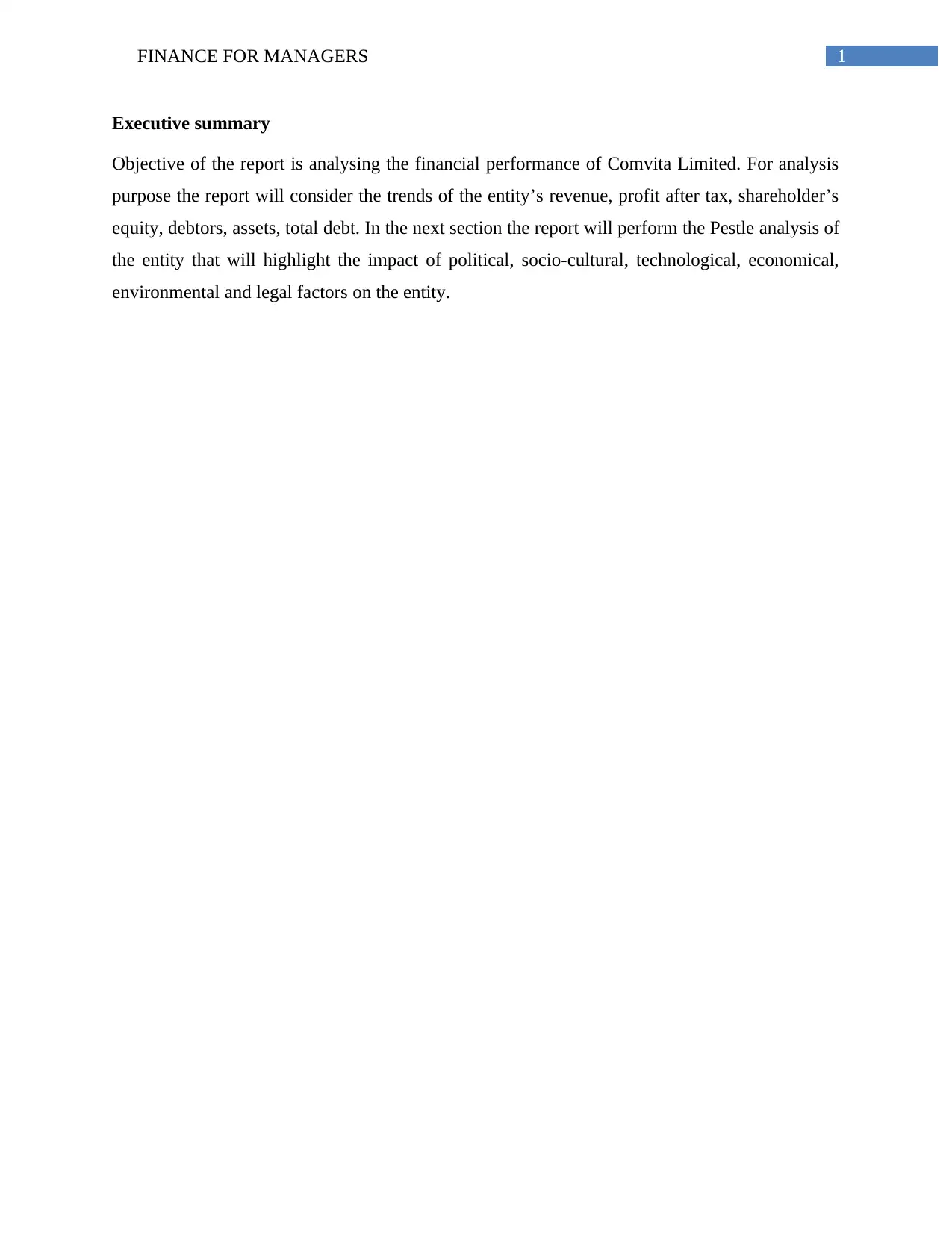
Looking into the trend of its operating revenues over the last 5 years it can be identified
that revenue of the entity from 2014 to 2016 were in increasing trend and increased to 230,743
from 115,283. Though in 2017 the revenue reduced to 155,879 the entity was able to increase the
revenue to 178,493 in 2018. It is signifying that the profitability position of the company
improved in 2018 as compared to the previous year (Robinson et al., 2015).
2018 2017 2016 2015 2014
0
50000
100000
150000
200000
250000
Revenue
Revenue
Trend of profit after tax –
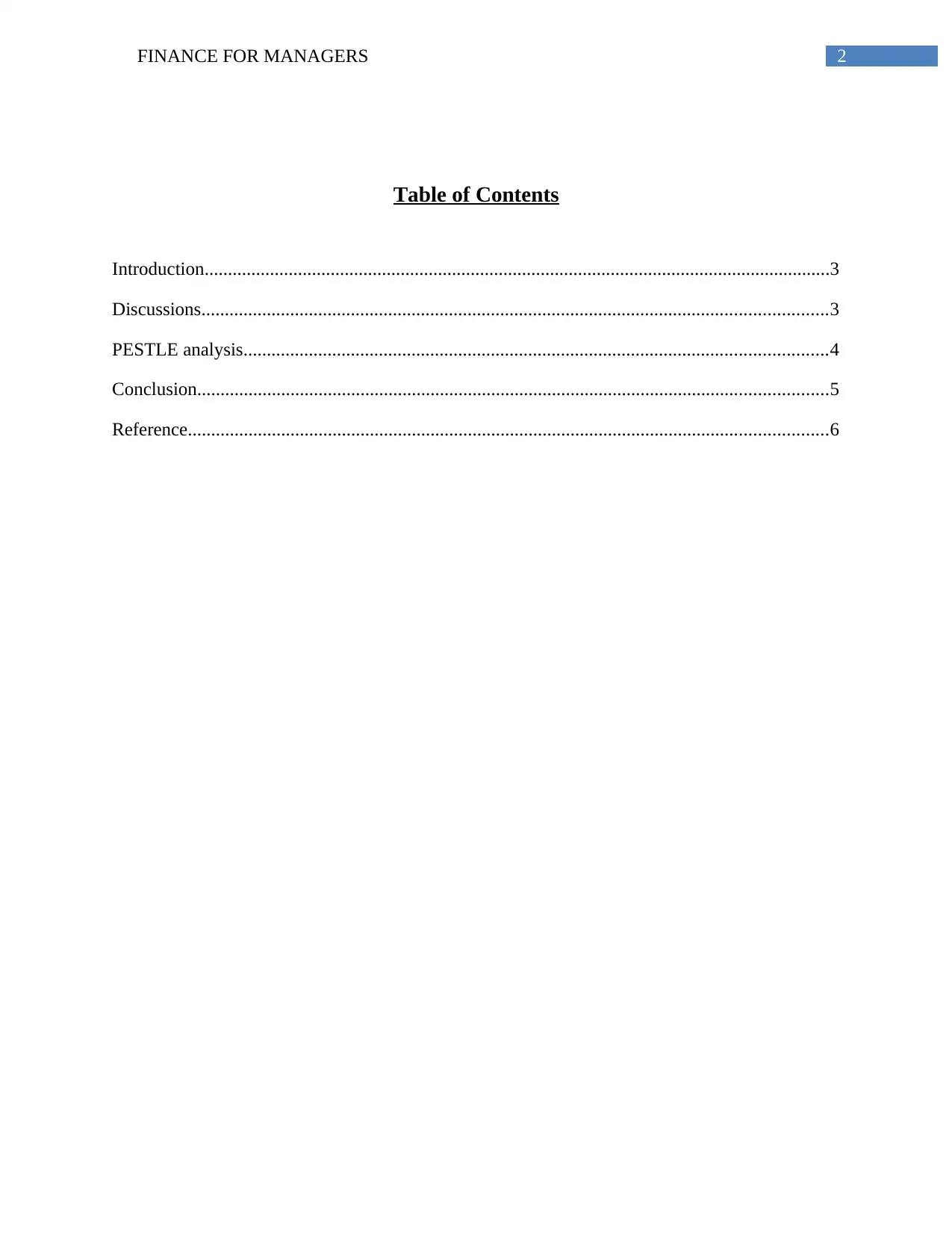
Profit after tax of the entity was in increasing trend till the year 2016 and increased to
18,477 from 7,922 over the years from 2014. However, from 2016 it started falling and till 2018
Introduction
Aim of the report is to analyse the financial highlights of Comvita Limited which is
engaged in manufacturing and marketing the natural health products. It operates through 6
segments including New Zealand, China, Australia, Asia, Europe and North America. The report
will highlight the trends of the entity’s revenue, profit after tax, shareholder’s equity, debtors,
assets, total debt. It will further perform the Pestle analysis for the entity (Comvita.co.nz, 2019).
Discussions
Trend of revenue –
Looking into the trend of its operating revenues over the last 5 years it can be identified
that revenue of the entity from 2014 to 2016 were in increasing trend and increased to 230,743
from 115,283. Though in 2017 the revenue reduced to 155,879 the entity was able to increase the
revenue to 178,493 in 2018. It is signifying that the profitability position of the company
improved in 2018 as compared to the previous year (Robinson et al., 2015).
2018 2017 2016 2015 2014
0
50000
100000
150000
200000
250000
Revenue
Revenue
Trend of profit after tax –
Profit after tax of the entity was in increasing trend till the year 2016 and increased to
18,477 from 7,922 over the years from 2014. However, from 2016 it started falling and till 2018
Paraphrase This Document
Need a fresh take? Get an instant paraphrase of this document with our AI Paraphraser

4FINANCE FOR MANAGERS
it maintained the reducing trend and reached to 8,211. It is signifying that the net profitability
position of the company improved in 2018 as compared to the previous year (Grimm &
Blazovich, 2016).
2018 2017 2016 2015 2014
0
2000
4000
6000
8000
10000
12000
14000
16000
18000
20000
Profit after tax
Profit after tax
Shareholder’s equity –
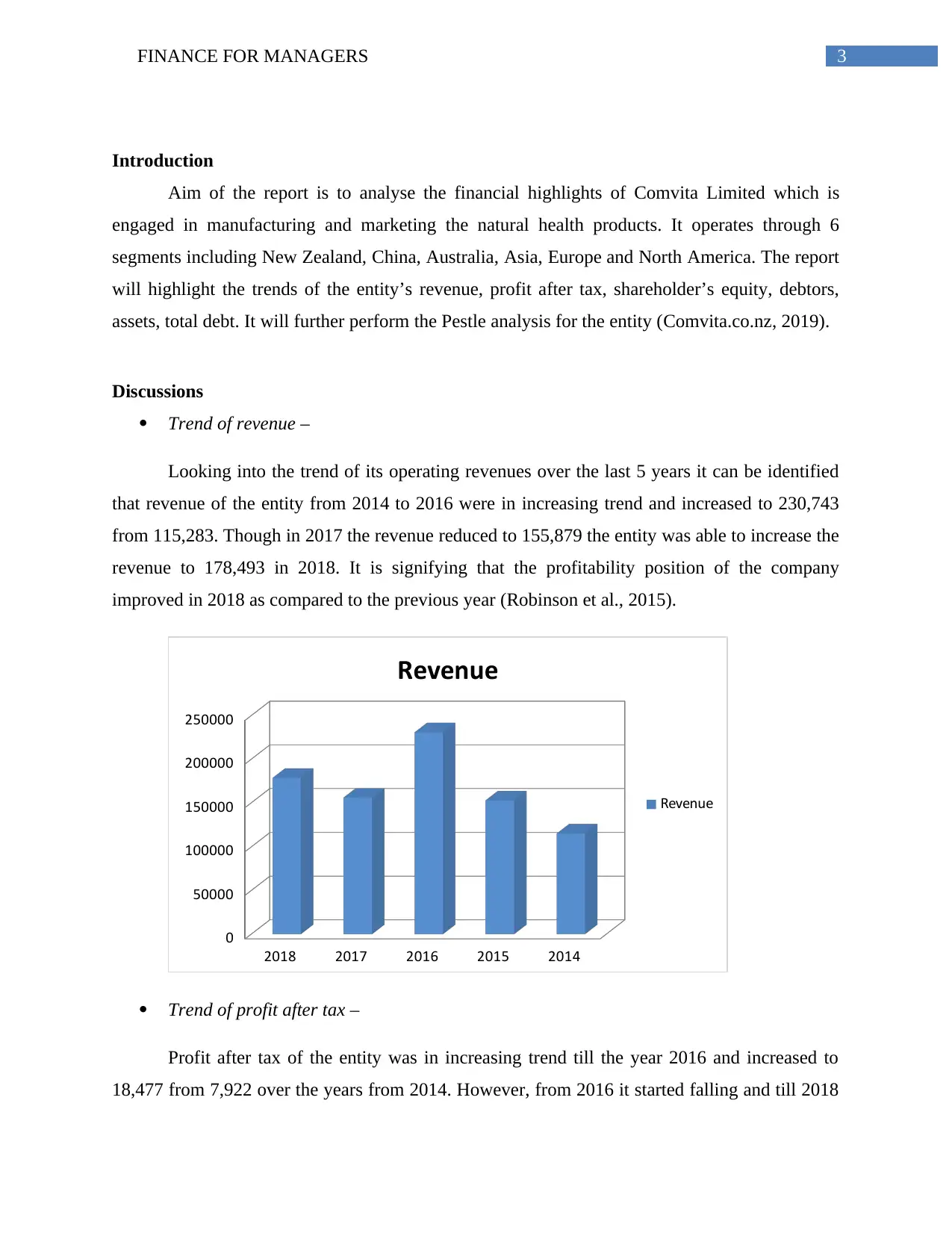
Total shareholder’s equity of the company is in increasing trend over the last 5 years.
Shareholder’s equity has been increased to 189,692 from 92,082 over the last 5 years period
covering the year 2014 to 2018. It is signifying that the entity is raising additional fund through
issuing equity (Robinson et al., 2015).
1 2 3 4 5
0
20000
40000
60000
80000
100000
120000
140000
160000
180000
200000
shareholder equity
shareholder equity
it maintained the reducing trend and reached to 8,211. It is signifying that the net profitability
position of the company improved in 2018 as compared to the previous year (Grimm &
Blazovich, 2016).
2018 2017 2016 2015 2014
0
2000
4000
6000
8000
10000
12000
14000
16000
18000
20000
Profit after tax
Profit after tax
Shareholder’s equity –
Total shareholder’s equity of the company is in increasing trend over the last 5 years.
Shareholder’s equity has been increased to 189,692 from 92,082 over the last 5 years period
covering the year 2014 to 2018. It is signifying that the entity is raising additional fund through
issuing equity (Robinson et al., 2015).
1 2 3 4 5
0
20000
40000
60000
80000
100000
120000
140000
160000
180000
200000
shareholder equity
shareholder equity

5FINANCE FOR MANAGERS
Assets –
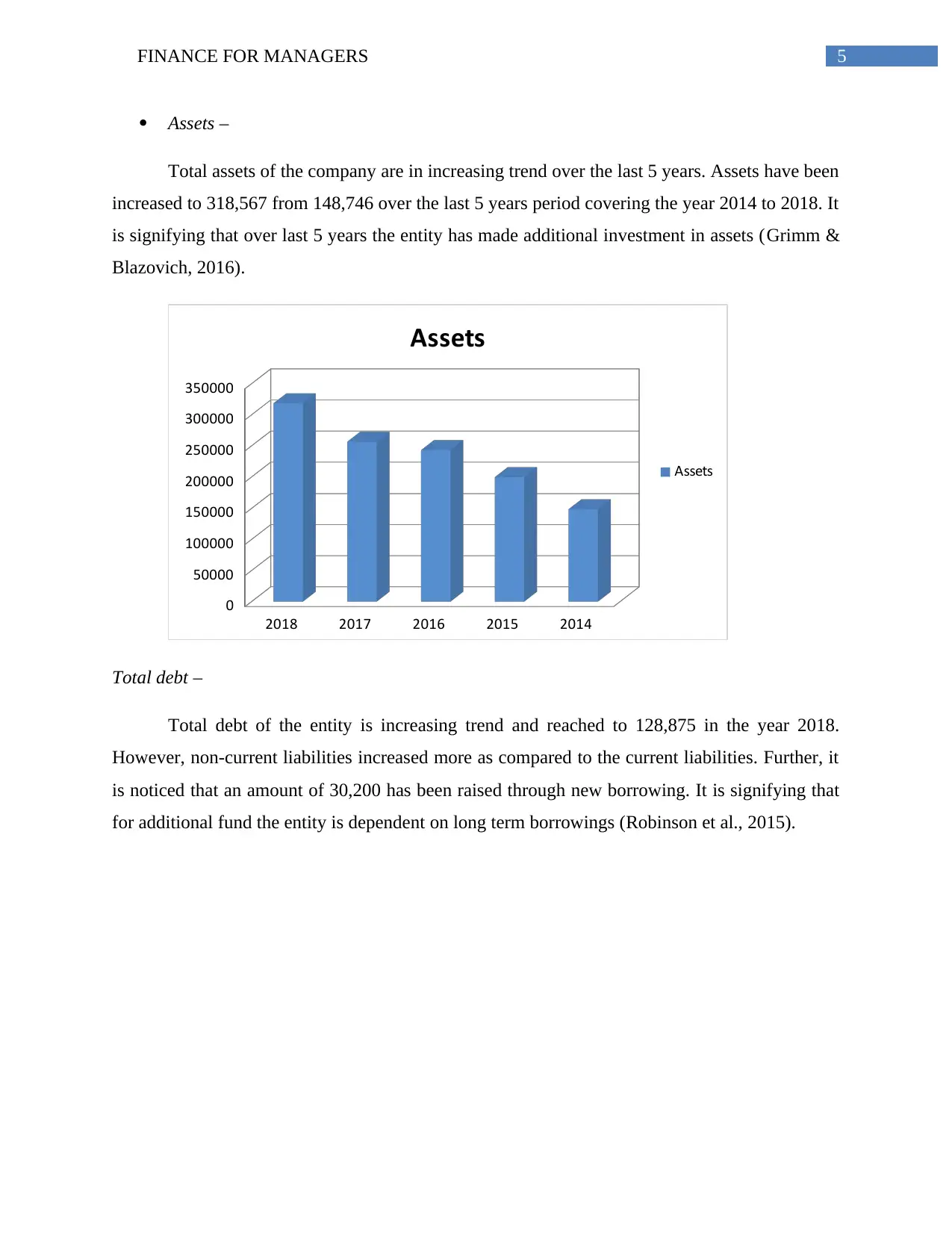
Total assets of the company are in increasing trend over the last 5 years. Assets have been
increased to 318,567 from 148,746 over the last 5 years period covering the year 2014 to 2018. It
is signifying that over last 5 years the entity has made additional investment in assets (Grimm &
Blazovich, 2016).
2018 2017 2016 2015 2014
0
50000
100000
150000
200000
250000
300000
350000
Assets
Assets
Total debt –
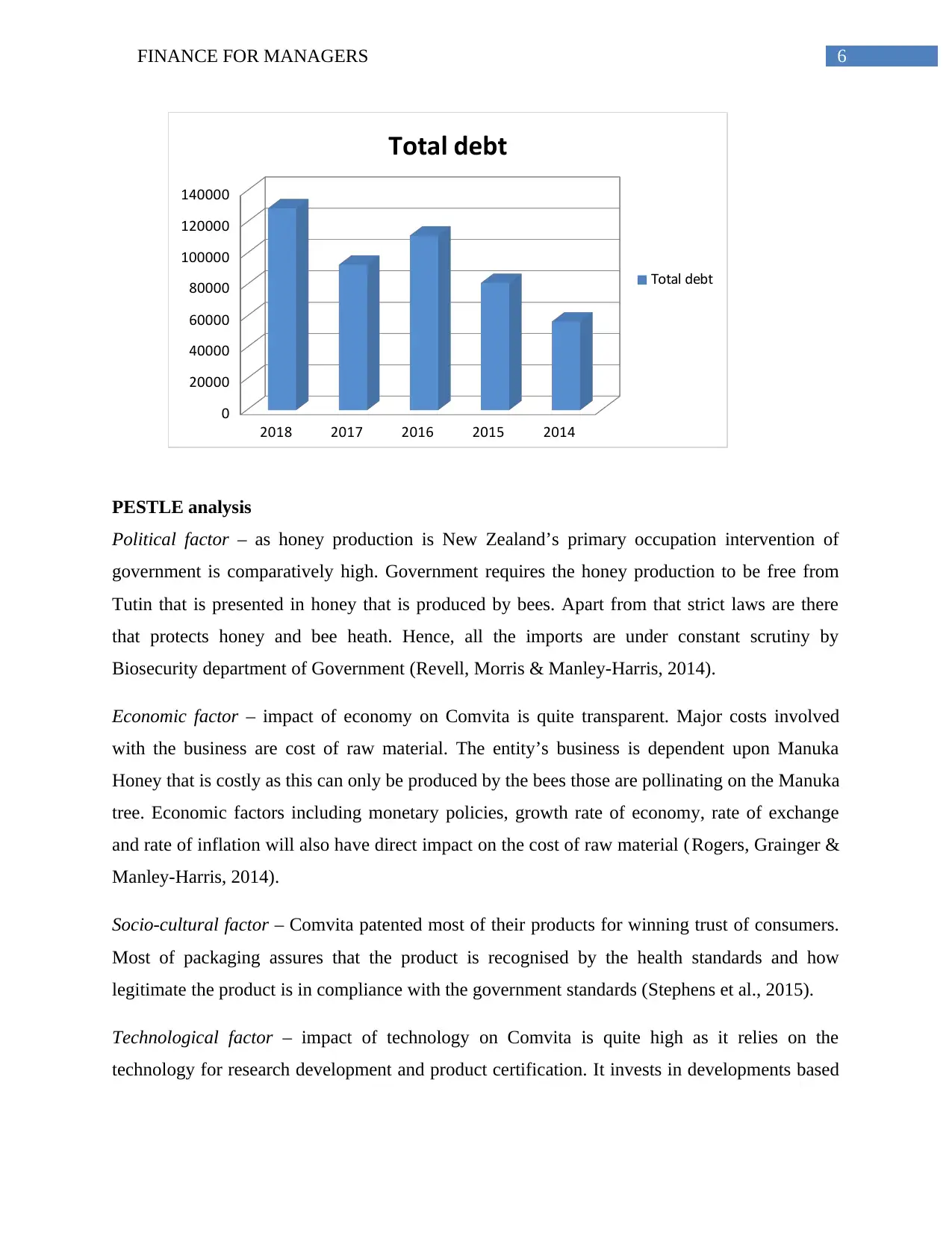
Total debt of the entity is increasing trend and reached to 128,875 in the year 2018.
However, non-current liabilities increased more as compared to the current liabilities. Further, it
is noticed that an amount of 30,200 has been raised through new borrowing. It is signifying that
for additional fund the entity is dependent on long term borrowings (Robinson et al., 2015).
Assets –
Total assets of the company are in increasing trend over the last 5 years. Assets have been
increased to 318,567 from 148,746 over the last 5 years period covering the year 2014 to 2018. It
is signifying that over last 5 years the entity has made additional investment in assets (Grimm &
Blazovich, 2016).
2018 2017 2016 2015 2014
0
50000
100000
150000
200000
250000
300000
350000
Assets
Assets
Total debt –
Total debt of the entity is increasing trend and reached to 128,875 in the year 2018.
However, non-current liabilities increased more as compared to the current liabilities. Further, it
is noticed that an amount of 30,200 has been raised through new borrowing. It is signifying that
for additional fund the entity is dependent on long term borrowings (Robinson et al., 2015).
⊘ This is a preview!⊘
Do you want full access?
Subscribe today to unlock all pages.

Trusted by 1+ million students worldwide

6FINANCE FOR MANAGERS
2018 2017 2016 2015 2014
0
20000
40000
60000
80000
100000
120000
140000
Total debt
Total debt
PESTLE analysis
Political factor – as honey production is New Zealand’s primary occupation intervention of
government is comparatively high. Government requires the honey production to be free from
Tutin that is presented in honey that is produced by bees. Apart from that strict laws are there
that protects honey and bee heath. Hence, all the imports are under constant scrutiny by
Biosecurity department of Government (Revell, Morris & Manley-Harris, 2014).
Economic factor – impact of economy on Comvita is quite transparent. Major costs involved
with the business are cost of raw material. The entity’s business is dependent upon Manuka
Honey that is costly as this can only be produced by the bees those are pollinating on the Manuka
tree. Economic factors including monetary policies, growth rate of economy, rate of exchange
and rate of inflation will also have direct impact on the cost of raw material ( Rogers, Grainger &
Manley-Harris, 2014).
Socio-cultural factor – Comvita patented most of their products for winning trust of consumers.
Most of packaging assures that the product is recognised by the health standards and how
legitimate the product is in compliance with the government standards (Stephens et al., 2015).
Technological factor – impact of technology on Comvita is quite high as it relies on the
technology for research development and product certification. It invests in developments based
2018 2017 2016 2015 2014
0
20000
40000
60000
80000
100000
120000
140000
Total debt
Total debt
PESTLE analysis
Political factor – as honey production is New Zealand’s primary occupation intervention of
government is comparatively high. Government requires the honey production to be free from
Tutin that is presented in honey that is produced by bees. Apart from that strict laws are there
that protects honey and bee heath. Hence, all the imports are under constant scrutiny by
Biosecurity department of Government (Revell, Morris & Manley-Harris, 2014).
Economic factor – impact of economy on Comvita is quite transparent. Major costs involved
with the business are cost of raw material. The entity’s business is dependent upon Manuka
Honey that is costly as this can only be produced by the bees those are pollinating on the Manuka
tree. Economic factors including monetary policies, growth rate of economy, rate of exchange
and rate of inflation will also have direct impact on the cost of raw material ( Rogers, Grainger &
Manley-Harris, 2014).
Socio-cultural factor – Comvita patented most of their products for winning trust of consumers.
Most of packaging assures that the product is recognised by the health standards and how
legitimate the product is in compliance with the government standards (Stephens et al., 2015).
Technological factor – impact of technology on Comvita is quite high as it relies on the
technology for research development and product certification. It invests in developments based
Paraphrase This Document
Need a fresh take? Get an instant paraphrase of this document with our AI Paraphraser

7FINANCE FOR MANAGERS
on research that assists the entity in making new products as well as exploring the benefits from
honey to the mankind (Revell, Morris & Manley-Harris, 2014).
Environment factor – as per the rules of government the bees shall be disease free. Further,
Comvita re-use raw material and recycles it in the processing factory, offices and warehouses.
Processing of honey is done through chemical free process that is the entity only uses hot water
(Kato et al., 2014).
Legal factor – it determines the consumer health and the policies associated with safety
standards. It describes the legal factors faced by the entity while producing as well as exporting
the honey products. Legal issues faced by the entity include legal implications while parenting
the products and technology and certifications (Rogers, Grainger & Manley-Harris, 2014).
Conclusion
From the above it can be concluded that the financial performances of the entity has been
deteriorated during the year 2018 as compared to the previous year. It can be established through
the result that in 2017 the revenue reduced to 155,879, however the entity was able to increase
the revenue to 178,493 in 2018. Further, the net profits over the 5 years are in reducing trend.
However, the entity depends on equity as well as debt for requirement of additional capital.
on research that assists the entity in making new products as well as exploring the benefits from
honey to the mankind (Revell, Morris & Manley-Harris, 2014).
Environment factor – as per the rules of government the bees shall be disease free. Further,
Comvita re-use raw material and recycles it in the processing factory, offices and warehouses.
Processing of honey is done through chemical free process that is the entity only uses hot water
(Kato et al., 2014).
Legal factor – it determines the consumer health and the policies associated with safety
standards. It describes the legal factors faced by the entity while producing as well as exporting
the honey products. Legal issues faced by the entity include legal implications while parenting
the products and technology and certifications (Rogers, Grainger & Manley-Harris, 2014).
Conclusion
From the above it can be concluded that the financial performances of the entity has been
deteriorated during the year 2018 as compared to the previous year. It can be established through
the result that in 2017 the revenue reduced to 155,879, however the entity was able to increase
the revenue to 178,493 in 2018. Further, the net profits over the 5 years are in reducing trend.
However, the entity depends on equity as well as debt for requirement of additional capital.

8FINANCE FOR MANAGERS
Reference
Comvita.co.nz. (2019). Retrieved 10 May 2019, from
https://www.comvita.co.nz/_assets/Investors/30-June-2018-Annual-Report.pdf
Easton, M., & Sommers, Z. (2018). Financial Statement Analysis & Valuation, 5e.
Grimm, S. D., & Blazovich, J. L. (2016). Developing student competencies: An integrated
approach to a financial statement analysis project. Journal of Accounting Education, 35,
69-101.
Kato, Y., Fujinaka, R., Ishisaka, A., Nitta, Y., Kitamoto, N., & Takimoto, Y. (2014). Plausible
authentication of manuka honey and related products by measuring leptosperin with
methyl syringate. Journal of agricultural and food chemistry, 62(27), 6400-6407.
Revell, L. E., Morris, B., & Manley-Harris, M. (2014). Analysis of volatile compounds in New
Zealand unifloral honeys by SPME–GC–MS and chemometric-based classification of
floral source. Journal of Food Measurement and Characterization, 8(2), 81-91.
Robinson, T. R., Henry, E., Pirie, W. L., & Broihahn, M. A. (2015). International financial
statement analysis. John Wiley & Sons.
Rogers, K. M., Grainger, M., & Manley-Harris, M. (2014). The unique manuka effect: why New
Zealand manuka honey fails the AOAC 998.12 C-4 sugar method. Journal of agricultural
and food chemistry, 62(12), 2615-2622.
Stephens, J. M., Greenwood, D. R., Fearnley, L., Bong, J., Schlothauer, R. C., & Loomes, K. M.
(2015). Honey production and compositional parameters. In Processing and impact on
active components in food (pp. 675-680). Academic Press.
.
Reference
Comvita.co.nz. (2019). Retrieved 10 May 2019, from
https://www.comvita.co.nz/_assets/Investors/30-June-2018-Annual-Report.pdf
Easton, M., & Sommers, Z. (2018). Financial Statement Analysis & Valuation, 5e.
Grimm, S. D., & Blazovich, J. L. (2016). Developing student competencies: An integrated
approach to a financial statement analysis project. Journal of Accounting Education, 35,
69-101.
Kato, Y., Fujinaka, R., Ishisaka, A., Nitta, Y., Kitamoto, N., & Takimoto, Y. (2014). Plausible
authentication of manuka honey and related products by measuring leptosperin with
methyl syringate. Journal of agricultural and food chemistry, 62(27), 6400-6407.
Revell, L. E., Morris, B., & Manley-Harris, M. (2014). Analysis of volatile compounds in New
Zealand unifloral honeys by SPME–GC–MS and chemometric-based classification of
floral source. Journal of Food Measurement and Characterization, 8(2), 81-91.
Robinson, T. R., Henry, E., Pirie, W. L., & Broihahn, M. A. (2015). International financial
statement analysis. John Wiley & Sons.
Rogers, K. M., Grainger, M., & Manley-Harris, M. (2014). The unique manuka effect: why New
Zealand manuka honey fails the AOAC 998.12 C-4 sugar method. Journal of agricultural
and food chemistry, 62(12), 2615-2622.
Stephens, J. M., Greenwood, D. R., Fearnley, L., Bong, J., Schlothauer, R. C., & Loomes, K. M.
(2015). Honey production and compositional parameters. In Processing and impact on
active components in food (pp. 675-680). Academic Press.
.
⊘ This is a preview!⊘
Do you want full access?
Subscribe today to unlock all pages.

Trusted by 1+ million students worldwide
1 out of 9
Related Documents
Your All-in-One AI-Powered Toolkit for Academic Success.
+13062052269
info@desklib.com
Available 24*7 on WhatsApp / Email
Unlock your academic potential
Copyright © 2020–2026 A2Z Services. All Rights Reserved. Developed and managed by ZUCOL.