Finance Law Assignment - AFCA Case: Matilda and Ulysses Analysis
VerifiedAdded on 2022/09/01
|7
|1308
|20
Report
AI Summary
This finance law assignment analyzes the case of Matilda and Ulysses, a young couple who are refugees seeking a loan. The assignment addresses key issues including whether the loan terms were unjust, and if T-BANK is liable for the actions of their recommended broker, Natalie, who provided false information on the loan application. The assignment explores the application of the Uniform Consumer Credit Code (UCCC) and the concept of irresponsible lending, referencing the case of Perpetual Trustee Company Ltd v Albert and Rose Khoshaba (2006). It argues that ReadyQik Finance Ltd may have engaged in irresponsible lending and that Matilda and Ulysses can seek remedies. The assignment concludes that Matilda and Ulysses are not accountable for the broker's actions but may have claims against the lender for not assessing their loan suitability. The analysis considers the couple's vulnerability due to their limited understanding of finance and low income, and the potential for unconscionable conduct by the lender. The assignment provides a comprehensive overview of the legal issues and potential remedies available to Matilda and Ulysses.
Running head: FINANCE LAW
Finance Law
Name of the Student
Name of the University
Authors Note
Course ID
Finance Law
Name of the Student
Name of the University
Authors Note
Course ID
Paraphrase This Document
Need a fresh take? Get an instant paraphrase of this document with our AI Paraphraser

1FINANCE LAW
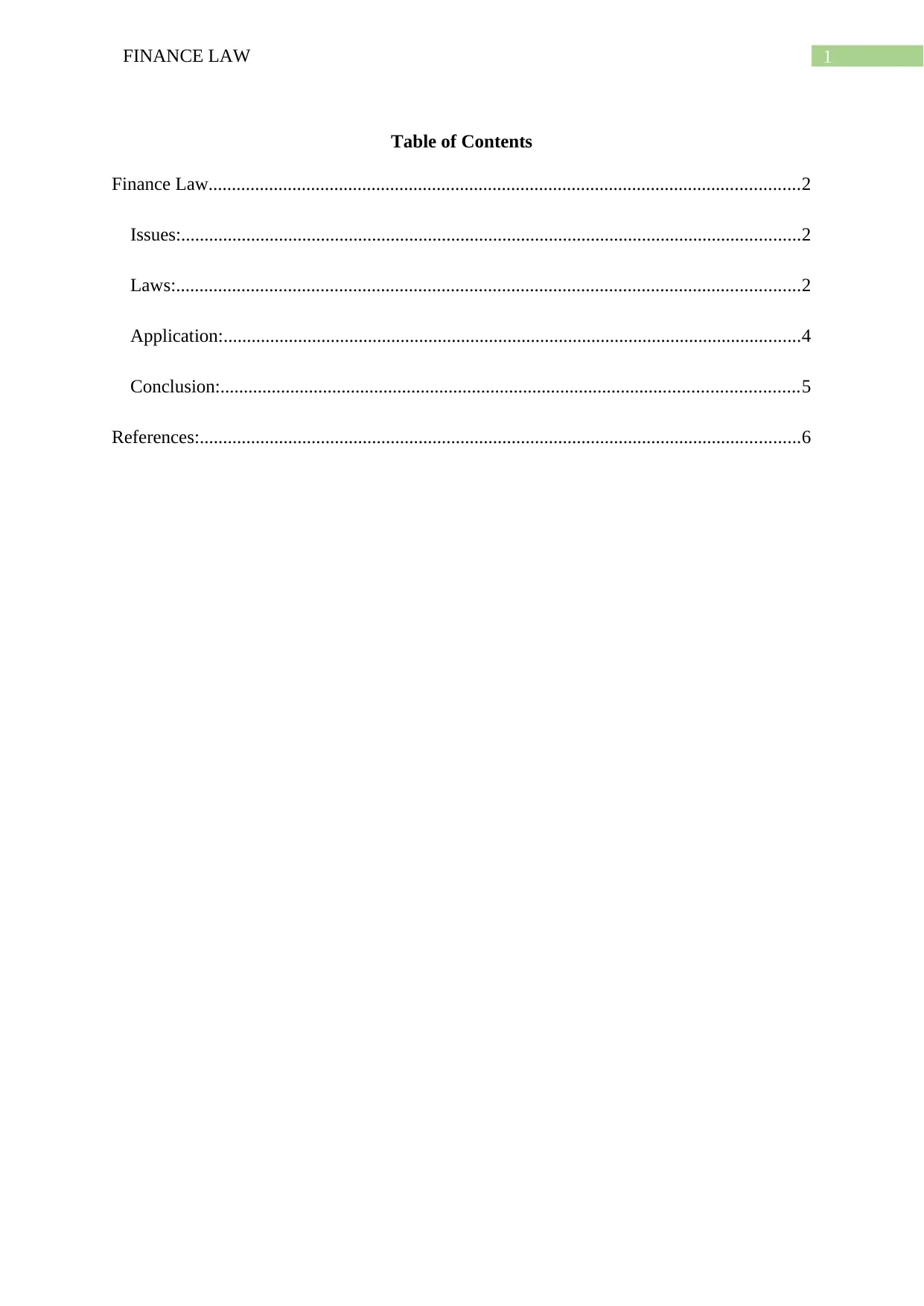
Table of Contents
Finance Law...............................................................................................................................2
Issues:.....................................................................................................................................2
Laws:......................................................................................................................................2
Application:............................................................................................................................4
Conclusion:............................................................................................................................5
References:.................................................................................................................................6
Table of Contents
Finance Law...............................................................................................................................2
Issues:.....................................................................................................................................2
Laws:......................................................................................................................................2
Application:............................................................................................................................4
Conclusion:............................................................................................................................5
References:.................................................................................................................................6

2FINANCE LAW
Finance Law
Issues:
In reviewing the complaint bought by Matilda and Ulysses, the issues identified are as
follows;
a. Whether the loan of complaint’s with the FSP is unjust; and
b. If the loan is unjust then what are the possible remedies?
Laws:
As stated in the “sec 11 of the UCCC” in any kind of proceedings where the party
makes a claim that a credit contract, mortgage or guarantee is one on which this code is
applicable, it is supposed to be unless the contrary is established1. Credit is considered
conclusively for the purpose of this code not to be given completely or predominantly for
personal, domestic or household purpose if the debtors makes the declaration that the credit is
to be implemented completely or mainly for the business or investment purpose.
There are several types of lending that occur with the help of intermediaries namely
brokers, that negotiate with and attracts the clients on their behalf of lenders mainly exchange
of commission. There have been several reports of brokers falsifying the information on the
loan applications, especially the low doc applications so that they can have the loans
approved and get their commission2. Problems comprising of brokers and other types of
intermediaries have been compounded due to the lack of redress available to customers that
1 Winship, Peter. "An Historical Overview of UCC Article 9." Unedited text of (2016).
2 Elvy, Stacy-Ann. "Contracting in the Age of the Internet of Things: Article 2 of the UCC
and Beyond." Hofstra L. Rev. 44 (2015): 839.
Finance Law
Issues:
In reviewing the complaint bought by Matilda and Ulysses, the issues identified are as
follows;
a. Whether the loan of complaint’s with the FSP is unjust; and
b. If the loan is unjust then what are the possible remedies?
Laws:
As stated in the “sec 11 of the UCCC” in any kind of proceedings where the party
makes a claim that a credit contract, mortgage or guarantee is one on which this code is
applicable, it is supposed to be unless the contrary is established1. Credit is considered
conclusively for the purpose of this code not to be given completely or predominantly for
personal, domestic or household purpose if the debtors makes the declaration that the credit is
to be implemented completely or mainly for the business or investment purpose.
There are several types of lending that occur with the help of intermediaries namely
brokers, that negotiate with and attracts the clients on their behalf of lenders mainly exchange
of commission. There have been several reports of brokers falsifying the information on the
loan applications, especially the low doc applications so that they can have the loans
approved and get their commission2. Problems comprising of brokers and other types of
intermediaries have been compounded due to the lack of redress available to customers that
1 Winship, Peter. "An Historical Overview of UCC Article 9." Unedited text of (2016).
2 Elvy, Stacy-Ann. "Contracting in the Age of the Internet of Things: Article 2 of the UCC
and Beyond." Hofstra L. Rev. 44 (2015): 839.
⊘ This is a preview!⊘
Do you want full access?
Subscribe today to unlock all pages.

Trusted by 1+ million students worldwide

3FINANCE LAW
have fallen victim to unscrupulous brokers, since the brokers under the law are considered as
agents of borrower.
The lenders would usually not be considered accountable for any kind of unfair
conduct done by the broker and the borrower will not be able to remain dependent on the
conduct of broker in the form of defence to any action that is bought against them. In the
leading example of “Perpetual Trustee Company Ltd v Albert and Rose Khoshaba (2006)”
the trial judge noticed that the perpetual trustee did not had any kind of knowledge regarding
the investment agreement and also had no involvement in falsifying the loan application3.
The trial judge discovered that loan agreement was unjust. The law court held that when a
lender is engaged in the asset lending it cannot be considered as the innocent party
irrespective of the ignorance of the circumstances which makes the loan unjust from the
mortgagor’s point of view.
The laws relating to the credit to consumers is apparently governed by the UCCC. As
per the “sec 6 (1)”, the UCCC is applicable only on the natural persons that seek credit
completely or predominantly for the personal, domestic or household purpose. Under the
“section 70 (1)” it allows the court with the power of reopening the unjust transactions. The
term unjust has been defined under the “sec 70 (7)” that include “unconscionable, harsh or
oppressive”. In undertaking the decision of reopening a transaction, the court should have
regard to the public interest4.
3 White, James J. "The Revision of Article 2: Commercial Sellers vs. Consumer
Buyers." Barry L. Rev. 23 (2017): 81.
4 Martin, Jennifer S., Colin P. Marks, and Wayne Barnes. "The Uniform Commercial Code
Survey: Introduction." Bus. Law. 71 (2015): 1243.
have fallen victim to unscrupulous brokers, since the brokers under the law are considered as
agents of borrower.
The lenders would usually not be considered accountable for any kind of unfair
conduct done by the broker and the borrower will not be able to remain dependent on the
conduct of broker in the form of defence to any action that is bought against them. In the
leading example of “Perpetual Trustee Company Ltd v Albert and Rose Khoshaba (2006)”
the trial judge noticed that the perpetual trustee did not had any kind of knowledge regarding
the investment agreement and also had no involvement in falsifying the loan application3.
The trial judge discovered that loan agreement was unjust. The law court held that when a
lender is engaged in the asset lending it cannot be considered as the innocent party
irrespective of the ignorance of the circumstances which makes the loan unjust from the
mortgagor’s point of view.
The laws relating to the credit to consumers is apparently governed by the UCCC. As
per the “sec 6 (1)”, the UCCC is applicable only on the natural persons that seek credit
completely or predominantly for the personal, domestic or household purpose. Under the
“section 70 (1)” it allows the court with the power of reopening the unjust transactions. The
term unjust has been defined under the “sec 70 (7)” that include “unconscionable, harsh or
oppressive”. In undertaking the decision of reopening a transaction, the court should have
regard to the public interest4.
3 White, James J. "The Revision of Article 2: Commercial Sellers vs. Consumer
Buyers." Barry L. Rev. 23 (2017): 81.
4 Martin, Jennifer S., Colin P. Marks, and Wayne Barnes. "The Uniform Commercial Code
Survey: Introduction." Bus. Law. 71 (2015): 1243.
Paraphrase This Document
Need a fresh take? Get an instant paraphrase of this document with our AI Paraphraser

4FINANCE LAW
A conduct can be considered unconscionable if it is mainly harsh or oppressive. For a
court consider unconscionable, a conduct should be more than just unfair. It should against
the conscience that is judged against the norms of the society. The equitable doctrine of
unconscionable conduct in its modern formulation was given in the case of “Commercial
Bank of Australia v Amadio” where the judge held that the doctrine is functional where the
party to the transaction is under the special disability in dealing with the other party such that
there is a lack of any reasonable extent of equality among them5.
While the term irresponsible lending implies that if an individual has received loan
that an individual is struggling to repay or they have defaulted they might have the claim for
compensation against the lender if they failed to identify that their loan was not suitable for
the borrower at the time when the contract was entered into.
Application:
The provision of “Uniform Consumer Credit Code under sec 6 (1)” will be
considered applicable in the case of Matilda and Ulysses. This provision is applicable to
Matilda and Ulysses because they are seeking credit wholly or predominantly for the personal
purpose.6
In the current situation it is noticed that Matilda and Ulysses were under the state of
unconscionable conduct in respect to the loans that was given to them. Natalia has knowingly
provided false information on the loan applications so that she can have the loans approved
and receive their commission7. Matilda and Ulysses can sue to the T-Bank for recommending
Natalie to them. Furthermore, both Matilda and Ulysses are the new the customers of T-
5 Chapman, J., And Thm Consumer Financing Industry. "Financing Consumer Goods Under
The Uniform Commercial Code: Installment Buyers And Defaulting Sellers."
6 Flint, Richard E. "Fraud, Letters of Credit, and the Uniform Commercial Code: It Is Time to Untether the
Independence Principle." Baylor L. Rev. 71 (2019): 353.
A conduct can be considered unconscionable if it is mainly harsh or oppressive. For a
court consider unconscionable, a conduct should be more than just unfair. It should against
the conscience that is judged against the norms of the society. The equitable doctrine of
unconscionable conduct in its modern formulation was given in the case of “Commercial
Bank of Australia v Amadio” where the judge held that the doctrine is functional where the
party to the transaction is under the special disability in dealing with the other party such that
there is a lack of any reasonable extent of equality among them5.
While the term irresponsible lending implies that if an individual has received loan
that an individual is struggling to repay or they have defaulted they might have the claim for
compensation against the lender if they failed to identify that their loan was not suitable for
the borrower at the time when the contract was entered into.
Application:
The provision of “Uniform Consumer Credit Code under sec 6 (1)” will be
considered applicable in the case of Matilda and Ulysses. This provision is applicable to
Matilda and Ulysses because they are seeking credit wholly or predominantly for the personal
purpose.6
In the current situation it is noticed that Matilda and Ulysses were under the state of
unconscionable conduct in respect to the loans that was given to them. Natalia has knowingly
provided false information on the loan applications so that she can have the loans approved
and receive their commission7. Matilda and Ulysses can sue to the T-Bank for recommending
Natalie to them. Furthermore, both Matilda and Ulysses are the new the customers of T-
5 Chapman, J., And Thm Consumer Financing Industry. "Financing Consumer Goods Under
The Uniform Commercial Code: Installment Buyers And Defaulting Sellers."
6 Flint, Richard E. "Fraud, Letters of Credit, and the Uniform Commercial Code: It Is Time to Untether the
Independence Principle." Baylor L. Rev. 71 (2019): 353.

5FINANCE LAW
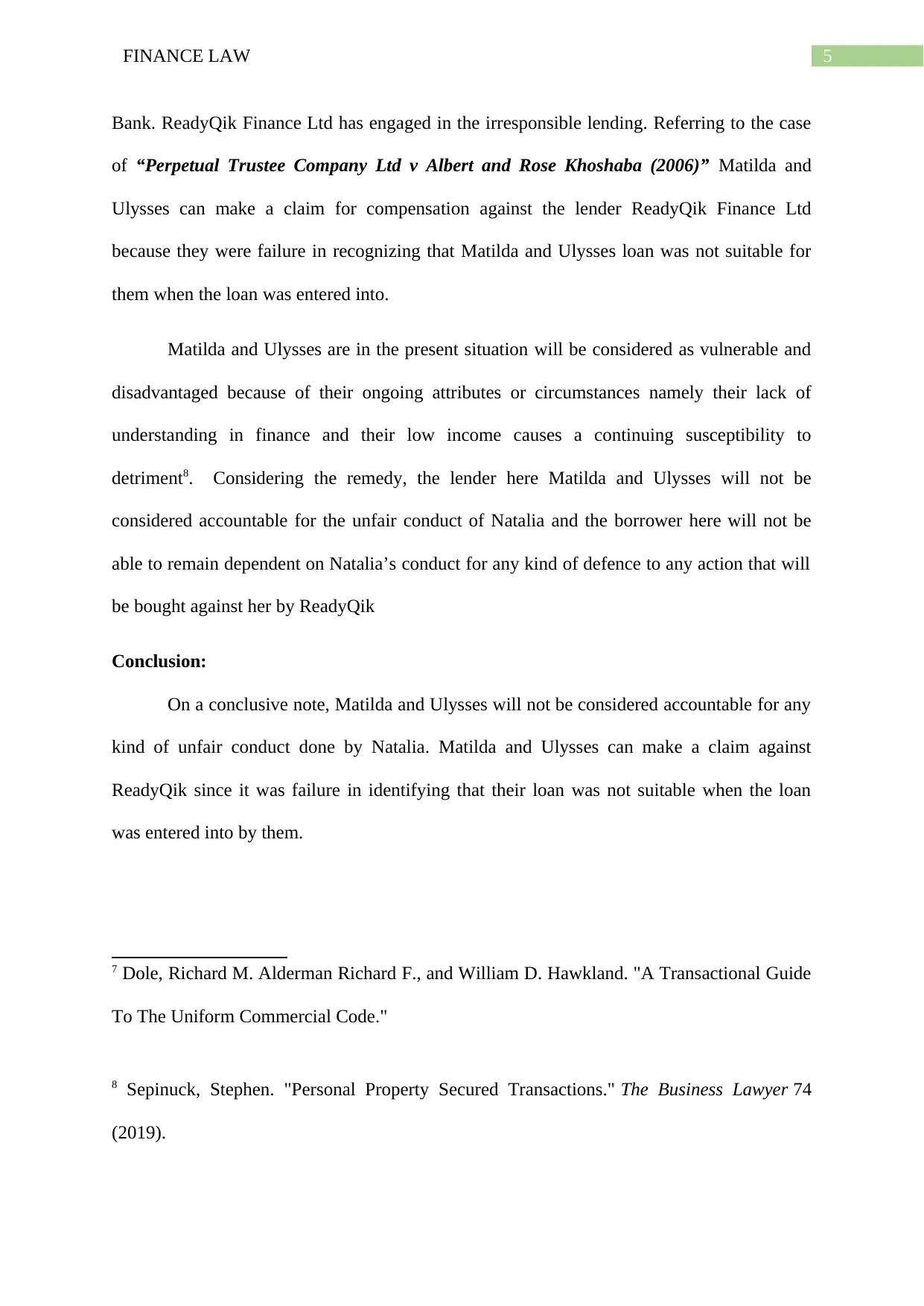
Bank. ReadyQik Finance Ltd has engaged in the irresponsible lending. Referring to the case
of “Perpetual Trustee Company Ltd v Albert and Rose Khoshaba (2006)” Matilda and
Ulysses can make a claim for compensation against the lender ReadyQik Finance Ltd
because they were failure in recognizing that Matilda and Ulysses loan was not suitable for
them when the loan was entered into.
Matilda and Ulysses are in the present situation will be considered as vulnerable and
disadvantaged because of their ongoing attributes or circumstances namely their lack of
understanding in finance and their low income causes a continuing susceptibility to
detriment8. Considering the remedy, the lender here Matilda and Ulysses will not be
considered accountable for the unfair conduct of Natalia and the borrower here will not be
able to remain dependent on Natalia’s conduct for any kind of defence to any action that will
be bought against her by ReadyQik
Conclusion:
On a conclusive note, Matilda and Ulysses will not be considered accountable for any
kind of unfair conduct done by Natalia. Matilda and Ulysses can make a claim against
ReadyQik since it was failure in identifying that their loan was not suitable when the loan
was entered into by them.
7 Dole, Richard M. Alderman Richard F., and William D. Hawkland. "A Transactional Guide
To The Uniform Commercial Code."
8 Sepinuck, Stephen. "Personal Property Secured Transactions." The Business Lawyer 74
(2019).
Bank. ReadyQik Finance Ltd has engaged in the irresponsible lending. Referring to the case
of “Perpetual Trustee Company Ltd v Albert and Rose Khoshaba (2006)” Matilda and
Ulysses can make a claim for compensation against the lender ReadyQik Finance Ltd
because they were failure in recognizing that Matilda and Ulysses loan was not suitable for
them when the loan was entered into.
Matilda and Ulysses are in the present situation will be considered as vulnerable and
disadvantaged because of their ongoing attributes or circumstances namely their lack of
understanding in finance and their low income causes a continuing susceptibility to
detriment8. Considering the remedy, the lender here Matilda and Ulysses will not be
considered accountable for the unfair conduct of Natalia and the borrower here will not be
able to remain dependent on Natalia’s conduct for any kind of defence to any action that will
be bought against her by ReadyQik
Conclusion:
On a conclusive note, Matilda and Ulysses will not be considered accountable for any
kind of unfair conduct done by Natalia. Matilda and Ulysses can make a claim against
ReadyQik since it was failure in identifying that their loan was not suitable when the loan
was entered into by them.
7 Dole, Richard M. Alderman Richard F., and William D. Hawkland. "A Transactional Guide
To The Uniform Commercial Code."
8 Sepinuck, Stephen. "Personal Property Secured Transactions." The Business Lawyer 74
(2019).
⊘ This is a preview!⊘
Do you want full access?
Subscribe today to unlock all pages.

Trusted by 1+ million students worldwide

6FINANCE LAW
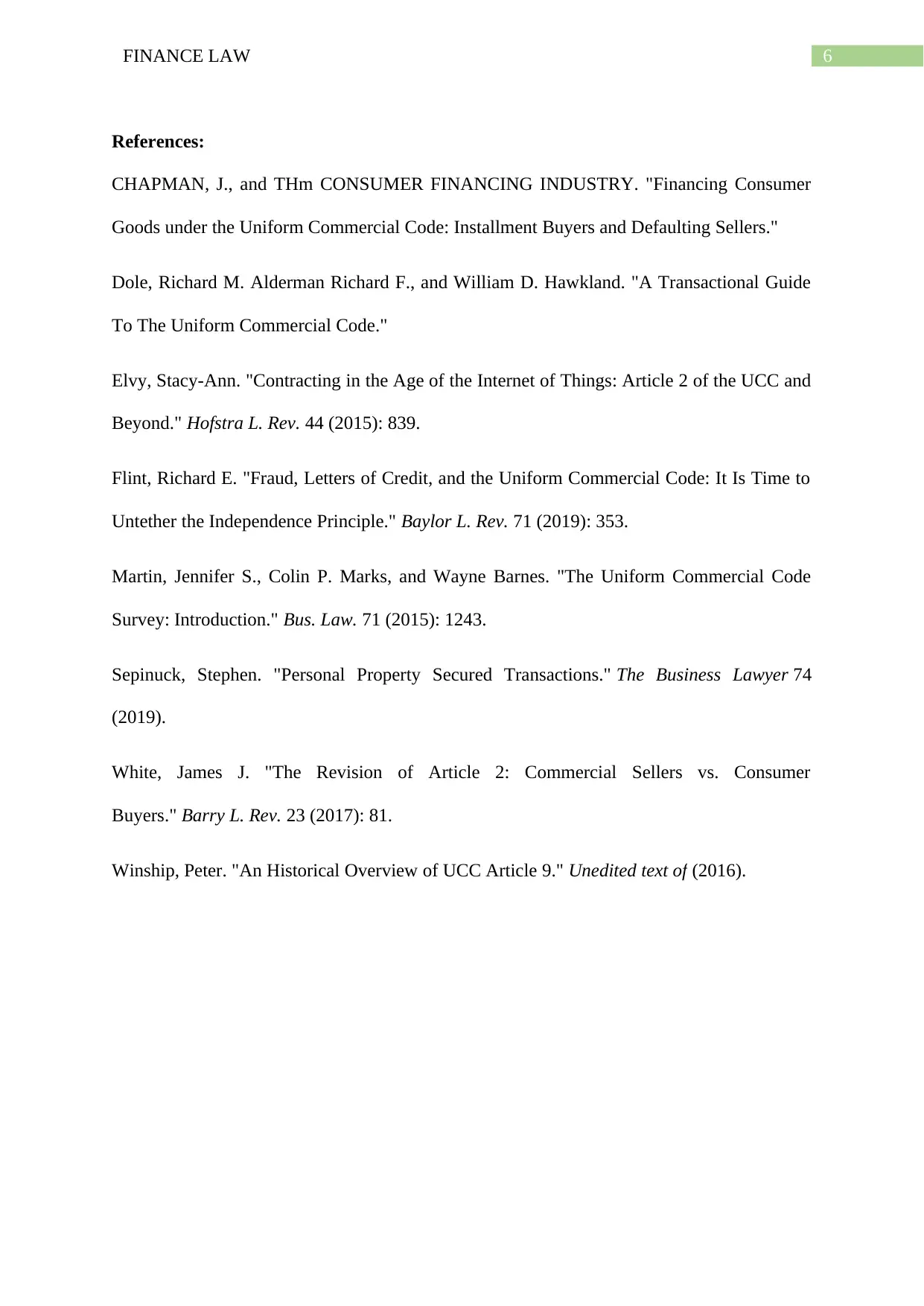
References:
CHAPMAN, J., and THm CONSUMER FINANCING INDUSTRY. "Financing Consumer
Goods under the Uniform Commercial Code: Installment Buyers and Defaulting Sellers."
Dole, Richard M. Alderman Richard F., and William D. Hawkland. "A Transactional Guide
To The Uniform Commercial Code."
Elvy, Stacy-Ann. "Contracting in the Age of the Internet of Things: Article 2 of the UCC and
Beyond." Hofstra L. Rev. 44 (2015): 839.
Flint, Richard E. "Fraud, Letters of Credit, and the Uniform Commercial Code: It Is Time to
Untether the Independence Principle." Baylor L. Rev. 71 (2019): 353.
Martin, Jennifer S., Colin P. Marks, and Wayne Barnes. "The Uniform Commercial Code
Survey: Introduction." Bus. Law. 71 (2015): 1243.
Sepinuck, Stephen. "Personal Property Secured Transactions." The Business Lawyer 74
(2019).
White, James J. "The Revision of Article 2: Commercial Sellers vs. Consumer
Buyers." Barry L. Rev. 23 (2017): 81.
Winship, Peter. "An Historical Overview of UCC Article 9." Unedited text of (2016).
References:
CHAPMAN, J., and THm CONSUMER FINANCING INDUSTRY. "Financing Consumer
Goods under the Uniform Commercial Code: Installment Buyers and Defaulting Sellers."
Dole, Richard M. Alderman Richard F., and William D. Hawkland. "A Transactional Guide
To The Uniform Commercial Code."
Elvy, Stacy-Ann. "Contracting in the Age of the Internet of Things: Article 2 of the UCC and
Beyond." Hofstra L. Rev. 44 (2015): 839.
Flint, Richard E. "Fraud, Letters of Credit, and the Uniform Commercial Code: It Is Time to
Untether the Independence Principle." Baylor L. Rev. 71 (2019): 353.
Martin, Jennifer S., Colin P. Marks, and Wayne Barnes. "The Uniform Commercial Code
Survey: Introduction." Bus. Law. 71 (2015): 1243.
Sepinuck, Stephen. "Personal Property Secured Transactions." The Business Lawyer 74
(2019).
White, James J. "The Revision of Article 2: Commercial Sellers vs. Consumer
Buyers." Barry L. Rev. 23 (2017): 81.
Winship, Peter. "An Historical Overview of UCC Article 9." Unedited text of (2016).
1 out of 7
Your All-in-One AI-Powered Toolkit for Academic Success.
+13062052269
info@desklib.com
Available 24*7 on WhatsApp / Email
Unlock your academic potential
Copyright © 2020–2025 A2Z Services. All Rights Reserved. Developed and managed by ZUCOL.