Infrastructure Asset Management: Impacts of the Financial Context

Verified

Added on  2023/06/10

|9
|1559
|397
Report
AI Summary
This report analyzes the four main impacts of the financial context on infrastructure asset management based on Hendrik du Toit's assessment of the world economy. It discusses the massive impact of economic development on the environment, highlighting the need for environmental management and sustainable infrastructure investments. The report also addresses income inequality and poverty, emphasizing the importance of long-term infrastructure planning and private sector investment. Furthermore, it explores the future of capitalism and the necessity for countries to absorb foreign ideas and align investments with governmental roles. Finally, the report reviews existing social contracts, emphasizing accountability and ethical asset management, while also addressing the challenges posed by population aging and decline. The conclusion reiterates the benefits of infrastructure asset management and the importance of aligning future investments with climate change realities and promoting sustainable development.
Document Page
The main impacts of the financial context
on infrastructure asset management
Name:
Course:
tabler-icon-diamond-filled.svg

Paraphrase This Document

Need a fresh take? Get an instant paraphrase of this document with our AI Paraphraser
Document Page
1
Executive summary
This report provides an analysis of the four main impacts of the financial context on
infrastructure asset management. This analysis is conducted in the light of Hendrik du Toit - the
CEO of Investec Asset Management- assessment of the world economy in the future.
Document Page
2
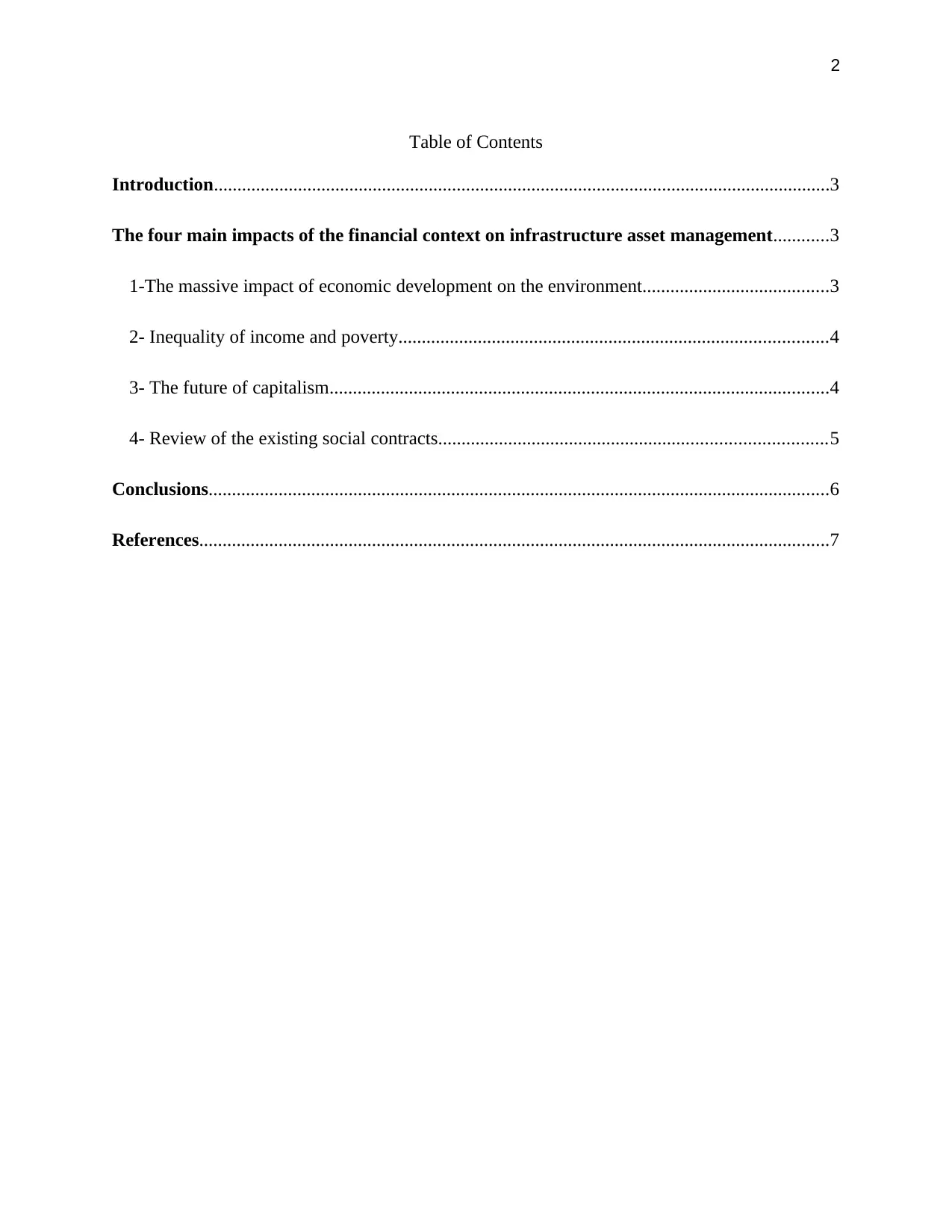
Table of Contents
Introduction....................................................................................................................................3
The four main impacts of the financial context on infrastructure asset management............3
1-The massive impact of economic development on the environment........................................3
2- Inequality of income and poverty............................................................................................4
3- The future of capitalism...........................................................................................................4
4- Review of the existing social contracts...................................................................................5
Conclusions.....................................................................................................................................6
References.......................................................................................................................................7
Document Page
3
Introduction
In March 2009, many people lost their homes and total life savings. The number of losses and
trauma gain the attention of people worldwide (Bruhn 2015). Since then, power has been shifting
from west to east and operations are transforming to digital. These two power shifts are
extremely important. They are straightened by aging populations, the slow economy in the west,
huge dates and demographic entitlements. Quality and democracy are important. In the west
entitlement is institutionalized, but the developing world lacks entitlements (Du Toit 2013).
The following section determines the four main impacts of this financial context on
infrastructure asset management.
The four main impacts of the financial context on infrastructure asset management
Infrastructure asset management (IAM) is a systemic approach to managing infrastructure assets.
It has many benefits, including customer satisfaction, risk management, sustainability,
governance and accountability. In order to ensure the best asset performance, IAM should be
functionally approached. Moreover, managers should ensure the achievement of the maximum
return on asset, safety, consider the environmental requirements and maintain the total cost of
ownership optimized (Too & Tay 2008).
According to Du Toit (2013), there are four main impacts of the financial context on
infrastructure asset management, as follows:
1-The massive impact of economic development on the environment
The environmental management is regulated nowadays. The mismanagement of the environment
has to be properly penalized. The internationalization of the environmental externalities provides
tabler-icon-diamond-filled.svg

Paraphrase This Document

Need a fresh take? Get an instant paraphrase of this document with our AI Paraphraser
Document Page
4
an ideal example. For instance, the BP spill in the Gulf and Mexico impacted all of the
stakeholders worldwide and the asset value (du Toit & Niklasson 2017).
The future infrastructure investments should be aligned with the realities of the climate change.
This includes the investments in energy and transportation that represent the largest invested
sectors. The national planning of infrastructure should be significantly improved to maintain
infrastructure sustainability. It has to take in consideration the goal of Paris Climate Agreement
aiming to limit the climate change to 2 degrees Celsius down from the pre-industrial levels. The
private sector investment should be increased in the environment-friendly infrastructure (du Toit,
Shah & Wilson 2017).
2- Inequality of income and poverty
Almost all of the governments realize the importance of the infrastructure. It is essential to
achieve sustainability and eliminate poverty and inequality (Stewart 2017). In order to do this,
the level of investment in infrastructure requires long-term planning at the national and regional
levels. The private investors have to be able to invest in infrastructure projects to revive the
global economy. They also have to depend on the new technology to decrease costs and enhance
the structural transformation. The new infrastructure projects have to be aligned with the effort
aiming to limit the global warming. The integration of these three factors represents a great
collaboration between the public and private sector from the project and institutional levels (du
Toit, Shah & Wilson 2017).
3- The future of capitalism
As no country can flourish in isolation, they should be able to absorb foreign ideas. The
investments have to be aligned with the role of the governments and regulators. This integrity is
Document Page
5
important to allocate the capital responsibility and maintains security (du Toit & Niklasson
2017).
The sustainable infrastructure is expected to act as a key supporter of the structural
transformation of the global economy. The developing countries are catching up with the
advanced economy because of the technology advance and the demographic transition
characterized by shifting from agriculture economies to manufacturing and service economies
(du Toit, Shah & Wilson 2017) .
Although globalization enforced countries to cooperate together to gain mutual benefits, its
benefits are not equally distributed, within the same country or around the world. Rectifying the
direction of globalization could lead to international development and growth. The governments
should take the first step to unlock the benefits for developing countries (Vella 2017).
4- Review of the existing social contracts
Business is expected to provide the best solutions to the societal problems. This could be
achieved through the assessment of social, environmental and governance performance (Arjaliès
& Bansal 2018). The asset manager should be accountable, responsible, consistent, open and
ethical in managing the asset. He has to concern the investment level, the costs and benefits and
the most effective ways of managing and maintaining the asset. An evaluation of options should
take place concerning the costs and benefits of the asset associated risk. Decision making should
be transparent and accountable. The asset managers must operate physical assets in the most
cost-effective way. This could be achieved by adopting a more integrated, holistic and structured
process (Too & Tay 2008).
The scale of population aging and decline is alarming. It takes place in Europe and East Asia.
Countries as Germany, Italy, Spain, Japan and South Korea population indicators are warning.
Document Page
6
These demographic factors have a negative impact on the development and financing. Also, the
resource distribution and the aggregate productivity growth have major impacts on age cohorts.
Although the trend of population decline occurred before the global financial crisis in 2008, it
has resulted in an increasing problem of the labor movement from less developed to more
developed regions. Moreover, about 100 million workers are going to retire over the coming 20
years. This trend is accompanied by high youth unemployment rates in many countries
accompanied by weak finance from the public sector side (Carbonaro et al. 2018).
Conclusions
Infrastructure asset management (IAM) has many benefits, including customer satisfaction, risk
management, sustainability, governance and accountability. The future infrastructure
investments should be aligned with the realities of the climate change. This includes the
investments in energy and transportation that represent the largest invested sectors.
In order to achieve sustainability and eliminate poverty and inequality, the level of investment in
infrastructure requires long-term planning at the national and regional levels. Rectifying the
direction of globalization could lead to international development and growth. The governments
should take the first step to unlock the benefits for developing countries.
tabler-icon-diamond-filled.svg

Paraphrase This Document

Need a fresh take? Get an instant paraphrase of this document with our AI Paraphraser
Document Page
7
References
Arjaliès, D & Bansal, P 2018, 'Beyond numbers: How investment managers accommodate
societal issues in financial decisions', Organization Studies, vol 39, no. 5-6, pp. 691–719.
Bruhn, A 2015, 'Personal and social impacts of significant financial loss', Australian Journal of
Management, vol 40, no. 3, pp. 459–477.
Carbonaro, G, Leanza, E, McCann, P & Medda, F 2018, 'Demographic decline, population aging
and modern financial approaches to urban policy', International Regional Science Review, vol
41, no. 2, pp. 210-232.
Du Toit, H 2013, Capitalism five years after the financial crisis: Perspectives of an institutional
investor, viewed 31 July 2018, <https://www.youtube.com/watch?v=tWoQLa7oAxE>.
du Toit, H & Niklasson, T 2017, 'Will a better future be what we leave behind?', How can we put
tomorrow before today?, vol 5, no. 1, pp. 25-29.
du Toit, H, Shah, A & Wilson, M 2017, 'Business commission on sustainable development', The
Business and Sustainable Development Commission, London.
Stewart, J 2017, 'Stepping into bigger shoes: The changing role of multilateral banks', Insight:
The global infrastructure Magazine, no. 9, pp. 35-37.
Too, E & Tay, L 2008, 'Infrastructure asset management (IAM): Evolution and evaluation', Bond
University, Australia.
Vella, J 2017, 'Securing the benefits of globalization: Asia's dilemma', Insight: The global
infrastructure Magazine, no. 7, pp. 16-17.
Document Page
8
chevron_up_icon
1 out of 9
circle_padding
hide_on_mobile
zoom_out_icon
[object Object]