Finance Report: Case Studies on Monetary Policy and Credit Ratings
VerifiedAdded on 2023/06/05
|11
|3609
|484
Report
AI Summary
This report delves into three crucial case studies within financial management: monetary policy, credit rating agencies, and the transition from LIBOR. The first case study examines monetary policy, its objectives (including full employment and currency stability), and the role of the Reserve Bank of Australia in managing inflation and interest rates. It analyzes the current monetary policy, the factors considered in decision-making, and provides recommendations for future directions, such as managing interest rates and maintaining money supply. The second case study focuses on credit rating agencies, exploring the problems that emerged during the global financial crisis, particularly the conflicts of interest and the assignment of high credit ratings to risky investments. It provides a critical analysis of these conflicts and offers recommendations for mitigating the risks. The third case study addresses the transition from LIBOR, a benchmark interest rate, highlighting the LIBOR scandal and its impact on global finance. The report discusses the problems associated with LIBOR manipulation and offers insights into the transition process and its implications. The report concludes with a synthesis of the findings and recommendations across the three case studies, providing a comprehensive overview of the challenges and opportunities in financial management.

Report

Paraphrase This Document
Need a fresh take? Get an instant paraphrase of this document with our AI Paraphraser
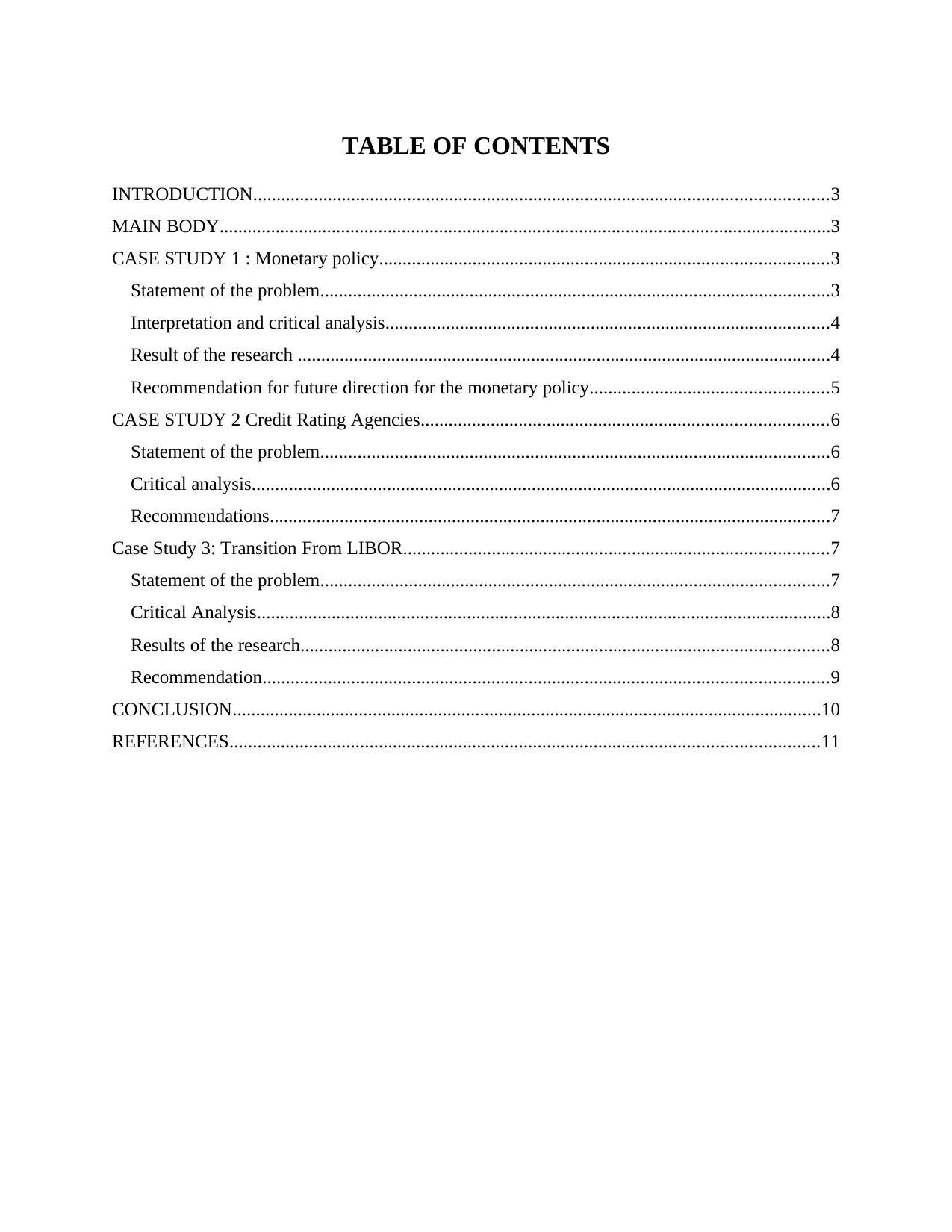
TABLE OF CONTENTS
INTRODUCTION...........................................................................................................................3
MAIN BODY...................................................................................................................................3
CASE STUDY 1 : Monetary policy................................................................................................3
Statement of the problem.............................................................................................................3
Interpretation and critical analysis...............................................................................................4
Result of the research ..................................................................................................................4
Recommendation for future direction for the monetary policy...................................................5
CASE STUDY 2 Credit Rating Agencies.......................................................................................6
Statement of the problem.............................................................................................................6
Critical analysis............................................................................................................................6
Recommendations........................................................................................................................7
Case Study 3: Transition From LIBOR...........................................................................................7
Statement of the problem.............................................................................................................7
Critical Analysis...........................................................................................................................8
Results of the research.................................................................................................................8
Recommendation.........................................................................................................................9
CONCLUSION..............................................................................................................................10
REFERENCES..............................................................................................................................11
INTRODUCTION...........................................................................................................................3
MAIN BODY...................................................................................................................................3
CASE STUDY 1 : Monetary policy................................................................................................3
Statement of the problem.............................................................................................................3
Interpretation and critical analysis...............................................................................................4
Result of the research ..................................................................................................................4
Recommendation for future direction for the monetary policy...................................................5
CASE STUDY 2 Credit Rating Agencies.......................................................................................6
Statement of the problem.............................................................................................................6
Critical analysis............................................................................................................................6
Recommendations........................................................................................................................7
Case Study 3: Transition From LIBOR...........................................................................................7
Statement of the problem.............................................................................................................7
Critical Analysis...........................................................................................................................8
Results of the research.................................................................................................................8
Recommendation.........................................................................................................................9
CONCLUSION..............................................................................................................................10
REFERENCES..............................................................................................................................11
INTRODUCTION
Financial management is the strategic planning, organizing, directing and controlling the
finances which is undertaken by the organization in order to achieve the set goals. To run any
business, it is important for an individual management to understand the financial expenditures
and transitions in such a way which can deliver the profitable outcome to the business (Shearer,
Rauterberg and et.al., 2019). The current report has given three case studies which is based on
monetary policies, credit rating agencies and transition from LIBOR. In this assessment, it will
highlight the statement of the particular issues and provide the critical analysis of the subject.
Along with this, it is important to identify and evaluate the result of the research and mention the
recommendations as well for betterment of the individual business in regard with mentioned
subjects.
MAIN BODY
CASE STUDY 1 : Monetary policy
Statement of the problem
Monetary policy generally involves the influencing the interest rates mainly to affect the
aggregate demand inflation as well as employment in the economy. Monetary police is one of the
important economic policies that is used to stabilize the business cycles. The high as well as
sustained growth of economic particular in the conjunction with low rate inflation is the main
concern of the policy. So rate of the inflation selected as policy objective that has to be pursuant
with the good rate of output as well as employment growth (Lowe 2018). The inappropriate
selection that can be lead to macroeconomic welfare of losses. Monetary policy generally help
the economic growth. As increase in the growth that leads to high rate of the inflation that has to
be decrease here own rate of return on the money as well as induces portfolio that shift in the
approval of the real capital. Generally this generation a raise in capital stock as well as high level
of the output per individuals in long run. The high rate of inflation is the main problem in the
policies. When the central bank give or issue more money particularly to encourage investment
during the period of recession, it mainly increases chance of the inflation in the economy.
The main objective of the monetary policy in Australia are:
Maintenance of full employment in the country
Stability of currency of the country
Economic prosperity as well as welfare of individuals of the country
Financial management is the strategic planning, organizing, directing and controlling the
finances which is undertaken by the organization in order to achieve the set goals. To run any
business, it is important for an individual management to understand the financial expenditures
and transitions in such a way which can deliver the profitable outcome to the business (Shearer,
Rauterberg and et.al., 2019). The current report has given three case studies which is based on
monetary policies, credit rating agencies and transition from LIBOR. In this assessment, it will
highlight the statement of the particular issues and provide the critical analysis of the subject.
Along with this, it is important to identify and evaluate the result of the research and mention the
recommendations as well for betterment of the individual business in regard with mentioned
subjects.
MAIN BODY
CASE STUDY 1 : Monetary policy
Statement of the problem
Monetary policy generally involves the influencing the interest rates mainly to affect the
aggregate demand inflation as well as employment in the economy. Monetary police is one of the
important economic policies that is used to stabilize the business cycles. The high as well as
sustained growth of economic particular in the conjunction with low rate inflation is the main
concern of the policy. So rate of the inflation selected as policy objective that has to be pursuant
with the good rate of output as well as employment growth (Lowe 2018). The inappropriate
selection that can be lead to macroeconomic welfare of losses. Monetary policy generally help
the economic growth. As increase in the growth that leads to high rate of the inflation that has to
be decrease here own rate of return on the money as well as induces portfolio that shift in the
approval of the real capital. Generally this generation a raise in capital stock as well as high level
of the output per individuals in long run. The high rate of inflation is the main problem in the
policies. When the central bank give or issue more money particularly to encourage investment
during the period of recession, it mainly increases chance of the inflation in the economy.
The main objective of the monetary policy in Australia are:
Maintenance of full employment in the country
Stability of currency of the country
Economic prosperity as well as welfare of individuals of the country
⊘ This is a preview!⊘
Do you want full access?
Subscribe today to unlock all pages.

Trusted by 1+ million students worldwide
The stability is interpreted to mean stable and low inflation. So the low as well as stable
inflation preserves value or even purchasing power of money over time. The another objective
that is full employment is relates to reserve bank promoting that environment that generally
supports the full employment. It generally occurs when there are many jobs for the people who
are normally available as well as want to work.
Interpretation and critical analysis
Reserve bank of the Australia deliver the change in the monetary policy
The central bank in Australia is Reserve Bank of Australia's. Generally, the roles are set
out in Reserve bank Act 1959. The duty of bank is to contribute in the full employment, stability
of currency. Economic prosperity as well as welfare of the people. Reserve Banks is important
because it generally monitors the environment as well as mitigates the systemic risks that
particular disrupts financial system (Gonzalez, and Tadle 2021). The central bank generally
conduct the monetary policy through adjusting supply of the money particularly through the
open market operations. Generally, Reserve Bank uses the inflation targeting the framework
particularly to guide their monetary policy decision. Here, Reserve Bank usually conduct
monetary policy for achieving its objective of the full employment, economic prosperity and also
welfare of the people and price stability. This can be done by targeting the inflation rate between
2 and 3 per cent on an average over time. Here cash rate is main tool that is used to the manage
the inflation.
The monetary policy focus on setting interest rate overnight loans particularly in money
market by cash rate. Thus, in 2020 Reserve Bank generally put in place a broad set the monetary
policy measures mainly to lower funding cost as well as support supply of the credit in the
economy. The foreign exchange the intervention through RBA can also help in reducing the
volatility as well as improve the market function through balancing one sidedness of market. So
Reserve Bank of Australia may sell or even buy the Austrian dollars, generally in exchange for
the US dollars mainly to influence the demand and supply in foreign exchange market.
Result of the research
Reserve bank used to make the policy decision about setting of the monetary policy
The reserve bank of Australia implement or set monetary policy through setting the target
for cash rate. Generally, this is interest rate at is bank particular lead to other on overnight
unsecured basis, by using the Exchange Settlement balance this is usually they hold with the
inflation preserves value or even purchasing power of money over time. The another objective
that is full employment is relates to reserve bank promoting that environment that generally
supports the full employment. It generally occurs when there are many jobs for the people who
are normally available as well as want to work.
Interpretation and critical analysis
Reserve bank of the Australia deliver the change in the monetary policy
The central bank in Australia is Reserve Bank of Australia's. Generally, the roles are set
out in Reserve bank Act 1959. The duty of bank is to contribute in the full employment, stability
of currency. Economic prosperity as well as welfare of the people. Reserve Banks is important
because it generally monitors the environment as well as mitigates the systemic risks that
particular disrupts financial system (Gonzalez, and Tadle 2021). The central bank generally
conduct the monetary policy through adjusting supply of the money particularly through the
open market operations. Generally, Reserve Bank uses the inflation targeting the framework
particularly to guide their monetary policy decision. Here, Reserve Bank usually conduct
monetary policy for achieving its objective of the full employment, economic prosperity and also
welfare of the people and price stability. This can be done by targeting the inflation rate between
2 and 3 per cent on an average over time. Here cash rate is main tool that is used to the manage
the inflation.
The monetary policy focus on setting interest rate overnight loans particularly in money
market by cash rate. Thus, in 2020 Reserve Bank generally put in place a broad set the monetary
policy measures mainly to lower funding cost as well as support supply of the credit in the
economy. The foreign exchange the intervention through RBA can also help in reducing the
volatility as well as improve the market function through balancing one sidedness of market. So
Reserve Bank of Australia may sell or even buy the Austrian dollars, generally in exchange for
the US dollars mainly to influence the demand and supply in foreign exchange market.
Result of the research
Reserve bank used to make the policy decision about setting of the monetary policy
The reserve bank of Australia implement or set monetary policy through setting the target
for cash rate. Generally, this is interest rate at is bank particular lead to other on overnight
unsecured basis, by using the Exchange Settlement balance this is usually they hold with the
Paraphrase This Document
Need a fresh take? Get an instant paraphrase of this document with our AI Paraphraser
RBA. The traditional indicators of monetary policy mainly includes quality of the money,
interest rates, rate of change and different measures of the liquidity. The reserve bank of
Australia is generally uses inflation targeting approach simply to guide their monetary policy
decisions. The Reserve Bank Board generally makes decision that is of Australia monetary
policy. Here the board particularly has 9 members of which minimum five members includes
Deputy Governor thus Deputy chair or Governor as Chair essential present to start or conduct a
meeting. Here the Board members discusses a broad range of problems that help it assesses
whether or not the position of monetary policy is conformable with its objectives. So, each
month, the Reserve Bank staff generally prepare detailed papers on the recent developments in
the Australian as well as international economies and also financial markets (Jiang, Khattak
Ahmad. and Lin, 2021).
These papers generally include a recommendation for monetary policy decision. The
policy generally decision is made by the majority vote. The process of the monetary policy
decision includes four steps. First the current economic as well as financial condition is
evaluated on the basis of month, financial stability risks on the basis of half-yearly, the outlook
for economic quarterly. Then in the next step is Policy recommendation then in board meeting
that is monetary policy decision. Then the next step is public communication.
Recommendation for future direction for the monetary policy
For the long term, the country (Australia) interest Rate is particularly projected around
3.35 per cent in the year 2023 as well as 2.60 per cent in the year 2024, as per the Australia
econometric models. As in Australia the interest rates decisions are generally taken by Australia
Board. Current the interest rate is 2.35 per cent which is good in the year 2022. But for the
achieving the target on time as well as easily there may be need some changes such as the
country have to decrease the unemployment, currency devaluation, expand the open market
operations and increase inflation. So the Australia have to low their interest rates so it provides
more liquidity. By the purchase power of the people also increase. Even the central bank can also
use open market operation to maintain the money supply in the economic. Even they have to
make policies related to the employment so the employment will increase in the country which
will make economic stable.
interest rates, rate of change and different measures of the liquidity. The reserve bank of
Australia is generally uses inflation targeting approach simply to guide their monetary policy
decisions. The Reserve Bank Board generally makes decision that is of Australia monetary
policy. Here the board particularly has 9 members of which minimum five members includes
Deputy Governor thus Deputy chair or Governor as Chair essential present to start or conduct a
meeting. Here the Board members discusses a broad range of problems that help it assesses
whether or not the position of monetary policy is conformable with its objectives. So, each
month, the Reserve Bank staff generally prepare detailed papers on the recent developments in
the Australian as well as international economies and also financial markets (Jiang, Khattak
Ahmad. and Lin, 2021).
These papers generally include a recommendation for monetary policy decision. The
policy generally decision is made by the majority vote. The process of the monetary policy
decision includes four steps. First the current economic as well as financial condition is
evaluated on the basis of month, financial stability risks on the basis of half-yearly, the outlook
for economic quarterly. Then in the next step is Policy recommendation then in board meeting
that is monetary policy decision. Then the next step is public communication.
Recommendation for future direction for the monetary policy
For the long term, the country (Australia) interest Rate is particularly projected around
3.35 per cent in the year 2023 as well as 2.60 per cent in the year 2024, as per the Australia
econometric models. As in Australia the interest rates decisions are generally taken by Australia
Board. Current the interest rate is 2.35 per cent which is good in the year 2022. But for the
achieving the target on time as well as easily there may be need some changes such as the
country have to decrease the unemployment, currency devaluation, expand the open market
operations and increase inflation. So the Australia have to low their interest rates so it provides
more liquidity. By the purchase power of the people also increase. Even the central bank can also
use open market operation to maintain the money supply in the economic. Even they have to
make policies related to the employment so the employment will increase in the country which
will make economic stable.
CASE STUDY 2 Credit Rating Agencies
Statement of the problem
Issues emerged for the credit rating agencies during global financial crisis
The term credit rating means to quantify the assessment of borrower the creditworthiness
in particular term or financial obligation. In other words the Credit rating agency are
organization that generally assigns the credit rating to other, which rate a debtor capacity to pay
back the debt through making timely principle as well as interest payment and also likelihood of
the default (Wan 2020). The three biggest credit bureaus in the Australia are Equifax, Illion and
Experian. The credit rating agencies specialized in the evaluation and analysing creditworthiness
of the corporate as well as sovereign problems of the debt securities. The conflict of the interest
between the CRS as well as bond issuers has been determined as main issue because it generally
drives the CRS. In the global financial crisis the credit agencies drew the criticism for generally
giving high credit rating investment. Generally, they failed to determine the risk that have
warned investors particularly against in some types of debts like mortgage backed securities
(Zandi, and et.al., 2020).
Critical analysis
Conflicts of interest that arise for CRS and how it mitigates these risk.
It is a case when the entity has the issue of conflicting interest because of their duties
towards the more than one organization or person. In other words when an firm or individual is
unable to render impartial the assistance or even advice to the agency, that has impaired
objectivity in the performing the work, or even unfair competitive advantages. Conflicts of
interest is generally occurs when an individual person interest that is friendships, financial,
family or even the social factors that could be compromise her or his judgment, action and
decision in the work place (Nwogugu, 2021). There are some mitigation strategies for this type
of risk is create awareness about the interest rate. As they CRA are use four C of the credit that is
capacity, collateral, character and covenants. So the companies have to make their evaluation
effective so this type of risk is not arisen in the activity. So the credit analysis mainly focus on
the issuer capabilities or ability particular to generate cash flow. The conflict of interest is the
major problem or issue that is face by the credit rating agency so they to make some policies to
control this type of the risk.
Statement of the problem
Issues emerged for the credit rating agencies during global financial crisis
The term credit rating means to quantify the assessment of borrower the creditworthiness
in particular term or financial obligation. In other words the Credit rating agency are
organization that generally assigns the credit rating to other, which rate a debtor capacity to pay
back the debt through making timely principle as well as interest payment and also likelihood of
the default (Wan 2020). The three biggest credit bureaus in the Australia are Equifax, Illion and
Experian. The credit rating agencies specialized in the evaluation and analysing creditworthiness
of the corporate as well as sovereign problems of the debt securities. The conflict of the interest
between the CRS as well as bond issuers has been determined as main issue because it generally
drives the CRS. In the global financial crisis the credit agencies drew the criticism for generally
giving high credit rating investment. Generally, they failed to determine the risk that have
warned investors particularly against in some types of debts like mortgage backed securities
(Zandi, and et.al., 2020).
Critical analysis
Conflicts of interest that arise for CRS and how it mitigates these risk.
It is a case when the entity has the issue of conflicting interest because of their duties
towards the more than one organization or person. In other words when an firm or individual is
unable to render impartial the assistance or even advice to the agency, that has impaired
objectivity in the performing the work, or even unfair competitive advantages. Conflicts of
interest is generally occurs when an individual person interest that is friendships, financial,
family or even the social factors that could be compromise her or his judgment, action and
decision in the work place (Nwogugu, 2021). There are some mitigation strategies for this type
of risk is create awareness about the interest rate. As they CRA are use four C of the credit that is
capacity, collateral, character and covenants. So the companies have to make their evaluation
effective so this type of risk is not arisen in the activity. So the credit analysis mainly focus on
the issuer capabilities or ability particular to generate cash flow. The conflict of interest is the
major problem or issue that is face by the credit rating agency so they to make some policies to
control this type of the risk.
⊘ This is a preview!⊘
Do you want full access?
Subscribe today to unlock all pages.
Trusted by 1+ million students worldwide
Recommendations
Credit rating agencies provides information to the investors about bond and debt
instruments issuers can meet their obligations. The role of CRA will be to evaluate and rate the
companies, nations and financial instruments to understand the conflicts of interest. It is
important for an individual to understand the role of the CRA in regard with the conflict of
interest (Alexander and Cumming, 2020). However, it has been recommended to the credit rate
agencies that firstly they should assess the credit risk of the specific debts securities from where
they can be able to identify the appropriate risk which can be resolved within a specific time.
Also, they have to design and structure the plan for mitigating the credit risk and implement the
actions which can be taken by the regulator for the management of conflict of interest.
Case Study 3: Transition From LIBOR
Statement of the problem
Libor stands for London Interbank Offered Rate where this is a benchmark for interest
rate for business loans, mortgages and even financial instruments on global financial market.
Libor is known as the average interest rates where global banks borrow from one another and
includes the combination of the US dollars, euro, British pounds, Japanese yen and Swiss Franc.
However, Libor Scandal is a scheme which is highly publicized by the bankers at several
financial institutions interacted with each other to manipulate the Libor. This scheme is
important because Libor plays a crucial and significant role in the global finance market where it
is used to determine interest rate from the corporate business will pay for loans, to rate individual
for home mortgages and even student loans. Libor scandal was developed and discovered
because banks were falsely inflating and deflating their rates as per the profits which is acquired
from the trade areas (White, 2021).
Libor underpins approximately $350 trillion in derivatives. By undertaking the Libor
scheme, it measures in no longer liquid. The FCA has secured panel bank support to resume the
submission to Libor until 2021 as the future is no guaranteed. In the process of Libor scandal, it
includes Deutsch Bank, Barclays, Sociogroup, JPM and the Royal bank of Scotland. It has been
analysed that Libor scandal has affected the global borrowing where many banks worldwide uses
the Libor as a base rate for setting up the interest rates on customer and corporate loans. During
the beginning of 2003, Barclays and other fifteen global financial institutions came under the
Credit rating agencies provides information to the investors about bond and debt
instruments issuers can meet their obligations. The role of CRA will be to evaluate and rate the
companies, nations and financial instruments to understand the conflicts of interest. It is
important for an individual to understand the role of the CRA in regard with the conflict of
interest (Alexander and Cumming, 2020). However, it has been recommended to the credit rate
agencies that firstly they should assess the credit risk of the specific debts securities from where
they can be able to identify the appropriate risk which can be resolved within a specific time.
Also, they have to design and structure the plan for mitigating the credit risk and implement the
actions which can be taken by the regulator for the management of conflict of interest.
Case Study 3: Transition From LIBOR
Statement of the problem
Libor stands for London Interbank Offered Rate where this is a benchmark for interest
rate for business loans, mortgages and even financial instruments on global financial market.
Libor is known as the average interest rates where global banks borrow from one another and
includes the combination of the US dollars, euro, British pounds, Japanese yen and Swiss Franc.
However, Libor Scandal is a scheme which is highly publicized by the bankers at several
financial institutions interacted with each other to manipulate the Libor. This scheme is
important because Libor plays a crucial and significant role in the global finance market where it
is used to determine interest rate from the corporate business will pay for loans, to rate individual
for home mortgages and even student loans. Libor scandal was developed and discovered
because banks were falsely inflating and deflating their rates as per the profits which is acquired
from the trade areas (White, 2021).
Libor underpins approximately $350 trillion in derivatives. By undertaking the Libor
scheme, it measures in no longer liquid. The FCA has secured panel bank support to resume the
submission to Libor until 2021 as the future is no guaranteed. In the process of Libor scandal, it
includes Deutsch Bank, Barclays, Sociogroup, JPM and the Royal bank of Scotland. It has been
analysed that Libor scandal has affected the global borrowing where many banks worldwide uses
the Libor as a base rate for setting up the interest rates on customer and corporate loans. During
the beginning of 2003, Barclays and other fifteen global financial institutions came under the
Paraphrase This Document
Need a fresh take? Get an instant paraphrase of this document with our AI Paraphraser
research by authorities including US, Japan, Canada, Switzerland and UK connecting to
manipulate the Libor rate.
Critical Analysis
Through the research, it has been founded that Libor needs to replace by the another
scheme for handling the manipulation which is existed on the several financial banks and
institutions. Over the last decades, Libor has been abandoned by scandals and crisis where in
effective 31st December 2021, Libor will not able be able to used to issue new loans in the US.
With the time, the Libor was replaced by the SOFR which refers as Secured Overnight Financing
Rate which is considered by many experts for more accurate and secured pricing benchmark.
SOFR is a benchmark interest rate for dollar denominated derivatives and loans which replaces
the LIBOR. SOFR is important to be developed as it will provide the accurate means of
measuring the cost of borrowing money or loans by an individual and corporate (Read and
Beißer, 2021). As it has been known that SOFR is a benchmark that is used to price loans for the
business and consumer purposes as it is based on the rates that financial institutions pay each
other for overnight loans.
This new benchmark works by lending money using Treasury bond repurchase
agreements pros called as repos. These repos allow banks to make overnight loans to meet
liquidity and reserve requirements using the funds as confirmatory. However, the SOFR
comprises the weighted averages of the rates which is charged in repo transactions. It has been
identified that LIBOR is based on panel bank inputs where SOFR is a measure of the cost of
borrowing the cash overnight from where the corporate and consumers are able to identify the
key impact. Thus, SOFR has replaced and put the impact on the contract quotes of the Libor by
the appropriate interest rates and overnight loans.
Results of the research
From the past evidence, it has been analysed that Libor transition was one of the most
significant challenge that finance market have faced in many years. In 2021, the Financial
Conduct Authority has announced immediately after 31st December first week and 2months
where USD Libor setting will permanently cease after June 30th 2023 and the remaining tenures
will either or cease or no longer representatives (Goharian, B., 2019). The legacy challenges in
cash markets will arise as the result of transitions where the key issues is that legacy LIBOR
manipulate the Libor rate.
Critical Analysis
Through the research, it has been founded that Libor needs to replace by the another
scheme for handling the manipulation which is existed on the several financial banks and
institutions. Over the last decades, Libor has been abandoned by scandals and crisis where in
effective 31st December 2021, Libor will not able be able to used to issue new loans in the US.
With the time, the Libor was replaced by the SOFR which refers as Secured Overnight Financing
Rate which is considered by many experts for more accurate and secured pricing benchmark.
SOFR is a benchmark interest rate for dollar denominated derivatives and loans which replaces
the LIBOR. SOFR is important to be developed as it will provide the accurate means of
measuring the cost of borrowing money or loans by an individual and corporate (Read and
Beißer, 2021). As it has been known that SOFR is a benchmark that is used to price loans for the
business and consumer purposes as it is based on the rates that financial institutions pay each
other for overnight loans.
This new benchmark works by lending money using Treasury bond repurchase
agreements pros called as repos. These repos allow banks to make overnight loans to meet
liquidity and reserve requirements using the funds as confirmatory. However, the SOFR
comprises the weighted averages of the rates which is charged in repo transactions. It has been
identified that LIBOR is based on panel bank inputs where SOFR is a measure of the cost of
borrowing the cash overnight from where the corporate and consumers are able to identify the
key impact. Thus, SOFR has replaced and put the impact on the contract quotes of the Libor by
the appropriate interest rates and overnight loans.
Results of the research
From the past evidence, it has been analysed that Libor transition was one of the most
significant challenge that finance market have faced in many years. In 2021, the Financial
Conduct Authority has announced immediately after 31st December first week and 2months
where USD Libor setting will permanently cease after June 30th 2023 and the remaining tenures
will either or cease or no longer representatives (Goharian, B., 2019). The legacy challenges in
cash markets will arise as the result of transitions where the key issues is that legacy LIBOR
contracts may not suitable fallback language which is able to manage with the permanent USD
LIBOR ending.
Along with this, challenges on ground also can occur where during an online poll,
webinar audience was asked to describe their main challenge and issue they face with the LIBOR
transition where the results show that 48.4% of the people struggled with the term rate
availability with 29% illustrating that updating process and system is a key challenge for them.
Many systems and processes require the benchmark where this is a simple way, the market has
evolved and accept the convention (Xu, 2021). Along with this, if comparing the SOFR to Libor
it has been identified that SOFR is only overnight rate where Libor came in different maturities.
In the process of transition from LIBOR to SOFR, the key issues like overnight rate loans will
arise as SOFR is applicable for only the fixed time period.
Recommendation
There are different types of areas from where the transition can be done where in this
particular subject of finance institution it is required to keep the focus over main categories. The
existing financing expected to stay in place beyond the end of 2021 whee an amendment
agreement will be required. Also, new financing should be placed beyond 2021 where either
usage of RFR from the outset or build a clear mechanism to facilitate conversion to RFR before
end of 2021. However, it has been known that every company's Libor transition plan will be
slightly different because their products and services and strategies are unique and have own
priorities of their customer's.
Thus, it becomes important for the business enterprises to understand and implement a
successful LIBOR transition plan which can overall result the company at excellent manner. At
first, the company should structure and design a program, governance and project management
areas which should be covered accordingly. The second stage should assess the impact on their
business and setting of new benchmark market and product transitions. Moreover, contract
remediation activities supports the identifications of the treatment which will help the companies
to take the appropriate decisions. Along with this, client strategies, system and process changes,
risk and valuation and financing reporting and taxation will be implemented in definite order.
LIBOR ending.
Along with this, challenges on ground also can occur where during an online poll,
webinar audience was asked to describe their main challenge and issue they face with the LIBOR
transition where the results show that 48.4% of the people struggled with the term rate
availability with 29% illustrating that updating process and system is a key challenge for them.
Many systems and processes require the benchmark where this is a simple way, the market has
evolved and accept the convention (Xu, 2021). Along with this, if comparing the SOFR to Libor
it has been identified that SOFR is only overnight rate where Libor came in different maturities.
In the process of transition from LIBOR to SOFR, the key issues like overnight rate loans will
arise as SOFR is applicable for only the fixed time period.
Recommendation
There are different types of areas from where the transition can be done where in this
particular subject of finance institution it is required to keep the focus over main categories. The
existing financing expected to stay in place beyond the end of 2021 whee an amendment
agreement will be required. Also, new financing should be placed beyond 2021 where either
usage of RFR from the outset or build a clear mechanism to facilitate conversion to RFR before
end of 2021. However, it has been known that every company's Libor transition plan will be
slightly different because their products and services and strategies are unique and have own
priorities of their customer's.
Thus, it becomes important for the business enterprises to understand and implement a
successful LIBOR transition plan which can overall result the company at excellent manner. At
first, the company should structure and design a program, governance and project management
areas which should be covered accordingly. The second stage should assess the impact on their
business and setting of new benchmark market and product transitions. Moreover, contract
remediation activities supports the identifications of the treatment which will help the companies
to take the appropriate decisions. Along with this, client strategies, system and process changes,
risk and valuation and financing reporting and taxation will be implemented in definite order.
⊘ This is a preview!⊘
Do you want full access?
Subscribe today to unlock all pages.
Trusted by 1+ million students worldwide
CONCLUSION
The above mentioned report has concluded the brief overview of the financial areas
which is important for the business market to perform well in the global market. The assessment
has concluded the analysis based on three case studies which has been already given and detailed
the objectives of the project. This report will include the statement of the issue and critically
analyse the situation accordingly. However, results of the research also has been mentioned and
recommend the appropriate approaches of each case study.
The above mentioned report has concluded the brief overview of the financial areas
which is important for the business market to perform well in the global market. The assessment
has concluded the analysis based on three case studies which has been already given and detailed
the objectives of the project. This report will include the statement of the issue and critically
analyse the situation accordingly. However, results of the research also has been mentioned and
recommend the appropriate approaches of each case study.
Paraphrase This Document
Need a fresh take? Get an instant paraphrase of this document with our AI Paraphraser
REFERENCES
Books and Journals
Alexander, C. and Cumming, D., 2020. Corruption and Fraud in financial markets: Malpractice,
Misconduct and Manipulation. John Wiley & Sons.
Goharian, B., 2019. LIBOR Evolution: Is the Change in Submissions Methodology Fuel to the
Fires of Potential Litigation?. Available at SSRN 3435850.
Gonzalez, M. and Tadle, R.C., 2021. Monetary policy press releases: An international
comparison. Banco Central de Chile.
Jiang, Q., and et.al., 2021. Mitigation pathways to sustainable production and consumption:
examining the impact of commercial policy on carbon dioxide emissions in
Australia. Sustainable Production and Consumption. 25. pp.390-403.
Lowe, P., 2018. Demographic Change and Recent Monetary Policy. Address to Anika
Foundation Luncheon, Sydney. 8.
Nwogugu, M.I. ed., 2021. Complex Systems and Sustainability in the Global Auditing,
Consulting, and Credit Rating Agency Industries. IGI Global.
Read, O. and Beißer, J., 2021. The End of LIBOR: On Interest Rate Benchmark Reform,
Alternative Risk-Free Rates and IBOR Fallbacks, LIBOR Cessation and Transition.
Shearer, M., Rauterberg, G. and et.al., 2019, June. An agent-based model of financial benchmark
manipulation. In ICML-19 Workshop on AI in Finance.
Wan, W.Y., Godwin, A. and Yao, Q., 2020. When is an individual investor not in need of
consumer protection? A comparative analysis of Singapore, Hong Kong, and
Australia. Sing. J. Legal Stud.. p.190.
White, J., 2021. The rise of alternative rates to hit TP inter-company loans. International Tax
Review.
Xu, H., 2021, November. Corporate Governance Crisis Caused by Lack of Business Ethics.
In International Conference on Management, Business, and Technology (ICOMBEST
2021) (pp. 17-25). Atlantis Press.
Zandi, M., and et.al., 2020. Coronavirus: The Global Economic Threat. Moody’s Analytics, USA.
Books and Journals
Alexander, C. and Cumming, D., 2020. Corruption and Fraud in financial markets: Malpractice,
Misconduct and Manipulation. John Wiley & Sons.
Goharian, B., 2019. LIBOR Evolution: Is the Change in Submissions Methodology Fuel to the
Fires of Potential Litigation?. Available at SSRN 3435850.
Gonzalez, M. and Tadle, R.C., 2021. Monetary policy press releases: An international
comparison. Banco Central de Chile.
Jiang, Q., and et.al., 2021. Mitigation pathways to sustainable production and consumption:
examining the impact of commercial policy on carbon dioxide emissions in
Australia. Sustainable Production and Consumption. 25. pp.390-403.
Lowe, P., 2018. Demographic Change and Recent Monetary Policy. Address to Anika
Foundation Luncheon, Sydney. 8.
Nwogugu, M.I. ed., 2021. Complex Systems and Sustainability in the Global Auditing,
Consulting, and Credit Rating Agency Industries. IGI Global.
Read, O. and Beißer, J., 2021. The End of LIBOR: On Interest Rate Benchmark Reform,
Alternative Risk-Free Rates and IBOR Fallbacks, LIBOR Cessation and Transition.
Shearer, M., Rauterberg, G. and et.al., 2019, June. An agent-based model of financial benchmark
manipulation. In ICML-19 Workshop on AI in Finance.
Wan, W.Y., Godwin, A. and Yao, Q., 2020. When is an individual investor not in need of
consumer protection? A comparative analysis of Singapore, Hong Kong, and
Australia. Sing. J. Legal Stud.. p.190.
White, J., 2021. The rise of alternative rates to hit TP inter-company loans. International Tax
Review.
Xu, H., 2021, November. Corporate Governance Crisis Caused by Lack of Business Ethics.
In International Conference on Management, Business, and Technology (ICOMBEST
2021) (pp. 17-25). Atlantis Press.
Zandi, M., and et.al., 2020. Coronavirus: The Global Economic Threat. Moody’s Analytics, USA.

1 out of 11


Related Documents


Your All-in-One AI-Powered Toolkit for Academic Success.
+13062052269
info@desklib.com
Available 24*7 on WhatsApp / Email
![[object Object]](/_next/static/media/star-bottom.7253800d.svg)
Unlock your academic potential
Copyright © 2020–2026 A2Z Services. All Rights Reserved. Developed and managed by ZUCOL.