Applied Business Finance: Financial Performance Analysis & Improvement

Verified

Added on  2023/06/18

|18
|2439
|150
Report
AI Summary
This report provides an overview of applied business finance, focusing on financial management, the importance of financial statements, and the use of ratios for performance analysis. It covers key aspects such as balance sheets, income statements, and cash flow statements, explaining how these tools are used to compare performance, formulate plans, locate weaknesses, and judge efficiency. The report also discusses strategies for improving financial performance, including increasing revenue through marketing strategies and planning for major expenditures. It concludes by emphasizing the critical role of financial management in achieving organizational goals and objectives, highlighting the need for effective planning, organization, and control of financial resources. Desklib offers a range of study tools and resources to help students understand these complex concepts.

Document Page
Applied Business Finance
tabler-icon-diamond-filled.svg

Paraphrase This Document

Need a fresh take? Get an instant paraphrase of this document with our AI Paraphraser
Document Page
Document Page
Contents
INTRODUCTION...........................................................................................................................................3
SECTION 1....................................................................................................................................................3
Financial Management and its Importance.............................................................................................3
SECTION 2....................................................................................................................................................4
Discussing financial statements and use of ratios...................................................................................4
SECTION 3....................................................................................................................................................6
SECTION 4....................................................................................................................................................9
Discuss the process which business use for improve its financial performance:.....................................9
CONCLUSION.............................................................................................................................................12
REFERENCES..............................................................................................................................................13
Document Page
INTRODUCTION
Finance and management are the two key ideas in financial management. Finance is
concerned with currency and the structure of cash, while administration is concerned with how
allocate and use current infrastructure. As a result, financial management refers towards how run
a business or cash issues. It is one of most significant financial ideas nowadays. It relates to
financial executives' duties. As a result, the primary focus of financial accounting is the good
leadership of money in the firm. Financial Administration is often known as corporate financing
or financial management. Financial management differs depending on the type of company and
the size of the company. Various people believe that understanding the fundamentals of personal
finance in organizations is required to acquire good financial management. Banks in the Country
have gained substantial financial management competence in recent years. This knowledge may
assist a company in developing an effective corporate finance strategy.
SECTION 1
Financial Management and its Importance
To put it another way, financial management is the process of putting a corporation's
economic assets into action. Specific management concepts are included in management. It
focuses on the financial assets of a company. The proper management of a company's finances is
essential to guarantee that the operations are running smoothly. It provides dependable service as
well as increased fuel. The resources of a company must be properly handled. If something
doesn't happen, businesses will face barriers that will impede their capacity to study and expand.
It is a fantastic method for regulating a company's monetary activity. Operations like fund use,
transfers, fund acquisition, accounting, risk evaluation, and anything else involving money are
included in the procedures.
Importance of financial management
Effective Development: To gain success in the advancement of a company firm, efficient and
reliable finance management is required. A flawed strategy is determined to be among the most
major factors for business marketing failures. A good financial strategy is essential to the
achievement of a commercial firm in this regard.
tabler-icon-diamond-filled.svg

Paraphrase This Document

Need a fresh take? Get an instant paraphrase of this document with our AI Paraphraser
Document Page
Smoothing running of enterprises: Finance is required for the efficient operation of a business.
Finance is essential to a company's success, much as oil is to a car's motor. Each step, including
such marketing, registration, growth, and paying day-to-day expenditures, need financial
resources.
Integration of Operations: Financial management ensures that all divisions, including
manufacturing, marketing, purchasing, advertising, and accounting, work together to fulfill the
organization's goals. The finance manager's job is to make sure that various divisions' financial
demands are met on schedule. For instance, whereas if financial manager fails to deliver its
commitments to the procurement department for the sourcing of raw materials, it will have an
effect on the production unit, since there will be a scarcity of raw materials, resulting in no
supplies and reduced revenue.
Making Decisions: All judgments are made on the basis of profitability. Financial management
provides analytical examination of all data and statistics, as well as budgets, financial
information, and other financial documents. Such data assist money planning in calculating the
plan's viability in certain situations and guiding them in making appropriate risk-mitigation
decisions.
The banking sector has been transformed by modern advances in financial management and
related data processing. Financial institutions, for example, have traditionally had the benefit of
especially for small customers and companies, wherein personal contacts and closeness were
critical in assessing creditworthiness and monitoring debtors. The role of economic
administration can be automated and interfaced with the other bank services. In contrast, modern
financial planning technologies have reduced the cost of accessing data, information, and figures,
skewing the balance in the business's favor.
SECTION 2
Discussing financial statements and use of ratios
Financial statements are records that provide information about a business’ financial.
Conventional details surrounding the balance sheet, revenue or bank disclosures, and cash flow
statement. These are one of the most crucial components of business intelligence, and also the
principal way of sending financial information about a firm to private entities. Accrual
Document Page
accounting, when properly interpreted, is a representation of an entity's financial situation at a
specific moment in time. Income reports are designed to meet the needs of a variety of
consumers, includes existing and prospective stockholders, but also financiers.
Balance sheet: A balance sheet is a financial statement that shows the assets, obligations, and
owners equity of a company at a certain period in history. They provide a picture of what a
company earns, and the sum of funds its shareholders have invested, all on a given day. A
balance sheet shows how much a brand is profitable at any particular point in time such that may
better comprehend its financial situation. The balance sheet of a corporation is a document that
presents the current condition of the bank's balance sheet throughout time. It's a summary of
asset, cash, and liability values in a ledger account. The value of property demonstrates what we
can get out of the marketplace and how much we can get out of it. Liabilities are valued based on
how much they must pay in the upcoming. The sum of funds put into the company by the
proprietor is shown as capital. The general ledger formula is built around it.
Income statement: Along with the balance sheet and the cash cash flow, the income statement is
one of three financial report. The numbers from the general ledger for the appropriate accounting
statement are used to generate an income statement. An income statement, commonly known as
a financial statement (or P&L), is a key instrument for figuring out how a company's revenue and
costs compare. Essentially said, it indicates whether company makes a profit or not at a look. A
statement of income is often a list of sales and costs with the cash dividend at the bottom.
Cash flow statement: Along with the income statement and balance sheet, the cash flow
statement is the third major financial statement. It shows the cash flows from operating,
investment, and borrowing, which enables us to understand a firm's stability. There are two
techniques for creating a cash flow statement: directly and indirectly. A cash flow statement of
cash flows depicts a firm's cash inflows and outflows over time. One of a firm's most crucial
financial statements is the cash flow. A cash account appears on the company's balance sheet.
Use of ratio in financial management
Comparing performance: Ratio analysis aids in assessing a performance of the business.
Internally performance is comparing among separate departments to see how effectively
they function together in the same unit and as an organisation. Bankers, lenders, and
Document Page
lenders utilize ratios to evaluate a company's actual results and identify to choose whether
or not invest now. By making comparisons, they may obtain a comprehensive view of a
company's financial situation and suggest opportunities for future development.
Formulating plans: Financial ratio is used to measure financial effects on performance
and also forecast emerging developments. A comparing of historical ratios to current
ratios can aid in the formulation of a future strategy. Creating plans can help you make
better decisions. As a result, in able to adapt to the changing environment, big businesses
must have correct ratios.
Locating weakness: The firm's revenue operational efficiency might be extremely
outstanding. While reviewing the income reports, it may be tough to see any flaws. So if
the corporate accounting situation is steady, financial metrics can assist identify these
flaws. It is critical for big businesses to understand where their company is
underperforming and to act accordingly.
Judging efficiency: Accounting ratios assess the firm's capacity to maximize asset usage
and make profits. The ability to judge efficiency will aid the firm's decision-making
procedure and potential expansion capabilities. Accounting ratios may also be used to
determine how fast a firm is growing in comparison to past years and present
competition.
SECTION 3
Business review:
tabler-icon-diamond-filled.svg

Paraphrase This Document

Need a fresh take? Get an instant paraphrase of this document with our AI Paraphraser
Document Page
Document Page
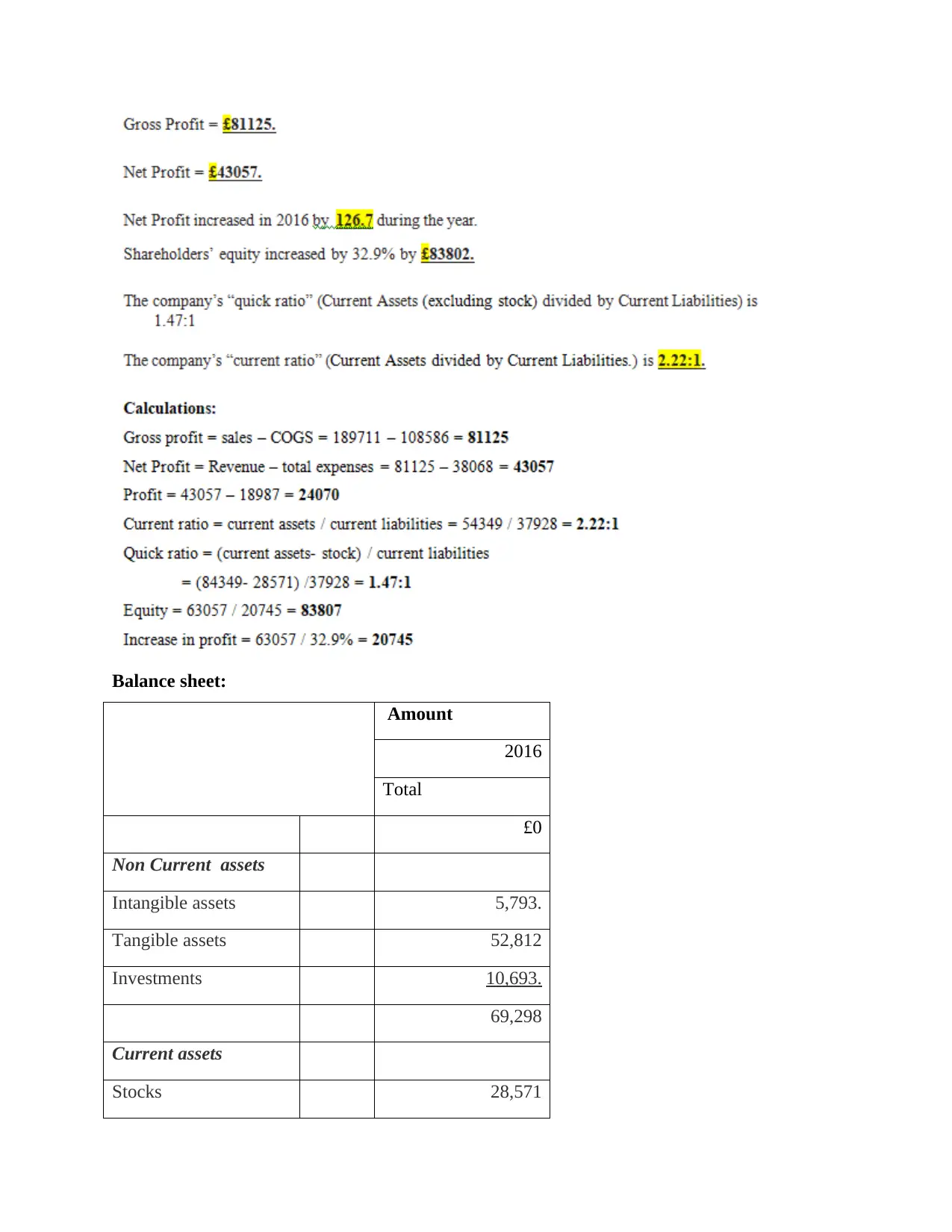
Balance sheet:
Amount
2016
Total
£0
Non Current assets
Intangible assets 5,793.
Tangible assets 52,812
Investments 10,693.
69,298
Current assets
Stocks 28,571
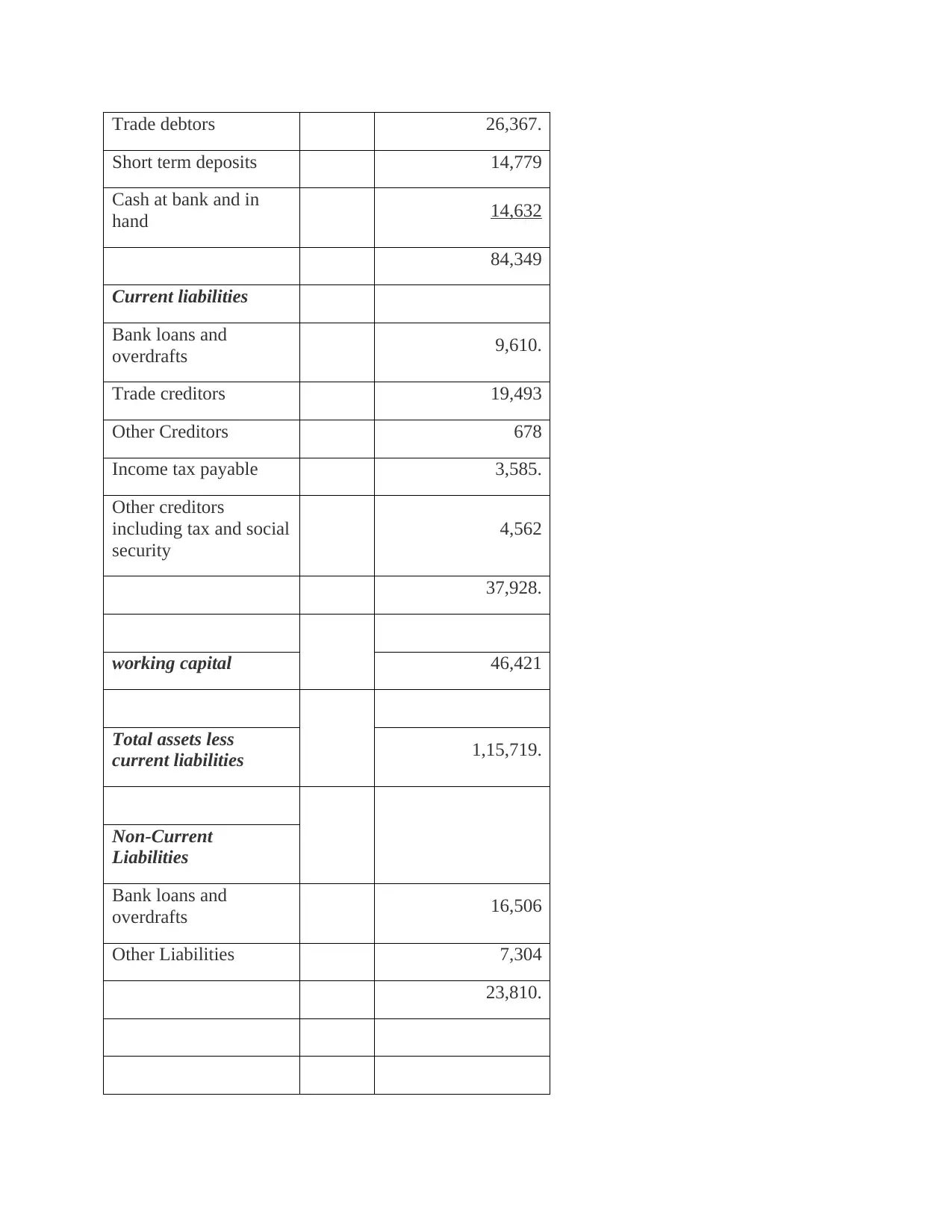
Document Page
Trade debtors 26,367.
Short term deposits 14,779
Cash at bank and in
hand 14,632
84,349
Current liabilities
Bank loans and
overdrafts 9,610.
Trade creditors 19,493
Other Creditors 678
Income tax payable 3,585.
Other creditors
including tax and social
security
4,562
37,928.
working capital 46,421
Total assets less
current liabilities 1,15,719.
Non-Current
Liabilities
Bank loans and
overdrafts 16,506
Other Liabilities 7,304
23,810.
tabler-icon-diamond-filled.svg

Paraphrase This Document

Need a fresh take? Get an instant paraphrase of this document with our AI Paraphraser
Document Page
Provisions for
liabilities 8,094.
Net assets 83,815
Capital and reserves
Called up share capital 39,436
Reserves 1322.
Retained earnings 43,057
Total equity 83,802
SECTION 4
Discuss the process which business use for improve its financial performance:
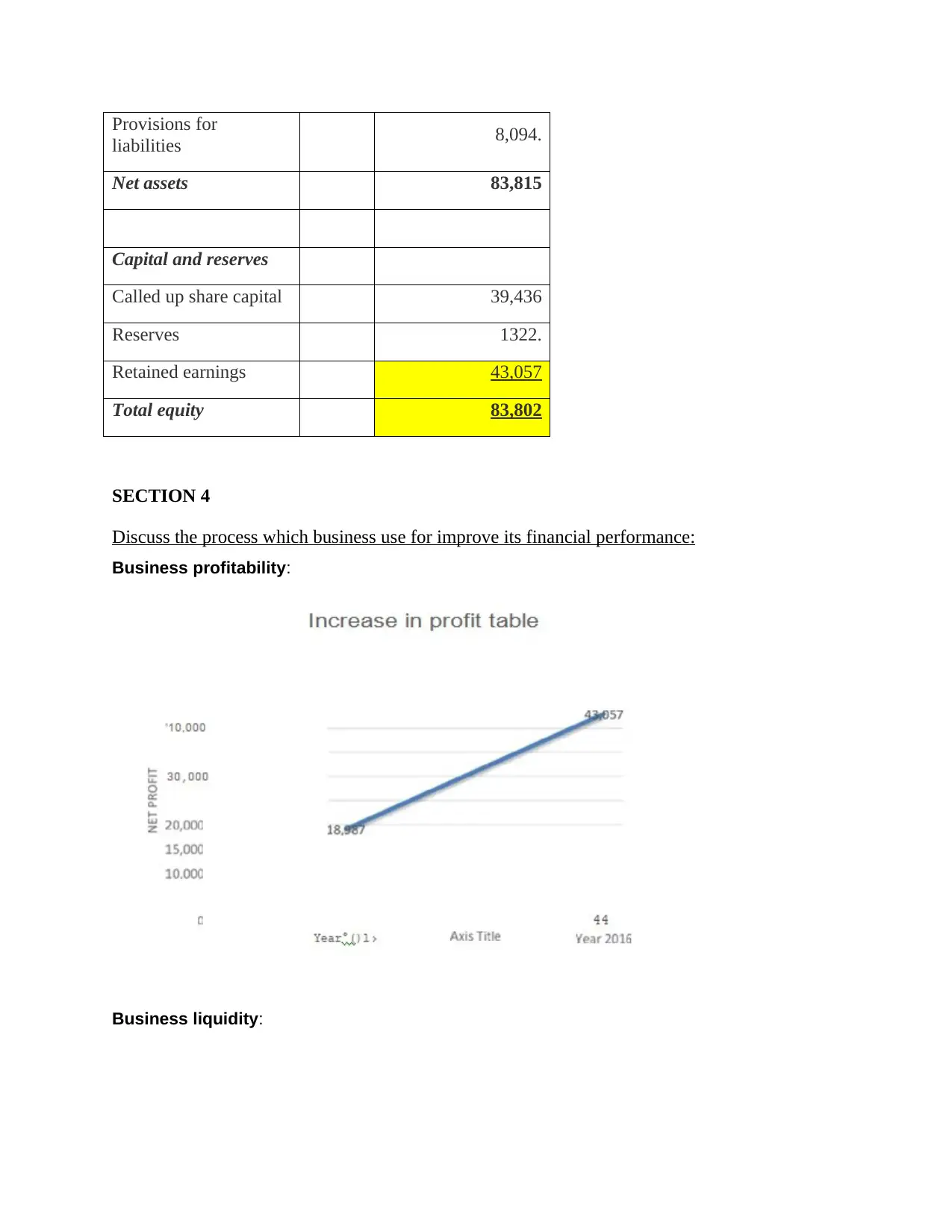
Business profitability:
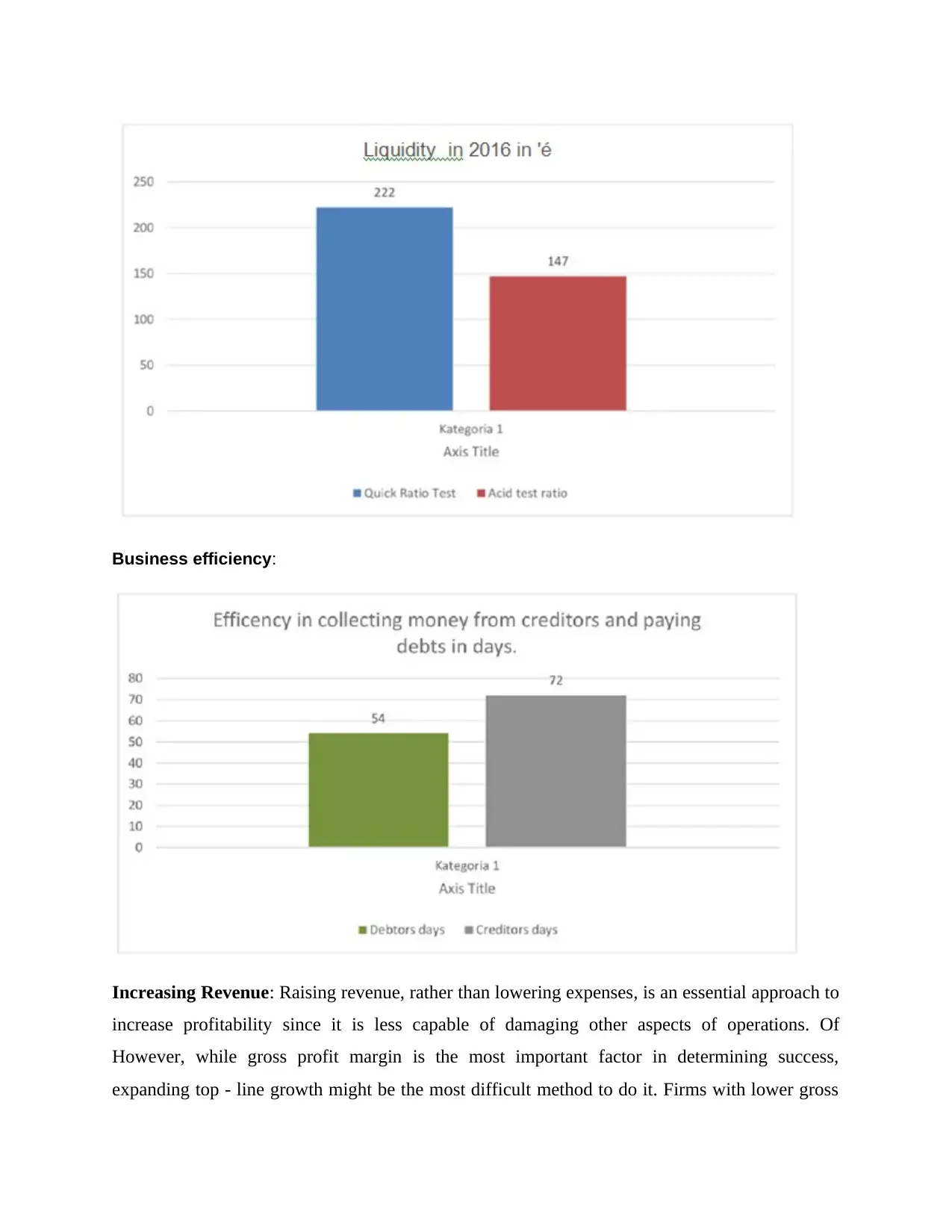
Business liquidity:
Document Page
Business efficiency:
Increasing Revenue: Raising revenue, rather than lowering expenses, is an essential approach to
increase profitability since it is less capable of damaging other aspects of operations. Of
However, while gross profit margin is the most important factor in determining success,
expanding top - line growth might be the most difficult method to do it. Firms with lower gross
chevron_up_icon
1 out of 18
circle_padding
hide_on_mobile
zoom_out_icon
[object Object]