Financial Management Report: Decision Making, Principles, and Control
VerifiedAdded on 2020/07/23
|13
|4470
|52
Report
AI Summary
This report provides a comprehensive analysis of financial management practices within an organization. It begins by exploring both formal and informal approaches to decision-making, highlighting the importance of understanding financial principles for strategic planning. The report then delves into the crucial role of management accountants in stewardship accounting, long and short-term planning, and the formulation of management information systems (MIS). Furthermore, it evaluates the significance of accounting control systems in ensuring financial validity, reliability, and compliance. The report also examines the impact of these systems on internal departments and their contribution to overall organizational objectives. The report concludes by assessing the importance of financial decision-making for long-term sustainability.
Financial Management

Paraphrase This Document
Need a fresh take? Get an instant paraphrase of this document with our AI Paraphraser
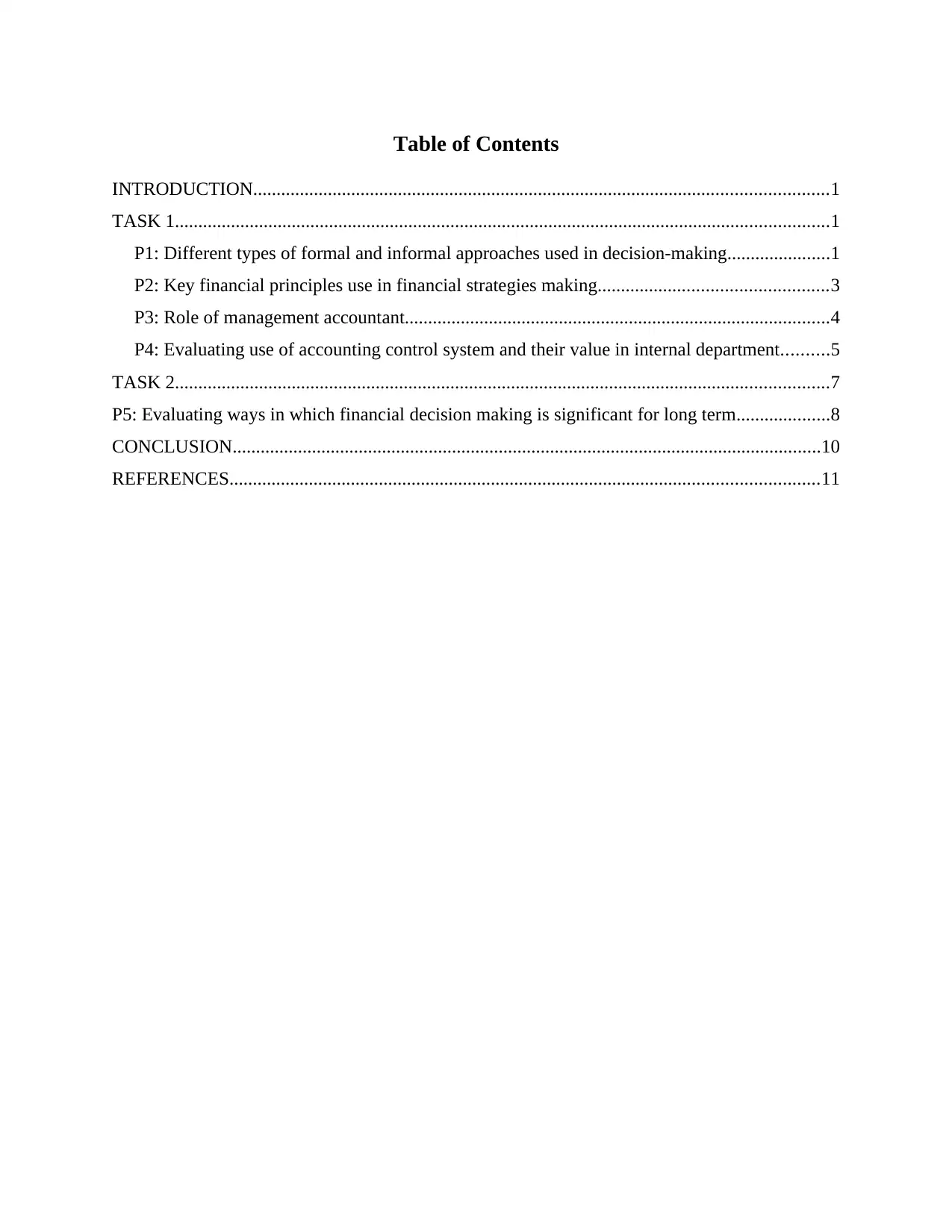
Table of Contents
INTRODUCTION...........................................................................................................................1
TASK 1............................................................................................................................................1
P1: Different types of formal and informal approaches used in decision-making......................1
P2: Key financial principles use in financial strategies making.................................................3
P3: Role of management accountant...........................................................................................4
P4: Evaluating use of accounting control system and their value in internal department..........5
TASK 2............................................................................................................................................7
P5: Evaluating ways in which financial decision making is significant for long term....................8
CONCLUSION..............................................................................................................................10
REFERENCES..............................................................................................................................11
INTRODUCTION...........................................................................................................................1
TASK 1............................................................................................................................................1
P1: Different types of formal and informal approaches used in decision-making......................1
P2: Key financial principles use in financial strategies making.................................................3
P3: Role of management accountant...........................................................................................4
P4: Evaluating use of accounting control system and their value in internal department..........5
TASK 2............................................................................................................................................7
P5: Evaluating ways in which financial decision making is significant for long term....................8
CONCLUSION..............................................................................................................................10
REFERENCES..............................................................................................................................11
INTRODUCTION
Finance is an essential aspects which is consider as life blood of an organisation. It is
used to manage and operate all important operations those are incurred during the period of time.
Without having proper flow of capital they are not able earn maximum profit during the period
of time. The primary objective of financial is to manage all necessary requirements which are
essential for increase profitability for an organisation. It would guide for the internal investments
and financing firms and not being able to operate resources in effective manner (Brigham and
Houston, 2012).
This project report provide crucial information about various formal and informal method
of decision-making. Understanding of key management principles use to enhance financial
sustainability for an organization. Crucial role of accountants and control systems are discuss
under this report. At the last, different ways to support financial decision-making. All this
information are analyse effectively in order to attain overall aims and objectives for an
organisation.
TASK 1
P1: Different types of formal and informal approaches used in decision-making
Financial management has emerged as utmost important and interesting areas for
academic studies as well as for examine practice finance managers. It included various aspects
those are based on effective decisions which are being made by an organisation during the period
of time. In general manner, understanding of finance realize as capital. While in real sense this
terms is study of money and their vital flow to operate a new businesses in more effective
manner. Finance is the study of amount and their essential supply. It is the process by which
raising of income and proper allocation of all resources on the basis of financial requirements of
the businesses is done. Whereas, management means effective planning, organising and
analysing every human activities in order to attain desire aims and objectives. They are held
responsible for regulating overall administration and management of money and their proper
flow in the department (Chandra, 2011). It has been seen that are two important sources of
decision making. Some of them are discuss underneath:
Formal: It refers to a particular organisation structure that is formularise relationship
among members of Thomas cook Group Plc and the processes by which they get interacted to
1
Finance is an essential aspects which is consider as life blood of an organisation. It is
used to manage and operate all important operations those are incurred during the period of time.
Without having proper flow of capital they are not able earn maximum profit during the period
of time. The primary objective of financial is to manage all necessary requirements which are
essential for increase profitability for an organisation. It would guide for the internal investments
and financing firms and not being able to operate resources in effective manner (Brigham and
Houston, 2012).
This project report provide crucial information about various formal and informal method
of decision-making. Understanding of key management principles use to enhance financial
sustainability for an organization. Crucial role of accountants and control systems are discuss
under this report. At the last, different ways to support financial decision-making. All this
information are analyse effectively in order to attain overall aims and objectives for an
organisation.
TASK 1
P1: Different types of formal and informal approaches used in decision-making
Financial management has emerged as utmost important and interesting areas for
academic studies as well as for examine practice finance managers. It included various aspects
those are based on effective decisions which are being made by an organisation during the period
of time. In general manner, understanding of finance realize as capital. While in real sense this
terms is study of money and their vital flow to operate a new businesses in more effective
manner. Finance is the study of amount and their essential supply. It is the process by which
raising of income and proper allocation of all resources on the basis of financial requirements of
the businesses is done. Whereas, management means effective planning, organising and
analysing every human activities in order to attain desire aims and objectives. They are held
responsible for regulating overall administration and management of money and their proper
flow in the department (Chandra, 2011). It has been seen that are two important sources of
decision making. Some of them are discuss underneath:
Formal: It refers to a particular organisation structure that is formularise relationship
among members of Thomas cook Group Plc and the processes by which they get interacted to
1
⊘ This is a preview!⊘
Do you want full access?
Subscribe today to unlock all pages.

Trusted by 1+ million students worldwide
form an effective environment. In recent time people become more aware of all risks those are
associated with the technology that has placed plenty of responsibility for evaluating
performance of an organisation. There are certain formal methods those are uses by department
are discussed underneath:
One-on-one meetings: This seems to be an effective process of formal method under
which two parties get involve to exchange their important informations. It saves time as
well as costs that can reduce certain burden on an organisation.
Department meetings: It is said to be one of the important sections in an organisation. It
is organise by company to analyse problems of every departments to examine their
significant issues associated with them (Renz and Herman, 2016).
Regular status reports on project: It is an important document that is used by project
managers as formal reporting on status of a project to steering committee. It consist of
crucial members such as senior manager or various stakeholders.
Informal: The functionality of institutions would to be assured to wide extent by
development of parallel system of informal regulations and process for making effective
decision-making. It is known as reliable person of existing support network to analyse internal
performance as well as determining skills of an organisation.
Popping by an employees desk at the workplace: It is said to be an essential aspects
which is related with getting information through popping at any employees desk. This
will distract other from their work.
Informal meeting: It is said to be important meeting which is far less important planned
and regulate or crucial as comparison to formal meeting. The primary feature of this
meeting which is unplanned. The management can anytime asked to organise meeting in
order to take crucial decision for the purpose of increase growth and sustainability for
Thomas cook Group Plc (Molina and Preve, 2012).
There are various factors those are affecting an effective decision making
Certainty: Decision are taken under various critical situation of certainty in case
manager has sufficient data to know the outcomes for Thomas cook Group Plc. The role of
manager is to determine the available alternatives as well as conditions those are required at the
time of making any crucial decision.
2
associated with the technology that has placed plenty of responsibility for evaluating
performance of an organisation. There are certain formal methods those are uses by department
are discussed underneath:
One-on-one meetings: This seems to be an effective process of formal method under
which two parties get involve to exchange their important informations. It saves time as
well as costs that can reduce certain burden on an organisation.
Department meetings: It is said to be one of the important sections in an organisation. It
is organise by company to analyse problems of every departments to examine their
significant issues associated with them (Renz and Herman, 2016).
Regular status reports on project: It is an important document that is used by project
managers as formal reporting on status of a project to steering committee. It consist of
crucial members such as senior manager or various stakeholders.
Informal: The functionality of institutions would to be assured to wide extent by
development of parallel system of informal regulations and process for making effective
decision-making. It is known as reliable person of existing support network to analyse internal
performance as well as determining skills of an organisation.
Popping by an employees desk at the workplace: It is said to be an essential aspects
which is related with getting information through popping at any employees desk. This
will distract other from their work.
Informal meeting: It is said to be important meeting which is far less important planned
and regulate or crucial as comparison to formal meeting. The primary feature of this
meeting which is unplanned. The management can anytime asked to organise meeting in
order to take crucial decision for the purpose of increase growth and sustainability for
Thomas cook Group Plc (Molina and Preve, 2012).
There are various factors those are affecting an effective decision making
Certainty: Decision are taken under various critical situation of certainty in case
manager has sufficient data to know the outcomes for Thomas cook Group Plc. The role of
manager is to determine the available alternatives as well as conditions those are required at the
time of making any crucial decision.
2
Paraphrase This Document
Need a fresh take? Get an instant paraphrase of this document with our AI Paraphraser
Risk: It has been determine the most of the management decision are made under the
situation of sever risk. Decision are made in order to deal with all kind of unnecessary impacts
that are affecting the overall performance of an organisation.
Uncertainty: It refers as an effective decision that is made under a given situation when
the probabilities of outcomes are unknown. There are no any specific awareness of every
alternative and also the results in accordance with the known alternatives.
P2: Key financial principles use in financial strategies making
There is not any specific model of use by financial system that suits every organisation,
but there are few basic that assist in place to attain good practice in financial management. It is
useful to determine certain key principles in case of formulating a financial system. These will
act as a particular guide to the owner as well as managers in making decision more effective.
There are some principles are mentioned underneath:
Consistency: It is known as quality or situation of being consistent. There is always a
seen that because of lack of consistency in matters of management policy. It is more crucial in
creating database, as they are embodiment of the businesses rules for which the database is being
created (Bernile and Lyandres, 2011).
Accountability: It is an assurance that a person or an organisation will be analyse on
their performance or attitude associated to something for which they are held responsible. The
obligation of an individual is to account for their activities and attain responsibility for them.
Transparency: It is used as effective means of holding public official accountable and
deal with any kind of vital issues. This seems to be more effective pillars of corporate
governance. The impacts of transparency is that every company such as Thomas cook Group Plc
would have enough data to deal with all sorts of implications.
Integrity: It happens to be the quality which is being related with honest and having
positive moral principles or position. It is more common personal selection to keep hold of
oneself consistent in following ethical considerations those are related with an organisation. In
common term all information collected by the finance manager is must be real and being
honestly recorded in the final account books (Allen, Hemming and Potter, 2013).
Accounting standard: It is a kind of principles that guide accountant to make use
standardize accounting rule and regulation so that more reliable and accurate chance of getting
3
situation of sever risk. Decision are made in order to deal with all kind of unnecessary impacts
that are affecting the overall performance of an organisation.
Uncertainty: It refers as an effective decision that is made under a given situation when
the probabilities of outcomes are unknown. There are no any specific awareness of every
alternative and also the results in accordance with the known alternatives.
P2: Key financial principles use in financial strategies making
There is not any specific model of use by financial system that suits every organisation,
but there are few basic that assist in place to attain good practice in financial management. It is
useful to determine certain key principles in case of formulating a financial system. These will
act as a particular guide to the owner as well as managers in making decision more effective.
There are some principles are mentioned underneath:
Consistency: It is known as quality or situation of being consistent. There is always a
seen that because of lack of consistency in matters of management policy. It is more crucial in
creating database, as they are embodiment of the businesses rules for which the database is being
created (Bernile and Lyandres, 2011).
Accountability: It is an assurance that a person or an organisation will be analyse on
their performance or attitude associated to something for which they are held responsible. The
obligation of an individual is to account for their activities and attain responsibility for them.
Transparency: It is used as effective means of holding public official accountable and
deal with any kind of vital issues. This seems to be more effective pillars of corporate
governance. The impacts of transparency is that every company such as Thomas cook Group Plc
would have enough data to deal with all sorts of implications.
Integrity: It happens to be the quality which is being related with honest and having
positive moral principles or position. It is more common personal selection to keep hold of
oneself consistent in following ethical considerations those are related with an organisation. In
common term all information collected by the finance manager is must be real and being
honestly recorded in the final account books (Allen, Hemming and Potter, 2013).
Accounting standard: It is a kind of principles that guide accountant to make use
standardize accounting rule and regulation so that more reliable and accurate chance of getting
3
positive outcomes can be more. It is held responsible so that financial statements are
understandable across large number of business enterprises.
There are certain important aspects those are needed to be taken into consideration while
following any kind of principles in long businesses.
Setting objectives to attain financial aims: It is an essential and utmost important
aspects for Thomas cook Group Plc to first set certain objectives in in different parameters such a
short term, medium and long term. This will leads to analyse which aspect of financial
information is helpful to formulate aims in coming time (Liao, Liu and Wang, 2011).
Ethical constrain: It is vital of Thomas cook Group Plc to make use of data or operations
in ethical ways so that maximum opportunities can be created in more limited period of time.
The primary benefits of doing business in ethical manner can increase moral as well as
importance for an organisation to make decision more accurate in coming time.
Increasing shareholders wealth: It has been seen that shareholders are most important
part of an organisation. They only need is to have certain amount of return on investment. This
will enhance their share of interest in an organisation as well as any financial planning made by
the company in near future time.
Delivering sustainable long term growth: By the help of all necessary financial data of
an organisation to inform decisions which will leads to support and make sustainable long term
growth for the company.
P3: Role of management accountant
It has been seen that corporate and management accountant work within one particular
company. The role of an them is to perform a specific series of activities to ensure their
companies financial security and handling necessary financial matters and henceforth, it ensure
to drive the business in more particular manner. They are responsible for determining the status
and success of an institution.
There are certain role of management accountant:
Stewardship accounting: They use to design an effective framework of cost and
financial accounts and prepare report on regulate collection of data from various departments
during the time of decision-making.
Long and short term planning: Accountant plays an eminent role in future forecasting
that is based on business and economic event for making upcoming plans. There are certain
4
understandable across large number of business enterprises.
There are certain important aspects those are needed to be taken into consideration while
following any kind of principles in long businesses.
Setting objectives to attain financial aims: It is an essential and utmost important
aspects for Thomas cook Group Plc to first set certain objectives in in different parameters such a
short term, medium and long term. This will leads to analyse which aspect of financial
information is helpful to formulate aims in coming time (Liao, Liu and Wang, 2011).
Ethical constrain: It is vital of Thomas cook Group Plc to make use of data or operations
in ethical ways so that maximum opportunities can be created in more limited period of time.
The primary benefits of doing business in ethical manner can increase moral as well as
importance for an organisation to make decision more accurate in coming time.
Increasing shareholders wealth: It has been seen that shareholders are most important
part of an organisation. They only need is to have certain amount of return on investment. This
will enhance their share of interest in an organisation as well as any financial planning made by
the company in near future time.
Delivering sustainable long term growth: By the help of all necessary financial data of
an organisation to inform decisions which will leads to support and make sustainable long term
growth for the company.
P3: Role of management accountant
It has been seen that corporate and management accountant work within one particular
company. The role of an them is to perform a specific series of activities to ensure their
companies financial security and handling necessary financial matters and henceforth, it ensure
to drive the business in more particular manner. They are responsible for determining the status
and success of an institution.
There are certain role of management accountant:
Stewardship accounting: They use to design an effective framework of cost and
financial accounts and prepare report on regulate collection of data from various departments
during the time of decision-making.
Long and short term planning: Accountant plays an eminent role in future forecasting
that is based on business and economic event for making upcoming plans. There are certain
4
⊘ This is a preview!⊘
Do you want full access?
Subscribe today to unlock all pages.
Trusted by 1+ million students worldwide
aspects are needed to be implemented such as strategies accounting, formulating corporate
strategies etc.
Formulating MIS: It is the responsibility of management accounting to make routine
reports in order to make long term decision making are forwarded to department level in respect
to take crucial actions at a given point of time (Cole, 2013).
Certain application of management accounting techniques are needed to be use so that to
incur, analyse and present financial data to support valuable decision-making. Some of them are:
Cost forecasting: Accountant use to valued of assets, costs and all kind of risk those are
arises in an organisation. Future costs that are going to be incurred by Thomas cook
Group Plc are needed to taken into account by the management accountant.
Managing risk: One of the primary areas where the use of basic rule and accounting
policies to perform their duties in more specific manner to hedge risk in an organisation.
Financial strategies means is all about forecasting risks and planning approaches to deal
with any kind of issues.
Financial management systems:
It is an essential ways for collecting necessary information about the overall performance
of an organisation. The collection of events that ensure effective financial management and risk
are taken into consideration. With the use of latest and advanced technologies to build integrated
and inclusive financial system will be the right option for Thomas cook Group Plc.
P4: Evaluating use of accounting control system and their value in internal department
Accounting control is an effective method and process which is being implemented by an
organization to help and enureses proper validity and reliability of their financial position. The
accounting control does not related with compliance with certain law and regulation, whether
they are frame to assist a company attain overall aims and objectives during the set limitation.
Internal control are said to be a valuable system which is used to analyse performance of
employees in respect to their duties in ethical manner (Martin, 2016). Internal control is said to
be an effective accounting and auditing process for assuring attainment of goals in operational
effectiveness and increase maximum profitability in given period of time. It would provide
continuous feedback for system in order to make sure that everything is running correctly. This
particular system is basically related with:
5
strategies etc.
Formulating MIS: It is the responsibility of management accounting to make routine
reports in order to make long term decision making are forwarded to department level in respect
to take crucial actions at a given point of time (Cole, 2013).
Certain application of management accounting techniques are needed to be use so that to
incur, analyse and present financial data to support valuable decision-making. Some of them are:
Cost forecasting: Accountant use to valued of assets, costs and all kind of risk those are
arises in an organisation. Future costs that are going to be incurred by Thomas cook
Group Plc are needed to taken into account by the management accountant.
Managing risk: One of the primary areas where the use of basic rule and accounting
policies to perform their duties in more specific manner to hedge risk in an organisation.
Financial strategies means is all about forecasting risks and planning approaches to deal
with any kind of issues.
Financial management systems:
It is an essential ways for collecting necessary information about the overall performance
of an organisation. The collection of events that ensure effective financial management and risk
are taken into consideration. With the use of latest and advanced technologies to build integrated
and inclusive financial system will be the right option for Thomas cook Group Plc.
P4: Evaluating use of accounting control system and their value in internal department
Accounting control is an effective method and process which is being implemented by an
organization to help and enureses proper validity and reliability of their financial position. The
accounting control does not related with compliance with certain law and regulation, whether
they are frame to assist a company attain overall aims and objectives during the set limitation.
Internal control are said to be a valuable system which is used to analyse performance of
employees in respect to their duties in ethical manner (Martin, 2016). Internal control is said to
be an effective accounting and auditing process for assuring attainment of goals in operational
effectiveness and increase maximum profitability in given period of time. It would provide
continuous feedback for system in order to make sure that everything is running correctly. This
particular system is basically related with:
5
Paraphrase This Document
Need a fresh take? Get an instant paraphrase of this document with our AI Paraphraser
Ensuring compliance with accounting norms: It is utmost important aspects for an
organization to make use of more reliable accounting rules and regulation which will assist
accountant to increase growth for Thomas cook Group Plc in an accounting period of time.
Protecting organisation assets: There are various ways by which assets of Thomas cook
Group Plc can easily be determine by the management accountant. Organising assets and other
related areas which are needed to be protected. Formulation of security plans of action. Proper
documentation of polices those are essential for increasing growth for an organisation.
Formulating dependable and timely financial reports: The primary motive of an
management accountant is record all necessary data which is reliable before posting it into the
financial statements. Another crucial aspects is to make timely statements so that decisions
would be made accordingly.
Cost control techniques:
It is said to be important practice for determining and eliminating business expenditure to
enhance profitability for an organisation by the help of using budgeting process. Thomas cook
Group Plc use to make comparison or actual outcomes to the budget expectations and in case of
actual cost are higher than planned manner. It can be done by taking past performances
information by determining information and estimation to control cost those are incurred during
the time of production process. This will assist by encouraging functional, tactical and strategic
planning at internal level of the departments (Bodnar and et, al., 2013).
Internal and external control: It has been seen that accounts managers always tried to
make use of data for the purpose of controlling both internal and external department of an
organisation. By the ways of using various costing techniques such as job costing or cost
accounting systems they can be able to determine internal level of an organisation. Whereas
external control can be done by using financial reports of the company in respect to analyse
current position of the company before submitting it with the other investors and shareholders.
There are certain specific types of cost controlling methods. Those are discussed underneath:
Budget: This happens to be an effective ways to control extra costs and expenses those
are being going to be incur by the company over the production of products and services. This is
said to be most common tools for controlling cost for Thomas cook Group Plc.
6
organization to make use of more reliable accounting rules and regulation which will assist
accountant to increase growth for Thomas cook Group Plc in an accounting period of time.
Protecting organisation assets: There are various ways by which assets of Thomas cook
Group Plc can easily be determine by the management accountant. Organising assets and other
related areas which are needed to be protected. Formulation of security plans of action. Proper
documentation of polices those are essential for increasing growth for an organisation.
Formulating dependable and timely financial reports: The primary motive of an
management accountant is record all necessary data which is reliable before posting it into the
financial statements. Another crucial aspects is to make timely statements so that decisions
would be made accordingly.
Cost control techniques:
It is said to be important practice for determining and eliminating business expenditure to
enhance profitability for an organisation by the help of using budgeting process. Thomas cook
Group Plc use to make comparison or actual outcomes to the budget expectations and in case of
actual cost are higher than planned manner. It can be done by taking past performances
information by determining information and estimation to control cost those are incurred during
the time of production process. This will assist by encouraging functional, tactical and strategic
planning at internal level of the departments (Bodnar and et, al., 2013).
Internal and external control: It has been seen that accounts managers always tried to
make use of data for the purpose of controlling both internal and external department of an
organisation. By the ways of using various costing techniques such as job costing or cost
accounting systems they can be able to determine internal level of an organisation. Whereas
external control can be done by using financial reports of the company in respect to analyse
current position of the company before submitting it with the other investors and shareholders.
There are certain specific types of cost controlling methods. Those are discussed underneath:
Budget: This happens to be an effective ways to control extra costs and expenses those
are being going to be incur by the company over the production of products and services. This is
said to be most common tools for controlling cost for Thomas cook Group Plc.
6
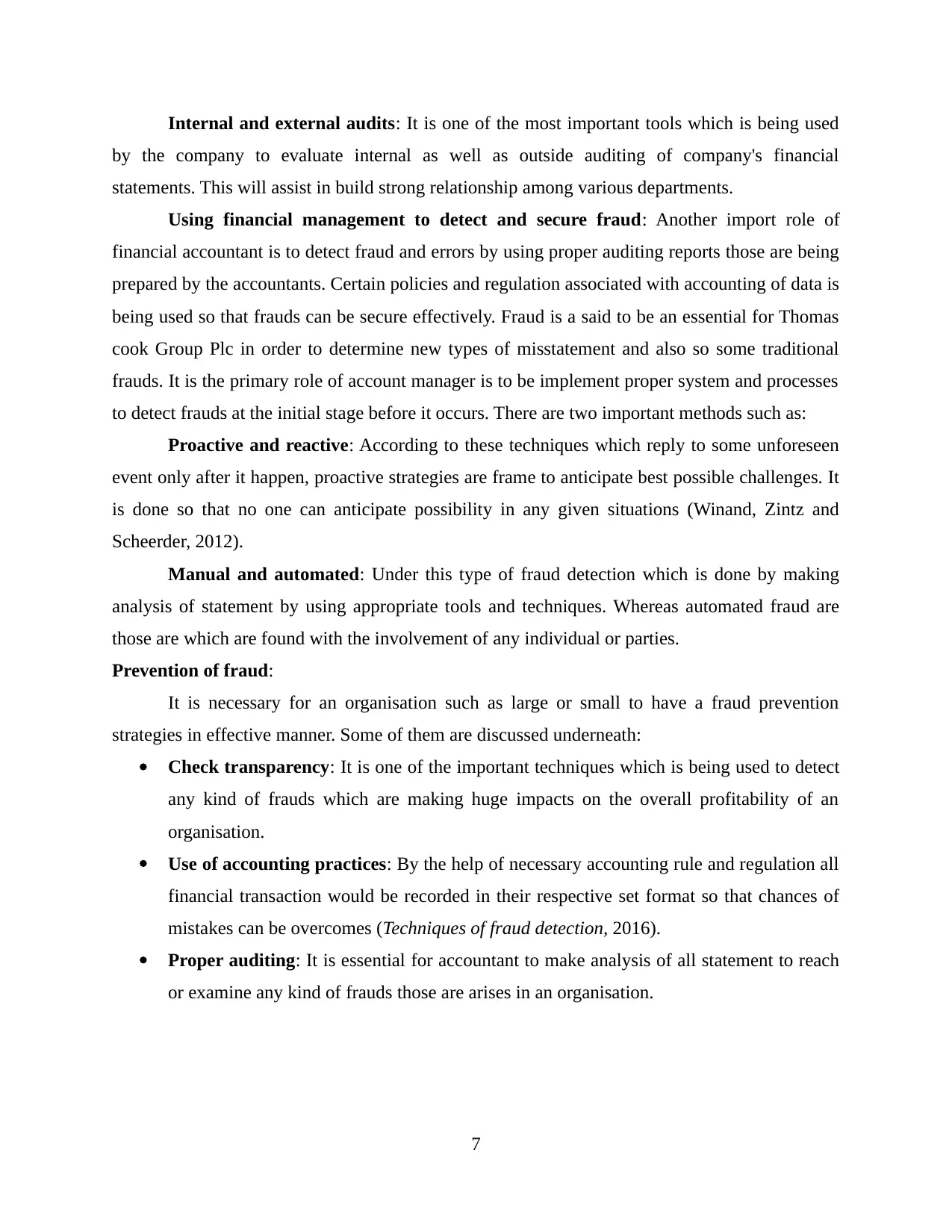
Internal and external audits: It is one of the most important tools which is being used
by the company to evaluate internal as well as outside auditing of company's financial
statements. This will assist in build strong relationship among various departments.
Using financial management to detect and secure fraud: Another import role of
financial accountant is to detect fraud and errors by using proper auditing reports those are being
prepared by the accountants. Certain policies and regulation associated with accounting of data is
being used so that frauds can be secure effectively. Fraud is a said to be an essential for Thomas
cook Group Plc in order to determine new types of misstatement and also so some traditional
frauds. It is the primary role of account manager is to be implement proper system and processes
to detect frauds at the initial stage before it occurs. There are two important methods such as:
Proactive and reactive: According to these techniques which reply to some unforeseen
event only after it happen, proactive strategies are frame to anticipate best possible challenges. It
is done so that no one can anticipate possibility in any given situations (Winand, Zintz and
Scheerder, 2012).
Manual and automated: Under this type of fraud detection which is done by making
analysis of statement by using appropriate tools and techniques. Whereas automated fraud are
those are which are found with the involvement of any individual or parties.
Prevention of fraud:
It is necessary for an organisation such as large or small to have a fraud prevention
strategies in effective manner. Some of them are discussed underneath:
Check transparency: It is one of the important techniques which is being used to detect
any kind of frauds which are making huge impacts on the overall profitability of an
organisation.
Use of accounting practices: By the help of necessary accounting rule and regulation all
financial transaction would be recorded in their respective set format so that chances of
mistakes can be overcomes (Techniques of fraud detection, 2016).
Proper auditing: It is essential for accountant to make analysis of all statement to reach
or examine any kind of frauds those are arises in an organisation.
7
by the company to evaluate internal as well as outside auditing of company's financial
statements. This will assist in build strong relationship among various departments.
Using financial management to detect and secure fraud: Another import role of
financial accountant is to detect fraud and errors by using proper auditing reports those are being
prepared by the accountants. Certain policies and regulation associated with accounting of data is
being used so that frauds can be secure effectively. Fraud is a said to be an essential for Thomas
cook Group Plc in order to determine new types of misstatement and also so some traditional
frauds. It is the primary role of account manager is to be implement proper system and processes
to detect frauds at the initial stage before it occurs. There are two important methods such as:
Proactive and reactive: According to these techniques which reply to some unforeseen
event only after it happen, proactive strategies are frame to anticipate best possible challenges. It
is done so that no one can anticipate possibility in any given situations (Winand, Zintz and
Scheerder, 2012).
Manual and automated: Under this type of fraud detection which is done by making
analysis of statement by using appropriate tools and techniques. Whereas automated fraud are
those are which are found with the involvement of any individual or parties.
Prevention of fraud:
It is necessary for an organisation such as large or small to have a fraud prevention
strategies in effective manner. Some of them are discussed underneath:
Check transparency: It is one of the important techniques which is being used to detect
any kind of frauds which are making huge impacts on the overall profitability of an
organisation.
Use of accounting practices: By the help of necessary accounting rule and regulation all
financial transaction would be recorded in their respective set format so that chances of
mistakes can be overcomes (Techniques of fraud detection, 2016).
Proper auditing: It is essential for accountant to make analysis of all statement to reach
or examine any kind of frauds those are arises in an organisation.
7
⊘ This is a preview!⊘
Do you want full access?
Subscribe today to unlock all pages.
Trusted by 1+ million students worldwide
TASK 2
P5: Evaluating ways in which financial decision making is significant for long term
(a): Identifying data obtained to inform operational and strategies decision
It has been seen that operational decision are made to manager in their everyday business
operations. Thus, managers would have all data on present discount rate in the market. It is not
easy as, because the number of operations that can be more effective. Collecting informations is
an important task that can make big impacts during the time of operating business during the
period of time. There is lot of operational information those are gather to manager operations on
regular basis. All vital decisions are made as per the nature and position of the company. This
provide information in respect and displays to managers and plenty of professional that support
their regular decision-making requirements. It is necessary to make use of financial statement of
Thomas cook Group Plc to check their present position (Sharan, 2012).
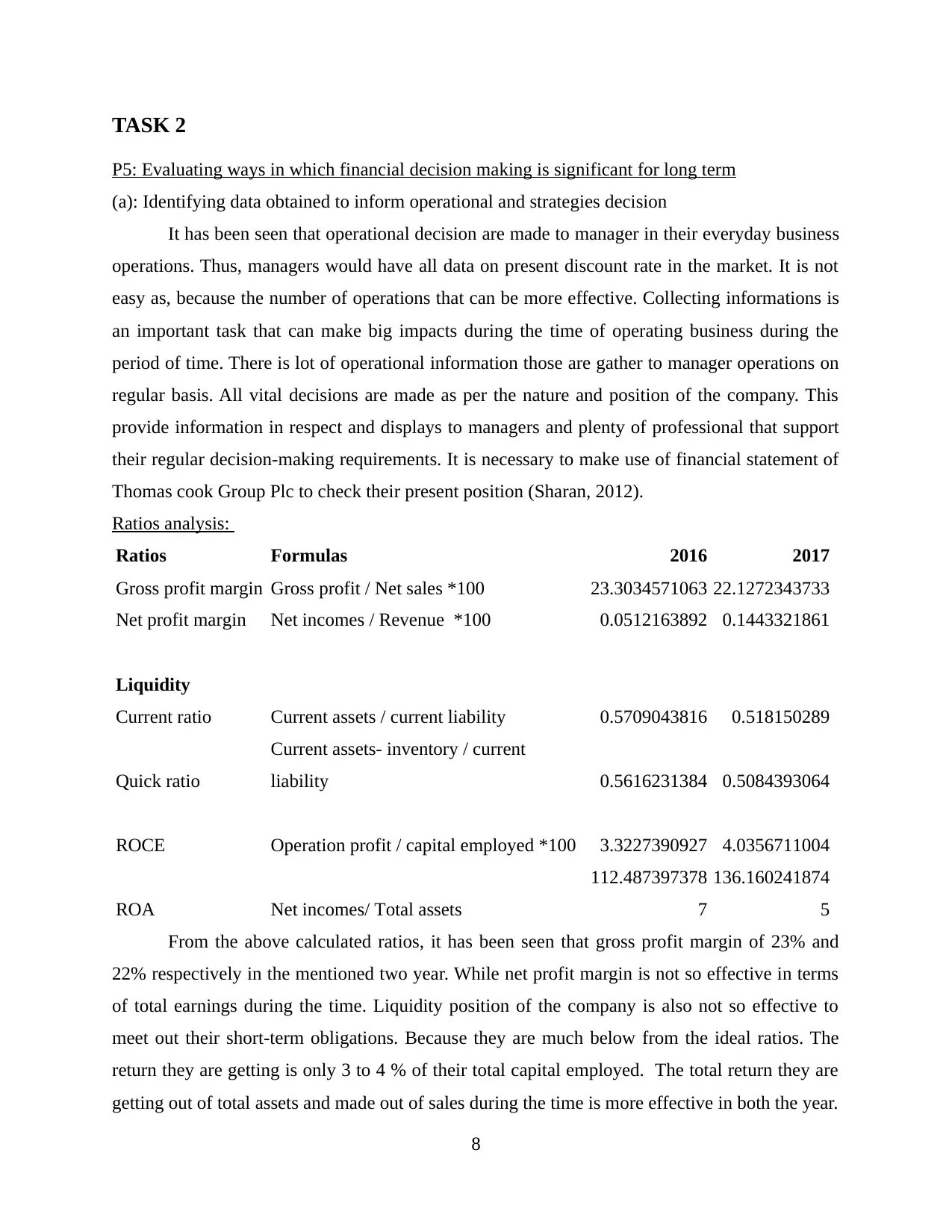
Ratios analysis:
Ratios Formulas 2016 2017
Gross profit margin Gross profit / Net sales *100 23.3034571063 22.1272343733
Net profit margin Net incomes / Revenue *100 0.0512163892 0.1443321861
Liquidity
Current ratio Current assets / current liability 0.5709043816 0.518150289
Quick ratio
Current assets- inventory / current
liability 0.5616231384 0.5084393064
ROCE Operation profit / capital employed *100 3.3227390927 4.0356711004
ROA Net incomes/ Total assets
112.487397378
7
136.160241874
5
From the above calculated ratios, it has been seen that gross profit margin of 23% and
22% respectively in the mentioned two year. While net profit margin is not so effective in terms
of total earnings during the time. Liquidity position of the company is also not so effective to
meet out their short-term obligations. Because they are much below from the ideal ratios. The
return they are getting is only 3 to 4 % of their total capital employed. The total return they are
getting out of total assets and made out of sales during the time is more effective in both the year.
8
P5: Evaluating ways in which financial decision making is significant for long term
(a): Identifying data obtained to inform operational and strategies decision
It has been seen that operational decision are made to manager in their everyday business
operations. Thus, managers would have all data on present discount rate in the market. It is not
easy as, because the number of operations that can be more effective. Collecting informations is
an important task that can make big impacts during the time of operating business during the
period of time. There is lot of operational information those are gather to manager operations on
regular basis. All vital decisions are made as per the nature and position of the company. This
provide information in respect and displays to managers and plenty of professional that support
their regular decision-making requirements. It is necessary to make use of financial statement of
Thomas cook Group Plc to check their present position (Sharan, 2012).
Ratios analysis:
Ratios Formulas 2016 2017
Gross profit margin Gross profit / Net sales *100 23.3034571063 22.1272343733
Net profit margin Net incomes / Revenue *100 0.0512163892 0.1443321861
Liquidity
Current ratio Current assets / current liability 0.5709043816 0.518150289
Quick ratio
Current assets- inventory / current
liability 0.5616231384 0.5084393064
ROCE Operation profit / capital employed *100 3.3227390927 4.0356711004
ROA Net incomes/ Total assets
112.487397378
7
136.160241874
5
From the above calculated ratios, it has been seen that gross profit margin of 23% and
22% respectively in the mentioned two year. While net profit margin is not so effective in terms
of total earnings during the time. Liquidity position of the company is also not so effective to
meet out their short-term obligations. Because they are much below from the ideal ratios. The
return they are getting is only 3 to 4 % of their total capital employed. The total return they are
getting out of total assets and made out of sales during the time is more effective in both the year.
8
Paraphrase This Document
Need a fresh take? Get an instant paraphrase of this document with our AI Paraphraser
(b): Investment appraisal techniques
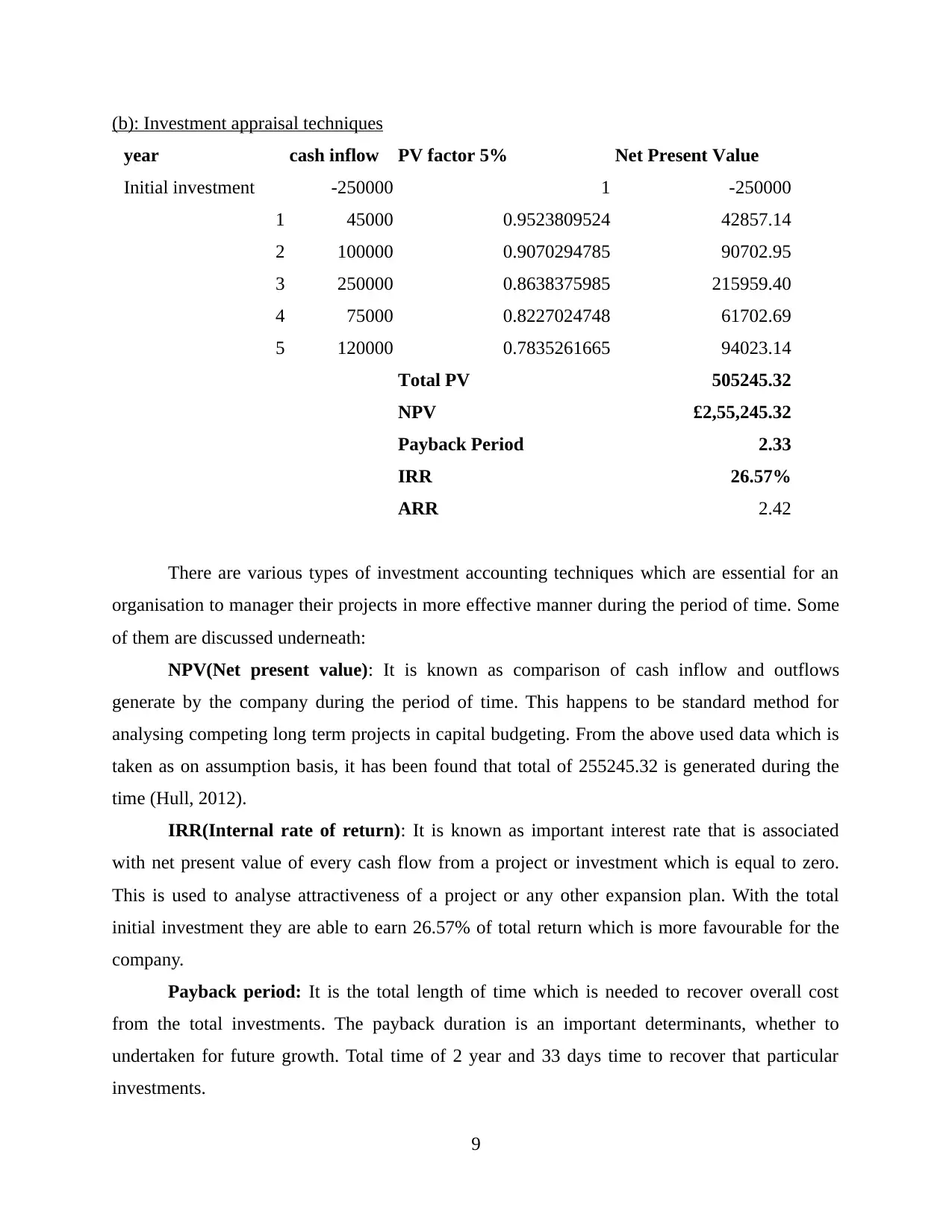
year cash inflow PV factor 5% Net Present Value
Initial investment -250000 1 -250000
1 45000 0.9523809524 42857.14
2 100000 0.9070294785 90702.95
3 250000 0.8638375985 215959.40
4 75000 0.8227024748 61702.69
5 120000 0.7835261665 94023.14
Total PV 505245.32
NPV £2,55,245.32
Payback Period 2.33
IRR 26.57%
ARR 2.42
There are various types of investment accounting techniques which are essential for an
organisation to manager their projects in more effective manner during the period of time. Some
of them are discussed underneath:
NPV(Net present value): It is known as comparison of cash inflow and outflows
generate by the company during the period of time. This happens to be standard method for
analysing competing long term projects in capital budgeting. From the above used data which is
taken as on assumption basis, it has been found that total of 255245.32 is generated during the
time (Hull, 2012).
IRR(Internal rate of return): It is known as important interest rate that is associated
with net present value of every cash flow from a project or investment which is equal to zero.
This is used to analyse attractiveness of a project or any other expansion plan. With the total
initial investment they are able to earn 26.57% of total return which is more favourable for the
company.
Payback period: It is the total length of time which is needed to recover overall cost
from the total investments. The payback duration is an important determinants, whether to
undertaken for future growth. Total time of 2 year and 33 days time to recover that particular
investments.
9
year cash inflow PV factor 5% Net Present Value
Initial investment -250000 1 -250000
1 45000 0.9523809524 42857.14
2 100000 0.9070294785 90702.95
3 250000 0.8638375985 215959.40
4 75000 0.8227024748 61702.69
5 120000 0.7835261665 94023.14
Total PV 505245.32
NPV £2,55,245.32
Payback Period 2.33
IRR 26.57%
ARR 2.42
There are various types of investment accounting techniques which are essential for an
organisation to manager their projects in more effective manner during the period of time. Some
of them are discussed underneath:
NPV(Net present value): It is known as comparison of cash inflow and outflows
generate by the company during the period of time. This happens to be standard method for
analysing competing long term projects in capital budgeting. From the above used data which is
taken as on assumption basis, it has been found that total of 255245.32 is generated during the
time (Hull, 2012).
IRR(Internal rate of return): It is known as important interest rate that is associated
with net present value of every cash flow from a project or investment which is equal to zero.
This is used to analyse attractiveness of a project or any other expansion plan. With the total
initial investment they are able to earn 26.57% of total return which is more favourable for the
company.
Payback period: It is the total length of time which is needed to recover overall cost
from the total investments. The payback duration is an important determinants, whether to
undertaken for future growth. Total time of 2 year and 33 days time to recover that particular
investments.
9
Valuation of techniques
Cash flow statements
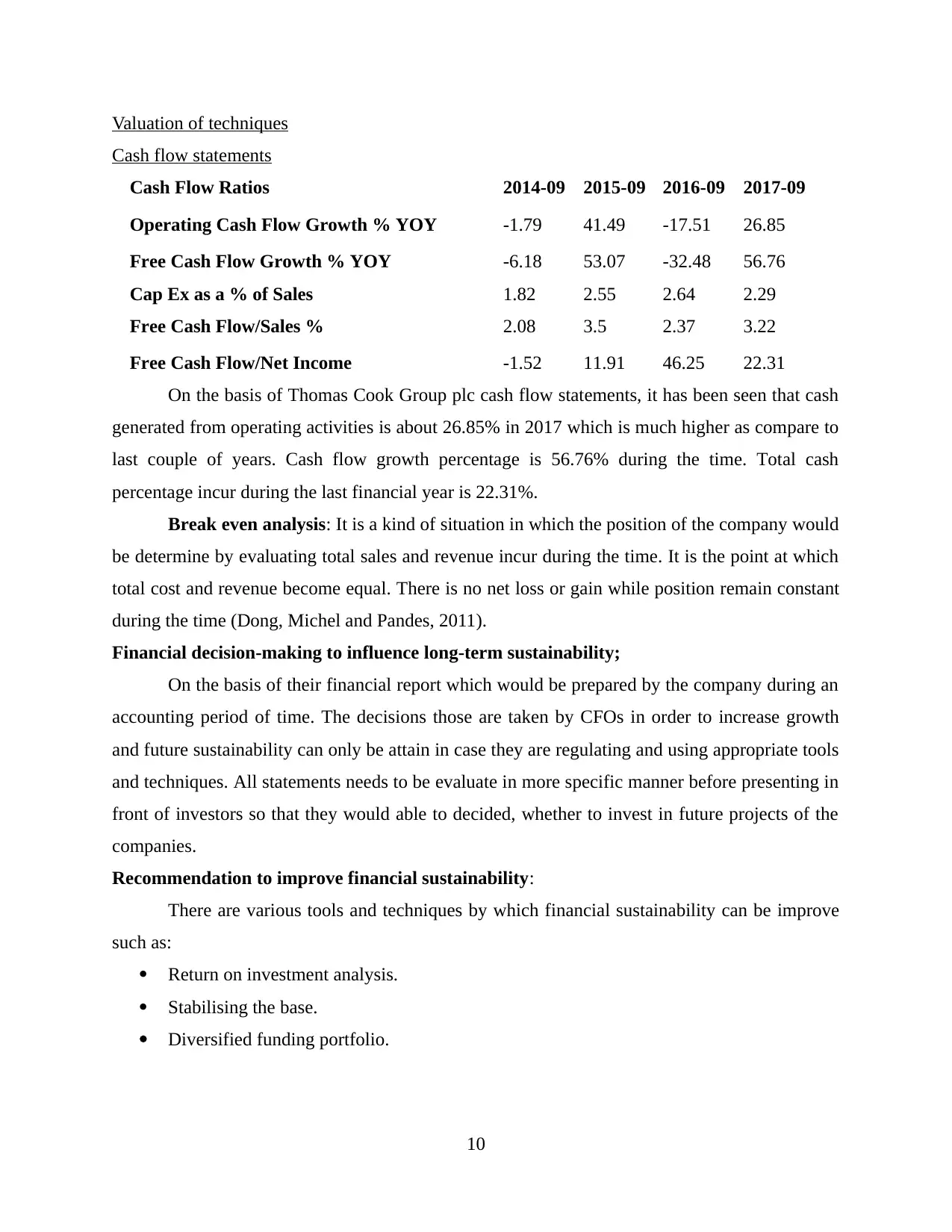
Cash Flow Ratios 2014-09 2015-09 2016-09 2017-09
Operating Cash Flow Growth % YOY -1.79 41.49 -17.51 26.85
Free Cash Flow Growth % YOY -6.18 53.07 -32.48 56.76
Cap Ex as a % of Sales 1.82 2.55 2.64 2.29
Free Cash Flow/Sales % 2.08 3.5 2.37 3.22
Free Cash Flow/Net Income -1.52 11.91 46.25 22.31
On the basis of Thomas Cook Group plc cash flow statements, it has been seen that cash
generated from operating activities is about 26.85% in 2017 which is much higher as compare to
last couple of years. Cash flow growth percentage is 56.76% during the time. Total cash
percentage incur during the last financial year is 22.31%.
Break even analysis: It is a kind of situation in which the position of the company would
be determine by evaluating total sales and revenue incur during the time. It is the point at which
total cost and revenue become equal. There is no net loss or gain while position remain constant
during the time (Dong, Michel and Pandes, 2011).
Financial decision-making to influence long-term sustainability;
On the basis of their financial report which would be prepared by the company during an
accounting period of time. The decisions those are taken by CFOs in order to increase growth
and future sustainability can only be attain in case they are regulating and using appropriate tools
and techniques. All statements needs to be evaluate in more specific manner before presenting in
front of investors so that they would able to decided, whether to invest in future projects of the
companies.
Recommendation to improve financial sustainability:
There are various tools and techniques by which financial sustainability can be improve
such as:
Return on investment analysis.
Stabilising the base.
Diversified funding portfolio.
10
Cash flow statements
Cash Flow Ratios 2014-09 2015-09 2016-09 2017-09
Operating Cash Flow Growth % YOY -1.79 41.49 -17.51 26.85
Free Cash Flow Growth % YOY -6.18 53.07 -32.48 56.76
Cap Ex as a % of Sales 1.82 2.55 2.64 2.29
Free Cash Flow/Sales % 2.08 3.5 2.37 3.22
Free Cash Flow/Net Income -1.52 11.91 46.25 22.31
On the basis of Thomas Cook Group plc cash flow statements, it has been seen that cash
generated from operating activities is about 26.85% in 2017 which is much higher as compare to
last couple of years. Cash flow growth percentage is 56.76% during the time. Total cash
percentage incur during the last financial year is 22.31%.
Break even analysis: It is a kind of situation in which the position of the company would
be determine by evaluating total sales and revenue incur during the time. It is the point at which
total cost and revenue become equal. There is no net loss or gain while position remain constant
during the time (Dong, Michel and Pandes, 2011).
Financial decision-making to influence long-term sustainability;
On the basis of their financial report which would be prepared by the company during an
accounting period of time. The decisions those are taken by CFOs in order to increase growth
and future sustainability can only be attain in case they are regulating and using appropriate tools
and techniques. All statements needs to be evaluate in more specific manner before presenting in
front of investors so that they would able to decided, whether to invest in future projects of the
companies.
Recommendation to improve financial sustainability:
There are various tools and techniques by which financial sustainability can be improve
such as:
Return on investment analysis.
Stabilising the base.
Diversified funding portfolio.
10
⊘ This is a preview!⊘
Do you want full access?
Subscribe today to unlock all pages.
Trusted by 1+ million students worldwide

1 out of 13


Related Documents


Your All-in-One AI-Powered Toolkit for Academic Success.
+13062052269
info@desklib.com
Available 24*7 on WhatsApp / Email
![[object Object]](/_next/static/media/star-bottom.7253800d.svg)
Unlock your academic potential
Copyright © 2020–2026 A2Z Services. All Rights Reserved. Developed and managed by ZUCOL.