Case Study: Financial Statement Analysis & Accounting Concepts
VerifiedAdded on 2023/06/10
|6
|865
|140
Case Study
AI Summary
This assignment presents a case study involving financial statement analysis and accounting principles. It includes preparing an income statement for Collins Consignment Sales, identifying discrepancies in a provided income statement, creating a balance sheet for Tanilba Bay Didgeridoo’s, and conducting a variance analysis for JB Hi-Fi's FY2017 income statement. The analysis involves comparing budgeted and actual figures to assess management performance, highlighting the impact of acquisitions on revenue and costs. The document also includes references to relevant finance and accounting literature.
ACCOUNTING:CONCEPTS & PRINCIPLES
STUDENT ID:
[Pick the date]
STUDENT ID:
[Pick the date]
Paraphrase This Document
Need a fresh take? Get an instant paraphrase of this document with our AI Paraphraser

Question B1
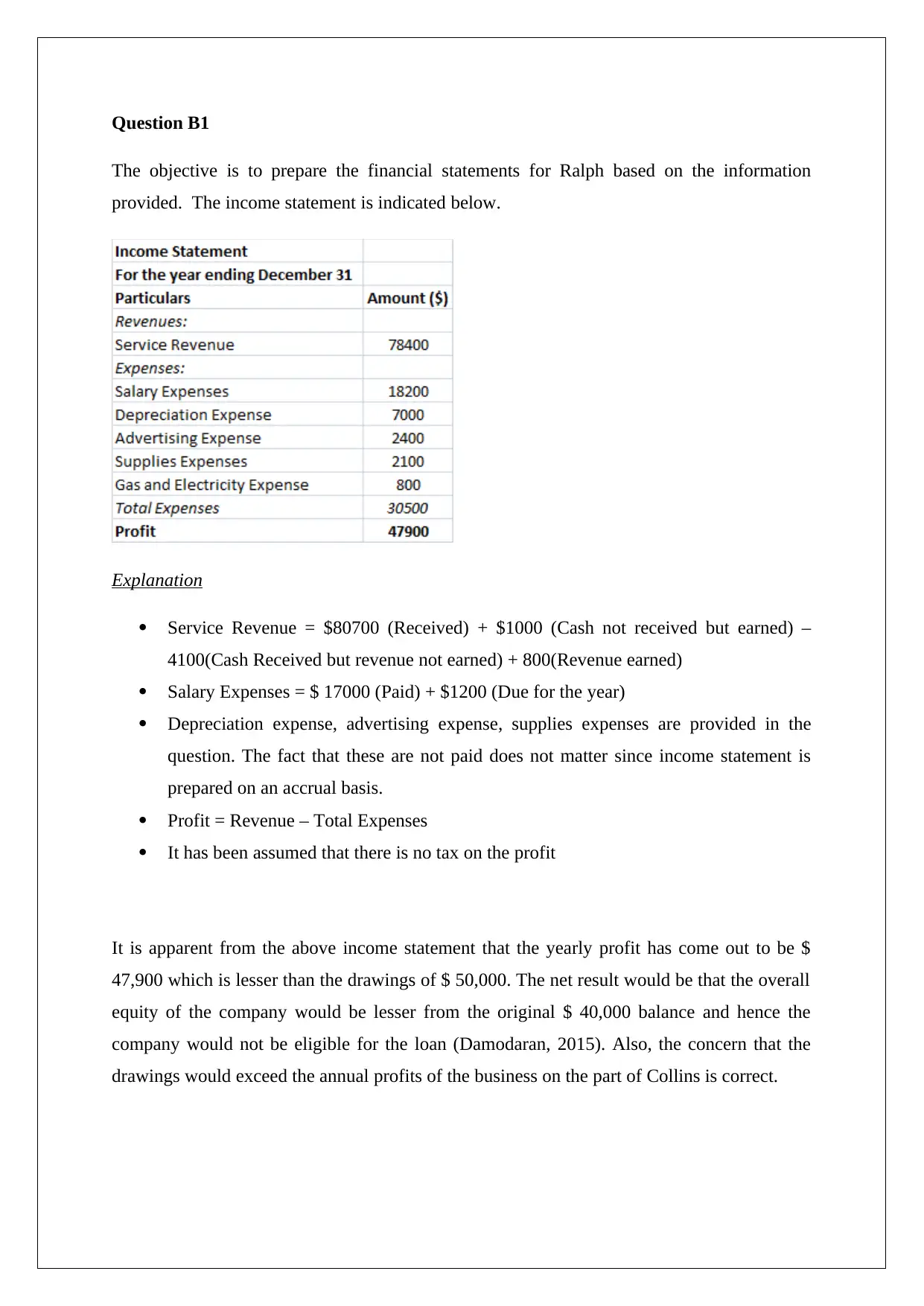
The objective is to prepare the financial statements for Ralph based on the information
provided. The income statement is indicated below.
Explanation
Service Revenue = $80700 (Received) + $1000 (Cash not received but earned) –
4100(Cash Received but revenue not earned) + 800(Revenue earned)
Salary Expenses = $ 17000 (Paid) + $1200 (Due for the year)
Depreciation expense, advertising expense, supplies expenses are provided in the
question. The fact that these are not paid does not matter since income statement is
prepared on an accrual basis.
Profit = Revenue – Total Expenses
It has been assumed that there is no tax on the profit
It is apparent from the above income statement that the yearly profit has come out to be $
47,900 which is lesser than the drawings of $ 50,000. The net result would be that the overall
equity of the company would be lesser from the original $ 40,000 balance and hence the
company would not be eligible for the loan (Damodaran, 2015). Also, the concern that the
drawings would exceed the annual profits of the business on the part of Collins is correct.
The objective is to prepare the financial statements for Ralph based on the information
provided. The income statement is indicated below.
Explanation
Service Revenue = $80700 (Received) + $1000 (Cash not received but earned) –
4100(Cash Received but revenue not earned) + 800(Revenue earned)
Salary Expenses = $ 17000 (Paid) + $1200 (Due for the year)
Depreciation expense, advertising expense, supplies expenses are provided in the
question. The fact that these are not paid does not matter since income statement is
prepared on an accrual basis.
Profit = Revenue – Total Expenses
It has been assumed that there is no tax on the profit
It is apparent from the above income statement that the yearly profit has come out to be $
47,900 which is lesser than the drawings of $ 50,000. The net result would be that the overall
equity of the company would be lesser from the original $ 40,000 balance and hence the
company would not be eligible for the loan (Damodaran, 2015). Also, the concern that the
drawings would exceed the annual profits of the business on the part of Collins is correct.

Question B2
1) No, I would not congratulate them due to the presence of serious discrepancies in the
income statement which comprises solely of the balance sheet items. It is expected that the
income statement should comprise of the revenue generated from sales and the various
expenses should be taken into account for delivering the product being sold. This would
include the cost of goods sold besides other operating costs (Brigham & Houston, 2014).
The costs incurred for asset acquisition are not operating expenses and therefore should
not be recorded in the income statement. Additionally, the cash obtained by way of equity
or bank loan does not constitute revenue. Further, the cash balance does not necessarily
indicate profit as the cash balance highlights the closing cash balance on a given date
which is derived from cash flow statement. The income statement on the other hand is
usually prepared on accrual basis (Brealey, Myers & Allen, 2014).
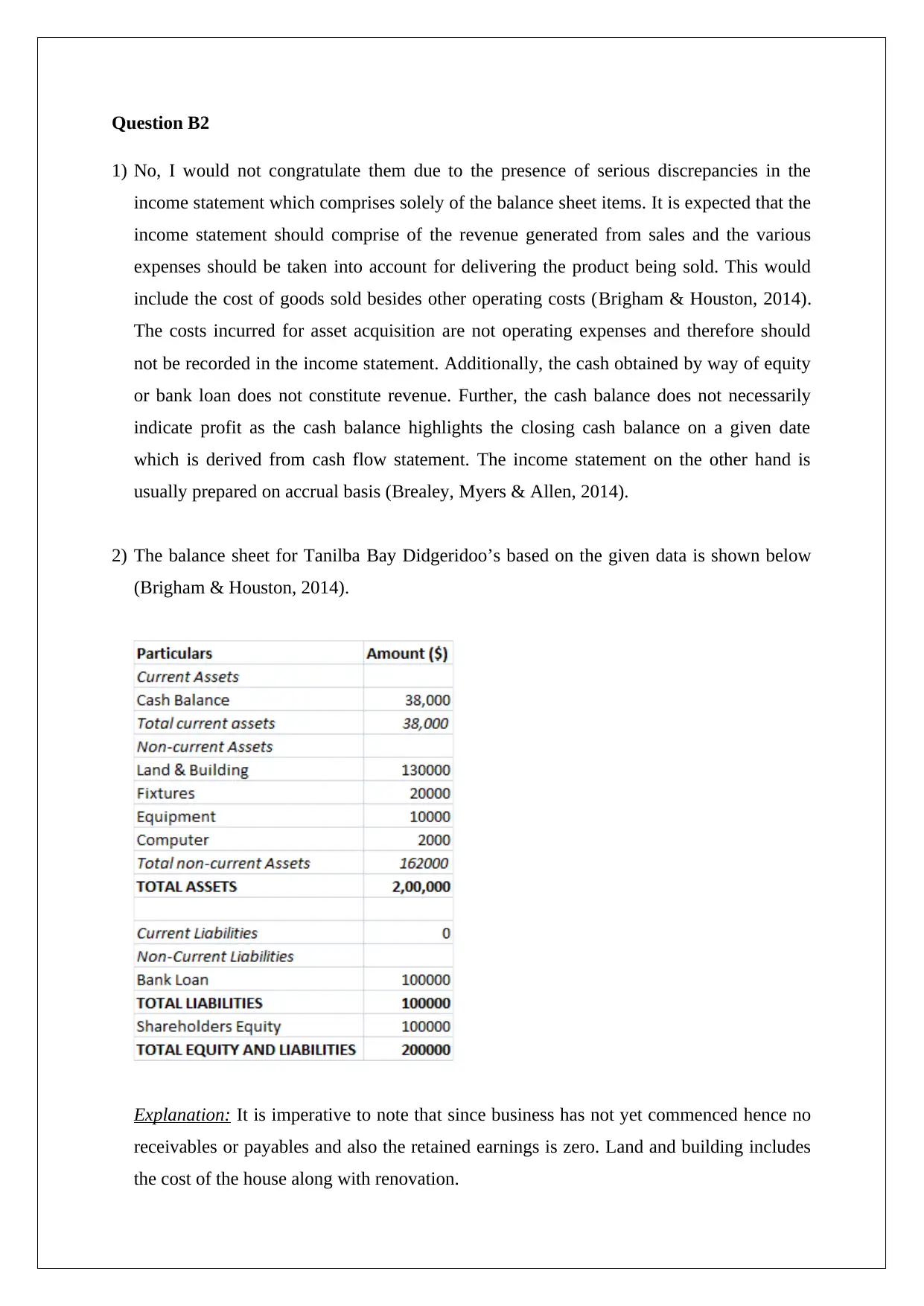
2) The balance sheet for Tanilba Bay Didgeridoo’s based on the given data is shown below
(Brigham & Houston, 2014).
Explanation: It is imperative to note that since business has not yet commenced hence no
receivables or payables and also the retained earnings is zero. Land and building includes
the cost of the house along with renovation.
1) No, I would not congratulate them due to the presence of serious discrepancies in the
income statement which comprises solely of the balance sheet items. It is expected that the
income statement should comprise of the revenue generated from sales and the various
expenses should be taken into account for delivering the product being sold. This would
include the cost of goods sold besides other operating costs (Brigham & Houston, 2014).
The costs incurred for asset acquisition are not operating expenses and therefore should
not be recorded in the income statement. Additionally, the cash obtained by way of equity
or bank loan does not constitute revenue. Further, the cash balance does not necessarily
indicate profit as the cash balance highlights the closing cash balance on a given date
which is derived from cash flow statement. The income statement on the other hand is
usually prepared on accrual basis (Brealey, Myers & Allen, 2014).
2) The balance sheet for Tanilba Bay Didgeridoo’s based on the given data is shown below
(Brigham & Houston, 2014).
Explanation: It is imperative to note that since business has not yet commenced hence no
receivables or payables and also the retained earnings is zero. Land and building includes
the cost of the house along with renovation.
⊘ This is a preview!⊘
Do you want full access?
Subscribe today to unlock all pages.

Trusted by 1+ million students worldwide

Question B3
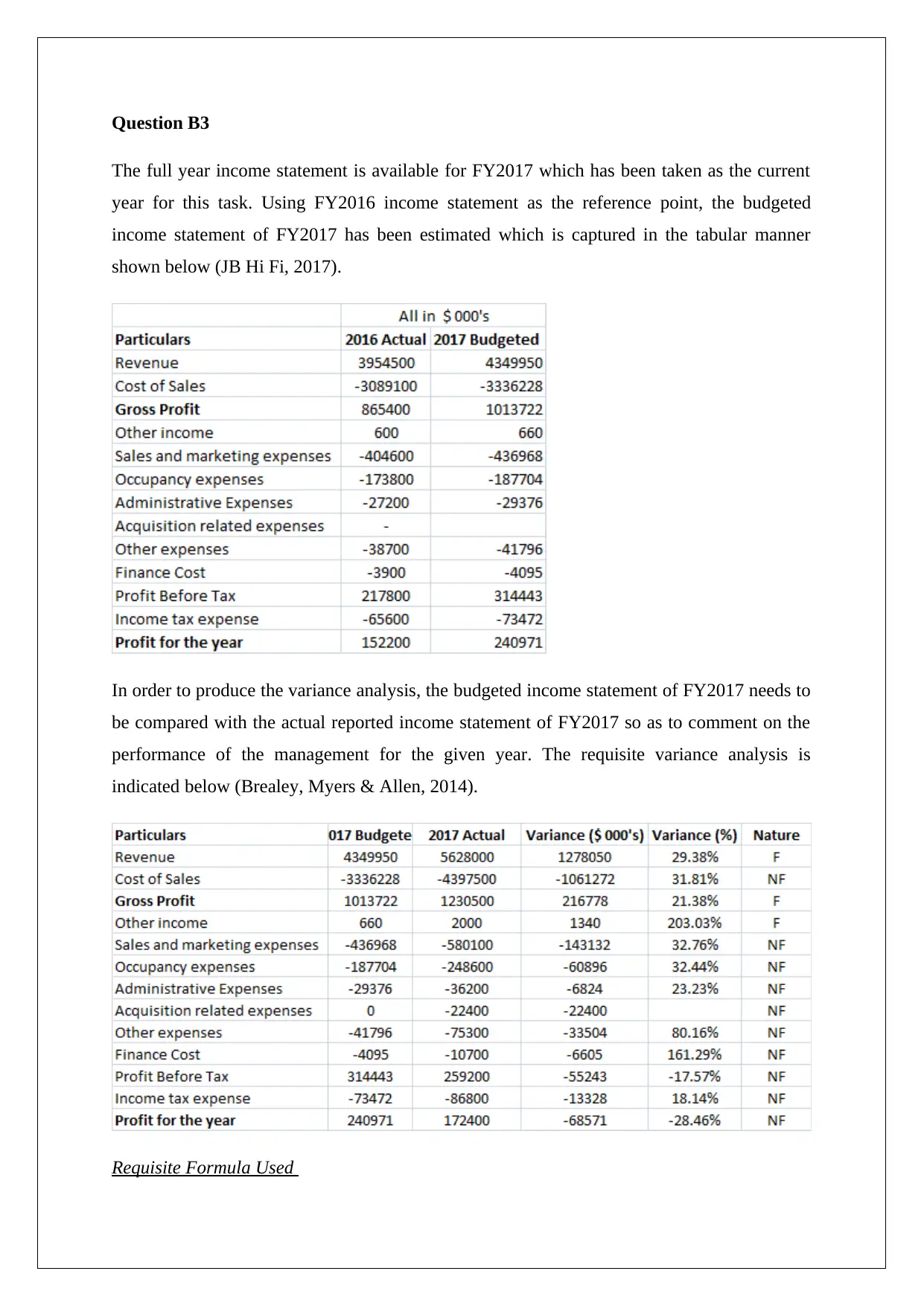
The full year income statement is available for FY2017 which has been taken as the current
year for this task. Using FY2016 income statement as the reference point, the budgeted
income statement of FY2017 has been estimated which is captured in the tabular manner
shown below (JB Hi Fi, 2017).
In order to produce the variance analysis, the budgeted income statement of FY2017 needs to
be compared with the actual reported income statement of FY2017 so as to comment on the
performance of the management for the given year. The requisite variance analysis is
indicated below (Brealey, Myers & Allen, 2014).
Requisite Formula Used
The full year income statement is available for FY2017 which has been taken as the current
year for this task. Using FY2016 income statement as the reference point, the budgeted
income statement of FY2017 has been estimated which is captured in the tabular manner
shown below (JB Hi Fi, 2017).
In order to produce the variance analysis, the budgeted income statement of FY2017 needs to
be compared with the actual reported income statement of FY2017 so as to comment on the
performance of the management for the given year. The requisite variance analysis is
indicated below (Brealey, Myers & Allen, 2014).
Requisite Formula Used
Paraphrase This Document
Need a fresh take? Get an instant paraphrase of this document with our AI Paraphraser

1) Variance = 2017 Actual - 2017 Budgeted
2) Variance (%) = (2017 Actual - 2017 Budgeted)/2017 Budgeted
3) F indicates favourable variance whereas NF indicates not favourable or unfavourable
variance
Comment
From the above variance analysis, it is apparent that in terms of top line growth the year was
better than the management expected but in terms of operating or net profit, the year was
worse than management expected. This is apparent from the fact that favourable variances
have been witnessed only for the revenue and the gross profit while for all the underlying
costs the variances are unfavourable thus implying that the actual costs incurred were
significantly higher than estimated (Damodaran, 2015). This may be attributed to the
acquisition that the company has undertaken owing to which the revenues and related costs
have both jumped significantly (JB Hi Fi, 2017).
2) Variance (%) = (2017 Actual - 2017 Budgeted)/2017 Budgeted
3) F indicates favourable variance whereas NF indicates not favourable or unfavourable
variance
Comment
From the above variance analysis, it is apparent that in terms of top line growth the year was
better than the management expected but in terms of operating or net profit, the year was
worse than management expected. This is apparent from the fact that favourable variances
have been witnessed only for the revenue and the gross profit while for all the underlying
costs the variances are unfavourable thus implying that the actual costs incurred were
significantly higher than estimated (Damodaran, 2015). This may be attributed to the
acquisition that the company has undertaken owing to which the revenues and related costs
have both jumped significantly (JB Hi Fi, 2017).

References
Brealey, R. A., Myers, S. C., & Allen, F. (2014) Principles of corporate finance (2nd ed.).
New York: McGraw-Hill Inc.
Brigham, E. F. & Houston, J. F., (2014) .Fundamentals of Financial Management (14th ed.).
Boston: Cengage Learning.
Damodaran, A. (2015). Applied corporate finance: A user’s manual (3rd ed.). New York:
Wiley, John & Sons.
JBHiFi (2017) Annual Report 2017, Retrieved from
https://www.jbhifi.com.au/Documents/2017%20Annual%20Report.pdf
Brealey, R. A., Myers, S. C., & Allen, F. (2014) Principles of corporate finance (2nd ed.).
New York: McGraw-Hill Inc.
Brigham, E. F. & Houston, J. F., (2014) .Fundamentals of Financial Management (14th ed.).
Boston: Cengage Learning.
Damodaran, A. (2015). Applied corporate finance: A user’s manual (3rd ed.). New York:
Wiley, John & Sons.
JBHiFi (2017) Annual Report 2017, Retrieved from
https://www.jbhifi.com.au/Documents/2017%20Annual%20Report.pdf
⊘ This is a preview!⊘
Do you want full access?
Subscribe today to unlock all pages.

Trusted by 1+ million students worldwide
1 out of 6
Related Documents
Your All-in-One AI-Powered Toolkit for Academic Success.
+13062052269
info@desklib.com
Available 24*7 on WhatsApp / Email
Unlock your academic potential
Copyright © 2020–2026 A2Z Services. All Rights Reserved. Developed and managed by ZUCOL.