Human-Computer Interaction Project: Flood Alarm Indicator Design
VerifiedAdded on 2023/06/14
|4
|1638
|338
Project
AI Summary
This project presents the design and development of a portable flood alarm indicator, addressing the critical need for early flood detection. The solution employs multiple water level sensors, a buzzer alarm, and a microcontroller to provide timely warnings. The design considerations include water detection capacity, alarm output, and communication protocols. The project highlights the importance of real-time monitoring of rainwater levels and proposes future enhancements such as GSM integration for remote alerts. References to relevant literature in human-computer interaction and sensor technology are included, demonstrating a comprehensive approach to the design and potential implementation of the flood alarm system. Desklib provides access to this and other solved assignments.
Flood Alarm Indicator
1st Author Name
Affiliation
City, Country
e-mail address
2nd Author Name
Affiliation
City, Country
e-mail address
3rd Author Name
Affiliation
City, Country
e-mail address
1.1 Introduction
Flood is among the mutual likely
calamities that our country faces. Many
people have died in this dangerous natural
catastrophe. Early precaution, as well as
safety measures, may be observed if in any
case, the individuals can be cautious about
the approaching downpour. Majority of the
people who perished in these deluges are not
conscious about the rainwater gathering
outside their household and the moment they
finally recognize the state, it is usually late
for the action. The objective of this research
is to come up with a transferrable flood
distress indictor that might be applied at
home for detecting the level of rainwater
around the houses.
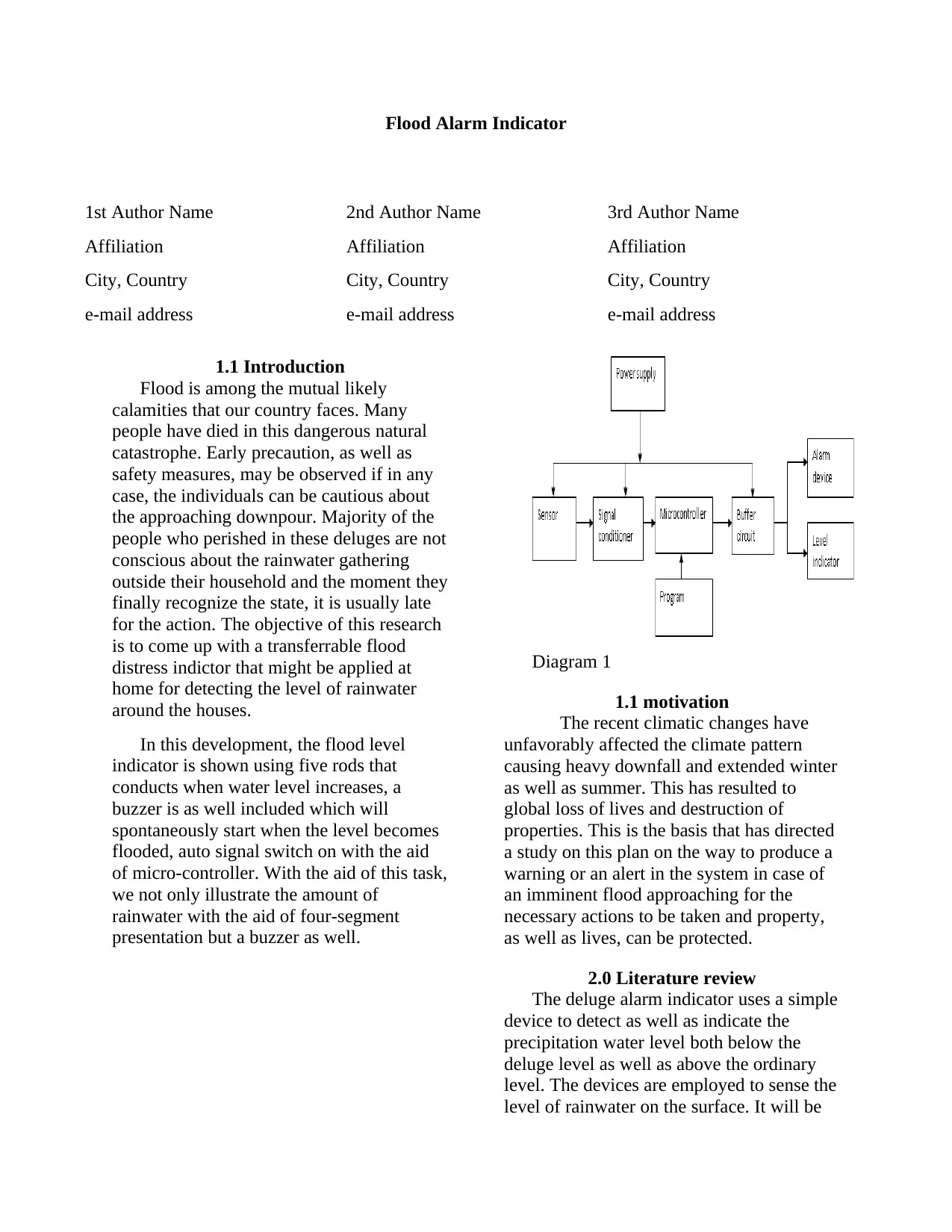
In this development, the flood level
indicator is shown using five rods that
conducts when water level increases, a
buzzer is as well included which will
spontaneously start when the level becomes
flooded, auto signal switch on with the aid
of micro-controller. With the aid of this task,
we not only illustrate the amount of
rainwater with the aid of four-segment
presentation but a buzzer as well.
Diagram 1
1.1 motivation
The recent climatic changes have
unfavorably affected the climate pattern
causing heavy downfall and extended winter
as well as summer. This has resulted to
global loss of lives and destruction of
properties. This is the basis that has directed
a study on this plan on the way to produce a
warning or an alert in the system in case of
an imminent flood approaching for the
necessary actions to be taken and property,
as well as lives, can be protected.
2.0 Literature review
The deluge alarm indicator uses a simple
device to detect as well as indicate the
precipitation water level both below the
deluge level as well as above the ordinary
level. The devices are employed to sense the
level of rainwater on the surface. It will be
1st Author Name
Affiliation
City, Country
e-mail address
2nd Author Name
Affiliation
City, Country
e-mail address
3rd Author Name
Affiliation
City, Country
e-mail address
1.1 Introduction
Flood is among the mutual likely
calamities that our country faces. Many
people have died in this dangerous natural
catastrophe. Early precaution, as well as
safety measures, may be observed if in any
case, the individuals can be cautious about
the approaching downpour. Majority of the
people who perished in these deluges are not
conscious about the rainwater gathering
outside their household and the moment they
finally recognize the state, it is usually late
for the action. The objective of this research
is to come up with a transferrable flood
distress indictor that might be applied at
home for detecting the level of rainwater
around the houses.
In this development, the flood level
indicator is shown using five rods that
conducts when water level increases, a
buzzer is as well included which will
spontaneously start when the level becomes
flooded, auto signal switch on with the aid
of micro-controller. With the aid of this task,
we not only illustrate the amount of
rainwater with the aid of four-segment
presentation but a buzzer as well.
Diagram 1
1.1 motivation
The recent climatic changes have
unfavorably affected the climate pattern
causing heavy downfall and extended winter
as well as summer. This has resulted to
global loss of lives and destruction of
properties. This is the basis that has directed
a study on this plan on the way to produce a
warning or an alert in the system in case of
an imminent flood approaching for the
necessary actions to be taken and property,
as well as lives, can be protected.
2.0 Literature review
The deluge alarm indicator uses a simple
device to detect as well as indicate the
precipitation water level both below the
deluge level as well as above the ordinary
level. The devices are employed to sense the
level of rainwater on the surface. It will be
Paraphrase This Document
Need a fresh take? Get an instant paraphrase of this document with our AI Paraphraser

accomplished by arranging conductors in
diverse rain scale levels placed at the
flattened ground. The conductors will be
placed in five diverse levels where level one
will represent the least rainfall, level two
temperate precipitation, level three
substantial rainfall while level four offers
flood caution and at the point, the device
should ring to notify the individuals at that
locality and a message is sent to individuals
through their mobile phones. The fifth level
is the flooding level.
According Wahab et al., 2010 to the
basic transistor based on the level of water,
marker circuit is valuable to indicate the
water levels in a on the ground. At whatever
point they is flood, we get alarms on specific
levels. Here we have made four levels (low,
medium, high and flood); alerts might be
made for more levels. Three LEDs are added
to demonstrate beginning three points (A, B,
C), and one Buzzer to show FLOOD level
(D). At flooding level, people will receive
beep sound from Buzzer.
A PIC16F877A would have the
capacity to do different undertaking. The
PIC16F877A has five ports that may be
designed to either output port or input port.
A portion of the pins has in excess of one
use and these uses can be initiated with
unique orders.
This task overall exhibits the
significance of monitoring the water level
when the water begins to amasses. The
transmission and gathering of information
from the water caution to the yield alert
require watchful development with the goal
that information can be transmitted and
gotten likewise. After the equipment is
fabricated and the program is composed, the
equipment and program experiences testing.
In the event that the testing is fruitful, the
venture is shown to the board. Be that as it
may, if the testing falls flat, the equipment
fabricated and the program composed will
be re-tried again until the point that it is
effective.
3.0 Design Statement
Designing as well as building a
transportable flood alarm pointer requires a
high understanding of a moveable water
device taking into consideration water
detecting capacity, alarm output,
communication protocols and others.
4.0 Personas
Flood
status
Outpu
t A
Outpu
t B
Outpu
t C
Outpu
t D
Flood 5 5 5 5
warning 0 5 5 5
Moderat
e
rainfall
0 0 5 5
Drizzlin
g
0 0 0 12
No
rainfall
0 0 0 0
Diagram 2
5.0 Conclusion
The whole project demonstrates the
significance of monitoring the level of
rainwater when it starts to mount up. The
transmission, as well as reception of
information from the rainwater sensor to the
output device, requires cautious erection so
that information can be conducted as well as
received properly. In days to come, the
scheme can be linked to a GSM phone as
well as be utilized to transmit warning
messages to people away from the area
where the structure is installed.
diverse rain scale levels placed at the
flattened ground. The conductors will be
placed in five diverse levels where level one
will represent the least rainfall, level two
temperate precipitation, level three
substantial rainfall while level four offers
flood caution and at the point, the device
should ring to notify the individuals at that
locality and a message is sent to individuals
through their mobile phones. The fifth level
is the flooding level.
According Wahab et al., 2010 to the
basic transistor based on the level of water,
marker circuit is valuable to indicate the
water levels in a on the ground. At whatever
point they is flood, we get alarms on specific
levels. Here we have made four levels (low,
medium, high and flood); alerts might be
made for more levels. Three LEDs are added
to demonstrate beginning three points (A, B,
C), and one Buzzer to show FLOOD level
(D). At flooding level, people will receive
beep sound from Buzzer.
A PIC16F877A would have the
capacity to do different undertaking. The
PIC16F877A has five ports that may be
designed to either output port or input port.
A portion of the pins has in excess of one
use and these uses can be initiated with
unique orders.
This task overall exhibits the
significance of monitoring the water level
when the water begins to amasses. The
transmission and gathering of information
from the water caution to the yield alert
require watchful development with the goal
that information can be transmitted and
gotten likewise. After the equipment is
fabricated and the program is composed, the
equipment and program experiences testing.
In the event that the testing is fruitful, the
venture is shown to the board. Be that as it
may, if the testing falls flat, the equipment
fabricated and the program composed will
be re-tried again until the point that it is
effective.
3.0 Design Statement
Designing as well as building a
transportable flood alarm pointer requires a
high understanding of a moveable water
device taking into consideration water
detecting capacity, alarm output,
communication protocols and others.
4.0 Personas
Flood
status
Outpu
t A
Outpu
t B
Outpu
t C
Outpu
t D
Flood 5 5 5 5
warning 0 5 5 5
Moderat
e
rainfall
0 0 5 5
Drizzlin
g
0 0 0 12
No
rainfall
0 0 0 0
Diagram 2
5.0 Conclusion
The whole project demonstrates the
significance of monitoring the level of
rainwater when it starts to mount up. The
transmission, as well as reception of
information from the rainwater sensor to the
output device, requires cautious erection so
that information can be conducted as well as
received properly. In days to come, the
scheme can be linked to a GSM phone as
well as be utilized to transmit warning
messages to people away from the area
where the structure is installed.

References
Liu, K.H., Hwang, S.L., Hsieh, M.H., Liang,
S.F.M. and Chuang, C.F., 2016.
Systematic layout planning in
human–system interface: An
evaluation of alarm displays with
spatial proximity for accidents
diagnosis of advanced boiling water
reactor. International Journal of
Industrial Ergonomics, 51, pp.30-42.
Teck, L.W., 2007. Portable Water Alarm
Detector. Faculty Of Electrical &
Electronics Engineering Universiti
Malaysia Pahang. Malaysia.
Rogers, Y., Sharp, H. and Preece, J.,
2011. Interaction design: beyond
human-computer interaction. John
Wiley & Sons.
Helander, M. G. (Ed.). (2014). Handbook of
human-computer interaction.
Elsevier.
Lazar, J., Feng, J.H. and Hochheiser, H.,
2017. Research methods in human-
computer interaction. Morgan
Kaufmann.
Jacko, J.A. ed., 2012. Human-computer
interaction handbook:
Fundamentals, evolving
technologies, and emerging
applications. CRC press.
Tan, D. and Nijholt, A., 2010. Brain-
computer interfaces and human-
computer interaction. In Brain-
Computer Interfaces(pp. 3-19).
Springer London.
Booth, P., 2014. An Introduction to Human-
Computer Interaction (Psychology
Revivals). Psychology Press.
Bender, V.C., Iaronka, O., Vizzotto, W.D.,
Dalla Costa, M.A., do Prado, R.N.
and Marchesan, T.B., 2013. Design
methodology for light-emitting diode
systems by considering an
electrothermal model. IEEE
Transactions on Electron
Devices, 60(11), pp.3799-3806.
Crandell, W.T., Johnson, A.M., Schweitzer,
T.S. and Holec, H.V., METROSPEC
Tech LLC, 2013. Layered structure
for use with high power light
emitting diode systems. U.S. Patent
8,525,193.
Li, Y.Q., Intematix Corp, 2011. Light
emitting diode (LED) based lighting
systems. U.S. Patent 7,972,030.
Kaur, I., 2010. Microcontroller based home
automation system with
security. International journal of
advanced computer science and
applications, 1(6), pp.60-65.
Kumar, N.S., Saravanan, M. and
Jeevananthan, S.,
2011. Microprocessors and
Microcontrollers. Oxford University
Press, Inc..
Wahab, M.H.A., Abdullah, N., Johari, A.
and Kadir, H.A., 2010. Gsm based
electrical control system for smart
home application. Journal of
Convergence Information
Technology, 5(1), pp.33-39.
Liu, K.H., Hwang, S.L., Hsieh, M.H., Liang,
S.F.M. and Chuang, C.F., 2016.
Systematic layout planning in
human–system interface: An
evaluation of alarm displays with
spatial proximity for accidents
diagnosis of advanced boiling water
reactor. International Journal of
Industrial Ergonomics, 51, pp.30-42.
Teck, L.W., 2007. Portable Water Alarm
Detector. Faculty Of Electrical &
Electronics Engineering Universiti
Malaysia Pahang. Malaysia.
Rogers, Y., Sharp, H. and Preece, J.,
2011. Interaction design: beyond
human-computer interaction. John
Wiley & Sons.
Helander, M. G. (Ed.). (2014). Handbook of
human-computer interaction.
Elsevier.
Lazar, J., Feng, J.H. and Hochheiser, H.,
2017. Research methods in human-
computer interaction. Morgan
Kaufmann.
Jacko, J.A. ed., 2012. Human-computer
interaction handbook:
Fundamentals, evolving
technologies, and emerging
applications. CRC press.
Tan, D. and Nijholt, A., 2010. Brain-
computer interfaces and human-
computer interaction. In Brain-
Computer Interfaces(pp. 3-19).
Springer London.
Booth, P., 2014. An Introduction to Human-
Computer Interaction (Psychology
Revivals). Psychology Press.
Bender, V.C., Iaronka, O., Vizzotto, W.D.,
Dalla Costa, M.A., do Prado, R.N.
and Marchesan, T.B., 2013. Design
methodology for light-emitting diode
systems by considering an
electrothermal model. IEEE
Transactions on Electron
Devices, 60(11), pp.3799-3806.
Crandell, W.T., Johnson, A.M., Schweitzer,
T.S. and Holec, H.V., METROSPEC
Tech LLC, 2013. Layered structure
for use with high power light
emitting diode systems. U.S. Patent
8,525,193.
Li, Y.Q., Intematix Corp, 2011. Light
emitting diode (LED) based lighting
systems. U.S. Patent 7,972,030.
Kaur, I., 2010. Microcontroller based home
automation system with
security. International journal of
advanced computer science and
applications, 1(6), pp.60-65.
Kumar, N.S., Saravanan, M. and
Jeevananthan, S.,
2011. Microprocessors and
Microcontrollers. Oxford University
Press, Inc..
Wahab, M.H.A., Abdullah, N., Johari, A.
and Kadir, H.A., 2010. Gsm based
electrical control system for smart
home application. Journal of
Convergence Information
Technology, 5(1), pp.33-39.
⊘ This is a preview!⊘
Do you want full access?
Subscribe today to unlock all pages.

Trusted by 1+ million students worldwide

Proakis, J.G. and Manolakis, D.G.,
2013. Digital signal processing.
Pearson Education.
Tietze, U., Schenk, C. and Gamm, E.,
2015. Electronic circuits: handbook
for design and application. Springer.
Shaer, O. and Hornecker, E., 2010. Tangible
user interfaces: past, present, and
future directions. Foundations and
Trends in Human-Computer
Interaction, 3(1–2), pp.1-137.
Müller, J., Alt, F., Michelis, D. and Schmidt,
A., 2010, October. Requirements and
design space for interactive public
displays. In Proceedings of the 18th
ACM international conference on
Multimedia (pp. 1285-1294). ACM.
Lockton, D., Harrison, D. and Stanton, N.A.,
2010. The Design with Intent
Method: A design tool for
influencing user behaviour. Applied
ergonomics, 41(3), pp.382-392.
Stanton, N.A., Salmon, P.M., Rafferty, L.A.,
Walker, G.H., Baber, C. and Jenkins,
D.P., 2017. Human factors methods:
a practical guide for engineering
and design. CRC Press.
Zimmerman, J., Stolterman, E. and Forlizzi,
J., 2010, August. An analysis and
critique of Research through Design:
towards a formalization of a research
approach. In Proceedings of the 8th
ACM Conference on Designing
Interactive Systems (pp. 310-319).
ACM.
Tidwell, J., 2010. Designing interfaces:
Patterns for effective interaction
design. " O'Reilly Media, Inc.".
Proakis, J.G. and Manolakis, D.G.,
2013. Digital signal processing.
Pearson Education.
Chu, C. and Young, M., Advanced Custom
Sensors Inc, 2006. Sensor signal
conditioner. U.S. Patent 6,996,488.
2013. Digital signal processing.
Pearson Education.
Tietze, U., Schenk, C. and Gamm, E.,
2015. Electronic circuits: handbook
for design and application. Springer.
Shaer, O. and Hornecker, E., 2010. Tangible
user interfaces: past, present, and
future directions. Foundations and
Trends in Human-Computer
Interaction, 3(1–2), pp.1-137.
Müller, J., Alt, F., Michelis, D. and Schmidt,
A., 2010, October. Requirements and
design space for interactive public
displays. In Proceedings of the 18th
ACM international conference on
Multimedia (pp. 1285-1294). ACM.
Lockton, D., Harrison, D. and Stanton, N.A.,
2010. The Design with Intent
Method: A design tool for
influencing user behaviour. Applied
ergonomics, 41(3), pp.382-392.
Stanton, N.A., Salmon, P.M., Rafferty, L.A.,
Walker, G.H., Baber, C. and Jenkins,
D.P., 2017. Human factors methods:
a practical guide for engineering
and design. CRC Press.
Zimmerman, J., Stolterman, E. and Forlizzi,
J., 2010, August. An analysis and
critique of Research through Design:
towards a formalization of a research
approach. In Proceedings of the 8th
ACM Conference on Designing
Interactive Systems (pp. 310-319).
ACM.
Tidwell, J., 2010. Designing interfaces:
Patterns for effective interaction
design. " O'Reilly Media, Inc.".
Proakis, J.G. and Manolakis, D.G.,
2013. Digital signal processing.
Pearson Education.
Chu, C. and Young, M., Advanced Custom
Sensors Inc, 2006. Sensor signal
conditioner. U.S. Patent 6,996,488.
1 out of 4
Your All-in-One AI-Powered Toolkit for Academic Success.
+13062052269
info@desklib.com
Available 24*7 on WhatsApp / Email
Unlock your academic potential
Copyright © 2020–2025 A2Z Services. All Rights Reserved. Developed and managed by ZUCOL.