Case Study: Family Nurse Practitioner SOAP Note and Patient Assessment

Verified

Added on  2022/08/15

|5
|751
|14
Case Study
AI Summary
This assignment presents a case study involving a Family Nurse Practitioner (FNP) and a patient presenting with dizziness, headache, nausea, and vomiting. The FNP utilizes the SOAP (Subjective, Objective, Assessment, Plan) note format to document the patient's condition. The subjective section details the patient's chief complaints, history of present illness, and medical history, including pre-existing conditions like diabetes, hypertension, and dyslipidemia. The objective section includes vital signs and neurological examination findings, such as cranial nerve assessments. The assessment identifies a potential transient ischemic attack (TIA) due to hypertension, considering the neurological symptoms observed. The plan includes immediate referral to a neurologist, bed rest, promoting various supportive measures like ventilation, coping strategies, and dietary balance, along with ordering investigations such as CT scan and fMRI. The assignment highlights the importance of a structured approach to patient assessment and clinical decision-making in family nursing practice.
Document Page
Running head: FAMILY NURSE PRACTITIONER
FAMILY NURSE PRACTITIONER
Name of Student
Name of University
Author note
tabler-icon-diamond-filled.svg

Paraphrase This Document

Need a fresh take? Get an instant paraphrase of this document with our AI Paraphraser
Document Page
1
FAMILY NURSE PRACTITIONER
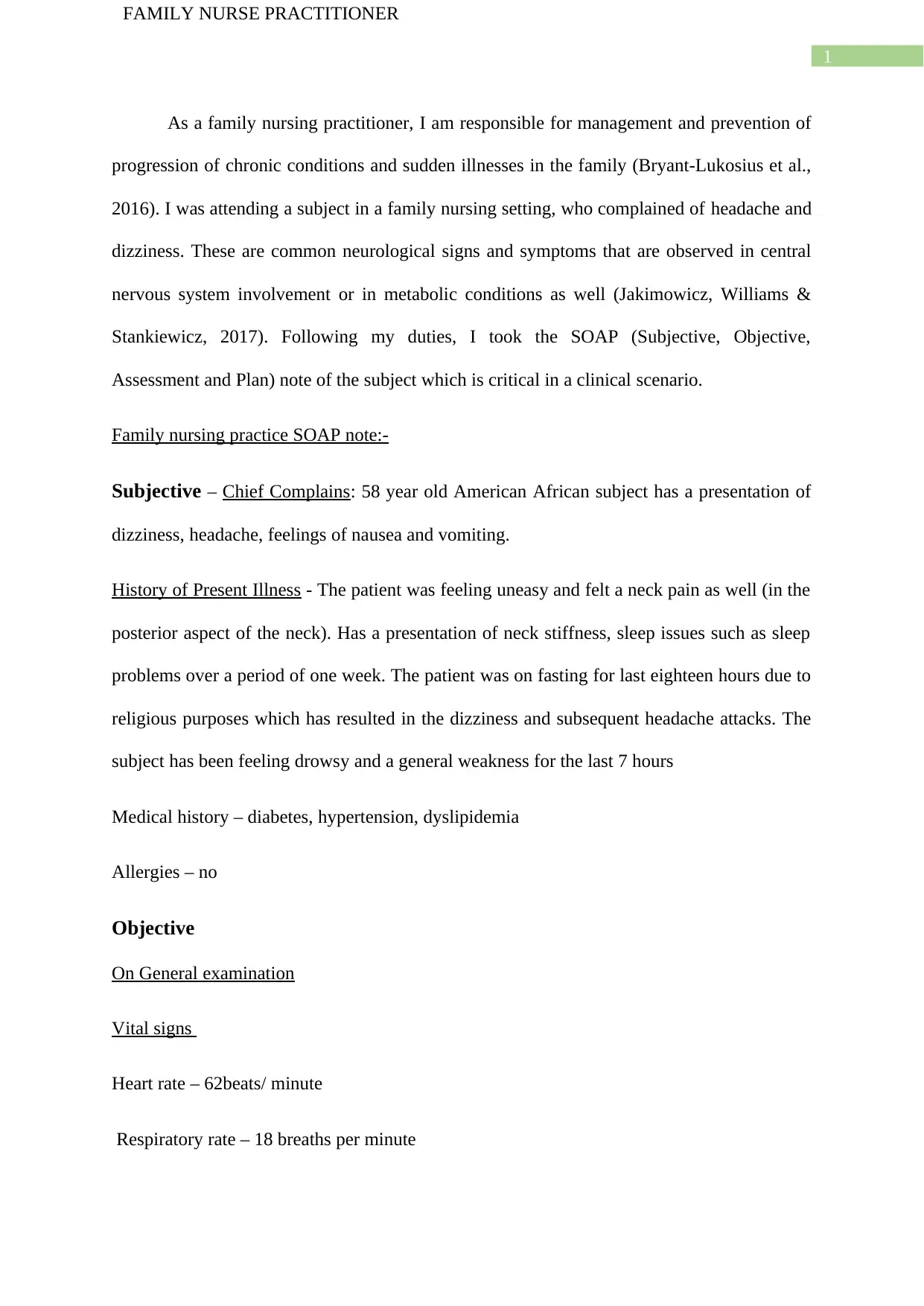
As a family nursing practitioner, I am responsible for management and prevention of
progression of chronic conditions and sudden illnesses in the family (Bryant‐Lukosius et al.,
2016). I was attending a subject in a family nursing setting, who complained of headache and
dizziness. These are common neurological signs and symptoms that are observed in central
nervous system involvement or in metabolic conditions as well (Jakimowicz, Williams &
Stankiewicz, 2017). Following my duties, I took the SOAP (Subjective, Objective,
Assessment and Plan) note of the subject which is critical in a clinical scenario.
Family nursing practice SOAP note:-
Subjective Chief Complains: 58 year old American African subject has a presentation of
dizziness, headache, feelings of nausea and vomiting.
History of Present Illness - The patient was feeling uneasy and felt a neck pain as well (in the
posterior aspect of the neck). Has a presentation of neck stiffness, sleep issues such as sleep
problems over a period of one week. The patient was on fasting for last eighteen hours due to
religious purposes which has resulted in the dizziness and subsequent headache attacks. The
subject has been feeling drowsy and a general weakness for the last 7 hours
Medical history – diabetes, hypertension, dyslipidemia
Allergies – no
Objective
On General examination
Vital signs
Heart rate – 62beats/ minute
Respiratory rate – 18 breaths per minute
Document Page
2
FAMILY NURSE PRACTITIONER
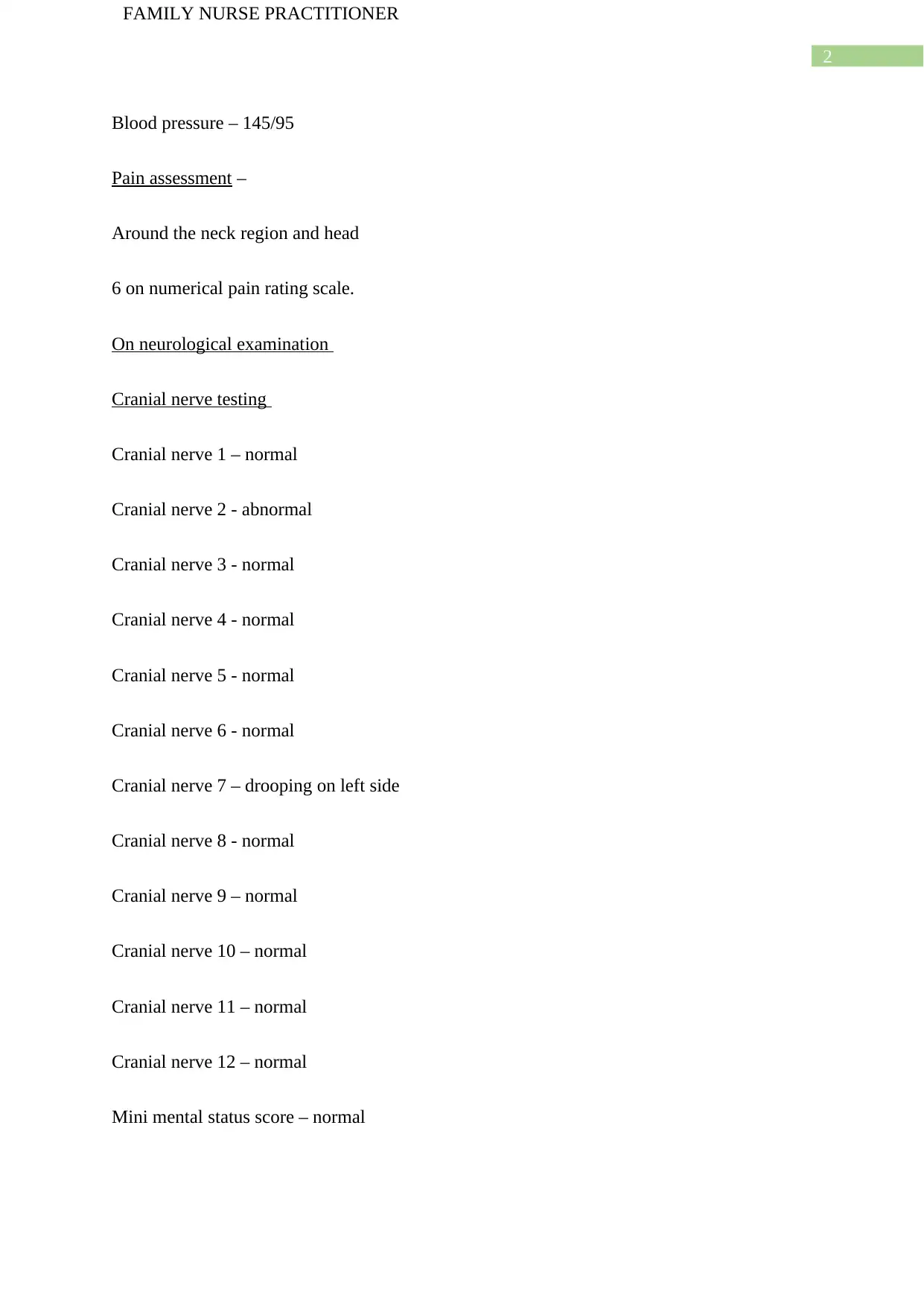
Blood pressure – 145/95
Pain assessment
Around the neck region and head
6 on numerical pain rating scale.
On neurological examination
Cranial nerve testing
Cranial nerve 1 – normal
Cranial nerve 2 - abnormal
Cranial nerve 3 - normal
Cranial nerve 4 - normal
Cranial nerve 5 - normal
Cranial nerve 6 - normal
Cranial nerve 7 – drooping on left side
Cranial nerve 8 - normal
Cranial nerve 9 – normal
Cranial nerve 10 – normal
Cranial nerve 11 – normal
Cranial nerve 12 – normal
Mini mental status score – normal
Document Page
3
FAMILY NURSE PRACTITIONER
Assessment
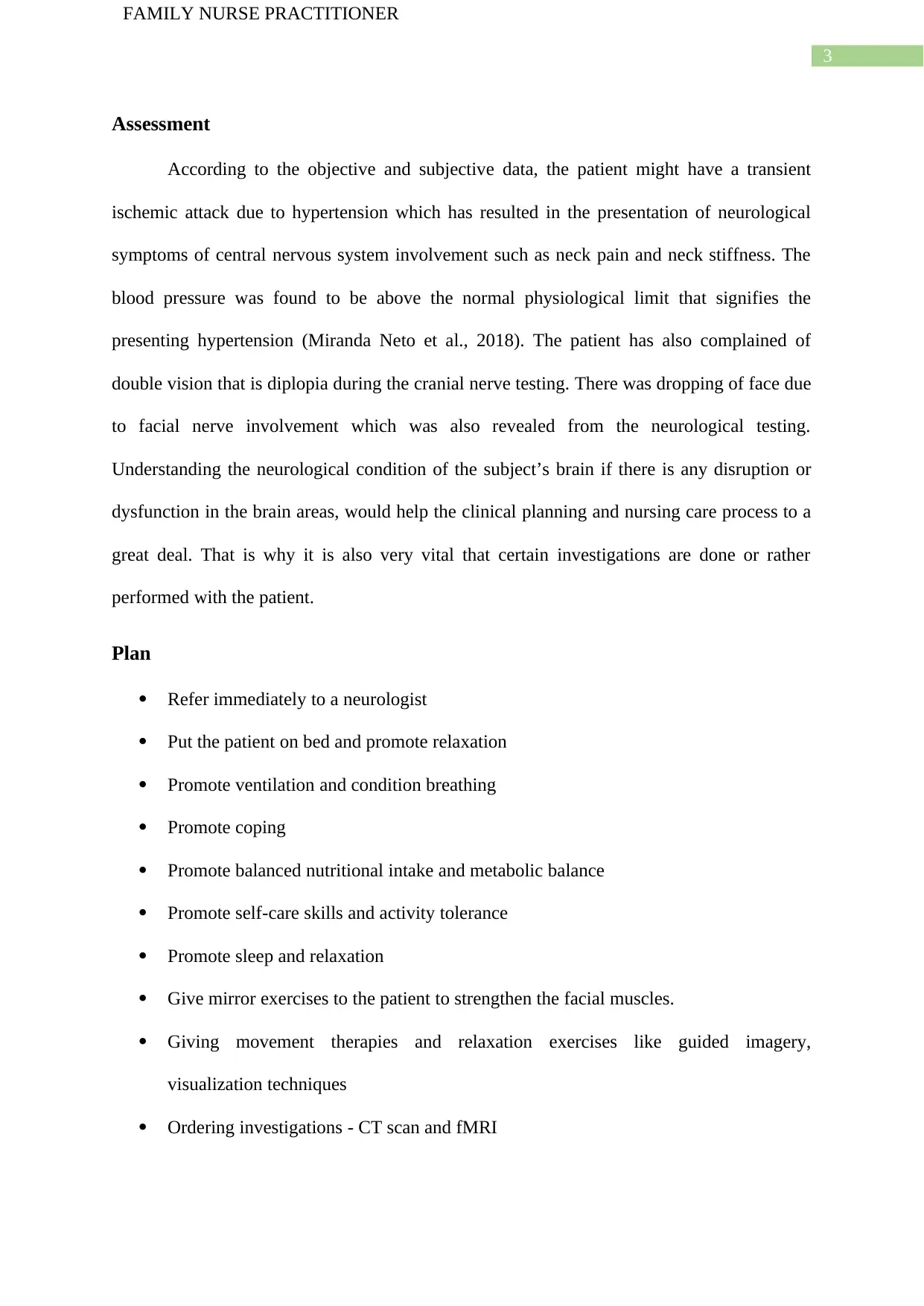
According to the objective and subjective data, the patient might have a transient
ischemic attack due to hypertension which has resulted in the presentation of neurological
symptoms of central nervous system involvement such as neck pain and neck stiffness. The
blood pressure was found to be above the normal physiological limit that signifies the
presenting hypertension (Miranda Neto et al., 2018). The patient has also complained of
double vision that is diplopia during the cranial nerve testing. There was dropping of face due
to facial nerve involvement which was also revealed from the neurological testing.
Understanding the neurological condition of the subject’s brain if there is any disruption or
dysfunction in the brain areas, would help the clinical planning and nursing care process to a
great deal. That is why it is also very vital that certain investigations are done or rather
performed with the patient.
Plan
Refer immediately to a neurologist
Put the patient on bed and promote relaxation
Promote ventilation and condition breathing
Promote coping
Promote balanced nutritional intake and metabolic balance
Promote self-care skills and activity tolerance
Promote sleep and relaxation
Give mirror exercises to the patient to strengthen the facial muscles.
Giving movement therapies and relaxation exercises like guided imagery,
visualization techniques
Ordering investigations - CT scan and fMRI
tabler-icon-diamond-filled.svg

Paraphrase This Document

Need a fresh take? Get an instant paraphrase of this document with our AI Paraphraser
Document Page
4
FAMILY NURSE PRACTITIONER
References
BryantLukosius, D., Spichiger, E., Martin, J., Stoll, H., Kellerhals, S. D., Fliedner, M., ... &
Schwendimann, R. (2016). Framework for evaluating the impact of advanced practice
nursing roles. Journal of Nursing Scholarship, 48(2), 201-209.
Jakimowicz, M., Williams, D., & Stankiewicz, G. (2017). A systematic review of experiences
of advanced practice nursing in general practice. BMC nursing, 16(1), 6.
Miranda Neto, M. V. D., Rewa, T., Leonello, V. M., & Oliveira, M. A. D. C. (2018).
Advanced practice nursing: a possibility for Primary Health Care?. Revista brasileira
de enfermagem, 71, 716-721.
chevron_up_icon
1 out of 5
circle_padding
hide_on_mobile
zoom_out_icon
[object Object]