Distributed Control Systems for Automation in Food Processing
VerifiedAdded on 2023/06/13
|10
|2320
|376
Report
AI Summary
This report explores the application of control systems in the food processing industry, focusing on automation and its benefits. It discusses the reasons for automation, including the need for improved quality, productivity, and compliance with hygiene regulations. The report details the role of sensors in environmental control, equipment maintenance, packaging inspection, material waste control, and process quality control. It further examines the evolution of control systems from programmable logic controllers (PLCs) to distributed control systems (DCSs) and elaborates on the three-level hierarchy structure of DCS. The benefits of DCS, such as incremental programming, easy fault identification, efficient data management, and open architecture, are also highlighted. The report concludes that DCS offers the flexibility and expansion needed in the rapidly transforming food industry, optimizing production processes and enabling the adoption of sophisticated tools for scheduling, planning, and quality control. Desklib provides access to similar solved assignments and study resources for students.
Running head: CONTROL SYSTEMS
CONTROL SYSTEMS
[Author Name(s), First M. Last, Omit Titles and Degrees]
[Institutional Affiliation(s)]
CONTROL SYSTEMS
[Author Name(s), First M. Last, Omit Titles and Degrees]
[Institutional Affiliation(s)]

Paraphrase This Document
Need a fresh take? Get an instant paraphrase of this document with our AI Paraphraser
2
CONTROL SYSTEMS
Automation in food processing control systems
Introduction
The rate of adoption of industrial automation in the food industry has been recorded to
take shape at relatively lower rates in comparison to the other industries, and manual handling
and assembling of food tend to have wide coverage. This is attributed to the fact that food
products have a diverse range of features among them fruits, vegetables and meat which thus call
for more individualized handling unit basis. This, in turn, calls for high levels of flexibility in the
industrial automation of the food industry in comparison to other mature industries. Factoring in
the diversity in the food industry, it becomes a challenge to establish a generic automation
solution as a result of the biological changes in the shape and size of raw materials in as much as
some of the features such as labeling, quality control, palletizing and packaging are generic in
the production process.
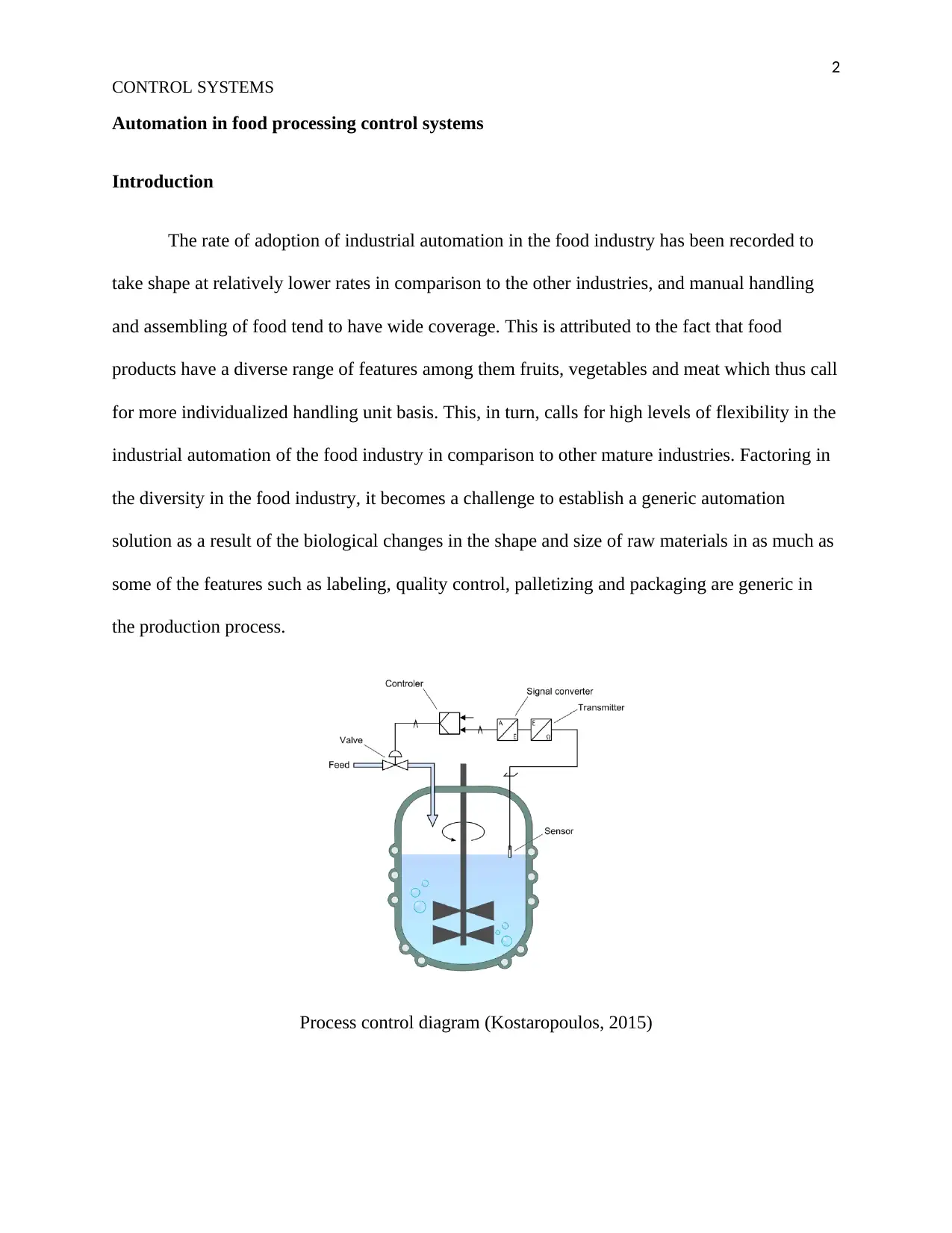
Process control diagram (Kostaropoulos, 2015)
CONTROL SYSTEMS
Automation in food processing control systems
Introduction
The rate of adoption of industrial automation in the food industry has been recorded to
take shape at relatively lower rates in comparison to the other industries, and manual handling
and assembling of food tend to have wide coverage. This is attributed to the fact that food
products have a diverse range of features among them fruits, vegetables and meat which thus call
for more individualized handling unit basis. This, in turn, calls for high levels of flexibility in the
industrial automation of the food industry in comparison to other mature industries. Factoring in
the diversity in the food industry, it becomes a challenge to establish a generic automation
solution as a result of the biological changes in the shape and size of raw materials in as much as
some of the features such as labeling, quality control, palletizing and packaging are generic in
the production process.
Process control diagram (Kostaropoulos, 2015)
3
CONTROL SYSTEMS
Reasons for automation of food processing
Despite the numerous hiccups associated with automation in the food industry, it still
becomes essential to automate the industry (Hitzmann, 2017, p. 176). The need to automate food
industry has been necessitated by the goal to achieve competitive advantage requirements which
are only achievable through improved quality of food and improved productivity. Through
automation in food processing, efficiency in the flow of work and use of labor is achieved and
thus a higher efficiency in the allocation of resources. Bearing the inefficiency, tedious and
inconsistent nature of human visual inspection, a need to develop more complex, reliable and
quality assuring technology was needed. Such technologies as computer vision have enhanced
automatic inspections of food products thereby enhancing higher levels of accuracy and
consistency in the evaluation of the food quality (Kostaropoulos, 2015, p. 596). Through food
automation, it has been able to collect, store and track data of all the events and processes in food
production operations which then allow the manufacturers to ascertain compliance with the
environmental and food hygiene provisions and regulations.
Food processing industries have been moved to increased automation dues to the rise in
the demand for higher quality products and the flexibility in sharing equipment used in the
manufacturing process among other factors. In response to these rising demands, the control
system vendors have managed to respond to the situations through the provision of the
appropriate hardware and modular software capability to give the process engineer an
opportunity to focus on the strategy of process control as opposed to concentrating on the control
system design (Lamb, 2013, p. 313). Still, through the development of sensors that can be used
in the measurement of the subjective and quality features among them smell and taste new vistas
have provided in automation application in the food processing industry.
CONTROL SYSTEMS
Reasons for automation of food processing
Despite the numerous hiccups associated with automation in the food industry, it still
becomes essential to automate the industry (Hitzmann, 2017, p. 176). The need to automate food
industry has been necessitated by the goal to achieve competitive advantage requirements which
are only achievable through improved quality of food and improved productivity. Through
automation in food processing, efficiency in the flow of work and use of labor is achieved and
thus a higher efficiency in the allocation of resources. Bearing the inefficiency, tedious and
inconsistent nature of human visual inspection, a need to develop more complex, reliable and
quality assuring technology was needed. Such technologies as computer vision have enhanced
automatic inspections of food products thereby enhancing higher levels of accuracy and
consistency in the evaluation of the food quality (Kostaropoulos, 2015, p. 596). Through food
automation, it has been able to collect, store and track data of all the events and processes in food
production operations which then allow the manufacturers to ascertain compliance with the
environmental and food hygiene provisions and regulations.
Food processing industries have been moved to increased automation dues to the rise in
the demand for higher quality products and the flexibility in sharing equipment used in the
manufacturing process among other factors. In response to these rising demands, the control
system vendors have managed to respond to the situations through the provision of the
appropriate hardware and modular software capability to give the process engineer an
opportunity to focus on the strategy of process control as opposed to concentrating on the control
system design (Lamb, 2013, p. 313). Still, through the development of sensors that can be used
in the measurement of the subjective and quality features among them smell and taste new vistas
have provided in automation application in the food processing industry.
⊘ This is a preview!⊘
Do you want full access?
Subscribe today to unlock all pages.

Trusted by 1+ million students worldwide
4
CONTROL SYSTEMS
Reduction in labor costs is yet another factor for the heightened interest in automation of
food production. A lot of manual work in food processing advocates for rapid and repetitive
movement. As a result of the tiresome environment of work besides the low skilled nature of the
work, low motivation levels are obtained that culminate into delicate safety issues and poor
quality of food. Through automating repetitive tasks, these concerns can be improved (Rahman,
2012, p. 1588). Depending on the type and specific requirements of the manufacturers,
automated systems in the processing and production of food vary in sizes and functions. While
some food products will require hard automation, i.e., fixed processing sequence for example
beverages, snacks, and dairy foods, others will call for a soft customized solutions to address
specific needs due to the complexity in their nature.
Sensors for food processing
Sensors tend to be the main interphase that exists between a control system and the process.
Sensors serve the following functions in the processing industry:
Environmental control
Maintenance of equipment
Inspection of packaging
Material waste control
Process quality control (McFarlane, 2012, p. 213)
Sensors have been designed to meet the specific needs of the food processing industry in a
bid to achieve the growing demand for reliable online low-cost sensors in the food industry. It
will be more important in the future to include in-line sensors in the automation of food industry
to aid in the monitoring and control of quality (Caldwell, 2012, p. 444).
CONTROL SYSTEMS
Reduction in labor costs is yet another factor for the heightened interest in automation of
food production. A lot of manual work in food processing advocates for rapid and repetitive
movement. As a result of the tiresome environment of work besides the low skilled nature of the
work, low motivation levels are obtained that culminate into delicate safety issues and poor
quality of food. Through automating repetitive tasks, these concerns can be improved (Rahman,
2012, p. 1588). Depending on the type and specific requirements of the manufacturers,
automated systems in the processing and production of food vary in sizes and functions. While
some food products will require hard automation, i.e., fixed processing sequence for example
beverages, snacks, and dairy foods, others will call for a soft customized solutions to address
specific needs due to the complexity in their nature.
Sensors for food processing
Sensors tend to be the main interphase that exists between a control system and the process.
Sensors serve the following functions in the processing industry:
Environmental control
Maintenance of equipment
Inspection of packaging
Material waste control
Process quality control (McFarlane, 2012, p. 213)
Sensors have been designed to meet the specific needs of the food processing industry in a
bid to achieve the growing demand for reliable online low-cost sensors in the food industry. It
will be more important in the future to include in-line sensors in the automation of food industry
to aid in the monitoring and control of quality (Caldwell, 2012, p. 444).
Paraphrase This Document
Need a fresh take? Get an instant paraphrase of this document with our AI Paraphraser
5
CONTROL SYSTEMS
Control systems for the food industry
The size of the industry and the nature of the plants within the same industry are the
determinants of the level of automation in the industry (Mutlu, 2016, p. 322). As a result of
changes in the technology, numerous food processing plants have evolved from the small and
more conservative approach in processing to more complex and technology-based processing.
Automation in the food industry started with the use of programmable controllers and single-
board computers in the manufacturing equipment as well as the use of very simple control
systems. Due to their simplicity of maintenance and operations, these devices were easily
adopted by the manufacturers. However, they were only limited to whatever services they could
offer which were the replacements of relays, counters, and timers (Zhou, 2016, p. 198).
To meet and maintain competitive advantages, numerous changes were done to the
manufacturing process that ensured flexibility in the production process. These changes allowed
for flexibility and ease of configuration of the systems used in the control and process
management systems. It is possible through technology for food manufacturers to either upgrade
their programmable logic controllers (PLCs) or install distributed control systems (DCSs)
(Sandeep, 2011, p. 188). It is possible to build upon the already existing programmable logic
systems to come up with a fully integrated control system that can be used in the execution of
various functions among them management of raw materials, process control and financial
management and reporting.
CONTROL SYSTEMS
Control systems for the food industry
The size of the industry and the nature of the plants within the same industry are the
determinants of the level of automation in the industry (Mutlu, 2016, p. 322). As a result of
changes in the technology, numerous food processing plants have evolved from the small and
more conservative approach in processing to more complex and technology-based processing.
Automation in the food industry started with the use of programmable controllers and single-
board computers in the manufacturing equipment as well as the use of very simple control
systems. Due to their simplicity of maintenance and operations, these devices were easily
adopted by the manufacturers. However, they were only limited to whatever services they could
offer which were the replacements of relays, counters, and timers (Zhou, 2016, p. 198).
To meet and maintain competitive advantages, numerous changes were done to the
manufacturing process that ensured flexibility in the production process. These changes allowed
for flexibility and ease of configuration of the systems used in the control and process
management systems. It is possible through technology for food manufacturers to either upgrade
their programmable logic controllers (PLCs) or install distributed control systems (DCSs)
(Sandeep, 2011, p. 188). It is possible to build upon the already existing programmable logic
systems to come up with a fully integrated control system that can be used in the execution of
various functions among them management of raw materials, process control and financial
management and reporting.
6
CONTROL SYSTEMS
Distributed control systems for food processing
The principle of operation of a distributed control system lies in breaking down into
smaller subsystems a large application to bring down the level of control to the level of the unit
when deemed appropriate to reduce the response time of the system. Through this, exchange of
information between the various control units is made possible hence allowing for the integration
of decision making a product line or plant level (Zongwei, 2015, p. 312). Different levels of
logical and conceptual sophistication are involved in the control of any process, and thus
numerous ways are used in the categorization of control functions into various levels of
hierarchy.
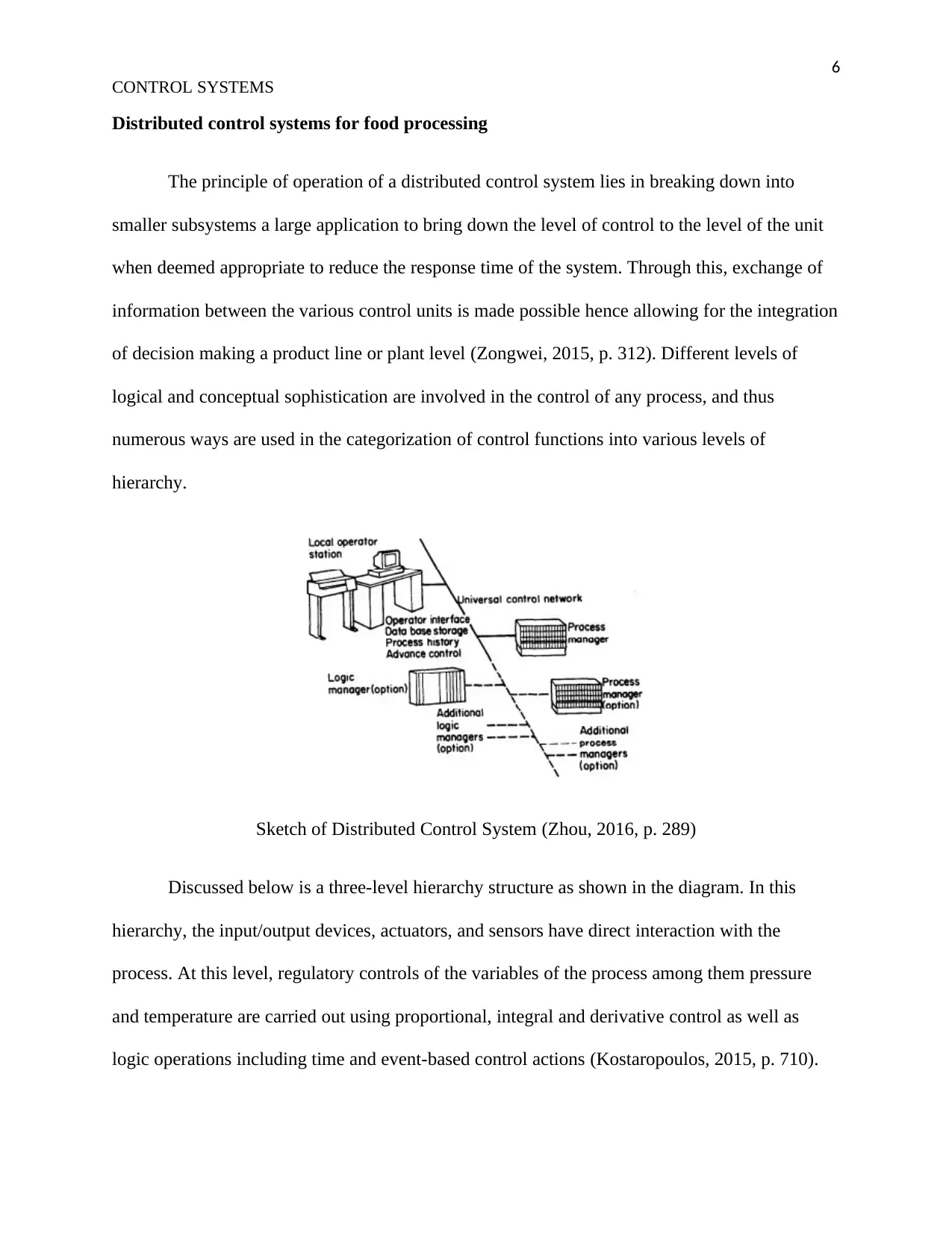
Sketch of Distributed Control System (Zhou, 2016, p. 289)
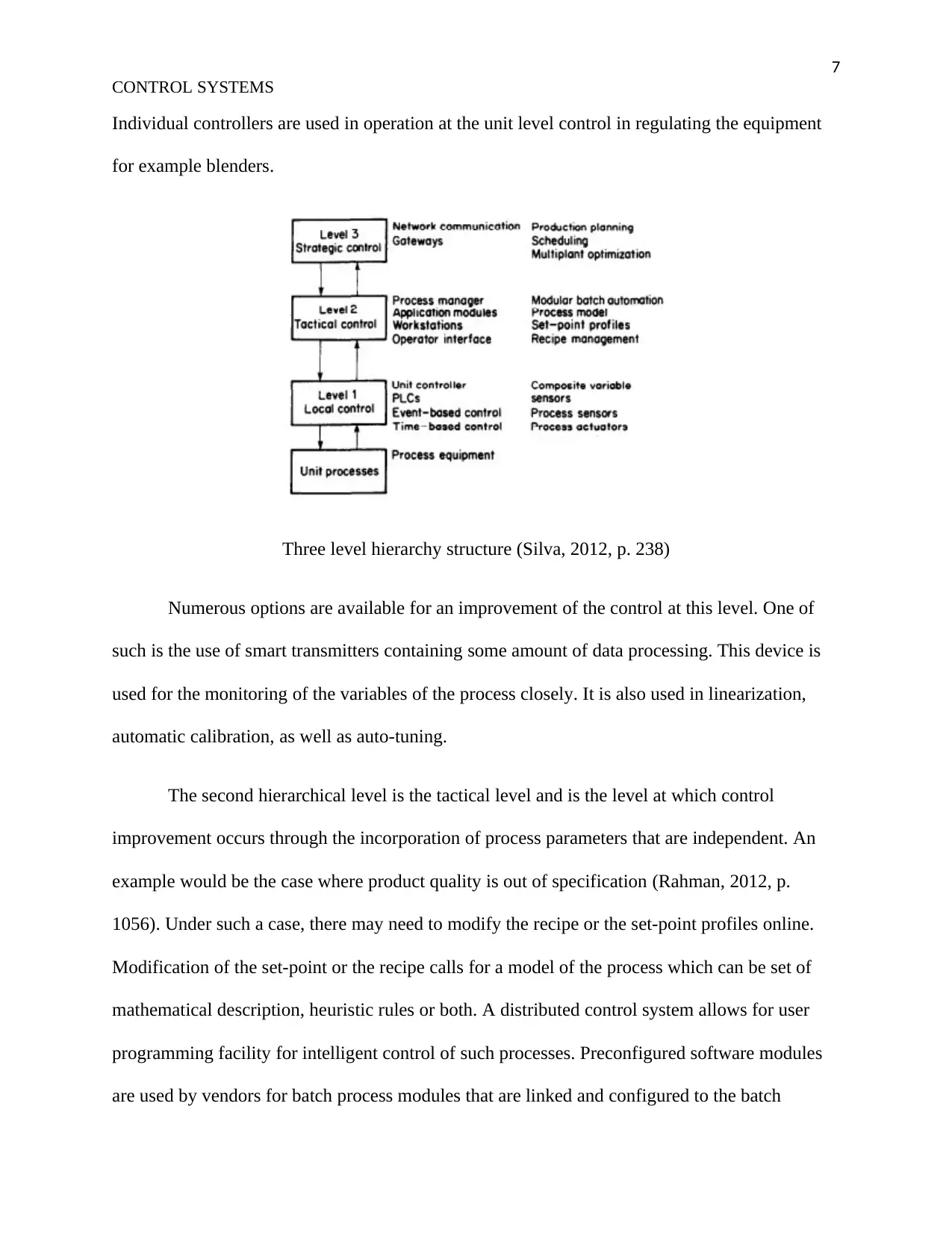
Discussed below is a three-level hierarchy structure as shown in the diagram. In this
hierarchy, the input/output devices, actuators, and sensors have direct interaction with the
process. At this level, regulatory controls of the variables of the process among them pressure
and temperature are carried out using proportional, integral and derivative control as well as
logic operations including time and event-based control actions (Kostaropoulos, 2015, p. 710).
CONTROL SYSTEMS
Distributed control systems for food processing
The principle of operation of a distributed control system lies in breaking down into
smaller subsystems a large application to bring down the level of control to the level of the unit
when deemed appropriate to reduce the response time of the system. Through this, exchange of
information between the various control units is made possible hence allowing for the integration
of decision making a product line or plant level (Zongwei, 2015, p. 312). Different levels of
logical and conceptual sophistication are involved in the control of any process, and thus
numerous ways are used in the categorization of control functions into various levels of
hierarchy.
Sketch of Distributed Control System (Zhou, 2016, p. 289)
Discussed below is a three-level hierarchy structure as shown in the diagram. In this
hierarchy, the input/output devices, actuators, and sensors have direct interaction with the
process. At this level, regulatory controls of the variables of the process among them pressure
and temperature are carried out using proportional, integral and derivative control as well as
logic operations including time and event-based control actions (Kostaropoulos, 2015, p. 710).
⊘ This is a preview!⊘
Do you want full access?
Subscribe today to unlock all pages.
Trusted by 1+ million students worldwide
7
CONTROL SYSTEMS
Individual controllers are used in operation at the unit level control in regulating the equipment
for example blenders.
Three level hierarchy structure (Silva, 2012, p. 238)
Numerous options are available for an improvement of the control at this level. One of
such is the use of smart transmitters containing some amount of data processing. This device is
used for the monitoring of the variables of the process closely. It is also used in linearization,
automatic calibration, as well as auto-tuning.
The second hierarchical level is the tactical level and is the level at which control
improvement occurs through the incorporation of process parameters that are independent. An
example would be the case where product quality is out of specification (Rahman, 2012, p.
1056). Under such a case, there may need to modify the recipe or the set-point profiles online.
Modification of the set-point or the recipe calls for a model of the process which can be set of
mathematical description, heuristic rules or both. A distributed control system allows for user
programming facility for intelligent control of such processes. Preconfigured software modules
are used by vendors for batch process modules that are linked and configured to the batch
CONTROL SYSTEMS
Individual controllers are used in operation at the unit level control in regulating the equipment
for example blenders.
Three level hierarchy structure (Silva, 2012, p. 238)
Numerous options are available for an improvement of the control at this level. One of
such is the use of smart transmitters containing some amount of data processing. This device is
used for the monitoring of the variables of the process closely. It is also used in linearization,
automatic calibration, as well as auto-tuning.
The second hierarchical level is the tactical level and is the level at which control
improvement occurs through the incorporation of process parameters that are independent. An
example would be the case where product quality is out of specification (Rahman, 2012, p.
1056). Under such a case, there may need to modify the recipe or the set-point profiles online.
Modification of the set-point or the recipe calls for a model of the process which can be set of
mathematical description, heuristic rules or both. A distributed control system allows for user
programming facility for intelligent control of such processes. Preconfigured software modules
are used by vendors for batch process modules that are linked and configured to the batch
Paraphrase This Document
Need a fresh take? Get an instant paraphrase of this document with our AI Paraphraser
8
CONTROL SYSTEMS
automation processes as opposed to the use of programming by users (Zhou, 2016, p. 255). This
helps the process engineer to easily configure or modify the software without necessarily having
to hire the services of a computer specialist.
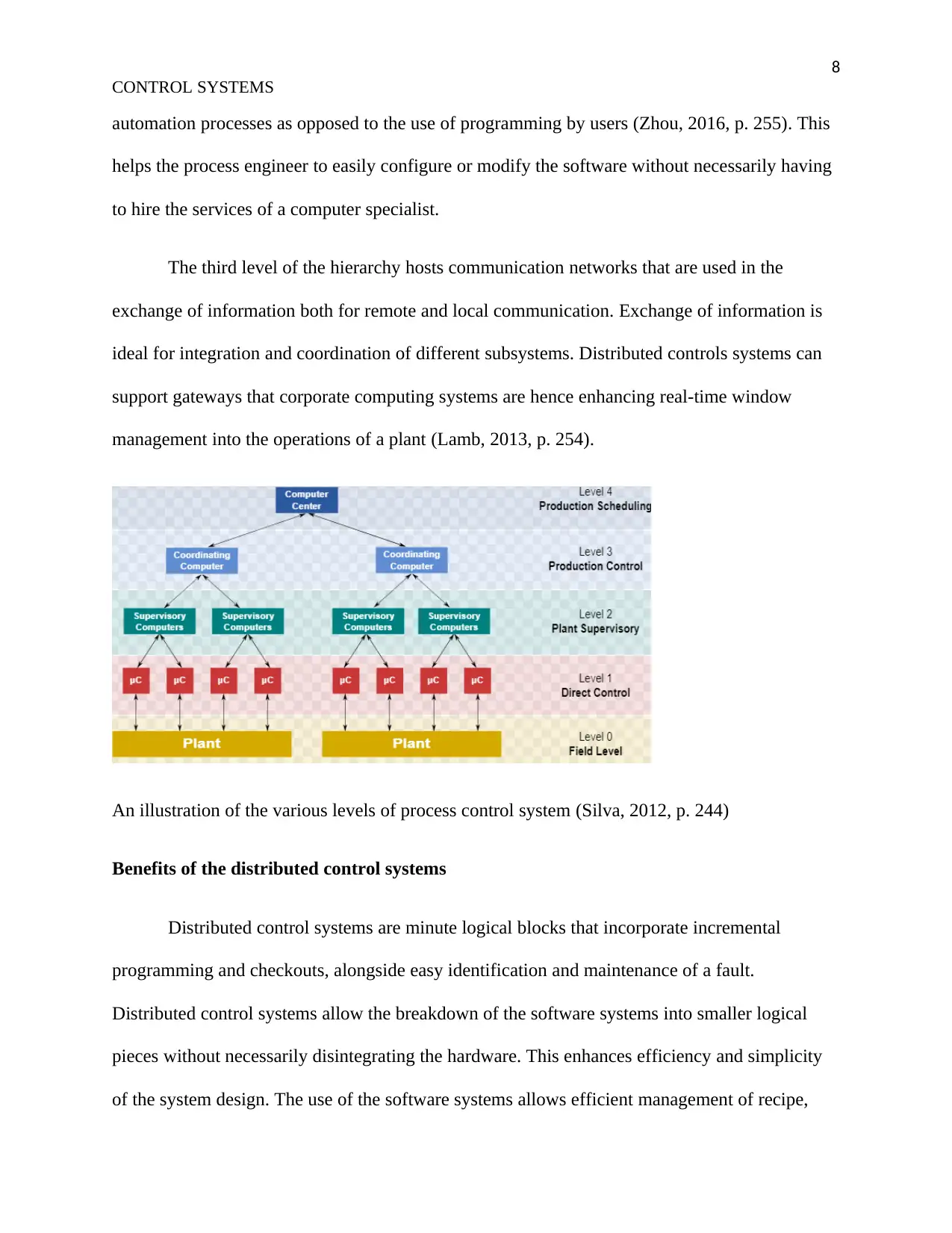
The third level of the hierarchy hosts communication networks that are used in the
exchange of information both for remote and local communication. Exchange of information is
ideal for integration and coordination of different subsystems. Distributed controls systems can
support gateways that corporate computing systems are hence enhancing real-time window
management into the operations of a plant (Lamb, 2013, p. 254).
An illustration of the various levels of process control system (Silva, 2012, p. 244)
Benefits of the distributed control systems
Distributed control systems are minute logical blocks that incorporate incremental
programming and checkouts, alongside easy identification and maintenance of a fault.
Distributed control systems allow the breakdown of the software systems into smaller logical
pieces without necessarily disintegrating the hardware. This enhances efficiency and simplicity
of the system design. The use of the software systems allows efficient management of recipe,
CONTROL SYSTEMS
automation processes as opposed to the use of programming by users (Zhou, 2016, p. 255). This
helps the process engineer to easily configure or modify the software without necessarily having
to hire the services of a computer specialist.
The third level of the hierarchy hosts communication networks that are used in the
exchange of information both for remote and local communication. Exchange of information is
ideal for integration and coordination of different subsystems. Distributed controls systems can
support gateways that corporate computing systems are hence enhancing real-time window
management into the operations of a plant (Lamb, 2013, p. 254).
An illustration of the various levels of process control system (Silva, 2012, p. 244)
Benefits of the distributed control systems
Distributed control systems are minute logical blocks that incorporate incremental
programming and checkouts, alongside easy identification and maintenance of a fault.
Distributed control systems allow the breakdown of the software systems into smaller logical
pieces without necessarily disintegrating the hardware. This enhances efficiency and simplicity
of the system design. The use of the software systems allows efficient management of recipe,
9
CONTROL SYSTEMS
analysis of the data on production as well as accurate recording. It also allows for functions
touching on statistical and quality control (Rahman, 2012, p. 1598). Another benefit of
distributed control systems is the removal of automation through an integrated system.
Distributed control systems allow communication across the various subsystems involved in the
manufacturing process hence allowing for easy coordination of the process of production as
opposed to working with isolated islands which are based on single controllers.
Distributed control systems gracefully degrade form failure. Through the breakdown of
the systems, there is the distribution of the system providing an autonomy that is large enough to
prevent any chances of massive failure (Zhou, 2016, p. 128). This is opposed to the case of a
direct digital control strategy that depends on a single computer to manage the whole process. In
case of failure of the central control computer, the whole systems will fail to lead to stoppage of
the construction process. Distributed control systems have an open architecture. This allows for
easy integration of the existing devices into the system. An example is the programmable logic
controls which are already available in the factory are very important and required that the
chosen distributed control systems can communicate with the other devices from the system
vendors (Mutlu, 2016, p. 288).
In conclusion, distributed control systems provide for flexibility and expansion that an
industry undergoing rapid transformation needs as the case of the food industry currently.
Distributed control systems have a significant impact on the optimization of the production
process through their ease of implementation and operation. It offers opportunities for adoption
of even more sophisticated tools usable in the scheduling and planning of production, control of
quality among other functions.
CONTROL SYSTEMS
analysis of the data on production as well as accurate recording. It also allows for functions
touching on statistical and quality control (Rahman, 2012, p. 1598). Another benefit of
distributed control systems is the removal of automation through an integrated system.
Distributed control systems allow communication across the various subsystems involved in the
manufacturing process hence allowing for easy coordination of the process of production as
opposed to working with isolated islands which are based on single controllers.
Distributed control systems gracefully degrade form failure. Through the breakdown of
the systems, there is the distribution of the system providing an autonomy that is large enough to
prevent any chances of massive failure (Zhou, 2016, p. 128). This is opposed to the case of a
direct digital control strategy that depends on a single computer to manage the whole process. In
case of failure of the central control computer, the whole systems will fail to lead to stoppage of
the construction process. Distributed control systems have an open architecture. This allows for
easy integration of the existing devices into the system. An example is the programmable logic
controls which are already available in the factory are very important and required that the
chosen distributed control systems can communicate with the other devices from the system
vendors (Mutlu, 2016, p. 288).
In conclusion, distributed control systems provide for flexibility and expansion that an
industry undergoing rapid transformation needs as the case of the food industry currently.
Distributed control systems have a significant impact on the optimization of the production
process through their ease of implementation and operation. It offers opportunities for adoption
of even more sophisticated tools usable in the scheduling and planning of production, control of
quality among other functions.
⊘ This is a preview!⊘
Do you want full access?
Subscribe today to unlock all pages.
Trusted by 1+ million students worldwide
10
CONTROL SYSTEMS
References
Caldwell, D. G. (2012). Robotics and Automation in the Food Industry: Current and Future
Technologies. London: Elsevier Science.
Hitzmann, B. (2017). Measurement, Modeling, and Automation in Advanced Food Processing.
New York: Springer.
Kostaropoulos, G. S. (2015). Handbook of Food Processing Equipment. New York: Springer.
Lamb, F. (2013). Industrial Automation: Hands On. Cambridge: McGraw Hill Professional.
McFarlane, I. (2012). Automatic Control of Food Manufacturing Processes. New York: Springer
Science & Business Media.
Mutlu, M. (2016). Biosensors in Food Processing, Safety, and Quality Control. Manchester:
CRC Press.
Rahman, J. A. (2012). Handbook of Food Process Design. Sydney: John Wiley & Sons.
Sandeep, K. P. (2011). Thermal Processing of Foods: Control and Automation. London: John
Wiley & Sons.
Zhou, S. P. (2016). RFID and Sensor Network Automation in the Food Industry: Ensuring
Quality and Safety through Supply Chain Visibility. Kansas: John Wiley & Sons.
Zongwei, L. (2015). Robotics, Automation, and Control in Industrial and Service Settings.
London: IGI Global.
CONTROL SYSTEMS
References
Caldwell, D. G. (2012). Robotics and Automation in the Food Industry: Current and Future
Technologies. London: Elsevier Science.
Hitzmann, B. (2017). Measurement, Modeling, and Automation in Advanced Food Processing.
New York: Springer.
Kostaropoulos, G. S. (2015). Handbook of Food Processing Equipment. New York: Springer.
Lamb, F. (2013). Industrial Automation: Hands On. Cambridge: McGraw Hill Professional.
McFarlane, I. (2012). Automatic Control of Food Manufacturing Processes. New York: Springer
Science & Business Media.
Mutlu, M. (2016). Biosensors in Food Processing, Safety, and Quality Control. Manchester:
CRC Press.
Rahman, J. A. (2012). Handbook of Food Process Design. Sydney: John Wiley & Sons.
Sandeep, K. P. (2011). Thermal Processing of Foods: Control and Automation. London: John
Wiley & Sons.
Zhou, S. P. (2016). RFID and Sensor Network Automation in the Food Industry: Ensuring
Quality and Safety through Supply Chain Visibility. Kansas: John Wiley & Sons.
Zongwei, L. (2015). Robotics, Automation, and Control in Industrial and Service Settings.
London: IGI Global.

1 out of 10


Related Documents


Your All-in-One AI-Powered Toolkit for Academic Success.
+13062052269
info@desklib.com
Available 24*7 on WhatsApp / Email
![[object Object]](/_next/static/media/star-bottom.7253800d.svg)
Unlock your academic potential
Copyright © 2020–2026 A2Z Services. All Rights Reserved. Developed and managed by ZUCOL.