Analysis and Development of an Annual Football Training Program
VerifiedAdded on 2022/09/01
|10
|2390
|17
Report
AI Summary
This report provides a comprehensive analysis of an annual football training program designed for a 15-year-old footballer, Erick Goen. It begins by examining the physiological demands of football, including the importance of aerobic energy systems, playing positions, and the six stages of movement. The report then outlines the athlete's profile, detailing his training history and current fitness level. The core of the report is the proposed annual training program, which is divided into three phases: pre-season, in-season, and transition. The pre-season phase is further broken down into macrocycles focusing on functional strength, hypertrophy, maximal strength, and power, along with speed, agility, and flexibility training. The in-season phase emphasizes maintaining gains through competitive games and conditioning, while the transition phase focuses on rest and active recovery. The report includes a graphical representation of the training intensity and discusses the importance of microcycles in adjusting to the intensity of training. The document concludes with a bibliography of relevant sources.
Football analysis1
Football analysis
Student’s Name
Institution
Date
Football analysis
Student’s Name
Institution
Date

Paraphrase This Document
Need a fresh take? Get an instant paraphrase of this document with our AI Paraphraser
Football analysis2
Football analysis
Introduction
Science is being used in planning for training and nutritional strategies that lead to match and
game performance. Differences between an individual and the physical stresses the players are
exposed to during training determine every individual's role in contributing towards a match. To
know the demands of a football match, every player should be engaged in a training program that
makes them gain all the required essential skills. The training program equips them with both
physical skills and physiological measurements required for play and how to prepare for a
specific match.
The factors underpinning training include differential learning and physical literacy.
The effectiveness of the training program is based on physical, creative, technical and tactical
performances. The physical performance training perspective leads to high RCOD time
improvement. When there is high individual coordination in a training program, there follows
increased changes anticipation on the directions came up with by the training program. RCOD,
in this case, is age-dependent and thus higher interlimb coordination is found at the trainees aged
17 and above and are found to perform the best during a training program. To avoid jumping
performance, the players at this age are subjected to the training programs whose goal is
improving physical literacy. A technical perspective leads to a high number of shots, goals and
successful dribbles as a result of approaches based on differential learning and physical literacy.
The technical perspective involves perceptual capacity and the ability of an attacker to make
appropriate decisions. This allows them to make better adjustments and act appropriately.
Mastering technical and tactical skills lead to high performance in the game and lead to creative
Football analysis
Introduction
Science is being used in planning for training and nutritional strategies that lead to match and
game performance. Differences between an individual and the physical stresses the players are
exposed to during training determine every individual's role in contributing towards a match. To
know the demands of a football match, every player should be engaged in a training program that
makes them gain all the required essential skills. The training program equips them with both
physical skills and physiological measurements required for play and how to prepare for a
specific match.
The factors underpinning training include differential learning and physical literacy.
The effectiveness of the training program is based on physical, creative, technical and tactical
performances. The physical performance training perspective leads to high RCOD time
improvement. When there is high individual coordination in a training program, there follows
increased changes anticipation on the directions came up with by the training program. RCOD,
in this case, is age-dependent and thus higher interlimb coordination is found at the trainees aged
17 and above and are found to perform the best during a training program. To avoid jumping
performance, the players at this age are subjected to the training programs whose goal is
improving physical literacy. A technical perspective leads to a high number of shots, goals and
successful dribbles as a result of approaches based on differential learning and physical literacy.
The technical perspective involves perceptual capacity and the ability of an attacker to make
appropriate decisions. This allows them to make better adjustments and act appropriately.
Mastering technical and tactical skills lead to high performance in the game and lead to creative
Football analysis3
behavior. A beneficial training program beneficial effects are associated with creative
components and improved abilities. It is followed with fluency and versatility of the game and
the player can explore and improvise playing tactics. positioning behavior leads to increased
dispersion of the team, and the differential approach of learning leads a player to scenarios that
are unfamiliar which results in the emergence of new behaviors of functional movement. Players
can skillfully use the available space after the training program when they are given the freedom
to find a solution to a given task. These factors should be used by coaches in their training
programs for players who mostly are under the age group of 15. players with the age of above 17
need programs of higher durations as a result of more time spent in training tactical behaviors
that are rigid.
I will construct an annual program for Erick Goen, a footballer aged 15. At first, I shall look at
the physiological demands of football that must be considered when coming up with an annual
program.
Physiological demands of football
Physiological demands are determined through analysis of matches and physiological
measurements at the time of football matches. They are influenced by the physical activities of a
football player, the playing position, the style of playing and the tactical role, the technical
qualities, environmental factors, the game's importance, the type of playing surface, the
opponent's quality and the ball possession of the team (Randers 2011). What is deemed
important during the game are the periods of high intensity and the top class players and low
players are distinguished through their high running speed. Football uses the aerobic system of
energy with an 85% to 98% heart rate maximal values. A player maximumly uptakes 7-% of
oxygen. There is a high turnover of anaerobic energy used due to many intense actions used and
behavior. A beneficial training program beneficial effects are associated with creative
components and improved abilities. It is followed with fluency and versatility of the game and
the player can explore and improvise playing tactics. positioning behavior leads to increased
dispersion of the team, and the differential approach of learning leads a player to scenarios that
are unfamiliar which results in the emergence of new behaviors of functional movement. Players
can skillfully use the available space after the training program when they are given the freedom
to find a solution to a given task. These factors should be used by coaches in their training
programs for players who mostly are under the age group of 15. players with the age of above 17
need programs of higher durations as a result of more time spent in training tactical behaviors
that are rigid.
I will construct an annual program for Erick Goen, a footballer aged 15. At first, I shall look at
the physiological demands of football that must be considered when coming up with an annual
program.
Physiological demands of football
Physiological demands are determined through analysis of matches and physiological
measurements at the time of football matches. They are influenced by the physical activities of a
football player, the playing position, the style of playing and the tactical role, the technical
qualities, environmental factors, the game's importance, the type of playing surface, the
opponent's quality and the ball possession of the team (Randers 2011). What is deemed
important during the game are the periods of high intensity and the top class players and low
players are distinguished through their high running speed. Football uses the aerobic system of
energy with an 85% to 98% heart rate maximal values. A player maximumly uptakes 7-% of
oxygen. There is a high turnover of anaerobic energy used due to many intense actions used and
⊘ This is a preview!⊘
Do you want full access?
Subscribe today to unlock all pages.

Trusted by 1+ million students worldwide
Football analysis4
there is a good utilization of creatine phosphate and accumulation of lactate. To prepare for a
football game and its training, careful planning must be done and good nutritional strategies
utilized.
There are different playing positions in football. There are 11 members in a complete football
team that consists of 10 players and 1 goalkeeper. The ten outfield players take defensive
positions, midfield positions and attacking positions (Mauro 2019).
Goalkeeper never changes his position during the game and stays only in the penalty area. They
prevent the scoring of the opposing team and are the only ones that are allowed to use hands
during the game. Their hands are protected from harm and injuries by wearing gloves and their
jersey is colored to distinguish them from other players.
Defenders' responsibility is intercepting the ball of the attacking team and makes the ball passes
to fellow teammates. There are center back defenders, the sweeper, the defending fullback and
the wing-back defender. Midfielders are located at the field's central position during the game
between the attack and defense. There are the central midfielders who fight to control the ball
and can understand the game strategies, there are defensive midfielders who positioned in front
of the defenders who easily asses the game and disrupt oppositions (GAURAV, SINGH, &
SINGH 2015). There are attacking midfielders who are always positioned behind the striker in
the middle of the field. They create opportunities for striking in their team. There are also wide
midfielders who are positioned at the field's other sections. They give width to the section of the
midfield that helps in the tactical passing of the ball. There are six stages of movement that are
used in football. This includes the angle of approach, the follow-through, the contact of the ball,
the loading of the swing limb and also the swinging phase.
there is a good utilization of creatine phosphate and accumulation of lactate. To prepare for a
football game and its training, careful planning must be done and good nutritional strategies
utilized.
There are different playing positions in football. There are 11 members in a complete football
team that consists of 10 players and 1 goalkeeper. The ten outfield players take defensive
positions, midfield positions and attacking positions (Mauro 2019).
Goalkeeper never changes his position during the game and stays only in the penalty area. They
prevent the scoring of the opposing team and are the only ones that are allowed to use hands
during the game. Their hands are protected from harm and injuries by wearing gloves and their
jersey is colored to distinguish them from other players.
Defenders' responsibility is intercepting the ball of the attacking team and makes the ball passes
to fellow teammates. There are center back defenders, the sweeper, the defending fullback and
the wing-back defender. Midfielders are located at the field's central position during the game
between the attack and defense. There are the central midfielders who fight to control the ball
and can understand the game strategies, there are defensive midfielders who positioned in front
of the defenders who easily asses the game and disrupt oppositions (GAURAV, SINGH, &
SINGH 2015). There are attacking midfielders who are always positioned behind the striker in
the middle of the field. They create opportunities for striking in their team. There are also wide
midfielders who are positioned at the field's other sections. They give width to the section of the
midfield that helps in the tactical passing of the ball. There are six stages of movement that are
used in football. This includes the angle of approach, the follow-through, the contact of the ball,
the loading of the swing limb and also the swinging phase.
Paraphrase This Document
Need a fresh take? Get an instant paraphrase of this document with our AI Paraphraser
Football analysis5
Joints motions are used during the lower extremities and kicks, the movements of the upper body
are used. The hip extension enables ball kicking after it is externally rotated. When kicking the
ball, the hips go into flexion and rotates internally and the ankle joints make plantar flexion at the
joint of the ankle to prepare for the ball's impact.
During the game, the muscles used include the gluteus medius and the gluteus maximus that help
the foot during the kicking activities on the planting stage. Throughout the swinging stages,
hamstrings are used. quadriceps and knee extensor muscles such as rector femoris are used in
creating a concentric activity that produces a fast forward velocity. The greatest activity of the
muscles is enabled by gastrocnemius by the kicking leg at all motion stages. The trunk, the hips,
the upper body, and the legs are used in movements during a football play.
There are more football injuries during the game than it is during the training period. During a
playing season, a player gets 2.0 injuries where the most common injuries are thigh strain that
represents 17% of all the other injuries experiences. During the incidences of matches, players
experience injuries during the first and the second halves of the game (Dijk et al. 2017). During
competitive seasons, players suffer hamstring strains and traumatic injuries while during pre-
seasons on, players suffer overuse injuries. Match injuries and training injuries remain stable
irrespective of the season and injury risks increase with an increase in time during the first and
the second half of the game (Whalan, Lovell, & Sampsonn2019).
The training program shall entail the weight of passes, the angle of support, the technique of
making passes, how to pass to the proper foot, how to check the ball, how to make short and
sharp passes, movements and how to time movements (Samur 2019).
Joints motions are used during the lower extremities and kicks, the movements of the upper body
are used. The hip extension enables ball kicking after it is externally rotated. When kicking the
ball, the hips go into flexion and rotates internally and the ankle joints make plantar flexion at the
joint of the ankle to prepare for the ball's impact.
During the game, the muscles used include the gluteus medius and the gluteus maximus that help
the foot during the kicking activities on the planting stage. Throughout the swinging stages,
hamstrings are used. quadriceps and knee extensor muscles such as rector femoris are used in
creating a concentric activity that produces a fast forward velocity. The greatest activity of the
muscles is enabled by gastrocnemius by the kicking leg at all motion stages. The trunk, the hips,
the upper body, and the legs are used in movements during a football play.
There are more football injuries during the game than it is during the training period. During a
playing season, a player gets 2.0 injuries where the most common injuries are thigh strain that
represents 17% of all the other injuries experiences. During the incidences of matches, players
experience injuries during the first and the second halves of the game (Dijk et al. 2017). During
competitive seasons, players suffer hamstring strains and traumatic injuries while during pre-
seasons on, players suffer overuse injuries. Match injuries and training injuries remain stable
irrespective of the season and injury risks increase with an increase in time during the first and
the second half of the game (Whalan, Lovell, & Sampsonn2019).
The training program shall entail the weight of passes, the angle of support, the technique of
making passes, how to pass to the proper foot, how to check the ball, how to make short and
sharp passes, movements and how to time movements (Samur 2019).
Football analysis6
The athlete's profile
Erick Geon's profile is that he was regularly trained in high school, in college, and in his
professional career. He is able to perform free weight and machine exercises due to his excellent
skills, he completed a resistance training program that consisted of all the 8 training exercises
and 2 to 3 sets of 12RM TO 15RM loads. His resistance training status is advanced and during
the offseason, his resistance training goal is hypertrophy (Lawrence & Crawford, 2018).
Annual training program to be undertaken
His training shall involve three phases which include the pre-season phase, the in-season phase
and the transition phase (Palmieri, National Strength & Conditioning Association & Krein 2019.
The pre-season phase shall take seven months and under it, there shall be other macrocycles with
the aim of obtaining optimum strength and power (Zambak 2019). During strength and power
conditioning, strength is laid off in all together training for a few weeks. This is a functional
strength program that helps in balancing the strenuous football training program. It includes
hypertrophy program used to increase the mass of muscles. The preseason is divided into 4
phases which are the functional, the hypertrophy, maximal strength and power. He shall be
trained on speed and agility, and flexibility training. According to Bradley (2014) flexibility
training, the degree of the player's movement shall impact his speed, agility, and power. It helps
in curbing the occurrence of injuries during overstretching. On top of stretching exercises done
as part of warm-up during the exercises, he should spend three days a week stretching (Favero,
Drust, & Dawson 2015).
During the in-season phase, he shall be trained on how to maintain what he gained during the
pre-season (Kerr 2015). He should be engaged in competitive games during this period where he
The athlete's profile
Erick Geon's profile is that he was regularly trained in high school, in college, and in his
professional career. He is able to perform free weight and machine exercises due to his excellent
skills, he completed a resistance training program that consisted of all the 8 training exercises
and 2 to 3 sets of 12RM TO 15RM loads. His resistance training status is advanced and during
the offseason, his resistance training goal is hypertrophy (Lawrence & Crawford, 2018).
Annual training program to be undertaken
His training shall involve three phases which include the pre-season phase, the in-season phase
and the transition phase (Palmieri, National Strength & Conditioning Association & Krein 2019.
The pre-season phase shall take seven months and under it, there shall be other macrocycles with
the aim of obtaining optimum strength and power (Zambak 2019). During strength and power
conditioning, strength is laid off in all together training for a few weeks. This is a functional
strength program that helps in balancing the strenuous football training program. It includes
hypertrophy program used to increase the mass of muscles. The preseason is divided into 4
phases which are the functional, the hypertrophy, maximal strength and power. He shall be
trained on speed and agility, and flexibility training. According to Bradley (2014) flexibility
training, the degree of the player's movement shall impact his speed, agility, and power. It helps
in curbing the occurrence of injuries during overstretching. On top of stretching exercises done
as part of warm-up during the exercises, he should spend three days a week stretching (Favero,
Drust, & Dawson 2015).
During the in-season phase, he shall be trained on how to maintain what he gained during the
pre-season (Kerr 2015). He should be engaged in competitive games during this period where he
⊘ This is a preview!⊘
Do you want full access?
Subscribe today to unlock all pages.
Trusted by 1+ million students worldwide
Football analysis7
should engage in conditioning work, and weight training. The last phase shall be the transition
phase which may take four to six weeks. one must take time to rest physically and mentally to
avoid burnout. Weight training is avoided at the highest degree and he must remain physically
active.
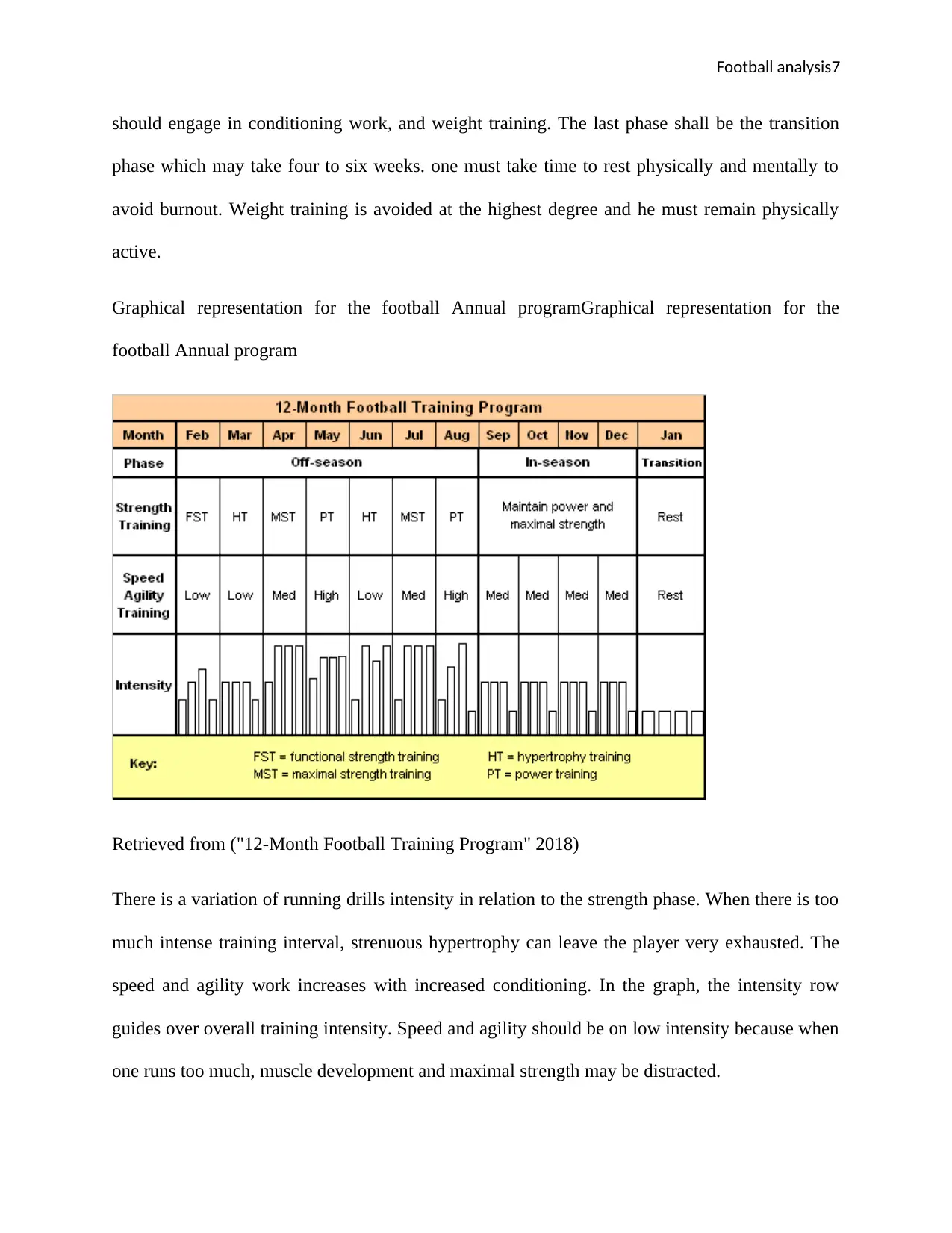
Graphical representation for the football Annual programGraphical representation for the
football Annual program
Retrieved from ("12-Month Football Training Program" 2018)
There is a variation of running drills intensity in relation to the strength phase. When there is too
much intense training interval, strenuous hypertrophy can leave the player very exhausted. The
speed and agility work increases with increased conditioning. In the graph, the intensity row
guides over overall training intensity. Speed and agility should be on low intensity because when
one runs too much, muscle development and maximal strength may be distracted.
should engage in conditioning work, and weight training. The last phase shall be the transition
phase which may take four to six weeks. one must take time to rest physically and mentally to
avoid burnout. Weight training is avoided at the highest degree and he must remain physically
active.
Graphical representation for the football Annual programGraphical representation for the
football Annual program
Retrieved from ("12-Month Football Training Program" 2018)
There is a variation of running drills intensity in relation to the strength phase. When there is too
much intense training interval, strenuous hypertrophy can leave the player very exhausted. The
speed and agility work increases with increased conditioning. In the graph, the intensity row
guides over overall training intensity. Speed and agility should be on low intensity because when
one runs too much, muscle development and maximal strength may be distracted.
Paraphrase This Document
Need a fresh take? Get an instant paraphrase of this document with our AI Paraphraser
Football analysis8
One microcycle for a single component of fitness
Macrocycles last between three to six weeks where there are different training objectives and
methods that vary in each cycle ("Jamaican football context: From the plantation to schoolboy
football" 2019). This is done to adjust to the intensity of the training. Some aspects of training
are built in the back of others. An example includes maximal strength training which follows
functional strength training to enhance fitness. In relation to his profile, maximal strength
training should involve heavy weight lifting, which he has been able to undertake sine high
school. Microcycles last for one week to facilitate training. They should take place during the
pre-season in football.
One microcycle for a single component of fitness
Macrocycles last between three to six weeks where there are different training objectives and
methods that vary in each cycle ("Jamaican football context: From the plantation to schoolboy
football" 2019). This is done to adjust to the intensity of the training. Some aspects of training
are built in the back of others. An example includes maximal strength training which follows
functional strength training to enhance fitness. In relation to his profile, maximal strength
training should involve heavy weight lifting, which he has been able to undertake sine high
school. Microcycles last for one week to facilitate training. They should take place during the
pre-season in football.
Football analysis9
Bibliography
The 12-Month Football Training Program. Last modified May 20, 2018.
https://www.jenreviews.com/football-training-program/.
Bradley, D. "Football flexibility." Materials Today 17, no. 7 (2014), 320.
doi:10.1016/j.mattod.2014.08.006.
Dijk, C. N., P. Neyret, M. Cohen, S. D. Villa, H. Pereira, and J. M. Oliveira. Injuries and
Health Problems in Football: What Everyone Should Know. Basingstoke, England: Springer,
2017.
Favero, T., B. Drust, and B. Dawson. International Research in Science and Soccer II. London,
England: Routledge, 2015.
GAURAV, V., A. SINGH, and S. SINGH. "Comparison of selected physical fitness
components among male football players of different playing positions." Turkish Journal of
Sport and Exercise 17, no. 2 (2015), 22. doi:10.15314/tjse.68533.
The Jamaican football context: From the plantation to schoolboy football. An Ethnography of
Football and Masculinities in Jamaica, 2019. doi:10.5040/9781350056565.0005.
Kerr, R. L. "America Meets Football, and Football Meets Frank Merriwell." How
Postmodernism Explains Football and Football Explains Postmodernism, 2015, 7-21.
doi:10.1057/9781137534071_2.
Lawrence, S., and G. Crawford. "Football 2.0?" Digital Football Cultures, 2018, 186-204.
doi:10.4324/9781351118903-12.
Bibliography
The 12-Month Football Training Program. Last modified May 20, 2018.
https://www.jenreviews.com/football-training-program/.
Bradley, D. "Football flexibility." Materials Today 17, no. 7 (2014), 320.
doi:10.1016/j.mattod.2014.08.006.
Dijk, C. N., P. Neyret, M. Cohen, S. D. Villa, H. Pereira, and J. M. Oliveira. Injuries and
Health Problems in Football: What Everyone Should Know. Basingstoke, England: Springer,
2017.
Favero, T., B. Drust, and B. Dawson. International Research in Science and Soccer II. London,
England: Routledge, 2015.
GAURAV, V., A. SINGH, and S. SINGH. "Comparison of selected physical fitness
components among male football players of different playing positions." Turkish Journal of
Sport and Exercise 17, no. 2 (2015), 22. doi:10.15314/tjse.68533.
The Jamaican football context: From the plantation to schoolboy football. An Ethnography of
Football and Masculinities in Jamaica, 2019. doi:10.5040/9781350056565.0005.
Kerr, R. L. "America Meets Football, and Football Meets Frank Merriwell." How
Postmodernism Explains Football and Football Explains Postmodernism, 2015, 7-21.
doi:10.1057/9781137534071_2.
Lawrence, S., and G. Crawford. "Football 2.0?" Digital Football Cultures, 2018, 186-204.
doi:10.4324/9781351118903-12.
⊘ This is a preview!⊘
Do you want full access?
Subscribe today to unlock all pages.
Trusted by 1+ million students worldwide
Football analysis10
Mauro, M. "Flexible positions." Youth Sport, Migration and Culture, 2019, 71-93.
doi:10.4324/9781351205238-4.
Palmieri, J., National Strength & Conditioning Association, and D. Krein. Strength Training for
Football. Human Kinetics Publishers, 2019.
Randers, M. B. Physiological Demands, Fitness Effects, and Cardiovascular Health Benefits of
Recreational Football: PhD Thesis. 2011.
Samur, S. "Process Management in Football Youth Development Program." Journal of
Education and Training Studies 7, no. 9 (2019), 8. doi:10.11114/jets.v7i9.4342.
Whalan, M., R. Lovell, and J. A. Sampson. "Do Niggles Matter? - Increased injury risk
following physical complaints in football (soccer)." Science and Medicine in Football, 2019, 1-
9. doi:10.1080/24733938.2019.1705996.
Zambak, Ö. "Evaluation of Maximum aerobic power, shoot speed and 20m. sprint powerof
football players at pre-season, mid-season." International Journal of Disabilities Sports &
Health Sciences, 2019, 72-77. doi:10.33438/ijdshs.624026.
Mauro, M. "Flexible positions." Youth Sport, Migration and Culture, 2019, 71-93.
doi:10.4324/9781351205238-4.
Palmieri, J., National Strength & Conditioning Association, and D. Krein. Strength Training for
Football. Human Kinetics Publishers, 2019.
Randers, M. B. Physiological Demands, Fitness Effects, and Cardiovascular Health Benefits of
Recreational Football: PhD Thesis. 2011.
Samur, S. "Process Management in Football Youth Development Program." Journal of
Education and Training Studies 7, no. 9 (2019), 8. doi:10.11114/jets.v7i9.4342.
Whalan, M., R. Lovell, and J. A. Sampson. "Do Niggles Matter? - Increased injury risk
following physical complaints in football (soccer)." Science and Medicine in Football, 2019, 1-
9. doi:10.1080/24733938.2019.1705996.
Zambak, Ö. "Evaluation of Maximum aerobic power, shoot speed and 20m. sprint powerof
football players at pre-season, mid-season." International Journal of Disabilities Sports &
Health Sciences, 2019, 72-77. doi:10.33438/ijdshs.624026.

1 out of 10


Your All-in-One AI-Powered Toolkit for Academic Success.
+13062052269
info@desklib.com
Available 24*7 on WhatsApp / Email
![[object Object]](/_next/static/media/star-bottom.7253800d.svg)
Unlock your academic potential
Copyright © 2020–2026 A2Z Services. All Rights Reserved. Developed and managed by ZUCOL.