Formative Assessment: Improving Learning & Student Engagement
VerifiedAdded on 2023/06/18
|13
|3469
|259
Report
AI Summary
This report provides a comprehensive overview of formative assessment within the context of secondary classrooms. It begins by defining assessment and differentiating various types, with a focus on formative assessment's key elements: identifying learning gaps, providing feedback, learning progressions, and student involvement. The report explores techniques for implementing formative assessments, such as debates, entry/exit slips, polls, and quizzes. Furthermore, it details the implications of formative assessment for students, teachers, and parents, highlighting its impact on student learning, the teacher's role in planning, and strategies for actively involving students and parents in the assessment process. The report also acknowledges potential challenges in implementing formative assessment and concludes by emphasizing its importance in improving learning outcomes. Desklib offers a wealth of similar resources for students seeking academic support.
ASSESSMENT FOR, AND AND OF
LEARNING - FORMATIVE
ASSESSMENT
LEARNING - FORMATIVE
ASSESSMENT

Paraphrase This Document
Need a fresh take? Get an instant paraphrase of this document with our AI Paraphraser
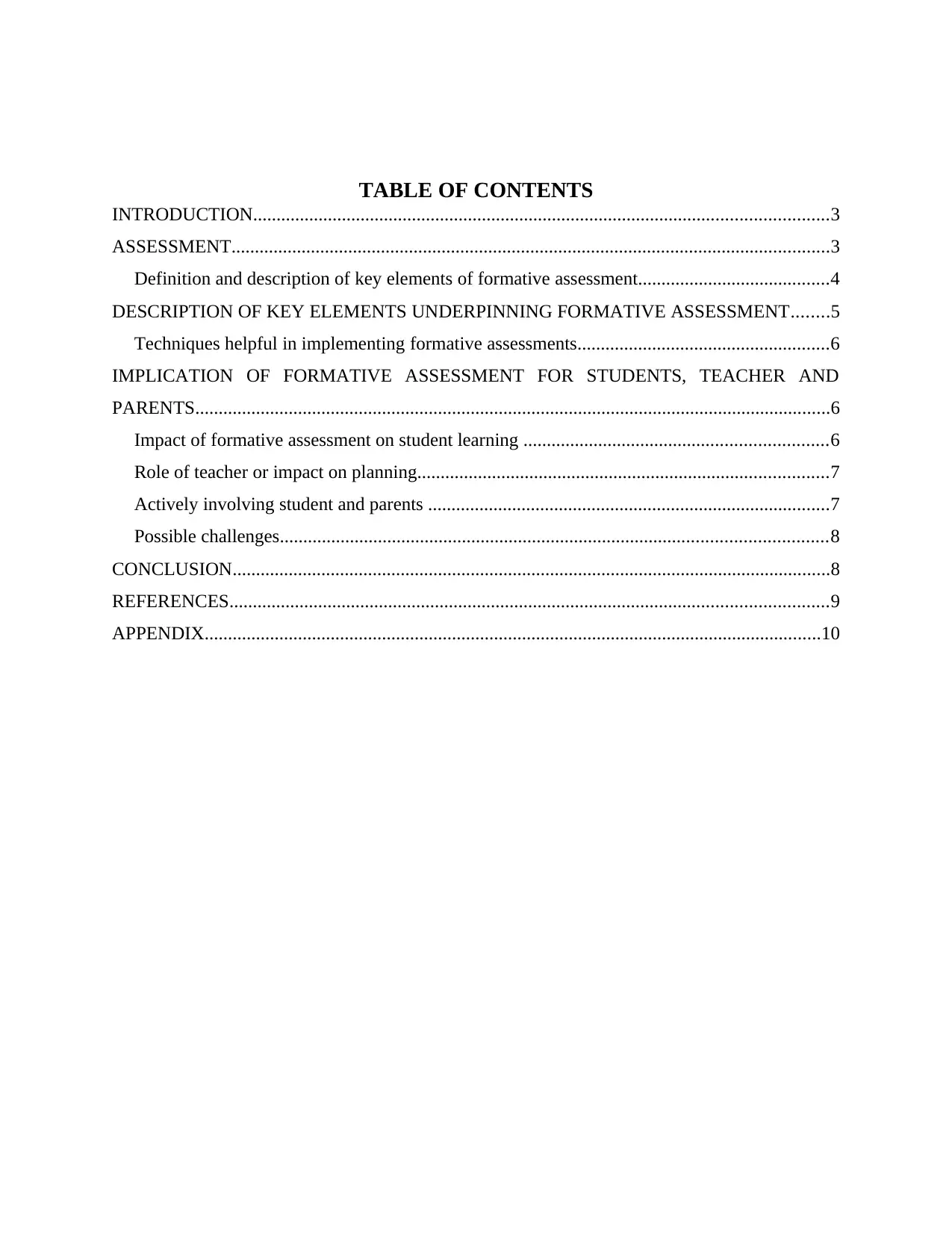
TABLE OF CONTENTS
INTRODUCTION...........................................................................................................................3
ASSESSMENT................................................................................................................................3
Definition and description of key elements of formative assessment.........................................4
DESCRIPTION OF KEY ELEMENTS UNDERPINNING FORMATIVE ASSESSMENT........5
Techniques helpful in implementing formative assessments......................................................6
IMPLICATION OF FORMATIVE ASSESSMENT FOR STUDENTS, TEACHER AND
PARENTS........................................................................................................................................6
Impact of formative assessment on student learning .................................................................6
Role of teacher or impact on planning........................................................................................7
Actively involving student and parents ......................................................................................7
Possible challenges.....................................................................................................................8
CONCLUSION................................................................................................................................8
REFERENCES................................................................................................................................9
APPENDIX....................................................................................................................................10
INTRODUCTION...........................................................................................................................3
ASSESSMENT................................................................................................................................3
Definition and description of key elements of formative assessment.........................................4
DESCRIPTION OF KEY ELEMENTS UNDERPINNING FORMATIVE ASSESSMENT........5
Techniques helpful in implementing formative assessments......................................................6
IMPLICATION OF FORMATIVE ASSESSMENT FOR STUDENTS, TEACHER AND
PARENTS........................................................................................................................................6
Impact of formative assessment on student learning .................................................................6
Role of teacher or impact on planning........................................................................................7
Actively involving student and parents ......................................................................................7
Possible challenges.....................................................................................................................8
CONCLUSION................................................................................................................................8
REFERENCES................................................................................................................................9
APPENDIX....................................................................................................................................10
INTRODUCTION
Assessment is important component of education process that helps in analysing
understanding the learning needs, capabilities and existing skills or knowledge that are present in
particular student. So, that alternative strategies can be used to improve its skills and knowledge
for bright future ahead or getting a better job opportunities. This report has consisted of
information related to what is assessment, formative assessment and its implication for the
student, teacher and parents.
ASSESSMENT
Assessment is the procedure of collecting and discussing the gathered information with the
help of multiple and diversified sources in order to develop a deep and detailed understanding
about the knowledge of students, the things they understand and can do according to their
perception which acts as a result of their educational experiences (Rowe, 2017). It is a systematic
basis for preparing deductions about the learning and development of the students. It is basically
reviewing the gathered information about educational programs and services that has been
undertaken with any purpose such as quality improvements, decision making as well as planning
about certain activities. It is highly beneficial for tutors as well as students in order to understand
about the exact learning of the students along with updation of understanding the exact amount
of knowledge gained by them. The benefits of doing assessments include:
Increases student’s ability to learn, develop and engagement into certain actions which
enhances their level of understanding.
Stronger programs and services that are self studied and can be redefined with proper
feedbacks.
This acts as an opportunity to make necessary improvements based on accurate
evaluations of requirements.
It enhances communication part and collaboration amongst departments along with
offices.
It also helps to increase the accountability.
The basic purpose of assessment is to fulfil the requirements in two ways i.e. the assessment
for improvement and the assessment for accountability. Many staff members and tutors are
Assessment is important component of education process that helps in analysing
understanding the learning needs, capabilities and existing skills or knowledge that are present in
particular student. So, that alternative strategies can be used to improve its skills and knowledge
for bright future ahead or getting a better job opportunities. This report has consisted of
information related to what is assessment, formative assessment and its implication for the
student, teacher and parents.
ASSESSMENT
Assessment is the procedure of collecting and discussing the gathered information with the
help of multiple and diversified sources in order to develop a deep and detailed understanding
about the knowledge of students, the things they understand and can do according to their
perception which acts as a result of their educational experiences (Rowe, 2017). It is a systematic
basis for preparing deductions about the learning and development of the students. It is basically
reviewing the gathered information about educational programs and services that has been
undertaken with any purpose such as quality improvements, decision making as well as planning
about certain activities. It is highly beneficial for tutors as well as students in order to understand
about the exact learning of the students along with updation of understanding the exact amount
of knowledge gained by them. The benefits of doing assessments include:
Increases student’s ability to learn, develop and engagement into certain actions which
enhances their level of understanding.
Stronger programs and services that are self studied and can be redefined with proper
feedbacks.
This acts as an opportunity to make necessary improvements based on accurate
evaluations of requirements.
It enhances communication part and collaboration amongst departments along with
offices.
It also helps to increase the accountability.
The basic purpose of assessment is to fulfil the requirements in two ways i.e. the assessment
for improvement and the assessment for accountability. Many staff members and tutors are
⊘ This is a preview!⊘
Do you want full access?
Subscribe today to unlock all pages.

Trusted by 1+ million students worldwide
motivated by the benefits of the assessment for further improvements among the students. This
demonstrates the effectiveness of programs and services all across the institutions (Carless,
2017). The assessment data are of various types due to which significant decisions related to the
institutions as well as students career has been taken. Assessments within the institutions are
utilised for wide variety of reasons such as high stake assessments which are standardised tests
used for the purpose of accountability which helps the tutors to take important decisions about
students on the basis of score cards achieved in high stake tests. Next is pre assessment which
generally administered even before students start to begin their learning. These are generally
utilised to establish baseline against which educators’ measures learning progress over the course
of program. Another is formative assessments which in process help the tutors to give educators
in process feedback about exactly what students are learning or not understood so that
instructional approaches, learning material and academic support can be modified accordingly
(Jaafar and Lin, 2017). One more is summative assessments that are used to appraise the students
learning at the outcome or final results that are typically administered various times during the
complete course or program.
Some other forms of assessments are interim assessment i.e. used to evaluate where students
are in their learning process and determine whether they are going towards the right direction or
not. Another is placement assessments that are extremely helpful to place students into any
particular course or academic program (Ng, 2020). The last one is screening assessment that are
utilised in order to determine whether students may required specialised assistance or services or
whether they are ready to start the course or programs or not.
Definition and description of key elements of formative assessment
Definition of formative assessment
The basic purpose of formative assessment carried out in education is of ensuring better
establishment and understanding of the points to the students they have learnt during their
classroom studies. Therefore, monitoring of student's learning can be established along with the
provision of feedback to both the teachers and students themselves.
In the words of Grob, Holmeier and Labudde (2017), formative assessment refers to the number
of assessment procedures that aims to provide the information necessary for making adjustments
in teaching in order to improvise the learning process.
demonstrates the effectiveness of programs and services all across the institutions (Carless,
2017). The assessment data are of various types due to which significant decisions related to the
institutions as well as students career has been taken. Assessments within the institutions are
utilised for wide variety of reasons such as high stake assessments which are standardised tests
used for the purpose of accountability which helps the tutors to take important decisions about
students on the basis of score cards achieved in high stake tests. Next is pre assessment which
generally administered even before students start to begin their learning. These are generally
utilised to establish baseline against which educators’ measures learning progress over the course
of program. Another is formative assessments which in process help the tutors to give educators
in process feedback about exactly what students are learning or not understood so that
instructional approaches, learning material and academic support can be modified accordingly
(Jaafar and Lin, 2017). One more is summative assessments that are used to appraise the students
learning at the outcome or final results that are typically administered various times during the
complete course or program.
Some other forms of assessments are interim assessment i.e. used to evaluate where students
are in their learning process and determine whether they are going towards the right direction or
not. Another is placement assessments that are extremely helpful to place students into any
particular course or academic program (Ng, 2020). The last one is screening assessment that are
utilised in order to determine whether students may required specialised assistance or services or
whether they are ready to start the course or programs or not.
Definition and description of key elements of formative assessment
Definition of formative assessment
The basic purpose of formative assessment carried out in education is of ensuring better
establishment and understanding of the points to the students they have learnt during their
classroom studies. Therefore, monitoring of student's learning can be established along with the
provision of feedback to both the teachers and students themselves.
In the words of Grob, Holmeier and Labudde (2017), formative assessment refers to the number
of assessment procedures that aims to provide the information necessary for making adjustments
in teaching in order to improvise the learning process.
Paraphrase This Document
Need a fresh take? Get an instant paraphrase of this document with our AI Paraphraser
It is generally carried out at a frequency of monthly or quarterly in order to enhance and monitor
the learning of the students. McCarthy, (2017) has defined formative assessment as a set of
informal and formal assessment methods which the teachers undertook during the process of
learning with the prior objective of enhancing the undertstanding along with thier competencies
through modifying the methods of learning and teaching.
DESCRIPTION OF KEY ELEMENTS UNDERPINNING FORMATIVE ASSESSMENT
There are majorly four key elements that are underpinning the process of formative assessment,
such as the following:
Identification of gap: This elements is considered as the base on which the whole process of
formative assessment is build upon. It involves definition of what students have gained through
the learning process and what they are expected to gain. It established collaboration between the
learner and teachers to determine the goals and outcomes of the learning along with stating the
criteria for achieving the determined goals.
Feedback: It means rich conversation between the student and teacher. It helps teacher in getting
information regarding the present status of student's learning along with the identifying the
possible next steps that student should take to improvise thier learning (McCarthy, 2017). To
ensure advance learning of the student, there must be timely and constructive feedback provided
from the teacher's side. Feedback should include a detailed description of the gap between the
current status of student's learning against the desired learning goals. It allows even teachers to
make modification in their instructional approaches to ensure better learning of the students.
Learning progressions: It is the method used by teachers to breakdown thier higher learning
goal into many smaller goals or can be said that more manageable sub – goals. Here teachers
undertake to determine the location of the students on the learning continuum, so that they can
work collaboratively with thier students to identify number of smaller goals in order to
accomplish thier learning goal at the end of the learning process.
Involving students: Students involvement in taking decisions related to thier self – assessment
and own learning results in helping students to engage themselves in reflecting and building
metacognitive skills (Elmahdi, Al-Hattami and Fawzi, 2018). It leads to influencing the
motivation of students and their self – esteem by involving them in their own assessments and
helping them in understanding on how to improve thier learnings.
the learning of the students. McCarthy, (2017) has defined formative assessment as a set of
informal and formal assessment methods which the teachers undertook during the process of
learning with the prior objective of enhancing the undertstanding along with thier competencies
through modifying the methods of learning and teaching.
DESCRIPTION OF KEY ELEMENTS UNDERPINNING FORMATIVE ASSESSMENT
There are majorly four key elements that are underpinning the process of formative assessment,
such as the following:
Identification of gap: This elements is considered as the base on which the whole process of
formative assessment is build upon. It involves definition of what students have gained through
the learning process and what they are expected to gain. It established collaboration between the
learner and teachers to determine the goals and outcomes of the learning along with stating the
criteria for achieving the determined goals.
Feedback: It means rich conversation between the student and teacher. It helps teacher in getting
information regarding the present status of student's learning along with the identifying the
possible next steps that student should take to improvise thier learning (McCarthy, 2017). To
ensure advance learning of the student, there must be timely and constructive feedback provided
from the teacher's side. Feedback should include a detailed description of the gap between the
current status of student's learning against the desired learning goals. It allows even teachers to
make modification in their instructional approaches to ensure better learning of the students.
Learning progressions: It is the method used by teachers to breakdown thier higher learning
goal into many smaller goals or can be said that more manageable sub – goals. Here teachers
undertake to determine the location of the students on the learning continuum, so that they can
work collaboratively with thier students to identify number of smaller goals in order to
accomplish thier learning goal at the end of the learning process.
Involving students: Students involvement in taking decisions related to thier self – assessment
and own learning results in helping students to engage themselves in reflecting and building
metacognitive skills (Elmahdi, Al-Hattami and Fawzi, 2018). It leads to influencing the
motivation of students and their self – esteem by involving them in their own assessments and
helping them in understanding on how to improve thier learnings.
Formative assessment must be accompanied by an appropriate feedback to enhance the quality of
formative assessment. Teachers are too able to use the results of formative assessments to adjust
their strategies of teaching to match with the learning materials and conditions.
Techniques helpful in implementing formative assessments
Several techniques that are popularly being used by teachers in carrying out formative
assessment for thier students, some of these techniques are as follows:
Debates: This technique allows for exemplifying various ways of thinking reagrding the problem
and how to resolve it. It demonstrates and develops higher order problem solving and thinking
skills. It helps students in improving their understanding of the concepts well and teachers in
understanding the status of student's learning.
Entry and exit slips: Additional provision of minutes both at the beginning and end of the class
provide greater opportunities to teachers in knowing what their students has retained and thus
ensures better understanding and learning on a regular basis (Hamodi and et.al., 2017).
Everyday, class must begin with raising of questions from both teacher and student's side to
ensure quick revision of previous learning.
Polls and Low stakes quizzes: To identify whether the students are knowing as per the
expectations of the teacher, polls and quizzes are considered as the best technique to ensure the
knowledge and understanding of the students to the expected level. Through this quick formative
assessment can be easily done where teachers can see the responses of each individual student to
determine how students are doing.
IMPLICATION OF FORMATIVE ASSESSMENT FOR STUDENTS,
TEACHER AND PARENTS
Impact of formative assessment on student learning
Formative assessment is wide varieties of method or strategies that are used by the
teacher in order to evaluate the key skills, learning needs and academic progress that has been
made by the student during the academic course. The main purpose of formative assessment is to
monitor and measure the progress of the student learning thus provide helpful feedbacks to the
formative assessment. Teachers are too able to use the results of formative assessments to adjust
their strategies of teaching to match with the learning materials and conditions.
Techniques helpful in implementing formative assessments
Several techniques that are popularly being used by teachers in carrying out formative
assessment for thier students, some of these techniques are as follows:
Debates: This technique allows for exemplifying various ways of thinking reagrding the problem
and how to resolve it. It demonstrates and develops higher order problem solving and thinking
skills. It helps students in improving their understanding of the concepts well and teachers in
understanding the status of student's learning.
Entry and exit slips: Additional provision of minutes both at the beginning and end of the class
provide greater opportunities to teachers in knowing what their students has retained and thus
ensures better understanding and learning on a regular basis (Hamodi and et.al., 2017).
Everyday, class must begin with raising of questions from both teacher and student's side to
ensure quick revision of previous learning.
Polls and Low stakes quizzes: To identify whether the students are knowing as per the
expectations of the teacher, polls and quizzes are considered as the best technique to ensure the
knowledge and understanding of the students to the expected level. Through this quick formative
assessment can be easily done where teachers can see the responses of each individual student to
determine how students are doing.
IMPLICATION OF FORMATIVE ASSESSMENT FOR STUDENTS,
TEACHER AND PARENTS
Impact of formative assessment on student learning
Formative assessment is wide varieties of method or strategies that are used by the
teacher in order to evaluate the key skills, learning needs and academic progress that has been
made by the student during the academic course. The main purpose of formative assessment is to
monitor and measure the progress of the student learning thus provide helpful feedbacks to the
⊘ This is a preview!⊘
Do you want full access?
Subscribe today to unlock all pages.
Trusted by 1+ million students worldwide
students as well as staff for their overall growth and development. It is a powerful way or
method that is helps teacher in endeavour or the teacher is easily able to understand or identified
the strength and key weakness areas of the student. Thereby adjust its learning standard,
instruction techniques as per the student capabilities so that it can learn and graps the knowledge
in minimum time frame possible (Leenknecht and et.al., (2021)). It improves the student
achievement through identifying the grasp in limited time and planning strategies to fill the same
for better outcome. Moreover, it contribute in enhancing student engagement through providing
proper instruction, direction or guideline related to the manner in which task can be completed.
Therefore, formative assessment have positive impact on student learning and progress.
Role of teacher or impact on planning
Teacher plays an important or significant role in formative assessment as it is able to
extract necessary information about the student performance, its capabilities and knowledge that
can be used by it to enhance its learning. Such as it encourage student to self reflect on
themselves or their actual capabilities to know what are the existing skills that are present in him
or her. Thus plan method or techniques that can be used to improve their learning for getting a
good job opportunities in future scenario. In addition to this, teacher is the one that conduct the
formative assessment in order to extract necessary information about the student, find its key gap
and areas that needs to be improved further for better outcome. In another words, the collected
information helps teacher in shaping or planning the techniques to improve the academic grade
of the student. It also provides continuous feedback to the child on areas related to the personal
and professional development it has made in terms of gaining new skills, knowledge for a good
job ahead (Andrade, Bennett & Cizek, (Eds.). (2019)). Formative assessment also helps teacher
in understanding areas where the student is facing challenges or problem so that appropriate
solution can be provided for enhancing its learning capabilities.
Actively involving student and parents
The teacher in order to actively involve the student and their parents in the formative
assessment has to devote more time and energy to explain the process of child progress.
Likewise, arranging a meeting with the parent and student to inform them about the information
that has been extracted through assessing the learning work of student in the classroom.
Secondly, to send email about additional homework question to the parents so that they can
engage student in the learning process for their overall growth. Furthermore, providing the
method that is helps teacher in endeavour or the teacher is easily able to understand or identified
the strength and key weakness areas of the student. Thereby adjust its learning standard,
instruction techniques as per the student capabilities so that it can learn and graps the knowledge
in minimum time frame possible (Leenknecht and et.al., (2021)). It improves the student
achievement through identifying the grasp in limited time and planning strategies to fill the same
for better outcome. Moreover, it contribute in enhancing student engagement through providing
proper instruction, direction or guideline related to the manner in which task can be completed.
Therefore, formative assessment have positive impact on student learning and progress.
Role of teacher or impact on planning
Teacher plays an important or significant role in formative assessment as it is able to
extract necessary information about the student performance, its capabilities and knowledge that
can be used by it to enhance its learning. Such as it encourage student to self reflect on
themselves or their actual capabilities to know what are the existing skills that are present in him
or her. Thus plan method or techniques that can be used to improve their learning for getting a
good job opportunities in future scenario. In addition to this, teacher is the one that conduct the
formative assessment in order to extract necessary information about the student, find its key gap
and areas that needs to be improved further for better outcome. In another words, the collected
information helps teacher in shaping or planning the techniques to improve the academic grade
of the student. It also provides continuous feedback to the child on areas related to the personal
and professional development it has made in terms of gaining new skills, knowledge for a good
job ahead (Andrade, Bennett & Cizek, (Eds.). (2019)). Formative assessment also helps teacher
in understanding areas where the student is facing challenges or problem so that appropriate
solution can be provided for enhancing its learning capabilities.
Actively involving student and parents
The teacher in order to actively involve the student and their parents in the formative
assessment has to devote more time and energy to explain the process of child progress.
Likewise, arranging a meeting with the parent and student to inform them about the information
that has been extracted through assessing the learning work of student in the classroom.
Secondly, to send email about additional homework question to the parents so that they can
engage student in the learning process for their overall growth. Furthermore, providing the
Paraphrase This Document
Need a fresh take? Get an instant paraphrase of this document with our AI Paraphraser
written feedback to the parents and student so that they are aware about the actual progress has
been made by the child during the course. Thus, it contributes in providing meaningful feedback
about the student to itself and its parents so that right action can be taken at right time for
maximum benefits (Yan and et.al., (2021)). At last sharing the sample work to the parent
provide a idea related to the way homework need to be completed as children does not have
ideas about what is standard work. Thus it lead in more progress of child in minimum time
frame possible and achievement of academic growth.
Possible challenges
There are different challenges that a teacher face in implementing the formative
assessment to analysis and evaluate the education, skills and knowledge of the student. Such as,
lot of test and grades need to be made by the teacher in order to help parents in understanding
what is formative assessment and its benefits for their child. So, it is very time consuming
process as there are various instruction or feedback provided to student that may result in
decreasing the potential learning While, the teacher may also not have sufficient skills,
knowledge and capabilities related to the way formative assessment can be conducted to know
existing skills of the student. (Grob, Holmeier, & Labudde (2017)) Furthermore, it involves too
much data tracking about each and every student such as its name, skills and rating so that
necessary information about it can be provided to the parents related to their academic
achievement round the year.
CONCLUSION
From the above report it has been concluded that formative assessment must be
undertaken by the teachers in frequent manner to ensure student's learning are in alignment with
the desired learning goals. Formative assessment can be better accomplished with the
establishment of effective collaboration between teachers,students and their parents along with
the provision of appropriate feedback on a timely basis.
been made by the child during the course. Thus, it contributes in providing meaningful feedback
about the student to itself and its parents so that right action can be taken at right time for
maximum benefits (Yan and et.al., (2021)). At last sharing the sample work to the parent
provide a idea related to the way homework need to be completed as children does not have
ideas about what is standard work. Thus it lead in more progress of child in minimum time
frame possible and achievement of academic growth.
Possible challenges
There are different challenges that a teacher face in implementing the formative
assessment to analysis and evaluate the education, skills and knowledge of the student. Such as,
lot of test and grades need to be made by the teacher in order to help parents in understanding
what is formative assessment and its benefits for their child. So, it is very time consuming
process as there are various instruction or feedback provided to student that may result in
decreasing the potential learning While, the teacher may also not have sufficient skills,
knowledge and capabilities related to the way formative assessment can be conducted to know
existing skills of the student. (Grob, Holmeier, & Labudde (2017)) Furthermore, it involves too
much data tracking about each and every student such as its name, skills and rating so that
necessary information about it can be provided to the parents related to their academic
achievement round the year.
CONCLUSION
From the above report it has been concluded that formative assessment must be
undertaken by the teachers in frequent manner to ensure student's learning are in alignment with
the desired learning goals. Formative assessment can be better accomplished with the
establishment of effective collaboration between teachers,students and their parents along with
the provision of appropriate feedback on a timely basis.
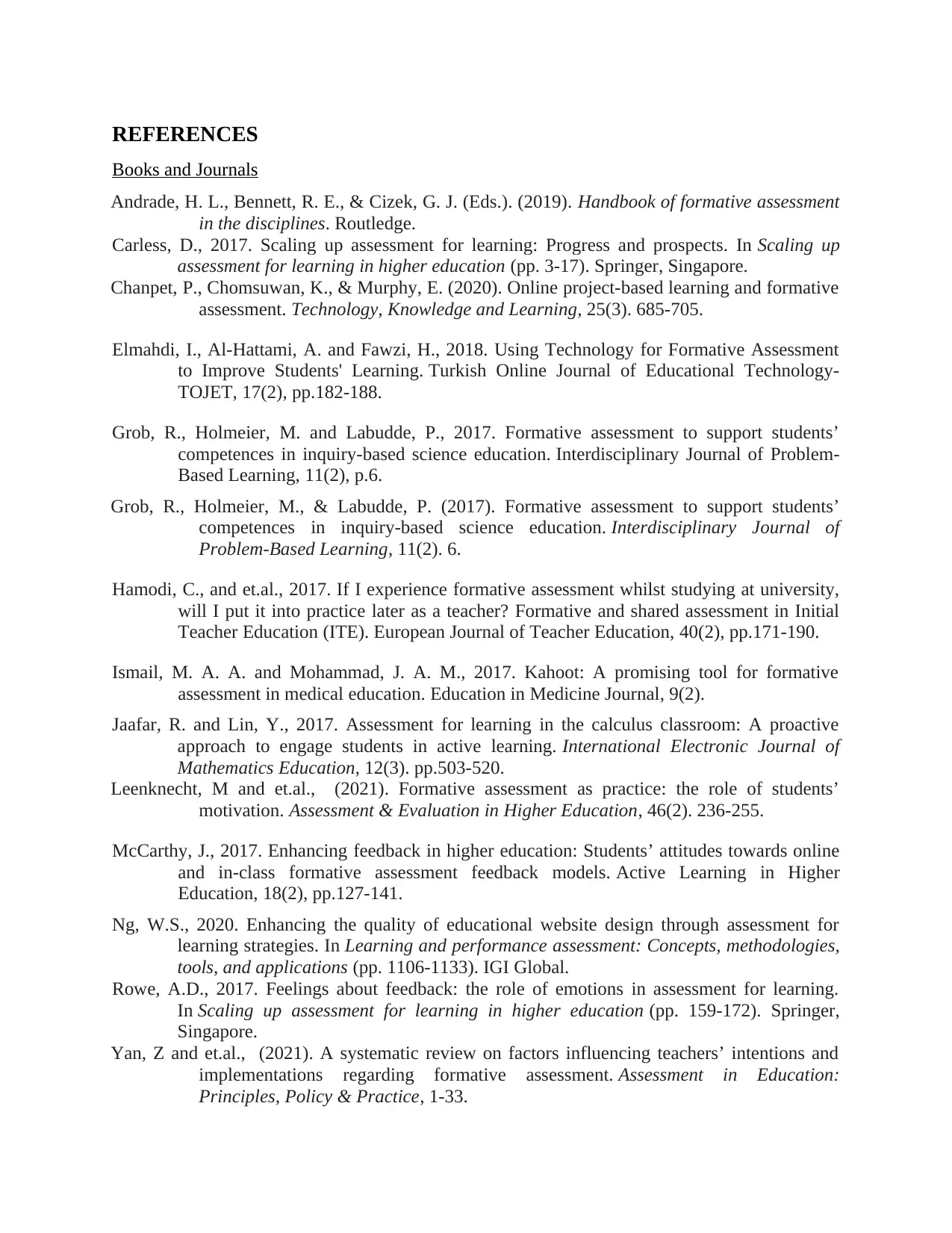
REFERENCES
Books and Journals
Andrade, H. L., Bennett, R. E., & Cizek, G. J. (Eds.). (2019). Handbook of formative assessment
in the disciplines. Routledge.
Carless, D., 2017. Scaling up assessment for learning: Progress and prospects. In Scaling up
assessment for learning in higher education (pp. 3-17). Springer, Singapore.
Chanpet, P., Chomsuwan, K., & Murphy, E. (2020). Online project-based learning and formative
assessment. Technology, Knowledge and Learning, 25(3). 685-705.
Elmahdi, I., Al-Hattami, A. and Fawzi, H., 2018. Using Technology for Formative Assessment
to Improve Students' Learning. Turkish Online Journal of Educational Technology-
TOJET, 17(2), pp.182-188.
Grob, R., Holmeier, M. and Labudde, P., 2017. Formative assessment to support students’
competences in inquiry-based science education. Interdisciplinary Journal of Problem-
Based Learning, 11(2), p.6.
Grob, R., Holmeier, M., & Labudde, P. (2017). Formative assessment to support students’
competences in inquiry-based science education. Interdisciplinary Journal of
Problem-Based Learning, 11(2). 6.
Hamodi, C., and et.al., 2017. If I experience formative assessment whilst studying at university,
will I put it into practice later as a teacher? Formative and shared assessment in Initial
Teacher Education (ITE). European Journal of Teacher Education, 40(2), pp.171-190.
Ismail, M. A. A. and Mohammad, J. A. M., 2017. Kahoot: A promising tool for formative
assessment in medical education. Education in Medicine Journal, 9(2).
Jaafar, R. and Lin, Y., 2017. Assessment for learning in the calculus classroom: A proactive
approach to engage students in active learning. International Electronic Journal of
Mathematics Education, 12(3). pp.503-520.
Leenknecht, M and et.al., (2021). Formative assessment as practice: the role of students’
motivation. Assessment & Evaluation in Higher Education, 46(2). 236-255.
McCarthy, J., 2017. Enhancing feedback in higher education: Students’ attitudes towards online
and in-class formative assessment feedback models. Active Learning in Higher
Education, 18(2), pp.127-141.
Ng, W.S., 2020. Enhancing the quality of educational website design through assessment for
learning strategies. In Learning and performance assessment: Concepts, methodologies,
tools, and applications (pp. 1106-1133). IGI Global.
Rowe, A.D., 2017. Feelings about feedback: the role of emotions in assessment for learning.
In Scaling up assessment for learning in higher education (pp. 159-172). Springer,
Singapore.
Yan, Z and et.al., (2021). A systematic review on factors influencing teachers’ intentions and
implementations regarding formative assessment. Assessment in Education:
Principles, Policy & Practice, 1-33.
Books and Journals
Andrade, H. L., Bennett, R. E., & Cizek, G. J. (Eds.). (2019). Handbook of formative assessment
in the disciplines. Routledge.
Carless, D., 2017. Scaling up assessment for learning: Progress and prospects. In Scaling up
assessment for learning in higher education (pp. 3-17). Springer, Singapore.
Chanpet, P., Chomsuwan, K., & Murphy, E. (2020). Online project-based learning and formative
assessment. Technology, Knowledge and Learning, 25(3). 685-705.
Elmahdi, I., Al-Hattami, A. and Fawzi, H., 2018. Using Technology for Formative Assessment
to Improve Students' Learning. Turkish Online Journal of Educational Technology-
TOJET, 17(2), pp.182-188.
Grob, R., Holmeier, M. and Labudde, P., 2017. Formative assessment to support students’
competences in inquiry-based science education. Interdisciplinary Journal of Problem-
Based Learning, 11(2), p.6.
Grob, R., Holmeier, M., & Labudde, P. (2017). Formative assessment to support students’
competences in inquiry-based science education. Interdisciplinary Journal of
Problem-Based Learning, 11(2). 6.
Hamodi, C., and et.al., 2017. If I experience formative assessment whilst studying at university,
will I put it into practice later as a teacher? Formative and shared assessment in Initial
Teacher Education (ITE). European Journal of Teacher Education, 40(2), pp.171-190.
Ismail, M. A. A. and Mohammad, J. A. M., 2017. Kahoot: A promising tool for formative
assessment in medical education. Education in Medicine Journal, 9(2).
Jaafar, R. and Lin, Y., 2017. Assessment for learning in the calculus classroom: A proactive
approach to engage students in active learning. International Electronic Journal of
Mathematics Education, 12(3). pp.503-520.
Leenknecht, M and et.al., (2021). Formative assessment as practice: the role of students’
motivation. Assessment & Evaluation in Higher Education, 46(2). 236-255.
McCarthy, J., 2017. Enhancing feedback in higher education: Students’ attitudes towards online
and in-class formative assessment feedback models. Active Learning in Higher
Education, 18(2), pp.127-141.
Ng, W.S., 2020. Enhancing the quality of educational website design through assessment for
learning strategies. In Learning and performance assessment: Concepts, methodologies,
tools, and applications (pp. 1106-1133). IGI Global.
Rowe, A.D., 2017. Feelings about feedback: the role of emotions in assessment for learning.
In Scaling up assessment for learning in higher education (pp. 159-172). Springer,
Singapore.
Yan, Z and et.al., (2021). A systematic review on factors influencing teachers’ intentions and
implementations regarding formative assessment. Assessment in Education:
Principles, Policy & Practice, 1-33.
⊘ This is a preview!⊘
Do you want full access?
Subscribe today to unlock all pages.
Trusted by 1+ million students worldwide
APPENDIX
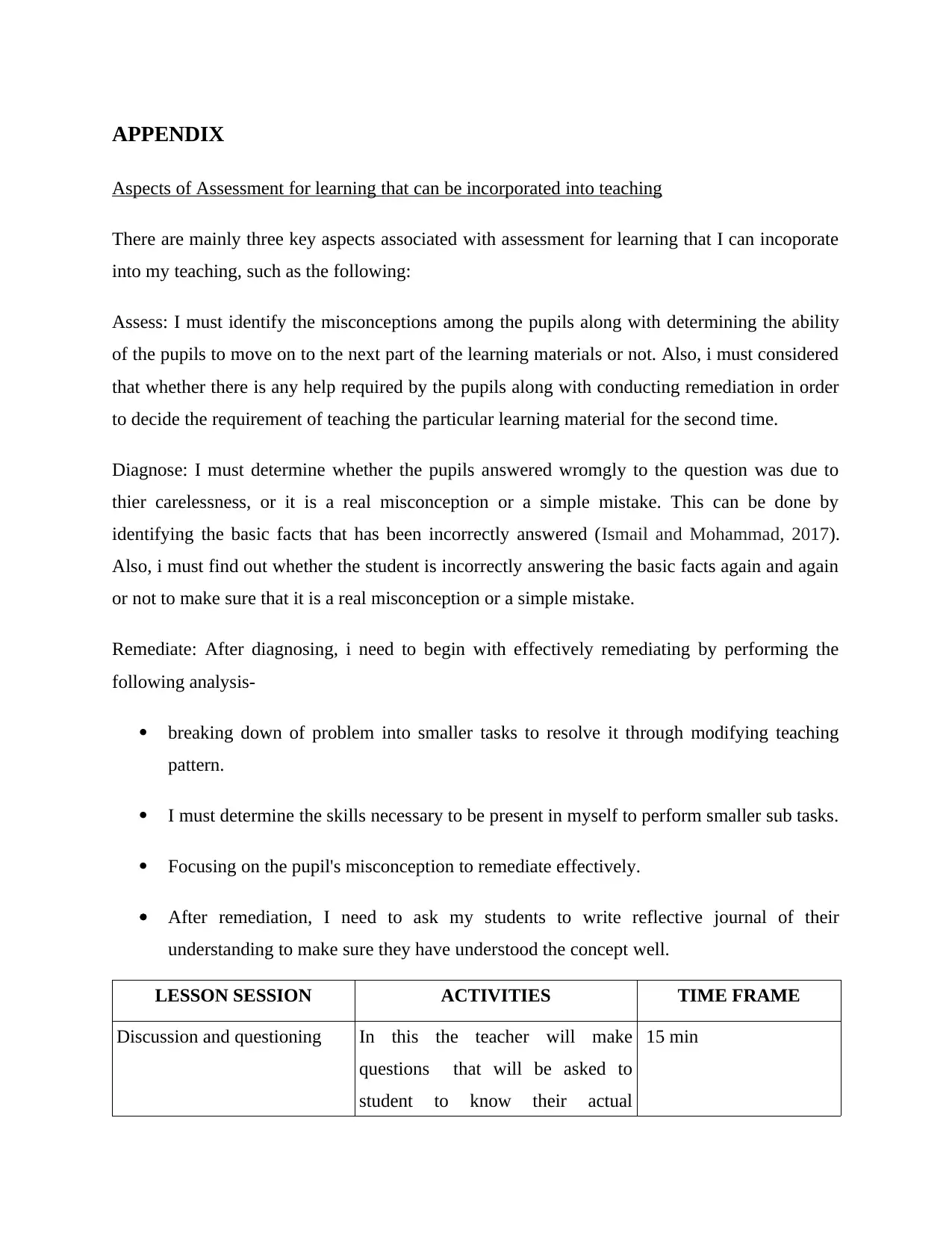
Aspects of Assessment for learning that can be incorporated into teaching
There are mainly three key aspects associated with assessment for learning that I can incoporate
into my teaching, such as the following:
Assess: I must identify the misconceptions among the pupils along with determining the ability
of the pupils to move on to the next part of the learning materials or not. Also, i must considered
that whether there is any help required by the pupils along with conducting remediation in order
to decide the requirement of teaching the particular learning material for the second time.
Diagnose: I must determine whether the pupils answered wromgly to the question was due to
thier carelessness, or it is a real misconception or a simple mistake. This can be done by
identifying the basic facts that has been incorrectly answered (Ismail and Mohammad, 2017).
Also, i must find out whether the student is incorrectly answering the basic facts again and again
or not to make sure that it is a real misconception or a simple mistake.
Remediate: After diagnosing, i need to begin with effectively remediating by performing the
following analysis-
breaking down of problem into smaller tasks to resolve it through modifying teaching
pattern.
I must determine the skills necessary to be present in myself to perform smaller sub tasks.
Focusing on the pupil's misconception to remediate effectively.
After remediation, I need to ask my students to write reflective journal of their
understanding to make sure they have understood the concept well.
LESSON SESSION ACTIVITIES TIME FRAME
Discussion and questioning In this the teacher will make
questions that will be asked to
student to know their actual
15 min
Aspects of Assessment for learning that can be incorporated into teaching
There are mainly three key aspects associated with assessment for learning that I can incoporate
into my teaching, such as the following:
Assess: I must identify the misconceptions among the pupils along with determining the ability
of the pupils to move on to the next part of the learning materials or not. Also, i must considered
that whether there is any help required by the pupils along with conducting remediation in order
to decide the requirement of teaching the particular learning material for the second time.
Diagnose: I must determine whether the pupils answered wromgly to the question was due to
thier carelessness, or it is a real misconception or a simple mistake. This can be done by
identifying the basic facts that has been incorrectly answered (Ismail and Mohammad, 2017).
Also, i must find out whether the student is incorrectly answering the basic facts again and again
or not to make sure that it is a real misconception or a simple mistake.
Remediate: After diagnosing, i need to begin with effectively remediating by performing the
following analysis-
breaking down of problem into smaller tasks to resolve it through modifying teaching
pattern.
I must determine the skills necessary to be present in myself to perform smaller sub tasks.
Focusing on the pupil's misconception to remediate effectively.
After remediation, I need to ask my students to write reflective journal of their
understanding to make sure they have understood the concept well.
LESSON SESSION ACTIVITIES TIME FRAME
Discussion and questioning In this the teacher will make
questions that will be asked to
student to know their actual
15 min
Paraphrase This Document
Need a fresh take? Get an instant paraphrase of this document with our AI Paraphraser
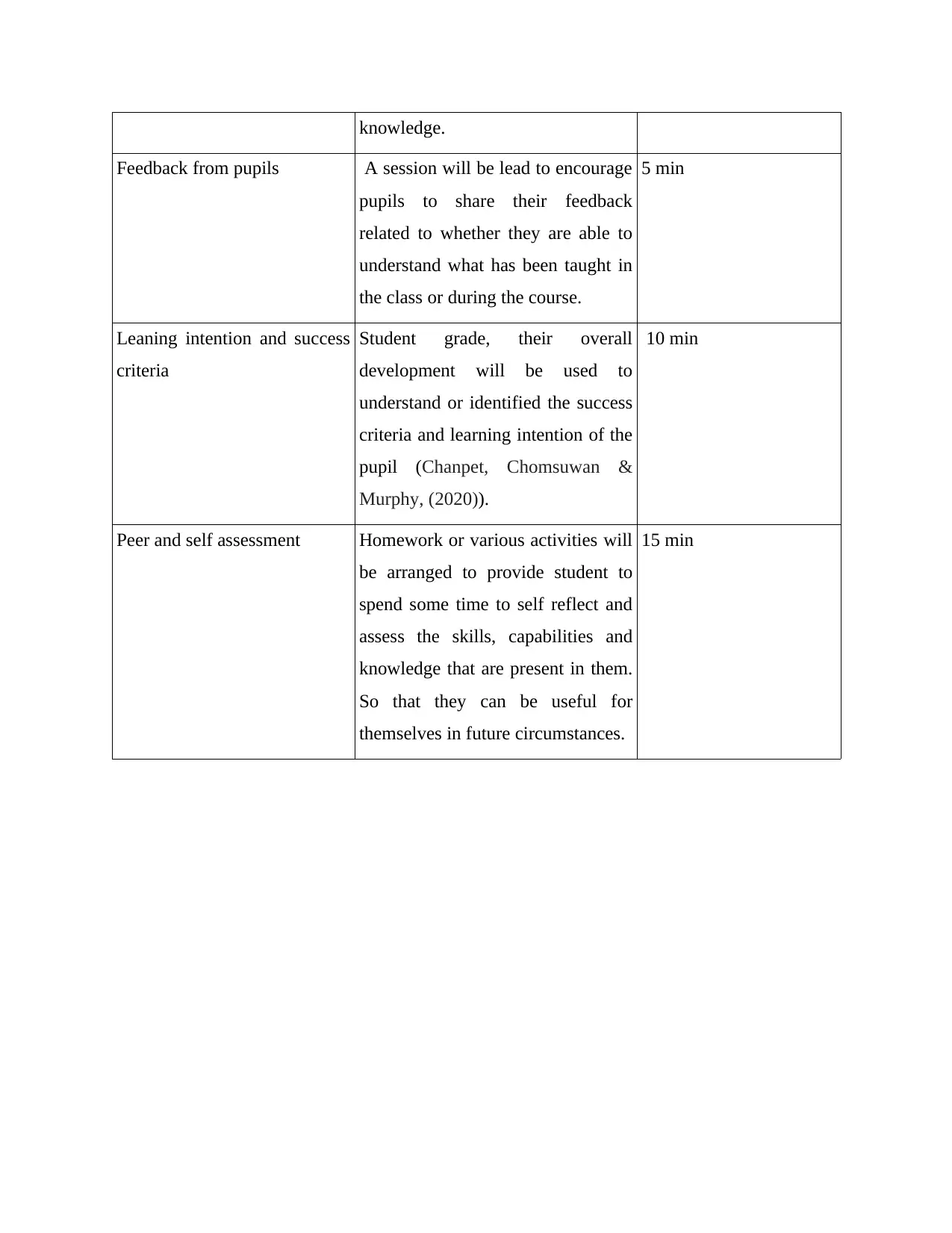
knowledge.
Feedback from pupils A session will be lead to encourage
pupils to share their feedback
related to whether they are able to
understand what has been taught in
the class or during the course.
5 min
Leaning intention and success
criteria
Student grade, their overall
development will be used to
understand or identified the success
criteria and learning intention of the
pupil (Chanpet, Chomsuwan &
Murphy, (2020)).
10 min
Peer and self assessment Homework or various activities will
be arranged to provide student to
spend some time to self reflect and
assess the skills, capabilities and
knowledge that are present in them.
So that they can be useful for
themselves in future circumstances.
15 min
Feedback from pupils A session will be lead to encourage
pupils to share their feedback
related to whether they are able to
understand what has been taught in
the class or during the course.
5 min
Leaning intention and success
criteria
Student grade, their overall
development will be used to
understand or identified the success
criteria and learning intention of the
pupil (Chanpet, Chomsuwan &
Murphy, (2020)).
10 min
Peer and self assessment Homework or various activities will
be arranged to provide student to
spend some time to self reflect and
assess the skills, capabilities and
knowledge that are present in them.
So that they can be useful for
themselves in future circumstances.
15 min

⊘ This is a preview!⊘
Do you want full access?
Subscribe today to unlock all pages.
Trusted by 1+ million students worldwide

1 out of 13


Related Documents


Your All-in-One AI-Powered Toolkit for Academic Success.
+13062052269
info@desklib.com
Available 24*7 on WhatsApp / Email
![[object Object]](/_next/static/media/star-bottom.7253800d.svg)
Unlock your academic potential
Copyright © 2020–2026 A2Z Services. All Rights Reserved. Developed and managed by ZUCOL.