Analyzing TED Talks through Sociological Concepts - Spring 2019
VerifiedAdded on 2022/09/28
|7
|1808
|18
Homework Assignment
AI Summary
This assignment presents a sociological analysis of several TED Talks, applying key concepts from theorists like Foucault, Weber, Marx, and Mills. It explores themes of vulnerability and power in politics, class polarization and alienation in the global economy, the dilemma of following rules versus ethical considerations during crises, and the importance of a circular economy for environmental sustainability. Each TED Talk is examined through a sociological lens, connecting individual experiences to broader social structures and issues. Desklib provides access to this and other solved assignments to aid students in their studies.
Running head: TED TALKS
TED TALKS
Name of the Student
Name of the University
Author Note
TED TALKS
Name of the Student
Name of the University
Author Note

Paraphrase This Document
Need a fresh take? Get an instant paraphrase of this document with our AI Paraphraser
1TED TALKS
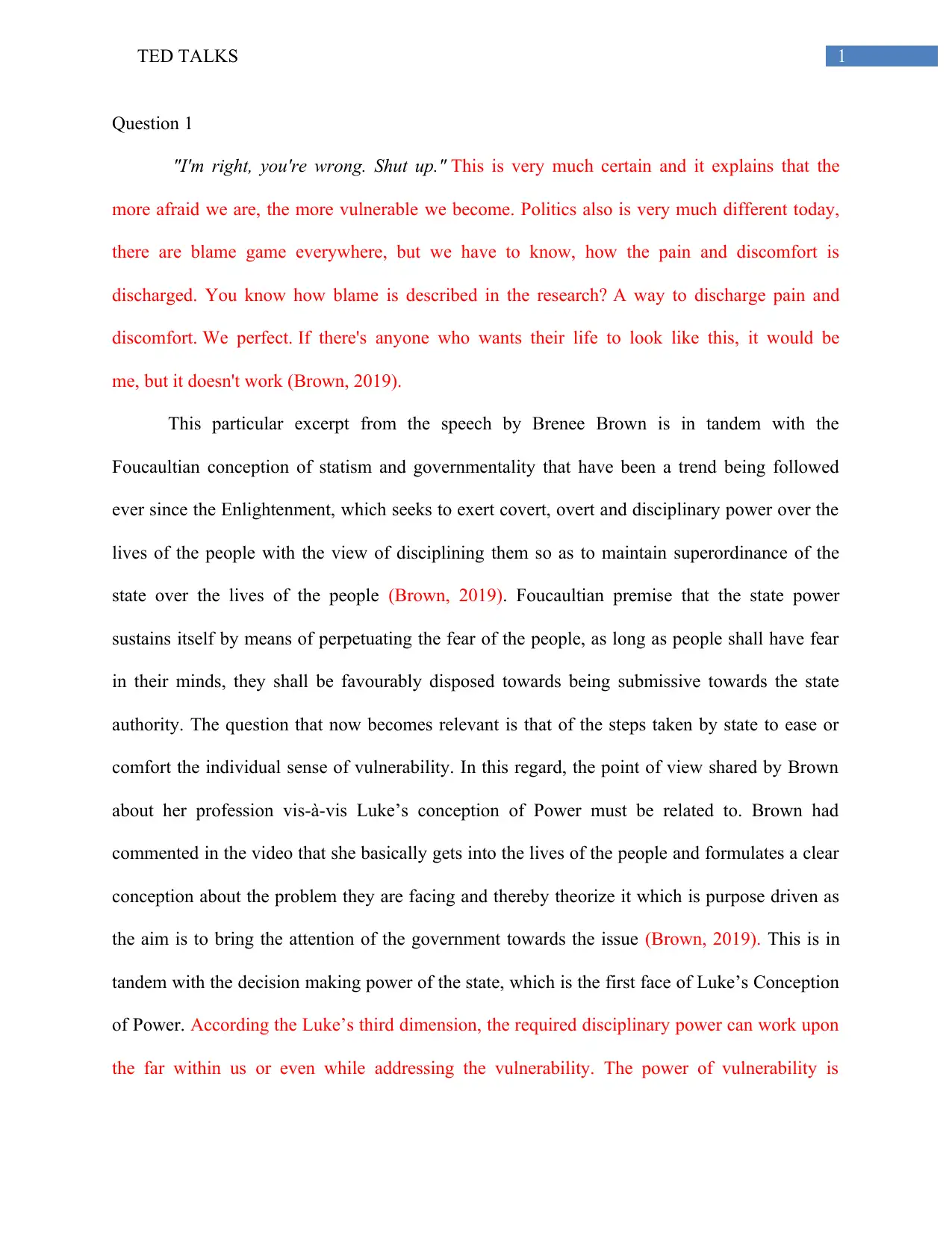
Question 1
"I'm right, you're wrong. Shut up." This is very much certain and it explains that the
more afraid we are, the more vulnerable we become. Politics also is very much different today,
there are blame game everywhere, but we have to know, how the pain and discomfort is
discharged. You know how blame is described in the research? A way to discharge pain and
discomfort. We perfect. If there's anyone who wants their life to look like this, it would be
me, but it doesn't work (Brown, 2019).
This particular excerpt from the speech by Brenee Brown is in tandem with the
Foucaultian conception of statism and governmentality that have been a trend being followed
ever since the Enlightenment, which seeks to exert covert, overt and disciplinary power over the
lives of the people with the view of disciplining them so as to maintain superordinance of the
state over the lives of the people (Brown, 2019). Foucaultian premise that the state power
sustains itself by means of perpetuating the fear of the people, as long as people shall have fear
in their minds, they shall be favourably disposed towards being submissive towards the state
authority. The question that now becomes relevant is that of the steps taken by state to ease or
comfort the individual sense of vulnerability. In this regard, the point of view shared by Brown
about her profession vis-à-vis Luke’s conception of Power must be related to. Brown had
commented in the video that she basically gets into the lives of the people and formulates a clear
conception about the problem they are facing and thereby theorize it which is purpose driven as
the aim is to bring the attention of the government towards the issue (Brown, 2019). This is in
tandem with the decision making power of the state, which is the first face of Luke’s Conception
of Power. According the Luke’s third dimension, the required disciplinary power can work upon
the far within us or even while addressing the vulnerability. The power of vulnerability is
Question 1
"I'm right, you're wrong. Shut up." This is very much certain and it explains that the
more afraid we are, the more vulnerable we become. Politics also is very much different today,
there are blame game everywhere, but we have to know, how the pain and discomfort is
discharged. You know how blame is described in the research? A way to discharge pain and
discomfort. We perfect. If there's anyone who wants their life to look like this, it would be
me, but it doesn't work (Brown, 2019).
This particular excerpt from the speech by Brenee Brown is in tandem with the
Foucaultian conception of statism and governmentality that have been a trend being followed
ever since the Enlightenment, which seeks to exert covert, overt and disciplinary power over the
lives of the people with the view of disciplining them so as to maintain superordinance of the
state over the lives of the people (Brown, 2019). Foucaultian premise that the state power
sustains itself by means of perpetuating the fear of the people, as long as people shall have fear
in their minds, they shall be favourably disposed towards being submissive towards the state
authority. The question that now becomes relevant is that of the steps taken by state to ease or
comfort the individual sense of vulnerability. In this regard, the point of view shared by Brown
about her profession vis-à-vis Luke’s conception of Power must be related to. Brown had
commented in the video that she basically gets into the lives of the people and formulates a clear
conception about the problem they are facing and thereby theorize it which is purpose driven as
the aim is to bring the attention of the government towards the issue (Brown, 2019). This is in
tandem with the decision making power of the state, which is the first face of Luke’s Conception
of Power. According the Luke’s third dimension, the required disciplinary power can work upon
the far within us or even while addressing the vulnerability. The power of vulnerability is
2TED TALKS
relational and it challenges the concepts of shame and fear. However in the practical world, the
government and the political parties indulge in blame game and deliberate over what should have
been rater than what should be done and that is very much in tandem with Luke’s second face of
power and that is the non decision making power. Thus basically this suggests that the
government is not incompetent rather it is reluctant in most cases to do anything substantially
helpful for the people.
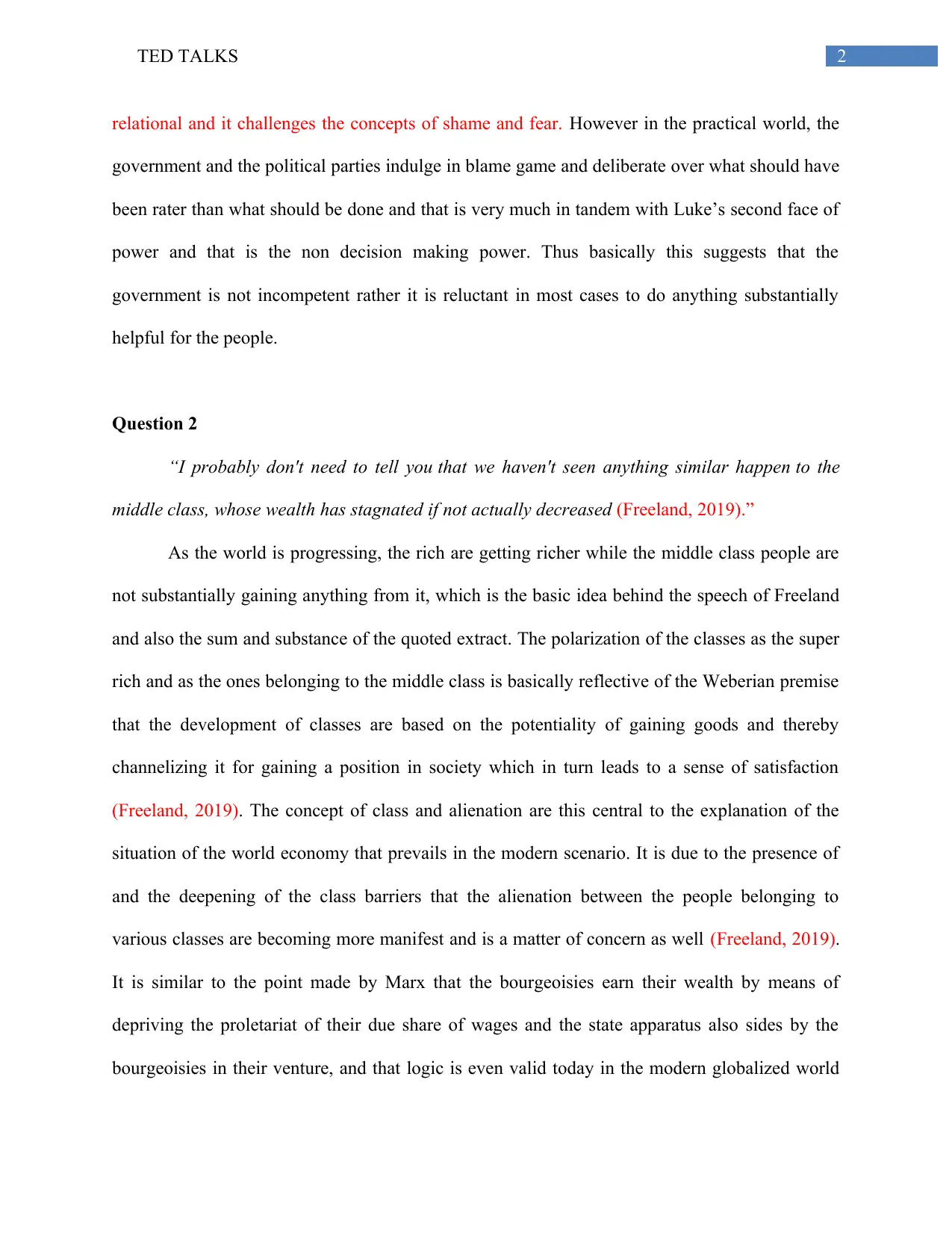
Question 2
“I probably don't need to tell you that we haven't seen anything similar happen to the
middle class, whose wealth has stagnated if not actually decreased (Freeland, 2019).”
As the world is progressing, the rich are getting richer while the middle class people are
not substantially gaining anything from it, which is the basic idea behind the speech of Freeland
and also the sum and substance of the quoted extract. The polarization of the classes as the super
rich and as the ones belonging to the middle class is basically reflective of the Weberian premise
that the development of classes are based on the potentiality of gaining goods and thereby
channelizing it for gaining a position in society which in turn leads to a sense of satisfaction
(Freeland, 2019). The concept of class and alienation are this central to the explanation of the
situation of the world economy that prevails in the modern scenario. It is due to the presence of
and the deepening of the class barriers that the alienation between the people belonging to
various classes are becoming more manifest and is a matter of concern as well (Freeland, 2019).
It is similar to the point made by Marx that the bourgeoisies earn their wealth by means of
depriving the proletariat of their due share of wages and the state apparatus also sides by the
bourgeoisies in their venture, and that logic is even valid today in the modern globalized world
relational and it challenges the concepts of shame and fear. However in the practical world, the
government and the political parties indulge in blame game and deliberate over what should have
been rater than what should be done and that is very much in tandem with Luke’s second face of
power and that is the non decision making power. Thus basically this suggests that the
government is not incompetent rather it is reluctant in most cases to do anything substantially
helpful for the people.
Question 2
“I probably don't need to tell you that we haven't seen anything similar happen to the
middle class, whose wealth has stagnated if not actually decreased (Freeland, 2019).”
As the world is progressing, the rich are getting richer while the middle class people are
not substantially gaining anything from it, which is the basic idea behind the speech of Freeland
and also the sum and substance of the quoted extract. The polarization of the classes as the super
rich and as the ones belonging to the middle class is basically reflective of the Weberian premise
that the development of classes are based on the potentiality of gaining goods and thereby
channelizing it for gaining a position in society which in turn leads to a sense of satisfaction
(Freeland, 2019). The concept of class and alienation are this central to the explanation of the
situation of the world economy that prevails in the modern scenario. It is due to the presence of
and the deepening of the class barriers that the alienation between the people belonging to
various classes are becoming more manifest and is a matter of concern as well (Freeland, 2019).
It is similar to the point made by Marx that the bourgeoisies earn their wealth by means of
depriving the proletariat of their due share of wages and the state apparatus also sides by the
bourgeoisies in their venture, and that logic is even valid today in the modern globalized world
⊘ This is a preview!⊘
Do you want full access?
Subscribe today to unlock all pages.

Trusted by 1+ million students worldwide
3TED TALKS
as hinted at by Freeland that the middle class pays their taxes while the rich business tycoons try
to avoid them, which puts a greater degree of pressure upon the middle class to make meet the
ends (Freeland, 2019). There can exist a movement within one’s class position, but not usually
between the class positions. We can say that the upward social mobility is still in moderate
terms. This is what can be called as the modern day scenario of alienation which has been
described by Freeland as Plutocracy, deriving its name from the alien planet Pluto which has
diminished in size to such an extent that it has failed to qualify itself as a planet any longer.
Similar has been with the size of the ultra rich who have become very few in number while the
number of middle class and the ones without wealth have increased manifold times.
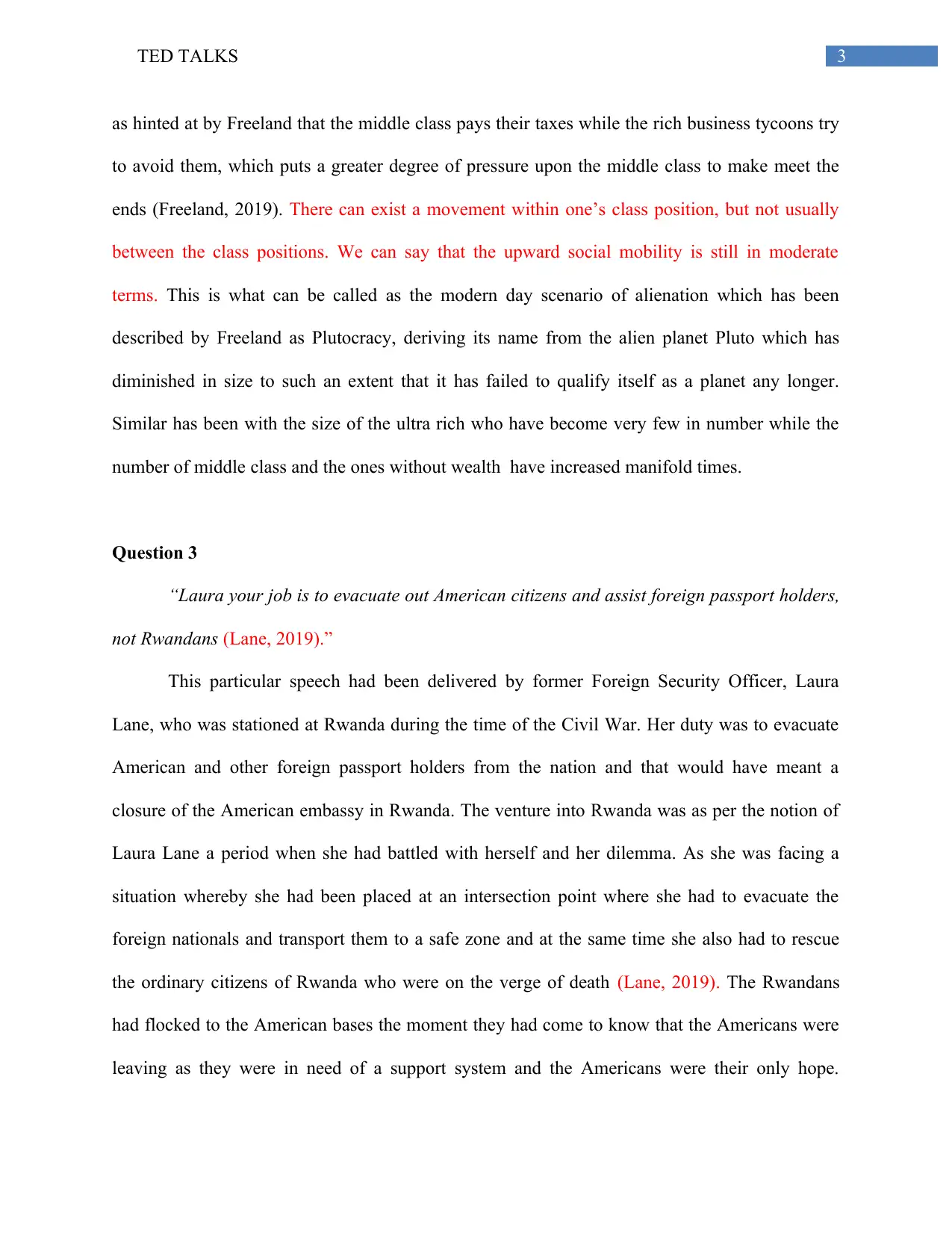
Question 3
“Laura your job is to evacuate out American citizens and assist foreign passport holders,
not Rwandans (Lane, 2019).”
This particular speech had been delivered by former Foreign Security Officer, Laura
Lane, who was stationed at Rwanda during the time of the Civil War. Her duty was to evacuate
American and other foreign passport holders from the nation and that would have meant a
closure of the American embassy in Rwanda. The venture into Rwanda was as per the notion of
Laura Lane a period when she had battled with herself and her dilemma. As she was facing a
situation whereby she had been placed at an intersection point where she had to evacuate the
foreign nationals and transport them to a safe zone and at the same time she also had to rescue
the ordinary citizens of Rwanda who were on the verge of death (Lane, 2019). The Rwandans
had flocked to the American bases the moment they had come to know that the Americans were
leaving as they were in need of a support system and the Americans were their only hope.
as hinted at by Freeland that the middle class pays their taxes while the rich business tycoons try
to avoid them, which puts a greater degree of pressure upon the middle class to make meet the
ends (Freeland, 2019). There can exist a movement within one’s class position, but not usually
between the class positions. We can say that the upward social mobility is still in moderate
terms. This is what can be called as the modern day scenario of alienation which has been
described by Freeland as Plutocracy, deriving its name from the alien planet Pluto which has
diminished in size to such an extent that it has failed to qualify itself as a planet any longer.
Similar has been with the size of the ultra rich who have become very few in number while the
number of middle class and the ones without wealth have increased manifold times.
Question 3
“Laura your job is to evacuate out American citizens and assist foreign passport holders,
not Rwandans (Lane, 2019).”
This particular speech had been delivered by former Foreign Security Officer, Laura
Lane, who was stationed at Rwanda during the time of the Civil War. Her duty was to evacuate
American and other foreign passport holders from the nation and that would have meant a
closure of the American embassy in Rwanda. The venture into Rwanda was as per the notion of
Laura Lane a period when she had battled with herself and her dilemma. As she was facing a
situation whereby she had been placed at an intersection point where she had to evacuate the
foreign nationals and transport them to a safe zone and at the same time she also had to rescue
the ordinary citizens of Rwanda who were on the verge of death (Lane, 2019). The Rwandans
had flocked to the American bases the moment they had come to know that the Americans were
leaving as they were in need of a support system and the Americans were their only hope.
Paraphrase This Document
Need a fresh take? Get an instant paraphrase of this document with our AI Paraphraser
4TED TALKS
Though she wanted to help the Rwandans by staying there but the American Government could
not give consent to her wish. She had felt as well as seen the horror that a genocide could wage
by her own eyes, hence she felt that she needed to do something instead of just escaping from the
nation and the decision is something which she regrets as she could have done something either
by appealing to the American Government to give up on the idea of closing the embassy and also
appeal to the UN to increase the security forces (Lane, 2019). The experience of Lane thus
makes it clear that the society is bound by a culture which is transmitted through socialization
and for a society to progress and make a difference it is necessary to reorient towards unlearning
what one has leant as the key to progress is evolution. All acts of deviance or resistance are not
necessarily with the intention of altering the order of peace and stability. The aspects which used
to be considered as a taboo are thus in modern context considered as acceptable, homosexuality
for instance and that change has been for the betterment of the society. Thus one must try to
break away from the conventions of the society in order to make social life better and much more
suited for the incorporation and addressing of the changing realities of life.
Question 4
“Design out waste, keep products and materials in use and transition to renewable
energy (Brandt, 2019).”
These are the three principles which have been provided by Brandt as the key to a
circular economy that seeks on recycling the materials used. According to her the global tech
giants have a potentiality of consuming huge amounts of energy which are enough to power
geographical contiguities for a large and extended period of time. However the tech giants do not
use the technologies which are meant for recycling and the condition of the earth is indeed in a
bad shape which needs to be repaired (Brandt, 2019). This issue of saving the earth is not a
Though she wanted to help the Rwandans by staying there but the American Government could
not give consent to her wish. She had felt as well as seen the horror that a genocide could wage
by her own eyes, hence she felt that she needed to do something instead of just escaping from the
nation and the decision is something which she regrets as she could have done something either
by appealing to the American Government to give up on the idea of closing the embassy and also
appeal to the UN to increase the security forces (Lane, 2019). The experience of Lane thus
makes it clear that the society is bound by a culture which is transmitted through socialization
and for a society to progress and make a difference it is necessary to reorient towards unlearning
what one has leant as the key to progress is evolution. All acts of deviance or resistance are not
necessarily with the intention of altering the order of peace and stability. The aspects which used
to be considered as a taboo are thus in modern context considered as acceptable, homosexuality
for instance and that change has been for the betterment of the society. Thus one must try to
break away from the conventions of the society in order to make social life better and much more
suited for the incorporation and addressing of the changing realities of life.
Question 4
“Design out waste, keep products and materials in use and transition to renewable
energy (Brandt, 2019).”
These are the three principles which have been provided by Brandt as the key to a
circular economy that seeks on recycling the materials used. According to her the global tech
giants have a potentiality of consuming huge amounts of energy which are enough to power
geographical contiguities for a large and extended period of time. However the tech giants do not
use the technologies which are meant for recycling and the condition of the earth is indeed in a
bad shape which needs to be repaired (Brandt, 2019). This issue of saving the earth is not a
5TED TALKS
personal or a public issue it is as Mills had pointed out that the relationship between society and
individual should be seen from the perspective of the connection between the personal and the
public aspects. Mills had pointed out that the individual cannot be separated from the public and
the public cannot consider the private to be of less importance, as both make up an integral part
of the social collectivity (Brandt, 2019). Hence the issue of recycling of the materials and
reducing of the wastage must be done with the help of academic literacy and expert knowledge
in order to the give the social imagination of a better future for all a sense of completion and
fulfillment. Waste generated on an individual basis has a great impact in shaping the harm it is
likely to do for the general cause and an individual act of saving the environment is also equally
capable of bringing about a change for the society at large. Hence the individual and the society
are not clinical separations rather they are complementary to each other and that
complementarity must be maintained for the sake of harmony and development to prevail.
personal or a public issue it is as Mills had pointed out that the relationship between society and
individual should be seen from the perspective of the connection between the personal and the
public aspects. Mills had pointed out that the individual cannot be separated from the public and
the public cannot consider the private to be of less importance, as both make up an integral part
of the social collectivity (Brandt, 2019). Hence the issue of recycling of the materials and
reducing of the wastage must be done with the help of academic literacy and expert knowledge
in order to the give the social imagination of a better future for all a sense of completion and
fulfillment. Waste generated on an individual basis has a great impact in shaping the harm it is
likely to do for the general cause and an individual act of saving the environment is also equally
capable of bringing about a change for the society at large. Hence the individual and the society
are not clinical separations rather they are complementary to each other and that
complementarity must be maintained for the sake of harmony and development to prevail.
⊘ This is a preview!⊘
Do you want full access?
Subscribe today to unlock all pages.
Trusted by 1+ million students worldwide
6TED TALKS
Reference List
Brandt, K. (2019). A world without waste. Retrieved 23 August 2019, from
https://www.ted.com/talks/kate_e_brandt_a_world_without_waste
Brown, B. (2019). The power of vulnerability. Retrieved 23 August 2019, from
https://www.ted.com/talks/brene_brown_on_vulnerability
Freeland, C. (2019). The rise of the new global super-rich. Retrieved 23 August 2019, from
https://www.ted.com/talks/chrystia_freeland_the_rise_of_the_new_global_super_rich
Lane, L. (2019). When you shouldn't follow the rules. Retrieved 23 August 2019, from
https://www.ted.com/talks/laura_lane_when_you_shouldn_t_follow_the_rules
Reference List
Brandt, K. (2019). A world without waste. Retrieved 23 August 2019, from
https://www.ted.com/talks/kate_e_brandt_a_world_without_waste
Brown, B. (2019). The power of vulnerability. Retrieved 23 August 2019, from
https://www.ted.com/talks/brene_brown_on_vulnerability
Freeland, C. (2019). The rise of the new global super-rich. Retrieved 23 August 2019, from
https://www.ted.com/talks/chrystia_freeland_the_rise_of_the_new_global_super_rich
Lane, L. (2019). When you shouldn't follow the rules. Retrieved 23 August 2019, from
https://www.ted.com/talks/laura_lane_when_you_shouldn_t_follow_the_rules

1 out of 7


Your All-in-One AI-Powered Toolkit for Academic Success.
+13062052269
info@desklib.com
Available 24*7 on WhatsApp / Email
![[object Object]](/_next/static/media/star-bottom.7253800d.svg)
Unlock your academic potential
Copyright © 2020–2026 A2Z Services. All Rights Reserved. Developed and managed by ZUCOL.