Business and Management: FSA Report on McCom Industries Operations
VerifiedAdded on 2019/09/20
|10
|2184
|389
Report
AI Summary
This report presents a Facility and Systems Analysis (FSA) of McCom Industries Ltd, a Mumbai-based manufacturer of copper components for electrical industries. The report provides an overview of the company's operations, including its manufacturing processes, products/services, and quality management. It examines the company's operational strategy, facility layout, capacity planning, and inventory management. The analysis includes an assessment of the supply chain, lean operations, and operations scheduling. The report also provides recommendations for improvement, such as adopting Just-In-Time (JIT) inventory management, and discusses the managerial implications of these recommendations. Furthermore, the report highlights the surprising level of employee coordination and effective communication within the company. The conclusion emphasizes the company's current success and the need for strategic implementation to ensure future growth.
FSA Report
Business and Management
Student Name:
Student ID:
Course Name:
Course ID:
Faculty Name:
University Name:
Business and Management
Student Name:
Student ID:
Course Name:
Course ID:
Faculty Name:
University Name:

Paraphrase This Document
Need a fresh take? Get an instant paraphrase of this document with our AI Paraphraser
Table of Contents
Introduction................................................................................................................................2
Facility Overview.......................................................................................................................2
Analysis of Operations Process/es.............................................................................................3
Operations Strategy................................................................................................................3
Products/Services...................................................................................................................3
Processes which create/deliver products/services..................................................................3
Quality management/control..................................................................................................3
Forecasting.............................................................................................................................3
Facility Location....................................................................................................................3
Facility Layout.......................................................................................................................3
Capacity Planning..................................................................................................................3
Inventory planning/management............................................................................................4
Supply chain management.....................................................................................................4
Lean Operations.....................................................................................................................4
Operations Scheduling...........................................................................................................4
Recommendation for Improvement...........................................................................................4
Implementation and Managerial Implications...........................................................................4
Surprises.....................................................................................................................................4
Conclusion..................................................................................................................................4
Introduction................................................................................................................................2
Facility Overview.......................................................................................................................2
Analysis of Operations Process/es.............................................................................................3
Operations Strategy................................................................................................................3
Products/Services...................................................................................................................3
Processes which create/deliver products/services..................................................................3
Quality management/control..................................................................................................3
Forecasting.............................................................................................................................3
Facility Location....................................................................................................................3
Facility Layout.......................................................................................................................3
Capacity Planning..................................................................................................................3
Inventory planning/management............................................................................................4
Supply chain management.....................................................................................................4
Lean Operations.....................................................................................................................4
Operations Scheduling...........................................................................................................4
Recommendation for Improvement...........................................................................................4
Implementation and Managerial Implications...........................................................................4
Surprises.....................................................................................................................................4
Conclusion..................................................................................................................................4
Introduction
This paper is concerned with the assessment of operations process within the McCom
Industries Ltd. The company is situated in Mumbai and has been considered for the study due
to easy reachability. The next sections discuss the various aspects of company operations and
facility overview.
Facility Overview
McCom Industries is a manufacturing and services company that manufactures copper
components, turned and brazed components, cold forged components, copper bus bars for
electrical industries, and others.
Nature of Business:
The Company is into engineering products and services. The company is current situated in
Mumbai and is focused towards developing good relationship with its customers.
Established:
The Company was established in the year 1973 and is successfully operational.
Industry Types:
The engineering products and services related to semiconductor and rectifier industry. The
company is focused towards providing services to the semiconductor companies by providing
good quality engineering components used for Diodes, and SCRs.
Number of employees:
There are 80 employees at present including the management. The structure of the company
is short. There are four layers that cover the whole organization. The layers are owner,
manager, supervisor, and employees (from left to right).
This paper is concerned with the assessment of operations process within the McCom
Industries Ltd. The company is situated in Mumbai and has been considered for the study due
to easy reachability. The next sections discuss the various aspects of company operations and
facility overview.
Facility Overview
McCom Industries is a manufacturing and services company that manufactures copper
components, turned and brazed components, cold forged components, copper bus bars for
electrical industries, and others.
Nature of Business:
The Company is into engineering products and services. The company is current situated in
Mumbai and is focused towards developing good relationship with its customers.
Established:
The Company was established in the year 1973 and is successfully operational.
Industry Types:
The engineering products and services related to semiconductor and rectifier industry. The
company is focused towards providing services to the semiconductor companies by providing
good quality engineering components used for Diodes, and SCRs.
Number of employees:
There are 80 employees at present including the management. The structure of the company
is short. There are four layers that cover the whole organization. The layers are owner,
manager, supervisor, and employees (from left to right).
⊘ This is a preview!⊘
Do you want full access?
Subscribe today to unlock all pages.

Trusted by 1+ million students worldwide
Market Segment:
The semiconductor industry is expected to be around US$11-130 billion by 2018 (IBEF,
2016). The market for the products and services provided by the company is appreciable and
the future seems bright.
Customer Demographics
The customers of the company are those companies that further manufactures product for
their customers. These customers are not the end users of the product or services bought from
McCom. They use the products of McCom to further manufacture other products and
services. Some of the major companies as customers are Terminus Circuits, SmartPlay
Technologies, Ineda Systems, and others.
Major Suppliers
The company brings raw material for the production of components and there are no major
suppliers in particular. The company procure material from numerous available suppliers to
garner the benefit of costs associated with the procurement. The presence of multiple
suppliers helps get supplies at low prices.
Analysis of Operations Process/es
This section covers the various aspects of operations processes of the company. The company
manufactures the products as stated above and it also oriented towards innovation and
upgrading of various technological products like Brazing, Cold Forging, Machining, and
developing copper bases that are customized as per customer preferences.
The semiconductor industry is expected to be around US$11-130 billion by 2018 (IBEF,
2016). The market for the products and services provided by the company is appreciable and
the future seems bright.
Customer Demographics
The customers of the company are those companies that further manufactures product for
their customers. These customers are not the end users of the product or services bought from
McCom. They use the products of McCom to further manufacture other products and
services. Some of the major companies as customers are Terminus Circuits, SmartPlay
Technologies, Ineda Systems, and others.
Major Suppliers
The company brings raw material for the production of components and there are no major
suppliers in particular. The company procure material from numerous available suppliers to
garner the benefit of costs associated with the procurement. The presence of multiple
suppliers helps get supplies at low prices.
Analysis of Operations Process/es
This section covers the various aspects of operations processes of the company. The company
manufactures the products as stated above and it also oriented towards innovation and
upgrading of various technological products like Brazing, Cold Forging, Machining, and
developing copper bases that are customized as per customer preferences.
Paraphrase This Document
Need a fresh take? Get an instant paraphrase of this document with our AI Paraphraser
Operations Strategy
The operational strategy of the company is to ensure that the products developed are as per
the national standard and of high quality. The implementation of high quality manufacturing
procedures within the company has been the orientation of the company while managing all
the activities with focus on the efficiency and effectiveness. McCom manufactures products
at the competitive rates and engage in bulk selling. The deployment of efficient
manufacturing methods has been the strengths of the company that have been discussed
ahead. Moreover, the presence of dedicated employee groups and the low cost manufacturing
due to low wages has been the strength of the company. One of the weaknesses of the
company has been the inability to forecast the right amount of expected sales due to the
fluctuating marketing conditions. It has been a challenging aspect that is yet to be resolved.
Products/Services
The products mentioned earlier are the only that the company produces. Apart from that, the
company engages in providing services to its clients before and after sales of the products.
Moreover, the company provides onsite management of the products it sell and also assist the
clients in easy handling and management of these products.
Processes which create/deliver products/services
The company engage in product manufacturing considering the number of orders it has at
present and the likely demand in the market. It delivers products at the company doorstep.
Moreover, due to the lean supply chain methods used by the company, the cost incurred on
the product delivery is short and fast. The company sell its products only through the sales
agent and, therefore, it saves cost on larger distribution channels. The orders are gained
through the sales agent by visiting various clients and then the products are packed and
shipped directly to the company.
The operational strategy of the company is to ensure that the products developed are as per
the national standard and of high quality. The implementation of high quality manufacturing
procedures within the company has been the orientation of the company while managing all
the activities with focus on the efficiency and effectiveness. McCom manufactures products
at the competitive rates and engage in bulk selling. The deployment of efficient
manufacturing methods has been the strengths of the company that have been discussed
ahead. Moreover, the presence of dedicated employee groups and the low cost manufacturing
due to low wages has been the strength of the company. One of the weaknesses of the
company has been the inability to forecast the right amount of expected sales due to the
fluctuating marketing conditions. It has been a challenging aspect that is yet to be resolved.
Products/Services
The products mentioned earlier are the only that the company produces. Apart from that, the
company engages in providing services to its clients before and after sales of the products.
Moreover, the company provides onsite management of the products it sell and also assist the
clients in easy handling and management of these products.
Processes which create/deliver products/services
The company engage in product manufacturing considering the number of orders it has at
present and the likely demand in the market. It delivers products at the company doorstep.
Moreover, due to the lean supply chain methods used by the company, the cost incurred on
the product delivery is short and fast. The company sell its products only through the sales
agent and, therefore, it saves cost on larger distribution channels. The orders are gained
through the sales agent by visiting various clients and then the products are packed and
shipped directly to the company.
Quality management/control
At present the company does not uses the Total Quality Management at major level.
However, to some extent it does consider maintaining quality of the products through the use
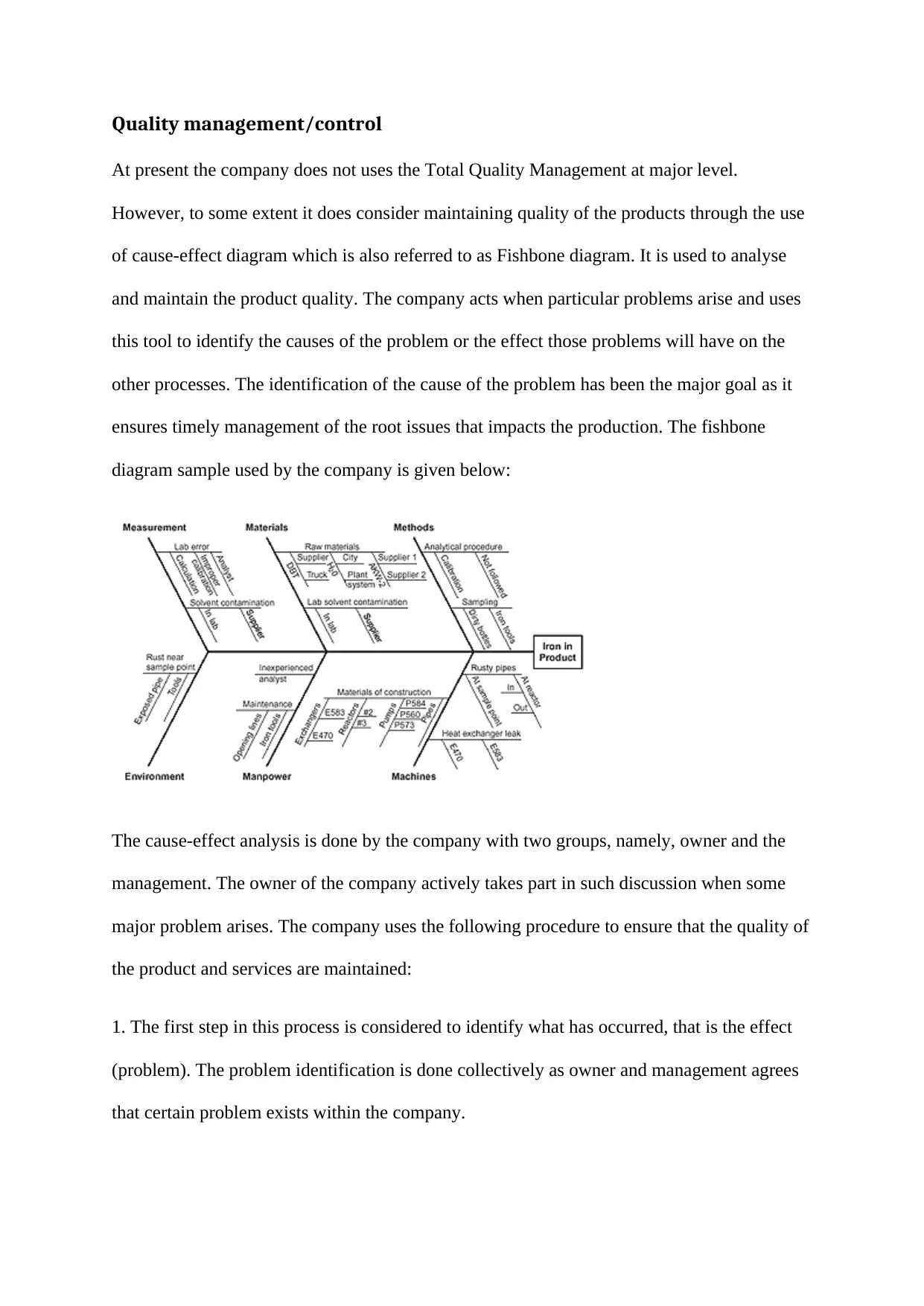
of cause-effect diagram which is also referred to as Fishbone diagram. It is used to analyse
and maintain the product quality. The company acts when particular problems arise and uses
this tool to identify the causes of the problem or the effect those problems will have on the
other processes. The identification of the cause of the problem has been the major goal as it
ensures timely management of the root issues that impacts the production. The fishbone
diagram sample used by the company is given below:
The cause-effect analysis is done by the company with two groups, namely, owner and the
management. The owner of the company actively takes part in such discussion when some
major problem arises. The company uses the following procedure to ensure that the quality of
the product and services are maintained:
1. The first step in this process is considered to identify what has occurred, that is the effect
(problem). The problem identification is done collectively as owner and management agrees
that certain problem exists within the company.
At present the company does not uses the Total Quality Management at major level.
However, to some extent it does consider maintaining quality of the products through the use
of cause-effect diagram which is also referred to as Fishbone diagram. It is used to analyse
and maintain the product quality. The company acts when particular problems arise and uses
this tool to identify the causes of the problem or the effect those problems will have on the
other processes. The identification of the cause of the problem has been the major goal as it
ensures timely management of the root issues that impacts the production. The fishbone
diagram sample used by the company is given below:
The cause-effect analysis is done by the company with two groups, namely, owner and the
management. The owner of the company actively takes part in such discussion when some
major problem arises. The company uses the following procedure to ensure that the quality of
the product and services are maintained:
1. The first step in this process is considered to identify what has occurred, that is the effect
(problem). The problem identification is done collectively as owner and management agrees
that certain problem exists within the company.
⊘ This is a preview!⊘
Do you want full access?
Subscribe today to unlock all pages.
Trusted by 1+ million students worldwide
2. The next step in the process taken by the company is to brainstorm the various aspects that
could have been the possible causes to the problem such as methods adopted to conduct the
manufacturing, machines that are used, people working within the manufacturing unit,
materials that are procured from the external parties, methods applied to measure the product
quality, and the environment in which the product is being manufactured.
3. The third step that is taken in this process is writing down the causes under various
categories and forming branches around the arrow.
4. The major question that is asked by every member of the team while brainstorming is
“why the issue came up?” The likely causes are then placed at appropriate branches
successively.
5. The focus of the management and the owner always stay on getting to the root cause of the
problem and thus they keep asking the same question for all the pointers identified till they
reach the root.
6. After the identification of the root cause, the methods to implement the solution for the
problem takes place.
This method has been successful within the company in the past decade and the owner and
the management are likely to follow this till any further change in strategy is needed.
Forecasting
The industry in which the company operates is somewhat volatile and being an intermediary
product, the company faces challenge in effectively forecasting the demand of its product. In
this industry, a few percentage decrease in the demand at the final users’ end, cause major
rippling effect at the company’s end as the clients’ drastically reduce the order size.
Therefore, the company resort less to the forecasting of the products in the future and relies
could have been the possible causes to the problem such as methods adopted to conduct the
manufacturing, machines that are used, people working within the manufacturing unit,
materials that are procured from the external parties, methods applied to measure the product
quality, and the environment in which the product is being manufactured.
3. The third step that is taken in this process is writing down the causes under various
categories and forming branches around the arrow.
4. The major question that is asked by every member of the team while brainstorming is
“why the issue came up?” The likely causes are then placed at appropriate branches
successively.
5. The focus of the management and the owner always stay on getting to the root cause of the
problem and thus they keep asking the same question for all the pointers identified till they
reach the root.
6. After the identification of the root cause, the methods to implement the solution for the
problem takes place.
This method has been successful within the company in the past decade and the owner and
the management are likely to follow this till any further change in strategy is needed.
Forecasting
The industry in which the company operates is somewhat volatile and being an intermediary
product, the company faces challenge in effectively forecasting the demand of its product. In
this industry, a few percentage decrease in the demand at the final users’ end, cause major
rippling effect at the company’s end as the clients’ drastically reduce the order size.
Therefore, the company resort less to the forecasting of the products in the future and relies
Paraphrase This Document
Need a fresh take? Get an instant paraphrase of this document with our AI Paraphraser
more on the finalized demand made by the client. The clients are good at forecasting and thus
they book advance order with the company which McCom manufactures and supplies. It
provides more stability.
Facility Location
The company is not oriented towards bringing any change in the current facility as it seems
enough sighting the current order amount. There are some machinery that stays idle and it is
expected that the unexpected rise in the bulk orders can be effectively managed. The
selection of the current location was based on two factors such as availability of transport and
nearness to the market.
Facility Layout
The layout of the facility is traditional with major area covering the manufacturing
machineries. There are three large halls and two small offices beside the manufacturing
facility. The large halls are used as warehouse and the offices are used for the management
and owner (occasional visitor) to manage the functioning. Due to the presence of the
company facility near to the market, it didn’t require opening separate headquarter from the
manufacturing facility. This ensures effective client handling as well overseeing production.
Capacity Planning
The capacity of the planning of the company mostly depends on the clients’ expectation of
the end users’ market. As stated earlier, the company relies less on forecasting due to
volatility and therefore the clients’ inputs are what guides the capacity planning. The
company still has 20% of the idle capacity that is not utilised on regular basis. 20% of the
machinery are sitting idle which is sometime outsourced to other similar company sometime.
they book advance order with the company which McCom manufactures and supplies. It
provides more stability.
Facility Location
The company is not oriented towards bringing any change in the current facility as it seems
enough sighting the current order amount. There are some machinery that stays idle and it is
expected that the unexpected rise in the bulk orders can be effectively managed. The
selection of the current location was based on two factors such as availability of transport and
nearness to the market.
Facility Layout
The layout of the facility is traditional with major area covering the manufacturing
machineries. There are three large halls and two small offices beside the manufacturing
facility. The large halls are used as warehouse and the offices are used for the management
and owner (occasional visitor) to manage the functioning. Due to the presence of the
company facility near to the market, it didn’t require opening separate headquarter from the
manufacturing facility. This ensures effective client handling as well overseeing production.
Capacity Planning
The capacity of the planning of the company mostly depends on the clients’ expectation of
the end users’ market. As stated earlier, the company relies less on forecasting due to
volatility and therefore the clients’ inputs are what guides the capacity planning. The
company still has 20% of the idle capacity that is not utilised on regular basis. 20% of the
machinery are sitting idle which is sometime outsourced to other similar company sometime.
Inventory planning/management
The inventory is managed at the three halls beside the manufacturing unit. The facility is kept
airtight and it is ensured that limited intrusion from external environment takes place as the
company fears that the moisture in the air might tamper the product quality. The products are
kept sealed within the packets specially designed for the product.
Supply chain management
The company has maintained good relationship with its multiple suppliers. It has helped the
company gain materials at the right price. As per the supply of the finished goods are
concerned, the company directly ship the finished intermediary goods to the clients after
receiving the order. The company does not engage in longer distribution format. The vehicles
are owned by the company and it does not hold any control over the suppliers except good
relationship.
Lean Operations
The company keeps one month stock of materials at the company facility. The reason is that
one month buffer is what company has always required to effectively managing the seamless
manufacturing process. In one way, it can be stated the company is slightly oriented towards
JIT (Just in Time) with keeping limited buffer at its end. The major reason behind this
orientation is the nearness to the supplier units.
Operations Scheduling
The workload arrangement and controlling takes place only when the new orders arrive or in
case of emergency such as worker issues. The human resources are scheduled at the
beginning of the new order while keeping buffer for all the likely issues such as employee
absenteeism, budget, and unexpected orders.
The inventory is managed at the three halls beside the manufacturing unit. The facility is kept
airtight and it is ensured that limited intrusion from external environment takes place as the
company fears that the moisture in the air might tamper the product quality. The products are
kept sealed within the packets specially designed for the product.
Supply chain management
The company has maintained good relationship with its multiple suppliers. It has helped the
company gain materials at the right price. As per the supply of the finished goods are
concerned, the company directly ship the finished intermediary goods to the clients after
receiving the order. The company does not engage in longer distribution format. The vehicles
are owned by the company and it does not hold any control over the suppliers except good
relationship.
Lean Operations
The company keeps one month stock of materials at the company facility. The reason is that
one month buffer is what company has always required to effectively managing the seamless
manufacturing process. In one way, it can be stated the company is slightly oriented towards
JIT (Just in Time) with keeping limited buffer at its end. The major reason behind this
orientation is the nearness to the supplier units.
Operations Scheduling
The workload arrangement and controlling takes place only when the new orders arrive or in
case of emergency such as worker issues. The human resources are scheduled at the
beginning of the new order while keeping buffer for all the likely issues such as employee
absenteeism, budget, and unexpected orders.
⊘ This is a preview!⊘
Do you want full access?
Subscribe today to unlock all pages.
Trusted by 1+ million students worldwide
Recommendation for Improvement
It is recommended that the company should consider JIT seriously due to the fluctuating
orders as the threat and the relationship with the suppliers as the strength. Moreover, the
company should also look for retail selling in open market. It will reduce the dependency on
few companies and idle machineries will come into action.
Implementation and Managerial Implications
The implementation of Just in Time process will ensure that the production is managed
effectively according to the demand and that too by keeping limited inventory size. This
change will help the company in coping with the sudden reduction in orders due to
fluctuating demands.
Surprises
The coordination among the employees was what surprised me at the company’s facility.
Despite the presence of machineries, the company required more than 50 employees to work
at the manufacturing unit. Moreover, the coordination among them was a necessary part in
effective production. The employees were actively engaged without external supervision and
everyone knew what they were supposed to be doing everyday (effective communication of
management can be credited for the same).
Conclusion
In the end, it can be stated that the company is doing quite well at present. However, it needs
some timely implementation of few strategies mentioned above to ensure strong growth in
the future.
It is recommended that the company should consider JIT seriously due to the fluctuating
orders as the threat and the relationship with the suppliers as the strength. Moreover, the
company should also look for retail selling in open market. It will reduce the dependency on
few companies and idle machineries will come into action.
Implementation and Managerial Implications
The implementation of Just in Time process will ensure that the production is managed
effectively according to the demand and that too by keeping limited inventory size. This
change will help the company in coping with the sudden reduction in orders due to
fluctuating demands.
Surprises
The coordination among the employees was what surprised me at the company’s facility.
Despite the presence of machineries, the company required more than 50 employees to work
at the manufacturing unit. Moreover, the coordination among them was a necessary part in
effective production. The employees were actively engaged without external supervision and
everyone knew what they were supposed to be doing everyday (effective communication of
management can be credited for the same).
Conclusion
In the end, it can be stated that the company is doing quite well at present. However, it needs
some timely implementation of few strategies mentioned above to ensure strong growth in
the future.

1 out of 10


Related Documents


Your All-in-One AI-Powered Toolkit for Academic Success.
+13062052269
info@desklib.com
Available 24*7 on WhatsApp / Email
![[object Object]](/_next/static/media/star-bottom.7253800d.svg)
Unlock your academic potential
Copyright © 2020–2025 A2Z Services. All Rights Reserved. Developed and managed by ZUCOL.