Analysis of Future Cash Flows for Net Present Value Calculation

Verified

Added on  2022/08/24

|5
|753
|19
Report
AI Summary
This report provides a comprehensive analysis of future cash flows and their critical role in capital budgeting and investment decision-making. It explains how to estimate future cash flows, focusing on incremental after-tax free cash flows, and outlines the key formulas and considerations for calculating the Net Present Value (NPV) of an investment. The report covers the components of cash flow, including revenue, operating expenses, depreciation, and working capital, and discusses the importance of tax shields and the use of the Weighted Average Cost of Capital (WACC) for discounting future cash flows. It also emphasizes the importance of considering both the cash inflows and outflows associated with an investment, providing a practical framework for evaluating project viability. Furthermore, the report highlights the significance of sunk costs and their exclusion from the analysis, concluding that the effective use of future cash flow analysis is essential for making informed investment decisions.

Document Page
Running head: FUTURE CASH FLOWS
Future Cash Flows
Name of the Student:
Name of the University:
Author’s Note:
tabler-icon-diamond-filled.svg

Paraphrase This Document

Need a fresh take? Get an instant paraphrase of this document with our AI Paraphraser
Document Page
1FINANCE
Table of Contents
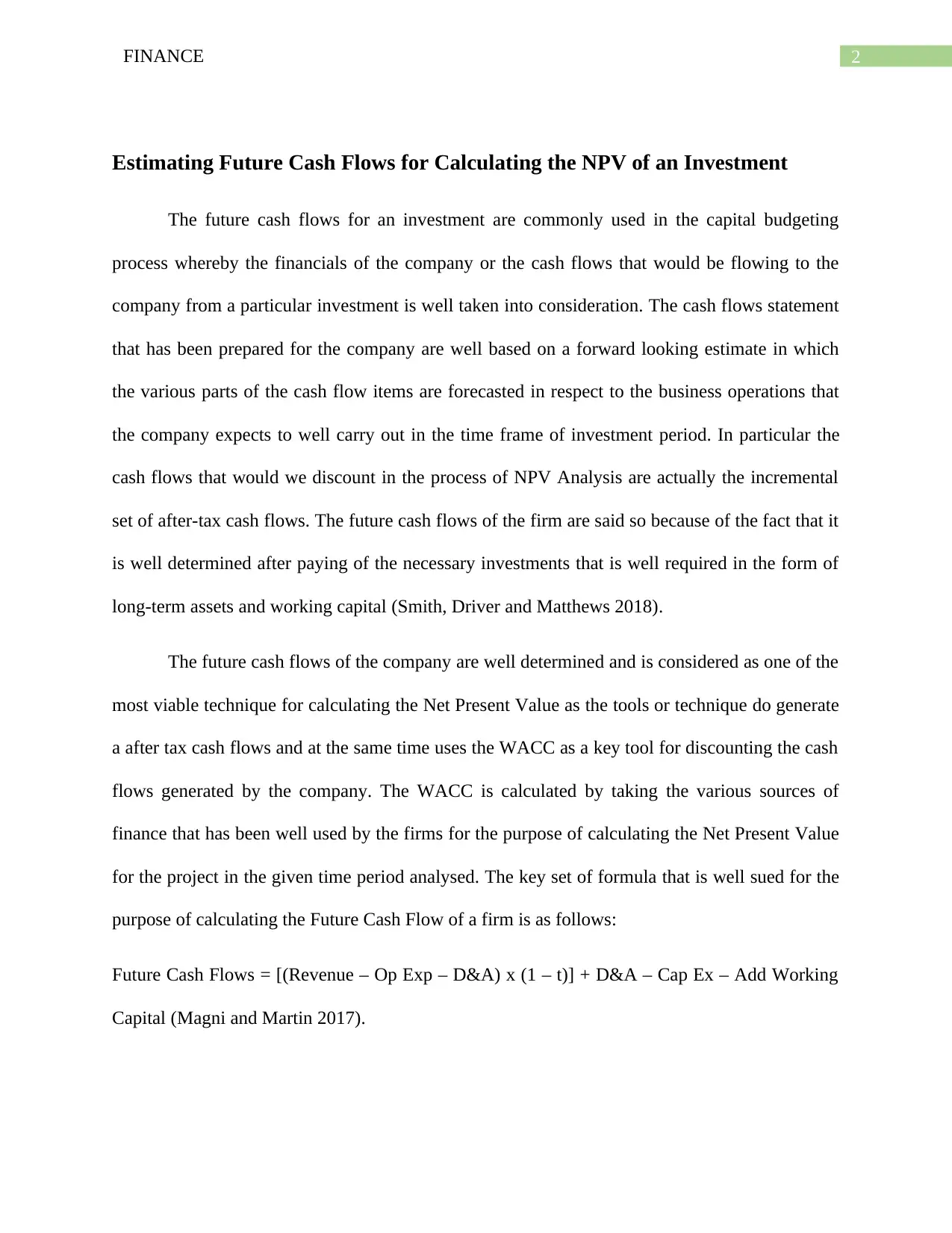
Estimating Future Cash Flows for Calculating the NPV of an Investment.....................................2
References........................................................................................................................................4
Document Page
2FINANCE
Estimating Future Cash Flows for Calculating the NPV of an Investment
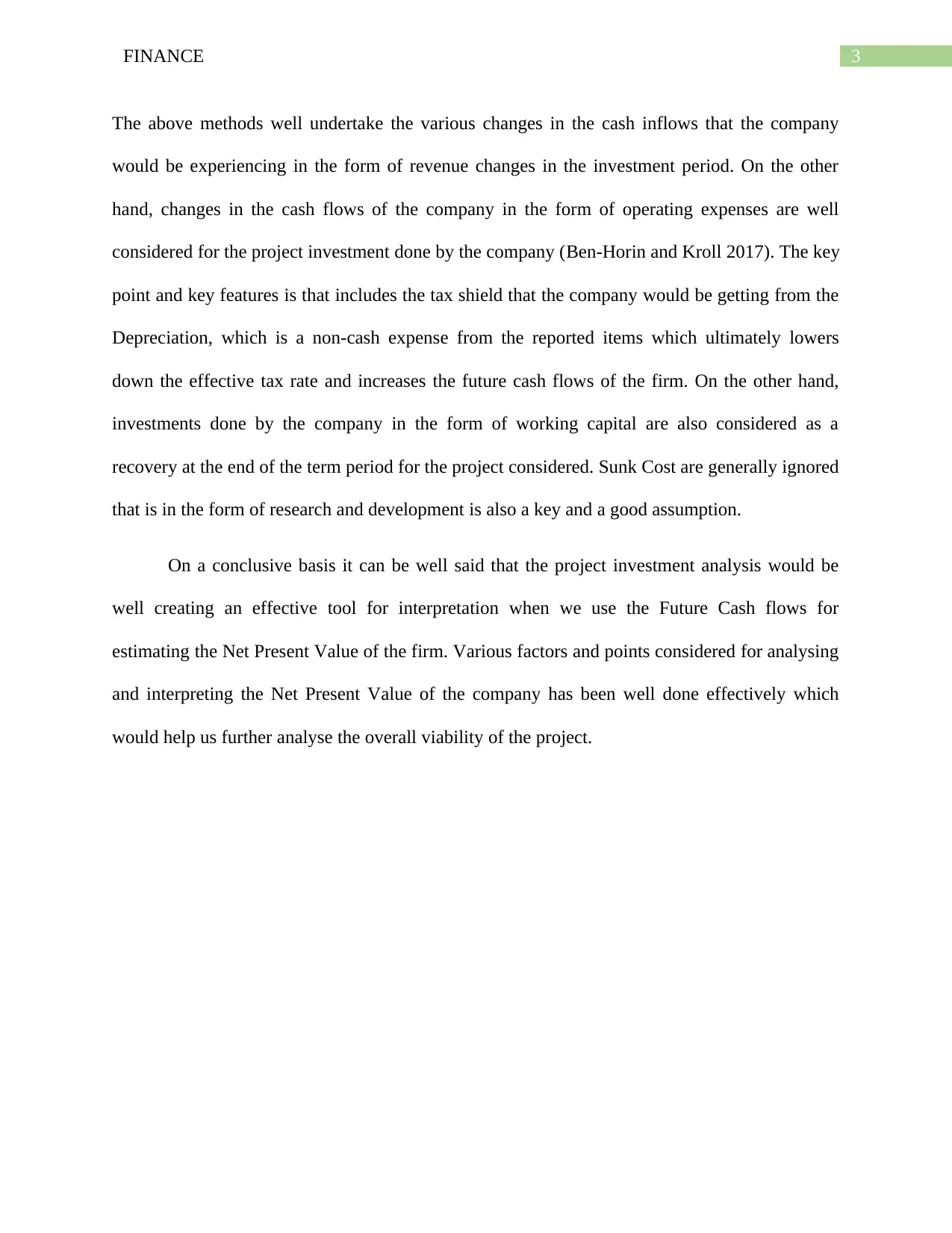
The future cash flows for an investment are commonly used in the capital budgeting
process whereby the financials of the company or the cash flows that would be flowing to the
company from a particular investment is well taken into consideration. The cash flows statement
that has been prepared for the company are well based on a forward looking estimate in which
the various parts of the cash flow items are forecasted in respect to the business operations that
the company expects to well carry out in the time frame of investment period. In particular the
cash flows that would we discount in the process of NPV Analysis are actually the incremental
set of after-tax cash flows. The future cash flows of the firm are said so because of the fact that it
is well determined after paying of the necessary investments that is well required in the form of
long-term assets and working capital (Smith, Driver and Matthews 2018).
The future cash flows of the company are well determined and is considered as one of the
most viable technique for calculating the Net Present Value as the tools or technique do generate
a after tax cash flows and at the same time uses the WACC as a key tool for discounting the cash
flows generated by the company. The WACC is calculated by taking the various sources of
finance that has been well used by the firms for the purpose of calculating the Net Present Value
for the project in the given time period analysed. The key set of formula that is well sued for the
purpose of calculating the Future Cash Flow of a firm is as follows:
Future Cash Flows = [(Revenue – Op Exp – D&A) x (1 – t)] + D&A – Cap Ex – Add Working
Capital (Magni and Martin 2017).
Document Page
3FINANCE
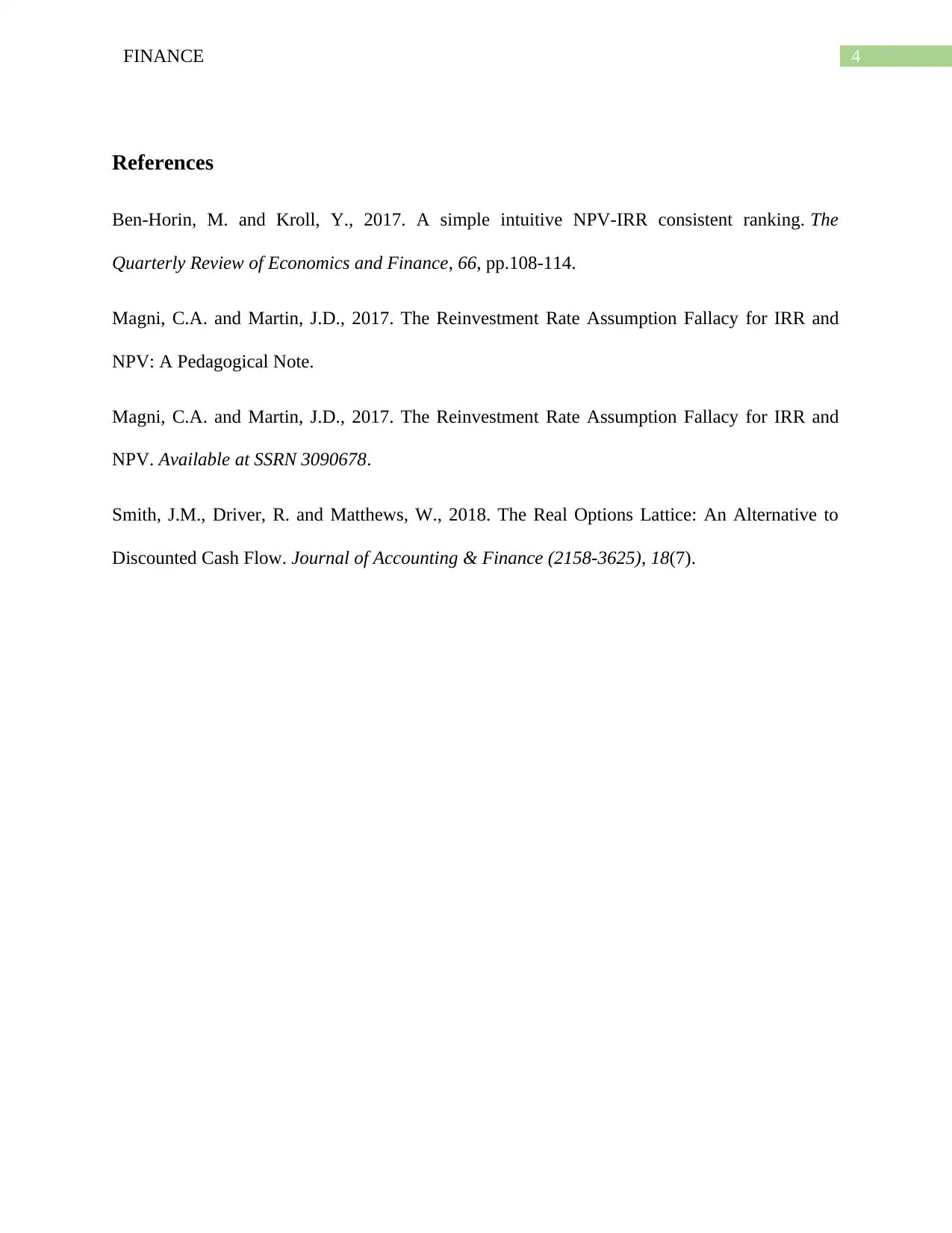
The above methods well undertake the various changes in the cash inflows that the company
would be experiencing in the form of revenue changes in the investment period. On the other
hand, changes in the cash flows of the company in the form of operating expenses are well
considered for the project investment done by the company (Ben-Horin and Kroll 2017). The key
point and key features is that includes the tax shield that the company would be getting from the
Depreciation, which is a non-cash expense from the reported items which ultimately lowers
down the effective tax rate and increases the future cash flows of the firm. On the other hand,
investments done by the company in the form of working capital are also considered as a
recovery at the end of the term period for the project considered. Sunk Cost are generally ignored
that is in the form of research and development is also a key and a good assumption.
On a conclusive basis it can be well said that the project investment analysis would be
well creating an effective tool for interpretation when we use the Future Cash flows for
estimating the Net Present Value of the firm. Various factors and points considered for analysing
and interpreting the Net Present Value of the company has been well done effectively which
would help us further analyse the overall viability of the project.
tabler-icon-diamond-filled.svg

Paraphrase This Document

Need a fresh take? Get an instant paraphrase of this document with our AI Paraphraser
Document Page
4FINANCE
References
Ben-Horin, M. and Kroll, Y., 2017. A simple intuitive NPV-IRR consistent ranking. The
Quarterly Review of Economics and Finance, 66, pp.108-114.
Magni, C.A. and Martin, J.D., 2017. The Reinvestment Rate Assumption Fallacy for IRR and
NPV: A Pedagogical Note.
Magni, C.A. and Martin, J.D., 2017. The Reinvestment Rate Assumption Fallacy for IRR and
NPV. Available at SSRN 3090678.
Smith, J.M., Driver, R. and Matthews, W., 2018. The Real Options Lattice: An Alternative to
Discounted Cash Flow. Journal of Accounting & Finance (2158-3625), 18(7).
chevron_up_icon
1 out of 5
circle_padding
hide_on_mobile
zoom_out_icon
[object Object]