Game Theory Assignment: Nash Equilibrium, Duopolies, and Cartels
VerifiedAdded on 2020/02/24
|13
|2229
|135
Homework Assignment
AI Summary
This document provides a comprehensive solution to a game theory assignment, exploring key concepts such as Nash equilibrium, duopolies, and cartels. The assignment begins by analyzing a two-person game, identifying the absence of a pure Nash equilibrium and explaining the strategic choices of players. The solution then delves into a duopoly model, calculating the optimal outputs and profits of firms under both symmetric and asymmetric information scenarios, including the impact of a first-mover advantage. Finally, the assignment examines a cartel scenario, determining the equilibrium output and profits for firms both within and outside the cartel agreement, highlighting the incentives to cheat and the conditions under which cooperation might be sustained. The solutions incorporate relevant economic models and equations to explain the strategic interactions and outcomes.
Running head: GAME THEORY
Game Theory
Name of the Student
Name of the University
Author Note
Game Theory
Name of the Student
Name of the University
Author Note
Paraphrase This Document
Need a fresh take? Get an instant paraphrase of this document with our AI Paraphraser

1GAME THEORY
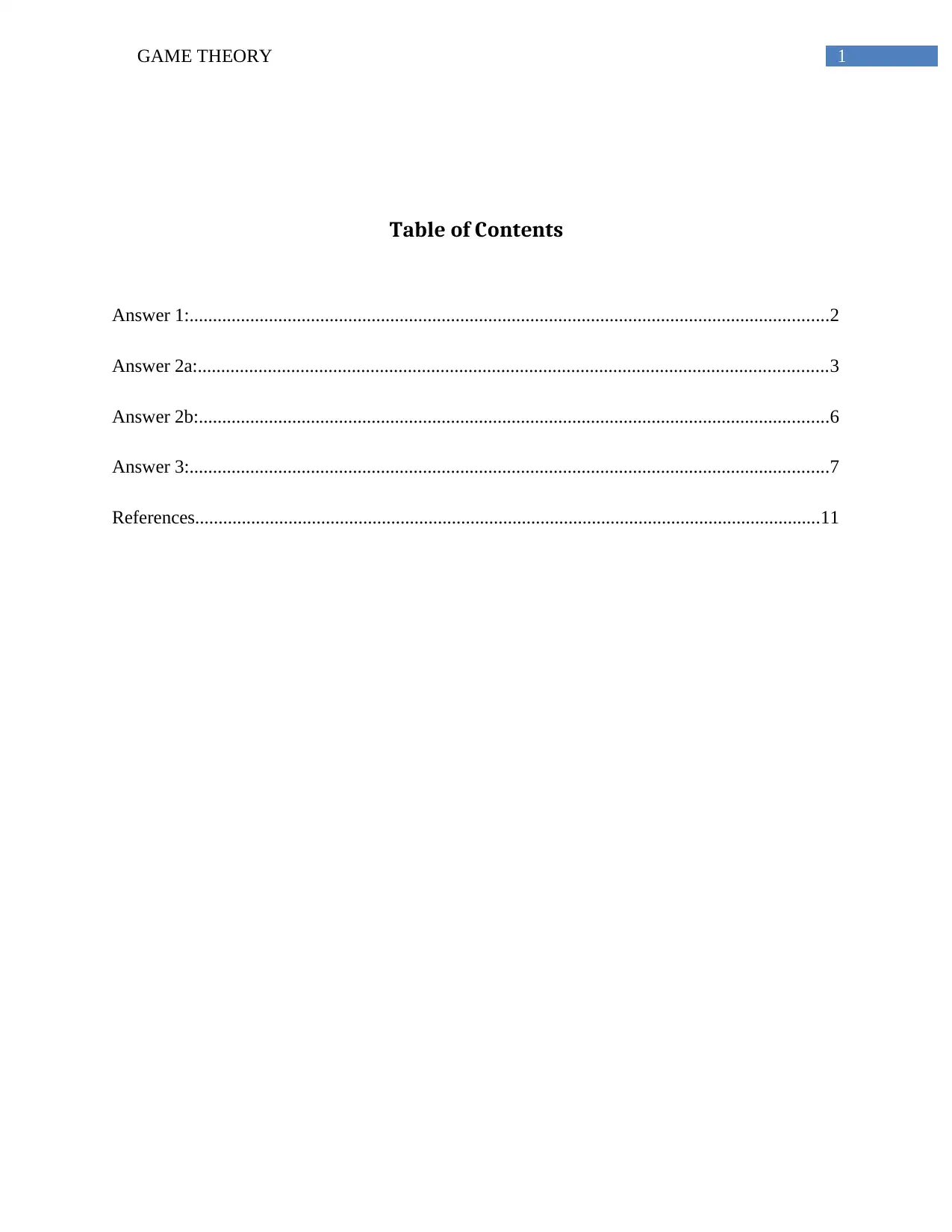
Table of Contents
Answer 1:.........................................................................................................................................2
Answer 2a:.......................................................................................................................................3
Answer 2b:.......................................................................................................................................6
Answer 3:.........................................................................................................................................7
References......................................................................................................................................11
Table of Contents
Answer 1:.........................................................................................................................................2
Answer 2a:.......................................................................................................................................3
Answer 2b:.......................................................................................................................................6
Answer 3:.........................................................................................................................................7
References......................................................................................................................................11

2GAME THEORY
Answer 1:
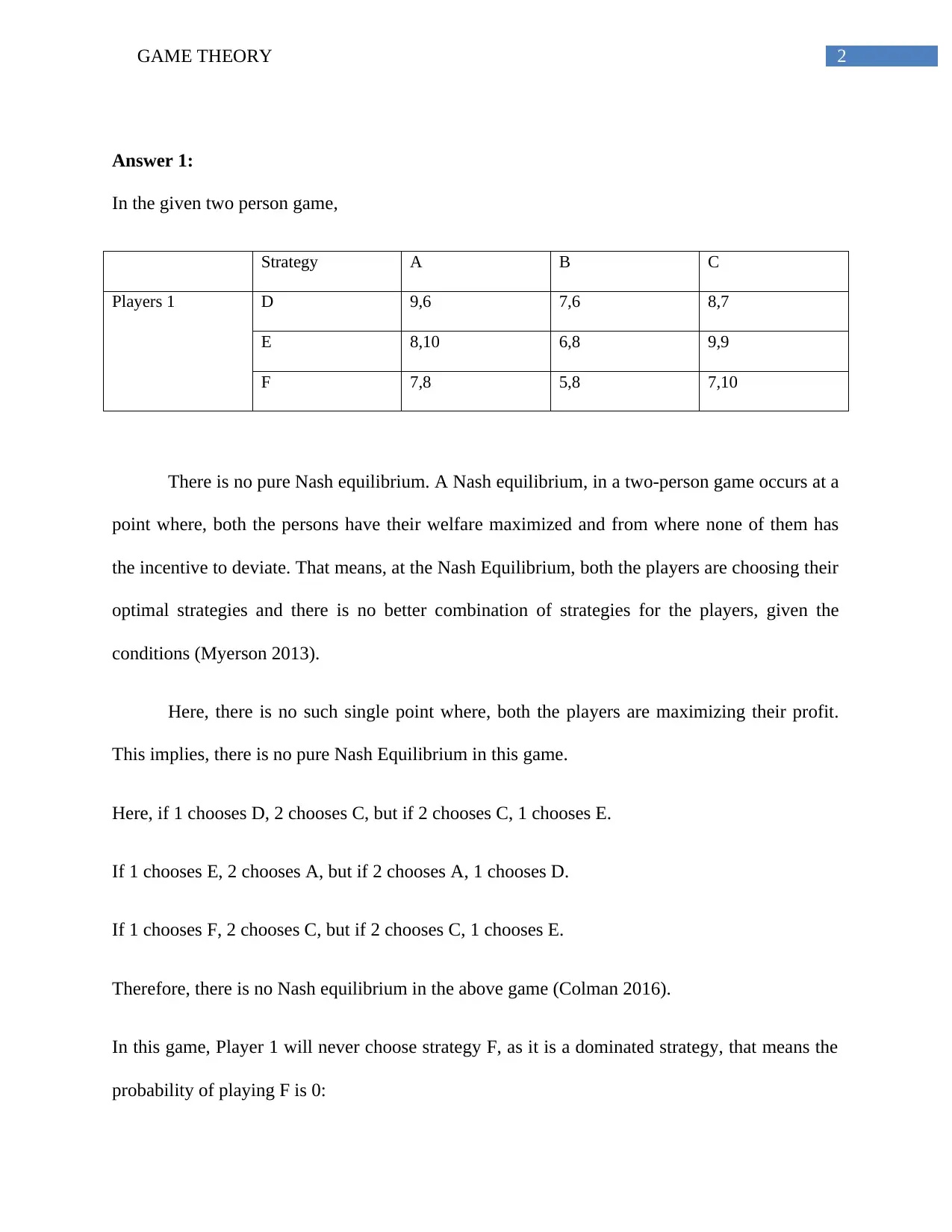
In the given two person game,
Strategy A B C
Players 1 D 9,6 7,6 8,7
E 8,10 6,8 9,9
F 7,8 5,8 7,10
There is no pure Nash equilibrium. A Nash equilibrium, in a two-person game occurs at a
point where, both the persons have their welfare maximized and from where none of them has
the incentive to deviate. That means, at the Nash Equilibrium, both the players are choosing their
optimal strategies and there is no better combination of strategies for the players, given the
conditions (Myerson 2013).
Here, there is no such single point where, both the players are maximizing their profit.
This implies, there is no pure Nash Equilibrium in this game.
Here, if 1 chooses D, 2 chooses C, but if 2 chooses C, 1 chooses E.
If 1 chooses E, 2 chooses A, but if 2 chooses A, 1 chooses D.
If 1 chooses F, 2 chooses C, but if 2 chooses C, 1 chooses E.
Therefore, there is no Nash equilibrium in the above game (Colman 2016).
In this game, Player 1 will never choose strategy F, as it is a dominated strategy, that means the
probability of playing F is 0:
Answer 1:
In the given two person game,
Strategy A B C
Players 1 D 9,6 7,6 8,7
E 8,10 6,8 9,9
F 7,8 5,8 7,10
There is no pure Nash equilibrium. A Nash equilibrium, in a two-person game occurs at a
point where, both the persons have their welfare maximized and from where none of them has
the incentive to deviate. That means, at the Nash Equilibrium, both the players are choosing their
optimal strategies and there is no better combination of strategies for the players, given the
conditions (Myerson 2013).
Here, there is no such single point where, both the players are maximizing their profit.
This implies, there is no pure Nash Equilibrium in this game.
Here, if 1 chooses D, 2 chooses C, but if 2 chooses C, 1 chooses E.
If 1 chooses E, 2 chooses A, but if 2 chooses A, 1 chooses D.
If 1 chooses F, 2 chooses C, but if 2 chooses C, 1 chooses E.
Therefore, there is no Nash equilibrium in the above game (Colman 2016).
In this game, Player 1 will never choose strategy F, as it is a dominated strategy, that means the
probability of playing F is 0:
⊘ This is a preview!⊘
Do you want full access?
Subscribe today to unlock all pages.

Trusted by 1+ million students worldwide

3GAME THEORY
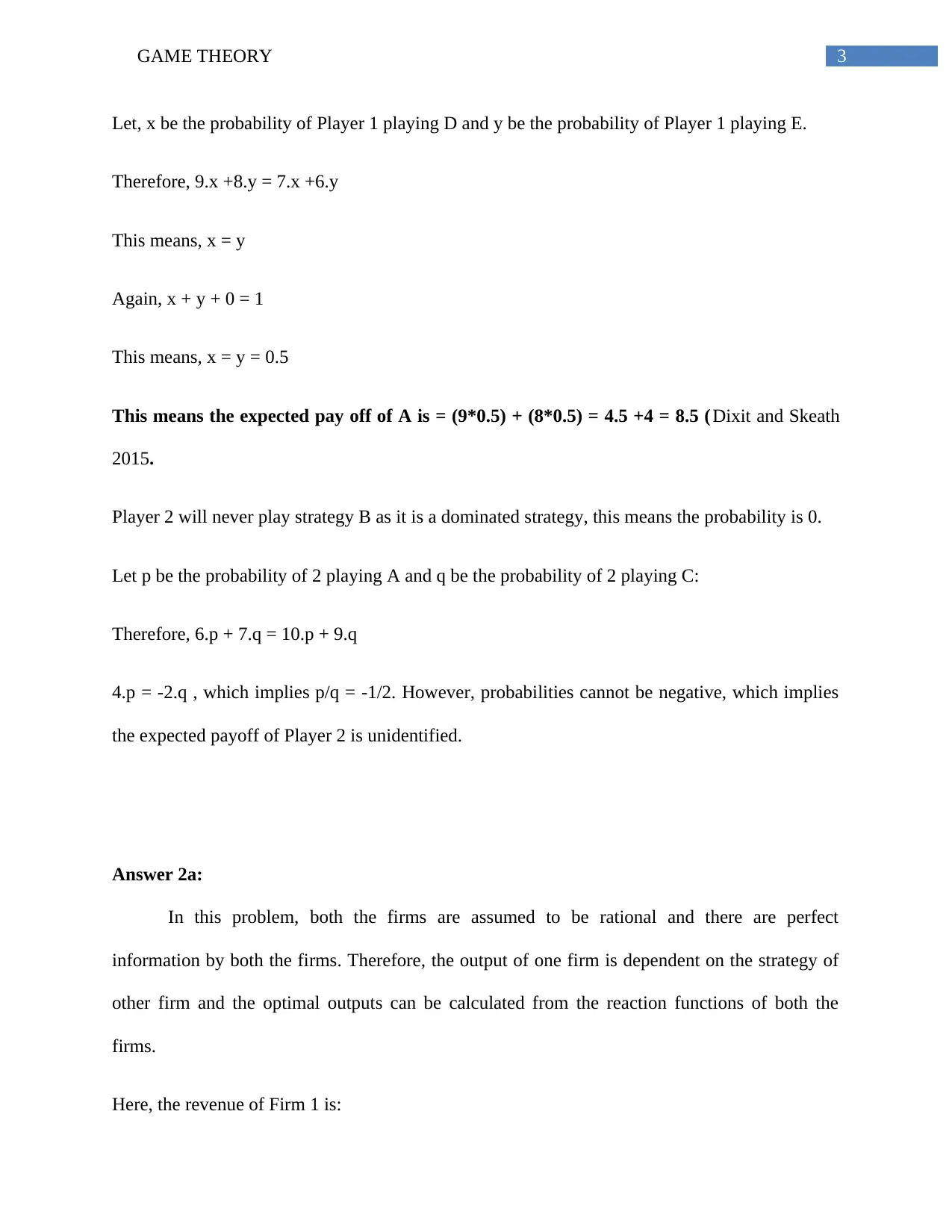
Let, x be the probability of Player 1 playing D and y be the probability of Player 1 playing E.
Therefore, 9.x +8.y = 7.x +6.y
This means, x = y
Again, x + y + 0 = 1
This means, x = y = 0.5
This means the expected pay off of A is = (9*0.5) + (8*0.5) = 4.5 +4 = 8.5 ( Dixit and Skeath
2015.
Player 2 will never play strategy B as it is a dominated strategy, this means the probability is 0.
Let p be the probability of 2 playing A and q be the probability of 2 playing C:
Therefore, 6.p + 7.q = 10.p + 9.q
4.p = -2.q , which implies p/q = -1/2. However, probabilities cannot be negative, which implies
the expected payoff of Player 2 is unidentified.
Answer 2a:
In this problem, both the firms are assumed to be rational and there are perfect
information by both the firms. Therefore, the output of one firm is dependent on the strategy of
other firm and the optimal outputs can be calculated from the reaction functions of both the
firms.
Here, the revenue of Firm 1 is:
Let, x be the probability of Player 1 playing D and y be the probability of Player 1 playing E.
Therefore, 9.x +8.y = 7.x +6.y
This means, x = y
Again, x + y + 0 = 1
This means, x = y = 0.5
This means the expected pay off of A is = (9*0.5) + (8*0.5) = 4.5 +4 = 8.5 ( Dixit and Skeath
2015.
Player 2 will never play strategy B as it is a dominated strategy, this means the probability is 0.
Let p be the probability of 2 playing A and q be the probability of 2 playing C:
Therefore, 6.p + 7.q = 10.p + 9.q
4.p = -2.q , which implies p/q = -1/2. However, probabilities cannot be negative, which implies
the expected payoff of Player 2 is unidentified.
Answer 2a:
In this problem, both the firms are assumed to be rational and there are perfect
information by both the firms. Therefore, the output of one firm is dependent on the strategy of
other firm and the optimal outputs can be calculated from the reaction functions of both the
firms.
Here, the revenue of Firm 1 is:
Paraphrase This Document
Need a fresh take? Get an instant paraphrase of this document with our AI Paraphraser

4GAME THEORY
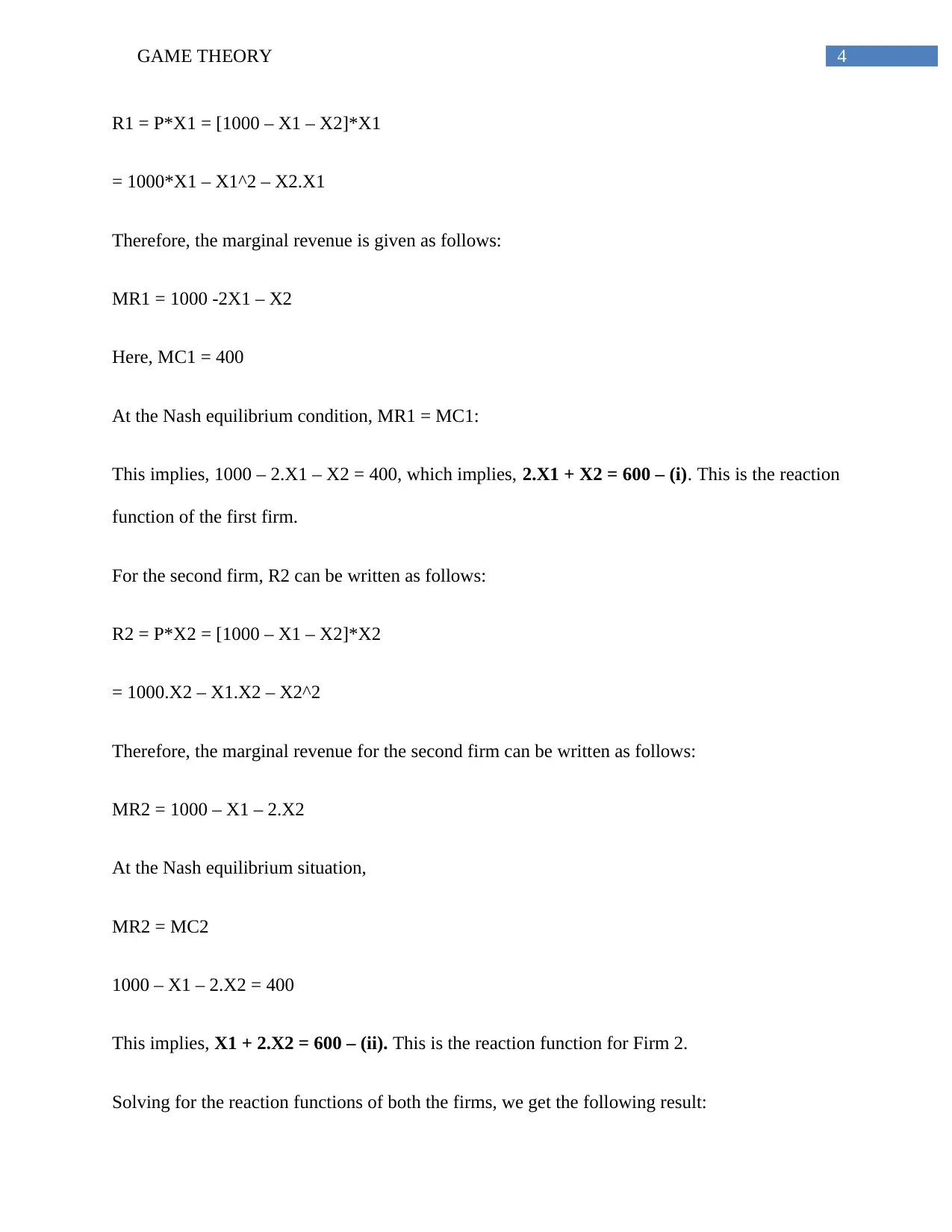
R1 = P*X1 = [1000 – X1 – X2]*X1
= 1000*X1 – X1^2 – X2.X1
Therefore, the marginal revenue is given as follows:
MR1 = 1000 -2X1 – X2
Here, MC1 = 400
At the Nash equilibrium condition, MR1 = MC1:
This implies, 1000 – 2.X1 – X2 = 400, which implies, 2.X1 + X2 = 600 – (i). This is the reaction
function of the first firm.
For the second firm, R2 can be written as follows:
R2 = P*X2 = [1000 – X1 – X2]*X2
= 1000.X2 – X1.X2 – X2^2
Therefore, the marginal revenue for the second firm can be written as follows:
MR2 = 1000 – X1 – 2.X2
At the Nash equilibrium situation,
MR2 = MC2
1000 – X1 – 2.X2 = 400
This implies, X1 + 2.X2 = 600 – (ii). This is the reaction function for Firm 2.
Solving for the reaction functions of both the firms, we get the following result:
R1 = P*X1 = [1000 – X1 – X2]*X1
= 1000*X1 – X1^2 – X2.X1
Therefore, the marginal revenue is given as follows:
MR1 = 1000 -2X1 – X2
Here, MC1 = 400
At the Nash equilibrium condition, MR1 = MC1:
This implies, 1000 – 2.X1 – X2 = 400, which implies, 2.X1 + X2 = 600 – (i). This is the reaction
function of the first firm.
For the second firm, R2 can be written as follows:
R2 = P*X2 = [1000 – X1 – X2]*X2
= 1000.X2 – X1.X2 – X2^2
Therefore, the marginal revenue for the second firm can be written as follows:
MR2 = 1000 – X1 – 2.X2
At the Nash equilibrium situation,
MR2 = MC2
1000 – X1 – 2.X2 = 400
This implies, X1 + 2.X2 = 600 – (ii). This is the reaction function for Firm 2.
Solving for the reaction functions of both the firms, we get the following result:

5GAME THEORY
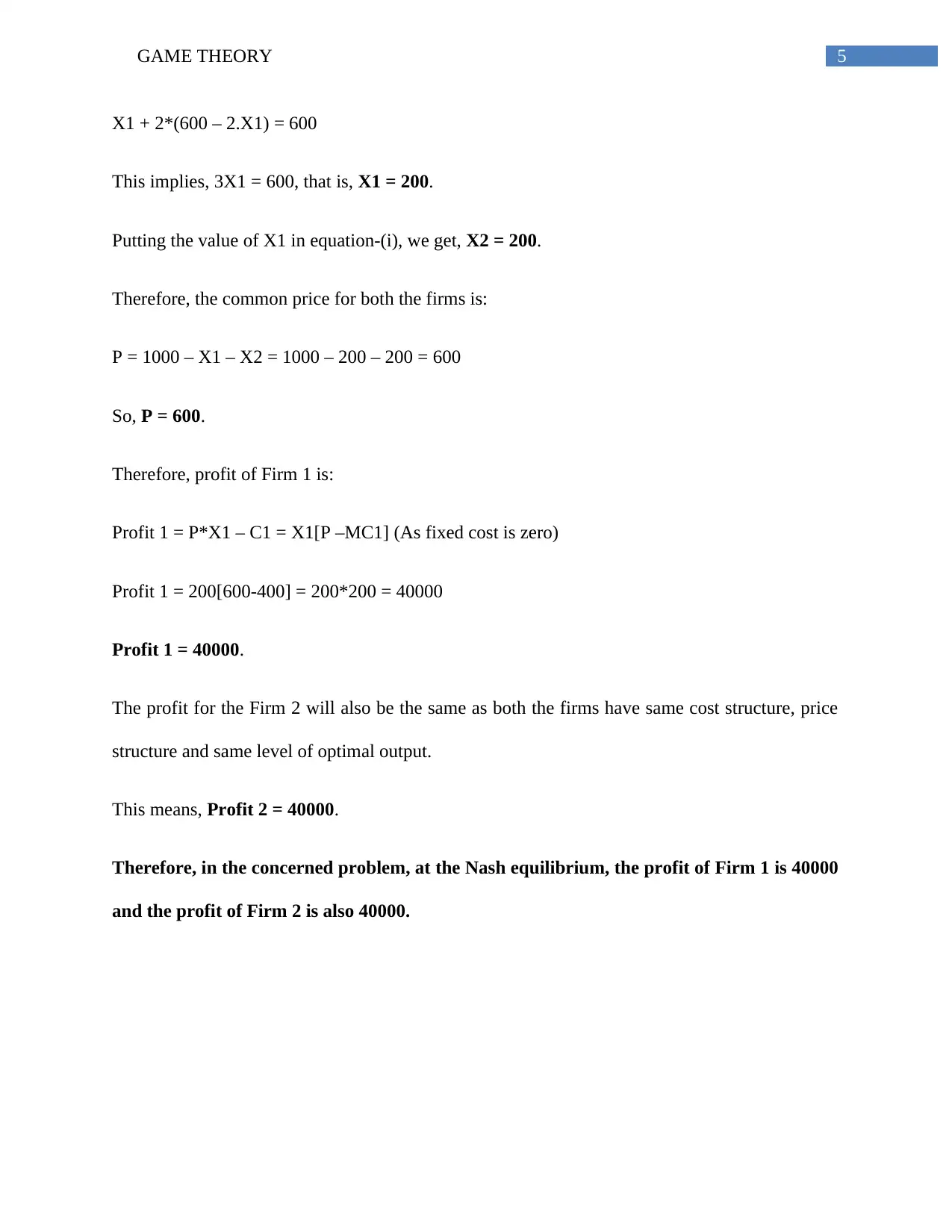
X1 + 2*(600 – 2.X1) = 600
This implies, 3X1 = 600, that is, X1 = 200.
Putting the value of X1 in equation-(i), we get, X2 = 200.
Therefore, the common price for both the firms is:
P = 1000 – X1 – X2 = 1000 – 200 – 200 = 600
So, P = 600.
Therefore, profit of Firm 1 is:
Profit 1 = P*X1 – C1 = X1[P –MC1] (As fixed cost is zero)
Profit 1 = 200[600-400] = 200*200 = 40000
Profit 1 = 40000.
The profit for the Firm 2 will also be the same as both the firms have same cost structure, price
structure and same level of optimal output.
This means, Profit 2 = 40000.
Therefore, in the concerned problem, at the Nash equilibrium, the profit of Firm 1 is 40000
and the profit of Firm 2 is also 40000.
X1 + 2*(600 – 2.X1) = 600
This implies, 3X1 = 600, that is, X1 = 200.
Putting the value of X1 in equation-(i), we get, X2 = 200.
Therefore, the common price for both the firms is:
P = 1000 – X1 – X2 = 1000 – 200 – 200 = 600
So, P = 600.
Therefore, profit of Firm 1 is:
Profit 1 = P*X1 – C1 = X1[P –MC1] (As fixed cost is zero)
Profit 1 = 200[600-400] = 200*200 = 40000
Profit 1 = 40000.
The profit for the Firm 2 will also be the same as both the firms have same cost structure, price
structure and same level of optimal output.
This means, Profit 2 = 40000.
Therefore, in the concerned problem, at the Nash equilibrium, the profit of Firm 1 is 40000
and the profit of Firm 2 is also 40000.
⊘ This is a preview!⊘
Do you want full access?
Subscribe today to unlock all pages.

Trusted by 1+ million students worldwide

6GAME THEORY
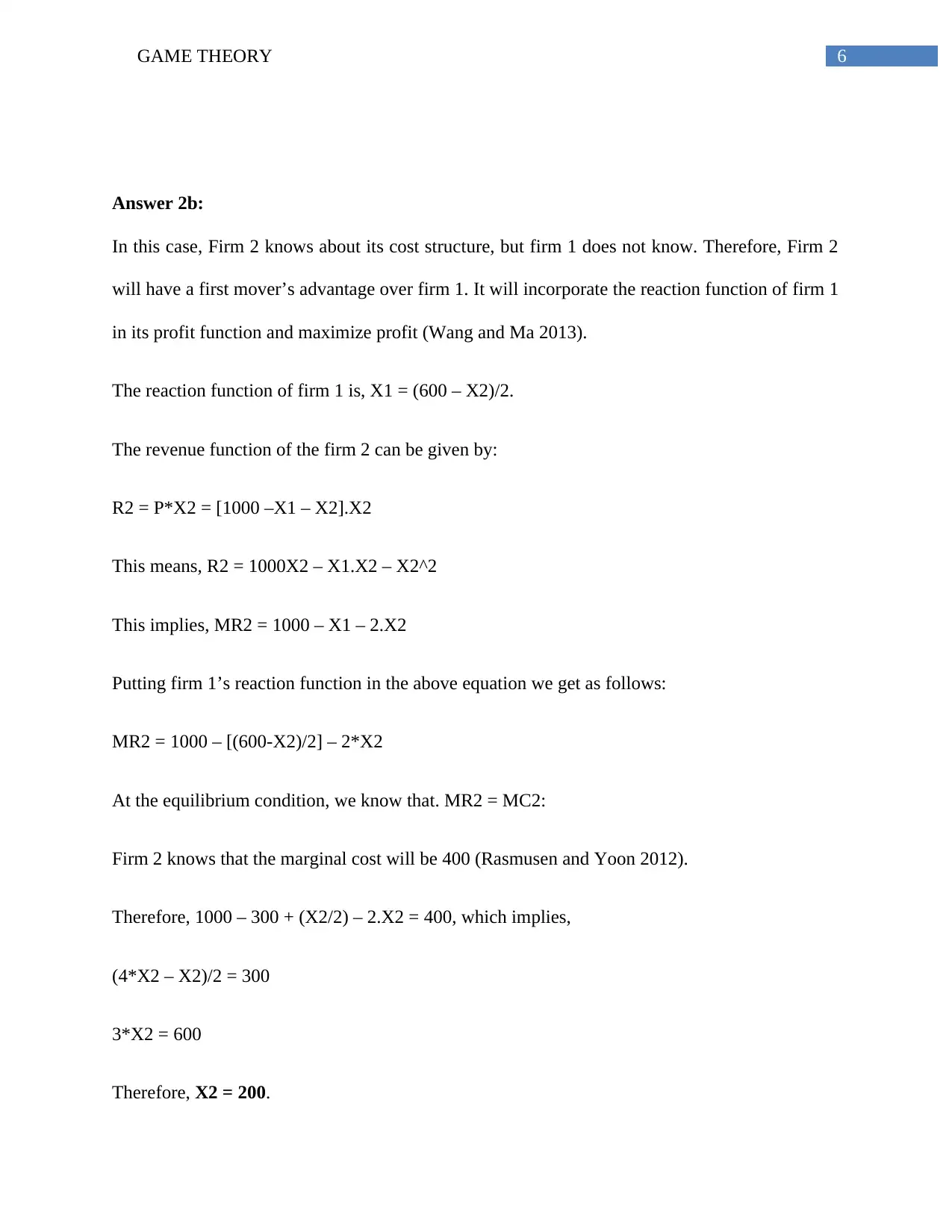
Answer 2b:
In this case, Firm 2 knows about its cost structure, but firm 1 does not know. Therefore, Firm 2
will have a first mover’s advantage over firm 1. It will incorporate the reaction function of firm 1
in its profit function and maximize profit (Wang and Ma 2013).
The reaction function of firm 1 is, X1 = (600 – X2)/2.
The revenue function of the firm 2 can be given by:
R2 = P*X2 = [1000 –X1 – X2].X2
This means, R2 = 1000X2 – X1.X2 – X2^2
This implies, MR2 = 1000 – X1 – 2.X2
Putting firm 1’s reaction function in the above equation we get as follows:
MR2 = 1000 – [(600-X2)/2] – 2*X2
At the equilibrium condition, we know that. MR2 = MC2:
Firm 2 knows that the marginal cost will be 400 (Rasmusen and Yoon 2012).
Therefore, 1000 – 300 + (X2/2) – 2.X2 = 400, which implies,
(4*X2 – X2)/2 = 300
3*X2 = 600
Therefore, X2 = 200.
Answer 2b:
In this case, Firm 2 knows about its cost structure, but firm 1 does not know. Therefore, Firm 2
will have a first mover’s advantage over firm 1. It will incorporate the reaction function of firm 1
in its profit function and maximize profit (Wang and Ma 2013).
The reaction function of firm 1 is, X1 = (600 – X2)/2.
The revenue function of the firm 2 can be given by:
R2 = P*X2 = [1000 –X1 – X2].X2
This means, R2 = 1000X2 – X1.X2 – X2^2
This implies, MR2 = 1000 – X1 – 2.X2
Putting firm 1’s reaction function in the above equation we get as follows:
MR2 = 1000 – [(600-X2)/2] – 2*X2
At the equilibrium condition, we know that. MR2 = MC2:
Firm 2 knows that the marginal cost will be 400 (Rasmusen and Yoon 2012).
Therefore, 1000 – 300 + (X2/2) – 2.X2 = 400, which implies,
(4*X2 – X2)/2 = 300
3*X2 = 600
Therefore, X2 = 200.
Paraphrase This Document
Need a fresh take? Get an instant paraphrase of this document with our AI Paraphraser

7GAME THEORY
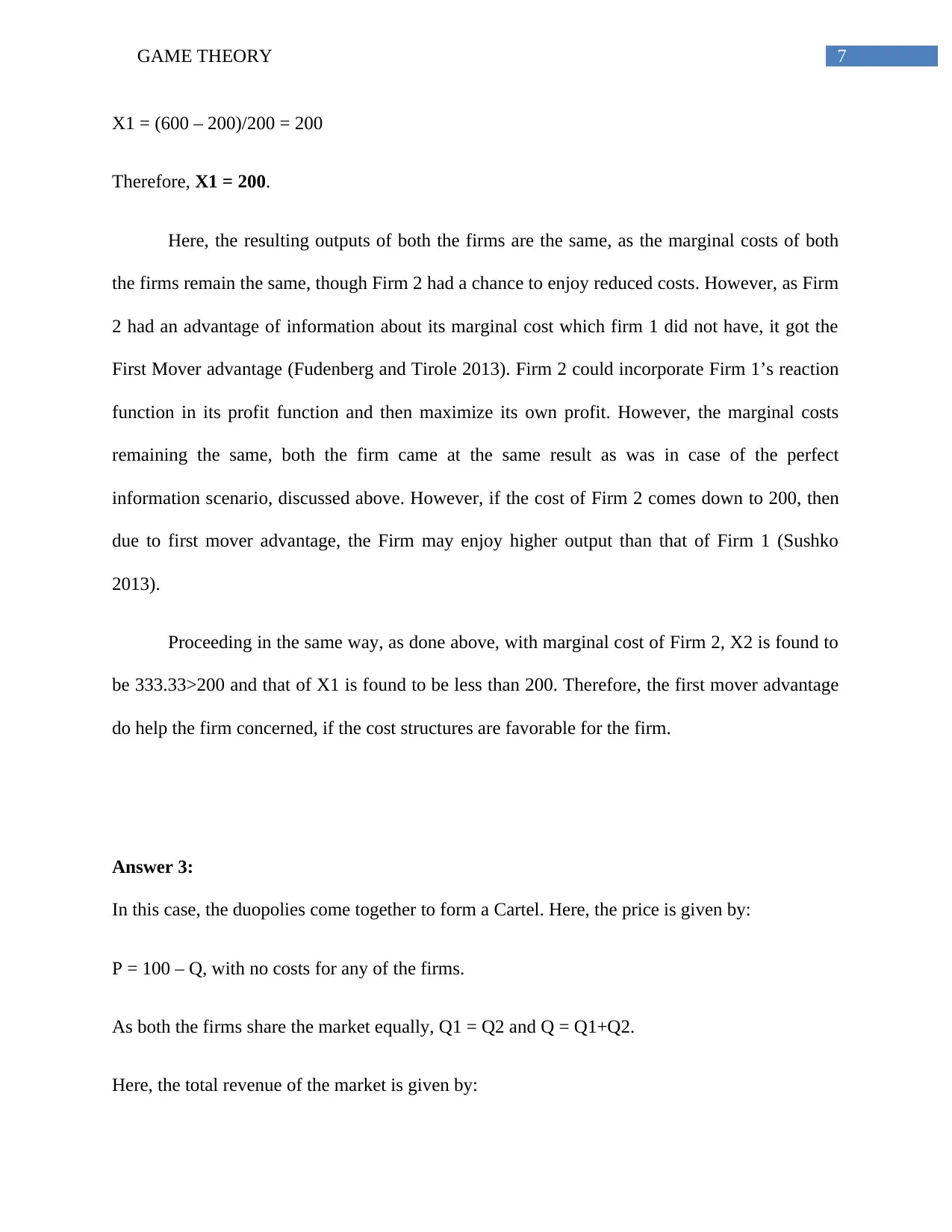
X1 = (600 – 200)/200 = 200
Therefore, X1 = 200.
Here, the resulting outputs of both the firms are the same, as the marginal costs of both
the firms remain the same, though Firm 2 had a chance to enjoy reduced costs. However, as Firm
2 had an advantage of information about its marginal cost which firm 1 did not have, it got the
First Mover advantage (Fudenberg and Tirole 2013). Firm 2 could incorporate Firm 1’s reaction
function in its profit function and then maximize its own profit. However, the marginal costs
remaining the same, both the firm came at the same result as was in case of the perfect
information scenario, discussed above. However, if the cost of Firm 2 comes down to 200, then
due to first mover advantage, the Firm may enjoy higher output than that of Firm 1 (Sushko
2013).
Proceeding in the same way, as done above, with marginal cost of Firm 2, X2 is found to
be 333.33>200 and that of X1 is found to be less than 200. Therefore, the first mover advantage
do help the firm concerned, if the cost structures are favorable for the firm.
Answer 3:
In this case, the duopolies come together to form a Cartel. Here, the price is given by:
P = 100 – Q, with no costs for any of the firms.
As both the firms share the market equally, Q1 = Q2 and Q = Q1+Q2.
Here, the total revenue of the market is given by:
X1 = (600 – 200)/200 = 200
Therefore, X1 = 200.
Here, the resulting outputs of both the firms are the same, as the marginal costs of both
the firms remain the same, though Firm 2 had a chance to enjoy reduced costs. However, as Firm
2 had an advantage of information about its marginal cost which firm 1 did not have, it got the
First Mover advantage (Fudenberg and Tirole 2013). Firm 2 could incorporate Firm 1’s reaction
function in its profit function and then maximize its own profit. However, the marginal costs
remaining the same, both the firm came at the same result as was in case of the perfect
information scenario, discussed above. However, if the cost of Firm 2 comes down to 200, then
due to first mover advantage, the Firm may enjoy higher output than that of Firm 1 (Sushko
2013).
Proceeding in the same way, as done above, with marginal cost of Firm 2, X2 is found to
be 333.33>200 and that of X1 is found to be less than 200. Therefore, the first mover advantage
do help the firm concerned, if the cost structures are favorable for the firm.
Answer 3:
In this case, the duopolies come together to form a Cartel. Here, the price is given by:
P = 100 – Q, with no costs for any of the firms.
As both the firms share the market equally, Q1 = Q2 and Q = Q1+Q2.
Here, the total revenue of the market is given by:

8GAME THEORY
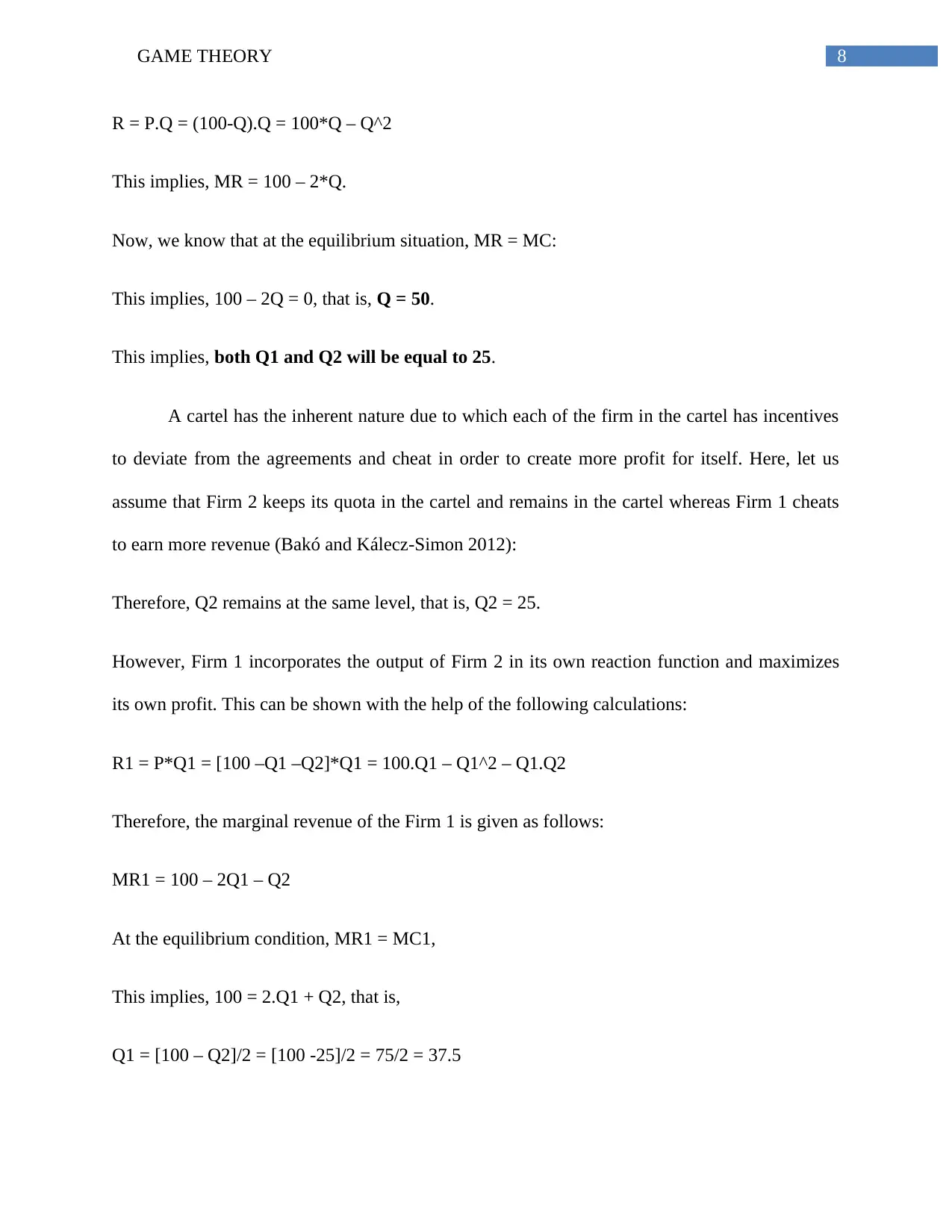
R = P.Q = (100-Q).Q = 100*Q – Q^2
This implies, MR = 100 – 2*Q.
Now, we know that at the equilibrium situation, MR = MC:
This implies, 100 – 2Q = 0, that is, Q = 50.
This implies, both Q1 and Q2 will be equal to 25.
A cartel has the inherent nature due to which each of the firm in the cartel has incentives
to deviate from the agreements and cheat in order to create more profit for itself. Here, let us
assume that Firm 2 keeps its quota in the cartel and remains in the cartel whereas Firm 1 cheats
to earn more revenue (Bakó and Kálecz-Simon 2012):
Therefore, Q2 remains at the same level, that is, Q2 = 25.
However, Firm 1 incorporates the output of Firm 2 in its own reaction function and maximizes
its own profit. This can be shown with the help of the following calculations:
R1 = P*Q1 = [100 –Q1 –Q2]*Q1 = 100.Q1 – Q1^2 – Q1.Q2
Therefore, the marginal revenue of the Firm 1 is given as follows:
MR1 = 100 – 2Q1 – Q2
At the equilibrium condition, MR1 = MC1,
This implies, 100 = 2.Q1 + Q2, that is,
Q1 = [100 – Q2]/2 = [100 -25]/2 = 75/2 = 37.5
R = P.Q = (100-Q).Q = 100*Q – Q^2
This implies, MR = 100 – 2*Q.
Now, we know that at the equilibrium situation, MR = MC:
This implies, 100 – 2Q = 0, that is, Q = 50.
This implies, both Q1 and Q2 will be equal to 25.
A cartel has the inherent nature due to which each of the firm in the cartel has incentives
to deviate from the agreements and cheat in order to create more profit for itself. Here, let us
assume that Firm 2 keeps its quota in the cartel and remains in the cartel whereas Firm 1 cheats
to earn more revenue (Bakó and Kálecz-Simon 2012):
Therefore, Q2 remains at the same level, that is, Q2 = 25.
However, Firm 1 incorporates the output of Firm 2 in its own reaction function and maximizes
its own profit. This can be shown with the help of the following calculations:
R1 = P*Q1 = [100 –Q1 –Q2]*Q1 = 100.Q1 – Q1^2 – Q1.Q2
Therefore, the marginal revenue of the Firm 1 is given as follows:
MR1 = 100 – 2Q1 – Q2
At the equilibrium condition, MR1 = MC1,
This implies, 100 = 2.Q1 + Q2, that is,
Q1 = [100 – Q2]/2 = [100 -25]/2 = 75/2 = 37.5
⊘ This is a preview!⊘
Do you want full access?
Subscribe today to unlock all pages.

Trusted by 1+ million students worldwide

9GAME THEORY
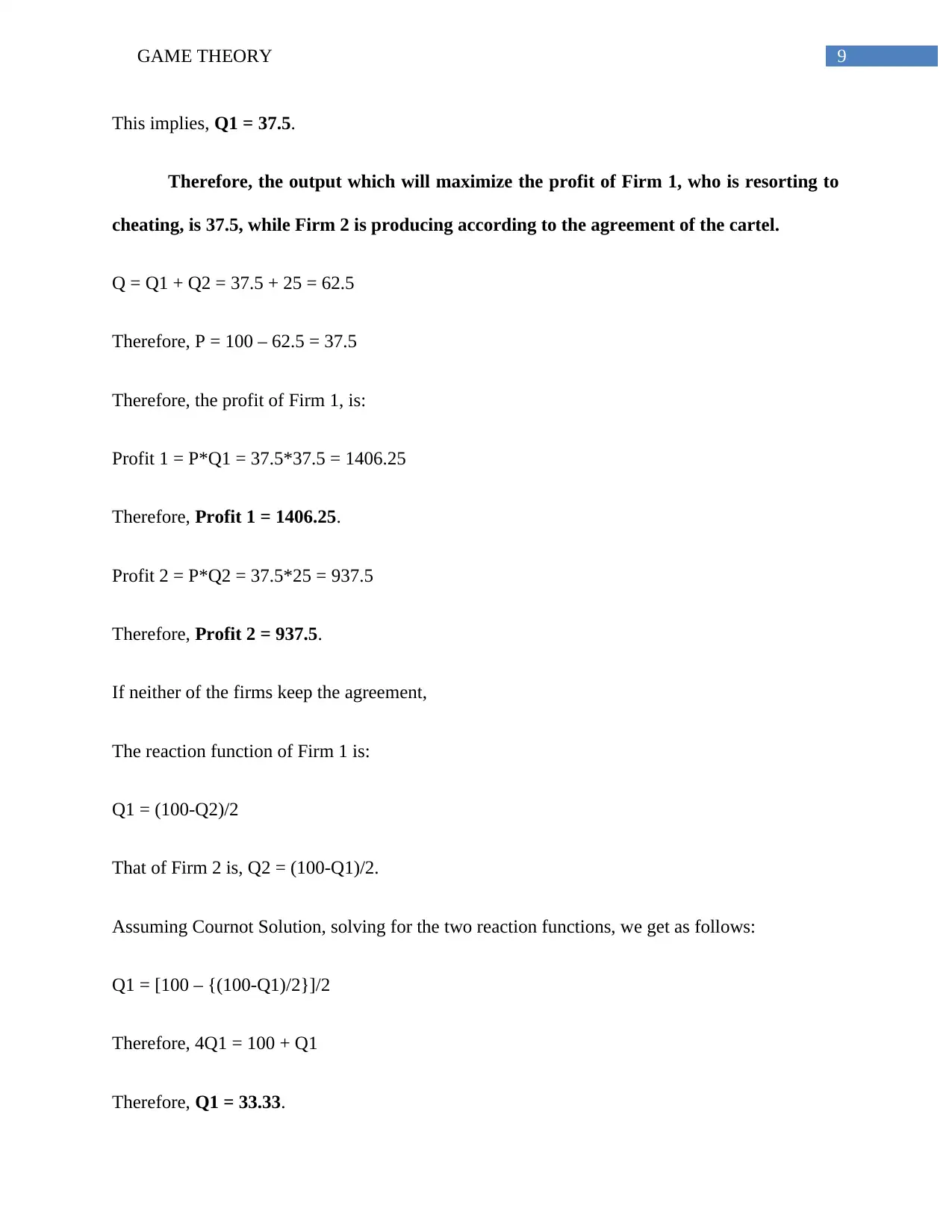
This implies, Q1 = 37.5.
Therefore, the output which will maximize the profit of Firm 1, who is resorting to
cheating, is 37.5, while Firm 2 is producing according to the agreement of the cartel.
Q = Q1 + Q2 = 37.5 + 25 = 62.5
Therefore, P = 100 – 62.5 = 37.5
Therefore, the profit of Firm 1, is:
Profit 1 = P*Q1 = 37.5*37.5 = 1406.25
Therefore, Profit 1 = 1406.25.
Profit 2 = P*Q2 = 37.5*25 = 937.5
Therefore, Profit 2 = 937.5.
If neither of the firms keep the agreement,
The reaction function of Firm 1 is:
Q1 = (100-Q2)/2
That of Firm 2 is, Q2 = (100-Q1)/2.
Assuming Cournot Solution, solving for the two reaction functions, we get as follows:
Q1 = [100 – {(100-Q1)/2}]/2
Therefore, 4Q1 = 100 + Q1
Therefore, Q1 = 33.33.
This implies, Q1 = 37.5.
Therefore, the output which will maximize the profit of Firm 1, who is resorting to
cheating, is 37.5, while Firm 2 is producing according to the agreement of the cartel.
Q = Q1 + Q2 = 37.5 + 25 = 62.5
Therefore, P = 100 – 62.5 = 37.5
Therefore, the profit of Firm 1, is:
Profit 1 = P*Q1 = 37.5*37.5 = 1406.25
Therefore, Profit 1 = 1406.25.
Profit 2 = P*Q2 = 37.5*25 = 937.5
Therefore, Profit 2 = 937.5.
If neither of the firms keep the agreement,
The reaction function of Firm 1 is:
Q1 = (100-Q2)/2
That of Firm 2 is, Q2 = (100-Q1)/2.
Assuming Cournot Solution, solving for the two reaction functions, we get as follows:
Q1 = [100 – {(100-Q1)/2}]/2
Therefore, 4Q1 = 100 + Q1
Therefore, Q1 = 33.33.
Paraphrase This Document
Need a fresh take? Get an instant paraphrase of this document with our AI Paraphraser

10GAME THEORY
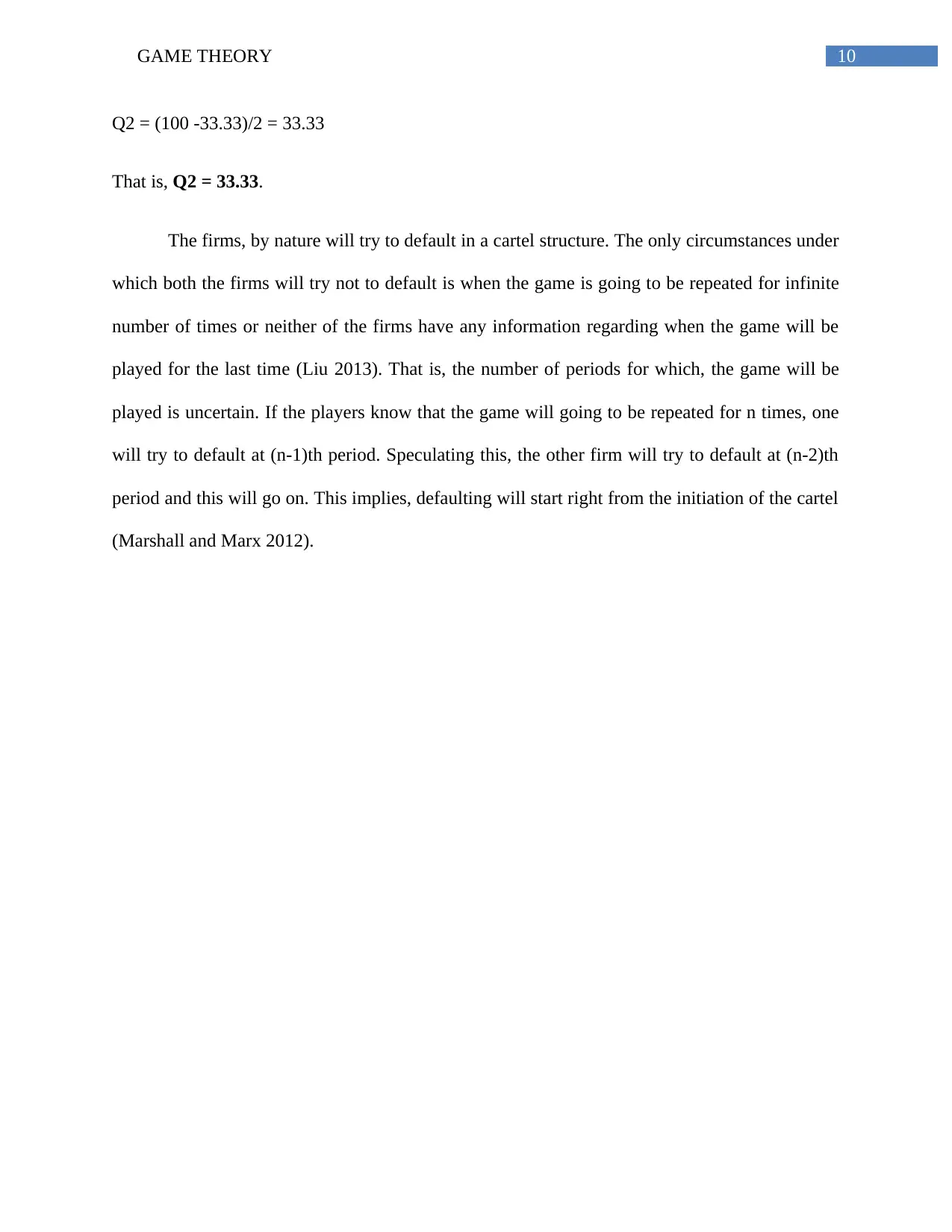
Q2 = (100 -33.33)/2 = 33.33
That is, Q2 = 33.33.
The firms, by nature will try to default in a cartel structure. The only circumstances under
which both the firms will try not to default is when the game is going to be repeated for infinite
number of times or neither of the firms have any information regarding when the game will be
played for the last time (Liu 2013). That is, the number of periods for which, the game will be
played is uncertain. If the players know that the game will going to be repeated for n times, one
will try to default at (n-1)th period. Speculating this, the other firm will try to default at (n-2)th
period and this will go on. This implies, defaulting will start right from the initiation of the cartel
(Marshall and Marx 2012).
Q2 = (100 -33.33)/2 = 33.33
That is, Q2 = 33.33.
The firms, by nature will try to default in a cartel structure. The only circumstances under
which both the firms will try not to default is when the game is going to be repeated for infinite
number of times or neither of the firms have any information regarding when the game will be
played for the last time (Liu 2013). That is, the number of periods for which, the game will be
played is uncertain. If the players know that the game will going to be repeated for n times, one
will try to default at (n-1)th period. Speculating this, the other firm will try to default at (n-2)th
period and this will go on. This implies, defaulting will start right from the initiation of the cartel
(Marshall and Marx 2012).

11GAME THEORY
References
Bakó, B. and Kálecz-Simon, A., 2012. Price discrimination in asymmetric Cournot
oligopoly. Economics Letters, 116(3), pp.301-303.
Colman, A.M., 2016. Game theory and experimental games: The study of strategic interaction.
Elsevier.
Dixit, A.K. and Skeath, S., 2015. Games of Strategy: Fourth International Student Edition. WW
Norton & Company.
Fudenberg, D. and Tirole, J., 2013. Dynamic models of oligopoly. Taylor & Francis.
Liu, P.T. ed., 2013. Dynamic optimization and mathematical economics. Springer Science &
Business Media.
Marshall, R.C. and Marx, L.M., 2012. The economics of collusion: Cartels and bidding rings.
Mit Press.
Myerson, R.B., 2013. Game theory. Harvard university press.
Rasmusen, E. and Yoon, Y.R., 2012. First versus second mover advantage with information
asymmetry about the profitability of new markets. The Journal of Industrial Economics, 60(3),
pp.374-405.
Sushko, I. ed., 2013. Oligopoly dynamics: Models and tools. Springer Science & Business
Media.
References
Bakó, B. and Kálecz-Simon, A., 2012. Price discrimination in asymmetric Cournot
oligopoly. Economics Letters, 116(3), pp.301-303.
Colman, A.M., 2016. Game theory and experimental games: The study of strategic interaction.
Elsevier.
Dixit, A.K. and Skeath, S., 2015. Games of Strategy: Fourth International Student Edition. WW
Norton & Company.
Fudenberg, D. and Tirole, J., 2013. Dynamic models of oligopoly. Taylor & Francis.
Liu, P.T. ed., 2013. Dynamic optimization and mathematical economics. Springer Science &
Business Media.
Marshall, R.C. and Marx, L.M., 2012. The economics of collusion: Cartels and bidding rings.
Mit Press.
Myerson, R.B., 2013. Game theory. Harvard university press.
Rasmusen, E. and Yoon, Y.R., 2012. First versus second mover advantage with information
asymmetry about the profitability of new markets. The Journal of Industrial Economics, 60(3),
pp.374-405.
Sushko, I. ed., 2013. Oligopoly dynamics: Models and tools. Springer Science & Business
Media.
⊘ This is a preview!⊘
Do you want full access?
Subscribe today to unlock all pages.

Trusted by 1+ million students worldwide
1 out of 13
Related Documents
Your All-in-One AI-Powered Toolkit for Academic Success.
+13062052269
info@desklib.com
Available 24*7 on WhatsApp / Email
Unlock your academic potential
Copyright © 2020–2025 A2Z Services. All Rights Reserved. Developed and managed by ZUCOL.