NDIS Assistive Technology Assessment: Shogo Williams, 26 years old
VerifiedAdded on 2022/08/19
|11
|4103
|26
Report
AI Summary
This report details an assistive technology assessment for Shogo Williams, a 26-year-old individual with a physical disability, conducted to determine suitable assistive technology (AT) to support his goals outlined in his NDIS plan. The assessment covers Shogo's current status, functional limitations, and past AT use. It includes trials of different wheelchairs, such as the Xenon SA Folding Wheelchair and Xtender Power Assist Wheelchair, along with various cushions. The report outlines the outcomes of each trial, providing reasons for recommendations or rejections, and assessing potential risks and benefits of the proposed AT solutions. The final recommendation focuses on the Xtender Power Assist Wheelchair with Jay Fusion Cushion, emphasizing how this combination will enhance Shogo's mobility, reduce fatigue, and promote independence in his daily activities and community participation. Furthermore, the report highlights the impact of the recommended AT on Shogo's long-term functional status and outcomes. The report adheres to NDIS guidelines, considering factors such as reasonable and necessary supports and AT strategy, and provides essential information for the NDIA to determine funding for the proposed AT support.
General Assistive Technology
Assessment Template
Notes for Assistive Technology (AT) Assessors of General AT Supports
There are specific templates available for the following types of AT:
General Assistive Technology Assessment
Continence Assessment
Prosthetics and Orthotics Assessment
Vehicle Modifications Assessment
Complex Home Modification Assessment
Dog Guide Assessment
The assessment information provided in this form will be used by the NDIA to understand how the
specified AT will assist the participant in pursuing their goals and in assessing whether it is reasonable
and necessary for the NDIS to fund AT support.
Using this template is not mandatory. If a provider elects to provide information in another format, they
must include all information described in this template. Information provided needs to include an outline
of the functional impact of each feature being recommended. This should include how the AT will support
capacity building, promote independence and impact alternative forms of support.
The primary criteria NDIS delegates use when determining if a piece of equipment or modification is
suitable for the NDIS to fund is section 34: reasonable and necessary supports of the National Disability
Insurance Scheme Act 2013 (NDIS Act; external) and section 34.
Additional information on how the recommendation(s) will be considered in the context of specific
supports can be found in the NDIS Operational Guidelines available online and the NDIS (Supports for
Participants) Rules 2013.
AT Strategy: Supports will be provided in line with the NDIA’s AT Strategy that can be found at Assistive
Technology Strategy and as outlined in NDIS AT Complexity document.
Assistive Technology (AT) Assessor: An AT assessor can assess a participant's needs and situation
and identify the most appropriate AT, they may be an AT Mentor, allied health practitioner, continence
nurse, rehabilitation engineer or other suitably qualified practitioners.
AT Assessors have obligations under the NDIS Provider Terms of Business, Quality and Safeguards
Commission and their respective professional registration under Australian Health Practitioner Regulation
Agency (AHPRA).
Caution: AT Assessors must be aware of and observe the law concerning AT that is likely to restrain a
participant. National Disability Insurance Scheme (Restrictive Practices and Behaviour Support) Rules
2018
The NDIA expects AT assessors to consider all options for addressing the participant’s disability-related
functional limitations and pursuing goals, including non-AT supports.
NDIS AT Levels 3 & 4 trials: Where the AT assessor and participant need to work with an AT supplier to
trial and develop a specification for the AT support, reasonable supplier costs can be quoted, and if
agreed, claimed against the participant’s plan (category ‘rental/trial’). Supplier specification/order details
are required with this assessment to enable the NDIS to consider quotes/prices from the supplier.
Quotations should is attached where applicable. Items < $1500 may be funded from the CORE
consumables budget and do not require an assessment and quote. Quotations can include printouts of
web orders and stock numbers from relevant State-based equipment suppliers where relevant.
AT assessors can keep up to date at NDIS provider assistive technology. Participants can keep up to
date at NDIS participant assistive technology.
General Assistive Technology Assessment Template Page 1 of 11
Assessment Template
Notes for Assistive Technology (AT) Assessors of General AT Supports
There are specific templates available for the following types of AT:
General Assistive Technology Assessment
Continence Assessment
Prosthetics and Orthotics Assessment
Vehicle Modifications Assessment
Complex Home Modification Assessment
Dog Guide Assessment
The assessment information provided in this form will be used by the NDIA to understand how the
specified AT will assist the participant in pursuing their goals and in assessing whether it is reasonable
and necessary for the NDIS to fund AT support.
Using this template is not mandatory. If a provider elects to provide information in another format, they
must include all information described in this template. Information provided needs to include an outline
of the functional impact of each feature being recommended. This should include how the AT will support
capacity building, promote independence and impact alternative forms of support.
The primary criteria NDIS delegates use when determining if a piece of equipment or modification is
suitable for the NDIS to fund is section 34: reasonable and necessary supports of the National Disability
Insurance Scheme Act 2013 (NDIS Act; external) and section 34.
Additional information on how the recommendation(s) will be considered in the context of specific
supports can be found in the NDIS Operational Guidelines available online and the NDIS (Supports for
Participants) Rules 2013.
AT Strategy: Supports will be provided in line with the NDIA’s AT Strategy that can be found at Assistive
Technology Strategy and as outlined in NDIS AT Complexity document.
Assistive Technology (AT) Assessor: An AT assessor can assess a participant's needs and situation
and identify the most appropriate AT, they may be an AT Mentor, allied health practitioner, continence
nurse, rehabilitation engineer or other suitably qualified practitioners.
AT Assessors have obligations under the NDIS Provider Terms of Business, Quality and Safeguards
Commission and their respective professional registration under Australian Health Practitioner Regulation
Agency (AHPRA).
Caution: AT Assessors must be aware of and observe the law concerning AT that is likely to restrain a
participant. National Disability Insurance Scheme (Restrictive Practices and Behaviour Support) Rules
2018
The NDIA expects AT assessors to consider all options for addressing the participant’s disability-related
functional limitations and pursuing goals, including non-AT supports.
NDIS AT Levels 3 & 4 trials: Where the AT assessor and participant need to work with an AT supplier to
trial and develop a specification for the AT support, reasonable supplier costs can be quoted, and if
agreed, claimed against the participant’s plan (category ‘rental/trial’). Supplier specification/order details
are required with this assessment to enable the NDIS to consider quotes/prices from the supplier.
Quotations should is attached where applicable. Items < $1500 may be funded from the CORE
consumables budget and do not require an assessment and quote. Quotations can include printouts of
web orders and stock numbers from relevant State-based equipment suppliers where relevant.
AT assessors can keep up to date at NDIS provider assistive technology. Participants can keep up to
date at NDIS participant assistive technology.
General Assistive Technology Assessment Template Page 1 of 11

Paraphrase This Document
Need a fresh take? Get an instant paraphrase of this document with our AI Paraphraser
General Assistive Technology
Assessment Template
Notes for navigating and editing this document
General Notes
This document is protected so that only editable fields can be changed, but additional rows in tables can
be inserted as required.
All editable fields have unlimited text entry, and the document will expand in page length when large
amounts of text are entered.
Spelling and grammar can be checked according to the word processor you are using.
The document can be navigated with just the Tab key to encompass varying modes of navigation and
levels of computer skills
JAWS Specific Comments
Ins + F1 will read document information including the general layout, header and footer information
Ins + F6 will bring up a headings list allowing a JAWS user to jump to heading sections if desired
Ins + F7 will bring a list of web links embedded in the document.
Ins + Z will turn on quick navigation fields so a JAWS user can use say “H” to jump to the next heading
for easy navigation.
PART 1 –Participant and Plan Management Details
1.1 NDIS Participant Details
Name Shogo Williams
Date of Birth
Age 26 years
NDIS Number
Address
Contact Telephone Number 043xxxxxxx
Email
Preferred Contact Method
Nominee or Guardian Name
Nominee or Guardian Phone
NDIS Support Coordinator
Contact Details
1.2 Plan Management Details
Agency Managed
Self-Managed Yes
Registered Plan Management Provider
Contact Details
PART 2 –Assessment
General Assistive Technology Assessment Template Page 2 of 11
Assessment Template
Notes for navigating and editing this document
General Notes
This document is protected so that only editable fields can be changed, but additional rows in tables can
be inserted as required.
All editable fields have unlimited text entry, and the document will expand in page length when large
amounts of text are entered.
Spelling and grammar can be checked according to the word processor you are using.
The document can be navigated with just the Tab key to encompass varying modes of navigation and
levels of computer skills
JAWS Specific Comments
Ins + F1 will read document information including the general layout, header and footer information
Ins + F6 will bring up a headings list allowing a JAWS user to jump to heading sections if desired
Ins + F7 will bring a list of web links embedded in the document.
Ins + Z will turn on quick navigation fields so a JAWS user can use say “H” to jump to the next heading
for easy navigation.
PART 1 –Participant and Plan Management Details
1.1 NDIS Participant Details
Name Shogo Williams
Date of Birth
Age 26 years
NDIS Number
Address
Contact Telephone Number 043xxxxxxx
Preferred Contact Method
Nominee or Guardian Name
Nominee or Guardian Phone
NDIS Support Coordinator
Contact Details
1.2 Plan Management Details
Agency Managed
Self-Managed Yes
Registered Plan Management Provider
Contact Details
PART 2 –Assessment
General Assistive Technology Assessment Template Page 2 of 11
General Assistive Technology
Assessment Template
2.1 Background
General: Describe participant’s current status, which may include diagnosis, prognosis, co-existing
conditions, disability, personal and instrumental activities of daily living, formal and informal support
arrangements and life transitions.
Shogo is 26 years, an outgoing young guy who is organised, active and passionate about working in the
community and with disability organisations. Currently, Shogo is finishing up his last semester at
Murdoch Unit while living with a physical disability. Shogo participates in various physical activities as he
attends his local gym twice a week and plays sledge hockey at the ice skating group. Shogo wishes to
maintain his independence and current participation in daily activities with minimal use of assistive
technology. Shogo social situation and home environment was not assessed during the assessment
2.2 Participant Goals
If the participant’s NDIS plan has been made available, you can refer to the statement of the participant’s
goals and outline those relevant to the AT solution.
Shogo’s Current NDIS plan goals include:
I would like to be independent with the support of AT to maximise my mobility in the home and
wider community
I would like to continue to participate in social and physical activities of my interests with the
support of my AT.
2.3 Functional Assessment
Outline the specific functional limitation/s related to the participant’s disability that indicates the need for
assistive technology. Summarise relevant assessments that have been undertaken, such as skin
integrity, cognitive assessments, positive behaviour support assessments. Please only comment on the
below points where applicable.
Functional Limitation Details
Physical
Shogo mobilises in a manual wheelchair at home and in the
community. Shogo was observed sitting during the management of
pivot from his wheelchair. Mechanical assessment tool (MAT) was
completed to assess Shogo sitting in balance.
Upper limb- Shogo presented with good sitting balance and was able to
maintain the upright posture without any additional support for the
majority of time spent in a wheelchair. Shogo was able to maintain
sitting balance while mobilising the wheelchair and exercising.
Shogo attends cardio exercises to maintain his upper body strength,
which is required to play sledge hockey.
Lower limb- Shogo was unable to mobilise without aid and has no
standing tolerance.
Sensory Nil issue noted
Communication Clear communicator, he was able to initiate conversation and
effectively communicated by writing.
Cognitive Nil issue noted
Behavioural No issue noted
2.4 Assistive Technology Assessment
2.4.1 Describe the participant’s past and present use of assistive technology and how this solution will
support the participant to pursue their goals. Consider if the participant is an experienced or novice user
of assistive technology and whether this is replacement assistive technology.
General Assistive Technology Assessment Template Page 3 of 11
Assessment Template
2.1 Background
General: Describe participant’s current status, which may include diagnosis, prognosis, co-existing
conditions, disability, personal and instrumental activities of daily living, formal and informal support
arrangements and life transitions.
Shogo is 26 years, an outgoing young guy who is organised, active and passionate about working in the
community and with disability organisations. Currently, Shogo is finishing up his last semester at
Murdoch Unit while living with a physical disability. Shogo participates in various physical activities as he
attends his local gym twice a week and plays sledge hockey at the ice skating group. Shogo wishes to
maintain his independence and current participation in daily activities with minimal use of assistive
technology. Shogo social situation and home environment was not assessed during the assessment
2.2 Participant Goals
If the participant’s NDIS plan has been made available, you can refer to the statement of the participant’s
goals and outline those relevant to the AT solution.
Shogo’s Current NDIS plan goals include:
I would like to be independent with the support of AT to maximise my mobility in the home and
wider community
I would like to continue to participate in social and physical activities of my interests with the
support of my AT.
2.3 Functional Assessment
Outline the specific functional limitation/s related to the participant’s disability that indicates the need for
assistive technology. Summarise relevant assessments that have been undertaken, such as skin
integrity, cognitive assessments, positive behaviour support assessments. Please only comment on the
below points where applicable.
Functional Limitation Details
Physical
Shogo mobilises in a manual wheelchair at home and in the
community. Shogo was observed sitting during the management of
pivot from his wheelchair. Mechanical assessment tool (MAT) was
completed to assess Shogo sitting in balance.
Upper limb- Shogo presented with good sitting balance and was able to
maintain the upright posture without any additional support for the
majority of time spent in a wheelchair. Shogo was able to maintain
sitting balance while mobilising the wheelchair and exercising.
Shogo attends cardio exercises to maintain his upper body strength,
which is required to play sledge hockey.
Lower limb- Shogo was unable to mobilise without aid and has no
standing tolerance.
Sensory Nil issue noted
Communication Clear communicator, he was able to initiate conversation and
effectively communicated by writing.
Cognitive Nil issue noted
Behavioural No issue noted
2.4 Assistive Technology Assessment
2.4.1 Describe the participant’s past and present use of assistive technology and how this solution will
support the participant to pursue their goals. Consider if the participant is an experienced or novice user
of assistive technology and whether this is replacement assistive technology.
General Assistive Technology Assessment Template Page 3 of 11
⊘ This is a preview!⊘
Do you want full access?
Subscribe today to unlock all pages.

Trusted by 1+ million students worldwide
General Assistive Technology
Assessment Template
Since 2013, Shogo is using RAM Titanium manual wheelchair and Jay Ion cushion to mobilise around
the house and in community. Shogo also uses assistive driver controls to enable community participation.
Shogo explained by using an only minimal amount of assistive technology but used it to the fullest to
meet his occupational goals. This assessment will evaluate whether replacement wheelchair with the
option of power assist will enable Shogo’s mobility to access community, maximise energy and reduce
fatigue.
2.4.2 Trial of potential Assistive Technology equipment: Describe the duration, location and functional
outcome of assistive technology trials. If no trial was able to be undertaken, provide information outlining
why this was not possible such as remote/rural location, availability of equipment etc. What steps have
They have been taken to ensure the suitability of the assistive technology (for example confirmed the
assistive technology measurements are compatible within the home environment).
A trail of three different wheelchairs and pressure cushion was completed at Occupation therapy clinic,
and information about Shogo’s home and community environment was gathered during formal and
informal assessment.
Shogo requires the wheelchair to mobilise within his apartment to complete his daily activities and in the
community to incline uneven sidewalk, slopes and ramps.
Assistive Technology Trial Trail of Xenon SA Folding Wheelchair with
ROHO cushion
Outcome (Reasons why or why not recommended)
The Xenon SA Folding Wheelchair with ROHO
cushion was trialled, however, deemed
inappropriate for the following reasons: -
This chair was similar to the wheelchair
that Shogo uses currently, but the chair
cannot be customised to accommodate
any future needs for Shogo.
As discussed with Shogo and given all the
other option available for the wheelchair,
he declined this wheelchair after trail.
The pressure cushion was not appropriate
for Shogo as he did not demonstrate safe
transfer from his wheelchair and Shogo
reported cushion was not comfortable and
supporting.
Assistive Technology Trial Trail of Xtender Power Assist Wheelchair with
Jay X2 Cushion
Outcome (Reasons why or why not recommended) The Xtender Power Assist Wheelchair with Jay
Fusion Cushion was trailed and identified as the
most appropriate option available for Shogo: -
The option will allow Shogo to continue to
use a self-propelled manual wheelchair
with power assist wheel, which reduces
energy expenditure and decreases his
fatigue and prevent any secondary
injuries that will enhance participation in
activities of his choice.
General Assistive Technology Assessment Template Page 4 of 11
Assessment Template
Since 2013, Shogo is using RAM Titanium manual wheelchair and Jay Ion cushion to mobilise around
the house and in community. Shogo also uses assistive driver controls to enable community participation.
Shogo explained by using an only minimal amount of assistive technology but used it to the fullest to
meet his occupational goals. This assessment will evaluate whether replacement wheelchair with the
option of power assist will enable Shogo’s mobility to access community, maximise energy and reduce
fatigue.
2.4.2 Trial of potential Assistive Technology equipment: Describe the duration, location and functional
outcome of assistive technology trials. If no trial was able to be undertaken, provide information outlining
why this was not possible such as remote/rural location, availability of equipment etc. What steps have
They have been taken to ensure the suitability of the assistive technology (for example confirmed the
assistive technology measurements are compatible within the home environment).
A trail of three different wheelchairs and pressure cushion was completed at Occupation therapy clinic,
and information about Shogo’s home and community environment was gathered during formal and
informal assessment.
Shogo requires the wheelchair to mobilise within his apartment to complete his daily activities and in the
community to incline uneven sidewalk, slopes and ramps.
Assistive Technology Trial Trail of Xenon SA Folding Wheelchair with
ROHO cushion
Outcome (Reasons why or why not recommended)
The Xenon SA Folding Wheelchair with ROHO
cushion was trialled, however, deemed
inappropriate for the following reasons: -
This chair was similar to the wheelchair
that Shogo uses currently, but the chair
cannot be customised to accommodate
any future needs for Shogo.
As discussed with Shogo and given all the
other option available for the wheelchair,
he declined this wheelchair after trail.
The pressure cushion was not appropriate
for Shogo as he did not demonstrate safe
transfer from his wheelchair and Shogo
reported cushion was not comfortable and
supporting.
Assistive Technology Trial Trail of Xtender Power Assist Wheelchair with
Jay X2 Cushion
Outcome (Reasons why or why not recommended) The Xtender Power Assist Wheelchair with Jay
Fusion Cushion was trailed and identified as the
most appropriate option available for Shogo: -
The option will allow Shogo to continue to
use a self-propelled manual wheelchair
with power assist wheel, which reduces
energy expenditure and decreases his
fatigue and prevent any secondary
injuries that will enhance participation in
activities of his choice.
General Assistive Technology Assessment Template Page 4 of 11
Paraphrase This Document
Need a fresh take? Get an instant paraphrase of this document with our AI Paraphraser
General Assistive Technology
Assessment Template
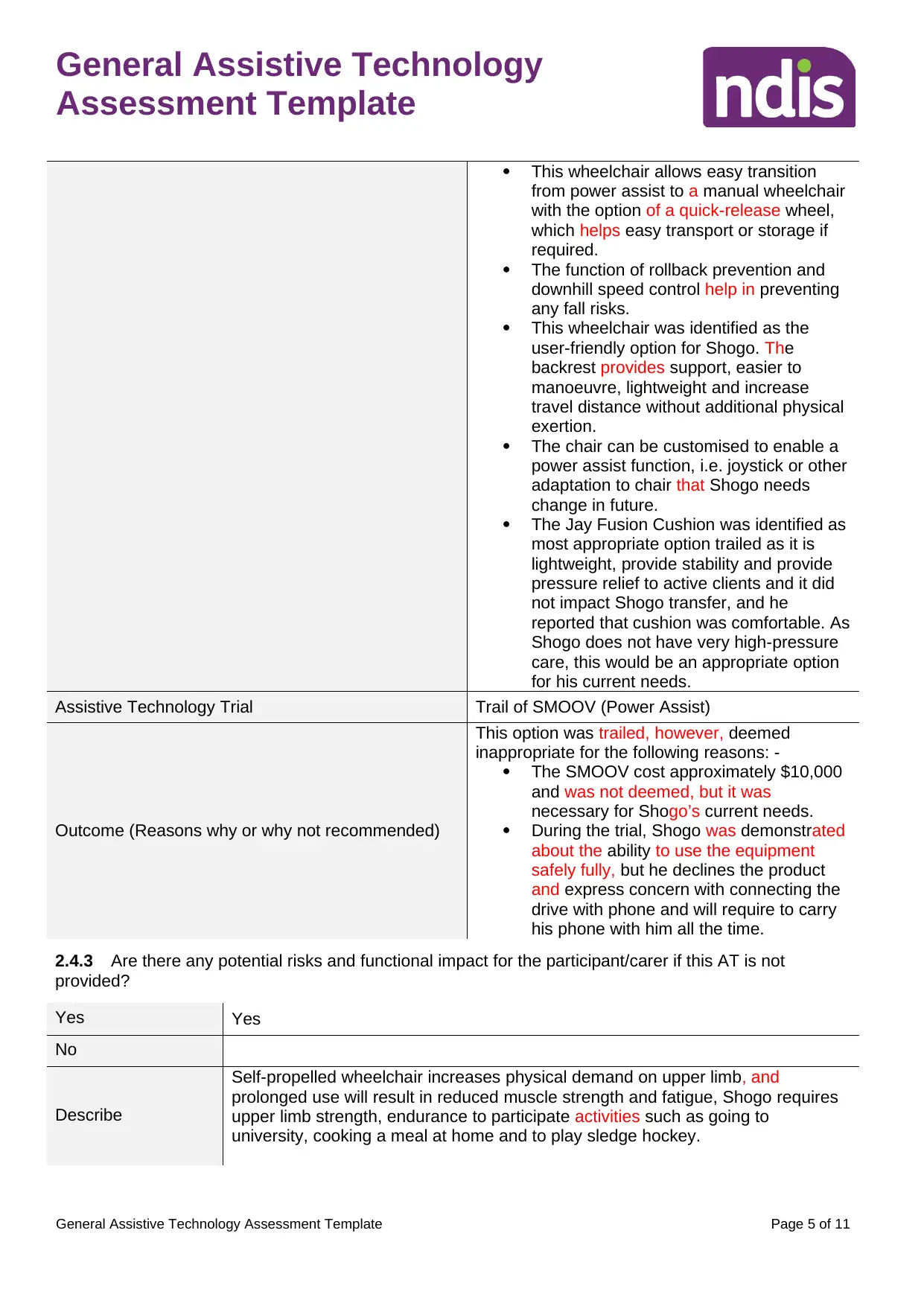
This wheelchair allows easy transition
from power assist to a manual wheelchair
with the option of a quick-release wheel,
which helps easy transport or storage if
required.
The function of rollback prevention and
downhill speed control help in preventing
any fall risks.
This wheelchair was identified as the
user-friendly option for Shogo. The
backrest provides support, easier to
manoeuvre, lightweight and increase
travel distance without additional physical
exertion.
The chair can be customised to enable a
power assist function, i.e. joystick or other
adaptation to chair that Shogo needs
change in future.
The Jay Fusion Cushion was identified as
most appropriate option trailed as it is
lightweight, provide stability and provide
pressure relief to active clients and it did
not impact Shogo transfer, and he
reported that cushion was comfortable. As
Shogo does not have very high-pressure
care, this would be an appropriate option
for his current needs.
Assistive Technology Trial Trail of SMOOV (Power Assist)
Outcome (Reasons why or why not recommended)
This option was trailed, however, deemed
inappropriate for the following reasons: -
The SMOOV cost approximately $10,000
and was not deemed, but it was
necessary for Shogo’s current needs.
During the trial, Shogo was demonstrated
about the ability to use the equipment
safely fully, but he declines the product
and express concern with connecting the
drive with phone and will require to carry
his phone with him all the time.
2.4.3 Are there any potential risks and functional impact for the participant/carer if this AT is not
provided?
Yes Yes
No
Describe
Self-propelled wheelchair increases physical demand on upper limb, and
prolonged use will result in reduced muscle strength and fatigue, Shogo requires
upper limb strength, endurance to participate activities such as going to
university, cooking a meal at home and to play sledge hockey.
General Assistive Technology Assessment Template Page 5 of 11
Assessment Template
This wheelchair allows easy transition
from power assist to a manual wheelchair
with the option of a quick-release wheel,
which helps easy transport or storage if
required.
The function of rollback prevention and
downhill speed control help in preventing
any fall risks.
This wheelchair was identified as the
user-friendly option for Shogo. The
backrest provides support, easier to
manoeuvre, lightweight and increase
travel distance without additional physical
exertion.
The chair can be customised to enable a
power assist function, i.e. joystick or other
adaptation to chair that Shogo needs
change in future.
The Jay Fusion Cushion was identified as
most appropriate option trailed as it is
lightweight, provide stability and provide
pressure relief to active clients and it did
not impact Shogo transfer, and he
reported that cushion was comfortable. As
Shogo does not have very high-pressure
care, this would be an appropriate option
for his current needs.
Assistive Technology Trial Trail of SMOOV (Power Assist)
Outcome (Reasons why or why not recommended)
This option was trailed, however, deemed
inappropriate for the following reasons: -
The SMOOV cost approximately $10,000
and was not deemed, but it was
necessary for Shogo’s current needs.
During the trial, Shogo was demonstrated
about the ability to use the equipment
safely fully, but he declines the product
and express concern with connecting the
drive with phone and will require to carry
his phone with him all the time.
2.4.3 Are there any potential risks and functional impact for the participant/carer if this AT is not
provided?
Yes Yes
No
Describe
Self-propelled wheelchair increases physical demand on upper limb, and
prolonged use will result in reduced muscle strength and fatigue, Shogo requires
upper limb strength, endurance to participate activities such as going to
university, cooking a meal at home and to play sledge hockey.
General Assistive Technology Assessment Template Page 5 of 11
General Assistive Technology
Assessment Template
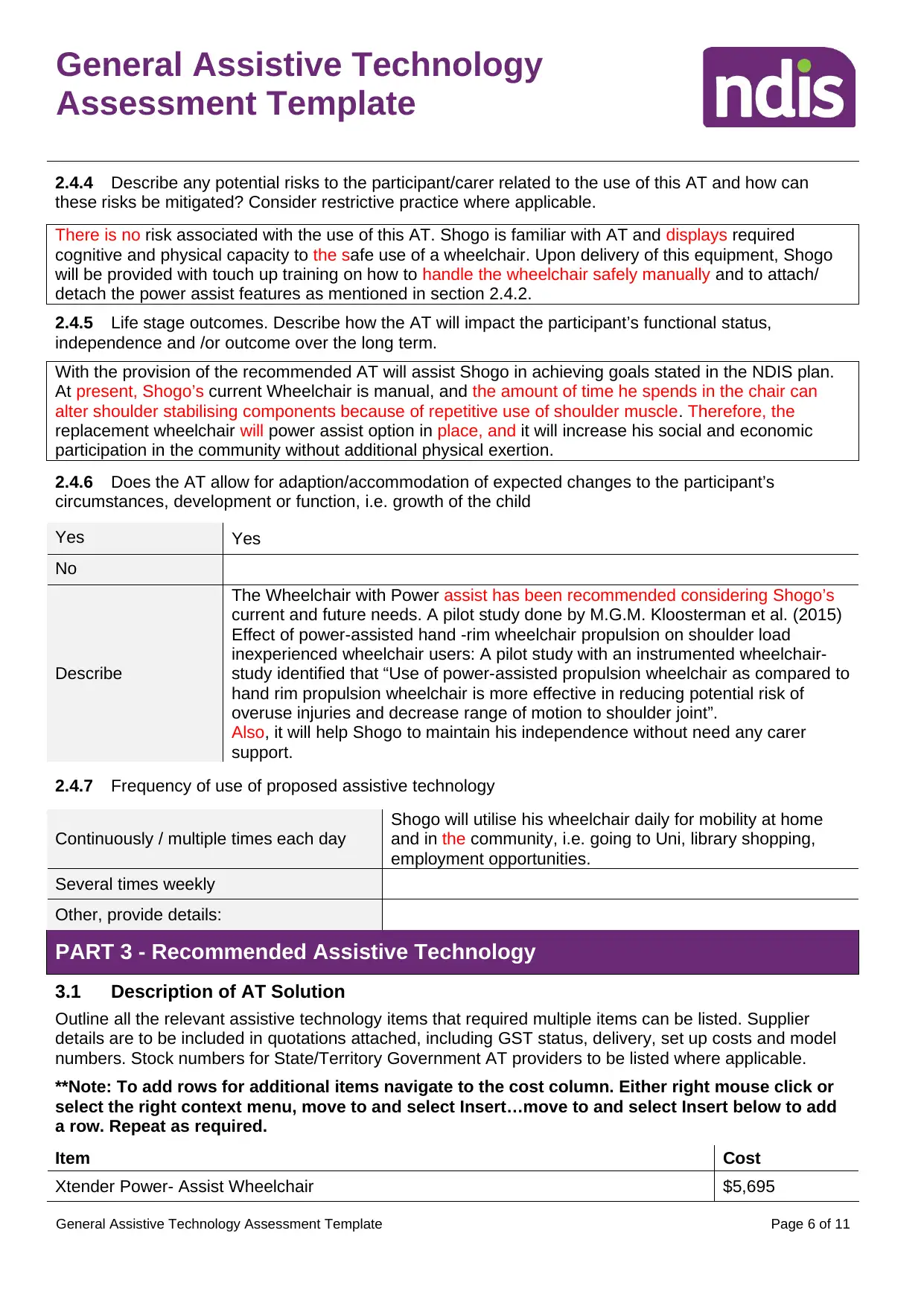
2.4.4 Describe any potential risks to the participant/carer related to the use of this AT and how can
these risks be mitigated? Consider restrictive practice where applicable.
There is no risk associated with the use of this AT. Shogo is familiar with AT and displays required
cognitive and physical capacity to the safe use of a wheelchair. Upon delivery of this equipment, Shogo
will be provided with touch up training on how to handle the wheelchair safely manually and to attach/
detach the power assist features as mentioned in section 2.4.2.
2.4.5 Life stage outcomes. Describe how the AT will impact the participant’s functional status,
independence and /or outcome over the long term.
With the provision of the recommended AT will assist Shogo in achieving goals stated in the NDIS plan.
At present, Shogo’s current Wheelchair is manual, and the amount of time he spends in the chair can
alter shoulder stabilising components because of repetitive use of shoulder muscle. Therefore, the
replacement wheelchair will power assist option in place, and it will increase his social and economic
participation in the community without additional physical exertion.
2.4.6 Does the AT allow for adaption/accommodation of expected changes to the participant’s
circumstances, development or function, i.e. growth of the child
Yes Yes
No
Describe
The Wheelchair with Power assist has been recommended considering Shogo’s
current and future needs. A pilot study done by M.G.M. Kloosterman et al. (2015)
Effect of power-assisted hand -rim wheelchair propulsion on shoulder load
inexperienced wheelchair users: A pilot study with an instrumented wheelchair-
study identified that “Use of power-assisted propulsion wheelchair as compared to
hand rim propulsion wheelchair is more effective in reducing potential risk of
overuse injuries and decrease range of motion to shoulder joint”.
Also, it will help Shogo to maintain his independence without need any carer
support.
2.4.7 Frequency of use of proposed assistive technology
Continuously / multiple times each day
Shogo will utilise his wheelchair daily for mobility at home
and in the community, i.e. going to Uni, library shopping,
employment opportunities.
Several times weekly
Other, provide details:
PART 3 - Recommended Assistive Technology
3.1 Description of AT Solution
Outline all the relevant assistive technology items that required multiple items can be listed. Supplier
details are to be included in quotations attached, including GST status, delivery, set up costs and model
numbers. Stock numbers for State/Territory Government AT providers to be listed where applicable.
**Note: To add rows for additional items navigate to the cost column. Either right mouse click or
select the right context menu, move to and select Insert…move to and select Insert below to add
a row. Repeat as required.
Item Cost
Xtender Power- Assist Wheelchair $5,695
General Assistive Technology Assessment Template Page 6 of 11
Assessment Template
2.4.4 Describe any potential risks to the participant/carer related to the use of this AT and how can
these risks be mitigated? Consider restrictive practice where applicable.
There is no risk associated with the use of this AT. Shogo is familiar with AT and displays required
cognitive and physical capacity to the safe use of a wheelchair. Upon delivery of this equipment, Shogo
will be provided with touch up training on how to handle the wheelchair safely manually and to attach/
detach the power assist features as mentioned in section 2.4.2.
2.4.5 Life stage outcomes. Describe how the AT will impact the participant’s functional status,
independence and /or outcome over the long term.
With the provision of the recommended AT will assist Shogo in achieving goals stated in the NDIS plan.
At present, Shogo’s current Wheelchair is manual, and the amount of time he spends in the chair can
alter shoulder stabilising components because of repetitive use of shoulder muscle. Therefore, the
replacement wheelchair will power assist option in place, and it will increase his social and economic
participation in the community without additional physical exertion.
2.4.6 Does the AT allow for adaption/accommodation of expected changes to the participant’s
circumstances, development or function, i.e. growth of the child
Yes Yes
No
Describe
The Wheelchair with Power assist has been recommended considering Shogo’s
current and future needs. A pilot study done by M.G.M. Kloosterman et al. (2015)
Effect of power-assisted hand -rim wheelchair propulsion on shoulder load
inexperienced wheelchair users: A pilot study with an instrumented wheelchair-
study identified that “Use of power-assisted propulsion wheelchair as compared to
hand rim propulsion wheelchair is more effective in reducing potential risk of
overuse injuries and decrease range of motion to shoulder joint”.
Also, it will help Shogo to maintain his independence without need any carer
support.
2.4.7 Frequency of use of proposed assistive technology
Continuously / multiple times each day
Shogo will utilise his wheelchair daily for mobility at home
and in the community, i.e. going to Uni, library shopping,
employment opportunities.
Several times weekly
Other, provide details:
PART 3 - Recommended Assistive Technology
3.1 Description of AT Solution
Outline all the relevant assistive technology items that required multiple items can be listed. Supplier
details are to be included in quotations attached, including GST status, delivery, set up costs and model
numbers. Stock numbers for State/Territory Government AT providers to be listed where applicable.
**Note: To add rows for additional items navigate to the cost column. Either right mouse click or
select the right context menu, move to and select Insert…move to and select Insert below to add
a row. Repeat as required.
Item Cost
Xtender Power- Assist Wheelchair $5,695
General Assistive Technology Assessment Template Page 6 of 11
⊘ This is a preview!⊘
Do you want full access?
Subscribe today to unlock all pages.
Trusted by 1+ million students worldwide
General Assistive Technology
Assessment Template
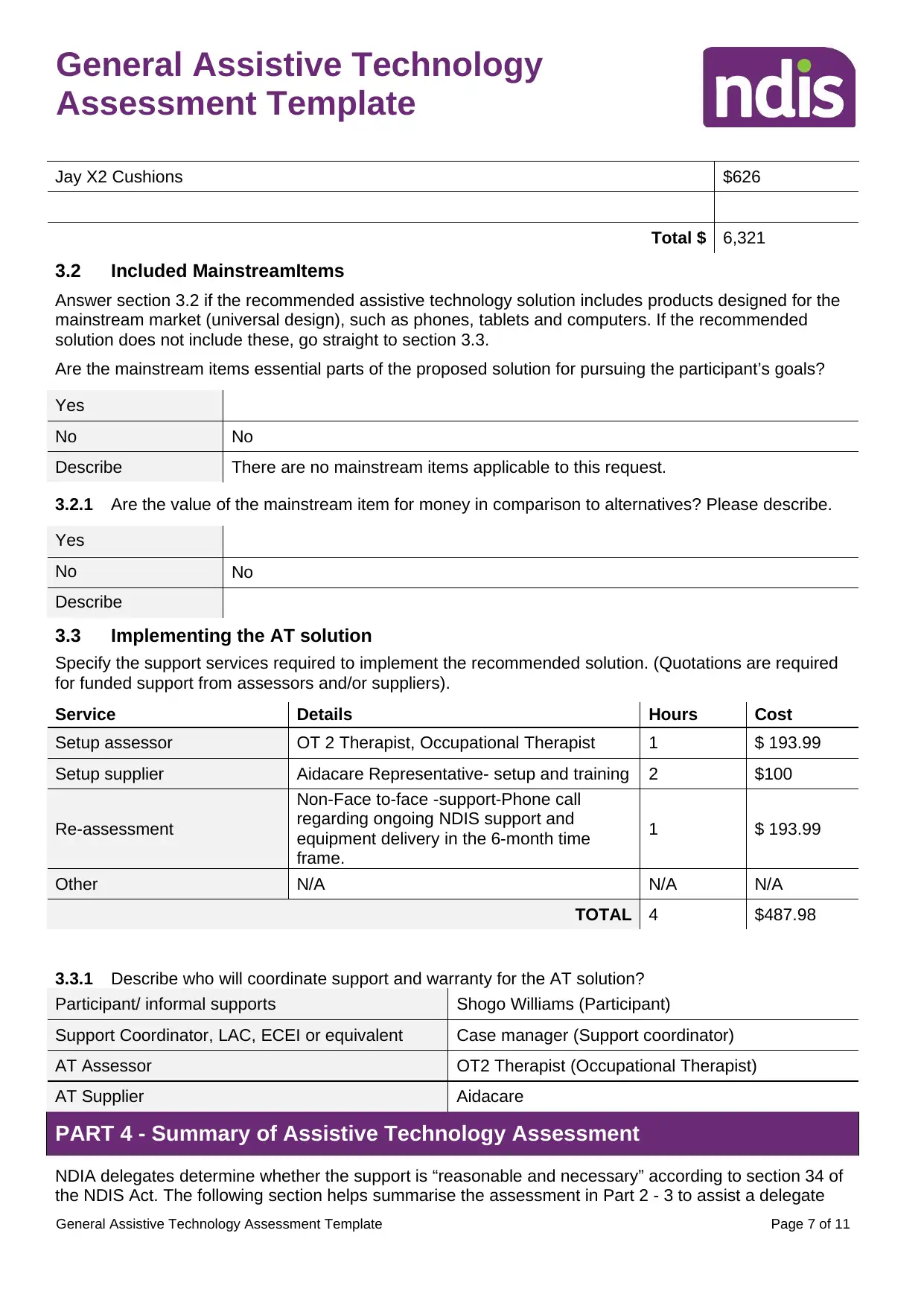
Jay X2 Cushions $626
Total $ 6,321
3.2 Included MainstreamItems
Answer section 3.2 if the recommended assistive technology solution includes products designed for the
mainstream market (universal design), such as phones, tablets and computers. If the recommended
solution does not include these, go straight to section 3.3.
Are the mainstream items essential parts of the proposed solution for pursuing the participant’s goals?
Yes
No No
Describe There are no mainstream items applicable to this request.
3.2.1 Are the value of the mainstream item for money in comparison to alternatives? Please describe.
Yes
No No
Describe
3.3 Implementing the AT solution
Specify the support services required to implement the recommended solution. (Quotations are required
for funded support from assessors and/or suppliers).
Service Details Hours Cost
Setup assessor OT 2 Therapist, Occupational Therapist 1 $ 193.99
Setup supplier Aidacare Representative- setup and training 2 $100
Re-assessment
Non-Face to-face -support-Phone call
regarding ongoing NDIS support and
equipment delivery in the 6-month time
frame.
1 $ 193.99
Other N/A N/A N/A
TOTAL 4 $487.98
3.3.1 Describe who will coordinate support and warranty for the AT solution?
Participant/ informal supports Shogo Williams (Participant)
Support Coordinator, LAC, ECEI or equivalent Case manager (Support coordinator)
AT Assessor OT2 Therapist (Occupational Therapist)
AT Supplier Aidacare
PART 4 - Summary of Assistive Technology Assessment
NDIA delegates determine whether the support is “reasonable and necessary” according to section 34 of
the NDIS Act. The following section helps summarise the assessment in Part 2 - 3 to assist a delegate
General Assistive Technology Assessment Template Page 7 of 11
Assessment Template
Jay X2 Cushions $626
Total $ 6,321
3.2 Included MainstreamItems
Answer section 3.2 if the recommended assistive technology solution includes products designed for the
mainstream market (universal design), such as phones, tablets and computers. If the recommended
solution does not include these, go straight to section 3.3.
Are the mainstream items essential parts of the proposed solution for pursuing the participant’s goals?
Yes
No No
Describe There are no mainstream items applicable to this request.
3.2.1 Are the value of the mainstream item for money in comparison to alternatives? Please describe.
Yes
No No
Describe
3.3 Implementing the AT solution
Specify the support services required to implement the recommended solution. (Quotations are required
for funded support from assessors and/or suppliers).
Service Details Hours Cost
Setup assessor OT 2 Therapist, Occupational Therapist 1 $ 193.99
Setup supplier Aidacare Representative- setup and training 2 $100
Re-assessment
Non-Face to-face -support-Phone call
regarding ongoing NDIS support and
equipment delivery in the 6-month time
frame.
1 $ 193.99
Other N/A N/A N/A
TOTAL 4 $487.98
3.3.1 Describe who will coordinate support and warranty for the AT solution?
Participant/ informal supports Shogo Williams (Participant)
Support Coordinator, LAC, ECEI or equivalent Case manager (Support coordinator)
AT Assessor OT2 Therapist (Occupational Therapist)
AT Supplier Aidacare
PART 4 - Summary of Assistive Technology Assessment
NDIA delegates determine whether the support is “reasonable and necessary” according to section 34 of
the NDIS Act. The following section helps summarise the assessment in Part 2 - 3 to assist a delegate
General Assistive Technology Assessment Template Page 7 of 11
Paraphrase This Document
Need a fresh take? Get an instant paraphrase of this document with our AI Paraphraser
General Assistive Technology
Assessment Template
decision. If the rationale is already outlined earlier, please cite section as appropriate.
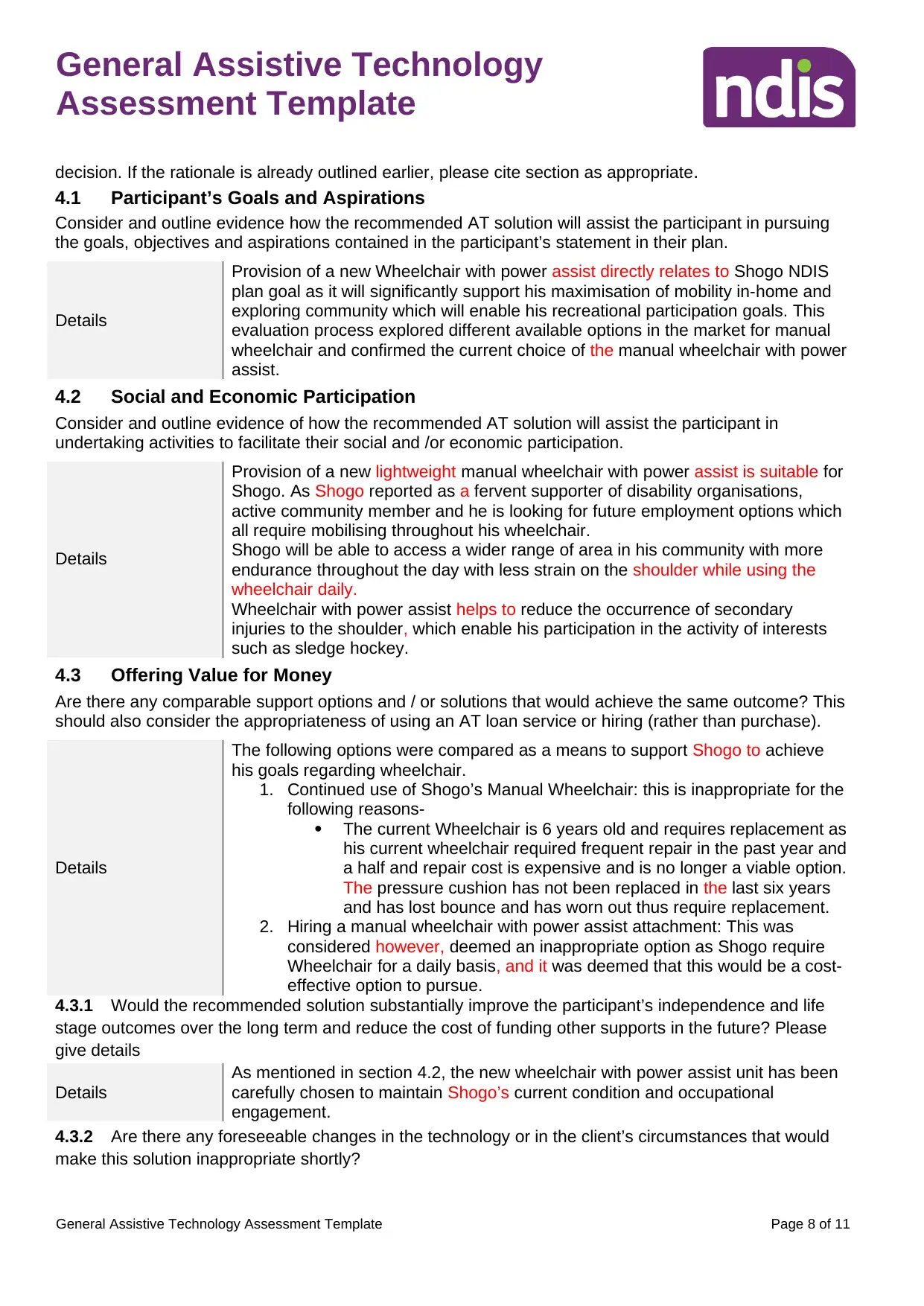
4.1 Participant’s Goals and Aspirations
Consider and outline evidence how the recommended AT solution will assist the participant in pursuing
the goals, objectives and aspirations contained in the participant’s statement in their plan.
Details
Provision of a new Wheelchair with power assist directly relates to Shogo NDIS
plan goal as it will significantly support his maximisation of mobility in-home and
exploring community which will enable his recreational participation goals. This
evaluation process explored different available options in the market for manual
wheelchair and confirmed the current choice of the manual wheelchair with power
assist.
4.2 Social and Economic Participation
Consider and outline evidence of how the recommended AT solution will assist the participant in
undertaking activities to facilitate their social and /or economic participation.
Details
Provision of a new lightweight manual wheelchair with power assist is suitable for
Shogo. As Shogo reported as a fervent supporter of disability organisations,
active community member and he is looking for future employment options which
all require mobilising throughout his wheelchair.
Shogo will be able to access a wider range of area in his community with more
endurance throughout the day with less strain on the shoulder while using the
wheelchair daily.
Wheelchair with power assist helps to reduce the occurrence of secondary
injuries to the shoulder, which enable his participation in the activity of interests
such as sledge hockey.
4.3 Offering Value for Money
Are there any comparable support options and / or solutions that would achieve the same outcome? This
should also consider the appropriateness of using an AT loan service or hiring (rather than purchase).
Details
The following options were compared as a means to support Shogo to achieve
his goals regarding wheelchair.
1. Continued use of Shogo’s Manual Wheelchair: this is inappropriate for the
following reasons-
The current Wheelchair is 6 years old and requires replacement as
his current wheelchair required frequent repair in the past year and
a half and repair cost is expensive and is no longer a viable option.
The pressure cushion has not been replaced in the last six years
and has lost bounce and has worn out thus require replacement.
2. Hiring a manual wheelchair with power assist attachment: This was
considered however, deemed an inappropriate option as Shogo require
Wheelchair for a daily basis, and it was deemed that this would be a cost-
effective option to pursue.
4.3.1 Would the recommended solution substantially improve the participant’s independence and life
stage outcomes over the long term and reduce the cost of funding other supports in the future? Please
give details
Details
As mentioned in section 4.2, the new wheelchair with power assist unit has been
carefully chosen to maintain Shogo’s current condition and occupational
engagement.
4.3.2 Are there any foreseeable changes in the technology or in the client’s circumstances that would
make this solution inappropriate shortly?
General Assistive Technology Assessment Template Page 8 of 11
Assessment Template
decision. If the rationale is already outlined earlier, please cite section as appropriate.
4.1 Participant’s Goals and Aspirations
Consider and outline evidence how the recommended AT solution will assist the participant in pursuing
the goals, objectives and aspirations contained in the participant’s statement in their plan.
Details
Provision of a new Wheelchair with power assist directly relates to Shogo NDIS
plan goal as it will significantly support his maximisation of mobility in-home and
exploring community which will enable his recreational participation goals. This
evaluation process explored different available options in the market for manual
wheelchair and confirmed the current choice of the manual wheelchair with power
assist.
4.2 Social and Economic Participation
Consider and outline evidence of how the recommended AT solution will assist the participant in
undertaking activities to facilitate their social and /or economic participation.
Details
Provision of a new lightweight manual wheelchair with power assist is suitable for
Shogo. As Shogo reported as a fervent supporter of disability organisations,
active community member and he is looking for future employment options which
all require mobilising throughout his wheelchair.
Shogo will be able to access a wider range of area in his community with more
endurance throughout the day with less strain on the shoulder while using the
wheelchair daily.
Wheelchair with power assist helps to reduce the occurrence of secondary
injuries to the shoulder, which enable his participation in the activity of interests
such as sledge hockey.
4.3 Offering Value for Money
Are there any comparable support options and / or solutions that would achieve the same outcome? This
should also consider the appropriateness of using an AT loan service or hiring (rather than purchase).
Details
The following options were compared as a means to support Shogo to achieve
his goals regarding wheelchair.
1. Continued use of Shogo’s Manual Wheelchair: this is inappropriate for the
following reasons-
The current Wheelchair is 6 years old and requires replacement as
his current wheelchair required frequent repair in the past year and
a half and repair cost is expensive and is no longer a viable option.
The pressure cushion has not been replaced in the last six years
and has lost bounce and has worn out thus require replacement.
2. Hiring a manual wheelchair with power assist attachment: This was
considered however, deemed an inappropriate option as Shogo require
Wheelchair for a daily basis, and it was deemed that this would be a cost-
effective option to pursue.
4.3.1 Would the recommended solution substantially improve the participant’s independence and life
stage outcomes over the long term and reduce the cost of funding other supports in the future? Please
give details
Details
As mentioned in section 4.2, the new wheelchair with power assist unit has been
carefully chosen to maintain Shogo’s current condition and occupational
engagement.
4.3.2 Are there any foreseeable changes in the technology or in the client’s circumstances that would
make this solution inappropriate shortly?
General Assistive Technology Assessment Template Page 8 of 11
General Assistive Technology
Assessment Template
Yes
No No
Comment
4.4 Effective and Beneficial Support
Having regard to evidenced-based practice, what evidence indicates the proposed AT solution will be or
is likely to be, effective and beneficial for the participant? (e.g. past participant experience of same AT)
Strong/modest/
case study/ past AT
use/lived experience
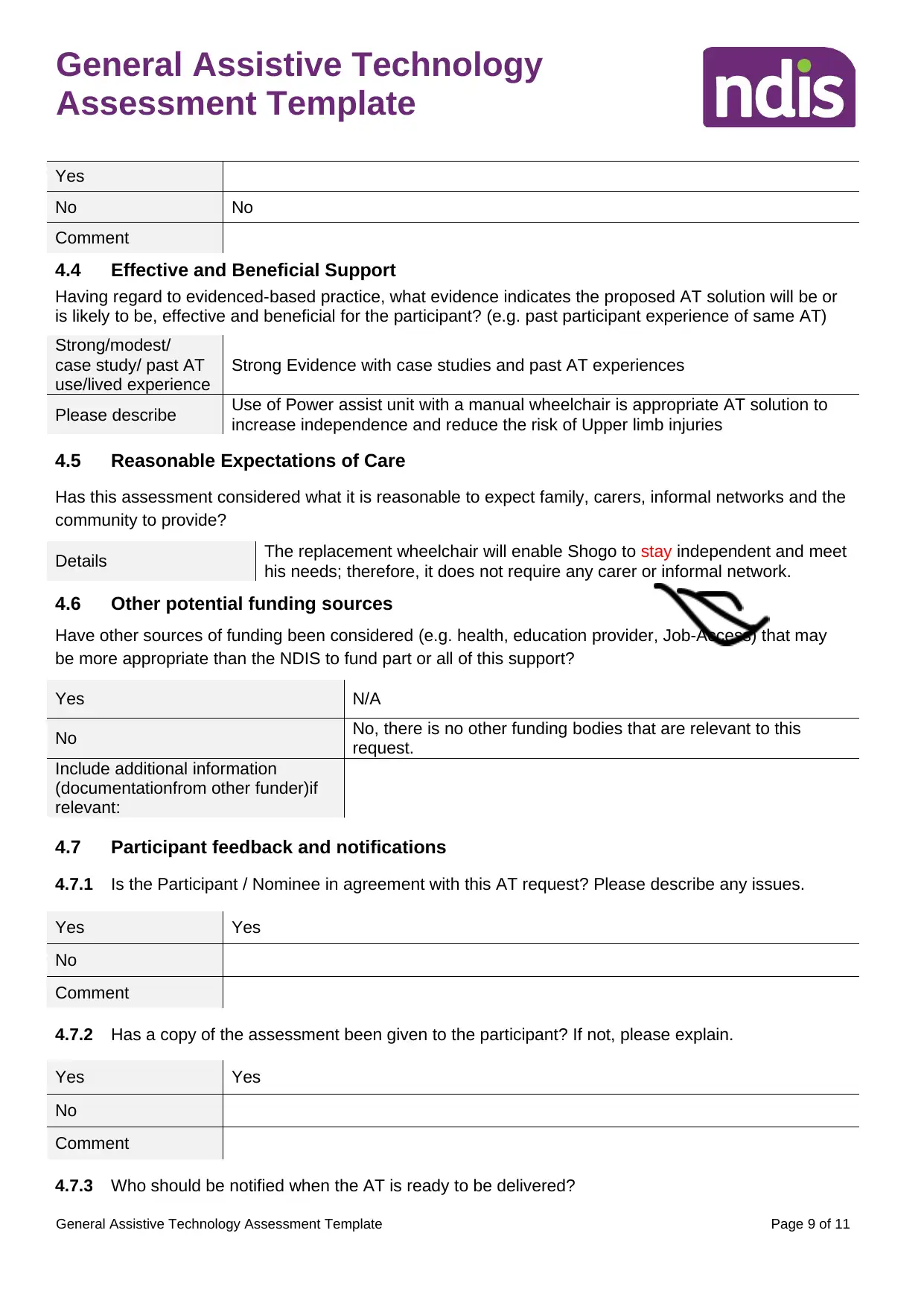
Strong Evidence with case studies and past AT experiences
Please describe Use of Power assist unit with a manual wheelchair is appropriate AT solution to
increase independence and reduce the risk of Upper limb injuries
4.5 Reasonable Expectations of Care
Has this assessment considered what it is reasonable to expect family, carers, informal networks and the
community to provide?
Details The replacement wheelchair will enable Shogo to stay independent and meet
his needs; therefore, it does not require any carer or informal network.
4.6 Other potential funding sources
Have other sources of funding been considered (e.g. health, education provider, Job-Access) that may
be more appropriate than the NDIS to fund part or all of this support?
Yes N/A
No No, there is no other funding bodies that are relevant to this
request.
Include additional information
(documentationfrom other funder)if
relevant:
4.7 Participant feedback and notifications
4.7.1 Is the Participant / Nominee in agreement with this AT request? Please describe any issues.
Yes Yes
No
Comment
4.7.2 Has a copy of the assessment been given to the participant? If not, please explain.
Yes Yes
No
Comment
4.7.3 Who should be notified when the AT is ready to be delivered?
General Assistive Technology Assessment Template Page 9 of 11
Assessment Template
Yes
No No
Comment
4.4 Effective and Beneficial Support
Having regard to evidenced-based practice, what evidence indicates the proposed AT solution will be or
is likely to be, effective and beneficial for the participant? (e.g. past participant experience of same AT)
Strong/modest/
case study/ past AT
use/lived experience
Strong Evidence with case studies and past AT experiences
Please describe Use of Power assist unit with a manual wheelchair is appropriate AT solution to
increase independence and reduce the risk of Upper limb injuries
4.5 Reasonable Expectations of Care
Has this assessment considered what it is reasonable to expect family, carers, informal networks and the
community to provide?
Details The replacement wheelchair will enable Shogo to stay independent and meet
his needs; therefore, it does not require any carer or informal network.
4.6 Other potential funding sources
Have other sources of funding been considered (e.g. health, education provider, Job-Access) that may
be more appropriate than the NDIS to fund part or all of this support?
Yes N/A
No No, there is no other funding bodies that are relevant to this
request.
Include additional information
(documentationfrom other funder)if
relevant:
4.7 Participant feedback and notifications
4.7.1 Is the Participant / Nominee in agreement with this AT request? Please describe any issues.
Yes Yes
No
Comment
4.7.2 Has a copy of the assessment been given to the participant? If not, please explain.
Yes Yes
No
Comment
4.7.3 Who should be notified when the AT is ready to be delivered?
General Assistive Technology Assessment Template Page 9 of 11
⊘ This is a preview!⊘
Do you want full access?
Subscribe today to unlock all pages.
Trusted by 1+ million students worldwide
General Assistive Technology
Assessment Template
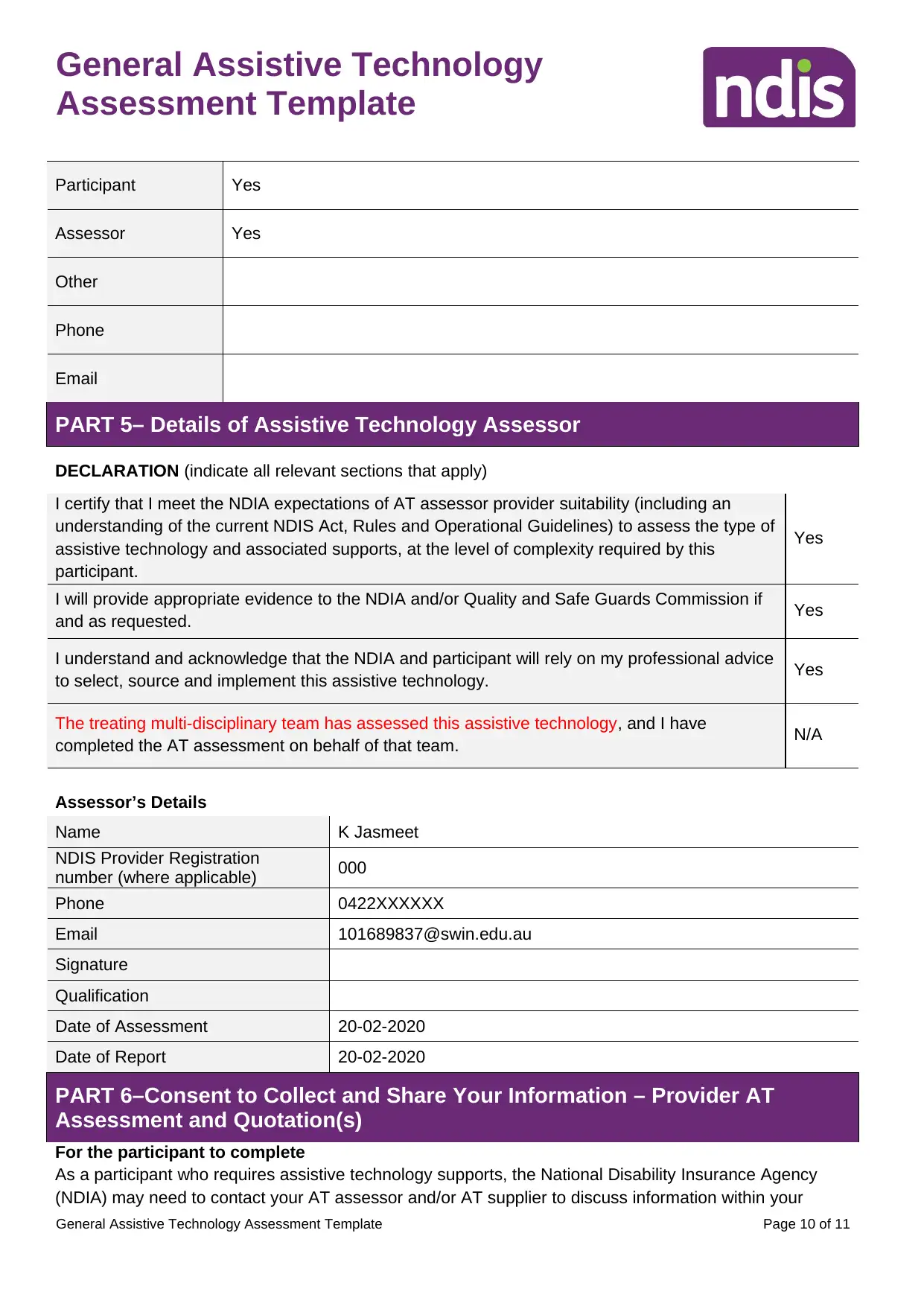
Participant Yes
Assessor Yes
Other
Phone
Email
PART 5– Details of Assistive Technology Assessor
DECLARATION (indicate all relevant sections that apply)
I certify that I meet the NDIA expectations of AT assessor provider suitability (including an
understanding of the current NDIS Act, Rules and Operational Guidelines) to assess the type of
assistive technology and associated supports, at the level of complexity required by this
participant.
Yes
I will provide appropriate evidence to the NDIA and/or Quality and Safe Guards Commission if
and as requested. Yes
I understand and acknowledge that the NDIA and participant will rely on my professional advice
to select, source and implement this assistive technology. Yes
The treating multi-disciplinary team has assessed this assistive technology, and I have
completed the AT assessment on behalf of that team. N/A
Assessor’s Details
Name K Jasmeet
NDIS Provider Registration
number (where applicable) 000
Phone 0422XXXXXX
Email 101689837@swin.edu.au
Signature
Qualification
Date of Assessment 20-02-2020
Date of Report 20-02-2020
PART 6–Consent to Collect and Share Your Information – Provider AT
Assessment and Quotation(s)
For the participant to complete
As a participant who requires assistive technology supports, the National Disability Insurance Agency
(NDIA) may need to contact your AT assessor and/or AT supplier to discuss information within your
General Assistive Technology Assessment Template Page 10 of 11
Assessment Template
Participant Yes
Assessor Yes
Other
Phone
PART 5– Details of Assistive Technology Assessor
DECLARATION (indicate all relevant sections that apply)
I certify that I meet the NDIA expectations of AT assessor provider suitability (including an
understanding of the current NDIS Act, Rules and Operational Guidelines) to assess the type of
assistive technology and associated supports, at the level of complexity required by this
participant.
Yes
I will provide appropriate evidence to the NDIA and/or Quality and Safe Guards Commission if
and as requested. Yes
I understand and acknowledge that the NDIA and participant will rely on my professional advice
to select, source and implement this assistive technology. Yes
The treating multi-disciplinary team has assessed this assistive technology, and I have
completed the AT assessment on behalf of that team. N/A
Assessor’s Details
Name K Jasmeet
NDIS Provider Registration
number (where applicable) 000
Phone 0422XXXXXX
Email 101689837@swin.edu.au
Signature
Qualification
Date of Assessment 20-02-2020
Date of Report 20-02-2020
PART 6–Consent to Collect and Share Your Information – Provider AT
Assessment and Quotation(s)
For the participant to complete
As a participant who requires assistive technology supports, the National Disability Insurance Agency
(NDIA) may need to contact your AT assessor and/or AT supplier to discuss information within your
General Assistive Technology Assessment Template Page 10 of 11
Paraphrase This Document
Need a fresh take? Get an instant paraphrase of this document with our AI Paraphraser
General Assistive Technology
Assessment Template
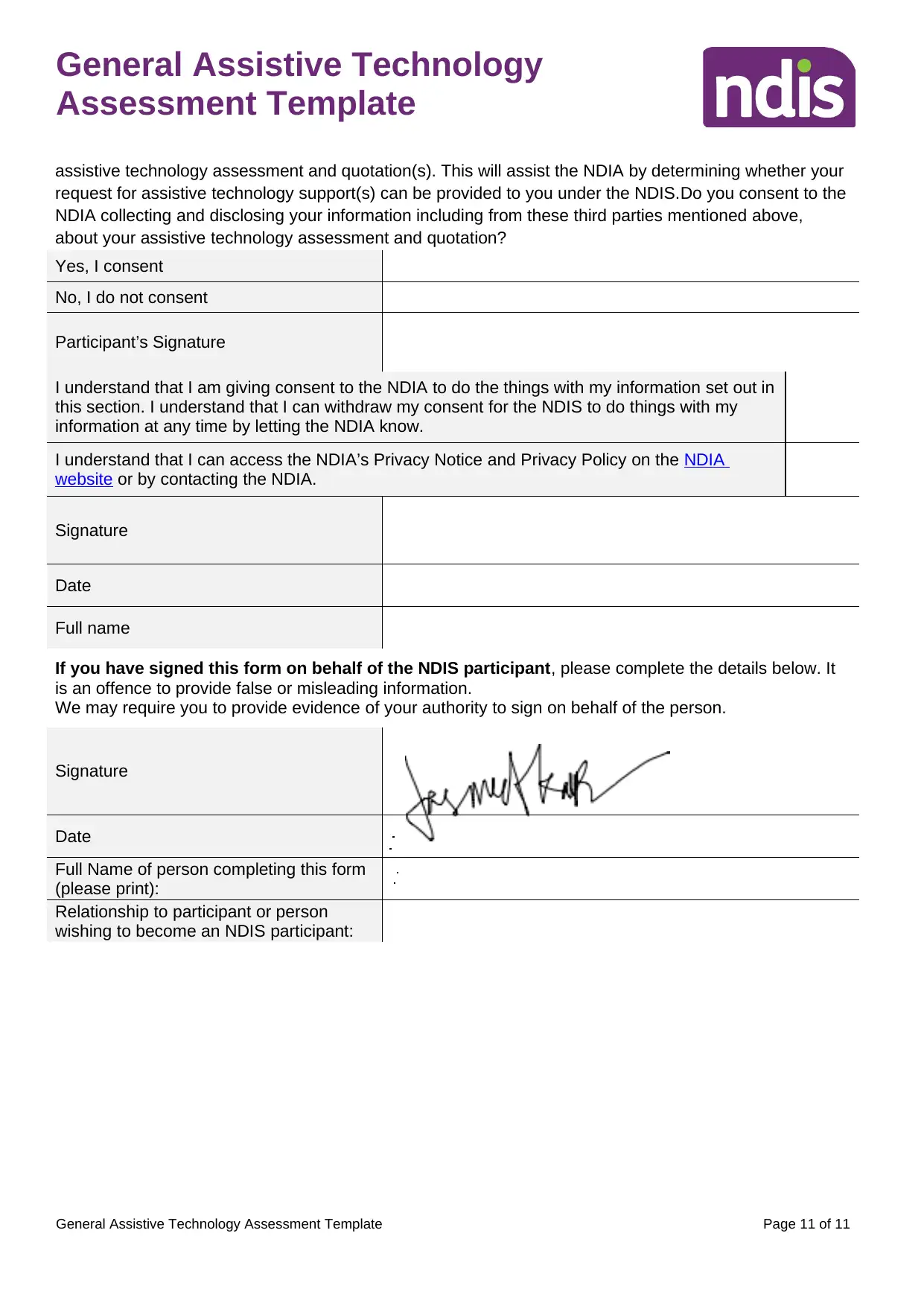
assistive technology assessment and quotation(s). This will assist the NDIA by determining whether your
request for assistive technology support(s) can be provided to you under the NDIS.Do you consent to the
NDIA collecting and disclosing your information including from these third parties mentioned above,
about your assistive technology assessment and quotation?
Yes, I consent
No, I do not consent
Participant’s Signature
I understand that I am giving consent to the NDIA to do the things with my information set out in
this section. I understand that I can withdraw my consent for the NDIS to do things with my
information at any time by letting the NDIA know.
I understand that I can access the NDIA’s Privacy Notice and Privacy Policy on the NDIA
website or by contacting the NDIA.
Signature
Date
Full name
If you have signed this form on behalf of the NDIS participant, please complete the details below. It
is an offence to provide false or misleading information.
We may require you to provide evidence of your authority to sign on behalf of the person.
Signature
Date
Full Name of person completing this form
(please print):
Relationship to participant or person
wishing to become an NDIS participant:
General Assistive Technology Assessment Template Page 11 of 11
Assessment Template
assistive technology assessment and quotation(s). This will assist the NDIA by determining whether your
request for assistive technology support(s) can be provided to you under the NDIS.Do you consent to the
NDIA collecting and disclosing your information including from these third parties mentioned above,
about your assistive technology assessment and quotation?
Yes, I consent
No, I do not consent
Participant’s Signature
I understand that I am giving consent to the NDIA to do the things with my information set out in
this section. I understand that I can withdraw my consent for the NDIS to do things with my
information at any time by letting the NDIA know.
I understand that I can access the NDIA’s Privacy Notice and Privacy Policy on the NDIA
website or by contacting the NDIA.
Signature
Date
Full name
If you have signed this form on behalf of the NDIS participant, please complete the details below. It
is an offence to provide false or misleading information.
We may require you to provide evidence of your authority to sign on behalf of the person.
Signature
Date
Full Name of person completing this form
(please print):
Relationship to participant or person
wishing to become an NDIS participant:
General Assistive Technology Assessment Template Page 11 of 11

1 out of 11


Your All-in-One AI-Powered Toolkit for Academic Success.
+13062052269
info@desklib.com
Available 24*7 on WhatsApp / Email
![[object Object]](/_next/static/media/star-bottom.7253800d.svg)
Unlock your academic potential
Copyright © 2020–2026 A2Z Services. All Rights Reserved. Developed and managed by ZUCOL.