Genetic Engineering: Transgenic Crops and Australian Development
VerifiedAdded on 2022/12/27
|13
|2588
|2
Essay
AI Summary
This essay examines the application of genetic engineering, particularly focusing on the development and growth of Australia. It begins by introducing the concept of genetic engineering, recombinant DNA technology, and its historical context, highlighting the early experiments by Mendel and the advancements in the field. The essay then delves into the background of genetic engineering, explaining its methods and significance in modifying organisms. It explores the benefits of transgenic crops in increasing food production, particularly in the context of Australia, and the regulatory framework governing GM crops in the country. The essay also discusses specific examples like GM cotton and DHA canola and their contributions to the Australian economy. It further evaluates the marketing perspective of biotechnology and addresses the environmental and ethical concerns associated with GMOs, including potential risks like genetic contamination and effects on the environment. Finally, the essay concludes by acknowledging the potential of genetic engineering for development while emphasizing the need for further research and balanced risk management.
Running head: GENETIC ENGINEERING
Genetic Engineering
Name of the student
Name of the university
Author’s name
Genetic Engineering
Name of the student
Name of the university
Author’s name

Paraphrase This Document
Need a fresh take? Get an instant paraphrase of this document with our AI Paraphraser
1GENETIC ENGINEERING
Rationale
Now a day, there are various movies like “Hulk,” which shows the example of genetic
engineering. However, the film described only an idea which can be possible in the distant future
as genetic engineering is a compassionate field. It is the direct manipulation of the heritable and
non-heritable genetic components of species (Rietveld, 2019).
Gregor Mendel, through his experiments on pea plants, found the science behind the law
of inheritance. Mendel took eight years to continue his operations and research on pea plants
form 1856-1863. Till then, no one had the idea that what Mendel was doing and how those
experiments will change the future (Gayon, 2016). Mendel published his first experimental study
in 1865 (Campanile, Lederman & Kampourakis, 2015). Till then everyone was having a series of
questions like “How can these genetics benefit everybody?” or “How is this procedure
occurring?” or “How are the genes cross-linking and replicating and forming its copies?”
It has been 30,000 years since when humans have been altering the genes of the different
species. It was in the year 1972 when the first direct transfer of DNA of one organism was
transferred to another. This experiment was conducted by Herbert Boyer and Stanley Cohen
(Dwivedi, Kumar & Verma, 2019). It was in 1972 when Boyer and Cohen founded the
recombinant DNA technology, where they for the first time used restriction enzyme and DNA
ligase. However, those times faced a single issue, which was inadequate knowledge and things
required for the progress in the field of genetics. As time passed, several progressions were made
in recombinant DNA technology which boosted the field of genetic engineering. This helped in
solving and meeting different challenges of human, animal, and plant sciences. Therefore, this
Rationale
Now a day, there are various movies like “Hulk,” which shows the example of genetic
engineering. However, the film described only an idea which can be possible in the distant future
as genetic engineering is a compassionate field. It is the direct manipulation of the heritable and
non-heritable genetic components of species (Rietveld, 2019).
Gregor Mendel, through his experiments on pea plants, found the science behind the law
of inheritance. Mendel took eight years to continue his operations and research on pea plants
form 1856-1863. Till then, no one had the idea that what Mendel was doing and how those
experiments will change the future (Gayon, 2016). Mendel published his first experimental study
in 1865 (Campanile, Lederman & Kampourakis, 2015). Till then everyone was having a series of
questions like “How can these genetics benefit everybody?” or “How is this procedure
occurring?” or “How are the genes cross-linking and replicating and forming its copies?”
It has been 30,000 years since when humans have been altering the genes of the different
species. It was in the year 1972 when the first direct transfer of DNA of one organism was
transferred to another. This experiment was conducted by Herbert Boyer and Stanley Cohen
(Dwivedi, Kumar & Verma, 2019). It was in 1972 when Boyer and Cohen founded the
recombinant DNA technology, where they for the first time used restriction enzyme and DNA
ligase. However, those times faced a single issue, which was inadequate knowledge and things
required for the progress in the field of genetics. As time passed, several progressions were made
in recombinant DNA technology which boosted the field of genetic engineering. This helped in
solving and meeting different challenges of human, animal, and plant sciences. Therefore, this

2GENETIC ENGINEERING
essay proposes the following question – “How the approach of transgenic crops does help in
the development and growth of Australia?”
essay proposes the following question – “How the approach of transgenic crops does help in
the development and growth of Australia?”
⊘ This is a preview!⊘
Do you want full access?
Subscribe today to unlock all pages.

Trusted by 1+ million students worldwide
3GENETIC ENGINEERING
Background
Genetic engineering is known as the recombinant DNA technology consists of various
types of techniques which slices and links the genetic material, especially DNA from the
different biological organisms which result in the formation of a new kind of genetic component.
Genetic engineering is a tool that is capable of changing or moderating life on earth (Rosenberg,
2017). The essence of this tool is to alter the genes back and forth, not only in between the line of
organisms but also among the different limits that divide all the living species. The outcome will
be a new species, self-propagating and will remain everlasting (Rosenberg, 2017).
Unlike the old methods of animal and plant breeding, where the technique comprised of
multiple steps in which the organism was selected initially with the desired phenotype; however,
in the genetic engineering genes are directly taken from one body and inserted into the other
body without any further multiple steps. It is a very significant approach as it enables to study the
function of numerous and specific genes (Alexander, 2003). Recently all the production of drugs,
vaccines or any other bioproduct like GMO’s is constructed with the help of genetic engineering
(Nielsen, 2013).
Background
Genetic engineering is known as the recombinant DNA technology consists of various
types of techniques which slices and links the genetic material, especially DNA from the
different biological organisms which result in the formation of a new kind of genetic component.
Genetic engineering is a tool that is capable of changing or moderating life on earth (Rosenberg,
2017). The essence of this tool is to alter the genes back and forth, not only in between the line of
organisms but also among the different limits that divide all the living species. The outcome will
be a new species, self-propagating and will remain everlasting (Rosenberg, 2017).
Unlike the old methods of animal and plant breeding, where the technique comprised of
multiple steps in which the organism was selected initially with the desired phenotype; however,
in the genetic engineering genes are directly taken from one body and inserted into the other
body without any further multiple steps. It is a very significant approach as it enables to study the
function of numerous and specific genes (Alexander, 2003). Recently all the production of drugs,
vaccines or any other bioproduct like GMO’s is constructed with the help of genetic engineering
(Nielsen, 2013).
Paraphrase This Document
Need a fresh take? Get an instant paraphrase of this document with our AI Paraphraser
4GENETIC ENGINEERING
Evidence
According to a world’s demographic study, the world’s population is expected to increase
by three-fold more by the year 2050 than compared to the current population. This will cause the
rise of several issues out of which the primary concern will be food security. Thus, it is
mandatory to double or triple the rate of food production to feed the almost 8 billion people,
majority of the population of whom will reside in the developing countries (Herrera & Estrella,
2000). This challenge will be much more elevated by the further issue which is the declining
shortage of water and the fact that the new food which needs to be produced on the current
amount of agricultural land if the forest regions of the surrounding as a whole are to be
conserved. Different methods are there through which production of the food can be augmented
in an ecological approach such as using organic manures, enhanced control of the pests,
preservation of land materials and water, utilization of different types of enhanced plants created
through conventional or genetic technique. Out of all these, the better application belongs to the
biotechnological assets, which are the transgenic plant varieties. They have better capability
towards enhancing agricultural production when they are included in the traditional farming
systems (Herrera & Estrella, 2000).
All the gene technology and the GM approaches conducted in Australia are performed
according to the Australian legislation, and they all follow the regulations which are set by the
Office of the Gene Technology Regulator. There are various types of genetic engineering
approaches such as the simple selection, crossing, interspecies crossing, somatic hybridization,
cell selection process, microinjection and many more procedures. Australia started using various
GM technologies on developing cotton varieties since 1984. Due to this, there have been
Evidence
According to a world’s demographic study, the world’s population is expected to increase
by three-fold more by the year 2050 than compared to the current population. This will cause the
rise of several issues out of which the primary concern will be food security. Thus, it is
mandatory to double or triple the rate of food production to feed the almost 8 billion people,
majority of the population of whom will reside in the developing countries (Herrera & Estrella,
2000). This challenge will be much more elevated by the further issue which is the declining
shortage of water and the fact that the new food which needs to be produced on the current
amount of agricultural land if the forest regions of the surrounding as a whole are to be
conserved. Different methods are there through which production of the food can be augmented
in an ecological approach such as using organic manures, enhanced control of the pests,
preservation of land materials and water, utilization of different types of enhanced plants created
through conventional or genetic technique. Out of all these, the better application belongs to the
biotechnological assets, which are the transgenic plant varieties. They have better capability
towards enhancing agricultural production when they are included in the traditional farming
systems (Herrera & Estrella, 2000).
All the gene technology and the GM approaches conducted in Australia are performed
according to the Australian legislation, and they all follow the regulations which are set by the
Office of the Gene Technology Regulator. There are various types of genetic engineering
approaches such as the simple selection, crossing, interspecies crossing, somatic hybridization,
cell selection process, microinjection and many more procedures. Australia started using various
GM technologies on developing cotton varieties since 1984. Due to this, there have been
5GENETIC ENGINEERING
enormous improvements were made. Now, Australia has the highest cotton yield in the world. It
also exports $2.5 billion of cotton per year.
Along with GM cotton, Australia is also responsible for growing GM DHA canola. They
produce high quality oils which are rich in docosahexaenoic acid. This has a benefit as this
nutrient is only found in the algae found in the ocean. This will help in decreasing the world’s
overall demand for fishes and will help in increasing the demand for DHA canola. Thus, this will
increase the export of DHA canola and will assist directly in developing Australia (Gilbert,
2016) (Australian Government, 2019).
According to the Australia New Zealand food standard code, the GM crops can only be
produced using the permitted gene technologies. Such as the Canola can be created using the
herbicide-tolerant canola line GT73 or from herbicide-tolerant canola line Westar-Oxy-235. The
GM cotton can be developed using the insect-protected cotton lines 531, 757 and 1076 or
herbicide-tolerant cotton line 1445. There are various other gene technology methods through
which the GM crops can be produced which are listed in the Australia New Zealand Food
Standards Code - Standard 1.5.2 - Food Produced Using Gene Technology (Australian
Government, 2019).
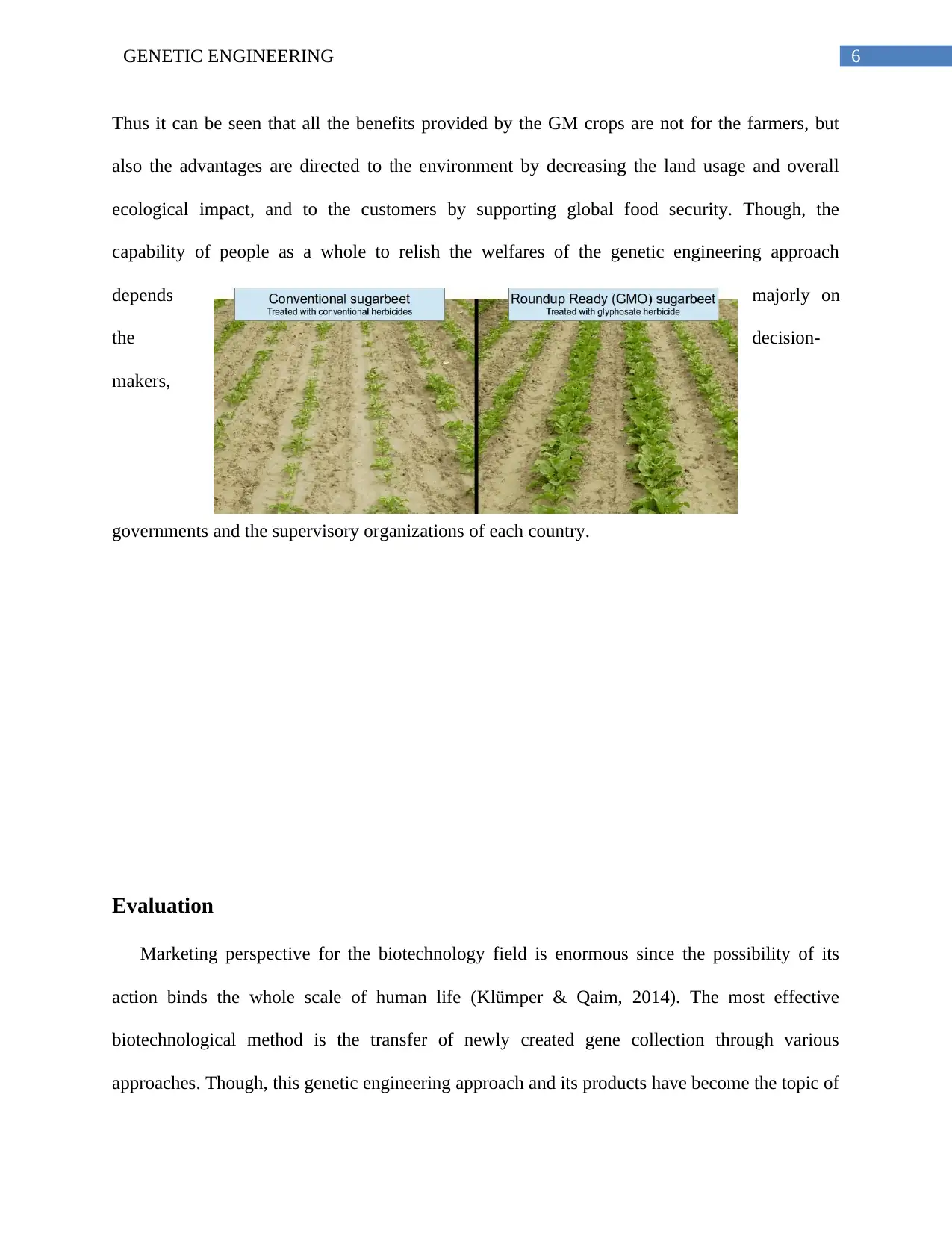
If the focus is shifted towards the herbicide-tolerant GM crops, it is seen that they have better
management of harmful weeds and allow the acceptance of more eco-friendly phytosanitary
components, as well as ecological no-till farming practices. The decrease in the loss of crops due
to the pests, viruses, and weeds that strive for all the soil elements, together with savings in
phytosanitary components and fuel, ultimately enhances the final harvest when linked with
conventional crops.
enormous improvements were made. Now, Australia has the highest cotton yield in the world. It
also exports $2.5 billion of cotton per year.
Along with GM cotton, Australia is also responsible for growing GM DHA canola. They
produce high quality oils which are rich in docosahexaenoic acid. This has a benefit as this
nutrient is only found in the algae found in the ocean. This will help in decreasing the world’s
overall demand for fishes and will help in increasing the demand for DHA canola. Thus, this will
increase the export of DHA canola and will assist directly in developing Australia (Gilbert,
2016) (Australian Government, 2019).
According to the Australia New Zealand food standard code, the GM crops can only be
produced using the permitted gene technologies. Such as the Canola can be created using the
herbicide-tolerant canola line GT73 or from herbicide-tolerant canola line Westar-Oxy-235. The
GM cotton can be developed using the insect-protected cotton lines 531, 757 and 1076 or
herbicide-tolerant cotton line 1445. There are various other gene technology methods through
which the GM crops can be produced which are listed in the Australia New Zealand Food
Standards Code - Standard 1.5.2 - Food Produced Using Gene Technology (Australian
Government, 2019).
If the focus is shifted towards the herbicide-tolerant GM crops, it is seen that they have better
management of harmful weeds and allow the acceptance of more eco-friendly phytosanitary
components, as well as ecological no-till farming practices. The decrease in the loss of crops due
to the pests, viruses, and weeds that strive for all the soil elements, together with savings in
phytosanitary components and fuel, ultimately enhances the final harvest when linked with
conventional crops.
⊘ This is a preview!⊘
Do you want full access?
Subscribe today to unlock all pages.
Trusted by 1+ million students worldwide
6GENETIC ENGINEERING
Thus it can be seen that all the benefits provided by the GM crops are not for the farmers, but
also the advantages are directed to the environment by decreasing the land usage and overall
ecological impact, and to the customers by supporting global food security. Though, the
capability of people as a whole to relish the welfares of the genetic engineering approach
depends majorly on
the decision-
makers,
governments and the supervisory organizations of each country.
Evaluation
Marketing perspective for the biotechnology field is enormous since the possibility of its
action binds the whole scale of human life (Klümper & Qaim, 2014). The most effective
biotechnological method is the transfer of newly created gene collection through various
approaches. Though, this genetic engineering approach and its products have become the topic of
Thus it can be seen that all the benefits provided by the GM crops are not for the farmers, but
also the advantages are directed to the environment by decreasing the land usage and overall
ecological impact, and to the customers by supporting global food security. Though, the
capability of people as a whole to relish the welfares of the genetic engineering approach
depends majorly on
the decision-
makers,
governments and the supervisory organizations of each country.
Evaluation
Marketing perspective for the biotechnology field is enormous since the possibility of its
action binds the whole scale of human life (Klümper & Qaim, 2014). The most effective
biotechnological method is the transfer of newly created gene collection through various
approaches. Though, this genetic engineering approach and its products have become the topic of
Paraphrase This Document
Need a fresh take? Get an instant paraphrase of this document with our AI Paraphraser
7GENETIC ENGINEERING
controversy all around the world. Apart from the advantages, genetically modified organisms
(GMOs) have also been measured as a problem towards the environment and human health
(Prakash et al., 2011).
According to the report published by the Law Centre of IUCN, the World Conservation
Union (2004) has listed various environmental hazards related to the utilization of GMOs in the
field (Prakash et al., 2011). The risks can be described as -
Genetic contamination/ Interbreeding - Hosted GMOs may breed with wild-type or
sexually well-suited species. The original characteristic of the organism may dissolve in
wild-type unless a discriminating dominant advantage is shown to the inheritor. Though,
tolerances capabilities of wild-types can also get develop and enhanced, thus changing
the innate species’ biological affiliation and behavior (Stewart, Halfhill & Warwick,
2003).
Effects on environment - The reaction of the modification in a particular organism may
spread towards the ecosystem. The modification reactions are always linked with the
danger of ecological imbalance and annihilation.
Contrary effects on the health of individuals or the atmosphere - These comprises of
strong level of pathogenicity, rise of a new illness, pest or weed, elevated burden of
illness if the receiver entity is a pathogenic microbe or virus, augmented weed or pest
problem if the receiver entity is a plant or invertebrate, and adversative effects on species,
populations, or environments.
Ethical issues - Numerous ethical concerns are linked to horizontal gene transfer from
GMOs have been elevated comprising apparent dangers to the integrity and intrinsic
worth of the creatures tangled, to the notion of natural order and integrity of creatures,
controversy all around the world. Apart from the advantages, genetically modified organisms
(GMOs) have also been measured as a problem towards the environment and human health
(Prakash et al., 2011).
According to the report published by the Law Centre of IUCN, the World Conservation
Union (2004) has listed various environmental hazards related to the utilization of GMOs in the
field (Prakash et al., 2011). The risks can be described as -
Genetic contamination/ Interbreeding - Hosted GMOs may breed with wild-type or
sexually well-suited species. The original characteristic of the organism may dissolve in
wild-type unless a discriminating dominant advantage is shown to the inheritor. Though,
tolerances capabilities of wild-types can also get develop and enhanced, thus changing
the innate species’ biological affiliation and behavior (Stewart, Halfhill & Warwick,
2003).
Effects on environment - The reaction of the modification in a particular organism may
spread towards the ecosystem. The modification reactions are always linked with the
danger of ecological imbalance and annihilation.
Contrary effects on the health of individuals or the atmosphere - These comprises of
strong level of pathogenicity, rise of a new illness, pest or weed, elevated burden of
illness if the receiver entity is a pathogenic microbe or virus, augmented weed or pest
problem if the receiver entity is a plant or invertebrate, and adversative effects on species,
populations, or environments.
Ethical issues - Numerous ethical concerns are linked to horizontal gene transfer from
GMOs have been elevated comprising apparent dangers to the integrity and intrinsic
worth of the creatures tangled, to the notion of natural order and integrity of creatures,
8GENETIC ENGINEERING
and to the integrity of the environments in which the genetically altered creature arises
(Maghari & Ardekani, 2011).
However, Article 16 of the Cartagena Protocol of Biosafety is directly linked with the
management of risks associated with GMO’s. The management approach initiates and sustains
suitable procedures and monitors the methods to control, manage, and regulate the dangers
recognized in the establishment of risk valuation (Prakash et al., 2011).
The risk management approach also directs its focus on the economic/political features of the
GMO biosafety problem. It is a rumour that there are a large number of risks associated with the
implementation of GMO; however, there is a sufficient number of advantages which enables in
balancing the risks. However, there is still a need for both practically and legally to take steps to
administer the dangers and to guarantee that damage will be diminished (Prakash et al., 2011).
Conclusion
In conclusion, the claim that genetic engineering helps in developing countries can be partially
supported because it will take a few more years to accept genetic engineering globally. However,
in the current scenario, it can be seen that genetic engineering has balanced the risks and benefits
equally. Thus it will require more improvements to have its influence globally. This is because
the evidence supplied for the research question is all about the historical data. There is little
definite proof for supporting the fact that genetic engineering helps in developing countries.
However, further research can be done in the field of genetic engineering to understand its
influence better and compare it with the conventional system.
and to the integrity of the environments in which the genetically altered creature arises
(Maghari & Ardekani, 2011).
However, Article 16 of the Cartagena Protocol of Biosafety is directly linked with the
management of risks associated with GMO’s. The management approach initiates and sustains
suitable procedures and monitors the methods to control, manage, and regulate the dangers
recognized in the establishment of risk valuation (Prakash et al., 2011).
The risk management approach also directs its focus on the economic/political features of the
GMO biosafety problem. It is a rumour that there are a large number of risks associated with the
implementation of GMO; however, there is a sufficient number of advantages which enables in
balancing the risks. However, there is still a need for both practically and legally to take steps to
administer the dangers and to guarantee that damage will be diminished (Prakash et al., 2011).
Conclusion
In conclusion, the claim that genetic engineering helps in developing countries can be partially
supported because it will take a few more years to accept genetic engineering globally. However,
in the current scenario, it can be seen that genetic engineering has balanced the risks and benefits
equally. Thus it will require more improvements to have its influence globally. This is because
the evidence supplied for the research question is all about the historical data. There is little
definite proof for supporting the fact that genetic engineering helps in developing countries.
However, further research can be done in the field of genetic engineering to understand its
influence better and compare it with the conventional system.
⊘ This is a preview!⊘
Do you want full access?
Subscribe today to unlock all pages.
Trusted by 1+ million students worldwide

9GENETIC ENGINEERING
Paraphrase This Document
Need a fresh take? Get an instant paraphrase of this document with our AI Paraphraser
10GENETIC ENGINEERING
REFERENCE
ACRE (2007). Managing the Footprint of Agriculture : Towards a Comparative Assessment of
Risks and Benefits for Novel Agricultural Systems.
Alexander, D. R. (2003). Uses and abuses of genetic engineering.
Campanile, M. F., Lederman, N. G., & Kampourakis, K. (2015). Mendelian genetics as a
platform for teaching about Nature of Science and Scientific Inquiry: The value of
textbooks. Science & Education, 24(1-2), 205-225.
Dwivedi, A., Kumar, K., & Verma, P. K. (2019). Constructing Synthetic Pathways in Plants:
Strategies and Tools. In Current Developments in Biotechnology and Bioengineering (pp. 77-
113). Elsevier.
Gayon, J. (2016). From Mendel to epigenetics: History of genetics. Comptes rendus
biologies, 339(7-8), 225-230.
Nielsen, J. (2013). Production of biopharmaceutical proteins by yeast: advances through
metabolic engineering. Bioengineered, 4(4), 207-211.
Rietveld, M. (2019). The Hulk’s Incredible Genome. Retrieved 31 August 2019, from
http://www.genomenewsnetwork.org/articles/07_03/hulk.shtml
Rosenberg, E. (2017). Genetic Engineering. It's In Your DNA, 81-93. doi: 10.1016/b978-0-12-
812502-1.00010-x
Prakash, D., Verma, S., Bhatia, R., & Tiwary, B. N. (2011). Risks and precautions of genetically
modified organisms. ISRN Ecology, 2011.
REFERENCE
ACRE (2007). Managing the Footprint of Agriculture : Towards a Comparative Assessment of
Risks and Benefits for Novel Agricultural Systems.
Alexander, D. R. (2003). Uses and abuses of genetic engineering.
Campanile, M. F., Lederman, N. G., & Kampourakis, K. (2015). Mendelian genetics as a
platform for teaching about Nature of Science and Scientific Inquiry: The value of
textbooks. Science & Education, 24(1-2), 205-225.
Dwivedi, A., Kumar, K., & Verma, P. K. (2019). Constructing Synthetic Pathways in Plants:
Strategies and Tools. In Current Developments in Biotechnology and Bioengineering (pp. 77-
113). Elsevier.
Gayon, J. (2016). From Mendel to epigenetics: History of genetics. Comptes rendus
biologies, 339(7-8), 225-230.
Nielsen, J. (2013). Production of biopharmaceutical proteins by yeast: advances through
metabolic engineering. Bioengineered, 4(4), 207-211.
Rietveld, M. (2019). The Hulk’s Incredible Genome. Retrieved 31 August 2019, from
http://www.genomenewsnetwork.org/articles/07_03/hulk.shtml
Rosenberg, E. (2017). Genetic Engineering. It's In Your DNA, 81-93. doi: 10.1016/b978-0-12-
812502-1.00010-x
Prakash, D., Verma, S., Bhatia, R., & Tiwary, B. N. (2011). Risks and precautions of genetically
modified organisms. ISRN Ecology, 2011.
11GENETIC ENGINEERING
Stewart Jr, C. N., Halfhill, M. D., & Warwick, S. I. (2003). Genetic modification: transgene
introgression from genetically modified crops to their wild relatives. Nature Reviews
Genetics, 4(10), 806.
Maghari, B. M., & Ardekani, A. M. (2011). Genetically modified foods and social
concerns. Avicenna journal of medical biotechnology, 3(3), 109.
Herrera-Estrella, L. R. (2000). Genetically modified crops and developing countries. Plant
Physiology, 124(3), 923-926.
Pellegrino, E., Bedini, S., Nuti, M., & Ercoli, L. (2018). Impact of genetically engineered maize
on agronomic, environmental and toxicological traits: a meta-analysis of 21 years of field
data. Scientific reports, 8(1), 3113.
Klümper, W., & Qaim, M. (2014). A meta-analysis of the impacts of genetically modified
crops. PloS one, 9(11), e111629.
Australian Government. (2019). Australia New Zealand Food Standards Code - Standard 1.5.2 -
Food Produced Using Gene Technology. Retrieved 2 September 2019, from
https://www.legislation.gov.au/Details/F2014C00036
Gilbert, M. (2016). The Status of Transgenic Crops in Australia. Plant Pathogen Resistance
Biotechnology, 285.
Australian Government. (2019). Genetically Modified (GM) crops in Australia. Retrieved 2
September 2019, from
http://www.ogtr.gov.au/internet/ogtr/publishing.nsf/Content/9AA09BB4515EBAA2CA257D6B
Stewart Jr, C. N., Halfhill, M. D., & Warwick, S. I. (2003). Genetic modification: transgene
introgression from genetically modified crops to their wild relatives. Nature Reviews
Genetics, 4(10), 806.
Maghari, B. M., & Ardekani, A. M. (2011). Genetically modified foods and social
concerns. Avicenna journal of medical biotechnology, 3(3), 109.
Herrera-Estrella, L. R. (2000). Genetically modified crops and developing countries. Plant
Physiology, 124(3), 923-926.
Pellegrino, E., Bedini, S., Nuti, M., & Ercoli, L. (2018). Impact of genetically engineered maize
on agronomic, environmental and toxicological traits: a meta-analysis of 21 years of field
data. Scientific reports, 8(1), 3113.
Klümper, W., & Qaim, M. (2014). A meta-analysis of the impacts of genetically modified
crops. PloS one, 9(11), e111629.
Australian Government. (2019). Australia New Zealand Food Standards Code - Standard 1.5.2 -
Food Produced Using Gene Technology. Retrieved 2 September 2019, from
https://www.legislation.gov.au/Details/F2014C00036
Gilbert, M. (2016). The Status of Transgenic Crops in Australia. Plant Pathogen Resistance
Biotechnology, 285.
Australian Government. (2019). Genetically Modified (GM) crops in Australia. Retrieved 2
September 2019, from
http://www.ogtr.gov.au/internet/ogtr/publishing.nsf/Content/9AA09BB4515EBAA2CA257D6B
⊘ This is a preview!⊘
Do you want full access?
Subscribe today to unlock all pages.
Trusted by 1+ million students worldwide

1 out of 13


Your All-in-One AI-Powered Toolkit for Academic Success.
+13062052269
info@desklib.com
Available 24*7 on WhatsApp / Email
![[object Object]](/_next/static/media/star-bottom.7253800d.svg)
Unlock your academic potential
Copyright © 2020–2025 A2Z Services. All Rights Reserved. Developed and managed by ZUCOL.