How Genre Theory Aids or Hinders Translators in the Workplace
VerifiedAdded on 2023/06/10
|10
|3833
|269
Essay
AI Summary
This essay explores the utility of genre theory for translators in a professional context. It explains how genre theory, which categorizes literature and communication based on recurring social situations and responses, can aid translators in understanding the emotional and contextual nuances of a text. The essay discusses how identifying the correct genre helps translators avoid conflicts of interest, develop effective translation strategies, and enhance their understanding of both source and target texts. It also considers potential limitations, such as the dynamic nature of genres and the need to account for cultural contexts, and concludes that genre theory provides valuable support to translators by improving accuracy, cultural sensitivity, and overall effectiveness in conveying the intended message to the audience. Desklib provides a platform for students to access similar solved assignments and past papers.
3. Discuss how genre theory
can or cannot help translators
in a professional environment
can or cannot help translators
in a professional environment

Paraphrase This Document
Need a fresh take? Get an instant paraphrase of this document with our AI Paraphraser
Theory of genre is considered as collective term that is used in order to explain different
theoretical approaches that are connected with how similar situations generate response which
are referred as a genre (Wehrs, 2019). It serves as a helping hand for the translators in order to
shape the social context into different meaningful types. This theory is useful in understanding
different types of genres which is beneficial for the translators in order to perform better at their
workplace. The current essay will explain how the genre theory can or cannot be helpful for the
translators in a working industry.
The genre theory is a crucial in order to segment different types of literature into various
areas which is useful in order to understand the feelings and emotions which are related with the
subject (Miller, Devitt and Gallagher, 2018). These aspects may be useful in gaining a better
understanding of the overall material and may be useful for the translators to reduce the conflict
of interest that may frequently arise due to inaccurate identification of the genre (Bekker and
Clark, 2018). There are different aspects which may be considered in order to define various
genres and may have a significant impact in successfully evaluating the different factors. It has a
significant impact upon their ability to identify the type of content they are working upon. It is
beneficial in order to translate the content or literature which is available to theme effectively
and experience better results in order to get advantage in the professional atmosphere.
The genre may be of various kinds which may require different consideration in order to
produce better results (Nurminen, 2020). These different genres may provide deep information
about the type of factors which are necessary in making better use of the resources that are
available with the translator in the working scenario. It can be useful for the translators in order
to perform better activities with the help of appropriate knowledge of the genre they are working
in and it may provide them with various benefits in order to gain advantage (Bonsu, 2021). The
genre may provide better assistance to the translators for preparing better strategies in order to
perform the translation tasks effectively and gain better understanding of the literature available
to the translators. This can be resourceful for the individuals for enhance their experience of
changing the language of a particular matter by resisting its real meaning.
The identification of the appropriate genre can be crucial for the translators in order to
have a better experience of the translation activities and improve their efficiency in performing
the tasks. Genre analysis is helpful in spreading awareness among the translators about the
theoretical approaches that are connected with how similar situations generate response which
are referred as a genre (Wehrs, 2019). It serves as a helping hand for the translators in order to
shape the social context into different meaningful types. This theory is useful in understanding
different types of genres which is beneficial for the translators in order to perform better at their
workplace. The current essay will explain how the genre theory can or cannot be helpful for the
translators in a working industry.
The genre theory is a crucial in order to segment different types of literature into various
areas which is useful in order to understand the feelings and emotions which are related with the
subject (Miller, Devitt and Gallagher, 2018). These aspects may be useful in gaining a better
understanding of the overall material and may be useful for the translators to reduce the conflict
of interest that may frequently arise due to inaccurate identification of the genre (Bekker and
Clark, 2018). There are different aspects which may be considered in order to define various
genres and may have a significant impact in successfully evaluating the different factors. It has a
significant impact upon their ability to identify the type of content they are working upon. It is
beneficial in order to translate the content or literature which is available to theme effectively
and experience better results in order to get advantage in the professional atmosphere.
The genre may be of various kinds which may require different consideration in order to
produce better results (Nurminen, 2020). These different genres may provide deep information
about the type of factors which are necessary in making better use of the resources that are
available with the translator in the working scenario. It can be useful for the translators in order
to perform better activities with the help of appropriate knowledge of the genre they are working
in and it may provide them with various benefits in order to gain advantage (Bonsu, 2021). The
genre may provide better assistance to the translators for preparing better strategies in order to
perform the translation tasks effectively and gain better understanding of the literature available
to the translators. This can be resourceful for the individuals for enhance their experience of
changing the language of a particular matter by resisting its real meaning.
The identification of the appropriate genre can be crucial for the translators in order to
have a better experience of the translation activities and improve their efficiency in performing
the tasks. Genre analysis is helpful in spreading awareness among the translators about the
professional genres which may require different steps of development. It can provide the tricks
about source text and target text to the translators which can be helpful for evaluating the hidden
meaning of the different texts and situations (Brannon and et.al., 2022). The translators may
select the appropriate words and expressions which may be appropriate in order to explain the
emotions of the context and provide a better experience to the consumers (Gunaratne and et.al.,
2019). Genre analyse can provide the translators with a new approach towards performing
translation activities as the traditional way of translation may not be able to leave a better impact
on the audience. As most of the translators may focus upon the vocabulary, sound, grammar etc.
of the matter but several consider the genre aspect of translation.
The genre may have a major role in the translation as while performing the translation
practices from one language to another, the genre may not necessarily remain effective enough
(Toury, 2021). It may have an influence over the translation process of the translators which may
increase their productivity (Cohen and Rowlett, 2021). This theory may help in identifying the
real meaning of a data and convert it into a target language effectively. With the help of the
genre theory, the translators might have a support in their writing which may provide them with
the knowledge of the feelings which are crucial for understanding different concepts.
There are some crucial aspects such as the legal documents which do not require much
attention to the hidden meaning which is provided by in the text as it is a uniform text. Genre is
divided into various categories and sub-categories which may explain the appropriate knowledge
about different aspects of literature (Fisher, 2019). With the help of this knowledge. People may
be able to convert their understanding into productive outcomes and conduct better translation
activities. The genre identifying may provide with significant support in order to prepare better
translation activities which may be useful for the translators in order to gain better advantage.
The genre theory may explain how to distinguish between different categories of films
and differentiate between the emotions which are suitable for that particular content. It may be
suitable for a translator to follow the principles of this theory and convert the language by
retaining the essence of the overall context (Forghani, 2019). It may help in performing their job
role effectively at the workplace and gaining better advantage among different translators who
may not consider translating with the use of genre. The specific details of the context may be
crucial in order to prepare better translated matter for the audience to gain a better experience
and enjoy the content provided to them.
about source text and target text to the translators which can be helpful for evaluating the hidden
meaning of the different texts and situations (Brannon and et.al., 2022). The translators may
select the appropriate words and expressions which may be appropriate in order to explain the
emotions of the context and provide a better experience to the consumers (Gunaratne and et.al.,
2019). Genre analyse can provide the translators with a new approach towards performing
translation activities as the traditional way of translation may not be able to leave a better impact
on the audience. As most of the translators may focus upon the vocabulary, sound, grammar etc.
of the matter but several consider the genre aspect of translation.
The genre may have a major role in the translation as while performing the translation
practices from one language to another, the genre may not necessarily remain effective enough
(Toury, 2021). It may have an influence over the translation process of the translators which may
increase their productivity (Cohen and Rowlett, 2021). This theory may help in identifying the
real meaning of a data and convert it into a target language effectively. With the help of the
genre theory, the translators might have a support in their writing which may provide them with
the knowledge of the feelings which are crucial for understanding different concepts.
There are some crucial aspects such as the legal documents which do not require much
attention to the hidden meaning which is provided by in the text as it is a uniform text. Genre is
divided into various categories and sub-categories which may explain the appropriate knowledge
about different aspects of literature (Fisher, 2019). With the help of this knowledge. People may
be able to convert their understanding into productive outcomes and conduct better translation
activities. The genre identifying may provide with significant support in order to prepare better
translation activities which may be useful for the translators in order to gain better advantage.
The genre theory may explain how to distinguish between different categories of films
and differentiate between the emotions which are suitable for that particular content. It may be
suitable for a translator to follow the principles of this theory and convert the language by
retaining the essence of the overall context (Forghani, 2019). It may help in performing their job
role effectively at the workplace and gaining better advantage among different translators who
may not consider translating with the use of genre. The specific details of the context may be
crucial in order to prepare better translated matter for the audience to gain a better experience
and enjoy the content provided to them.
⊘ This is a preview!⊘
Do you want full access?
Subscribe today to unlock all pages.

Trusted by 1+ million students worldwide
Translators may be able to divide content into categories in various different areas which
may be crucial in order covert the important information in another language (Gruber, 2019).
The genre theory may be helpful in creating better awareness about the different areas of matter
that is prepared by different writers, poets and film makers. It may define the efforts of these
people towards making a content in one specific direction in order to prepare better identity of
their creation among the audience. By using this theory, these people may identify the unique
elements that are beneficial to conduct better translation practices. Creators may sometimes
collaborate two or more genre in order to prepare a new content on the basis of their imagination.
It may be due their vision to provide the audience with an experience of a variety of content to
explore from. The translators may be able to understand these aspects due to the hidden emotions
which are connected with the matter and may be able to translate effectively and gaining better
advantage in the industry.
The real meaning of genre has evolved over a period and different people may have a
different understanding of this area. Various concepts on genre may explain that the nature of
genre may be dynamic and it may change according to different situations and conditions
(Miller, Devitt and Gallagher, 2018). It may be connected with various social context that may
depict the significance of a subject matter in relation with the vision of the authors towards
giving a message about an idea. It is this, defined as a way of interacting and acting linguistically
which may provide knowledge of different areas in order to provide better assistance to the
translators for increasing their productivity on the field of transforming a subject matter from one
language to another effectively.
Different genres enter into relationships and interact with each other which may be
helpful in order to expand the knowledge of the material which will assist the translators to
efficiently transform the given language into different aspects (Dew and et.al., 2018). The
cultural aspect of a subject matter may be reflected by knowing the appropriate genre related
with the content and it may be useful for the translators in order to provide a better experience to
the service users (Mussgnug, 2018). The translators may get better advantage in order to translate
valuable texts and content which requires due consideration in order to provide appropriate
information people which may experience the translated content.
It may help the translators to focus upon different aspects which have a significant impact
upon the social and cultural aspect of the translation process and is a major factor for introducing
may be crucial in order covert the important information in another language (Gruber, 2019).
The genre theory may be helpful in creating better awareness about the different areas of matter
that is prepared by different writers, poets and film makers. It may define the efforts of these
people towards making a content in one specific direction in order to prepare better identity of
their creation among the audience. By using this theory, these people may identify the unique
elements that are beneficial to conduct better translation practices. Creators may sometimes
collaborate two or more genre in order to prepare a new content on the basis of their imagination.
It may be due their vision to provide the audience with an experience of a variety of content to
explore from. The translators may be able to understand these aspects due to the hidden emotions
which are connected with the matter and may be able to translate effectively and gaining better
advantage in the industry.
The real meaning of genre has evolved over a period and different people may have a
different understanding of this area. Various concepts on genre may explain that the nature of
genre may be dynamic and it may change according to different situations and conditions
(Miller, Devitt and Gallagher, 2018). It may be connected with various social context that may
depict the significance of a subject matter in relation with the vision of the authors towards
giving a message about an idea. It is this, defined as a way of interacting and acting linguistically
which may provide knowledge of different areas in order to provide better assistance to the
translators for increasing their productivity on the field of transforming a subject matter from one
language to another effectively.
Different genres enter into relationships and interact with each other which may be
helpful in order to expand the knowledge of the material which will assist the translators to
efficiently transform the given language into different aspects (Dew and et.al., 2018). The
cultural aspect of a subject matter may be reflected by knowing the appropriate genre related
with the content and it may be useful for the translators in order to provide a better experience to
the service users (Mussgnug, 2018). The translators may get better advantage in order to translate
valuable texts and content which requires due consideration in order to provide appropriate
information people which may experience the translated content.
It may help the translators to focus upon different aspects which have a significant impact
upon the social and cultural aspect of the translation process and is a major factor for introducing
Paraphrase This Document
Need a fresh take? Get an instant paraphrase of this document with our AI Paraphraser
the significant aspects from the content. These aspects may contain the essence of the matter and
have an important role in the overall success of conveying it to the end consumers. With the help
of these factors, a translator may reflect the heritage, ideology and the authority which is imbibed
in the matter prepared by a creator (Nurminen, 2020). These areas may reflect the dedication of
the person in collecting the information and preparing a content out of it. The translator can
provide the experience of all these aspects to the service users with the help of evaluating the
elements of the genre theory and preparing effective strategies for successfully achieving
efficiency in the practice. This aspect of learning may provide better experience to the audience
and motivate them to consume the translated version of the writer more frequently.
The sole idea of the text may reflect its significance and have a better impact upon the
audience who are frequently consuming the content in order to increase their satisfaction. This
factor may have a positive impact upon the translator as it may motivate him to gain a better
knowledge of different genres and sub-genres. With the help of this knowledge the translators
may be able to get better recognition and increase their overall effectiveness towards providing
better output in the market. It may be helpful for them for achieving accuracy in performing the
crucial tasks and have a better control over their emotions while performing translation activities.
A text or a visual content may be translated with the words that are reflected by the writer
but the emotions may come with the type of genre he has selected in order to provide that piece
of entertainment to the people. This aspect may be crucial for a translator in order to gain better
advantage in the workplace and reduce the pressure of translation (Risku, Rogl and Milošević,
2020). The translator may find efficiency in translating the subject matter into a different
language and able to give a better experience to the audience who is interested in experiencing it
in that language. This element of translation may be beneficial for the translators in order to
enhance their overall experience and have a better competitive advantage in the industry.
The genre analysis of both the oral and the written text may provide better knowledge to
the translator and may be significant for them in order to have a better impact on the consumers.
Different structure may be identified by the translator in order to translate their content
effectively and prepare better visual or written matter which may help to gain advantage in the
professional environment. These structures may provide a deep knowledge of different ways and
practices that may held in a culture and what all elements are significant in a language which
makes it unique. These aspects are mandatory when a person is conducting translation practices
have an important role in the overall success of conveying it to the end consumers. With the help
of these factors, a translator may reflect the heritage, ideology and the authority which is imbibed
in the matter prepared by a creator (Nurminen, 2020). These areas may reflect the dedication of
the person in collecting the information and preparing a content out of it. The translator can
provide the experience of all these aspects to the service users with the help of evaluating the
elements of the genre theory and preparing effective strategies for successfully achieving
efficiency in the practice. This aspect of learning may provide better experience to the audience
and motivate them to consume the translated version of the writer more frequently.
The sole idea of the text may reflect its significance and have a better impact upon the
audience who are frequently consuming the content in order to increase their satisfaction. This
factor may have a positive impact upon the translator as it may motivate him to gain a better
knowledge of different genres and sub-genres. With the help of this knowledge the translators
may be able to get better recognition and increase their overall effectiveness towards providing
better output in the market. It may be helpful for them for achieving accuracy in performing the
crucial tasks and have a better control over their emotions while performing translation activities.
A text or a visual content may be translated with the words that are reflected by the writer
but the emotions may come with the type of genre he has selected in order to provide that piece
of entertainment to the people. This aspect may be crucial for a translator in order to gain better
advantage in the workplace and reduce the pressure of translation (Risku, Rogl and Milošević,
2020). The translator may find efficiency in translating the subject matter into a different
language and able to give a better experience to the audience who is interested in experiencing it
in that language. This element of translation may be beneficial for the translators in order to
enhance their overall experience and have a better competitive advantage in the industry.
The genre analysis of both the oral and the written text may provide better knowledge to
the translator and may be significant for them in order to have a better impact on the consumers.
Different structure may be identified by the translator in order to translate their content
effectively and prepare better visual or written matter which may help to gain advantage in the
professional environment. These structures may provide a deep knowledge of different ways and
practices that may held in a culture and what all elements are significant in a language which
makes it unique. These aspects are mandatory when a person is conducting translation practices
in order to have a better impact over the audience who are consuming the content of the
translator. Various conventions that have a significant place in different cultures may be
provided by segmenting the matter into a specific genre and highlighting the crucial aspects of
translation which may be helpful for the translators in order to gain better recognition in the
professional business environment.
It may help in preparing attractive content as the direct translation of the words may miss
out the hidden meaning of specific aspects. These hidden elements may have a special place in
the content and may be crucial for the translator to evaluate in order to have a better impact over
their audience. It may help in increasing the engagement of consumers as emotions may connect
them towards the context and provide them with better assistance. This aspect of genre may be
helpful in order to perform better in the industry and increase the opportunities for the translators
in the market.
The ideology which has been highlighted buy a created may be reflected in the emotions,
attributes and gestures that are a significant part of the matter. It may not be overlooked by the
translator in order to prepare effective translations and have a better approach towards the
success of the translation process. The different ideologies may define the real meaning of what
the writer wants to convey with the help of the piece of information that has been provided to the
translator (Vargas-Iglesias, 2020). The genre of this content may reflect the significance of this
ideology and its impact upon the people who are consuming this knowledge on a regular basis.
The consumers might feel satisfied with the help of the knowledge provided by the translator and
may have a better advantage in their workplace.
The genre theory may be helpful in preparing various resources for the translators which
may be useful for the translators to improve their performance and achieve efficiency in
performing specific tasks. It may provide the translators with specific templates which may be
necessary in order to effectively transform the information from one language to another. The
genre theory may have a positive impact upon the overall development of the translators and
increase their productivity. It can help them to enhance their translation kills and increase the
relevance of the projects they are working on which may provide better assistance them in order
o gain better output. The translator may be able to make effective changes in his current
approach towards preparing better translated content and having better advantage in the industry.
translator. Various conventions that have a significant place in different cultures may be
provided by segmenting the matter into a specific genre and highlighting the crucial aspects of
translation which may be helpful for the translators in order to gain better recognition in the
professional business environment.
It may help in preparing attractive content as the direct translation of the words may miss
out the hidden meaning of specific aspects. These hidden elements may have a special place in
the content and may be crucial for the translator to evaluate in order to have a better impact over
their audience. It may help in increasing the engagement of consumers as emotions may connect
them towards the context and provide them with better assistance. This aspect of genre may be
helpful in order to perform better in the industry and increase the opportunities for the translators
in the market.
The ideology which has been highlighted buy a created may be reflected in the emotions,
attributes and gestures that are a significant part of the matter. It may not be overlooked by the
translator in order to prepare effective translations and have a better approach towards the
success of the translation process. The different ideologies may define the real meaning of what
the writer wants to convey with the help of the piece of information that has been provided to the
translator (Vargas-Iglesias, 2020). The genre of this content may reflect the significance of this
ideology and its impact upon the people who are consuming this knowledge on a regular basis.
The consumers might feel satisfied with the help of the knowledge provided by the translator and
may have a better advantage in their workplace.
The genre theory may be helpful in preparing various resources for the translators which
may be useful for the translators to improve their performance and achieve efficiency in
performing specific tasks. It may provide the translators with specific templates which may be
necessary in order to effectively transform the information from one language to another. The
genre theory may have a positive impact upon the overall development of the translators and
increase their productivity. It can help them to enhance their translation kills and increase the
relevance of the projects they are working on which may provide better assistance them in order
o gain better output. The translator may be able to make effective changes in his current
approach towards preparing better translated content and having better advantage in the industry.
⊘ This is a preview!⊘
Do you want full access?
Subscribe today to unlock all pages.
Trusted by 1+ million students worldwide
The format in which the information is produced may be maintained by the translator in order to
maintain the significance of the matter he or she is changing (Casanova and Brownlie, 2021).
Genre is a universal concept which may reflect the important features of a content and
help translators to enhance their overall performance. With the help of these practices, the
translator may be able to increase their skills and may become in demand by the people who are
frequently searching for productive translators. This may have a better impact upon the
translator and may increase their chances in order to improve their competitiveness in the
industry (Wehrs, 2019). The translator may be able to reflect the cultural significance of the
matter that is presented to the audience. It may help the people to gain a better understanding of
various aspects that may be highlighted by the genre in which the written or visual matter has
been presented.
These efforts of the translator to provide the overall information about the cultural and
heritage of the content may increase his chances of growth in the professional environment. It
may increase their demand in the market and may create various opportunities in order to
achieve success. These aspects are crucial for a translator to follow as they can have a positive
influence upon the overall learning of the translator in order to transform a piece of content in
order to increase the opportunities in the work environment. The genre theory can be useful to
highlight the originality in a content which may increase its significance in the market. The
translators have a better chance to find creative and innovative ideas in order to add identical
details which may be unique for the consumers and increase their interest towards the piece of
information provided to them in the form of visual or textual material (Tarchi, Zaccoletti and
Mason, 2021).
The translators can also understand hoe to mix two genres and prepare a unique concept
which may highlight the features of both the aspects effectively. It may be a difficult element for
the translator and may create several issues in order to effectively translate the matter into a
different language. The genre theory may explain the major impact of different cultures and
areas in a content which may be useful in order to increase the overall productivity of the
translator. It can also be useful to transform the significant content in different areas which may
help in providing better knowledge to the consumers (Parker-Flynn, 2018). The genre theory
may divide different information into categories for increasing the overall success in translating
content specifically. It may be useful for the translator to follow the system provided by this
maintain the significance of the matter he or she is changing (Casanova and Brownlie, 2021).
Genre is a universal concept which may reflect the important features of a content and
help translators to enhance their overall performance. With the help of these practices, the
translator may be able to increase their skills and may become in demand by the people who are
frequently searching for productive translators. This may have a better impact upon the
translator and may increase their chances in order to improve their competitiveness in the
industry (Wehrs, 2019). The translator may be able to reflect the cultural significance of the
matter that is presented to the audience. It may help the people to gain a better understanding of
various aspects that may be highlighted by the genre in which the written or visual matter has
been presented.
These efforts of the translator to provide the overall information about the cultural and
heritage of the content may increase his chances of growth in the professional environment. It
may increase their demand in the market and may create various opportunities in order to
achieve success. These aspects are crucial for a translator to follow as they can have a positive
influence upon the overall learning of the translator in order to transform a piece of content in
order to increase the opportunities in the work environment. The genre theory can be useful to
highlight the originality in a content which may increase its significance in the market. The
translators have a better chance to find creative and innovative ideas in order to add identical
details which may be unique for the consumers and increase their interest towards the piece of
information provided to them in the form of visual or textual material (Tarchi, Zaccoletti and
Mason, 2021).
The translators can also understand hoe to mix two genres and prepare a unique concept
which may highlight the features of both the aspects effectively. It may be a difficult element for
the translator and may create several issues in order to effectively translate the matter into a
different language. The genre theory may explain the major impact of different cultures and
areas in a content which may be useful in order to increase the overall productivity of the
translator. It can also be useful to transform the significant content in different areas which may
help in providing better knowledge to the consumers (Parker-Flynn, 2018). The genre theory
may divide different information into categories for increasing the overall success in translating
content specifically. It may be useful for the translator to follow the system provided by this
Paraphrase This Document
Need a fresh take? Get an instant paraphrase of this document with our AI Paraphraser
theory in order to enhance the overall success of the translated content and have a positive
impact over their job role. It is a helpful measure in order to gain recognition in the translation
industry and have better opportunities for them to grow in the current job scenario. This has been
a positive aspect in gaining better recognition by the job role and having better advantage in the
market. The content creators may use genre in order to engage the audience and increase their
satisfaction levels which may be helpful in order to gain better competitive advantage in the
industry (Meier, 2018). With the help of genre they may provide an idea of the type of content
thy are going to experience and what aspect will be helpful for them in order to gain better idea
of choosing the suitable content according to their preferences.
According to the above assessment it has been concluded that the genre theory has been
helpful for the translators in order to gain benefit while transforming content from one language
to another. It has been helpful for the translators to increase their productivity with the help of
the principles that are defined in the genre theory. It has been resourceful in order to increase the
engagement of the audience towards the translated content and increase the popularity of the
translator in the professional environment.
impact over their job role. It is a helpful measure in order to gain recognition in the translation
industry and have better opportunities for them to grow in the current job scenario. This has been
a positive aspect in gaining better recognition by the job role and having better advantage in the
market. The content creators may use genre in order to engage the audience and increase their
satisfaction levels which may be helpful in order to gain better competitive advantage in the
industry (Meier, 2018). With the help of genre they may provide an idea of the type of content
thy are going to experience and what aspect will be helpful for them in order to gain better idea
of choosing the suitable content according to their preferences.
According to the above assessment it has been concluded that the genre theory has been
helpful for the translators in order to gain benefit while transforming content from one language
to another. It has been helpful for the translators to increase their productivity with the help of
the principles that are defined in the genre theory. It has been resourceful in order to increase the
engagement of the audience towards the translated content and increase the popularity of the
translator in the professional environment.
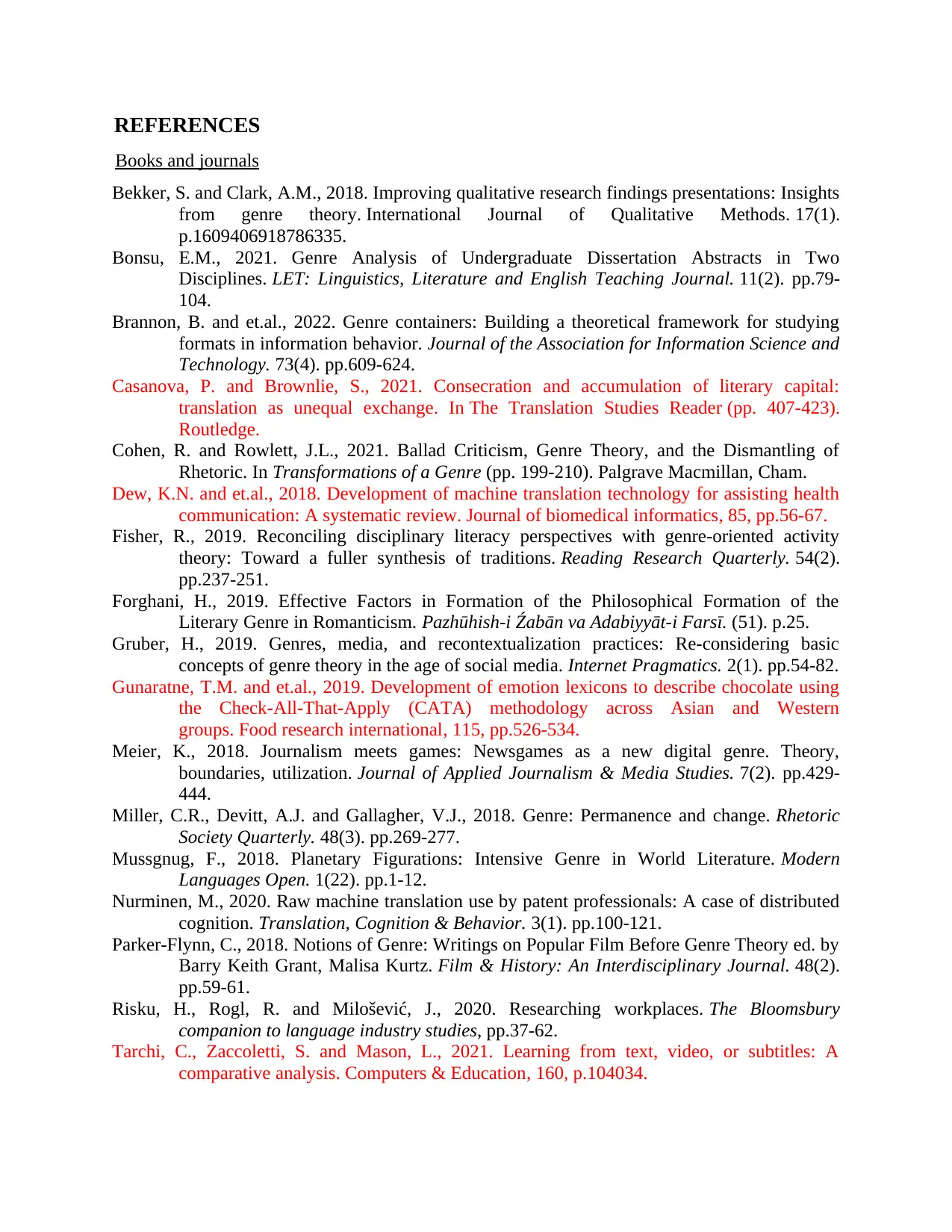
REFERENCES
Books and journals
Bekker, S. and Clark, A.M., 2018. Improving qualitative research findings presentations: Insights
from genre theory. International Journal of Qualitative Methods. 17(1).
p.1609406918786335.
Bonsu, E.M., 2021. Genre Analysis of Undergraduate Dissertation Abstracts in Two
Disciplines. LET: Linguistics, Literature and English Teaching Journal. 11(2). pp.79-
104.
Brannon, B. and et.al., 2022. Genre containers: Building a theoretical framework for studying
formats in information behavior. Journal of the Association for Information Science and
Technology. 73(4). pp.609-624.
Casanova, P. and Brownlie, S., 2021. Consecration and accumulation of literary capital:
translation as unequal exchange. In The Translation Studies Reader (pp. 407-423).
Routledge.
Cohen, R. and Rowlett, J.L., 2021. Ballad Criticism, Genre Theory, and the Dismantling of
Rhetoric. In Transformations of a Genre (pp. 199-210). Palgrave Macmillan, Cham.
Dew, K.N. and et.al., 2018. Development of machine translation technology for assisting health
communication: A systematic review. Journal of biomedical informatics, 85, pp.56-67.
Fisher, R., 2019. Reconciling disciplinary literacy perspectives with genre‐oriented activity
theory: Toward a fuller synthesis of traditions. Reading Research Quarterly. 54(2).
pp.237-251.
Forghani, H., 2019. Effective Factors in Formation of the Philosophical Formation of the
Literary Genre in Romanticism. Pazhūhish-i Źabān va Adabiyyāt-i Farsī. (51). p.25.
Gruber, H., 2019. Genres, media, and recontextualization practices: Re-considering basic
concepts of genre theory in the age of social media. Internet Pragmatics. 2(1). pp.54-82.
Gunaratne, T.M. and et.al., 2019. Development of emotion lexicons to describe chocolate using
the Check-All-That-Apply (CATA) methodology across Asian and Western
groups. Food research international, 115, pp.526-534.
Meier, K., 2018. Journalism meets games: Newsgames as a new digital genre. Theory,
boundaries, utilization. Journal of Applied Journalism & Media Studies. 7(2). pp.429-
444.
Miller, C.R., Devitt, A.J. and Gallagher, V.J., 2018. Genre: Permanence and change. Rhetoric
Society Quarterly. 48(3). pp.269-277.
Mussgnug, F., 2018. Planetary Figurations: Intensive Genre in World Literature. Modern
Languages Open. 1(22). pp.1-12.
Nurminen, M., 2020. Raw machine translation use by patent professionals: A case of distributed
cognition. Translation, Cognition & Behavior. 3(1). pp.100-121.
Parker-Flynn, C., 2018. Notions of Genre: Writings on Popular Film Before Genre Theory ed. by
Barry Keith Grant, Malisa Kurtz. Film & History: An Interdisciplinary Journal. 48(2).
pp.59-61.
Risku, H., Rogl, R. and Milošević, J., 2020. Researching workplaces. The Bloomsbury
companion to language industry studies, pp.37-62.
Tarchi, C., Zaccoletti, S. and Mason, L., 2021. Learning from text, video, or subtitles: A
comparative analysis. Computers & Education, 160, p.104034.
Books and journals
Bekker, S. and Clark, A.M., 2018. Improving qualitative research findings presentations: Insights
from genre theory. International Journal of Qualitative Methods. 17(1).
p.1609406918786335.
Bonsu, E.M., 2021. Genre Analysis of Undergraduate Dissertation Abstracts in Two
Disciplines. LET: Linguistics, Literature and English Teaching Journal. 11(2). pp.79-
104.
Brannon, B. and et.al., 2022. Genre containers: Building a theoretical framework for studying
formats in information behavior. Journal of the Association for Information Science and
Technology. 73(4). pp.609-624.
Casanova, P. and Brownlie, S., 2021. Consecration and accumulation of literary capital:
translation as unequal exchange. In The Translation Studies Reader (pp. 407-423).
Routledge.
Cohen, R. and Rowlett, J.L., 2021. Ballad Criticism, Genre Theory, and the Dismantling of
Rhetoric. In Transformations of a Genre (pp. 199-210). Palgrave Macmillan, Cham.
Dew, K.N. and et.al., 2018. Development of machine translation technology for assisting health
communication: A systematic review. Journal of biomedical informatics, 85, pp.56-67.
Fisher, R., 2019. Reconciling disciplinary literacy perspectives with genre‐oriented activity
theory: Toward a fuller synthesis of traditions. Reading Research Quarterly. 54(2).
pp.237-251.
Forghani, H., 2019. Effective Factors in Formation of the Philosophical Formation of the
Literary Genre in Romanticism. Pazhūhish-i Źabān va Adabiyyāt-i Farsī. (51). p.25.
Gruber, H., 2019. Genres, media, and recontextualization practices: Re-considering basic
concepts of genre theory in the age of social media. Internet Pragmatics. 2(1). pp.54-82.
Gunaratne, T.M. and et.al., 2019. Development of emotion lexicons to describe chocolate using
the Check-All-That-Apply (CATA) methodology across Asian and Western
groups. Food research international, 115, pp.526-534.
Meier, K., 2018. Journalism meets games: Newsgames as a new digital genre. Theory,
boundaries, utilization. Journal of Applied Journalism & Media Studies. 7(2). pp.429-
444.
Miller, C.R., Devitt, A.J. and Gallagher, V.J., 2018. Genre: Permanence and change. Rhetoric
Society Quarterly. 48(3). pp.269-277.
Mussgnug, F., 2018. Planetary Figurations: Intensive Genre in World Literature. Modern
Languages Open. 1(22). pp.1-12.
Nurminen, M., 2020. Raw machine translation use by patent professionals: A case of distributed
cognition. Translation, Cognition & Behavior. 3(1). pp.100-121.
Parker-Flynn, C., 2018. Notions of Genre: Writings on Popular Film Before Genre Theory ed. by
Barry Keith Grant, Malisa Kurtz. Film & History: An Interdisciplinary Journal. 48(2).
pp.59-61.
Risku, H., Rogl, R. and Milošević, J., 2020. Researching workplaces. The Bloomsbury
companion to language industry studies, pp.37-62.
Tarchi, C., Zaccoletti, S. and Mason, L., 2021. Learning from text, video, or subtitles: A
comparative analysis. Computers & Education, 160, p.104034.
⊘ This is a preview!⊘
Do you want full access?
Subscribe today to unlock all pages.
Trusted by 1+ million students worldwide

Toury, G., 2021. The nature and role of norms in translation. In The translation studies
reader (pp. 197-210). Routledge.
Vargas-Iglesias, J.J., 2020. Making sense of genre: The logic of video game genre
organization. Games and Culture. 15(2). pp.158-178.
Wehrs, D.R., 2019. Genre Theory and Historical Change: Theoretical Essays of Ralph Cohen by
Ralph Cohen. The Scriblerian and the Kit-Cats. 52(1). pp.85-87.
reader (pp. 197-210). Routledge.
Vargas-Iglesias, J.J., 2020. Making sense of genre: The logic of video game genre
organization. Games and Culture. 15(2). pp.158-178.
Wehrs, D.R., 2019. Genre Theory and Historical Change: Theoretical Essays of Ralph Cohen by
Ralph Cohen. The Scriblerian and the Kit-Cats. 52(1). pp.85-87.

1 out of 10


Related Documents


Your All-in-One AI-Powered Toolkit for Academic Success.
+13062052269
info@desklib.com
Available 24*7 on WhatsApp / Email
![[object Object]](/_next/static/media/star-bottom.7253800d.svg)
Unlock your academic potential
Copyright © 2020–2025 A2Z Services. All Rights Reserved. Developed and managed by ZUCOL.