Comprehensive Analysis of the German Tourism System & Stakeholders
VerifiedAdded on 2023/06/09
|6
|1298
|51
Report
AI Summary
This report provides a comprehensive analysis of the German tourism system, highlighting its key stakeholders, major elements, and the relationships between them. It identifies significant forces and pressures impacting the system, including environmental factors and the roles of various tourism organizations and business associations. The analysis explores how the Federal Government and individual states contribute to tourism policy and development, and examines conflicts between stakeholders such as destination management organizations and policymakers. The report concludes by referencing relevant literature and providing insights into the dynamics of the German tourism industry. Desklib offers a platform to explore similar solved assignments and past papers for students.
Running head: TOURISM SYSTEMS ANALYSIS 1
An Analysis of the German Tourism System
[Student’s Name]
[Institution]
[Instructor]
An Analysis of the German Tourism System
[Student’s Name]
[Institution]
[Instructor]
Paraphrase This Document
Need a fresh take? Get an instant paraphrase of this document with our AI Paraphraser

TOURISM SYSTEMS ANALYSIS 2
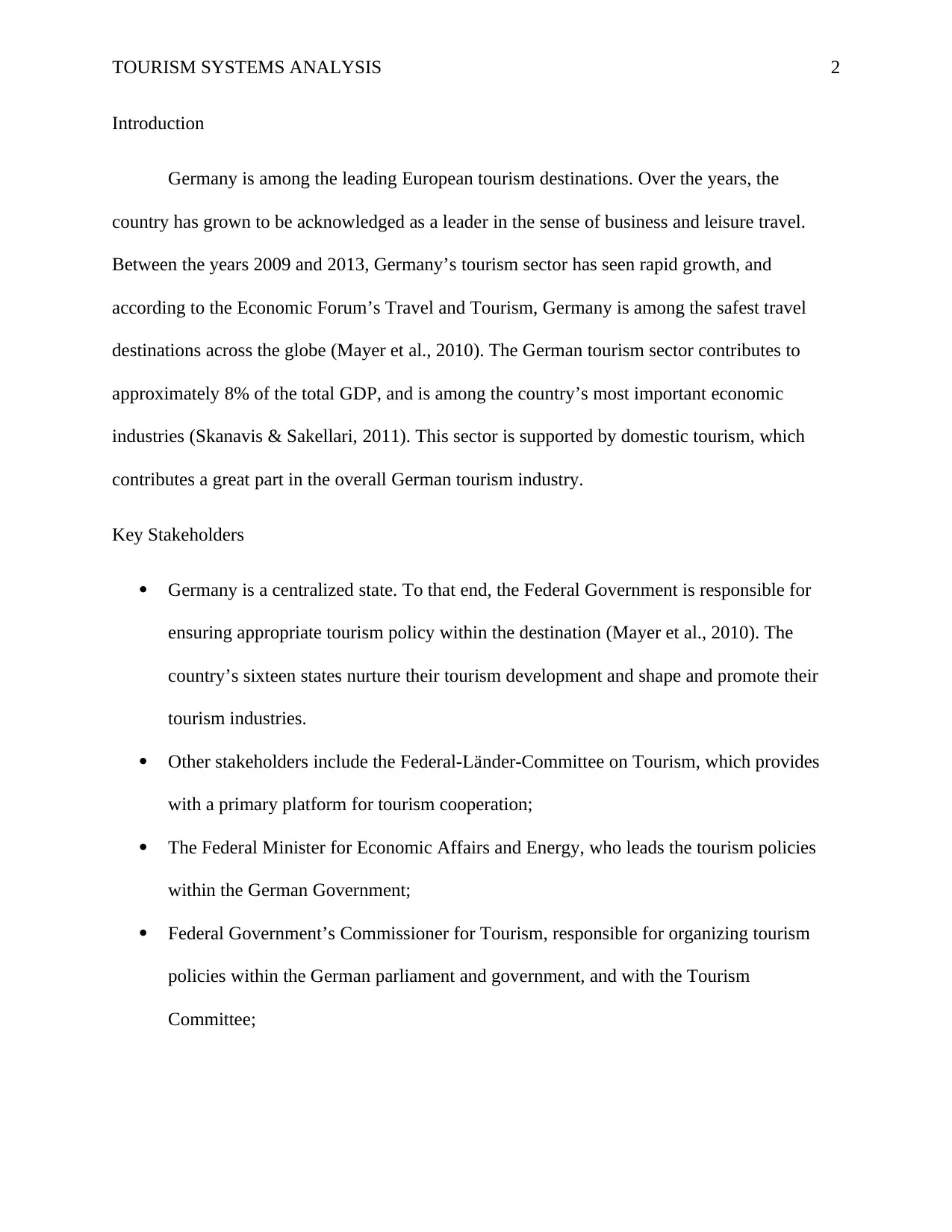
Introduction
Germany is among the leading European tourism destinations. Over the years, the
country has grown to be acknowledged as a leader in the sense of business and leisure travel.
Between the years 2009 and 2013, Germany’s tourism sector has seen rapid growth, and
according to the Economic Forum’s Travel and Tourism, Germany is among the safest travel
destinations across the globe (Mayer et al., 2010). The German tourism sector contributes to
approximately 8% of the total GDP, and is among the country’s most important economic
industries (Skanavis & Sakellari, 2011). This sector is supported by domestic tourism, which
contributes a great part in the overall German tourism industry.
Key Stakeholders
Germany is a centralized state. To that end, the Federal Government is responsible for
ensuring appropriate tourism policy within the destination (Mayer et al., 2010). The
country’s sixteen states nurture their tourism development and shape and promote their
tourism industries.
Other stakeholders include the Federal-Länder-Committee on Tourism, which provides
with a primary platform for tourism cooperation;
The Federal Minister for Economic Affairs and Energy, who leads the tourism policies
within the German Government;
Federal Government’s Commissioner for Tourism, responsible for organizing tourism
policies within the German parliament and government, and with the Tourism
Committee;
Introduction
Germany is among the leading European tourism destinations. Over the years, the
country has grown to be acknowledged as a leader in the sense of business and leisure travel.
Between the years 2009 and 2013, Germany’s tourism sector has seen rapid growth, and
according to the Economic Forum’s Travel and Tourism, Germany is among the safest travel
destinations across the globe (Mayer et al., 2010). The German tourism sector contributes to
approximately 8% of the total GDP, and is among the country’s most important economic
industries (Skanavis & Sakellari, 2011). This sector is supported by domestic tourism, which
contributes a great part in the overall German tourism industry.
Key Stakeholders
Germany is a centralized state. To that end, the Federal Government is responsible for
ensuring appropriate tourism policy within the destination (Mayer et al., 2010). The
country’s sixteen states nurture their tourism development and shape and promote their
tourism industries.
Other stakeholders include the Federal-Länder-Committee on Tourism, which provides
with a primary platform for tourism cooperation;
The Federal Minister for Economic Affairs and Energy, who leads the tourism policies
within the German Government;
Federal Government’s Commissioner for Tourism, responsible for organizing tourism
policies within the German parliament and government, and with the Tourism
Committee;

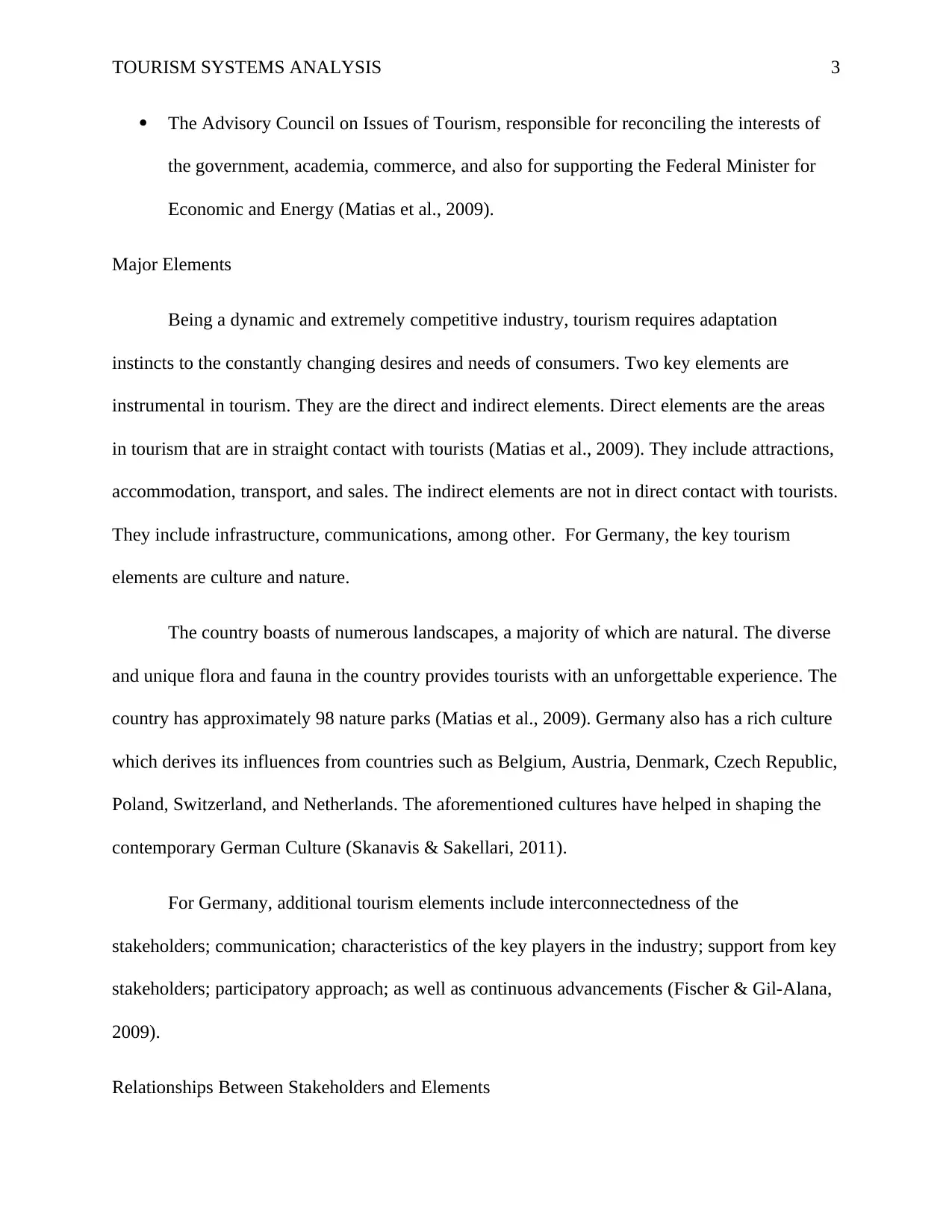
TOURISM SYSTEMS ANALYSIS 3
The Advisory Council on Issues of Tourism, responsible for reconciling the interests of
the government, academia, commerce, and also for supporting the Federal Minister for
Economic and Energy (Matias et al., 2009).
Major Elements
Being a dynamic and extremely competitive industry, tourism requires adaptation
instincts to the constantly changing desires and needs of consumers. Two key elements are
instrumental in tourism. They are the direct and indirect elements. Direct elements are the areas
in tourism that are in straight contact with tourists (Matias et al., 2009). They include attractions,
accommodation, transport, and sales. The indirect elements are not in direct contact with tourists.
They include infrastructure, communications, among other. For Germany, the key tourism
elements are culture and nature.
The country boasts of numerous landscapes, a majority of which are natural. The diverse
and unique flora and fauna in the country provides tourists with an unforgettable experience. The
country has approximately 98 nature parks (Matias et al., 2009). Germany also has a rich culture
which derives its influences from countries such as Belgium, Austria, Denmark, Czech Republic,
Poland, Switzerland, and Netherlands. The aforementioned cultures have helped in shaping the
contemporary German Culture (Skanavis & Sakellari, 2011).
For Germany, additional tourism elements include interconnectedness of the
stakeholders; communication; characteristics of the key players in the industry; support from key
stakeholders; participatory approach; as well as continuous advancements (Fischer & Gil-Alana,
2009).
Relationships Between Stakeholders and Elements
The Advisory Council on Issues of Tourism, responsible for reconciling the interests of
the government, academia, commerce, and also for supporting the Federal Minister for
Economic and Energy (Matias et al., 2009).
Major Elements
Being a dynamic and extremely competitive industry, tourism requires adaptation
instincts to the constantly changing desires and needs of consumers. Two key elements are
instrumental in tourism. They are the direct and indirect elements. Direct elements are the areas
in tourism that are in straight contact with tourists (Matias et al., 2009). They include attractions,
accommodation, transport, and sales. The indirect elements are not in direct contact with tourists.
They include infrastructure, communications, among other. For Germany, the key tourism
elements are culture and nature.
The country boasts of numerous landscapes, a majority of which are natural. The diverse
and unique flora and fauna in the country provides tourists with an unforgettable experience. The
country has approximately 98 nature parks (Matias et al., 2009). Germany also has a rich culture
which derives its influences from countries such as Belgium, Austria, Denmark, Czech Republic,
Poland, Switzerland, and Netherlands. The aforementioned cultures have helped in shaping the
contemporary German Culture (Skanavis & Sakellari, 2011).
For Germany, additional tourism elements include interconnectedness of the
stakeholders; communication; characteristics of the key players in the industry; support from key
stakeholders; participatory approach; as well as continuous advancements (Fischer & Gil-Alana,
2009).
Relationships Between Stakeholders and Elements
⊘ This is a preview!⊘
Do you want full access?
Subscribe today to unlock all pages.

Trusted by 1+ million students worldwide

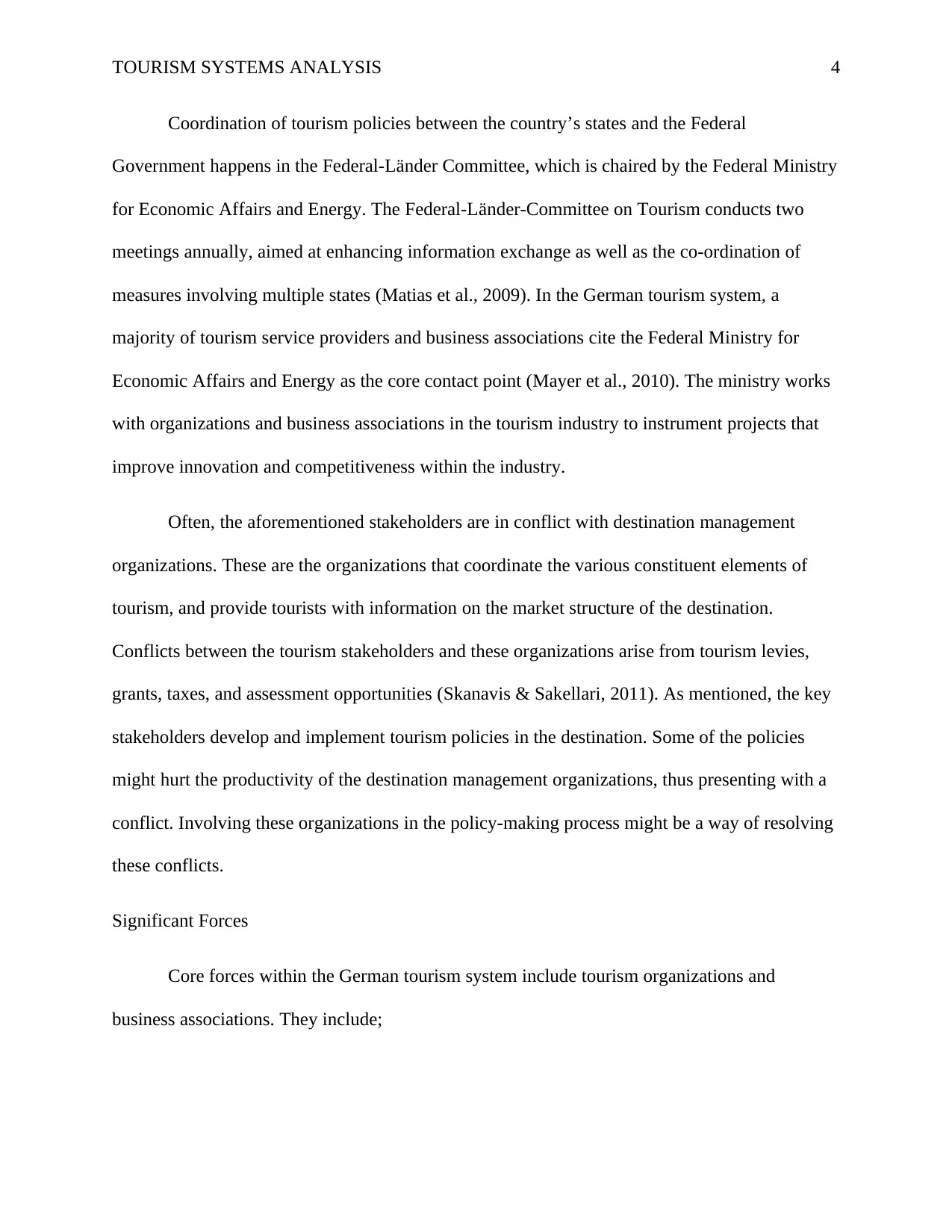
TOURISM SYSTEMS ANALYSIS 4
Coordination of tourism policies between the country’s states and the Federal
Government happens in the Federal-Länder Committee, which is chaired by the Federal Ministry
for Economic Affairs and Energy. The Federal-Länder-Committee on Tourism conducts two
meetings annually, aimed at enhancing information exchange as well as the co-ordination of
measures involving multiple states (Matias et al., 2009). In the German tourism system, a
majority of tourism service providers and business associations cite the Federal Ministry for
Economic Affairs and Energy as the core contact point (Mayer et al., 2010). The ministry works
with organizations and business associations in the tourism industry to instrument projects that
improve innovation and competitiveness within the industry.
Often, the aforementioned stakeholders are in conflict with destination management
organizations. These are the organizations that coordinate the various constituent elements of
tourism, and provide tourists with information on the market structure of the destination.
Conflicts between the tourism stakeholders and these organizations arise from tourism levies,
grants, taxes, and assessment opportunities (Skanavis & Sakellari, 2011). As mentioned, the key
stakeholders develop and implement tourism policies in the destination. Some of the policies
might hurt the productivity of the destination management organizations, thus presenting with a
conflict. Involving these organizations in the policy-making process might be a way of resolving
these conflicts.
Significant Forces
Core forces within the German tourism system include tourism organizations and
business associations. They include;
Coordination of tourism policies between the country’s states and the Federal
Government happens in the Federal-Länder Committee, which is chaired by the Federal Ministry
for Economic Affairs and Energy. The Federal-Länder-Committee on Tourism conducts two
meetings annually, aimed at enhancing information exchange as well as the co-ordination of
measures involving multiple states (Matias et al., 2009). In the German tourism system, a
majority of tourism service providers and business associations cite the Federal Ministry for
Economic Affairs and Energy as the core contact point (Mayer et al., 2010). The ministry works
with organizations and business associations in the tourism industry to instrument projects that
improve innovation and competitiveness within the industry.
Often, the aforementioned stakeholders are in conflict with destination management
organizations. These are the organizations that coordinate the various constituent elements of
tourism, and provide tourists with information on the market structure of the destination.
Conflicts between the tourism stakeholders and these organizations arise from tourism levies,
grants, taxes, and assessment opportunities (Skanavis & Sakellari, 2011). As mentioned, the key
stakeholders develop and implement tourism policies in the destination. Some of the policies
might hurt the productivity of the destination management organizations, thus presenting with a
conflict. Involving these organizations in the policy-making process might be a way of resolving
these conflicts.
Significant Forces
Core forces within the German tourism system include tourism organizations and
business associations. They include;
Paraphrase This Document
Need a fresh take? Get an instant paraphrase of this document with our AI Paraphraser

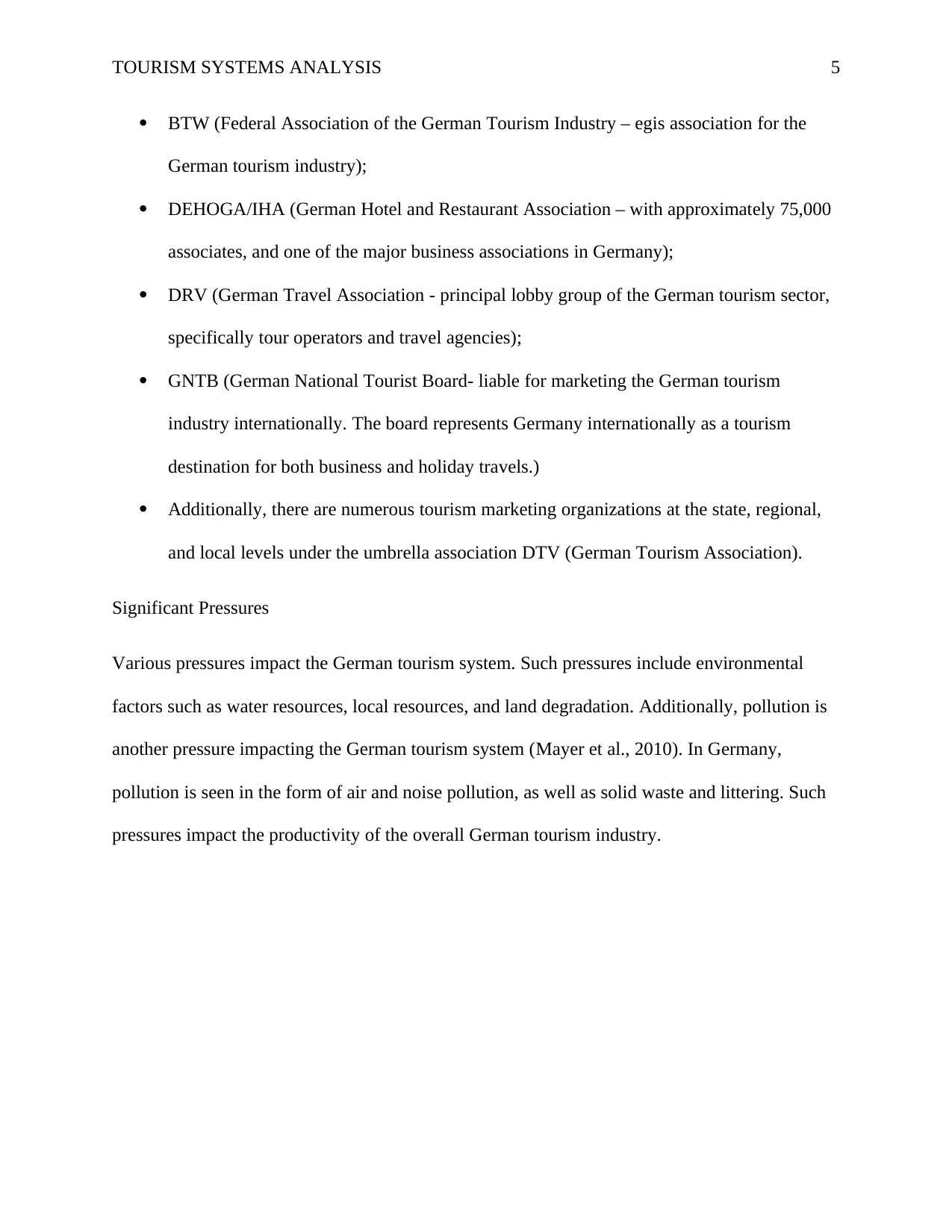
TOURISM SYSTEMS ANALYSIS 5
BTW (Federal Association of the German Tourism Industry – egis association for the
German tourism industry);
DEHOGA/IHA (German Hotel and Restaurant Association – with approximately 75,000
associates, and one of the major business associations in Germany);
DRV (German Travel Association - principal lobby group of the German tourism sector,
specifically tour operators and travel agencies);
GNTB (German National Tourist Board- liable for marketing the German tourism
industry internationally. The board represents Germany internationally as a tourism
destination for both business and holiday travels.)
Additionally, there are numerous tourism marketing organizations at the state, regional,
and local levels under the umbrella association DTV (German Tourism Association).
Significant Pressures
Various pressures impact the German tourism system. Such pressures include environmental
factors such as water resources, local resources, and land degradation. Additionally, pollution is
another pressure impacting the German tourism system (Mayer et al., 2010). In Germany,
pollution is seen in the form of air and noise pollution, as well as solid waste and littering. Such
pressures impact the productivity of the overall German tourism industry.
BTW (Federal Association of the German Tourism Industry – egis association for the
German tourism industry);
DEHOGA/IHA (German Hotel and Restaurant Association – with approximately 75,000
associates, and one of the major business associations in Germany);
DRV (German Travel Association - principal lobby group of the German tourism sector,
specifically tour operators and travel agencies);
GNTB (German National Tourist Board- liable for marketing the German tourism
industry internationally. The board represents Germany internationally as a tourism
destination for both business and holiday travels.)
Additionally, there are numerous tourism marketing organizations at the state, regional,
and local levels under the umbrella association DTV (German Tourism Association).
Significant Pressures
Various pressures impact the German tourism system. Such pressures include environmental
factors such as water resources, local resources, and land degradation. Additionally, pollution is
another pressure impacting the German tourism system (Mayer et al., 2010). In Germany,
pollution is seen in the form of air and noise pollution, as well as solid waste and littering. Such
pressures impact the productivity of the overall German tourism industry.

TOURISM SYSTEMS ANALYSIS 6
References
Ahlert, G. (2008). Estimating the economic impact of an increase in inbound tourism on the
German economy using TSA results. Journal of Travel Research, 47(2), 225-234.
Fischer, C., & Gil-Alana, L. A. (2009). The nature of the relationship between international
tourism and international trade: the case of German imports of Spanish wine. Applied
Economics, 41(11), 1345-1359.
Matias, Á., Nijkamp, P., & Sarmento, M. (Eds.). (2011). Tourism economics: Impact analysis.
Springer Science & Business Media.
Mayer, M., Müller, M., Woltering, M., Arnegger, J., & Job, H. (2010). The economic impact of
tourism in six German national parks. Landscape and Urban Planning, 97(2), 73-82.
PECHLANER, H., REUTER, C., & ZEHRER, A. (2010). Innovation Awards in the German
Tourism. Innovation and Entrepreneurship: Strategies and Processes for Success in
Tourism, 81.
Skanavis, C., & Sakellari, M. (2011). International tourism, domestic tourism and environmental
change: environmental education can find the balance. Tourismos, 6(1).
References
Ahlert, G. (2008). Estimating the economic impact of an increase in inbound tourism on the
German economy using TSA results. Journal of Travel Research, 47(2), 225-234.
Fischer, C., & Gil-Alana, L. A. (2009). The nature of the relationship between international
tourism and international trade: the case of German imports of Spanish wine. Applied
Economics, 41(11), 1345-1359.
Matias, Á., Nijkamp, P., & Sarmento, M. (Eds.). (2011). Tourism economics: Impact analysis.
Springer Science & Business Media.
Mayer, M., Müller, M., Woltering, M., Arnegger, J., & Job, H. (2010). The economic impact of
tourism in six German national parks. Landscape and Urban Planning, 97(2), 73-82.
PECHLANER, H., REUTER, C., & ZEHRER, A. (2010). Innovation Awards in the German
Tourism. Innovation and Entrepreneurship: Strategies and Processes for Success in
Tourism, 81.
Skanavis, C., & Sakellari, M. (2011). International tourism, domestic tourism and environmental
change: environmental education can find the balance. Tourismos, 6(1).
⊘ This is a preview!⊘
Do you want full access?
Subscribe today to unlock all pages.

Trusted by 1+ million students worldwide
1 out of 6
Related Documents
Your All-in-One AI-Powered Toolkit for Academic Success.
+13062052269
info@desklib.com
Available 24*7 on WhatsApp / Email
Unlock your academic potential
Copyright © 2020–2026 A2Z Services. All Rights Reserved. Developed and managed by ZUCOL.