Global Economic Analysis: Washington's Tariffs and India's Response

Verified

Added on  2022/10/17

|4
|623
|8
Report
AI Summary
This report analyzes the economic impact of US tariffs on India, focusing on the recent trade disputes initiated by the Trump administration. It examines the imposition of tariffs on steel and aluminum imports, the subsequent retaliatory measures taken by India, and the broader implications for global trade relations. The report discusses the US government's concerns regarding India's trade practices, including the Generalized System of Preference (GSP) and the H-IB visa policies. The analysis explores the potential consequences for both countries, including shifts in import sources and the challenges faced by India as a developing nation. The author disagrees with the view that the tariffs are unfair to India and suggests that India should reduce custom duties. The report concludes by highlighting the need for harmonious business relationships and the importance of addressing trade imbalances through negotiation and compromise.
Document Page
Running head: GLOBAL ECONOMIC 1
Global Economic
Name
Institution
tabler-icon-diamond-filled.svg

Paraphrase This Document

Need a fresh take? Get an instant paraphrase of this document with our AI Paraphraser
Document Page
GLOBAL ECONOMIC 2
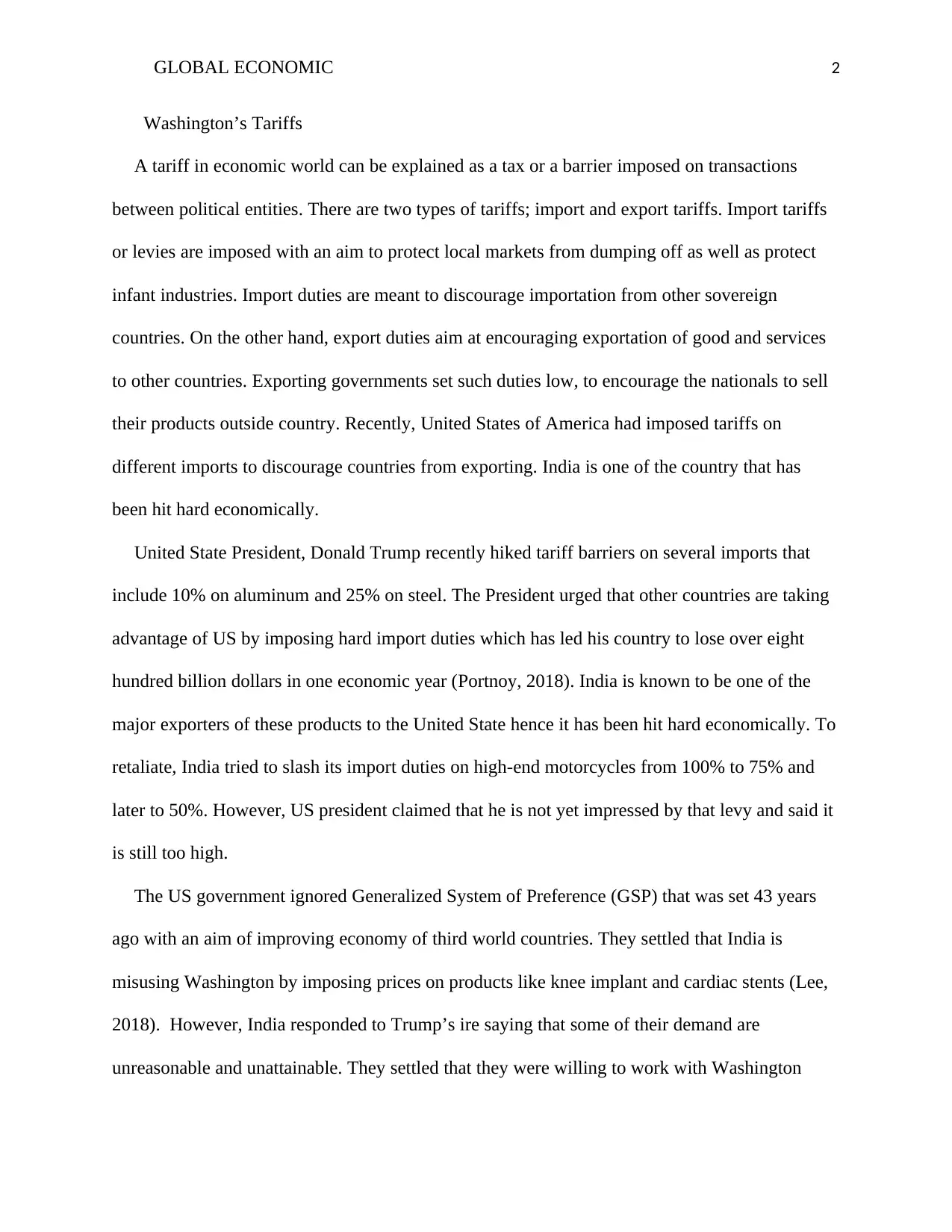
Washington’s Tariffs
A tariff in economic world can be explained as a tax or a barrier imposed on transactions
between political entities. There are two types of tariffs; import and export tariffs. Import tariffs
or levies are imposed with an aim to protect local markets from dumping off as well as protect
infant industries. Import duties are meant to discourage importation from other sovereign
countries. On the other hand, export duties aim at encouraging exportation of good and services
to other countries. Exporting governments set such duties low, to encourage the nationals to sell
their products outside country. Recently, United States of America had imposed tariffs on
different imports to discourage countries from exporting. India is one of the country that has
been hit hard economically.
United State President, Donald Trump recently hiked tariff barriers on several imports that
include 10% on aluminum and 25% on steel. The President urged that other countries are taking
advantage of US by imposing hard import duties which has led his country to lose over eight
hundred billion dollars in one economic year (Portnoy, 2018). India is known to be one of the
major exporters of these products to the United State hence it has been hit hard economically. To
retaliate, India tried to slash its import duties on high-end motorcycles from 100% to 75% and
later to 50%. However, US president claimed that he is not yet impressed by that levy and said it
is still too high.
The US government ignored Generalized System of Preference (GSP) that was set 43 years
ago with an aim of improving economy of third world countries. They settled that India is
misusing Washington by imposing prices on products like knee implant and cardiac stents (Lee,
2018). However, India responded to Trump’s ire saying that some of their demand are
unreasonable and unattainable. They settled that they were willing to work with Washington
Document Page
GLOBAL ECONOMIC 3
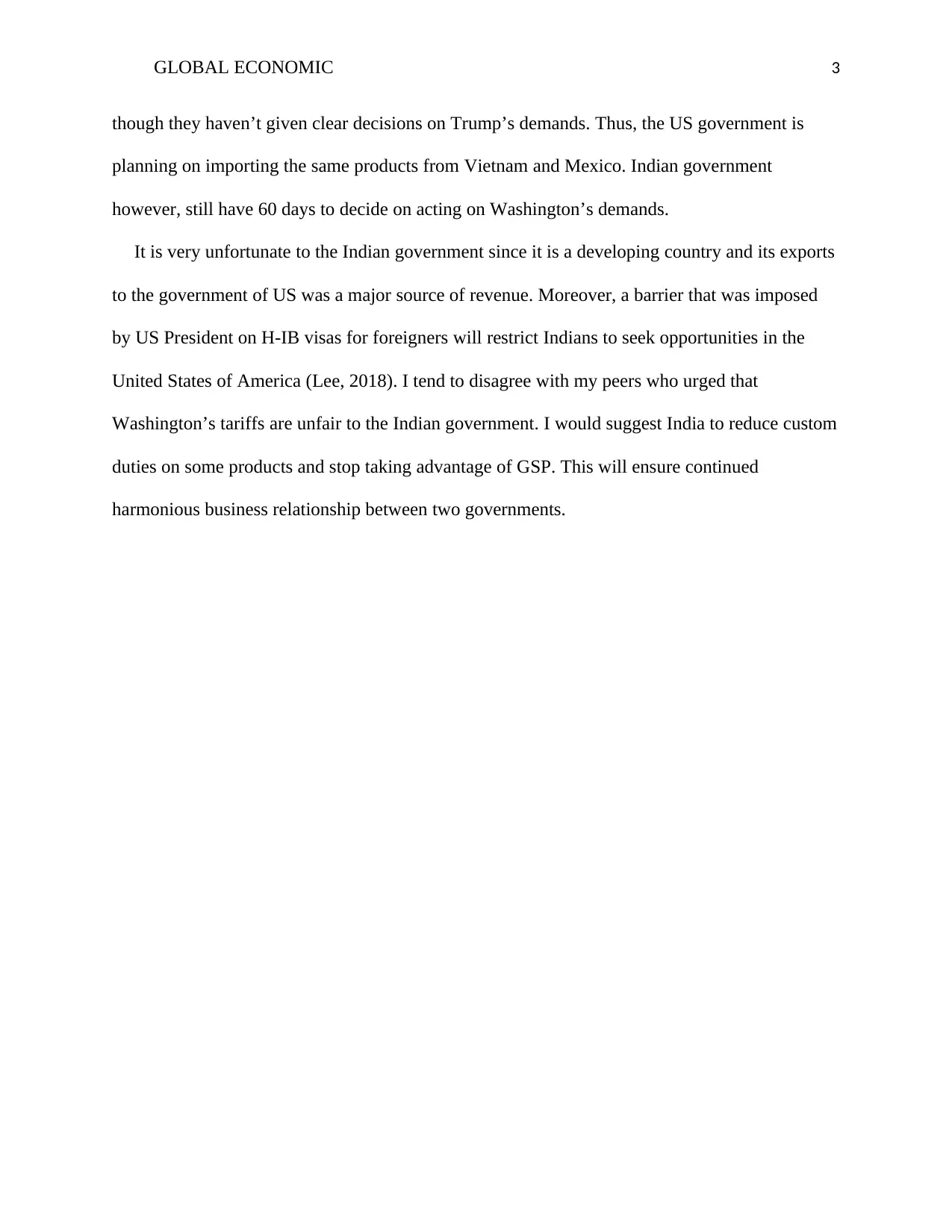
though they haven’t given clear decisions on Trump’s demands. Thus, the US government is
planning on importing the same products from Vietnam and Mexico. Indian government
however, still have 60 days to decide on acting on Washington’s demands.
It is very unfortunate to the Indian government since it is a developing country and its exports
to the government of US was a major source of revenue. Moreover, a barrier that was imposed
by US President on H-IB visas for foreigners will restrict Indians to seek opportunities in the
United States of America (Lee, 2018). I tend to disagree with my peers who urged that
Washington’s tariffs are unfair to the Indian government. I would suggest India to reduce custom
duties on some products and stop taking advantage of GSP. This will ensure continued
harmonious business relationship between two governments.
Document Page
GLOBAL ECONOMIC 4
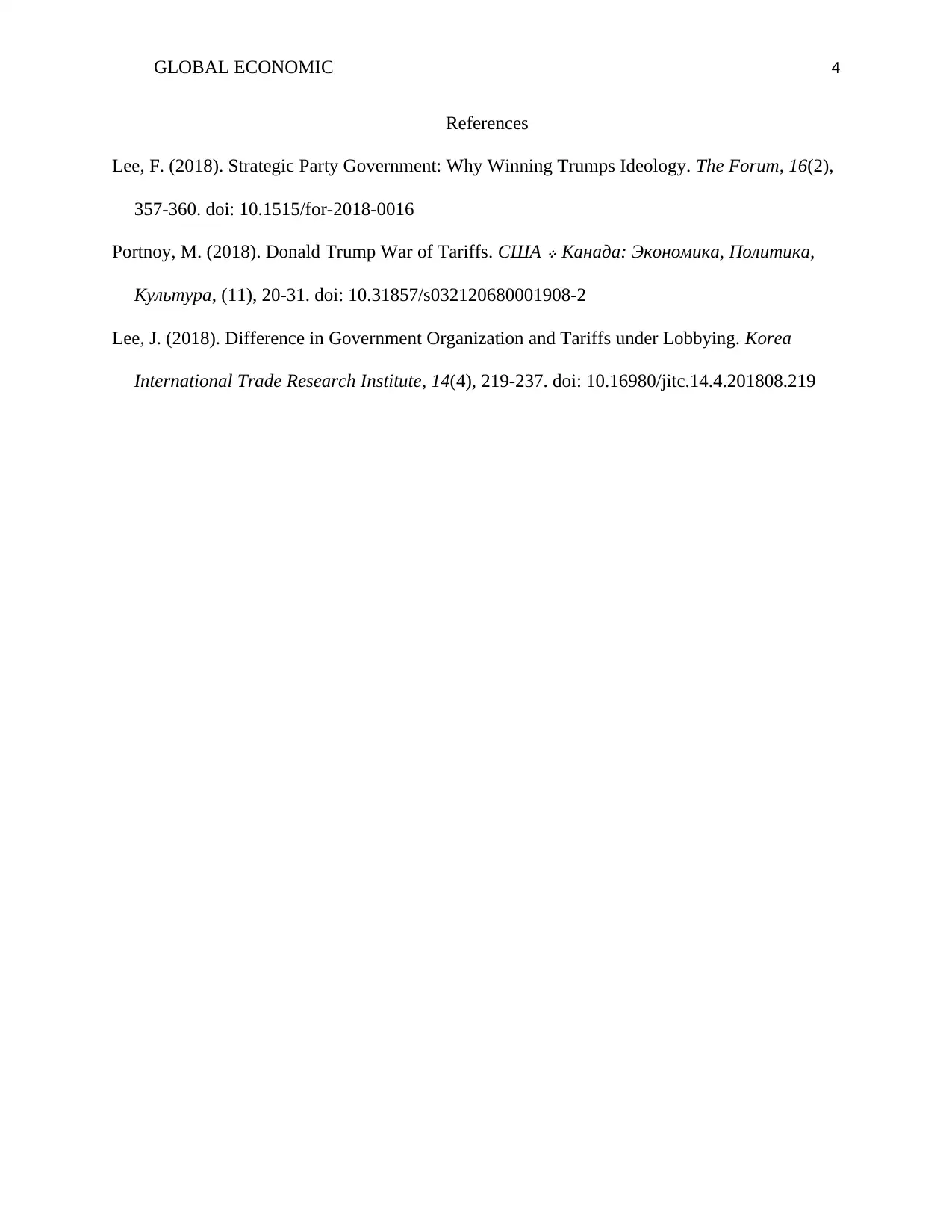
References
Lee, F. (2018). Strategic Party Government: Why Winning Trumps Ideology. The Forum, 16(2),
357-360. doi: 10.1515/for-2018-0016
Portnoy, M. (2018). Donald Trump War of Tariffs. США
܀ Канада: Экономика, Политика,
Культура, (11), 20-31. doi: 10.31857/s032120680001908-2
Lee, J. (2018). Difference in Government Organization and Tariffs under Lobbying. Korea
International Trade Research Institute, 14(4), 219-237. doi: 10.16980/jitc.14.4.201808.219
chevron_up_icon
1 out of 4
circle_padding
hide_on_mobile
zoom_out_icon
[object Object]