HI6008 - Managing Global Teams: A Comprehensive Literature Review
VerifiedAdded on 2023/06/07
|9
|2509
|190
Literature Review
AI Summary
This literature review delves into the complexities of managing global teams, highlighting the challenges faced by organizations operating internationally. It covers aspects such as cultural differences, communication barriers, time zone discrepancies, and decision-making difficulties. The review references various studies and theories, including Hofstede's cultural dimensions, to illustrate the impact of cultural diversity on team dynamics and work patterns. It also explores the role of technology in facilitating communication and collaboration, while acknowledging the persistent challenges related to effective communication and cultural understanding. The review emphasizes the importance of intercultural competence, appropriate leadership styles, and the establishment of a common organizational culture to foster better team management and performance. The study concludes by reiterating the significance of addressing these challenges to ensure successful collaboration and outcomes in global teams. Desklib offers a platform to explore more such assignments and study resources.
Managing global teams

Paraphrase This Document
Need a fresh take? Get an instant paraphrase of this document with our AI Paraphraser
Table of Contents
Introduction......................................................................................................................................3
Project Objective.............................................................................................................................3
Project Scope...................................................................................................................................3
Literature Review............................................................................................................................4
Conclusion.......................................................................................................................................7
Reference list...................................................................................................................................8
Introduction......................................................................................................................................3
Project Objective.............................................................................................................................3
Project Scope...................................................................................................................................3
Literature Review............................................................................................................................4
Conclusion.......................................................................................................................................7
Reference list...................................................................................................................................8
Introduction
Working in an international market is a way complicated and difficult than working in a
domestic market. International organization faces several challenges while managing global
teams. Global teams are made of people belonging from various cultural backgrounds with
different language preferences, understanding, different methods of doing works are so on. The
organizations that are working in a global level have to managing operations, human resources
and some others are functions in a very complicated manner. In order to manage global
operations in an effective manner and manage global teams, it is essential to have proper
understanding of the challenges that the organizations are facing or may have to face while
entering to the global market. The following study would unfurl the challenges faced by
organizations in managing global teams. It would review some literatures in order to have a
proper understanding of the challenges and the possible ways to mitigate challenges.
Project Objective
The main objective of this project is to understand the challenges faced by global teams and to
find out mitigating strategies that can be beneficial for dealing with such issues.
Project Scope
The project offers a wide range of scope that would give the readers an insight into the
challenges faced by organizations while managing global teams. The scope of the project
includes information regarding global teams. The way such teams operates. Due to the increasing
competition in each industry organizations are facing the need to have global mark and
international existence. The need for creating global organizations has created the need for
managing global teams (Shea et al.,2011). In most of the cases, operating in a global level
requires better communication among the employees, effective management, cooperation among
employees from diverse background (Ang and Van, 2015). This project would provide
understanding of how such organizations works in a global level. This would help in identifying
risks and challenges and strategies.
Working in an international market is a way complicated and difficult than working in a
domestic market. International organization faces several challenges while managing global
teams. Global teams are made of people belonging from various cultural backgrounds with
different language preferences, understanding, different methods of doing works are so on. The
organizations that are working in a global level have to managing operations, human resources
and some others are functions in a very complicated manner. In order to manage global
operations in an effective manner and manage global teams, it is essential to have proper
understanding of the challenges that the organizations are facing or may have to face while
entering to the global market. The following study would unfurl the challenges faced by
organizations in managing global teams. It would review some literatures in order to have a
proper understanding of the challenges and the possible ways to mitigate challenges.
Project Objective
The main objective of this project is to understand the challenges faced by global teams and to
find out mitigating strategies that can be beneficial for dealing with such issues.
Project Scope
The project offers a wide range of scope that would give the readers an insight into the
challenges faced by organizations while managing global teams. The scope of the project
includes information regarding global teams. The way such teams operates. Due to the increasing
competition in each industry organizations are facing the need to have global mark and
international existence. The need for creating global organizations has created the need for
managing global teams (Shea et al.,2011). In most of the cases, operating in a global level
requires better communication among the employees, effective management, cooperation among
employees from diverse background (Ang and Van, 2015). This project would provide
understanding of how such organizations works in a global level. This would help in identifying
risks and challenges and strategies.
⊘ This is a preview!⊘
Do you want full access?
Subscribe today to unlock all pages.

Trusted by 1+ million students worldwide
Literature Review
In the present scenario, globalization mainly influences the business organization to develop the
trade and business in the international market. Globalization mainly helps the organizations to
improve the efficiency level in the global market and additionally, it helps to lower down the
cost for the organizations (Colomo-Palacios et al., 2014). It directly helps the organization to
focus much on innovation and performance, which helps them to perform in the global market.
Global teams are the teams which are mainly formed in different geographical areas and cultural
boundaries. This mainly helps to achieve wide knowledge and understanding. On the other hand,
it also helps the business organizations to lower down the cost and motivates them to manage the
teams in a local level. The manager needs to manage the teams at different level, which creates a
burden for them. Most of the team members operate from remote areas, which create lack of
awareness among them. The different teams contribute of their own at local level. However, they
fail to understand the mutual benefits of different teams.
Therefore, it can be said that internalization of the business mainly helps to bring new innovation
and reality in the corporate world. It has been found that cultural difference in between the
societies and governments mainly brings different challenges which create several barriers for
the organizations to manage the business in the global teams (Wendling et al., 2013). In hofstede
cultural dimension theory, there are mainly four dimensions which are namely power distance
index, individualism versus collectivism, masculinity verses femininity and uncertainty
avoidance. These dimensions mainly help to create difference between national cultures. Mainly
different indexes help to bring difference in the perceptions and processes (Daim et al., 2012). It
can be said that different situations can be handled based on country’s wellbeing and quality.
Culture and work pattern has been studied more than 50 countries. Therefore, it can be said that
different cultures can directly affect the work pattern.
In any business organization the manager plays of the effective roles. Manager mainly manages
different teams at different locations. In order to retain the large number of employees the
management needs to look after needs and benefits of the employees. It helps the business
organizations to get efficient employees, who can easily manage different situations and
complexities (Reiche etal., 2016). Additionally, it can create different barriers and challenges for
In the present scenario, globalization mainly influences the business organization to develop the
trade and business in the international market. Globalization mainly helps the organizations to
improve the efficiency level in the global market and additionally, it helps to lower down the
cost for the organizations (Colomo-Palacios et al., 2014). It directly helps the organization to
focus much on innovation and performance, which helps them to perform in the global market.
Global teams are the teams which are mainly formed in different geographical areas and cultural
boundaries. This mainly helps to achieve wide knowledge and understanding. On the other hand,
it also helps the business organizations to lower down the cost and motivates them to manage the
teams in a local level. The manager needs to manage the teams at different level, which creates a
burden for them. Most of the team members operate from remote areas, which create lack of
awareness among them. The different teams contribute of their own at local level. However, they
fail to understand the mutual benefits of different teams.
Therefore, it can be said that internalization of the business mainly helps to bring new innovation
and reality in the corporate world. It has been found that cultural difference in between the
societies and governments mainly brings different challenges which create several barriers for
the organizations to manage the business in the global teams (Wendling et al., 2013). In hofstede
cultural dimension theory, there are mainly four dimensions which are namely power distance
index, individualism versus collectivism, masculinity verses femininity and uncertainty
avoidance. These dimensions mainly help to create difference between national cultures. Mainly
different indexes help to bring difference in the perceptions and processes (Daim et al., 2012). It
can be said that different situations can be handled based on country’s wellbeing and quality.
Culture and work pattern has been studied more than 50 countries. Therefore, it can be said that
different cultures can directly affect the work pattern.
In any business organization the manager plays of the effective roles. Manager mainly manages
different teams at different locations. In order to retain the large number of employees the
management needs to look after needs and benefits of the employees. It helps the business
organizations to get efficient employees, who can easily manage different situations and
complexities (Reiche etal., 2016). Additionally, it can create different barriers and challenges for
Paraphrase This Document
Need a fresh take? Get an instant paraphrase of this document with our AI Paraphraser
the different business organizations. Presently, all the businesses are much willing to develop
and use the human resource globally. Decision making can be considered as one of the major
challenges that are being faced by the companies as there is no such coordination among team
decisions. Due to ineffective time management, it becomes much difficult for teams to develop
their business decisions (Lilian, 2014).
Language can be considered as one of the barriers as teams are located in different geographical
areas. Due to mismanagement most of the important data gets lost. Most of the team members
find it difficult to adopt the different cultures of different countries. This directly affects the team
work and highly affects the final outcome. However, it can be said that success and failure of any
business is highly depended on communication (Zander et al., 2012). With the advent of
technology, most of the companies are trying to grab new opportunities in the internal market.
This is helping the companies to get success in the global market. In order to manage the global
teams, the companies need to select the right and most effective mode of communication. Both
misunderstanding and ineffective communication can create huge barrier in managing the global
teams.
Culture can be considered as another major barrier. Cultural differences can create huge gap in
the thinking as well as interpretation process. Cultural differences can also create huge barrier in
the communication, which affects the team work. The project manager of different companies
needs to focus much on the intercultural competence so that they can easily manage the
challenges in the right way. This will directly help the companies to manage the global teams.
Based on the organizational needs the management should adopt the right leadership style. This
will help to increase the productivity as well as the performance level (Shaffer et al., 2012).
Different time zones can be considered as of other challenge. Availability of different time
zones, teams involved in working at various geographical locations obtain limited time in order
to communicate and get in touch with each other. This disturbs the important projects of the
organization in which delays could not be accepted (Gibbs and Boyraz, 2015). The development
of technologies have made it more easy for the working teams in order to communicate but
again, time holds the most significant place. On the other hand, the timing of communication
delivery is significant for the effective communication among teams.
and use the human resource globally. Decision making can be considered as one of the major
challenges that are being faced by the companies as there is no such coordination among team
decisions. Due to ineffective time management, it becomes much difficult for teams to develop
their business decisions (Lilian, 2014).
Language can be considered as one of the barriers as teams are located in different geographical
areas. Due to mismanagement most of the important data gets lost. Most of the team members
find it difficult to adopt the different cultures of different countries. This directly affects the team
work and highly affects the final outcome. However, it can be said that success and failure of any
business is highly depended on communication (Zander et al., 2012). With the advent of
technology, most of the companies are trying to grab new opportunities in the internal market.
This is helping the companies to get success in the global market. In order to manage the global
teams, the companies need to select the right and most effective mode of communication. Both
misunderstanding and ineffective communication can create huge barrier in managing the global
teams.
Culture can be considered as another major barrier. Cultural differences can create huge gap in
the thinking as well as interpretation process. Cultural differences can also create huge barrier in
the communication, which affects the team work. The project manager of different companies
needs to focus much on the intercultural competence so that they can easily manage the
challenges in the right way. This will directly help the companies to manage the global teams.
Based on the organizational needs the management should adopt the right leadership style. This
will help to increase the productivity as well as the performance level (Shaffer et al., 2012).
Different time zones can be considered as of other challenge. Availability of different time
zones, teams involved in working at various geographical locations obtain limited time in order
to communicate and get in touch with each other. This disturbs the important projects of the
organization in which delays could not be accepted (Gibbs and Boyraz, 2015). The development
of technologies have made it more easy for the working teams in order to communicate but
again, time holds the most significant place. On the other hand, the timing of communication
delivery is significant for the effective communication among teams.
According to Peltoniemi (2015), individuals from varied cultures makes a challenge for the
existing teams. This is one of the main responsibilities of the project manager in order bring
down the challenges as well as to make a business environment between different teams that
helps them in communicating with everyone. There must be a common organizational culture
that is to be followed through the teams at different geographical locations along with in various
departments of the same companies. The common organizational culture created in the
organization would assist departments of the same companies (Bolmanm and Deal, 2017). The
same culture has been created in the organization would help the workers to manage in the
company’s environment as soon as could.
Organizational manager is considered as the focal figure in each project as well as it depends on
the manager’s capabilities that in which way the teams would be managed to get the most out of
the hard works given by the team members. The higher manager should set the apparent criteria
of the organizational performance that should be uniform for all the working teams (Harper,
2015). This helps in reporting the outcomes of the team efforts. This is very precious ton have a
right personal mind-set in order to manage the multicultural teams.
According to Moser and Kalton (2017), a survey has been conducted in various countries that
helped in evaluating the difficulties and odds faced by the teams in various countries. The
investigation was conducted on the perception that the consumer is from an automobile
organization from America and the technological design partner is from Germany. The
production is held in China and project manager is in States. As per the outcomes, it was a clear
assumption that the local work policies and processes of each country deliver a main role in the
project execution and application. A varied working philosophy of each is followed at the time of
completing the project. This is very much challenging to change the local understanding of the
individuals. For example, Chinese divided the entire project in separate parts and move forward
in steps. They have generally followed autocratic leadership style and are hard working. On the
other side, it could be said that Germans understood their works according to their understanding
(Kaplan, 2017). They work according the schedule and follow the working progress very
cautiously. On the other hand, Americans could be considered of both Chinese and Germans.
They with synchronization move forward after evaluating the main objectives of the project and
after that take steps in order to move further.
existing teams. This is one of the main responsibilities of the project manager in order bring
down the challenges as well as to make a business environment between different teams that
helps them in communicating with everyone. There must be a common organizational culture
that is to be followed through the teams at different geographical locations along with in various
departments of the same companies. The common organizational culture created in the
organization would assist departments of the same companies (Bolmanm and Deal, 2017). The
same culture has been created in the organization would help the workers to manage in the
company’s environment as soon as could.
Organizational manager is considered as the focal figure in each project as well as it depends on
the manager’s capabilities that in which way the teams would be managed to get the most out of
the hard works given by the team members. The higher manager should set the apparent criteria
of the organizational performance that should be uniform for all the working teams (Harper,
2015). This helps in reporting the outcomes of the team efforts. This is very precious ton have a
right personal mind-set in order to manage the multicultural teams.
According to Moser and Kalton (2017), a survey has been conducted in various countries that
helped in evaluating the difficulties and odds faced by the teams in various countries. The
investigation was conducted on the perception that the consumer is from an automobile
organization from America and the technological design partner is from Germany. The
production is held in China and project manager is in States. As per the outcomes, it was a clear
assumption that the local work policies and processes of each country deliver a main role in the
project execution and application. A varied working philosophy of each is followed at the time of
completing the project. This is very much challenging to change the local understanding of the
individuals. For example, Chinese divided the entire project in separate parts and move forward
in steps. They have generally followed autocratic leadership style and are hard working. On the
other side, it could be said that Germans understood their works according to their understanding
(Kaplan, 2017). They work according the schedule and follow the working progress very
cautiously. On the other hand, Americans could be considered of both Chinese and Germans.
They with synchronization move forward after evaluating the main objectives of the project and
after that take steps in order to move further.
⊘ This is a preview!⊘
Do you want full access?
Subscribe today to unlock all pages.
Trusted by 1+ million students worldwide
Organizational managers need to underline these difficulties and ensure that the involve teams
could feel to be part of the same organizational culture as well as standards that would make
them feel valued by the organizational management. This is seem that the ethnically aware f the
management and cross cultural communication process among the organizational teams that
could lead to better management of the organizations along with their projects.
The employees should be encouraged to participate equally in the projects. A common platform
should be established for effective communication. Virtual teams have proved to be one of the
major ways to resolve dilemma. Cultures of each individuals has to be respected and appreciated.
Conclusion
From the above discussion, it is understood that, organizations in a global level faces major
challenges. International organizations face challenges in order to maintain coordination among
the team members in a global level. The major challenges face by the organizations in global
level is communication issues, cultural gap, gap in time zone and difference in understanding. It
is also observed that language gap is also another major gap. Different nations have different
accents and this is one of the main reasons that create communication barriers. Virtual teams are
becoming popular days by day such teams are able to overcome barrier of physical distance.
However the issues are also prevalent in the case of such teams as wheel. Teams belonging from
different counties face dilemma as they have different language and time zone. The above study
establishes some of such issues and provides brief understanding of how such situations can be
dealt.
could feel to be part of the same organizational culture as well as standards that would make
them feel valued by the organizational management. This is seem that the ethnically aware f the
management and cross cultural communication process among the organizational teams that
could lead to better management of the organizations along with their projects.
The employees should be encouraged to participate equally in the projects. A common platform
should be established for effective communication. Virtual teams have proved to be one of the
major ways to resolve dilemma. Cultures of each individuals has to be respected and appreciated.
Conclusion
From the above discussion, it is understood that, organizations in a global level faces major
challenges. International organizations face challenges in order to maintain coordination among
the team members in a global level. The major challenges face by the organizations in global
level is communication issues, cultural gap, gap in time zone and difference in understanding. It
is also observed that language gap is also another major gap. Different nations have different
accents and this is one of the main reasons that create communication barriers. Virtual teams are
becoming popular days by day such teams are able to overcome barrier of physical distance.
However the issues are also prevalent in the case of such teams as wheel. Teams belonging from
different counties face dilemma as they have different language and time zone. The above study
establishes some of such issues and provides brief understanding of how such situations can be
dealt.
Paraphrase This Document
Need a fresh take? Get an instant paraphrase of this document with our AI Paraphraser
Reference list
Ang, S. and Van Dyne, L., 2015. Handbook of cultural intelligence. Routledge.
Bolman, L.G. and Deal, T.E., 2017. Reframing organizations: Artistry, choice, and leadership.
John Wiley & Sons.
Colomo-Palacios, R., Casado-Lumbreras, C., Soto-Acosta, P., García-Peñalvo, F.J. and Tovar,
E., 2014. Project managers in global software development teams: a study of the effects on
productivity and performance. Software Quality Journal, 22(1), pp.3-19.
Daim, T.U., Ha, A., Reutiman, S., Hughes, B., Pathak, U., Bynum, W. and Bhatla, A., 2012.
Exploring the communication breakdown in global virtual teams. International Journal of Project
Management, 30(2), pp.199-212.
Gibbs, J.L. and Boyraz, M., 2015. International HRM’s role in managing global teams. The
Routledge companion to international human resource management, pp.532-551.
Harper, C., 2015. Organizations: Structures, processes and outcomes. Routledge.
Kaplan, A., 2017. The conduct of inquiry: Methodology for behavioural science. Routledge.
Lilian, S.C., 2014. Virtual teams: Opportunities and challenges for e-leaders. Procedia-Social
and Behavioral Sciences, 110, pp.1251-1261.
Moser, C.A. and Kalton, G., 2017. Survey methods in social investigation. Routledge.
Peltoniemi, M., 2015. Cultural industries: Product–market characteristics, management
challenges and industry dynamics. International journal of management reviews, 17(1), pp.41-
68.
Reiche, B.S., Stahl, G.K., Mendenhall, M.E. and Oddou, G.R. eds., 2016. Readings and cases in
international human resource management. Taylor & Francis.
Shaffer, M.A., Kraimer, M.L., Chen, Y.P. and Bolino, M.C., 2012. Choices, challenges, and
career consequences of global work experiences: A review and future agenda. Journal of
Management, 38(4), pp.1282-1327.
Ang, S. and Van Dyne, L., 2015. Handbook of cultural intelligence. Routledge.
Bolman, L.G. and Deal, T.E., 2017. Reframing organizations: Artistry, choice, and leadership.
John Wiley & Sons.
Colomo-Palacios, R., Casado-Lumbreras, C., Soto-Acosta, P., García-Peñalvo, F.J. and Tovar,
E., 2014. Project managers in global software development teams: a study of the effects on
productivity and performance. Software Quality Journal, 22(1), pp.3-19.
Daim, T.U., Ha, A., Reutiman, S., Hughes, B., Pathak, U., Bynum, W. and Bhatla, A., 2012.
Exploring the communication breakdown in global virtual teams. International Journal of Project
Management, 30(2), pp.199-212.
Gibbs, J.L. and Boyraz, M., 2015. International HRM’s role in managing global teams. The
Routledge companion to international human resource management, pp.532-551.
Harper, C., 2015. Organizations: Structures, processes and outcomes. Routledge.
Kaplan, A., 2017. The conduct of inquiry: Methodology for behavioural science. Routledge.
Lilian, S.C., 2014. Virtual teams: Opportunities and challenges for e-leaders. Procedia-Social
and Behavioral Sciences, 110, pp.1251-1261.
Moser, C.A. and Kalton, G., 2017. Survey methods in social investigation. Routledge.
Peltoniemi, M., 2015. Cultural industries: Product–market characteristics, management
challenges and industry dynamics. International journal of management reviews, 17(1), pp.41-
68.
Reiche, B.S., Stahl, G.K., Mendenhall, M.E. and Oddou, G.R. eds., 2016. Readings and cases in
international human resource management. Taylor & Francis.
Shaffer, M.A., Kraimer, M.L., Chen, Y.P. and Bolino, M.C., 2012. Choices, challenges, and
career consequences of global work experiences: A review and future agenda. Journal of
Management, 38(4), pp.1282-1327.
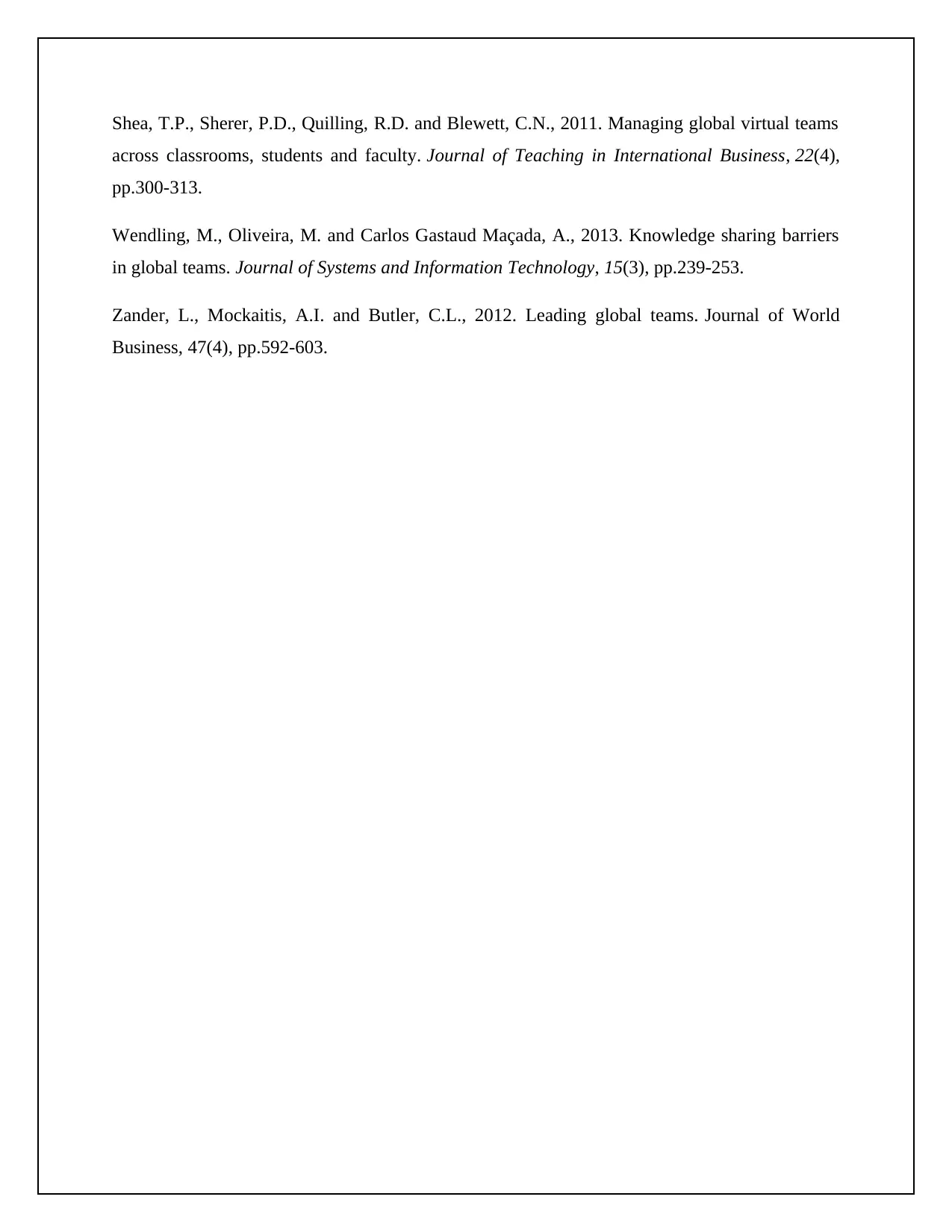
Shea, T.P., Sherer, P.D., Quilling, R.D. and Blewett, C.N., 2011. Managing global virtual teams
across classrooms, students and faculty. Journal of Teaching in International Business, 22(4),
pp.300-313.
Wendling, M., Oliveira, M. and Carlos Gastaud Maçada, A., 2013. Knowledge sharing barriers
in global teams. Journal of Systems and Information Technology, 15(3), pp.239-253.
Zander, L., Mockaitis, A.I. and Butler, C.L., 2012. Leading global teams. Journal of World
Business, 47(4), pp.592-603.
across classrooms, students and faculty. Journal of Teaching in International Business, 22(4),
pp.300-313.
Wendling, M., Oliveira, M. and Carlos Gastaud Maçada, A., 2013. Knowledge sharing barriers
in global teams. Journal of Systems and Information Technology, 15(3), pp.239-253.
Zander, L., Mockaitis, A.I. and Butler, C.L., 2012. Leading global teams. Journal of World
Business, 47(4), pp.592-603.
⊘ This is a preview!⊘
Do you want full access?
Subscribe today to unlock all pages.
Trusted by 1+ million students worldwide

1 out of 9


Related Documents


Your All-in-One AI-Powered Toolkit for Academic Success.
+13062052269
info@desklib.com
Available 24*7 on WhatsApp / Email
![[object Object]](/_next/static/media/star-bottom.7253800d.svg)
Unlock your academic potential
Copyright © 2020–2026 A2Z Services. All Rights Reserved. Developed and managed by ZUCOL.