Global Tourism Destinations: In-depth Analysis of Key Trends
VerifiedAdded on 2021/02/21
|13
|3950
|29
Report
AI Summary
This report provides a comprehensive overview of global tourism, examining the nature and trends of the industry. It explores the characteristics of key tourist-generating regions, analyzes the reasons behind the growth of both tourism-generating and receiving areas, and discusses emerging global tourism destinations and their life cycles. The report also delves into the roles and responsibilities of international organizations in tourism development, while addressing the threats, issues, and challenges facing the future of global tourism. The analysis includes statistical data on UK tourism, the impact of tourism on employment and revenue, and the factors attracting tourists, such as cultural heritage, leisure activities, and technological advancements. Furthermore, the report covers the benefits of global tourism, including GDP growth, infrastructure development, job creation, and support for rural communities, as well as the stages of destination life cycle from exploration to decline. The report concludes with a discussion of the challenges and opportunities in the evolving global tourism landscape.
Global Tourism
Destinations
Destinations

Paraphrase This Document
Need a fresh take? Get an instant paraphrase of this document with our AI Paraphraser

Table of Contents
INTRODUCTION...........................................................................................................................1
LO 1.................................................................................................................................................1
P1 Overview of Nature and Trend of Tourism:...........................................................................1
P 2 Characteristics of key tourist generation:..............................................................................3
LO2..................................................................................................................................................4
P3 Reasons for the growth of key global tourism generating and receiving areas of the world. 4
P4 Emerging Global Tourism Destination and Stages of Destination Life Cycle.......................5
LO3..................................................................................................................................................6
P5 Roles and Responsibilities of key International Organization in development of Global
Tourism .......................................................................................................................................6
LO4..................................................................................................................................................7
P6 Threats, Issues and Challenges of future development of global tourism..............................7
CONCLUSION ............................................................................................................................8
REFERENCS...................................................................................................................................9
INTRODUCTION...........................................................................................................................1
LO 1.................................................................................................................................................1
P1 Overview of Nature and Trend of Tourism:...........................................................................1
P 2 Characteristics of key tourist generation:..............................................................................3
LO2..................................................................................................................................................4
P3 Reasons for the growth of key global tourism generating and receiving areas of the world. 4
P4 Emerging Global Tourism Destination and Stages of Destination Life Cycle.......................5
LO3..................................................................................................................................................6
P5 Roles and Responsibilities of key International Organization in development of Global
Tourism .......................................................................................................................................6
LO4..................................................................................................................................................7
P6 Threats, Issues and Challenges of future development of global tourism..............................7
CONCLUSION ............................................................................................................................8
REFERENCS...................................................................................................................................9
⊘ This is a preview!⊘
Do you want full access?
Subscribe today to unlock all pages.

Trusted by 1+ million students worldwide
INTRODUCTION
Global tourism is all about having fun, pleasure and business across the world. It attracts
many tourist and people who are visiting various places. It is very much helpful for a person to
explore and make their business by meeting new people and exploring the world. Basically
global tourism can be defined as exploring with tourism spots like heritage, honey spot, MICE (it
is business purpose tourism), Medical and health development tourism, Film induced tourism
etc. All these tourisms comes under the global tourism because a person has to move or visit
different locations for different purposes.
This study includes the nature and trends of tourism, characteristics of key tourism
generation, reasons for the growth of global tourism, emerging global tourism and destination
life cycle, roles and responsibilities of international tourism development,challenges for future
development.
LO 1
P1 Overview of Nature and Trend of Tourism:
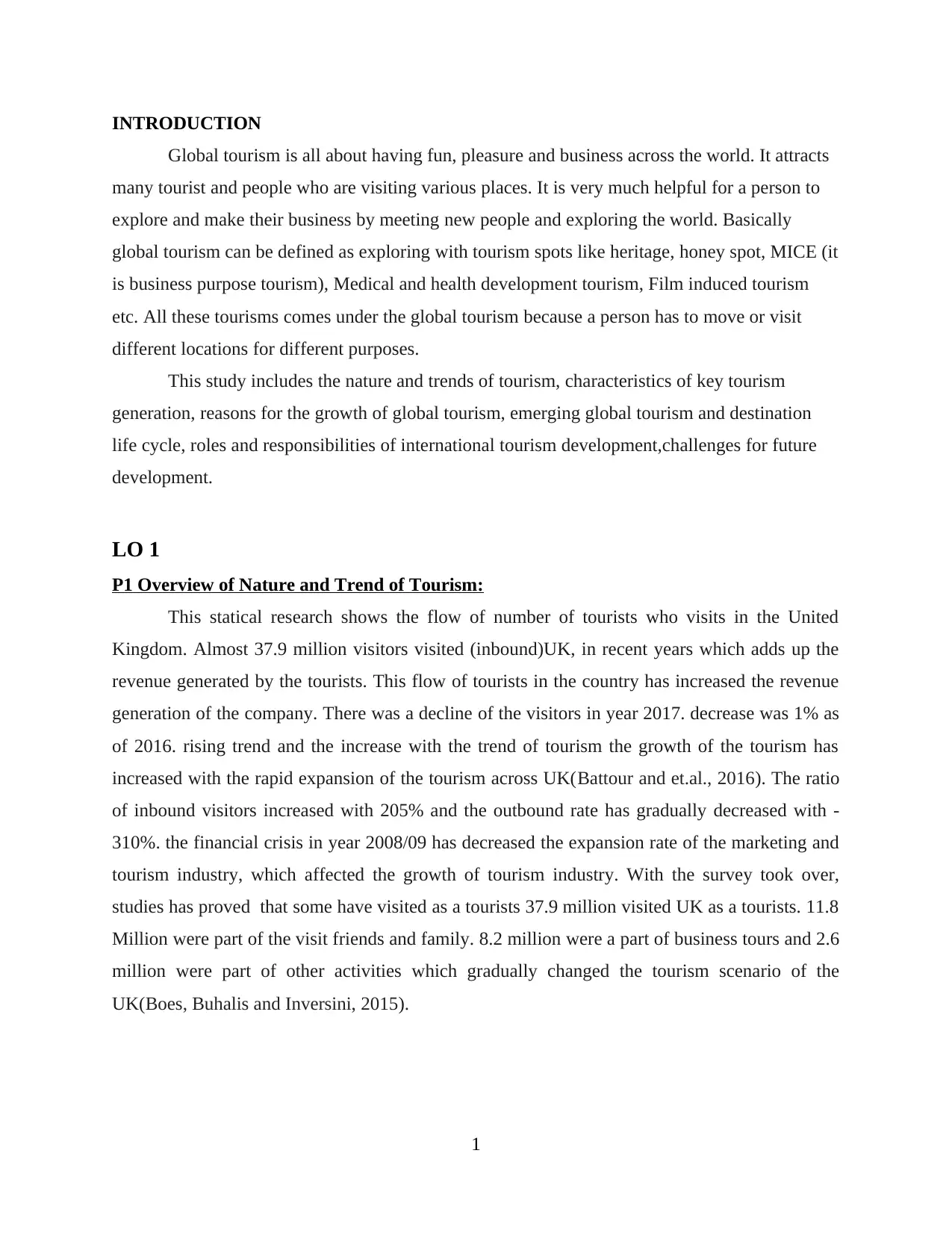
This statical research shows the flow of number of tourists who visits in the United
Kingdom. Almost 37.9 million visitors visited (inbound)UK, in recent years which adds up the
revenue generated by the tourists. This flow of tourists in the country has increased the revenue
generation of the company. There was a decline of the visitors in year 2017. decrease was 1% as
of 2016. rising trend and the increase with the trend of tourism the growth of the tourism has
increased with the rapid expansion of the tourism across UK(Battour and et.al., 2016). The ratio
of inbound visitors increased with 205% and the outbound rate has gradually decreased with -
310%. the financial crisis in year 2008/09 has decreased the expansion rate of the marketing and
tourism industry, which affected the growth of tourism industry. With the survey took over,
studies has proved that some have visited as a tourists 37.9 million visited UK as a tourists. 11.8
Million were part of the visit friends and family. 8.2 million were a part of business tours and 2.6
million were part of other activities which gradually changed the tourism scenario of the
UK(Boes, Buhalis and Inversini, 2015).
1
Global tourism is all about having fun, pleasure and business across the world. It attracts
many tourist and people who are visiting various places. It is very much helpful for a person to
explore and make their business by meeting new people and exploring the world. Basically
global tourism can be defined as exploring with tourism spots like heritage, honey spot, MICE (it
is business purpose tourism), Medical and health development tourism, Film induced tourism
etc. All these tourisms comes under the global tourism because a person has to move or visit
different locations for different purposes.
This study includes the nature and trends of tourism, characteristics of key tourism
generation, reasons for the growth of global tourism, emerging global tourism and destination
life cycle, roles and responsibilities of international tourism development,challenges for future
development.
LO 1
P1 Overview of Nature and Trend of Tourism:
This statical research shows the flow of number of tourists who visits in the United
Kingdom. Almost 37.9 million visitors visited (inbound)UK, in recent years which adds up the
revenue generated by the tourists. This flow of tourists in the country has increased the revenue
generation of the company. There was a decline of the visitors in year 2017. decrease was 1% as
of 2016. rising trend and the increase with the trend of tourism the growth of the tourism has
increased with the rapid expansion of the tourism across UK(Battour and et.al., 2016). The ratio
of inbound visitors increased with 205% and the outbound rate has gradually decreased with -
310%. the financial crisis in year 2008/09 has decreased the expansion rate of the marketing and
tourism industry, which affected the growth of tourism industry. With the survey took over,
studies has proved that some have visited as a tourists 37.9 million visited UK as a tourists. 11.8
Million were part of the visit friends and family. 8.2 million were a part of business tours and 2.6
million were part of other activities which gradually changed the tourism scenario of the
UK(Boes, Buhalis and Inversini, 2015).
1
Paraphrase This Document
Need a fresh take? Get an instant paraphrase of this document with our AI Paraphraser
From the recent study, tourism expenditure by the tourist was around £23 billion. Which
marked as a fall with respect to previous years. This is due to the recent change in trend which
has affected the revenue generation over the recent years. As the trends or the shift in the mindset
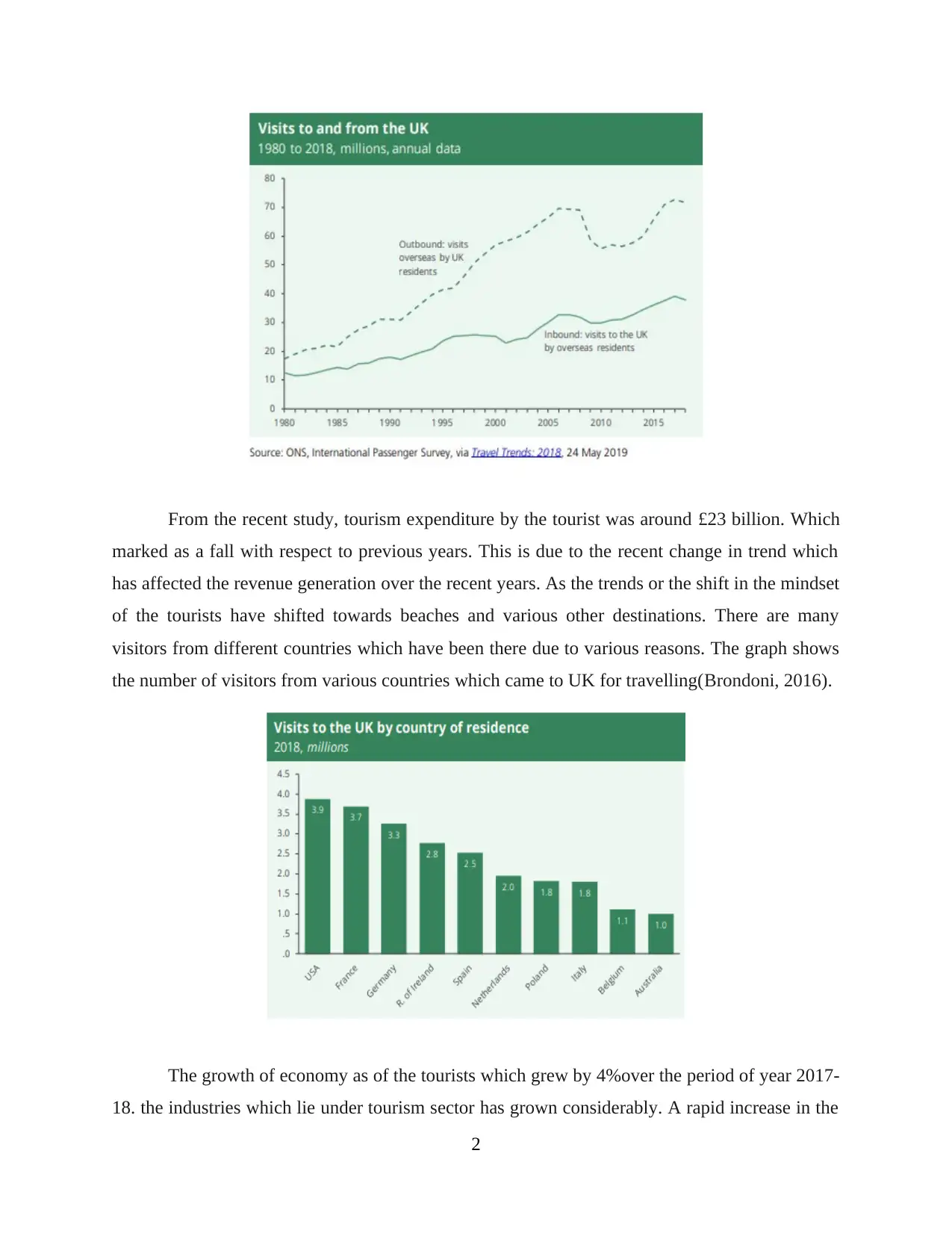
of the tourists have shifted towards beaches and various other destinations. There are many
visitors from different countries which have been there due to various reasons. The graph shows
the number of visitors from various countries which came to UK for travelling(Brondoni, 2016).
The growth of economy as of the tourists which grew by 4%over the period of year 2017-
18. the industries which lie under tourism sector has grown considerably. A rapid increase in the
2
marked as a fall with respect to previous years. This is due to the recent change in trend which
has affected the revenue generation over the recent years. As the trends or the shift in the mindset
of the tourists have shifted towards beaches and various other destinations. There are many
visitors from different countries which have been there due to various reasons. The graph shows
the number of visitors from various countries which came to UK for travelling(Brondoni, 2016).
The growth of economy as of the tourists which grew by 4%over the period of year 2017-
18. the industries which lie under tourism sector has grown considerably. A rapid increase in the
2
market which has changed overview of the scenario of the tourism growth and exchange of
culture. The consumption industry produced an outcome of £23 billion. Travel companies have
gained around £11 billion, food & beverage and accommodation contributed around £10 billion.
This has generated the employment opportunities for various locals which has increased the
employment rate and provide a benefit to the organization(Christian, 2016). Various sectors
generated the employment opportunities for various sectors of the industry. This has boosted up
the employment generation rate in UK. Market share has increased with the rise in the tourism in
UK which helped many of the locals and the government in the revenue generation. As a direct
employment of the workers employment services have changed the employment ratio within
various tourism sectors. Employment has increased the working culture of UK, which provided
employment opportunities for various young enthusiast which are in search of the employment
opportunities.
P 2 Characteristics of key tourist generation:
UK has a wide ancient history which reflects the Royalty and varied diverse culture
which attracts the tourists across the globe which facilitates the tourists to know about the royalty
and the culture of UK. As London is the fashion capital of the world many of the tourists are
attracted due to the fashion industry. This has increased the number of tourist generation in the
UK. These features attracts the customers of various counties to know about the diverse culture
and varied sectors which increases the tourism in UK. Leisure is one of the main reasons for the
tourism in UK as many of the facilities which are available in UK attracts the tourists(Garau-
Vadell and et.al., 2018).
Demographic-Demographic is one of the reasons which attracts various tourists worldwide
which increases the tourist. As the lifestyle of the tourists changes, UK is the most popular in
lifestyle, emerging trends are generated from London which is one of the biggest fashion capital
worldwide. Lifestyle of UK which is dependent on royalty and Royal living. UK has varied
diverse culture which attracts many of the customers. UK have a literacy rate of 99% which
attracts many of the students across the world for their research studies. Lifestyle of UK attracts
many of the people around the globe. Tourist shopping has attracted the growth and e3xpansion
of economy of Europe.
Economic- UK has a literacy level of 99% which has rapid expansion of job opportunities
which works for the youth of UK. Easy job is provided to youngsters which is the main reason
3
culture. The consumption industry produced an outcome of £23 billion. Travel companies have
gained around £11 billion, food & beverage and accommodation contributed around £10 billion.
This has generated the employment opportunities for various locals which has increased the
employment rate and provide a benefit to the organization(Christian, 2016). Various sectors
generated the employment opportunities for various sectors of the industry. This has boosted up
the employment generation rate in UK. Market share has increased with the rise in the tourism in
UK which helped many of the locals and the government in the revenue generation. As a direct
employment of the workers employment services have changed the employment ratio within
various tourism sectors. Employment has increased the working culture of UK, which provided
employment opportunities for various young enthusiast which are in search of the employment
opportunities.
P 2 Characteristics of key tourist generation:
UK has a wide ancient history which reflects the Royalty and varied diverse culture
which attracts the tourists across the globe which facilitates the tourists to know about the royalty
and the culture of UK. As London is the fashion capital of the world many of the tourists are
attracted due to the fashion industry. This has increased the number of tourist generation in the
UK. These features attracts the customers of various counties to know about the diverse culture
and varied sectors which increases the tourism in UK. Leisure is one of the main reasons for the
tourism in UK as many of the facilities which are available in UK attracts the tourists(Garau-
Vadell and et.al., 2018).
Demographic-Demographic is one of the reasons which attracts various tourists worldwide
which increases the tourist. As the lifestyle of the tourists changes, UK is the most popular in
lifestyle, emerging trends are generated from London which is one of the biggest fashion capital
worldwide. Lifestyle of UK which is dependent on royalty and Royal living. UK has varied
diverse culture which attracts many of the customers. UK have a literacy rate of 99% which
attracts many of the students across the world for their research studies. Lifestyle of UK attracts
many of the people around the globe. Tourist shopping has attracted the growth and e3xpansion
of economy of Europe.
Economic- UK has a literacy level of 99% which has rapid expansion of job opportunities
which works for the youth of UK. Easy job is provided to youngsters which is the main reason
3
⊘ This is a preview!⊘
Do you want full access?
Subscribe today to unlock all pages.
Trusted by 1+ million students worldwide
people migrate towards UK in search of job and business opportunities. Place of religious beliefs
are always flooded with tourists which boosts up the economy of the country. Technological
advancement has boosted the economy through tourism with various aspects like lag time is
reduced to zero which gives many customers a good response. Use of internet has boosted the
economy as in it gives a secure channel to tourist from frauds which increases the trust of the
tourists. As the exchange rates are high it adds up the value to the market of the UK many trace
practices are easier with the increase in economy(Gil-Alana and Huijbens, 2018).
Research Importance- Many of the young tourists visits UK for the purpose of researches about
the ancient history which can be a topic of researches which is carried out in order to evaluate the
research methodology.
LO2
P3 Reasons for the growth of key global tourism generating and receiving areas of the world.
There are many reasons for a global tourism to make tourism possible to each and every part
of the world. They do because they have stimulates the GDP growth for our country. The tourism
sector have the worth of 7.6 trillion dollars for travel and tourism account with 10% of GDP
growth rate which represents 7% of international trade and 30% of world export service. It also
helps in increasing the international trade. Worth of 1.2 trillion dollar has been earned from the
exports made in foreign countries. The international investment has been boosted because of
global tourism. It has became the second fastest growing industry in the terms of foreign direct
investment (FDI). The global tourism has also helped in developing the infrastructure for the
country. Many water supplies, airports, roads, energies and medical services facilities are
improved because of global tourism. It also supports the low income economy in various ways.
In year 2015, the world's 48 lower income and lower middle income countries have arrival of 29
million international tourist and earns 21 billion from international tourism(Gössling and Peeters,
2015).
The jobs are created in very effective way because of global tourism. It supports 292 million
jobs in years 2016 and it owns the 2nd position in providing employment to the people. It also
promotes the inclusive growth and it is labour intensive and have an approach to reach and
provides various kinds of benefits to its employees. These benefits are provided because of the
supply chain of global tourism sector. This sector have a very strong and trusted supply chain
management system which have all the connections and provides profits and benefits to the
4
are always flooded with tourists which boosts up the economy of the country. Technological
advancement has boosted the economy through tourism with various aspects like lag time is
reduced to zero which gives many customers a good response. Use of internet has boosted the
economy as in it gives a secure channel to tourist from frauds which increases the trust of the
tourists. As the exchange rates are high it adds up the value to the market of the UK many trace
practices are easier with the increase in economy(Gil-Alana and Huijbens, 2018).
Research Importance- Many of the young tourists visits UK for the purpose of researches about
the ancient history which can be a topic of researches which is carried out in order to evaluate the
research methodology.
LO2
P3 Reasons for the growth of key global tourism generating and receiving areas of the world.
There are many reasons for a global tourism to make tourism possible to each and every part
of the world. They do because they have stimulates the GDP growth for our country. The tourism
sector have the worth of 7.6 trillion dollars for travel and tourism account with 10% of GDP
growth rate which represents 7% of international trade and 30% of world export service. It also
helps in increasing the international trade. Worth of 1.2 trillion dollar has been earned from the
exports made in foreign countries. The international investment has been boosted because of
global tourism. It has became the second fastest growing industry in the terms of foreign direct
investment (FDI). The global tourism has also helped in developing the infrastructure for the
country. Many water supplies, airports, roads, energies and medical services facilities are
improved because of global tourism. It also supports the low income economy in various ways.
In year 2015, the world's 48 lower income and lower middle income countries have arrival of 29
million international tourist and earns 21 billion from international tourism(Gössling and Peeters,
2015).
The jobs are created in very effective way because of global tourism. It supports 292 million
jobs in years 2016 and it owns the 2nd position in providing employment to the people. It also
promotes the inclusive growth and it is labour intensive and have an approach to reach and
provides various kinds of benefits to its employees. These benefits are provided because of the
supply chain of global tourism sector. This sector have a very strong and trusted supply chain
management system which have all the connections and provides profits and benefits to the
4
Paraphrase This Document
Need a fresh take? Get an instant paraphrase of this document with our AI Paraphraser
organization. The major role played by the global tourism is that it strengthens the rural
communities in many ways. It always diversifies the rural economies and provides them with
their rural values and employment(Gowreesunkar and et.al.,2018). It helps a lot in providing jobs
to ethical minorities of the rural areas and they work for their development. The global tourism
also revitalized the urban areas as many urban areas uses the global tourism for increasing the
employment and regenerating its potential to create jobs, increase attractive investments and
improve the infrastructure. It provides many benefits to the women of our nation. Around 60-
70% of tourism sector employees are women. It has the highest female participation and it
always motivates the female employees to ore more and more. The global tourism also helps in
assessing the incomes via travel technology. This is done because of digital marketing. Digital
marketing plays a very major role in providing the employment to the people. All the researches,
bookings, purchasing, selling and there are a lot of informal way to earn money from digital
marketing in travel and tourism sector. Nowadays bloster's artist are also increasing in the global
tourism sector. In this they provide artisans benefits to the tourist by selling them their crafts. It
is mostly done in handicraft sector and tourist visiting the heritage resorts and palaces buys these
products, and the by selling of these products make business for the tourism sector(Kiráľová and
Pavlíčeka, 2015).
P4 Emerging Global Tourism Destination and Stages of Destination Life Cycle
The emergence of global tourism destination is growing in a very fast rate . The world
tourism organization has said that the number of tourist are increased by 6% in the year 2018. It
has increased the demand for travel and tourism, especially in the countries like India and china.
According to world tourism and travel council the number of travellers are expected to increase
to twice the rate of travel to advanced economies in upcoming 11 years. The world's fastest
growing tourism destinations are located in emerging markets. The community of host has gone
from strength to strength and the number of airbnb listing in India has been increased by more
than 150% each year. Whereas in stages of destination life cycle, The stages involved are
Exploration, Involvement, Development, Consolidation, Stagnation, Rejuvenation and Decline.
The Exploration is about few hardy and adventurous people looking for something different in
holiday and find a place which is special in its nature, heritage, culture, landscape and history.
Secondly, the involvement have local people start to notice that there are increasing numbers of
people coming to their local areas(Maji 2018). They start up the business as the local guides,
5
communities in many ways. It always diversifies the rural economies and provides them with
their rural values and employment(Gowreesunkar and et.al.,2018). It helps a lot in providing jobs
to ethical minorities of the rural areas and they work for their development. The global tourism
also revitalized the urban areas as many urban areas uses the global tourism for increasing the
employment and regenerating its potential to create jobs, increase attractive investments and
improve the infrastructure. It provides many benefits to the women of our nation. Around 60-
70% of tourism sector employees are women. It has the highest female participation and it
always motivates the female employees to ore more and more. The global tourism also helps in
assessing the incomes via travel technology. This is done because of digital marketing. Digital
marketing plays a very major role in providing the employment to the people. All the researches,
bookings, purchasing, selling and there are a lot of informal way to earn money from digital
marketing in travel and tourism sector. Nowadays bloster's artist are also increasing in the global
tourism sector. In this they provide artisans benefits to the tourist by selling them their crafts. It
is mostly done in handicraft sector and tourist visiting the heritage resorts and palaces buys these
products, and the by selling of these products make business for the tourism sector(Kiráľová and
Pavlíčeka, 2015).
P4 Emerging Global Tourism Destination and Stages of Destination Life Cycle
The emergence of global tourism destination is growing in a very fast rate . The world
tourism organization has said that the number of tourist are increased by 6% in the year 2018. It
has increased the demand for travel and tourism, especially in the countries like India and china.
According to world tourism and travel council the number of travellers are expected to increase
to twice the rate of travel to advanced economies in upcoming 11 years. The world's fastest
growing tourism destinations are located in emerging markets. The community of host has gone
from strength to strength and the number of airbnb listing in India has been increased by more
than 150% each year. Whereas in stages of destination life cycle, The stages involved are
Exploration, Involvement, Development, Consolidation, Stagnation, Rejuvenation and Decline.
The Exploration is about few hardy and adventurous people looking for something different in
holiday and find a place which is special in its nature, heritage, culture, landscape and history.
Secondly, the involvement have local people start to notice that there are increasing numbers of
people coming to their local areas(Maji 2018). They start up the business as the local guides,
5
food restaurants, hotels for accommodation and providing cabs facility to the tourists. Third is
development in which the big companies start investing money in the region to start their
business in the form of making large hotel buildings and providing the localities with
employment. Fourth stage is consolidation, in which the local economy is dominated by the
tourism sector and it is the source of earning for local population. This can result into removal of
local market which runs from farming and fishing. Fifth stage is stagnation, in which the
competition from other resorts and rowdiness and a loss of original feature can cause resort to
stop growing. The number of people going off then starts to decline, threatening local business
and services. Sixth stage is rejuvenation in which capital is involved in the form of money from
private or government company which creates an attraction for the resorts and hotels. The last
(sixth) stage is decline which is in the form of rejuvenation. It can be slow or rapid and regular
visitors can be replaced by people seeking a cheap break or day tripper(Tang, Zhong and Jiang,
2018).
FACTORS DRIVING GROWTH
There are 5 major factors for driving growth in global market. First is environmental factor in
which there are two parts, good climate and beautiful scenery. Environmental factor is all about
these two requirements. Second is Socio economic factor which consists of 4 parts and they are
accessibility, accommodation, amenities, ancillary and services. These parts effects the socio
economic factor very majorly. Third is historical and cultural factors in which the tourist are
attracted to a historical place which have the rich culture and heritage. Fourth is Religious factor
in which the people visit the religious places in for the inner peace, blessings and beliefs. Fifth is
other factors which includes miscellaneous activities.
LO3
P5 Roles and Responsibilities of key International Organization in development of Global
Tourism
The major international tourism organizations are UNWTO (WTO), IATA, UFTAA,
PATA, ASTA. There are many roles and responsibilities played by these firms in the economy.
UNWTO conducted a research studies. They organize many seminars and conferences such as
aviation, infrastructure, development planning and marketing that are shared by the countries. It
gathers information on tourism which includes statistical facilities, special events, regulations
and legislations. It collects, analyse and disseminates information in various aspect of tourism. It
6
development in which the big companies start investing money in the region to start their
business in the form of making large hotel buildings and providing the localities with
employment. Fourth stage is consolidation, in which the local economy is dominated by the
tourism sector and it is the source of earning for local population. This can result into removal of
local market which runs from farming and fishing. Fifth stage is stagnation, in which the
competition from other resorts and rowdiness and a loss of original feature can cause resort to
stop growing. The number of people going off then starts to decline, threatening local business
and services. Sixth stage is rejuvenation in which capital is involved in the form of money from
private or government company which creates an attraction for the resorts and hotels. The last
(sixth) stage is decline which is in the form of rejuvenation. It can be slow or rapid and regular
visitors can be replaced by people seeking a cheap break or day tripper(Tang, Zhong and Jiang,
2018).
FACTORS DRIVING GROWTH
There are 5 major factors for driving growth in global market. First is environmental factor in
which there are two parts, good climate and beautiful scenery. Environmental factor is all about
these two requirements. Second is Socio economic factor which consists of 4 parts and they are
accessibility, accommodation, amenities, ancillary and services. These parts effects the socio
economic factor very majorly. Third is historical and cultural factors in which the tourist are
attracted to a historical place which have the rich culture and heritage. Fourth is Religious factor
in which the people visit the religious places in for the inner peace, blessings and beliefs. Fifth is
other factors which includes miscellaneous activities.
LO3
P5 Roles and Responsibilities of key International Organization in development of Global
Tourism
The major international tourism organizations are UNWTO (WTO), IATA, UFTAA,
PATA, ASTA. There are many roles and responsibilities played by these firms in the economy.
UNWTO conducted a research studies. They organize many seminars and conferences such as
aviation, infrastructure, development planning and marketing that are shared by the countries. It
gathers information on tourism which includes statistical facilities, special events, regulations
and legislations. It collects, analyse and disseminates information in various aspect of tourism. It
6
⊘ This is a preview!⊘
Do you want full access?
Subscribe today to unlock all pages.
Trusted by 1+ million students worldwide
prepares draft for international agreement on tourism and it provides updates information to its
users. They had simplified the travel and shipping process by keeping the cost down. They allow
them to operate safely, securely, efficiently and economically by keeping all the rules and
regulations in mind. They seeks to ensure that they are well-informed with complexities of
aviation industry. It also serves as an intermediary between airlines, passengers as well as cargo
agents. It provides a solid expertise to airlines in a variety of industry solutions. It also helps to
regulate the legal questions of general concern in order to develop security measures. It also
helps in training of travels and freight agents. It unites the federations of travel agents and
national association to enhance and promote the interest of members. It represents the travel
agents activities before the various world bodies, government authorities and suppliers. It assists
through its education committees. It lobbies to oppose legislation which are directly harmful to
tourism. It also acts as an information and investigation centre. Pacific Asia Travel Association
(PATA) provides information and practical assistance in field of tourism. It assist upcoming
destination to develop their infrastructure. It serves as central source of information and
guidelines. It helps in members in doing the marketing o9f various products and services. It
organize an annual travel mart. The major roles were doing sponsorship of conference on
tourism-related matter. Another thing they do is discussion with airlines on fare construction and
travel destinations. All the travellers travelling in the flight, always do a research that on which
aircraft they will be flying. Assistance is done in all agencies in travel oriented matter. Co
operation to other states and government bodies. The government also plays a vital role in the
development process. It will aim to achieve necessary linkage and synergies in the policies and
program of all concerned departments and agencies by establishing effective co ordinations and
mechanism in central, state and district levels. The public and private sector partnership gives an
feasible means and is very much important for sustaining the growth of tourism. Therefore it is
the policy of the government to encourage emergence of such partnership. This will be achieved
by creating tourism development authority consisting of the senior officials of government and
tourism experts(Pratt and Liu, 2016.).
LO4
P6 Threats, Issues and Challenges of future development of global tourism
Various threats which can affect local tourism, is the access use of the utilities and the
natural resources which can affect the environment as there is over-tourism there arouse a need
7
users. They had simplified the travel and shipping process by keeping the cost down. They allow
them to operate safely, securely, efficiently and economically by keeping all the rules and
regulations in mind. They seeks to ensure that they are well-informed with complexities of
aviation industry. It also serves as an intermediary between airlines, passengers as well as cargo
agents. It provides a solid expertise to airlines in a variety of industry solutions. It also helps to
regulate the legal questions of general concern in order to develop security measures. It also
helps in training of travels and freight agents. It unites the federations of travel agents and
national association to enhance and promote the interest of members. It represents the travel
agents activities before the various world bodies, government authorities and suppliers. It assists
through its education committees. It lobbies to oppose legislation which are directly harmful to
tourism. It also acts as an information and investigation centre. Pacific Asia Travel Association
(PATA) provides information and practical assistance in field of tourism. It assist upcoming
destination to develop their infrastructure. It serves as central source of information and
guidelines. It helps in members in doing the marketing o9f various products and services. It
organize an annual travel mart. The major roles were doing sponsorship of conference on
tourism-related matter. Another thing they do is discussion with airlines on fare construction and
travel destinations. All the travellers travelling in the flight, always do a research that on which
aircraft they will be flying. Assistance is done in all agencies in travel oriented matter. Co
operation to other states and government bodies. The government also plays a vital role in the
development process. It will aim to achieve necessary linkage and synergies in the policies and
program of all concerned departments and agencies by establishing effective co ordinations and
mechanism in central, state and district levels. The public and private sector partnership gives an
feasible means and is very much important for sustaining the growth of tourism. Therefore it is
the policy of the government to encourage emergence of such partnership. This will be achieved
by creating tourism development authority consisting of the senior officials of government and
tourism experts(Pratt and Liu, 2016.).
LO4
P6 Threats, Issues and Challenges of future development of global tourism
Various threats which can affect local tourism, is the access use of the utilities and the
natural resources which can affect the environment as there is over-tourism there arouse a need
7
Paraphrase This Document
Need a fresh take? Get an instant paraphrase of this document with our AI Paraphraser
of the use of extra natural resources and facilities which can affect the natural geography of UK
with the use of natural resources there arises many problems like wastage of water which is a
major challenge which are faced by many countries. There are many changes in the climate
which can affect the use of natural resources. Pollution is one of the major threat which can
affect the climatic change and will affect the future of the global tourism. There are many means
of pollution which is affecting the safe working of the country. As the tourism increases there
emerges the increase in pollution which must be minimised in order to provide a safe functioning
of the country. Management of solid waste and sewerage, water waste management, use of
plastic must be minimised in order to provide a safer functioning(Wu, 2016).
Over-tourism leads to decline of the natural assets which is offered by nature. Tourism
must be carried out with a safe working environment in order to carry the functioning properly
which in turn creates a safer working environment for locals as well. Over-tourism will lead to
scarcity of natural resources like fresh water and air which will create a polluted atmosphere
which will lead to improper balance of nature. Unplanned development will lead to the blunders
which will affect the locals. Destructive fishing, depletion of forest which will lead to depletion
of natural resources. Weather and climate will reduce the climatic assets based on infrastructure
and tourism assets. Ecological imbalance leads to unfavourable conditions in the country. Social
issues emerges as the terrorism increases with the increase in population with respect to
overcrowding. Many of the criminal activities rises with the increase of tourism many activities
like pick-pockets, smuggling and various other illegal activities emerges with the increase in
activities of the tourism. Natural disaster can take place any time with the emerging alerts which
can affect many monuments and things of natural importance(Yavuz and et.al., 2018).
For the future development of the natural activities and to minimise the threats various
other activities must be minimised in order to create a safe channel which can maintain a safe
working of the channel which can generate the working strategy.
CONCLUSION
This study reflects the ways of creating a sustainable environment in the field of tourism which
can create an awareness of the tourism with respect to environment. Various analysis are carried
out to search the various marketing trends which are carried out in UK. Defining various
characteristics to evaluate areas of generation of tourism which can help in the growth of tourism
in UK. Evaluating the reasons for the growth and development of the tourism which can help in
8
with the use of natural resources there arises many problems like wastage of water which is a
major challenge which are faced by many countries. There are many changes in the climate
which can affect the use of natural resources. Pollution is one of the major threat which can
affect the climatic change and will affect the future of the global tourism. There are many means
of pollution which is affecting the safe working of the country. As the tourism increases there
emerges the increase in pollution which must be minimised in order to provide a safe functioning
of the country. Management of solid waste and sewerage, water waste management, use of
plastic must be minimised in order to provide a safer functioning(Wu, 2016).
Over-tourism leads to decline of the natural assets which is offered by nature. Tourism
must be carried out with a safe working environment in order to carry the functioning properly
which in turn creates a safer working environment for locals as well. Over-tourism will lead to
scarcity of natural resources like fresh water and air which will create a polluted atmosphere
which will lead to improper balance of nature. Unplanned development will lead to the blunders
which will affect the locals. Destructive fishing, depletion of forest which will lead to depletion
of natural resources. Weather and climate will reduce the climatic assets based on infrastructure
and tourism assets. Ecological imbalance leads to unfavourable conditions in the country. Social
issues emerges as the terrorism increases with the increase in population with respect to
overcrowding. Many of the criminal activities rises with the increase of tourism many activities
like pick-pockets, smuggling and various other illegal activities emerges with the increase in
activities of the tourism. Natural disaster can take place any time with the emerging alerts which
can affect many monuments and things of natural importance(Yavuz and et.al., 2018).
For the future development of the natural activities and to minimise the threats various
other activities must be minimised in order to create a safe channel which can maintain a safe
working of the channel which can generate the working strategy.
CONCLUSION
This study reflects the ways of creating a sustainable environment in the field of tourism which
can create an awareness of the tourism with respect to environment. Various analysis are carried
out to search the various marketing trends which are carried out in UK. Defining various
characteristics to evaluate areas of generation of tourism which can help in the growth of tourism
in UK. Evaluating the reasons for the growth and development of the tourism which can help in
8
the development of tourist activities. Investigating roles and responsibilities to create an
awareness for development of global tourism. Reviewing the drawbacks which affect the future
of global tourism and minimising the ways of the issues faced.
REFERENCS
Books and Journals
Battour, M. and et.al., 2016. Halal tourism: Concepts, practises, challenges and future. Tourism
management perspectives. 19. pp.150-154.
Boes, K., Buhalis, D. and Inversini, A., 2015. Conceptualising smart tourism destination
dimensions. In Information and communication technologies in tourism 2015 (pp. 391-
403). Springer, Cham.
Brondoni, S.M., 2016. Global Tourism Management. Mass, Experience and Sensations
Tourism. Symphonya. Emerging Issues in Management. (1). pp.7-24.
Christian, M., 2016. Tourism global production networks and uneven social upgrading in Kenya
and Uganda. Tourism Geographies. 18(1). pp.38-58.
Garau-Vadell, J.B. and et.al., 2018. Economic crisis and residents’ perception of the impacts of
tourism in mass tourism destinations. Journal of destination marketing & management. 7.
pp.68-75.
Gil-Alana, L.A. and Huijbens, E.H., 2018. Tourism in Iceland: Persistence and
seasonality. Annals of Tourism Research. 68. pp.20-29.
Gössling, S. and Peeters, P., 2015. Assessing tourism's global environmental impact 1900–
2050. Journal of Sustainable Tourism. 23(5). pp.639-659.
Gowreesunkar, V.G and et.al., A., 2018. Destination marketing organizations: Roles and
challenges. In The Routledge Handbook of Destination Marketing (pp. 16-34). Routledge.
Kiráľová, A. and Pavlíčeka, A., 2015. Development of social media strategies in tourism
destination. Procedia-Social and Behavioral Sciences. 175. pp.358-366.
Maji, P., 2018. Promoting Rural Heritage Tourism: A Case Study From Bishnupur. In Managing
Sustainable Tourism Resources (pp. 162-176). IGI Global.
Pratt, S. and Liu, A., 2016. Does tourism really lead to peace? A global view. International
Journal of Tourism Research. 18(1). pp.82-90.
9
awareness for development of global tourism. Reviewing the drawbacks which affect the future
of global tourism and minimising the ways of the issues faced.
REFERENCS
Books and Journals
Battour, M. and et.al., 2016. Halal tourism: Concepts, practises, challenges and future. Tourism
management perspectives. 19. pp.150-154.
Boes, K., Buhalis, D. and Inversini, A., 2015. Conceptualising smart tourism destination
dimensions. In Information and communication technologies in tourism 2015 (pp. 391-
403). Springer, Cham.
Brondoni, S.M., 2016. Global Tourism Management. Mass, Experience and Sensations
Tourism. Symphonya. Emerging Issues in Management. (1). pp.7-24.
Christian, M., 2016. Tourism global production networks and uneven social upgrading in Kenya
and Uganda. Tourism Geographies. 18(1). pp.38-58.
Garau-Vadell, J.B. and et.al., 2018. Economic crisis and residents’ perception of the impacts of
tourism in mass tourism destinations. Journal of destination marketing & management. 7.
pp.68-75.
Gil-Alana, L.A. and Huijbens, E.H., 2018. Tourism in Iceland: Persistence and
seasonality. Annals of Tourism Research. 68. pp.20-29.
Gössling, S. and Peeters, P., 2015. Assessing tourism's global environmental impact 1900–
2050. Journal of Sustainable Tourism. 23(5). pp.639-659.
Gowreesunkar, V.G and et.al., A., 2018. Destination marketing organizations: Roles and
challenges. In The Routledge Handbook of Destination Marketing (pp. 16-34). Routledge.
Kiráľová, A. and Pavlíčeka, A., 2015. Development of social media strategies in tourism
destination. Procedia-Social and Behavioral Sciences. 175. pp.358-366.
Maji, P., 2018. Promoting Rural Heritage Tourism: A Case Study From Bishnupur. In Managing
Sustainable Tourism Resources (pp. 162-176). IGI Global.
Pratt, S. and Liu, A., 2016. Does tourism really lead to peace? A global view. International
Journal of Tourism Research. 18(1). pp.82-90.
9
⊘ This is a preview!⊘
Do you want full access?
Subscribe today to unlock all pages.
Trusted by 1+ million students worldwide

1 out of 13


Related Documents


Your All-in-One AI-Powered Toolkit for Academic Success.
+13062052269
info@desklib.com
Available 24*7 on WhatsApp / Email
![[object Object]](/_next/static/media/star-bottom.7253800d.svg)
Unlock your academic potential
Copyright © 2020–2025 A2Z Services. All Rights Reserved. Developed and managed by ZUCOL.