Greenberg v. Miami Children’s Research Institute

Verified

Added on  2019/09/20

|4
|631
|420
Case Study
AI Summary
This case study examines the legal and ethical issues surrounding the Greenberg v. Miami Children's Research Institute case, focusing on the property rights of individuals concerning their tissue samples used in research. It delves into the concept of informed consent, the fiduciary duties of researchers, and the idea of public commons in relation to health-related research. The case highlights the conflict between private interests and the public good, particularly in the context of licensing research findings related to diseases like Canavan's. The analysis emphasizes that research findings, especially those concerning public health, should be accessible to all and not subject to private ownership or licensing.

Document Page
Greenberg v. Miami Children’s Research Institute
tabler-icon-diamond-filled.svg

Paraphrase This Document

Need a fresh take? Get an instant paraphrase of this document with our AI Paraphraser
Document Page
Property rights of an individual
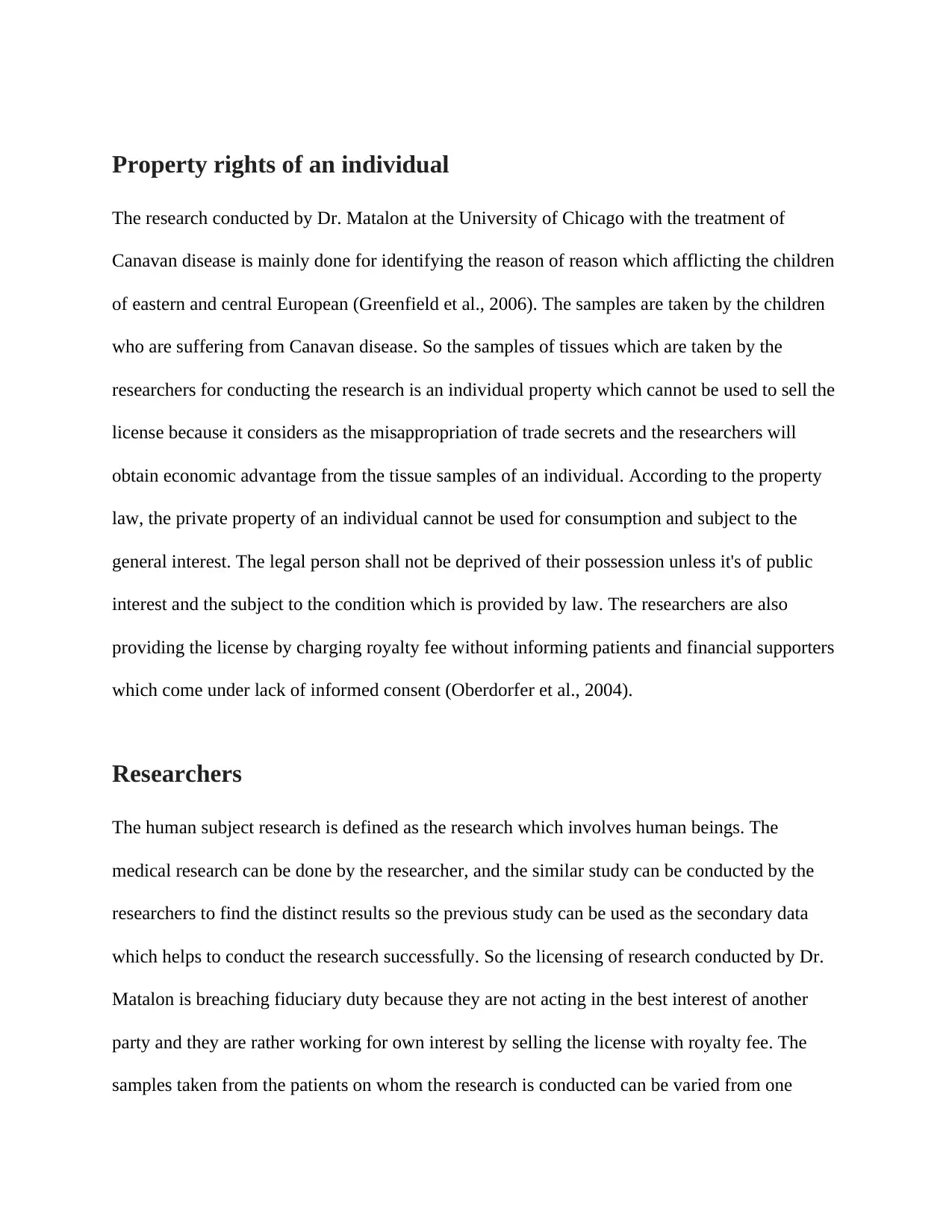
The research conducted by Dr. Matalon at the University of Chicago with the treatment of
Canavan disease is mainly done for identifying the reason of reason which afflicting the children
of eastern and central European (Greenfield et al., 2006). The samples are taken by the children
who are suffering from Canavan disease. So the samples of tissues which are taken by the
researchers for conducting the research is an individual property which cannot be used to sell the
license because it considers as the misappropriation of trade secrets and the researchers will
obtain economic advantage from the tissue samples of an individual. According to the property
law, the private property of an individual cannot be used for consumption and subject to the
general interest. The legal person shall not be deprived of their possession unless it's of public
interest and the subject to the condition which is provided by law. The researchers are also
providing the license by charging royalty fee without informing patients and financial supporters
which come under lack of informed consent (Oberdorfer et al., 2004).
Researchers
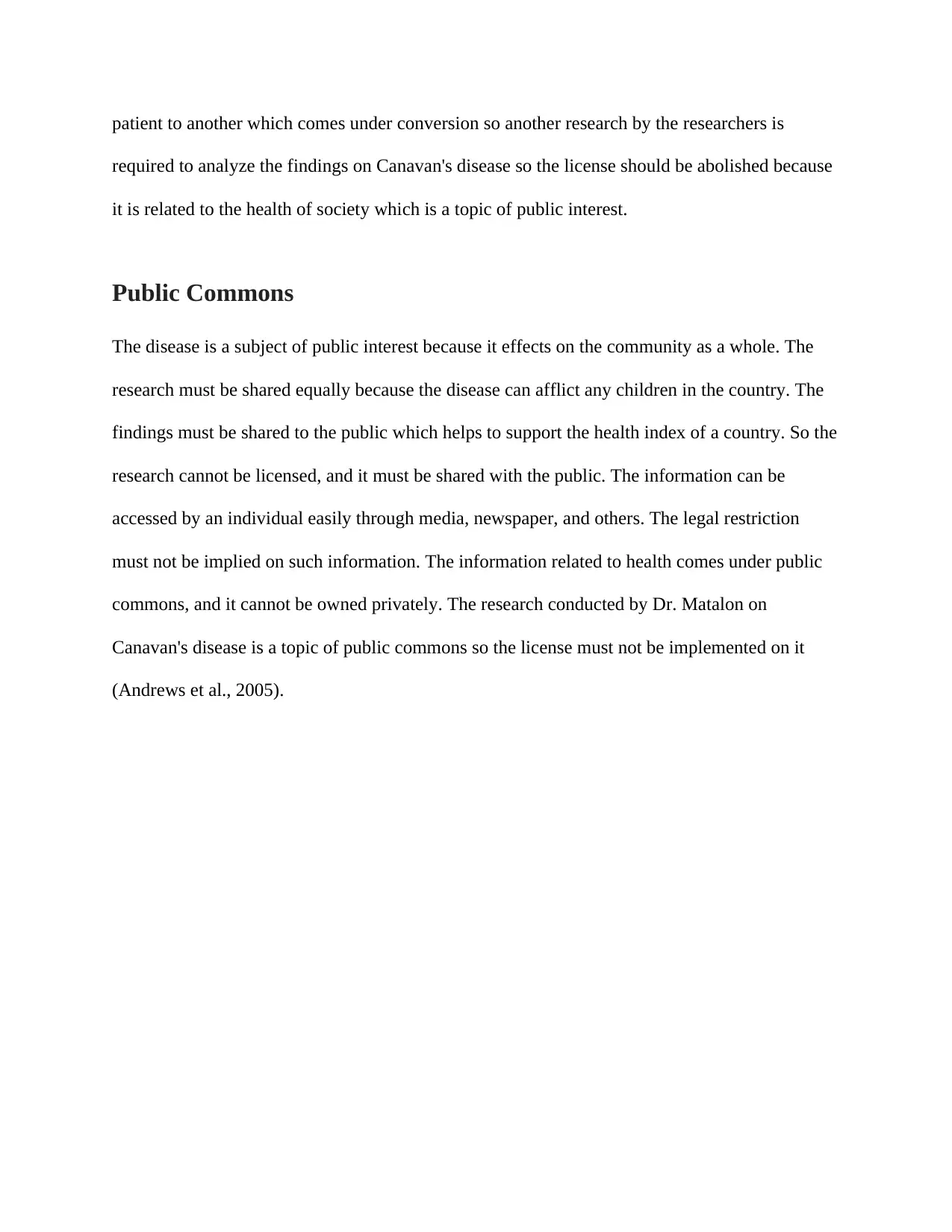
The human subject research is defined as the research which involves human beings. The
medical research can be done by the researcher, and the similar study can be conducted by the
researchers to find the distinct results so the previous study can be used as the secondary data
which helps to conduct the research successfully. So the licensing of research conducted by Dr.
Matalon is breaching fiduciary duty because they are not acting in the best interest of another
party and they are rather working for own interest by selling the license with royalty fee. The
samples taken from the patients on whom the research is conducted can be varied from one
Document Page
patient to another which comes under conversion so another research by the researchers is
required to analyze the findings on Canavan's disease so the license should be abolished because
it is related to the health of society which is a topic of public interest.
Public Commons
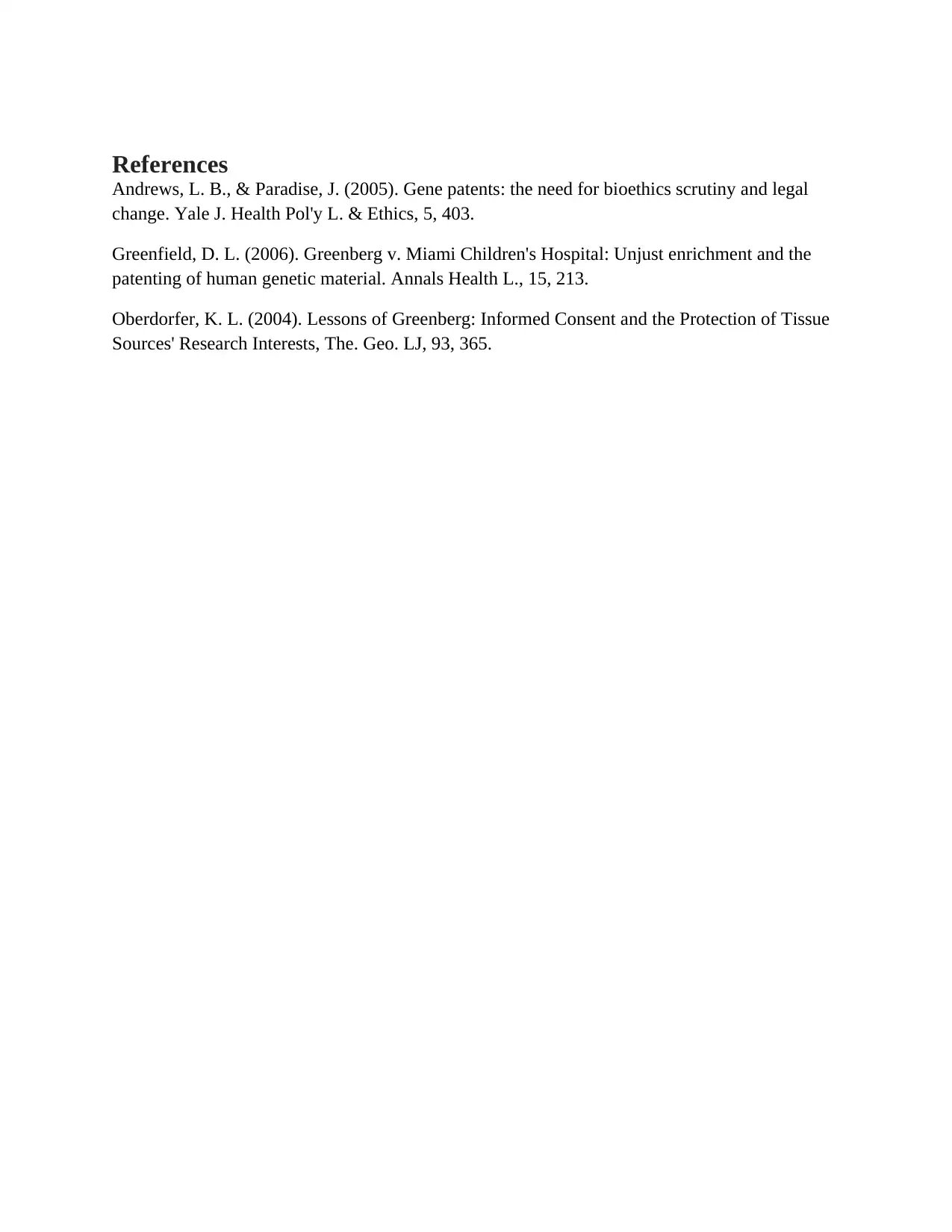
The disease is a subject of public interest because it effects on the community as a whole. The
research must be shared equally because the disease can afflict any children in the country. The
findings must be shared to the public which helps to support the health index of a country. So the
research cannot be licensed, and it must be shared with the public. The information can be
accessed by an individual easily through media, newspaper, and others. The legal restriction
must not be implied on such information. The information related to health comes under public
commons, and it cannot be owned privately. The research conducted by Dr. Matalon on
Canavan's disease is a topic of public commons so the license must not be implemented on it
(Andrews et al., 2005).
Document Page
References
Andrews, L. B., & Paradise, J. (2005). Gene patents: the need for bioethics scrutiny and legal
change. Yale J. Health Pol'y L. & Ethics, 5, 403.
Greenfield, D. L. (2006). Greenberg v. Miami Children's Hospital: Unjust enrichment and the
patenting of human genetic material. Annals Health L., 15, 213.
Oberdorfer, K. L. (2004). Lessons of Greenberg: Informed Consent and the Protection of Tissue
Sources' Research Interests, The. Geo. LJ, 93, 365.
chevron_up_icon
1 out of 4
circle_padding
hide_on_mobile
zoom_out_icon
[object Object]