Group Work vs. Individual Work: Academic and Professional Settings

Verified

Added on  2023/04/23

|5
|268
|468
Presentation
AI Summary
This presentation compares and contrasts group work with individual work in academic and professional settings. It begins by highlighting the importance of group work, citing sources like Kramer (2014) to emphasize its benefits, including skill development, enhanced performance, and improved communication. The presentation also addresses the resistance to group work, referencing Moreland (2013) to explain factors such as inappropriate tasks, miscommunication, and ineffective group formation. The presentation also evaluates the merits of each approach, providing a balanced view of the advantages and disadvantages of both group and individual work. This analysis is designed to provide a comprehensive understanding of group work dynamics and its application in various settings.

Document Page
GROUP WORK
tabler-icon-diamond-filled.svg

Paraphrase This Document

Need a fresh take? Get an instant paraphrase of this document with our AI Paraphraser
Document Page
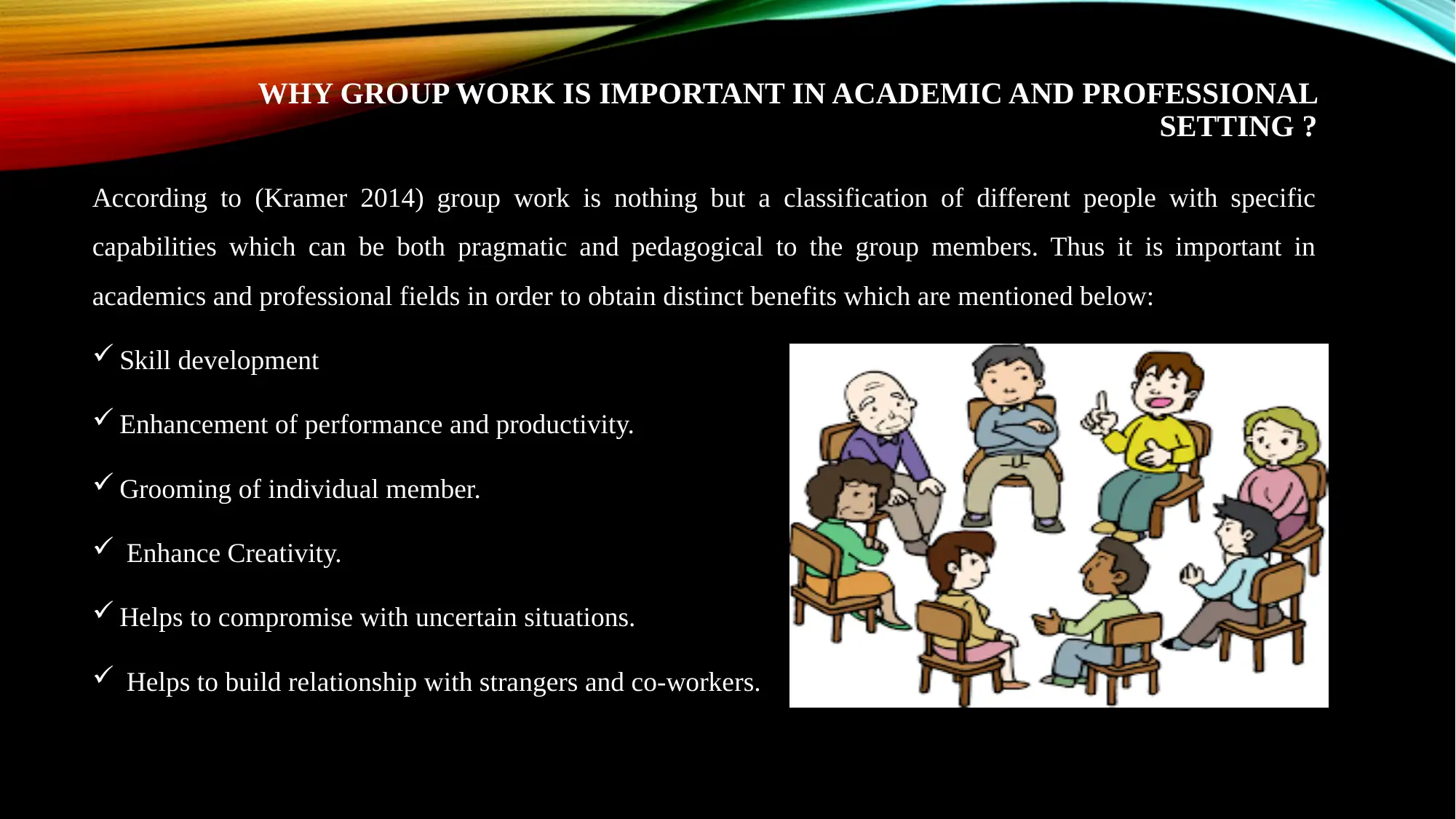
WHY GROUP WORK IS IMPORTANT IN ACADEMIC AND PROFESSIONAL
SETTING ?
According to (Kramer 2014) group work is nothing but a classification of different people with specific
capabilities which can be both pragmatic and pedagogical to the group members. Thus it is important in
academics and professional fields in order to obtain distinct benefits which are mentioned below:
Skill development
Enhancement of performance and productivity.
Grooming of individual member.
Enhance Creativity.
Helps to compromise with uncertain situations.
Helps to build relationship with strangers and co-workers.
Document Page
WHY IS THERE RESISTANCE TO GROUP WORK?
Followed by the study of (Moreland 2013) there are some members present in groups who are resistant to
group work for below reasons:
Inappropriate tasks are selected for group works with short deadlines and improper details which are not
enough as compared to the individual tasks.
Miscommunication of Group members.
An overused approach.
Discriminatory performance by group members.
Less effective group formation.
Sometimes it becomes a workload reducing procedure for teachers.
Document Page
REFERENCE
Kramer, A., Bhave, D.P. and Johnson, T.D., 2014. Personality and group performance:
The importance of personality composition and work tasks. Personality and Individual
Differences, 58, pp.132-137.
Moreland, R.L., Levine, J.M. and Wingert, M.L., 2013. Creating the ideal group:
Composition effects at work. Understanding group behavior, 2, pp.11-35.
tabler-icon-diamond-filled.svg

Paraphrase This Document

Need a fresh take? Get an instant paraphrase of this document with our AI Paraphraser
Document Page
chevron_up_icon
1 out of 5
circle_padding
hide_on_mobile
zoom_out_icon
[object Object]