Hamlet Act II Questions: Analysis of Scenes and Character Behavior
VerifiedAdded on 2020/05/28
|8
|2064
|1857
Homework Assignment
AI Summary
This document provides a comprehensive analysis of Hamlet Act II, addressing key questions about the play's plot, characters, and themes. The assignment explores Polonius's deceptive spying methods, Hamlet's feigned madness, and the political context surrounding Denmark's vulnerability. It examines Claudius and Gertrude's requests to Rosencrantz and Guildenstern, the ambassadors' report on Fortinbras, and Polonius's theories regarding Hamlet's behavior. The analysis delves into Hamlet's conversations with Polonius, Rosencrantz, and Guildenstern, including his ironic remarks and revelations about his state of mind. The document also examines the play within a play, the players' performance, and Hamlet's soliloquy, revealing his plans for revenge and his internal conflicts. The assignment draws upon literary analysis and critical essays to provide a detailed understanding of the scenes.
Hamlet Act II Questions Scene
Student Name: Student ID:
Unit Name: Unit ID:
Date Due: Professor Name:
Page | 1
Student Name: Student ID:
Unit Name: Unit ID:
Date Due: Professor Name:
Page | 1

Paraphrase This Document
Need a fresh take? Get an instant paraphrase of this document with our AI Paraphraser
Scene 1
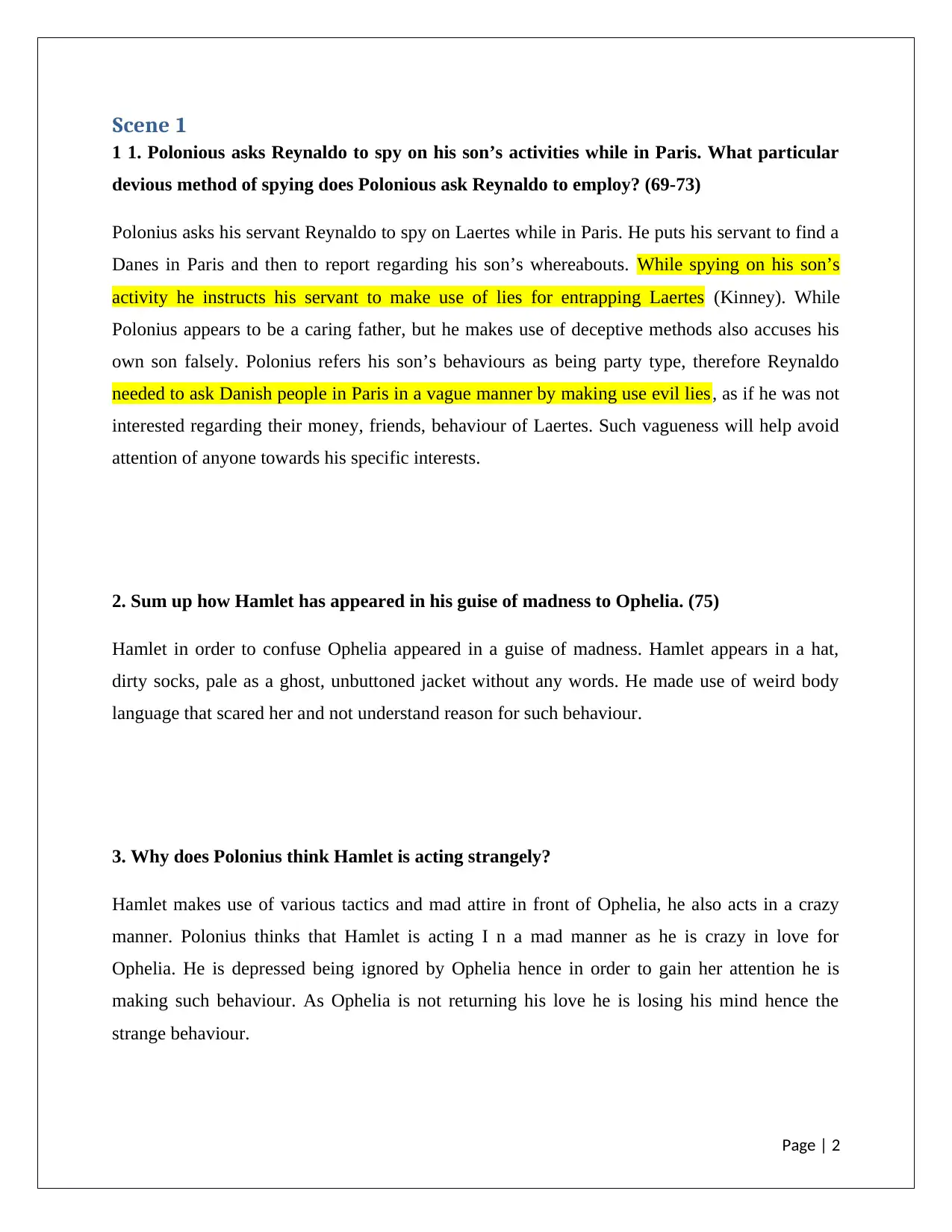
1 1. Polonious asks Reynaldo to spy on his son’s activities while in Paris. What particular
devious method of spying does Polonious ask Reynaldo to employ? (69-73)
Polonius asks his servant Reynaldo to spy on Laertes while in Paris. He puts his servant to find a
Danes in Paris and then to report regarding his son’s whereabouts. While spying on his son’s
activity he instructs his servant to make use of lies for entrapping Laertes (Kinney). While
Polonius appears to be a caring father, but he makes use of deceptive methods also accuses his
own son falsely. Polonius refers his son’s behaviours as being party type, therefore Reynaldo
needed to ask Danish people in Paris in a vague manner by making use evil lies, as if he was not
interested regarding their money, friends, behaviour of Laertes. Such vagueness will help avoid
attention of anyone towards his specific interests.
2. Sum up how Hamlet has appeared in his guise of madness to Ophelia. (75)
Hamlet in order to confuse Ophelia appeared in a guise of madness. Hamlet appears in a hat,
dirty socks, pale as a ghost, unbuttoned jacket without any words. He made use of weird body
language that scared her and not understand reason for such behaviour.
3. Why does Polonius think Hamlet is acting strangely?
Hamlet makes use of various tactics and mad attire in front of Ophelia, he also acts in a crazy
manner. Polonius thinks that Hamlet is acting I n a mad manner as he is crazy in love for
Ophelia. He is depressed being ignored by Ophelia hence in order to gain her attention he is
making such behaviour. As Ophelia is not returning his love he is losing his mind hence the
strange behaviour.
Page | 2
1 1. Polonious asks Reynaldo to spy on his son’s activities while in Paris. What particular
devious method of spying does Polonious ask Reynaldo to employ? (69-73)
Polonius asks his servant Reynaldo to spy on Laertes while in Paris. He puts his servant to find a
Danes in Paris and then to report regarding his son’s whereabouts. While spying on his son’s
activity he instructs his servant to make use of lies for entrapping Laertes (Kinney). While
Polonius appears to be a caring father, but he makes use of deceptive methods also accuses his
own son falsely. Polonius refers his son’s behaviours as being party type, therefore Reynaldo
needed to ask Danish people in Paris in a vague manner by making use evil lies, as if he was not
interested regarding their money, friends, behaviour of Laertes. Such vagueness will help avoid
attention of anyone towards his specific interests.
2. Sum up how Hamlet has appeared in his guise of madness to Ophelia. (75)
Hamlet in order to confuse Ophelia appeared in a guise of madness. Hamlet appears in a hat,
dirty socks, pale as a ghost, unbuttoned jacket without any words. He made use of weird body
language that scared her and not understand reason for such behaviour.
3. Why does Polonius think Hamlet is acting strangely?
Hamlet makes use of various tactics and mad attire in front of Ophelia, he also acts in a crazy
manner. Polonius thinks that Hamlet is acting I n a mad manner as he is crazy in love for
Ophelia. He is depressed being ignored by Ophelia hence in order to gain her attention he is
making such behaviour. As Ophelia is not returning his love he is losing his mind hence the
strange behaviour.
Page | 2
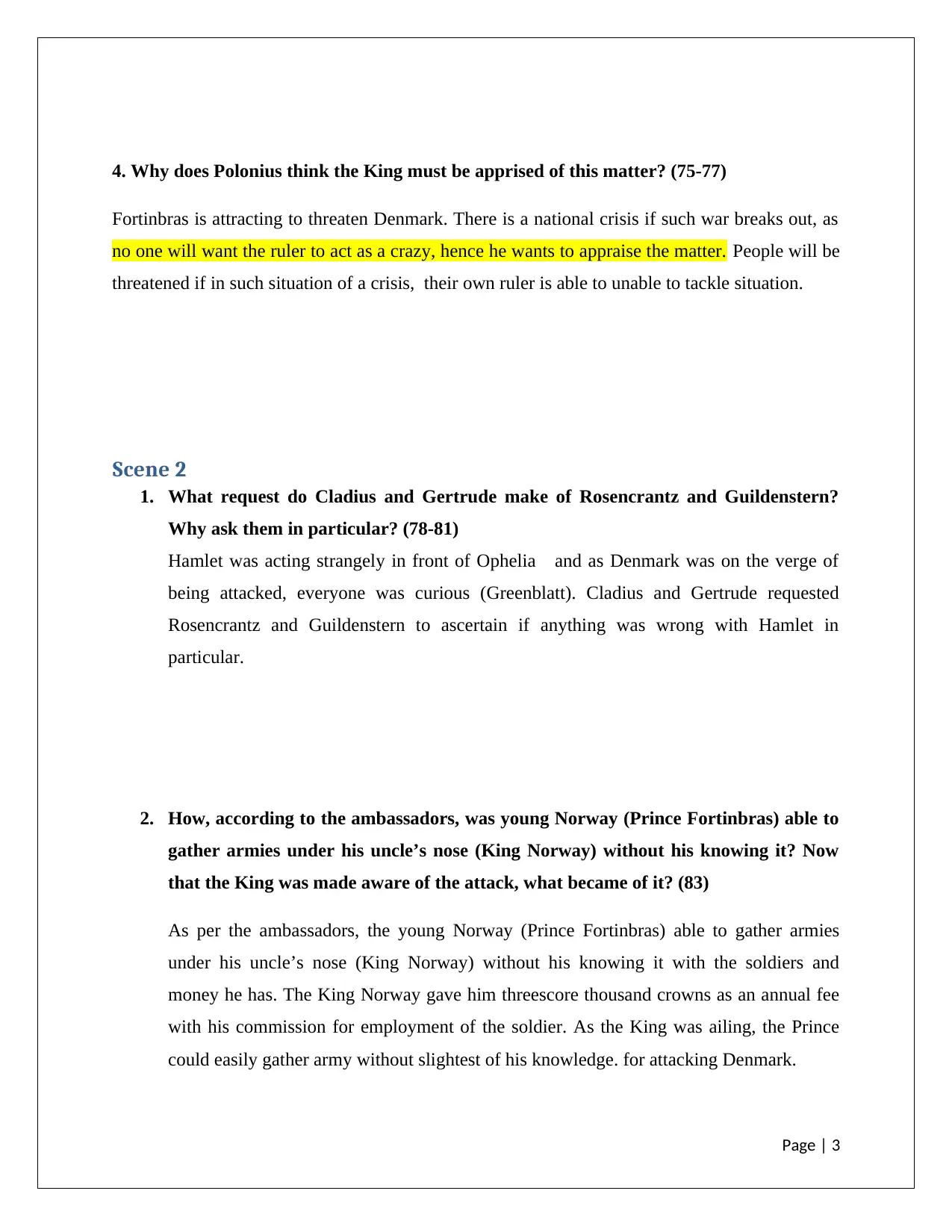
4. Why does Polonius think the King must be apprised of this matter? (75-77)
Fortinbras is attracting to threaten Denmark. There is a national crisis if such war breaks out, as
no one will want the ruler to act as a crazy, hence he wants to appraise the matter. People will be
threatened if in such situation of a crisis, their own ruler is able to unable to tackle situation.
Scene 2
1. What request do Cladius and Gertrude make of Rosencrantz and Guildenstern?
Why ask them in particular? (78-81)
Hamlet was acting strangely in front of Ophelia and as Denmark was on the verge of
being attacked, everyone was curious (Greenblatt). Cladius and Gertrude requested
Rosencrantz and Guildenstern to ascertain if anything was wrong with Hamlet in
particular.
2. How, according to the ambassadors, was young Norway (Prince Fortinbras) able to
gather armies under his uncle’s nose (King Norway) without his knowing it? Now
that the King was made aware of the attack, what became of it? (83)
As per the ambassadors, the young Norway (Prince Fortinbras) able to gather armies
under his uncle’s nose (King Norway) without his knowing it with the soldiers and
money he has. The King Norway gave him threescore thousand crowns as an annual fee
with his commission for employment of the soldier. As the King was ailing, the Prince
could easily gather army without slightest of his knowledge. for attacking Denmark.
Page | 3
Fortinbras is attracting to threaten Denmark. There is a national crisis if such war breaks out, as
no one will want the ruler to act as a crazy, hence he wants to appraise the matter. People will be
threatened if in such situation of a crisis, their own ruler is able to unable to tackle situation.
Scene 2
1. What request do Cladius and Gertrude make of Rosencrantz and Guildenstern?
Why ask them in particular? (78-81)
Hamlet was acting strangely in front of Ophelia and as Denmark was on the verge of
being attacked, everyone was curious (Greenblatt). Cladius and Gertrude requested
Rosencrantz and Guildenstern to ascertain if anything was wrong with Hamlet in
particular.
2. How, according to the ambassadors, was young Norway (Prince Fortinbras) able to
gather armies under his uncle’s nose (King Norway) without his knowing it? Now
that the King was made aware of the attack, what became of it? (83)
As per the ambassadors, the young Norway (Prince Fortinbras) able to gather armies
under his uncle’s nose (King Norway) without his knowing it with the soldiers and
money he has. The King Norway gave him threescore thousand crowns as an annual fee
with his commission for employment of the soldier. As the King was ailing, the Prince
could easily gather army without slightest of his knowledge. for attacking Denmark.
Page | 3
⊘ This is a preview!⊘
Do you want full access?
Subscribe today to unlock all pages.

Trusted by 1+ million students worldwide
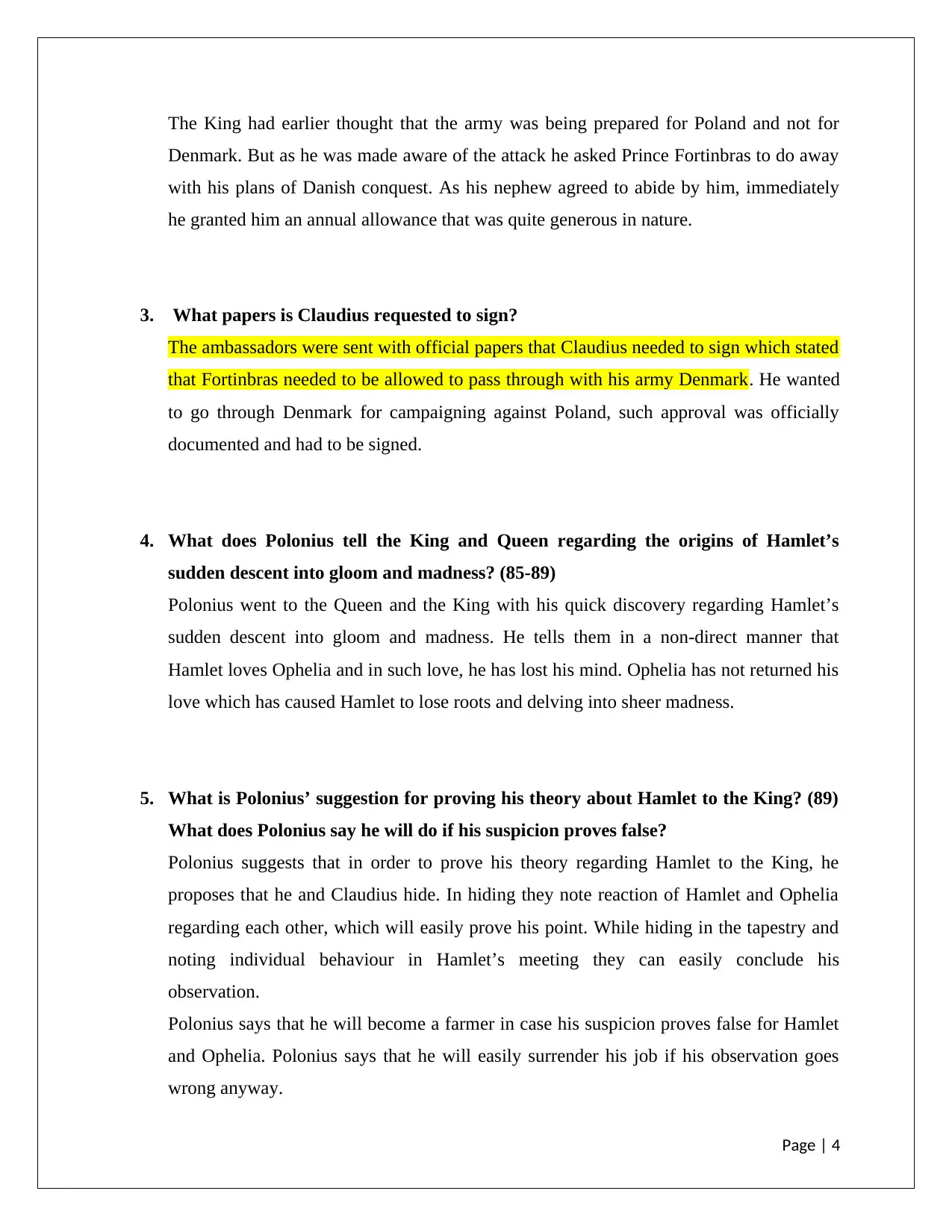
The King had earlier thought that the army was being prepared for Poland and not for
Denmark. But as he was made aware of the attack he asked Prince Fortinbras to do away
with his plans of Danish conquest. As his nephew agreed to abide by him, immediately
he granted him an annual allowance that was quite generous in nature.
3. What papers is Claudius requested to sign?
The ambassadors were sent with official papers that Claudius needed to sign which stated
that Fortinbras needed to be allowed to pass through with his army Denmark. He wanted
to go through Denmark for campaigning against Poland, such approval was officially
documented and had to be signed.
4. What does Polonius tell the King and Queen regarding the origins of Hamlet’s
sudden descent into gloom and madness? (85-89)
Polonius went to the Queen and the King with his quick discovery regarding Hamlet’s
sudden descent into gloom and madness. He tells them in a non-direct manner that
Hamlet loves Ophelia and in such love, he has lost his mind. Ophelia has not returned his
love which has caused Hamlet to lose roots and delving into sheer madness.
5. What is Polonius’ suggestion for proving his theory about Hamlet to the King? (89)
What does Polonius say he will do if his suspicion proves false?
Polonius suggests that in order to prove his theory regarding Hamlet to the King, he
proposes that he and Claudius hide. In hiding they note reaction of Hamlet and Ophelia
regarding each other, which will easily prove his point. While hiding in the tapestry and
noting individual behaviour in Hamlet’s meeting they can easily conclude his
observation.
Polonius says that he will become a farmer in case his suspicion proves false for Hamlet
and Ophelia. Polonius says that he will easily surrender his job if his observation goes
wrong anyway.
Page | 4
Denmark. But as he was made aware of the attack he asked Prince Fortinbras to do away
with his plans of Danish conquest. As his nephew agreed to abide by him, immediately
he granted him an annual allowance that was quite generous in nature.
3. What papers is Claudius requested to sign?
The ambassadors were sent with official papers that Claudius needed to sign which stated
that Fortinbras needed to be allowed to pass through with his army Denmark. He wanted
to go through Denmark for campaigning against Poland, such approval was officially
documented and had to be signed.
4. What does Polonius tell the King and Queen regarding the origins of Hamlet’s
sudden descent into gloom and madness? (85-89)
Polonius went to the Queen and the King with his quick discovery regarding Hamlet’s
sudden descent into gloom and madness. He tells them in a non-direct manner that
Hamlet loves Ophelia and in such love, he has lost his mind. Ophelia has not returned his
love which has caused Hamlet to lose roots and delving into sheer madness.
5. What is Polonius’ suggestion for proving his theory about Hamlet to the King? (89)
What does Polonius say he will do if his suspicion proves false?
Polonius suggests that in order to prove his theory regarding Hamlet to the King, he
proposes that he and Claudius hide. In hiding they note reaction of Hamlet and Ophelia
regarding each other, which will easily prove his point. While hiding in the tapestry and
noting individual behaviour in Hamlet’s meeting they can easily conclude his
observation.
Polonius says that he will become a farmer in case his suspicion proves false for Hamlet
and Ophelia. Polonius says that he will easily surrender his job if his observation goes
wrong anyway.
Page | 4
Paraphrase This Document
Need a fresh take? Get an instant paraphrase of this document with our AI Paraphraser
6. Give an example of Hamlet being verbally ironic in his conversation with Polonius.
(91-93)
Hamlet’s verbally ironic conversation which does not make sense takes place, as Hamlet
calls Polonius a Jepthah, an old wrinkled fishmonger man. An ideal example of the same
is, Hamlet’s mocks at Polonius by attacking every time he questions by changing his
language inside out. Hamlet is seen to be having no patience towards Polonius, which
further proves his behaviour towards him.
7. Why does Hamlet say in line 266 that beggars are bodies, and monarchs and heroes
are but shadows of beggars? (96-97)
Hamlet say in line 266 that beggars are bodies, and monarchs and heroes are but shadows
of beggars as he is in deep melancholy. He thinks deeply overcoming his accustomed
behaviour by providing a detailed speech of his misery. He refers to a bad dream also his
mood at that time. He wants to say in those lines that beggars do not have ambitions. But
kings and heroes possess ambition but they do not work on their ambitions, therefore they
are no variant of beggars themselves. Such deep though is a reflection of his thoughts
regarding inability to pursue his dreams.
8. What question does Hamlet pose of Rosencrantz and Guildenstern? (97-99)
Rosencrantz and Guildenstern visit their friend Hamlet surprisingly in Elsinore. While
talking philosophy Hamlet ask them as to why they have come to such a great distance.
Though both the friends try and dodge the question yet he wants to know who has sent
for them and why they were there.
9. What does Hamlet reveal to his two friends (R&G) about his state of mind? (99)
Page | 5
(91-93)
Hamlet’s verbally ironic conversation which does not make sense takes place, as Hamlet
calls Polonius a Jepthah, an old wrinkled fishmonger man. An ideal example of the same
is, Hamlet’s mocks at Polonius by attacking every time he questions by changing his
language inside out. Hamlet is seen to be having no patience towards Polonius, which
further proves his behaviour towards him.
7. Why does Hamlet say in line 266 that beggars are bodies, and monarchs and heroes
are but shadows of beggars? (96-97)
Hamlet say in line 266 that beggars are bodies, and monarchs and heroes are but shadows
of beggars as he is in deep melancholy. He thinks deeply overcoming his accustomed
behaviour by providing a detailed speech of his misery. He refers to a bad dream also his
mood at that time. He wants to say in those lines that beggars do not have ambitions. But
kings and heroes possess ambition but they do not work on their ambitions, therefore they
are no variant of beggars themselves. Such deep though is a reflection of his thoughts
regarding inability to pursue his dreams.
8. What question does Hamlet pose of Rosencrantz and Guildenstern? (97-99)
Rosencrantz and Guildenstern visit their friend Hamlet surprisingly in Elsinore. While
talking philosophy Hamlet ask them as to why they have come to such a great distance.
Though both the friends try and dodge the question yet he wants to know who has sent
for them and why they were there.
9. What does Hamlet reveal to his two friends (R&G) about his state of mind? (99)
Page | 5
Hamlet reveals to Rosencrantz and Guildenstern, his two friends regarding his state of
mind, which was of deep melancholy. He says that he is void of any type of merry and
fun from his life, which makes him face misery. He complains that nothing is capable of
making him happy at the moment.
10. Why, according to R&G, are the tragedians of the city forced to travel? (101)
According to Rosencrantz and Guildenstern, are the tragedians of the city forced to travel
for arrival of players, as a company of child actors have seized the London stage. R&G
have been passed by a troop of players while they were visiting Elsinore. The child actors
were popular then hence they were accompanying them.
11. What does Hamlet mean when he tells R&G that he is “but mad north-north-west”?
(103)
When Hamlet mean tells Rosencrantz and Guildenstern that he is “but mad north-north-
west” revealing his reasons for craziness. He provides details regarding his madness and
recent behaviour but says that he is in complete control of the situation.
12. Hamlet and the players recount part of a play concerning Pyrrhus, Priam, and
Hecuba. From the portion given here, write what happens to these 3 characters.
(109-113)
Hamlet and the players recount part of a play concerning Pyrrhus, Priam, and Hecuba by
reciting a scene from Virgil’s Aeneid. In the play, with fall of Troy, Priam dies in
Pyrrhus’ hands. Hecuba on the other hand, Priam’s wife was on verge of a wild grief and
agony as she is found to be weeping and shaking. This is the fate decided in the play.
Page | 6
mind, which was of deep melancholy. He says that he is void of any type of merry and
fun from his life, which makes him face misery. He complains that nothing is capable of
making him happy at the moment.
10. Why, according to R&G, are the tragedians of the city forced to travel? (101)
According to Rosencrantz and Guildenstern, are the tragedians of the city forced to travel
for arrival of players, as a company of child actors have seized the London stage. R&G
have been passed by a troop of players while they were visiting Elsinore. The child actors
were popular then hence they were accompanying them.
11. What does Hamlet mean when he tells R&G that he is “but mad north-north-west”?
(103)
When Hamlet mean tells Rosencrantz and Guildenstern that he is “but mad north-north-
west” revealing his reasons for craziness. He provides details regarding his madness and
recent behaviour but says that he is in complete control of the situation.
12. Hamlet and the players recount part of a play concerning Pyrrhus, Priam, and
Hecuba. From the portion given here, write what happens to these 3 characters.
(109-113)
Hamlet and the players recount part of a play concerning Pyrrhus, Priam, and Hecuba by
reciting a scene from Virgil’s Aeneid. In the play, with fall of Troy, Priam dies in
Pyrrhus’ hands. Hecuba on the other hand, Priam’s wife was on verge of a wild grief and
agony as she is found to be weeping and shaking. This is the fate decided in the play.
Page | 6
⊘ This is a preview!⊘
Do you want full access?
Subscribe today to unlock all pages.
Trusted by 1+ million students worldwide
13. Hamlet makes a strange request of one of the players for tomorrow’s performance.
What is his request, and why do you suppose he makes it? (113-117)
Hamlet makes a strange request of one of the players for tomorrow’s performance for
addition of the play. He requested them to add twelve to sixteen original lines to the play.
Hamlet makes such a request as players will enact The Murder of Gonzago similar to
murdering the Ghost. He hopes that the crime enactment in front of the audience will
make Claudius guilty. He hopes that Claudia will reflect that he murdered King Hamlet.
14. What is meant by this oft quoted line, “What’s Hecuba to him, or he to Hecuba”
(line 565)?
The oft quoted line, “What’s Hecuba to him, or he to Hecuba” reflects that he is upset,
actors can show such true emotions. He is curious regarding that how can someone act a
fake story or regarding someone that he does not knows so truly. Hamlet is amazed
regarding the strangeness regarding the situation, as the players are so filled with rage
and grief. He tries to understand that players does not know Hecuba and Priam. However,
he curses his own self regarding his incapability to seek revenge from his murderous
uncle.
15. In his soliloquy, Hamlet both upbraids himself and reveals his course of action. Why
is he so cruel to himself, and what does he plan to do? (115-117)
Hamlet in soliloquy upbraids himself while revealing his course of action of being cruel
to himself. He did not ever acted before in this manner, hence he is surprised. He cannot
be certain regarding his behaviour and decisions hence he curses himself continuously.
Hamlet plans to act death of his father to the king. He has intentions to be the ghost of his
father. Ghost was not regarded as damned to be evil spirits. His play will be exact
Page | 7
What is his request, and why do you suppose he makes it? (113-117)
Hamlet makes a strange request of one of the players for tomorrow’s performance for
addition of the play. He requested them to add twelve to sixteen original lines to the play.
Hamlet makes such a request as players will enact The Murder of Gonzago similar to
murdering the Ghost. He hopes that the crime enactment in front of the audience will
make Claudius guilty. He hopes that Claudia will reflect that he murdered King Hamlet.
14. What is meant by this oft quoted line, “What’s Hecuba to him, or he to Hecuba”
(line 565)?
The oft quoted line, “What’s Hecuba to him, or he to Hecuba” reflects that he is upset,
actors can show such true emotions. He is curious regarding that how can someone act a
fake story or regarding someone that he does not knows so truly. Hamlet is amazed
regarding the strangeness regarding the situation, as the players are so filled with rage
and grief. He tries to understand that players does not know Hecuba and Priam. However,
he curses his own self regarding his incapability to seek revenge from his murderous
uncle.
15. In his soliloquy, Hamlet both upbraids himself and reveals his course of action. Why
is he so cruel to himself, and what does he plan to do? (115-117)
Hamlet in soliloquy upbraids himself while revealing his course of action of being cruel
to himself. He did not ever acted before in this manner, hence he is surprised. He cannot
be certain regarding his behaviour and decisions hence he curses himself continuously.
Hamlet plans to act death of his father to the king. He has intentions to be the ghost of his
father. Ghost was not regarded as damned to be evil spirits. His play will be exact
Page | 7
Paraphrase This Document
Need a fresh take? Get an instant paraphrase of this document with our AI Paraphraser
reflection of his father’s murder. He will observe Claudius behaviour while enacting the
play, he feels that Claudius will definitely show guilt on the scene of the crime.
Bibliography
Greenblatt, S., & Cohen, W. (Eds.). The Norton Shakespeare: Third International Student
Edition. WW Norton & Company, 2015.
Kinney, Arthur F., ed. Hamlet: Critical Essays. Routledge, 2013.
Page | 8
play, he feels that Claudius will definitely show guilt on the scene of the crime.
Bibliography
Greenblatt, S., & Cohen, W. (Eds.). The Norton Shakespeare: Third International Student
Edition. WW Norton & Company, 2015.
Kinney, Arthur F., ed. Hamlet: Critical Essays. Routledge, 2013.
Page | 8

1 out of 8


Your All-in-One AI-Powered Toolkit for Academic Success.
+13062052269
info@desklib.com
Available 24*7 on WhatsApp / Email
![[object Object]](/_next/static/media/star-bottom.7253800d.svg)
Unlock your academic potential
Copyright © 2020–2025 A2Z Services. All Rights Reserved. Developed and managed by ZUCOL.