Hand Hygiene Tracking System Report - Healthcare, University Name

Verified

Added on  2022/08/21

|11
|1044
|21
Report
AI Summary
This report focuses on Hand Hygiene Tracking Systems (HHTS) within the healthcare industry. It begins by highlighting the significance of HHTS in preventing healthcare-related infections, reducing contamination, and enhancing patient empathy. The report then reviews scholarly articles to support the use of HHTS, emphasizing its role in managing access, restricting germ transmission, and identifying preventive measures. A detailed plan for implementing change is outlined, including stakeholder involvement, communication strategies, and training programs for employees. The report also addresses the costs associated with implementing HHTS and the anticipated impacts, such as improved hygiene and revised stakeholder activities. The conclusion reiterates the importance of HHTS in infection control and emphasizes the roles of change managers, IT experts, and HR departments. The report acknowledges that changes in public policy and technological advancements will not affect these changes. The report concludes with a comprehensive list of references.
Document Page
Hand Hygiene
Tracking
System
Name of the Student
Name of the University
tabler-icon-diamond-filled.svg

Paraphrase This Document

Need a fresh take? Get an instant paraphrase of this document with our AI Paraphraser
Document Page
Introductio
n
The current trends of the
healthcare industries include
palliative data and rehabilitative
care (Awward et al., 2019)
The future trends of this
healthcare industry are
consumerization of healthcare ,
population heath management
and precision medicine (Zhang et
al., 2017)
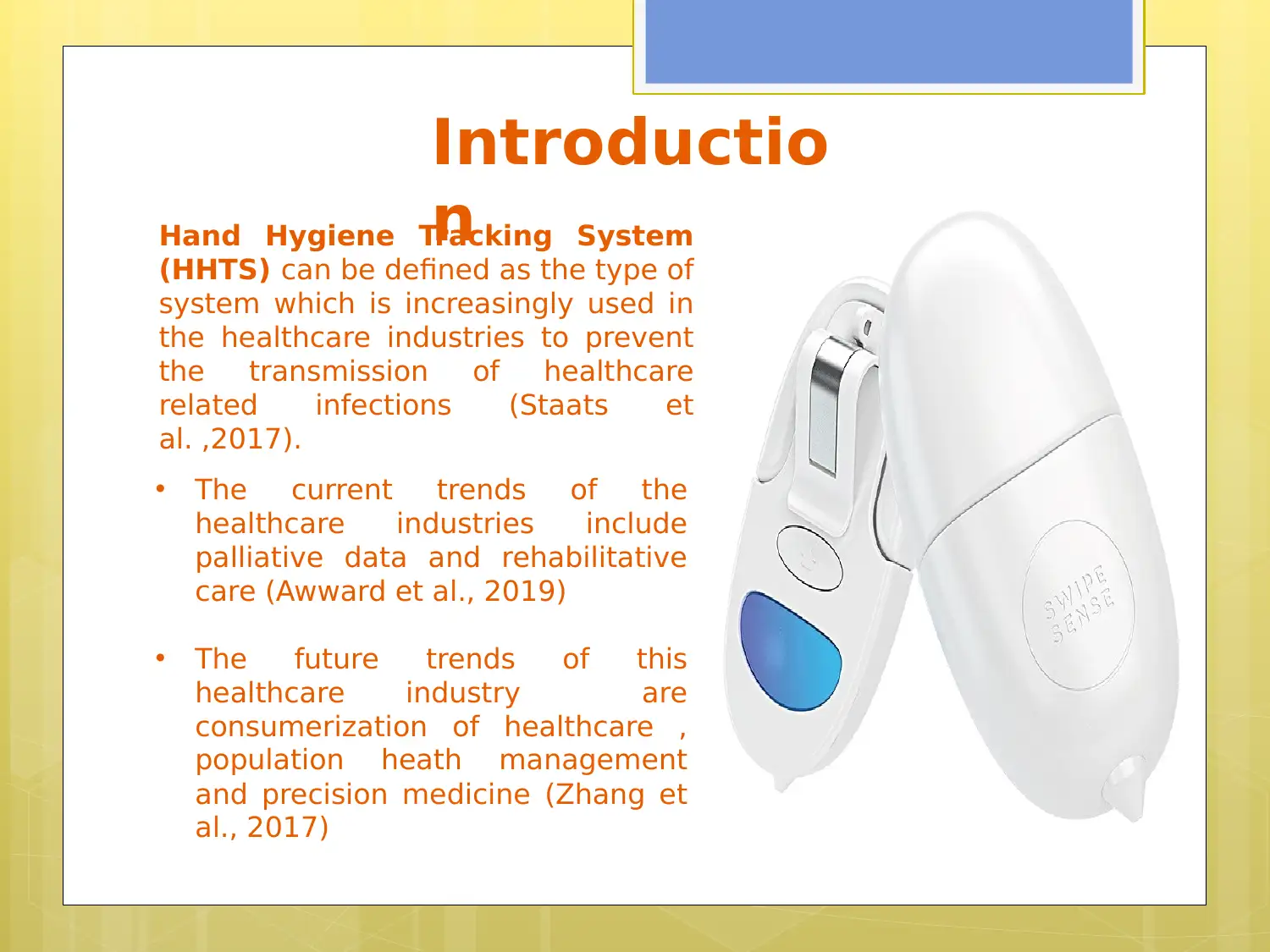
Hand Hygiene Tracking System
(HHTS) can be defined as the type of
system which is increasingly used in
the healthcare industries to prevent
the transmission of healthcare
related infections (Staats et
al. ,2017).
Document Page
Significance of the topic in healthcare
informatics
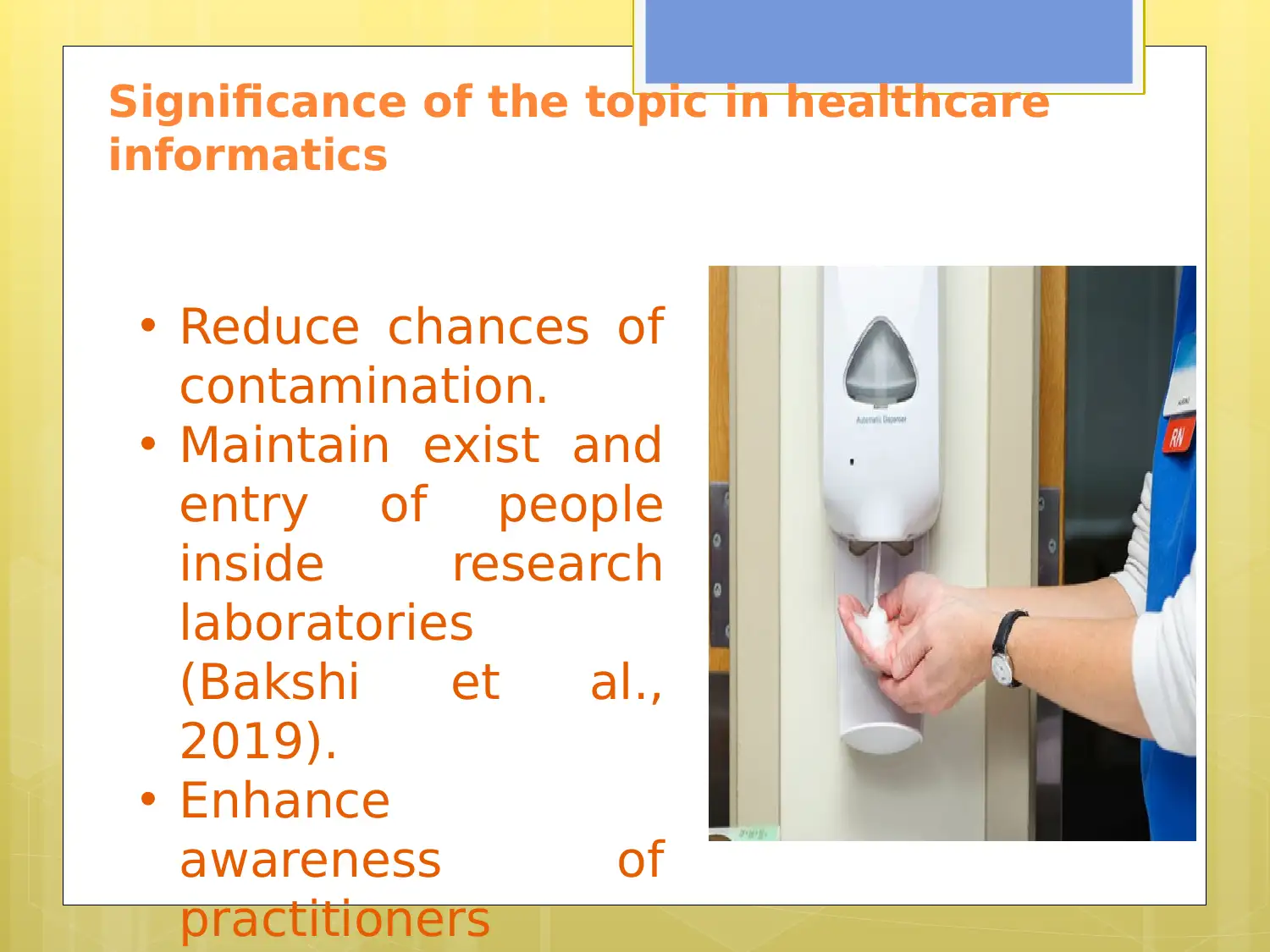
Reduce chances of
contamination.
Maintain exist and
entry of people
inside research
laboratories
(Bakshi et al.,
2019).
Enhance
awareness of
practitioners
Document Page
Research from scholarly articles
As discussed by Fagert et al. (2017), HHTS
can be useful to manage exist and entry of
a outsiders in a healthcare industry. The
researchers also stated that empathy of
the patients can be enhanced using this
system.
As elaborated by Haque et al. (2017),
transmission of germs can be restricted
using HHTS. The scholar also helped in
understanding that germ preventive
measure can be identified using HHTS.
tabler-icon-diamond-filled.svg

Paraphrase This Document

Need a fresh take? Get an instant paraphrase of this document with our AI Paraphraser
Document Page
Plan for implementing a change
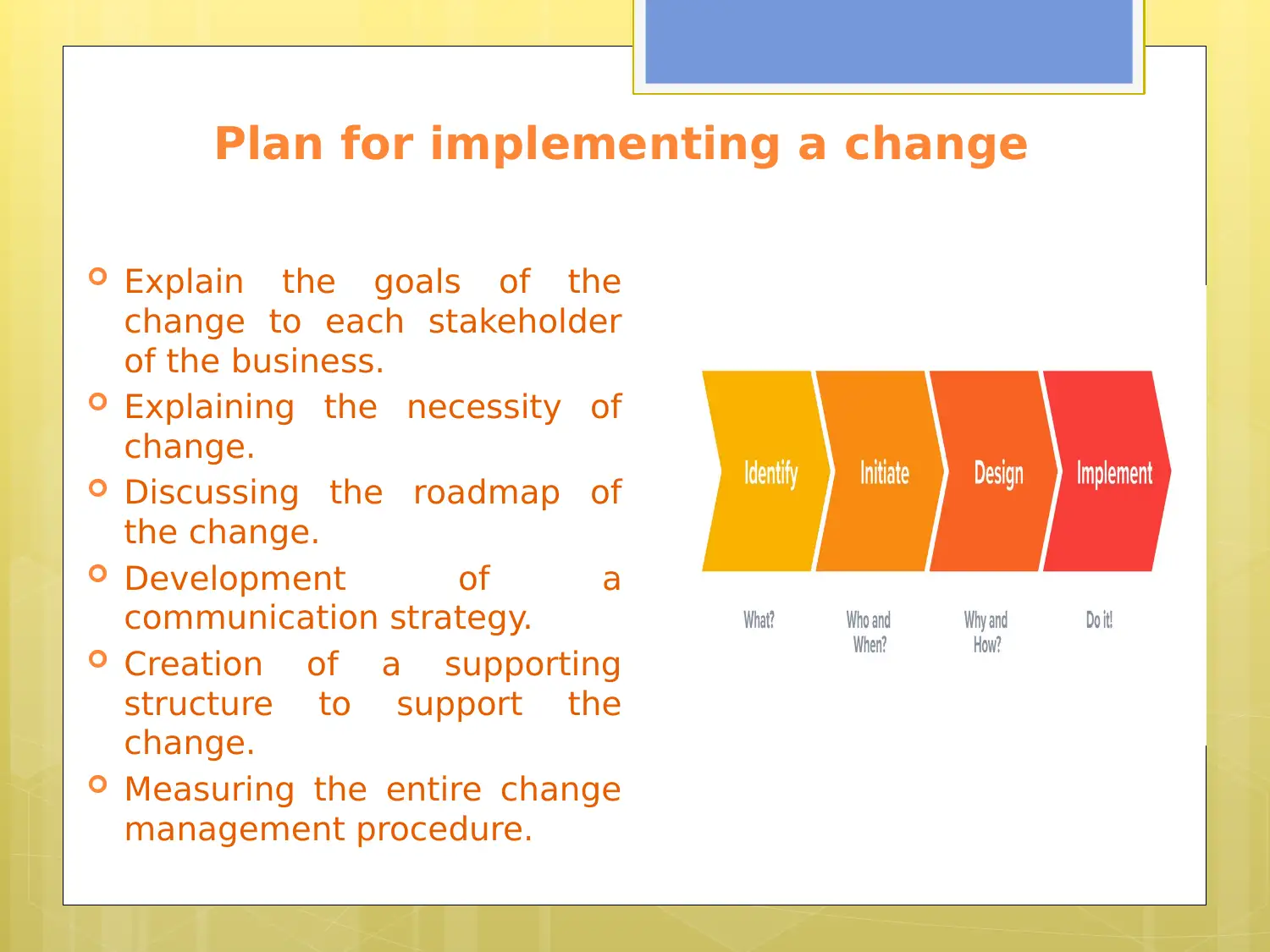
Explain the goals of the
change to each stakeholder
of the business.
Explaining the necessity of
change.
Discussing the roadmap of
the change.
Development of a
communication strategy.
Creation of a supporting
structure to support the
change.
Measuring the entire change
management procedure.
Document Page
Stakeholder involvement and training
programs
Involvement of the
management team, IT
expert, change manager
and HR department is very
much required to bring the
changes in the healthcare
industries (Kurtz, 2017)
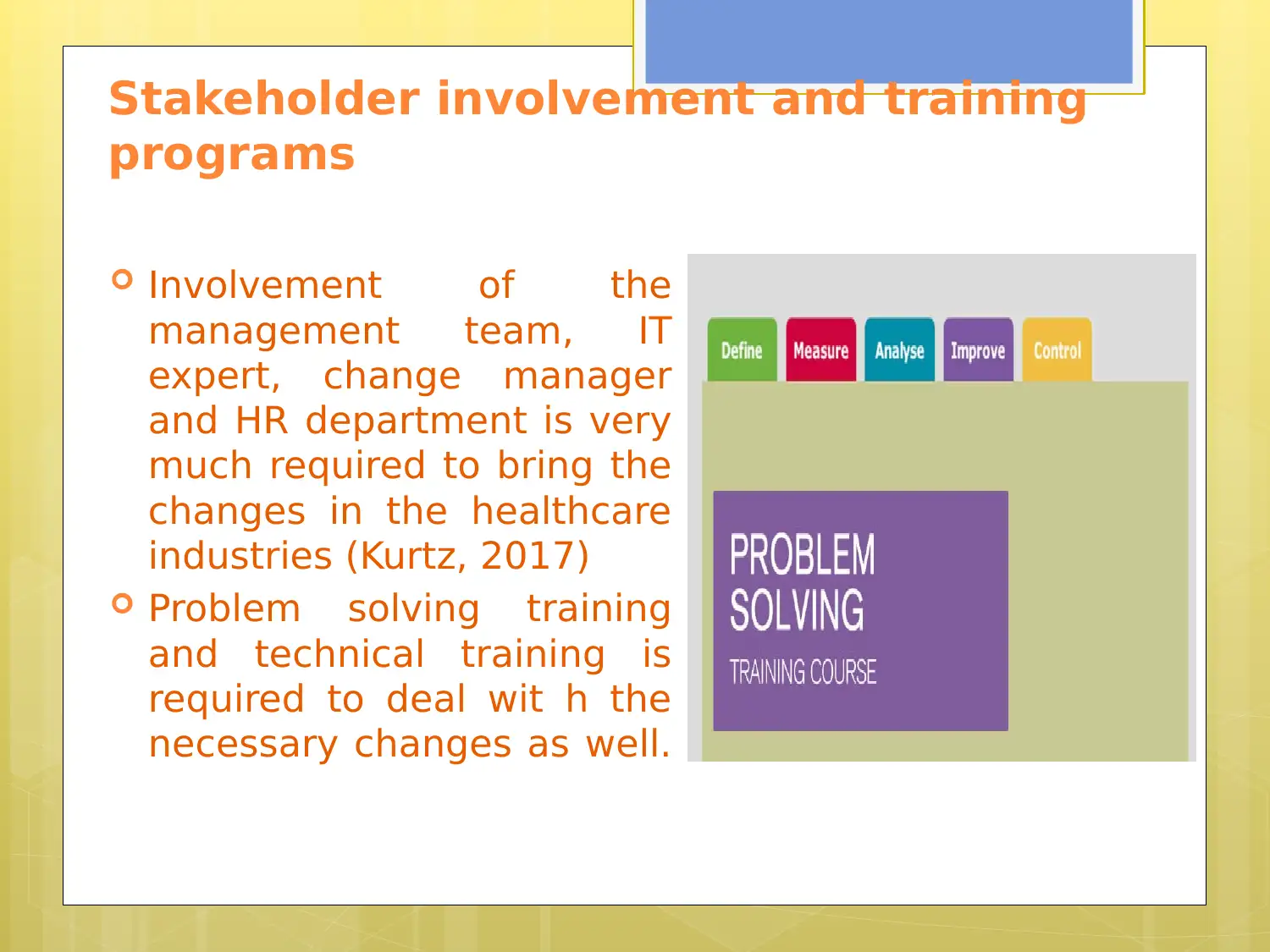
Problem solving training
and technical training is
required to deal wit h the
necessary changes as well.
Document Page
Significance of training and evaluation the success of the
change
Skill set of the employees
can be enhanced using the
on job training sessions
Creation and transfer of
knowledge can be boosted
using with these training
sessions as well (Nicolaides
et al. 2019).
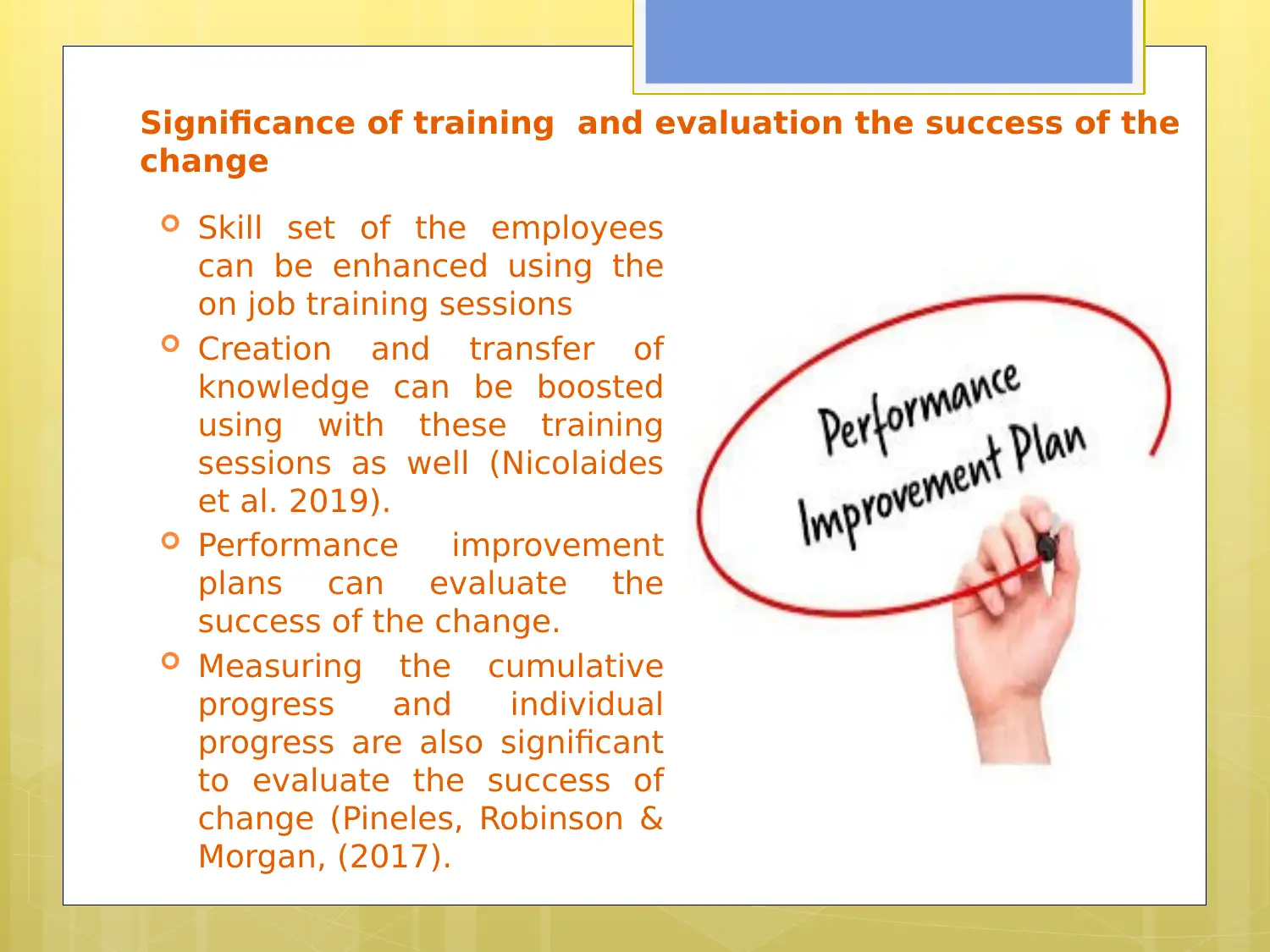
Performance improvement
plans can evaluate the
success of the change.
Measuring the cumulative
progress and individual
progress are also significant
to evaluate the success of
change (Pineles, Robinson &
Morgan, (2017).
tabler-icon-diamond-filled.svg

Paraphrase This Document

Need a fresh take? Get an instant paraphrase of this document with our AI Paraphraser
Document Page
Cost to enact the
change
Challenges of current
practices like
contamination which costs
a minimum of
USD$50000).
Training session for the
employees to deal with
issues like wasted
resources shall required
USD$1000.
Impact of changes
Hygiene of the infected
persons can be
enhanced after the
enactment of HHTS
(Pong, 2019).
Daily activities of the
stakeholders can be
revised and maintained
if this change is
maintained (Soliman,
2018).
Document Page
Conclusion
Infection in a healthcare environment can
be restricted with the help of HHTS.
Role of change manager, IT expert and HR
department is very much significant to
bring about the changes.
Training sessions can be useful to enhance
the skill set of the employees of the
healthcare industries.
Changes in public policy and technological
advancements shall not be having any
effect on these changes.
Document Page
References
Dagher, G. G., Mohler, J., Milojkovic, M., & Marella, P. B. (2018). Ancile: Privacy-preserving
framework for access control and interoperability of electronic health records using blockchain
technology. Sustainable cities and society, 39, 283-297.
Eichler, H. G., Bloechl‐Daum, B., Broich, K., Kyrle, P. A., Oderkirk, J., Rasi, G., ... & Wenzl, M. (2019).
Data rich, information poor: can we use electronic health records to create a learning healthcare
system for pharmaceuticals?. Clinical Pharmacology & Therapeutics, 105(4), 912-922.
Ekblaw, A., Azaria, A., Halamka, J. D., & Lippman, A. (2016, August). A Case Study for Blockchain
in Healthcare:“MedRec” prototype for electronic health records and medical research data. In
Proceedings of IEEE open & big data conference (Vol. 13, p. 13).
Ginter, P. M., Duncan, W. J., & Swayne, L. E. (2018). The strategic management of health care
organizations. John Wiley & Sons.
Hebda, T. (2018). Toni Hebda. On-Line Journal of Nursing Informatics, 22(2).
Ivan, D. (2016, August). Moving toward a blockchain-based method for the secure storage of
patient records. In ONC/NIST Use of Blockchain for Healthcare and Research Workshop.
Gaithersburg, Maryland, United States: ONC/NIST (pp. 1-11).
Jamil, F., Hang, L., Kim, K., & Kim, D. (2019). A Novel Medical Blockchain Model for Drug Supply
Chain Integrity Management in a Smart Hospital. Electronics, 8(5), 505.
Kabir, A. I., Karim, R., Hossain, M. I., & Newaz, S. (2018). PROSPECTS AND CHALLENGES OF USING
BIG DATA IN HEALTHCARE SECTOR OF BANGLADESH: FOCUS ON THE REFORMATION OF THE
HEALTHCARE SYSTEM. Journal of Asian and African Social Science and Humanities (ISSN 2413-
2748), 4(1), 1-16.
Kamal, J. I. A. (2018). Implementation of Electronic Medical Records in Developing Countries:
Challenges & Barriers. DEVELOPMENT, 7(3).
Manogaran, G., Thota, C., Lopez, D., Vijayakumar, V., Abbas, K. M., & Sundarsekar, R. (2017). Big
data knowledge system in healthcare. In Internet of things and big data technologies for next
generation healthcare (pp. 133-157). Springer, Cham.
tabler-icon-diamond-filled.svg

Paraphrase This Document

Need a fresh take? Get an instant paraphrase of this document with our AI Paraphraser
Document Page
Thank You
chevron_up_icon
1 out of 11
circle_padding
hide_on_mobile
zoom_out_icon
[object Object]