An Overview of Stakeholders and Management in Healthcare Sector
VerifiedAdded on 2019/09/23
|14
|3211
|476
Report
AI Summary
This report provides a comprehensive overview of the healthcare sector, emphasizing the significance of stakeholder management. It defines stakeholders, categorizing them into internal, interface, and external groups, with examples such as management, medical staff, patients, suppliers, and the government. The report highlights the importance of stakeholder identification, understanding, and analysis, including the use of stakeholder analysis matrices to assess influence and importance. It delves into the complexities of managing diverse stakeholder interests, potential conflicts, and the need for effective communication and engagement to achieve organizational goals. The report also discusses the crucial role of stakeholder analysis in the healthcare sector, which faces competition on quality, pricing, patient satisfaction, and technological advancements. By understanding and prioritizing stakeholder needs, healthcare units can improve their performance and ensure long-term success. The report concludes by categorizing stakeholders based on their influence and importance, providing actionable strategies for effective stakeholder management.
Health Care Sector – An Overview
The Health Care Sector is one of the fastest growing sectors in terms of technological
advancements. It consists of preventive as well as remedial services. The sector also includes
diagnostic services which has gained significant importance in the last few decades. This sector
is not only limited to the services provided by medical practitioners, but also includes
manufacturers and dealers of pharmaceutical products and various other companies that provide
health insurance. Health Care Services also includes prescription drugs, ambulance services,
inpatient and outpatient healthcare etc. The diverse nature of services and goods covered by
health care sector gives rise to a variety of stakeholders who are interested in this sector.
(Staff, 2017)
Stakeholders – A brief Introduction
A stakeholder can be defined as a person, group or organization which has an interest in an
organization. He is a party who may be present within the organization or outside it and can
either affect the business, policies and objectives of the organization or can be affected by it. The
crucial stakeholders in a classic business setup are its employees, investors and the final
consumers or the customers. Stakeholders have the power to change the strategic future of the
Company. However, now-a-days, in the modern world with increased expectations from the
business environment, the definition of stakeholders cannot be confined to the original notion
and has to include additional stakeholders. The examples of these modern day stakeholders are
government, trade associations and community.
The Health Care Sector is one of the fastest growing sectors in terms of technological
advancements. It consists of preventive as well as remedial services. The sector also includes
diagnostic services which has gained significant importance in the last few decades. This sector
is not only limited to the services provided by medical practitioners, but also includes
manufacturers and dealers of pharmaceutical products and various other companies that provide
health insurance. Health Care Services also includes prescription drugs, ambulance services,
inpatient and outpatient healthcare etc. The diverse nature of services and goods covered by
health care sector gives rise to a variety of stakeholders who are interested in this sector.
(Staff, 2017)
Stakeholders – A brief Introduction
A stakeholder can be defined as a person, group or organization which has an interest in an
organization. He is a party who may be present within the organization or outside it and can
either affect the business, policies and objectives of the organization or can be affected by it. The
crucial stakeholders in a classic business setup are its employees, investors and the final
consumers or the customers. Stakeholders have the power to change the strategic future of the
Company. However, now-a-days, in the modern world with increased expectations from the
business environment, the definition of stakeholders cannot be confined to the original notion
and has to include additional stakeholders. The examples of these modern day stakeholders are
government, trade associations and community.

Paraphrase This Document
Need a fresh take? Get an instant paraphrase of this document with our AI Paraphraser
Stakeholders play a very crucial role in the business of an organization and hence it is very
important for a business to identify its stakeholders so as to enable itself to achieve its objectives
in the long run. An organization which neglects the needs of its stakeholders is deemed to fail in
its missions. It can be said that stakeholders act as a boon for the organizations which can cater
to their requirements and a bane for the organization that neglects them.
Stakeholder Management
Stakeholder Management has gained enormous importance in the recent past. With ever-growing
needs of the patients and life-changing technological advancements in the health care sector, it
becomes imperative to achieve the organizational goals without taking care of the stakeholders.
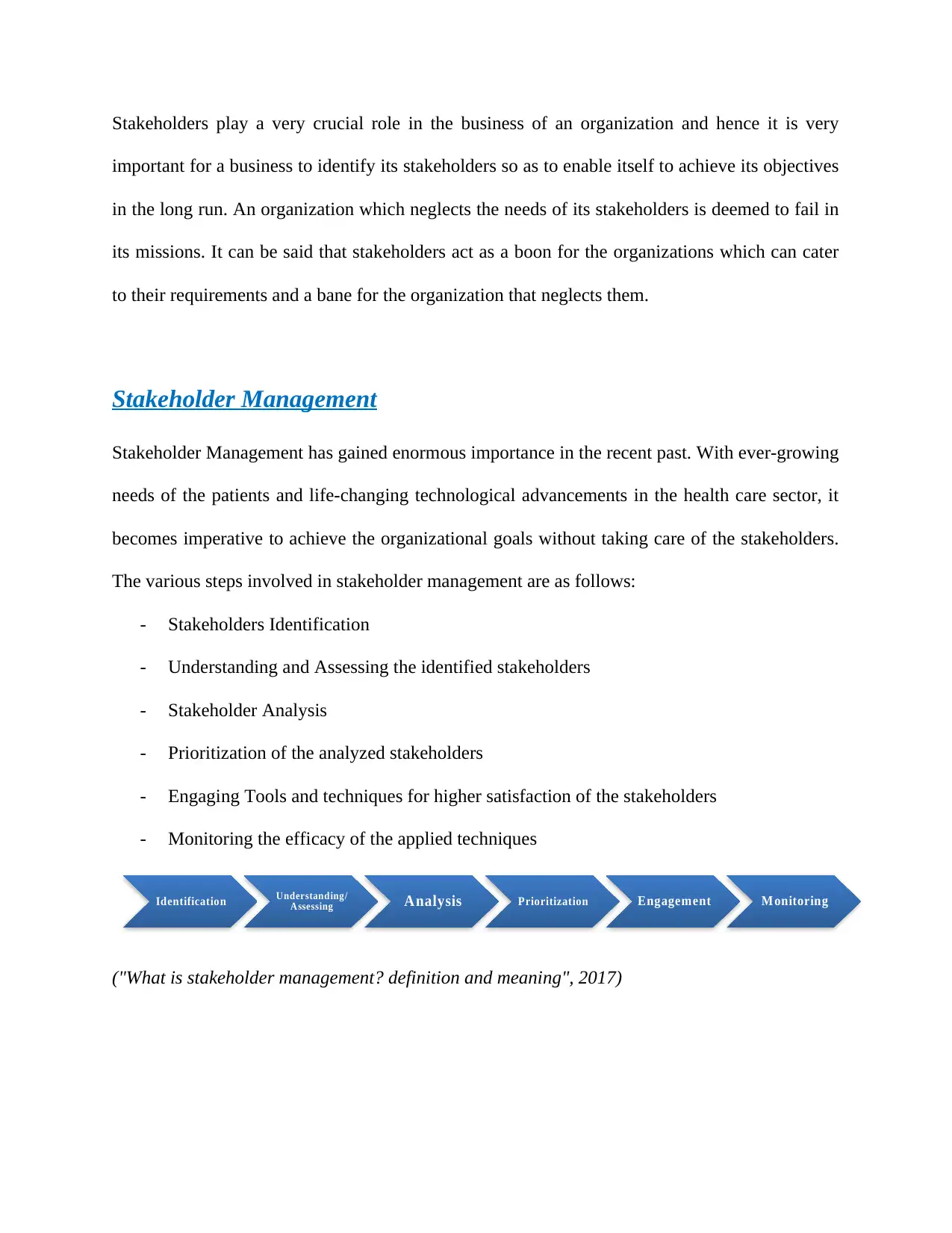
The various steps involved in stakeholder management are as follows:
- Stakeholders Identification
- Understanding and Assessing the identified stakeholders
- Stakeholder Analysis
- Prioritization of the analyzed stakeholders
- Engaging Tools and techniques for higher satisfaction of the stakeholders
- Monitoring the efficacy of the applied techniques
("What is stakeholder management? definition and meaning", 2017)
Identification Understanding/
Assessing Analysis Prioritization Engagement M onitoring
important for a business to identify its stakeholders so as to enable itself to achieve its objectives
in the long run. An organization which neglects the needs of its stakeholders is deemed to fail in
its missions. It can be said that stakeholders act as a boon for the organizations which can cater
to their requirements and a bane for the organization that neglects them.
Stakeholder Management
Stakeholder Management has gained enormous importance in the recent past. With ever-growing
needs of the patients and life-changing technological advancements in the health care sector, it
becomes imperative to achieve the organizational goals without taking care of the stakeholders.
The various steps involved in stakeholder management are as follows:
- Stakeholders Identification
- Understanding and Assessing the identified stakeholders
- Stakeholder Analysis
- Prioritization of the analyzed stakeholders
- Engaging Tools and techniques for higher satisfaction of the stakeholders
- Monitoring the efficacy of the applied techniques
("What is stakeholder management? definition and meaning", 2017)
Identification Understanding/
Assessing Analysis Prioritization Engagement M onitoring
Stakeholders Identification – A crucial step
As discussed above, it is very important to identify the stakeholders who can affect the
profitability of an organization. The organization undertakes projects to satisfy its stakeholders.
Stakeholders can be identified by using various techniques which includes the following:
- Development of organization charts to identify stakeholders at different levels of
organization structure
- Brainstorming amongst the team can also be used as a tool
- Review of the contractual documents of the organization to identify its suppliers, clients
and local agents.
- Preparing a list of stakeholders. The list should be starting with the most generic
stakeholders and should progress with the specific ones.
- Stakeholders can also be identified by keeping in view the historical aspects of the
organization.
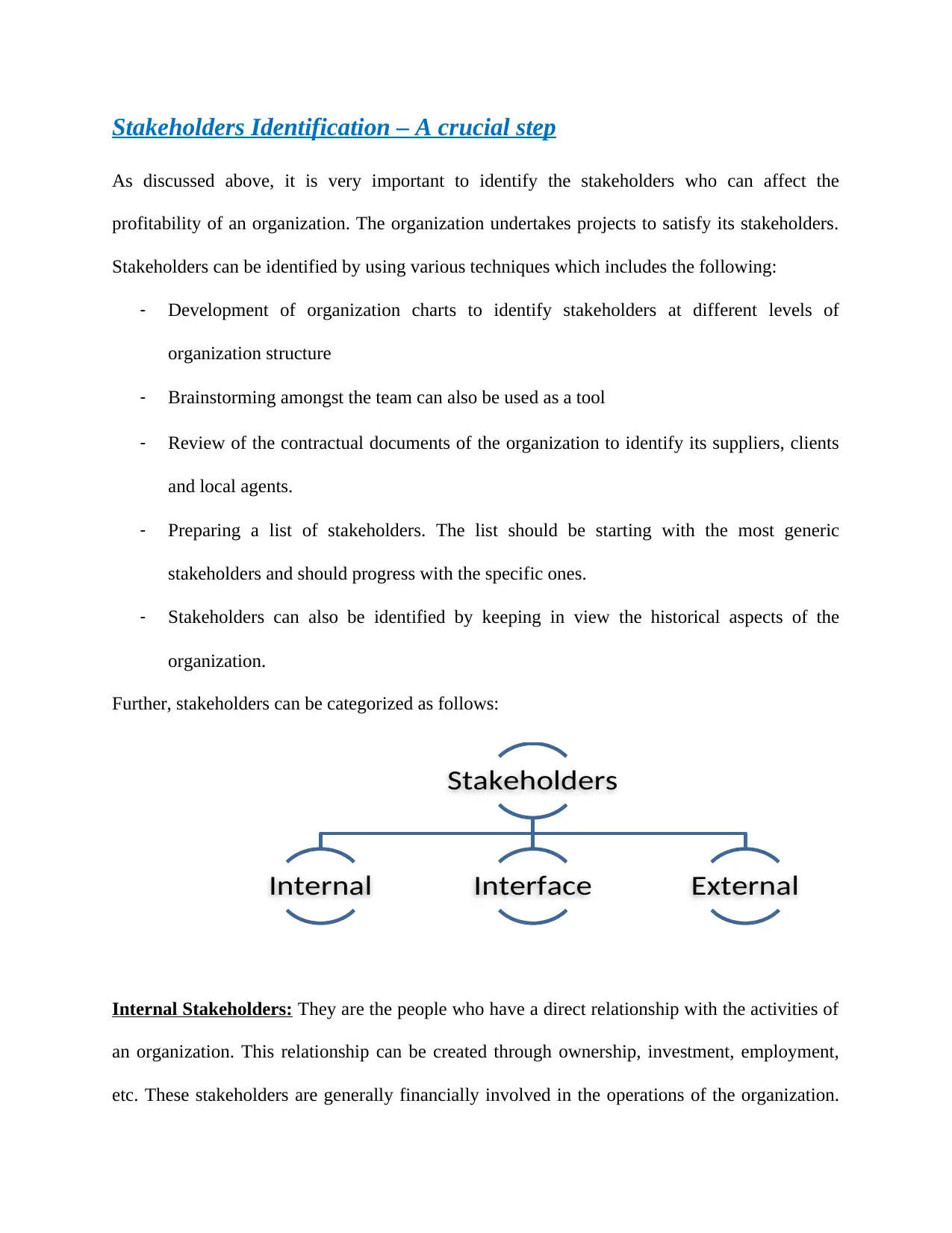
Further, stakeholders can be categorized as follows:
Internal Stakeholders: They are the people who have a direct relationship with the activities of
an organization. This relationship can be created through ownership, investment, employment,
etc. These stakeholders are generally financially involved in the operations of the organization.
Stakeholders
Internal Interface External
As discussed above, it is very important to identify the stakeholders who can affect the
profitability of an organization. The organization undertakes projects to satisfy its stakeholders.
Stakeholders can be identified by using various techniques which includes the following:
- Development of organization charts to identify stakeholders at different levels of
organization structure
- Brainstorming amongst the team can also be used as a tool
- Review of the contractual documents of the organization to identify its suppliers, clients
and local agents.
- Preparing a list of stakeholders. The list should be starting with the most generic
stakeholders and should progress with the specific ones.
- Stakeholders can also be identified by keeping in view the historical aspects of the
organization.
Further, stakeholders can be categorized as follows:
Internal Stakeholders: They are the people who have a direct relationship with the activities of
an organization. This relationship can be created through ownership, investment, employment,
etc. These stakeholders are generally financially involved in the operations of the organization.
Stakeholders
Internal Interface External
⊘ This is a preview!⊘
Do you want full access?
Subscribe today to unlock all pages.

Trusted by 1+ million students worldwide
Employees are the center of any organization and they also acts as the most important internal
stakeholders of the organization. They have wide impact on the strategy and success of the
organization. Directors and owners have even superior impact on the management of the
organization and they take a larger amount of accountability.
Interface Stakeholders: These are the group of people who act as an interface between the
internal and external stakeholders. They operate both within and outside the organization.
External Stakeholders: They are the group of people who are not an integral part of the
organization but are affected by the performance of the organization. Few of these stakeholders
can be customers, suppliers, government, society, creditors etc. Customers focus on the quality
and pricing of the products. Suppliers concentrate on the growth of business so that the
organization purchases materials from them in higher quantities. The Government acts as a
regulator and is concerned with the taxes and compliance of laws. Creditors fear that the
organization may get insolvent and keep a close look on its activities to recover the interest and
the principal. The community is concerned about the environmental damage caused by the
organization.
The techniques and tools mentioned above can be used to identify the stakeholders of the health
care sector as well. Based on these factors, the major stakeholders of this sector are as follows:
Internal Stakeholders for Health Care Sector:
- Management of the Health Care Unit
stakeholders of the organization. They have wide impact on the strategy and success of the
organization. Directors and owners have even superior impact on the management of the
organization and they take a larger amount of accountability.
Interface Stakeholders: These are the group of people who act as an interface between the
internal and external stakeholders. They operate both within and outside the organization.
External Stakeholders: They are the group of people who are not an integral part of the
organization but are affected by the performance of the organization. Few of these stakeholders
can be customers, suppliers, government, society, creditors etc. Customers focus on the quality
and pricing of the products. Suppliers concentrate on the growth of business so that the
organization purchases materials from them in higher quantities. The Government acts as a
regulator and is concerned with the taxes and compliance of laws. Creditors fear that the
organization may get insolvent and keep a close look on its activities to recover the interest and
the principal. The community is concerned about the environmental damage caused by the
organization.
The techniques and tools mentioned above can be used to identify the stakeholders of the health
care sector as well. Based on these factors, the major stakeholders of this sector are as follows:
Internal Stakeholders for Health Care Sector:
- Management of the Health Care Unit
Paraphrase This Document
Need a fresh take? Get an instant paraphrase of this document with our AI Paraphraser
- Professional Staff including medical practitioners who serves the patients at the Health
Care Unit
- Non-Professional staff of the organization
- Investors, who invest in the development and expansion of the Health Care Unit
Interface Stakeholders for Health Care Sector:
- Board of Trustees of the Hospital
- Medical Staff of the Health Care Unit
External Stakeholders for Health Care Sector:
- Patients are the most important stakeholder who needs to be satisfied
- Suppliers of various products including medicinal preparations to the Health Care Unit
- Local, national and international Competitors of the Health Care Unit
- Government, who acts as a regulator and collect taxes
As it can be seen that Health care sector has a large number of stakeholders, there are a large
number of problems that are associated with this huge number. The interests of the stakeholders
may not coincide with each other which lead to conflict between the same. An example of such a
conflict can be that the owners of the healthcare unit will have an objective of maximizing their
profits by minimizing the cost, which they can achieve by reducing the labor cost. This is in
contradiction to the objectives of the other stakeholders which includes professional and non-
professional staff.
Care Unit
- Non-Professional staff of the organization
- Investors, who invest in the development and expansion of the Health Care Unit
Interface Stakeholders for Health Care Sector:
- Board of Trustees of the Hospital
- Medical Staff of the Health Care Unit
External Stakeholders for Health Care Sector:
- Patients are the most important stakeholder who needs to be satisfied
- Suppliers of various products including medicinal preparations to the Health Care Unit
- Local, national and international Competitors of the Health Care Unit
- Government, who acts as a regulator and collect taxes
As it can be seen that Health care sector has a large number of stakeholders, there are a large
number of problems that are associated with this huge number. The interests of the stakeholders
may not coincide with each other which lead to conflict between the same. An example of such a
conflict can be that the owners of the healthcare unit will have an objective of maximizing their
profits by minimizing the cost, which they can achieve by reducing the labor cost. This is in
contradiction to the objectives of the other stakeholders which includes professional and non-
professional staff.
Understanding and Assessing the Stakeholders – A prerequisite for
Stakeholder Analysis
As there are a large number of stakeholders for the Health Care Sector, it becomes imperative to
study the nature of potential stakeholders so as to identify the areas of conflict amongst their
needs and objectives. The requirements of various stakeholders may be positively or negatively
correlated. Such correlation should be kept in mind before analyzing the stakeholders which will
help in creating a balanced plan that gives more importance to the critical parameters of such
stakeholders. A study of the public profile of stakeholders can help an organization to understand
the desires of the key stakeholders. The organization can collect information about the
stakeholders through online tools, in-person meetings and its social networks. The reputation of
stakeholders and their specific level of activity also play an important role in analyzing their
needs.
("Stakeholder Management: Planning Stakeholder Communication", 2017)
Stakeholders Analysis – A Fundamental step for efficacious
Stakeholder Management
Stakeholder Management is a vital area that used by organizations to gain support from various
stakeholders and to successfully achieve its goals. An organization that has a good stakeholder
analysis strategy has better growth prospects than an organization with weak stakeholder
analysis. It starts once the organization has identified its major stakeholders. The organization
can then resort to Stakeholder Planning to develop a strategy to fulfil its needs.
Stakeholder Analysis
As there are a large number of stakeholders for the Health Care Sector, it becomes imperative to
study the nature of potential stakeholders so as to identify the areas of conflict amongst their
needs and objectives. The requirements of various stakeholders may be positively or negatively
correlated. Such correlation should be kept in mind before analyzing the stakeholders which will
help in creating a balanced plan that gives more importance to the critical parameters of such
stakeholders. A study of the public profile of stakeholders can help an organization to understand
the desires of the key stakeholders. The organization can collect information about the
stakeholders through online tools, in-person meetings and its social networks. The reputation of
stakeholders and their specific level of activity also play an important role in analyzing their
needs.
("Stakeholder Management: Planning Stakeholder Communication", 2017)
Stakeholders Analysis – A Fundamental step for efficacious
Stakeholder Management
Stakeholder Management is a vital area that used by organizations to gain support from various
stakeholders and to successfully achieve its goals. An organization that has a good stakeholder
analysis strategy has better growth prospects than an organization with weak stakeholder
analysis. It starts once the organization has identified its major stakeholders. The organization
can then resort to Stakeholder Planning to develop a strategy to fulfil its needs.
⊘ This is a preview!⊘
Do you want full access?
Subscribe today to unlock all pages.
Trusted by 1+ million students worldwide
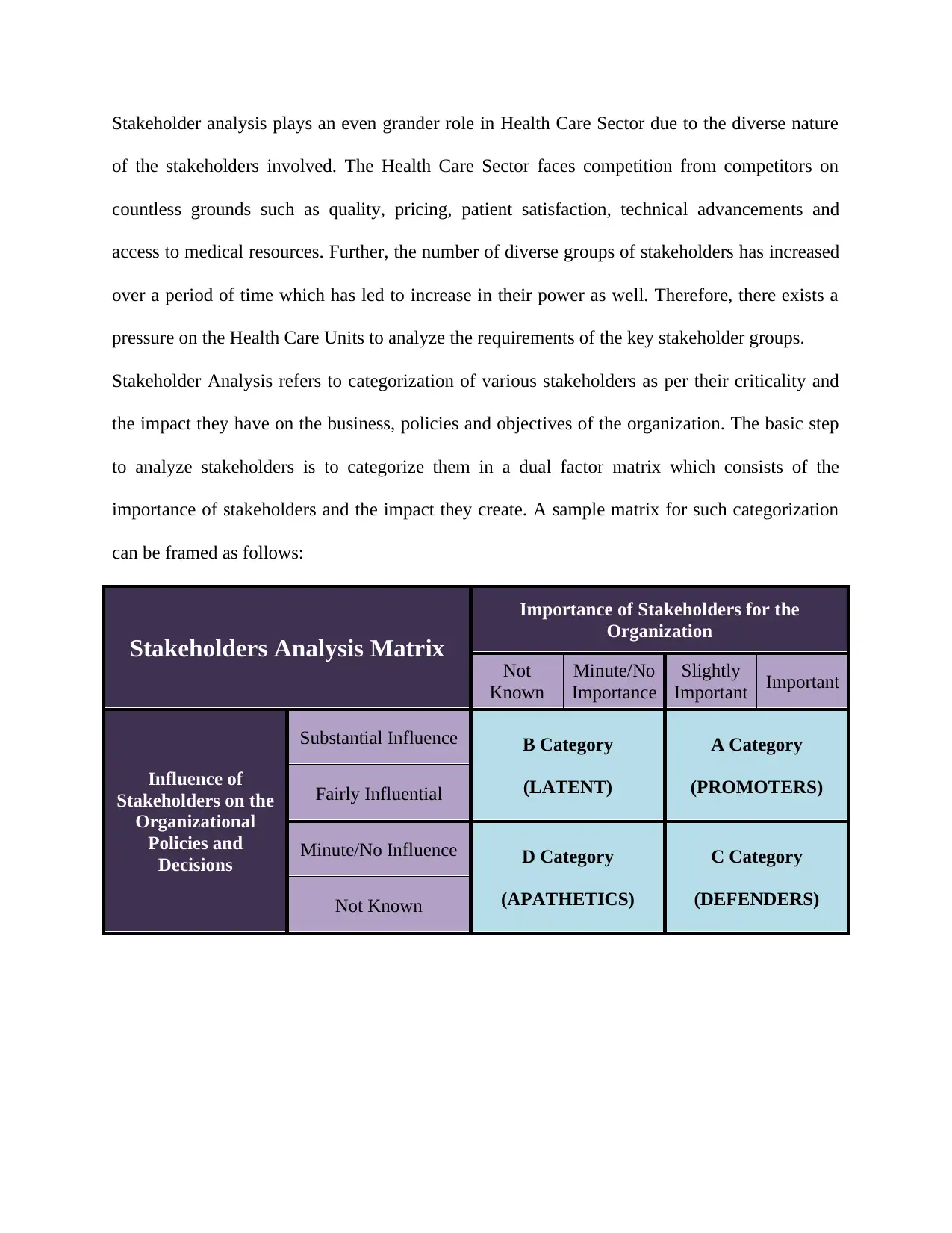
Stakeholder analysis plays an even grander role in Health Care Sector due to the diverse nature
of the stakeholders involved. The Health Care Sector faces competition from competitors on
countless grounds such as quality, pricing, patient satisfaction, technical advancements and
access to medical resources. Further, the number of diverse groups of stakeholders has increased
over a period of time which has led to increase in their power as well. Therefore, there exists a
pressure on the Health Care Units to analyze the requirements of the key stakeholder groups.
Stakeholder Analysis refers to categorization of various stakeholders as per their criticality and
the impact they have on the business, policies and objectives of the organization. The basic step
to analyze stakeholders is to categorize them in a dual factor matrix which consists of the
importance of stakeholders and the impact they create. A sample matrix for such categorization
can be framed as follows:
Stakeholders Analysis Matrix
Importance of Stakeholders for the
Organization
Not
Known
Minute/No
Importance
Slightly
Important Important
Influence of
Stakeholders on the
Organizational
Policies and
Decisions
Substantial Influence B Category
(LATENT)
A Category
(PROMOTERS)Fairly Influential
Minute/No Influence D Category
(APATHETICS)
C Category
(DEFENDERS)Not Known
of the stakeholders involved. The Health Care Sector faces competition from competitors on
countless grounds such as quality, pricing, patient satisfaction, technical advancements and
access to medical resources. Further, the number of diverse groups of stakeholders has increased
over a period of time which has led to increase in their power as well. Therefore, there exists a
pressure on the Health Care Units to analyze the requirements of the key stakeholder groups.
Stakeholder Analysis refers to categorization of various stakeholders as per their criticality and
the impact they have on the business, policies and objectives of the organization. The basic step
to analyze stakeholders is to categorize them in a dual factor matrix which consists of the
importance of stakeholders and the impact they create. A sample matrix for such categorization
can be framed as follows:
Stakeholders Analysis Matrix
Importance of Stakeholders for the
Organization
Not
Known
Minute/No
Importance
Slightly
Important Important
Influence of
Stakeholders on the
Organizational
Policies and
Decisions
Substantial Influence B Category
(LATENT)
A Category
(PROMOTERS)Fairly Influential
Minute/No Influence D Category
(APATHETICS)
C Category
(DEFENDERS)Not Known
Paraphrase This Document
Need a fresh take? Get an instant paraphrase of this document with our AI Paraphraser
Factors to assess the influence and importance of various Stakeholders
The organization should keep in view that different individuals and organizations behave in
different manners in diverse environments. The organization should rank the identified
stakeholders on the basis of their importance and influence.
Stakeholders can exert influence on the organization, both directly and indirectly. Direct
influence is when the organization gets affected by the actions performed by the stakeholders in
this context. This can include the negotiation power of the stakeholders, their authority and
leadership, the knowledge that they possess and the strategic resources they employ. In contrast,
indirect influence relates to the action of the stakeholders in the general environment of which
the organization is a part. This includes the political decisions of the Government, influence
through links of stakeholders in other similar groups, degree of consensus within the groups of
stakeholders and macro-economic factors.
While identifying the importance of stakeholders, the organization should consider factors such
as identification of stakeholders’ problems, the priorities of the identified problems and the
correlation between various stakeholders.
As per the above stakeholder analysis matrix, the stakeholders of the Health Care Sector can be
categorized as follows:
A Category (PROMOTERS):
These stakeholders are the key players for the success of the organization. They have the highest
influence on the operations, policies and objectives of the organization. This intern means that
the organization which is applying this step will essentially build healthy working associations
The organization should keep in view that different individuals and organizations behave in
different manners in diverse environments. The organization should rank the identified
stakeholders on the basis of their importance and influence.
Stakeholders can exert influence on the organization, both directly and indirectly. Direct
influence is when the organization gets affected by the actions performed by the stakeholders in
this context. This can include the negotiation power of the stakeholders, their authority and
leadership, the knowledge that they possess and the strategic resources they employ. In contrast,
indirect influence relates to the action of the stakeholders in the general environment of which
the organization is a part. This includes the political decisions of the Government, influence
through links of stakeholders in other similar groups, degree of consensus within the groups of
stakeholders and macro-economic factors.
While identifying the importance of stakeholders, the organization should consider factors such
as identification of stakeholders’ problems, the priorities of the identified problems and the
correlation between various stakeholders.
As per the above stakeholder analysis matrix, the stakeholders of the Health Care Sector can be
categorized as follows:
A Category (PROMOTERS):
These stakeholders are the key players for the success of the organization. They have the highest
influence on the operations, policies and objectives of the organization. This intern means that
the organization which is applying this step will essentially build healthy working associations
with A Category stakeholders, to ensure an active coalition of support for success of the Health
Care Unit. The organization is required to cater to the needs of these stakeholders by involving
them in organizational activities and should communicate with them on a regular basis. Poor
management of this category can harm the goodwill of the organization and can lead to disturbed
management. The Health Care Sector should compose specialized decision making bodies to
ensure that the needs of the organization are fulfilled. Further, organizational governance can
also play an important role in achieving the objective. The examples of Health Sector
Stakeholders that fall into this category are as follows:
1. Management of the Health Care Unit: The Management, which includes the senior and
middle level management of the organization, plays an inimitable role in the performance
of the organization. They have a direct relationship with the policies that are executed by
the organization. A satisfied management can positively contribute in the success of the
organization.
2. Professional Staff including medical practitioners: The professional staff of the health
care unit is most important in gathering goodwill for the health care sector. The attitude
of the professional staff has a direct relation with the number of patients that the health
care unit caters. It is very difficult for an organization to employ new professional staff.
3. Patients: Patients are the center of all activities performed by a Health Care Unit.
Patients have a direct impact on the policies of the organization as non-fulfilment of the
needs of the patients would render all other efforts to be in vain. Any organization is
required to provide special attention to its customers and in case of health care units,
patients are the customers of the business.
Care Unit. The organization is required to cater to the needs of these stakeholders by involving
them in organizational activities and should communicate with them on a regular basis. Poor
management of this category can harm the goodwill of the organization and can lead to disturbed
management. The Health Care Sector should compose specialized decision making bodies to
ensure that the needs of the organization are fulfilled. Further, organizational governance can
also play an important role in achieving the objective. The examples of Health Sector
Stakeholders that fall into this category are as follows:
1. Management of the Health Care Unit: The Management, which includes the senior and
middle level management of the organization, plays an inimitable role in the performance
of the organization. They have a direct relationship with the policies that are executed by
the organization. A satisfied management can positively contribute in the success of the
organization.
2. Professional Staff including medical practitioners: The professional staff of the health
care unit is most important in gathering goodwill for the health care sector. The attitude
of the professional staff has a direct relation with the number of patients that the health
care unit caters. It is very difficult for an organization to employ new professional staff.
3. Patients: Patients are the center of all activities performed by a Health Care Unit.
Patients have a direct impact on the policies of the organization as non-fulfilment of the
needs of the patients would render all other efforts to be in vain. Any organization is
required to provide special attention to its customers and in case of health care units,
patients are the customers of the business.
⊘ This is a preview!⊘
Do you want full access?
Subscribe today to unlock all pages.
Trusted by 1+ million students worldwide
B Category (LATENT):
It is important to meet the needs of this category of stakeholders. The organization should
consult them on a periodic basis and should try to increase their level of interest. The
organization should try to increase the engagement of these stakeholders. The examples of
Health Sector Stakeholders that may fall into this category are as follows:
1. Board of Trustees of the Hospital: Although the Board of Trustees is concerned about
the operations of the health care unit, still they are not as important as the other owners
and patients. However, they exert high amount of influence on the policies and objectives
of the Health Care Units.
2. Local, national and international Competitors: Competitors of every business exercise
high amount of influence on the Organizational strategies which relates to the pricing and
technological advancements. The Health Care units within the sector have to keep a track
on the progress of its competitors.
3. Government: The Government is a regulator for the industry. It ensures compliance of
various legislatures of the country. The Government is also an interested party as it
collects taxes from the business. It influences the business strategies as the Government
policies are mandatory for all the organizations including the Health Care Sector.
C Category (DEFENDERS):
The organization should show consideration to this category of stakeholders as well. They should
be involved in areas where the level of risk is low. These are stakeholders who have high
importance for the organization, but at the same time have a low influence on the business
decisions. This intern means that the stakeholders will have to apply special initiatives to get
It is important to meet the needs of this category of stakeholders. The organization should
consult them on a periodic basis and should try to increase their level of interest. The
organization should try to increase the engagement of these stakeholders. The examples of
Health Sector Stakeholders that may fall into this category are as follows:
1. Board of Trustees of the Hospital: Although the Board of Trustees is concerned about
the operations of the health care unit, still they are not as important as the other owners
and patients. However, they exert high amount of influence on the policies and objectives
of the Health Care Units.
2. Local, national and international Competitors: Competitors of every business exercise
high amount of influence on the Organizational strategies which relates to the pricing and
technological advancements. The Health Care units within the sector have to keep a track
on the progress of its competitors.
3. Government: The Government is a regulator for the industry. It ensures compliance of
various legislatures of the country. The Government is also an interested party as it
collects taxes from the business. It influences the business strategies as the Government
policies are mandatory for all the organizations including the Health Care Sector.
C Category (DEFENDERS):
The organization should show consideration to this category of stakeholders as well. They should
be involved in areas where the level of risk is low. These are stakeholders who have high
importance for the organization, but at the same time have a low influence on the business
decisions. This intern means that the stakeholders will have to apply special initiatives to get
Paraphrase This Document
Need a fresh take? Get an instant paraphrase of this document with our AI Paraphraser
their interests protected. They can act as potential supporters for the organization and can help in
brand building. The organization should enquire about the interest areas of this category and
should keep them informed about the areas of their interest. The examples of Health Sector
Stakeholders that may fall into this category are as follows:
1. Suppliers of various products including medicinal preparations: As discussed earlier,
Suppliers are one of the key stakeholders for the Health Care Sector. Generally, they are
very important to the organization but are not able to exert high influence on the
organization due to competition in the market. However, few suppliers can also be placed
“A Category” due to the unique nature of the products and services supplied by them.
2. Non-Professional staff: The non-professional staff, that includes the administrative staff,
is important to the operations of the organization but they are not able to influence the
policies of the organization. They are not treated as a fundamental part of the Health Care
Sector and hence should be categorized under this “Defenders”.
D Category (APATHETICS):
This category of stakeholders has low influence as well as low importance for the organizational
objectives. They require restricted monitoring or assessment as they are of low priority for the
Organization. They require minimum efforts from the Organization. The Health Care Units
should communicate with these stakeholders through general communications that includes
websites and newsletters.
brand building. The organization should enquire about the interest areas of this category and
should keep them informed about the areas of their interest. The examples of Health Sector
Stakeholders that may fall into this category are as follows:
1. Suppliers of various products including medicinal preparations: As discussed earlier,
Suppliers are one of the key stakeholders for the Health Care Sector. Generally, they are
very important to the organization but are not able to exert high influence on the
organization due to competition in the market. However, few suppliers can also be placed
“A Category” due to the unique nature of the products and services supplied by them.
2. Non-Professional staff: The non-professional staff, that includes the administrative staff,
is important to the operations of the organization but they are not able to influence the
policies of the organization. They are not treated as a fundamental part of the Health Care
Sector and hence should be categorized under this “Defenders”.
D Category (APATHETICS):
This category of stakeholders has low influence as well as low importance for the organizational
objectives. They require restricted monitoring or assessment as they are of low priority for the
Organization. They require minimum efforts from the Organization. The Health Care Units
should communicate with these stakeholders through general communications that includes
websites and newsletters.
Stakeholders Prioritization – A Division of Stakeholder Analysis
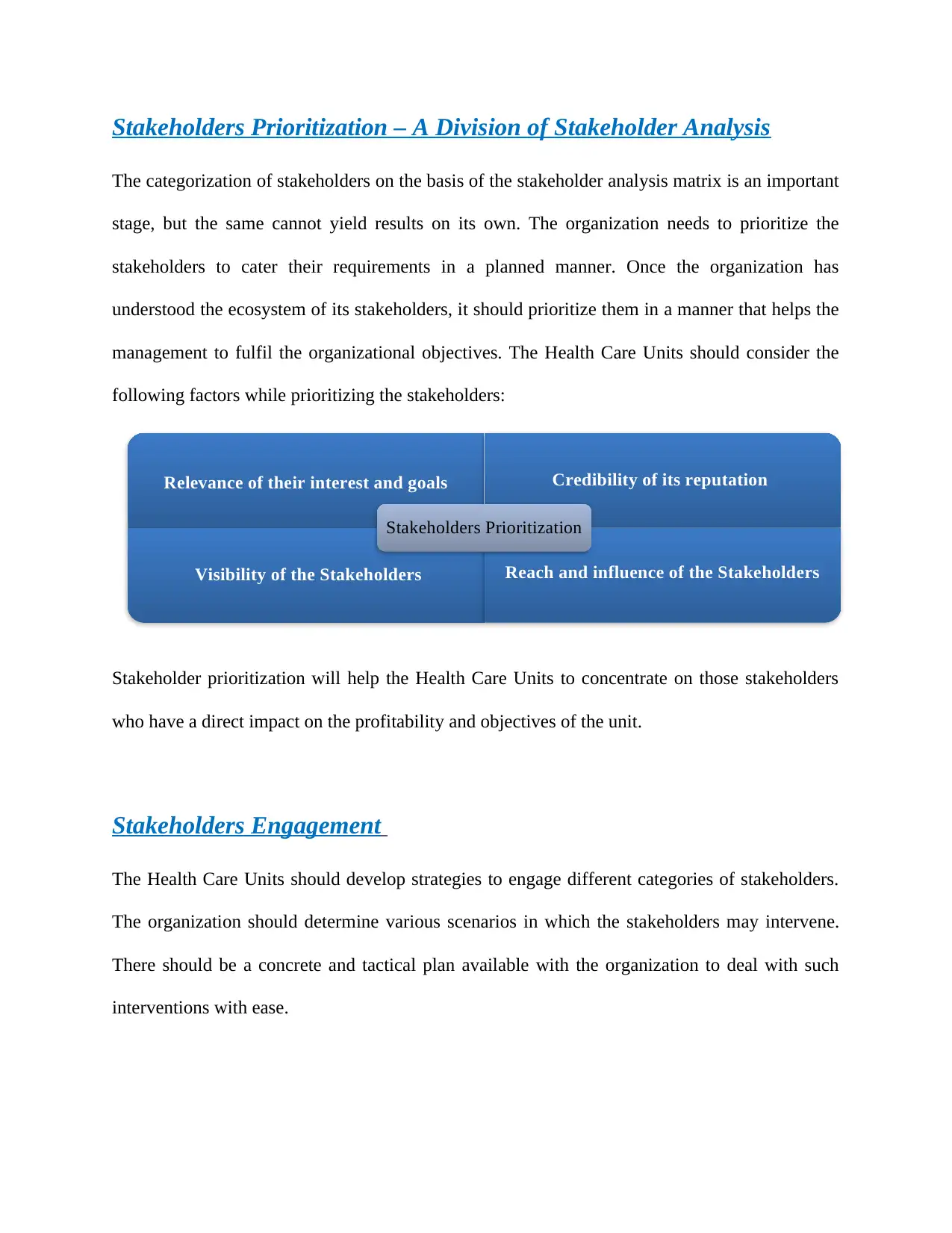
The categorization of stakeholders on the basis of the stakeholder analysis matrix is an important
stage, but the same cannot yield results on its own. The organization needs to prioritize the
stakeholders to cater their requirements in a planned manner. Once the organization has
understood the ecosystem of its stakeholders, it should prioritize them in a manner that helps the
management to fulfil the organizational objectives. The Health Care Units should consider the
following factors while prioritizing the stakeholders:
Stakeholder prioritization will help the Health Care Units to concentrate on those stakeholders
who have a direct impact on the profitability and objectives of the unit.
Stakeholders Engagement
The Health Care Units should develop strategies to engage different categories of stakeholders.
The organization should determine various scenarios in which the stakeholders may intervene.
There should be a concrete and tactical plan available with the organization to deal with such
interventions with ease.
Relevance of their interest and goals Credibility of its reputation
Visibility of the Stakeholders Reach and influence of the Stakeholders
Stakeholders Prioritization
The categorization of stakeholders on the basis of the stakeholder analysis matrix is an important
stage, but the same cannot yield results on its own. The organization needs to prioritize the
stakeholders to cater their requirements in a planned manner. Once the organization has
understood the ecosystem of its stakeholders, it should prioritize them in a manner that helps the
management to fulfil the organizational objectives. The Health Care Units should consider the
following factors while prioritizing the stakeholders:
Stakeholder prioritization will help the Health Care Units to concentrate on those stakeholders
who have a direct impact on the profitability and objectives of the unit.
Stakeholders Engagement
The Health Care Units should develop strategies to engage different categories of stakeholders.
The organization should determine various scenarios in which the stakeholders may intervene.
There should be a concrete and tactical plan available with the organization to deal with such
interventions with ease.
Relevance of their interest and goals Credibility of its reputation
Visibility of the Stakeholders Reach and influence of the Stakeholders
Stakeholders Prioritization
⊘ This is a preview!⊘
Do you want full access?
Subscribe today to unlock all pages.
Trusted by 1+ million students worldwide

1 out of 14


Related Documents


Your All-in-One AI-Powered Toolkit for Academic Success.
+13062052269
info@desklib.com
Available 24*7 on WhatsApp / Email
![[object Object]](/_next/static/media/star-bottom.7253800d.svg)
Unlock your academic potential
Copyright © 2020–2025 A2Z Services. All Rights Reserved. Developed and managed by ZUCOL.