Strategic Issues in Health Information Management Report
VerifiedAdded on 2023/06/10
|15
|4415
|123
Report
AI Summary
This report provides a comprehensive literature review of strategic issues affecting Health Information Management (HIM). It begins by defining strategic planning and emphasizing its importance within the healthcare context. The report then conducts a SWOT analysis, identifying strengths, weaknesses, opportunities, and threats related to HIM, particularly focusing on automation, data security, and cost-effectiveness. Current issues impacting HIM are identified, followed by a discussion of strategic solutions to address challenges such as patient care delays, unnecessary tests, and follow-up of test results. The role of stakeholders and their involvement in strategic planning are also examined. The report highlights the evolving role of HIM professionals and the impact of technological advancements, including the crucial need for data security and the potential for data breaches. This analysis provides a foundation for developing a strategic plan for a healthcare setting.
RUNNING HEAD: STRATEGIC ISSUES AFFECTING HEALTH INFORMATION MANAGEMENT IN
THE CURRENT ENVIRONMENT
STRATEGIC ISSUES AFFECTING HEALTH INFORMATION MANAGEMENT IN
THE CURRENT ENVIRONMENT
Student’s Name
University Name
Author’s Name
THE CURRENT ENVIRONMENT
STRATEGIC ISSUES AFFECTING HEALTH INFORMATION MANAGEMENT IN
THE CURRENT ENVIRONMENT
Student’s Name
University Name
Author’s Name

Paraphrase This Document
Need a fresh take? Get an instant paraphrase of this document with our AI Paraphraser
2
STRATEGIC ISSUES AFFECTING HEALTH INFORMATION MANAGEMENT IN THE CURRENT
ENVIRONMENT
Table of Contents
Literature Review: Strategic Planning of health information management...............................3
1. What is Strategic Plan?..........................................................................................................3
1.1 Importance of Strategic planning.....................................................................................3
2. SWOT analysis: health information management issues.......................................................4
2.1 Strengths and major advantages.......................................................................................4
2.2 Weaknesses.......................................................................................................................6
2.3 Opportunities....................................................................................................................7
2.4 Threats..............................................................................................................................8
3. Identification of current issues impacting Health Information Management that can be
addressed in the strategic plan....................................................................................................8
4. Discussion of strategic solutions for ways in which issues related to Health Information
Management will be addressed..................................................................................................9
4.1 Solutions to patient care delays........................................................................................9
4.2 Solutions to prevent unnecessary tests and studies..........................................................9
4.3 Lack in the follow up of the test results.........................................................................10
5. Stakeholder importance and involvement in strategic planning..........................................10
Reference List..........................................................................................................................12
STRATEGIC ISSUES AFFECTING HEALTH INFORMATION MANAGEMENT IN THE CURRENT
ENVIRONMENT
Table of Contents
Literature Review: Strategic Planning of health information management...............................3
1. What is Strategic Plan?..........................................................................................................3
1.1 Importance of Strategic planning.....................................................................................3
2. SWOT analysis: health information management issues.......................................................4
2.1 Strengths and major advantages.......................................................................................4
2.2 Weaknesses.......................................................................................................................6
2.3 Opportunities....................................................................................................................7
2.4 Threats..............................................................................................................................8
3. Identification of current issues impacting Health Information Management that can be
addressed in the strategic plan....................................................................................................8
4. Discussion of strategic solutions for ways in which issues related to Health Information
Management will be addressed..................................................................................................9
4.1 Solutions to patient care delays........................................................................................9
4.2 Solutions to prevent unnecessary tests and studies..........................................................9
4.3 Lack in the follow up of the test results.........................................................................10
5. Stakeholder importance and involvement in strategic planning..........................................10
Reference List..........................................................................................................................12
3
STRATEGIC ISSUES AFFECTING HEALTH INFORMATION MANAGEMENT IN THE CURRENT
ENVIRONMENT
Literature Review: Strategic Planning of health information management
1. What is Strategic Plan?
In spite of overexposure of the concept by business press, the conception of strategic
planning has still been an obscure concept. However, if an organisation, particularly
pertaining to the public sector, takes the process seriously, then can generate genuine value
towards its stakeholders. Strategic planning can be simply defined as a procedure planning by
means of which the organisation is aiming to achieve a certain position and the blueprint
involves details of the actions that various stakeholders are going to undertake. Inspired from
the views of Abdelhak, Grostick, & Hanken (2014), it can be opined that a public
organisation that is moving without a strategic plan is actually not planning to develop its
service and this is certainly a good implication for the society or community against which it
is projected. The organisations in the public health sector should keep in mind that the
business environment of the health service industry of Australia is fast evolving and if they
do not follow a certain guideline for future development, they would be lost in the tough
market competition.
A strategic plan is usually a framework that determines the direction in which
everybody involved with the organisation should be performing and also the subtle
suggestions which the organisation should be following in order to make everybody work in
the desired direction. In order to optimise the future potential of the organisation, Aquino
Shluzas et al. (2014), opines that the ideal strategic plan should include the following:
A strategic analysis highlighting the major strengths, weaknesses, threats as well as
opportunities
The explanation of strategies as well as tactics employed by the organisation
Details of the methods implemented for performance monitoring
STRATEGIC ISSUES AFFECTING HEALTH INFORMATION MANAGEMENT IN THE CURRENT
ENVIRONMENT
Literature Review: Strategic Planning of health information management
1. What is Strategic Plan?
In spite of overexposure of the concept by business press, the conception of strategic
planning has still been an obscure concept. However, if an organisation, particularly
pertaining to the public sector, takes the process seriously, then can generate genuine value
towards its stakeholders. Strategic planning can be simply defined as a procedure planning by
means of which the organisation is aiming to achieve a certain position and the blueprint
involves details of the actions that various stakeholders are going to undertake. Inspired from
the views of Abdelhak, Grostick, & Hanken (2014), it can be opined that a public
organisation that is moving without a strategic plan is actually not planning to develop its
service and this is certainly a good implication for the society or community against which it
is projected. The organisations in the public health sector should keep in mind that the
business environment of the health service industry of Australia is fast evolving and if they
do not follow a certain guideline for future development, they would be lost in the tough
market competition.
A strategic plan is usually a framework that determines the direction in which
everybody involved with the organisation should be performing and also the subtle
suggestions which the organisation should be following in order to make everybody work in
the desired direction. In order to optimise the future potential of the organisation, Aquino
Shluzas et al. (2014), opines that the ideal strategic plan should include the following:
A strategic analysis highlighting the major strengths, weaknesses, threats as well as
opportunities
The explanation of strategies as well as tactics employed by the organisation
Details of the methods implemented for performance monitoring
⊘ This is a preview!⊘
Do you want full access?
Subscribe today to unlock all pages.

Trusted by 1+ million students worldwide
4
STRATEGIC ISSUES AFFECTING HEALTH INFORMATION MANAGEMENT IN THE CURRENT
ENVIRONMENT
1.1 Importance of Strategic planning
Development of a strategic plan helps an organisation to define the scope of the major
activities undertaken by the organisation. It also helps the organisation to review the
motivation level of the employees, calculate future costs and employ the means of support
that would help in achievement of the future targets. Moreover, Azaria et al. (2016), opines
that this would also help in the better understanding of the external and internal
environmental factors that have been affecting the business. This, in turn, would create an
awareness among the upper management so that they can take the advantages of the future
facing business opportunities. Again, this also helps the management and the executives to
decide what strategies as well as tactics they should undertake in order to accept the business
opportunities and avoid the potential threats. In fact, Ben-Assuli (2015), implies that the
strategic planning phase makes the potential change drivers (major employee) to realise that
the upper management wants steady progress of the company and as an impact the also gives
their best to fulfil the organisational objectives. A significant part of the strategic plan is the
employee motivation planning. This helps the companies to keep track of the performances of
the employees and how they are working towards development of basic skills and added
potential to match the future standards of the organisation.
2. SWOT analysis: health information management issues
2.1 Strengths and major advantages
In the context of health information system of the public hospitals ne major concern is
the dubiousness regarding the implementation of automation of health database management.
Many scholar have raised queries like if the number on internal staff is sufficient and they
have the necessary calibre to maintain the information collection and management system, is
it really necessary to introduce automation as incur additional costs? Hence in the following
STRATEGIC ISSUES AFFECTING HEALTH INFORMATION MANAGEMENT IN THE CURRENT
ENVIRONMENT
1.1 Importance of Strategic planning
Development of a strategic plan helps an organisation to define the scope of the major
activities undertaken by the organisation. It also helps the organisation to review the
motivation level of the employees, calculate future costs and employ the means of support
that would help in achievement of the future targets. Moreover, Azaria et al. (2016), opines
that this would also help in the better understanding of the external and internal
environmental factors that have been affecting the business. This, in turn, would create an
awareness among the upper management so that they can take the advantages of the future
facing business opportunities. Again, this also helps the management and the executives to
decide what strategies as well as tactics they should undertake in order to accept the business
opportunities and avoid the potential threats. In fact, Ben-Assuli (2015), implies that the
strategic planning phase makes the potential change drivers (major employee) to realise that
the upper management wants steady progress of the company and as an impact the also gives
their best to fulfil the organisational objectives. A significant part of the strategic plan is the
employee motivation planning. This helps the companies to keep track of the performances of
the employees and how they are working towards development of basic skills and added
potential to match the future standards of the organisation.
2. SWOT analysis: health information management issues
2.1 Strengths and major advantages
In the context of health information system of the public hospitals ne major concern is
the dubiousness regarding the implementation of automation of health database management.
Many scholar have raised queries like if the number on internal staff is sufficient and they
have the necessary calibre to maintain the information collection and management system, is
it really necessary to introduce automation as incur additional costs? Hence in the following
Paraphrase This Document
Need a fresh take? Get an instant paraphrase of this document with our AI Paraphraser
5
STRATEGIC ISSUES AFFECTING HEALTH INFORMATION MANAGEMENT IN THE CURRENT
ENVIRONMENT
SWOT analysis a detailed perspective assessment have been undertaken to identify if the
Health Information management system (HIS) is actually beneficial or not. The first major
advantage is the easier access to patients’ data, which is particularly beneficial from the
perspective of the health care providers. According to the ideas of Cresswell et al. (2017), the
online digital database of the patient’s data enables the requisite individual data of the
patients to be available with a few clicks. Something, from crises periods the doctors requires
to recheck the test reports of a certain patient. Influenced from the views of Detwiller, M., &
Petillion, W. (2014), it can be opined that in case of the availability of a common patients’
information database, the doctors do not need to go looking for the IPD files. A simple ID
entry into the online database would give him or her access to all essential documents and
hence timely decisions of treatments ensue.
The second benefit of Health Information digital database management is the high level cost
effectiveness. This database helps in cutting down the cost incurred a lot of manual work that
is generally performed by health care professionals. Influenced from the findings of Hsiao et
al. (2018), it can be opined that the flow of patients in the public hospitals is generally high
and particularly for big hospitals with beds over 200, manual management is time taking and
often formalities like documentation and past record submission of the patient’s medical
history makes a delay in the treatment of the respective patients. However, Jones et al.
(2014), opines that the electronic data base enables in the cutting down of manpower and this
saves a great amount of cost that could have been incurred by the resources that are required
for manual recording of data including the cost incurred by the human capital.
The third advantage of the HIS system is the improvement in the efficiency of the health
care service. As per Lee, Bagheri & Kao (2015), development and maintenance of software
for the service of health information management reduces the scope of human intervention in
the process and thus the chances of human problems like as fatigue, miscommunication and
STRATEGIC ISSUES AFFECTING HEALTH INFORMATION MANAGEMENT IN THE CURRENT
ENVIRONMENT
SWOT analysis a detailed perspective assessment have been undertaken to identify if the
Health Information management system (HIS) is actually beneficial or not. The first major
advantage is the easier access to patients’ data, which is particularly beneficial from the
perspective of the health care providers. According to the ideas of Cresswell et al. (2017), the
online digital database of the patient’s data enables the requisite individual data of the
patients to be available with a few clicks. Something, from crises periods the doctors requires
to recheck the test reports of a certain patient. Influenced from the views of Detwiller, M., &
Petillion, W. (2014), it can be opined that in case of the availability of a common patients’
information database, the doctors do not need to go looking for the IPD files. A simple ID
entry into the online database would give him or her access to all essential documents and
hence timely decisions of treatments ensue.
The second benefit of Health Information digital database management is the high level cost
effectiveness. This database helps in cutting down the cost incurred a lot of manual work that
is generally performed by health care professionals. Influenced from the findings of Hsiao et
al. (2018), it can be opined that the flow of patients in the public hospitals is generally high
and particularly for big hospitals with beds over 200, manual management is time taking and
often formalities like documentation and past record submission of the patient’s medical
history makes a delay in the treatment of the respective patients. However, Jones et al.
(2014), opines that the electronic data base enables in the cutting down of manpower and this
saves a great amount of cost that could have been incurred by the resources that are required
for manual recording of data including the cost incurred by the human capital.
The third advantage of the HIS system is the improvement in the efficiency of the health
care service. As per Lee, Bagheri & Kao (2015), development and maintenance of software
for the service of health information management reduces the scope of human intervention in
the process and thus the chances of human problems like as fatigue, miscommunication and
6
STRATEGIC ISSUES AFFECTING HEALTH INFORMATION MANAGEMENT IN THE CURRENT
ENVIRONMENT
also lacking of focus. The automated software delivers the same performance however be the
work pressure and delivers the outcome with same level of accuracy day in or day out. There
are also scope for reduction of human errors (casual or intentional), if processes are
maintained with the HIS software. An example can be provided. Based on the instance
provided by Levesque et al. (2015), it can be opined that during the time of billing one IDP
patient for medicines with the utilisation of the HIS software, the bills can hardly be wrong as
the software detects the price based on exactly the same drugs that the nurse have billed for,
unless and until there is shortage of the drug currently or a doctor introduces a prompt change
in his prescription of drugs. As informed by Milevska et al. (2017), the rate of per unit cost of
every drug is recorded in the software and the process of automation reduces the chances of
misinterpretation of costs.
The fifth advantage of the HIS implementation is data security. In public hospitals one
major challenge regarding patients’ data is maintaining the safety of the data. The
maintenance of online data enables the authorised personnel to access the HIS database and
that too in minimum possible time. The process of the data storage is also easy.
In the end it can be implied that improved access of the patients’ data means
improvement of the work efficiency and also improvement in the patients’ care and in the
end this improves the profitability of the public hospitals which is a big concern for the
Australian restaurants nowadays.
2.2 Weaknesses
The installation of the HIS software is a cost incurring process actually and it should
be understood that the level of revenue generation is not as much compared to the private
nursing care homes. As per Nguyen, Bellucci & Nguyen (2014), the average number of aged
population in Australia is increasing and this implies that the amount of patient admissions in
STRATEGIC ISSUES AFFECTING HEALTH INFORMATION MANAGEMENT IN THE CURRENT
ENVIRONMENT
also lacking of focus. The automated software delivers the same performance however be the
work pressure and delivers the outcome with same level of accuracy day in or day out. There
are also scope for reduction of human errors (casual or intentional), if processes are
maintained with the HIS software. An example can be provided. Based on the instance
provided by Levesque et al. (2015), it can be opined that during the time of billing one IDP
patient for medicines with the utilisation of the HIS software, the bills can hardly be wrong as
the software detects the price based on exactly the same drugs that the nurse have billed for,
unless and until there is shortage of the drug currently or a doctor introduces a prompt change
in his prescription of drugs. As informed by Milevska et al. (2017), the rate of per unit cost of
every drug is recorded in the software and the process of automation reduces the chances of
misinterpretation of costs.
The fifth advantage of the HIS implementation is data security. In public hospitals one
major challenge regarding patients’ data is maintaining the safety of the data. The
maintenance of online data enables the authorised personnel to access the HIS database and
that too in minimum possible time. The process of the data storage is also easy.
In the end it can be implied that improved access of the patients’ data means
improvement of the work efficiency and also improvement in the patients’ care and in the
end this improves the profitability of the public hospitals which is a big concern for the
Australian restaurants nowadays.
2.2 Weaknesses
The installation of the HIS software is a cost incurring process actually and it should
be understood that the level of revenue generation is not as much compared to the private
nursing care homes. As per Nguyen, Bellucci & Nguyen (2014), the average number of aged
population in Australia is increasing and this implies that the amount of patient admissions in
⊘ This is a preview!⊘
Do you want full access?
Subscribe today to unlock all pages.
Trusted by 1+ million students worldwide
7
STRATEGIC ISSUES AFFECTING HEALTH INFORMATION MANAGEMENT IN THE CURRENT
ENVIRONMENT
the upcoming day would increase and in turn the working population who are earning and are
liable to pay the bills are reducing. Hence the major question here is that whether high end
expenditure incurred by high technology would be applicable economically by the Australian
government or not.
It is evident that technology is fast evolving and as such the HIS software would also
incur new updates and regular up gradation and bring in new ways to handling the software
(Sligo et al. 2017). This would incur an additional IT cost and the elder staff who are not so
flamboyant with technology would face much issues.
Over dependence on technological assets can incur some disadvantages. The
computer system that is required for working of the HIS technology might incur some
technological errors. As Tadesse, Gebeyoh & Tadesse (2014), informs, this issue would be
fatally affecting the Accident and Emergency department. A common information system
interconnects all departments. It can be supposed that if a person on emergency approaches
the A&E department and due to technical issues the retrieval of the data of blood analysis
becomes problematic, the other following procedures of treatment would also get delayed.
This can even result in the death of the patient.
2.3 Opportunities
The roles of the health information management professional are changing nowadays.
Previously the professionals used to etch the records on paper. Nowadays with the benefits of
emerging technology, have enabled the HIM professionals to execute the process of
collection, storage, coding, interpretation and application of these data to render active
support to decision making of the clinicians, financial management of the management as
well as personal health management of the patients. As an impact, Wager, Lee, & Glaser
(2017), opines that nowadays, the role of the HIS professionals have become increasingly
STRATEGIC ISSUES AFFECTING HEALTH INFORMATION MANAGEMENT IN THE CURRENT
ENVIRONMENT
the upcoming day would increase and in turn the working population who are earning and are
liable to pay the bills are reducing. Hence the major question here is that whether high end
expenditure incurred by high technology would be applicable economically by the Australian
government or not.
It is evident that technology is fast evolving and as such the HIS software would also
incur new updates and regular up gradation and bring in new ways to handling the software
(Sligo et al. 2017). This would incur an additional IT cost and the elder staff who are not so
flamboyant with technology would face much issues.
Over dependence on technological assets can incur some disadvantages. The
computer system that is required for working of the HIS technology might incur some
technological errors. As Tadesse, Gebeyoh & Tadesse (2014), informs, this issue would be
fatally affecting the Accident and Emergency department. A common information system
interconnects all departments. It can be supposed that if a person on emergency approaches
the A&E department and due to technical issues the retrieval of the data of blood analysis
becomes problematic, the other following procedures of treatment would also get delayed.
This can even result in the death of the patient.
2.3 Opportunities
The roles of the health information management professional are changing nowadays.
Previously the professionals used to etch the records on paper. Nowadays with the benefits of
emerging technology, have enabled the HIM professionals to execute the process of
collection, storage, coding, interpretation and application of these data to render active
support to decision making of the clinicians, financial management of the management as
well as personal health management of the patients. As an impact, Wager, Lee, & Glaser
(2017), opines that nowadays, the role of the HIS professionals have become increasingly
Paraphrase This Document
Need a fresh take? Get an instant paraphrase of this document with our AI Paraphraser
8
STRATEGIC ISSUES AFFECTING HEALTH INFORMATION MANAGEMENT IN THE CURRENT
ENVIRONMENT
vital and the number of HIM professionals with HIS knowledge or expertise have increased.
It is estimated that the number of HIS professionals would increase by 49% by 2025.
According to the provided data of the Labour Department of Australia, about 2000 new
graduates are getting admitted to the hospitals or joining new crash courses for emerging as
HIS professionals.
2.4 Threats
One major threat to the health care information management is the breach of data.
Data breach is difficult when the records are kept on paper. However, the electronic database
enables the access to the entire data of all the patients in the hospitals. The HIS professionals
who are dealing with the patients data can easily leak data from the database. In fact, as
Waterson (2014), highlights, statistics confirm that 49% of the health care data that have been
breached from the online data bases have been operated from the end of the insiders of the
data management department who have sound IT skills. This data is usually extracted to
blackmail the hospital management or the patient parties on various grounds and often for
committing tax fraud. Unintentional data frauds can also take place (Williamset et al. 2017).
Recording of an individual patient’s data against the database of another patient have been a
regular phenomenon. This occurs due to the casual approach of the employees or at times due
to the incapability of the HIM workers to handle online databases.
STRATEGIC ISSUES AFFECTING HEALTH INFORMATION MANAGEMENT IN THE CURRENT
ENVIRONMENT
vital and the number of HIM professionals with HIS knowledge or expertise have increased.
It is estimated that the number of HIS professionals would increase by 49% by 2025.
According to the provided data of the Labour Department of Australia, about 2000 new
graduates are getting admitted to the hospitals or joining new crash courses for emerging as
HIS professionals.
2.4 Threats
One major threat to the health care information management is the breach of data.
Data breach is difficult when the records are kept on paper. However, the electronic database
enables the access to the entire data of all the patients in the hospitals. The HIS professionals
who are dealing with the patients data can easily leak data from the database. In fact, as
Waterson (2014), highlights, statistics confirm that 49% of the health care data that have been
breached from the online data bases have been operated from the end of the insiders of the
data management department who have sound IT skills. This data is usually extracted to
blackmail the hospital management or the patient parties on various grounds and often for
committing tax fraud. Unintentional data frauds can also take place (Williamset et al. 2017).
Recording of an individual patient’s data against the database of another patient have been a
regular phenomenon. This occurs due to the casual approach of the employees or at times due
to the incapability of the HIM workers to handle online databases.
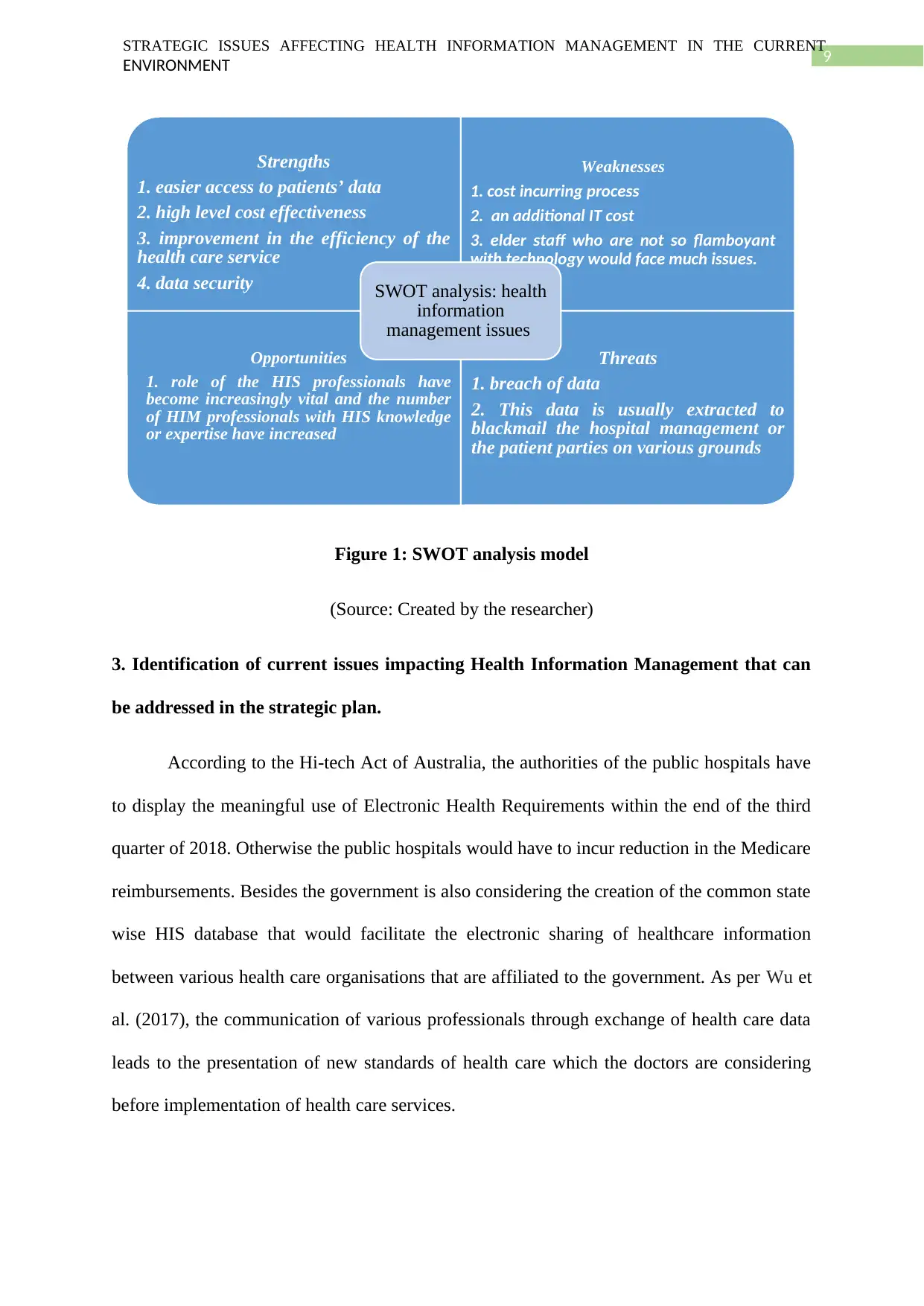
9
STRATEGIC ISSUES AFFECTING HEALTH INFORMATION MANAGEMENT IN THE CURRENT
ENVIRONMENT
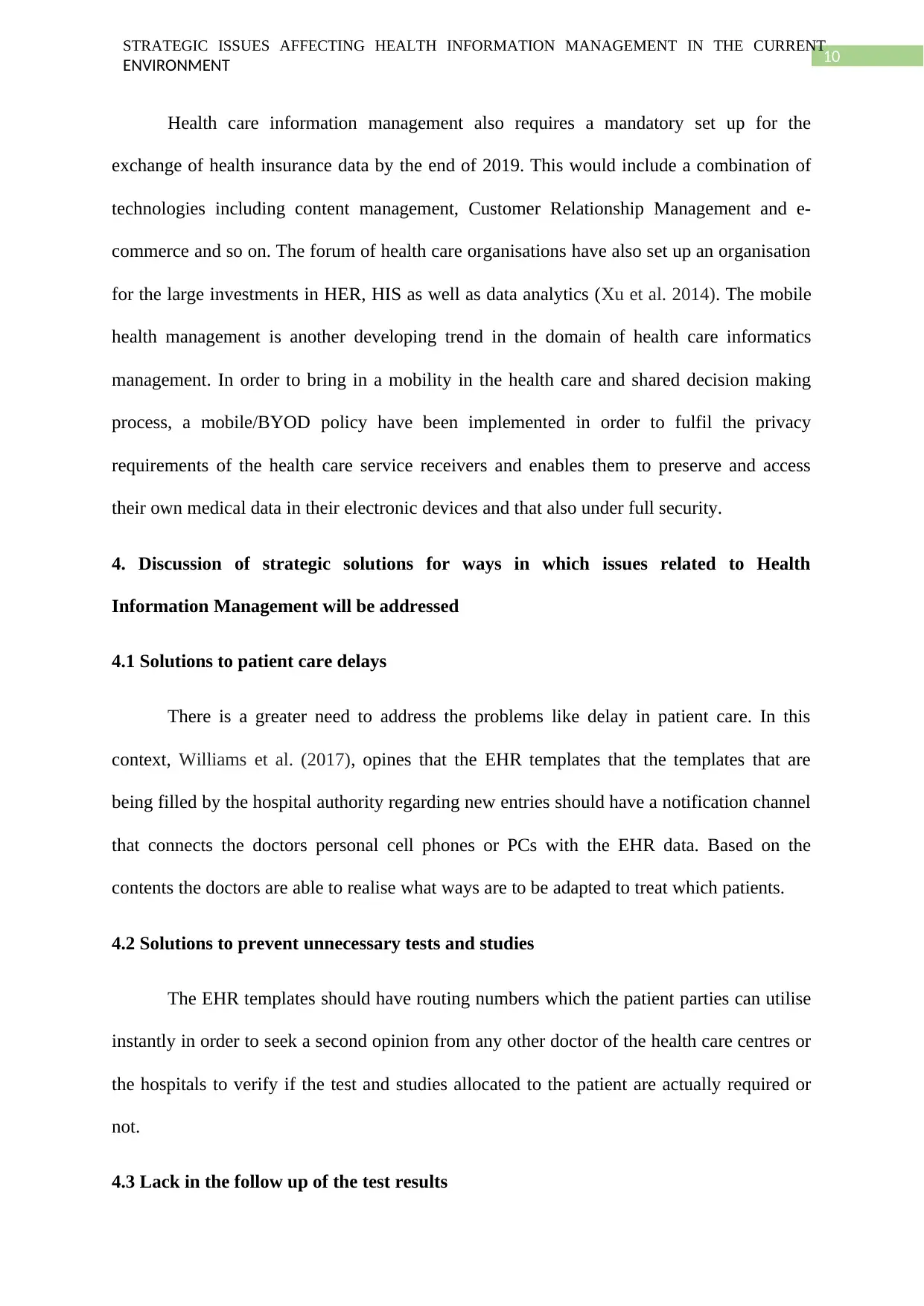
Figure 1: SWOT analysis model
(Source: Created by the researcher)
3. Identification of current issues impacting Health Information Management that can
be addressed in the strategic plan.
According to the Hi-tech Act of Australia, the authorities of the public hospitals have
to display the meaningful use of Electronic Health Requirements within the end of the third
quarter of 2018. Otherwise the public hospitals would have to incur reduction in the Medicare
reimbursements. Besides the government is also considering the creation of the common state
wise HIS database that would facilitate the electronic sharing of healthcare information
between various health care organisations that are affiliated to the government. As per Wu et
al. (2017), the communication of various professionals through exchange of health care data
leads to the presentation of new standards of health care which the doctors are considering
before implementation of health care services.
Strengths
1. easier access to patients’ data
2. high level cost effectiveness
3. improvement in the efficiency of the
health care service
4. data security
Weaknesses
1. cost incurring process
2. an additional IT cost
3. elder staff who are not so flamboyant
with technology would face much issues.
Opportunities
1. role of the HIS professionals have
become increasingly vital and the number
of HIM professionals with HIS knowledge
or expertise have increased
Threats
1. breach of data
2. This data is usually extracted to
blackmail the hospital management or
the patient parties on various grounds
SWOT analysis: health
information
management issues
STRATEGIC ISSUES AFFECTING HEALTH INFORMATION MANAGEMENT IN THE CURRENT
ENVIRONMENT
Figure 1: SWOT analysis model
(Source: Created by the researcher)
3. Identification of current issues impacting Health Information Management that can
be addressed in the strategic plan.
According to the Hi-tech Act of Australia, the authorities of the public hospitals have
to display the meaningful use of Electronic Health Requirements within the end of the third
quarter of 2018. Otherwise the public hospitals would have to incur reduction in the Medicare
reimbursements. Besides the government is also considering the creation of the common state
wise HIS database that would facilitate the electronic sharing of healthcare information
between various health care organisations that are affiliated to the government. As per Wu et
al. (2017), the communication of various professionals through exchange of health care data
leads to the presentation of new standards of health care which the doctors are considering
before implementation of health care services.
Strengths
1. easier access to patients’ data
2. high level cost effectiveness
3. improvement in the efficiency of the
health care service
4. data security
Weaknesses
1. cost incurring process
2. an additional IT cost
3. elder staff who are not so flamboyant
with technology would face much issues.
Opportunities
1. role of the HIS professionals have
become increasingly vital and the number
of HIM professionals with HIS knowledge
or expertise have increased
Threats
1. breach of data
2. This data is usually extracted to
blackmail the hospital management or
the patient parties on various grounds
SWOT analysis: health
information
management issues
⊘ This is a preview!⊘
Do you want full access?
Subscribe today to unlock all pages.
Trusted by 1+ million students worldwide
10
STRATEGIC ISSUES AFFECTING HEALTH INFORMATION MANAGEMENT IN THE CURRENT
ENVIRONMENT
Health care information management also requires a mandatory set up for the
exchange of health insurance data by the end of 2019. This would include a combination of
technologies including content management, Customer Relationship Management and e-
commerce and so on. The forum of health care organisations have also set up an organisation
for the large investments in HER, HIS as well as data analytics (Xu et al. 2014). The mobile
health management is another developing trend in the domain of health care informatics
management. In order to bring in a mobility in the health care and shared decision making
process, a mobile/BYOD policy have been implemented in order to fulfil the privacy
requirements of the health care service receivers and enables them to preserve and access
their own medical data in their electronic devices and that also under full security.
4. Discussion of strategic solutions for ways in which issues related to Health
Information Management will be addressed
4.1 Solutions to patient care delays
There is a greater need to address the problems like delay in patient care. In this
context, Williams et al. (2017), opines that the EHR templates that the templates that are
being filled by the hospital authority regarding new entries should have a notification channel
that connects the doctors personal cell phones or PCs with the EHR data. Based on the
contents the doctors are able to realise what ways are to be adapted to treat which patients.
4.2 Solutions to prevent unnecessary tests and studies
The EHR templates should have routing numbers which the patient parties can utilise
instantly in order to seek a second opinion from any other doctor of the health care centres or
the hospitals to verify if the test and studies allocated to the patient are actually required or
not.
4.3 Lack in the follow up of the test results
STRATEGIC ISSUES AFFECTING HEALTH INFORMATION MANAGEMENT IN THE CURRENT
ENVIRONMENT
Health care information management also requires a mandatory set up for the
exchange of health insurance data by the end of 2019. This would include a combination of
technologies including content management, Customer Relationship Management and e-
commerce and so on. The forum of health care organisations have also set up an organisation
for the large investments in HER, HIS as well as data analytics (Xu et al. 2014). The mobile
health management is another developing trend in the domain of health care informatics
management. In order to bring in a mobility in the health care and shared decision making
process, a mobile/BYOD policy have been implemented in order to fulfil the privacy
requirements of the health care service receivers and enables them to preserve and access
their own medical data in their electronic devices and that also under full security.
4. Discussion of strategic solutions for ways in which issues related to Health
Information Management will be addressed
4.1 Solutions to patient care delays
There is a greater need to address the problems like delay in patient care. In this
context, Williams et al. (2017), opines that the EHR templates that the templates that are
being filled by the hospital authority regarding new entries should have a notification channel
that connects the doctors personal cell phones or PCs with the EHR data. Based on the
contents the doctors are able to realise what ways are to be adapted to treat which patients.
4.2 Solutions to prevent unnecessary tests and studies
The EHR templates should have routing numbers which the patient parties can utilise
instantly in order to seek a second opinion from any other doctor of the health care centres or
the hospitals to verify if the test and studies allocated to the patient are actually required or
not.
4.3 Lack in the follow up of the test results
Paraphrase This Document
Need a fresh take? Get an instant paraphrase of this document with our AI Paraphraser
11
STRATEGIC ISSUES AFFECTING HEALTH INFORMATION MANAGEMENT IN THE CURRENT
ENVIRONMENT
In this context, Waterson, (2014), provides one unique solution. The end outcomes of
the patient’s test and/or studies can be recorded in the electronic database parallel with the
doctor’s personal database. As an outcome, when the doctors invigilate the respective
patients, they can enter the routing number of the patient to see the end results of the latest
conducted tests of the particular patient. The data optimisation teams should also be provided
to access the doctor’s portals so that they can check the update of the latest data in the portals
frequently. This would ensure increased patients safety as in many instances, the patients’
tests data do not reach the doctors if they are printed and filed. Rather, Lee, Bagheri & Kao
(2015), opines that about 70% of the doctors of the public hospitals are acquainted with the
HIS programs and hence they should start having personal data base of every patient check-
up. After allocation of regular duties, the doctors should take up the responsibility of
accessing the codes against the database of individual patients in order to gain a conception
of the current status of the patients and decide the treatment strategy even before physically
visiting the patients.
5. Stakeholder importance and involvement in strategic planning
Stakeholder involvement is one of the important credibility criteria of the success of
electronic information management. The major stakeholders in this context are the patients,
the patient parties, the database managers, the EHR recorders, HIS professionals, the assigned
doctors and the health care providers (Detwiller & Petillion, 2014). The doctors in this
context should have a separate portal for data access and all other stakeholders can access the
single data base. Out of them the patients can only access the database of the respective
patient codes. The database managers are liable to assign permissions to every other
stakeholder to access respective data. The data handling is another important concern in this
context. The official portal handling of the respective hospital should have a certain set of
terms and conditions. The patients are liable to share respective data with other doctors also.
STRATEGIC ISSUES AFFECTING HEALTH INFORMATION MANAGEMENT IN THE CURRENT
ENVIRONMENT
In this context, Waterson, (2014), provides one unique solution. The end outcomes of
the patient’s test and/or studies can be recorded in the electronic database parallel with the
doctor’s personal database. As an outcome, when the doctors invigilate the respective
patients, they can enter the routing number of the patient to see the end results of the latest
conducted tests of the particular patient. The data optimisation teams should also be provided
to access the doctor’s portals so that they can check the update of the latest data in the portals
frequently. This would ensure increased patients safety as in many instances, the patients’
tests data do not reach the doctors if they are printed and filed. Rather, Lee, Bagheri & Kao
(2015), opines that about 70% of the doctors of the public hospitals are acquainted with the
HIS programs and hence they should start having personal data base of every patient check-
up. After allocation of regular duties, the doctors should take up the responsibility of
accessing the codes against the database of individual patients in order to gain a conception
of the current status of the patients and decide the treatment strategy even before physically
visiting the patients.
5. Stakeholder importance and involvement in strategic planning
Stakeholder involvement is one of the important credibility criteria of the success of
electronic information management. The major stakeholders in this context are the patients,
the patient parties, the database managers, the EHR recorders, HIS professionals, the assigned
doctors and the health care providers (Detwiller & Petillion, 2014). The doctors in this
context should have a separate portal for data access and all other stakeholders can access the
single data base. Out of them the patients can only access the database of the respective
patient codes. The database managers are liable to assign permissions to every other
stakeholder to access respective data. The data handling is another important concern in this
context. The official portal handling of the respective hospital should have a certain set of
terms and conditions. The patients are liable to share respective data with other doctors also.
12
STRATEGIC ISSUES AFFECTING HEALTH INFORMATION MANAGEMENT IN THE CURRENT
ENVIRONMENT
They are also liable to get the soft copies of all the tests that are being conducted of the
patient during the tenure of admittance. The doctors can also similarly share data from their
own database for discussion with peers on particular cases.
STRATEGIC ISSUES AFFECTING HEALTH INFORMATION MANAGEMENT IN THE CURRENT
ENVIRONMENT
They are also liable to get the soft copies of all the tests that are being conducted of the
patient during the tenure of admittance. The doctors can also similarly share data from their
own database for discussion with peers on particular cases.
⊘ This is a preview!⊘
Do you want full access?
Subscribe today to unlock all pages.
Trusted by 1+ million students worldwide

1 out of 15


Related Documents


Your All-in-One AI-Powered Toolkit for Academic Success.
+13062052269
info@desklib.com
Available 24*7 on WhatsApp / Email
![[object Object]](/_next/static/media/star-bottom.7253800d.svg)
Unlock your academic potential
Copyright © 2020–2026 A2Z Services. All Rights Reserved. Developed and managed by ZUCOL.