Health Information Systems: Evaluating Healthcare Technology Report
VerifiedAdded on 2020/02/18
|18
|4517
|75
Report
AI Summary
This report provides an in-depth analysis of Health Information Systems (HIS), exploring their significance in modern healthcare. It examines the evolution and importance of HIS, highlighting its impact on the quality and safety of healthcare services, including the use of health apps and big data. The report reviews various sources, including the Global Information Technology Report 2013, to assess the benefits and challenges of implementing HIS. It discusses how HIS enhances patient care, improves administrative processes, and promotes economic growth. Furthermore, it addresses the potential risks associated with the technology, such as data security and the need for continuous upgrades. The report emphasizes the role of HIS in improving healthcare efficiency, reducing costs, and facilitating better patient outcomes. Overall, the report provides a comprehensive overview of HIS, its impact, and its future in the healthcare industry.
Running head: HEALTH INFORMATION SYSTEM
HEALTH INFORMATION SYSTEM
Name of the Student:
Name of the University:
Author Note:
HEALTH INFORMATION SYSTEM
Name of the Student:
Name of the University:
Author Note:

Paraphrase This Document
Need a fresh take? Get an instant paraphrase of this document with our AI Paraphraser
1HEALTH INFORMATION SYSTEM
Abstract
Information and the communication technology is an upgraded means of providing health
care services to the sick. It is beneficial to the patients as it has an easy access to the treatment
procedures as well as to the doctors. The new technology has the opportunity to incorporate
healthcare applications in the smart phones. This approach readily helps to monitor the
patient’s own physiological condition and then reporting it to their doctor. It helped in the
rate of admission to a hospital and is patient friendly. It is cost effective and enables the
patients to seek a better quality of health care of services. In this article, the health
information system evaluated is the health apps which are available for everyone, who uses a
smart phone.
Abstract
Information and the communication technology is an upgraded means of providing health
care services to the sick. It is beneficial to the patients as it has an easy access to the treatment
procedures as well as to the doctors. The new technology has the opportunity to incorporate
healthcare applications in the smart phones. This approach readily helps to monitor the
patient’s own physiological condition and then reporting it to their doctor. It helped in the
rate of admission to a hospital and is patient friendly. It is cost effective and enables the
patients to seek a better quality of health care of services. In this article, the health
information system evaluated is the health apps which are available for everyone, who uses a
smart phone.
2HEALTH INFORMATION SYSTEM
Table of Contents
Introduction................................................................................................................................3
The Importance of Heath Information Systems.........................................................................4
The impact of health on the quality and safety of health care...................................................5
The global information technology report 2013........................................................................6
The future of the health information technology...................................................................7
The surprising seeds of the big-data revolution in health care...................................................8
World Health Organisation- ehealth..........................................................................................9
Getting most from health apps...................................................................................................9
Conclusion................................................................................................................................12
References................................................................................................................................13
Table of Contents
Introduction................................................................................................................................3
The Importance of Heath Information Systems.........................................................................4
The impact of health on the quality and safety of health care...................................................5
The global information technology report 2013........................................................................6
The future of the health information technology...................................................................7
The surprising seeds of the big-data revolution in health care...................................................8
World Health Organisation- ehealth..........................................................................................9
Getting most from health apps...................................................................................................9
Conclusion................................................................................................................................12
References................................................................................................................................13
⊘ This is a preview!⊘
Do you want full access?
Subscribe today to unlock all pages.

Trusted by 1+ million students worldwide
3HEALTH INFORMATION SYSTEM
Introduction
A system that is used to record, store and transmits health related information is
termed as the health information system (Wager, Lee & Glaser, 2017). The decision-makers
and the health planner of a patient requires many types of information like the environmental
condition in which the health organizations operates, the financial resources of the
organization, the cost of the treatment, the facilities provided by them, the policy and legal
matters that the organization follows. They also need the information regarding the
availability of the healthcare services and the way they provides, the outcome of their
healthcare services like the mortality, morbidity, the outbreak of any disease and many such
other factors (Agha, 2014).
The decision-makers and the care planners can collect this essential information by an
efficient health information system. They ensure its users an easy access to a reliable and
useable data. This system includes disease surveillance systems, hospital patient surveillance
system, information based on human resource management and many other. These systems
collect, process the information that is related to health and influences the act of making
decision (Vashist, Schneider & Luong, 2014).
The health information system consists of three components and these include
resources of health information systems, indicators which encompasses the status of the
health and the inputs and outputs of the health system, sources and management of the data,
the information that becomes the tool for evidence and helps in promoting the health care
planning and by promoting an easy access of the care planners to these informations.
This discussion analyses different articles and papers that are provided that are related
to the health information system.
Introduction
A system that is used to record, store and transmits health related information is
termed as the health information system (Wager, Lee & Glaser, 2017). The decision-makers
and the health planner of a patient requires many types of information like the environmental
condition in which the health organizations operates, the financial resources of the
organization, the cost of the treatment, the facilities provided by them, the policy and legal
matters that the organization follows. They also need the information regarding the
availability of the healthcare services and the way they provides, the outcome of their
healthcare services like the mortality, morbidity, the outbreak of any disease and many such
other factors (Agha, 2014).
The decision-makers and the care planners can collect this essential information by an
efficient health information system. They ensure its users an easy access to a reliable and
useable data. This system includes disease surveillance systems, hospital patient surveillance
system, information based on human resource management and many other. These systems
collect, process the information that is related to health and influences the act of making
decision (Vashist, Schneider & Luong, 2014).
The health information system consists of three components and these include
resources of health information systems, indicators which encompasses the status of the
health and the inputs and outputs of the health system, sources and management of the data,
the information that becomes the tool for evidence and helps in promoting the health care
planning and by promoting an easy access of the care planners to these informations.
This discussion analyses different articles and papers that are provided that are related
to the health information system.
Paraphrase This Document
Need a fresh take? Get an instant paraphrase of this document with our AI Paraphraser
4HEALTH INFORMATION SYSTEM
The Importance of Heath Information Systems
The health information system is an efficient system of maintaining and recording all the
information that are related to the healthcare system of a health care organization. The quality
and safety of the care provided to an individual by the health care professionals are greatly
improved by the various innovations adopted by the health information technologies
(Istepanian, Laxminarayan & Pattichis, 2014). The health information system is important in
carrying out effective healthcare services.
The Organizational issues in the implementation and adoption of health information
technology innovations: an interpretative review:
One of the provided sources, the Organizational issues in the implementation and
adoption of health information technology innovations: an interpretative review states that
technological implementations play an important role in healthcare practices but it requires
attention of the researchers. This condition is mainly due to the lack of adequate theoretical
work that seeks effort and coordination.
The above article states that the health information systems are user friendly, as it is
designed in a simple way, easily navigable by the user, graphical and reduces the load
(Sultan, 2014). The health information system facilitates the easy use, cost of the service and
its maintenance and the benefits of early demonstration. The health information system on the
other hand may become obsolete if it fails to meet all the needs of its user (Cresswell &
Sheikh, 2013). This limitation may be the outcome of many reasons. Some of the user may
lack the required knowledge of the computer that is essential to operate the system,
sometimes the operation is of complex nature that delays the work and increases the time of
the service to be provided. The health information system may sometimes be exposed to the
risk of being accessed by some unauthorized people.
The Importance of Heath Information Systems
The health information system is an efficient system of maintaining and recording all the
information that are related to the healthcare system of a health care organization. The quality
and safety of the care provided to an individual by the health care professionals are greatly
improved by the various innovations adopted by the health information technologies
(Istepanian, Laxminarayan & Pattichis, 2014). The health information system is important in
carrying out effective healthcare services.
The Organizational issues in the implementation and adoption of health information
technology innovations: an interpretative review:
One of the provided sources, the Organizational issues in the implementation and
adoption of health information technology innovations: an interpretative review states that
technological implementations play an important role in healthcare practices but it requires
attention of the researchers. This condition is mainly due to the lack of adequate theoretical
work that seeks effort and coordination.
The above article states that the health information systems are user friendly, as it is
designed in a simple way, easily navigable by the user, graphical and reduces the load
(Sultan, 2014). The health information system facilitates the easy use, cost of the service and
its maintenance and the benefits of early demonstration. The health information system on the
other hand may become obsolete if it fails to meet all the needs of its user (Cresswell &
Sheikh, 2013). This limitation may be the outcome of many reasons. Some of the user may
lack the required knowledge of the computer that is essential to operate the system,
sometimes the operation is of complex nature that delays the work and increases the time of
the service to be provided. The health information system may sometimes be exposed to the
risk of being accessed by some unauthorized people.
5HEALTH INFORMATION SYSTEM
There are also a number of social impacts which are related to the successful
implementation of the health information system. This social aspect includes the literacy in
the information technology, attitude of the users toward the innovation of the technology and
the interpersonal relationships and roles of the workers who handle this system (Sallis, Owen
& Fisher, 2015).
The organizational aspects are also linked to the health information system. The
working efficiency in an organization may be hampered due to the new technology and the
innovation (Kellermann & Jones, 2013). The service also gets delayed as the staffs working
in the organization try to cope up with the new innovation. It is the duty of the management
and the specialist to look after the work progress and encourages the staff to utilize and use
the new technology efficiently.
Technological innovations are useful as well as useable and they form a support to the
organizations that deals with the healthcare professionals and the patients who are being
admitted there (Jones et al., 2014). These aspects are interlinked to each other as they seek
implementation from time to time. These implementation procedures are time consuming but
there are institutions that encourage the study of technologies and facilitate the development
of technologies and promote the staff to accept and use the innovation in the health care
systems. They also ensure that the implementations are used in a generalized manner.
The impact of health on the quality and safety of health care
The adoption of the various health information systems not only enhances the quality
of the healthcare services but also it helps to ensure the safety of the patient. According to
Ashly D. Black, although the information system of the healthcare is beneficial to both the
management and the users, there may be risks in implementing these technologies. Ashly in
his studies divided the technologies into three broad categories which includes the storage
There are also a number of social impacts which are related to the successful
implementation of the health information system. This social aspect includes the literacy in
the information technology, attitude of the users toward the innovation of the technology and
the interpersonal relationships and roles of the workers who handle this system (Sallis, Owen
& Fisher, 2015).
The organizational aspects are also linked to the health information system. The
working efficiency in an organization may be hampered due to the new technology and the
innovation (Kellermann & Jones, 2013). The service also gets delayed as the staffs working
in the organization try to cope up with the new innovation. It is the duty of the management
and the specialist to look after the work progress and encourages the staff to utilize and use
the new technology efficiently.
Technological innovations are useful as well as useable and they form a support to the
organizations that deals with the healthcare professionals and the patients who are being
admitted there (Jones et al., 2014). These aspects are interlinked to each other as they seek
implementation from time to time. These implementation procedures are time consuming but
there are institutions that encourage the study of technologies and facilitate the development
of technologies and promote the staff to accept and use the innovation in the health care
systems. They also ensure that the implementations are used in a generalized manner.
The impact of health on the quality and safety of health care
The adoption of the various health information systems not only enhances the quality
of the healthcare services but also it helps to ensure the safety of the patient. According to
Ashly D. Black, although the information system of the healthcare is beneficial to both the
management and the users, there may be risks in implementing these technologies. Ashly in
his studies divided the technologies into three broad categories which includes the storage
⊘ This is a preview!⊘
Do you want full access?
Subscribe today to unlock all pages.
Trusted by 1+ million students worldwide
6HEALTH INFORMATION SYSTEM
and management of the data as well as the transmission of the same, the support to the
clinical decision that has been made and lastly the facility of obtaining care from distance. He
included systems such as electronic records of the health condition, electronic prescribing
method and the entry of the order that is being done by the computerized provider. They
collected evidences that state the method is inconsistent and ineffective in some way. The
users become more dependent on the e-prescribing and thereby making the performance of
the practitioner to decrease.
In spite of being useful to the patients, the healthcare information system has also
many limitations. These technologies in the system are interconnected and when one system
is unable to work properly other systems are getting affected by it and the treatment
procedures gets delayed. Moreover, it takes a lot of time for both the operators and the
patients to get accustomed with the innovations. Another important problem of health
information system is that it has a risk of getting hacked by the hackers and they get access to
the information which is supposed to be kept confidential. This system is in a constant
process of improvement to a high grade. This upgrading of the system is expensive and it is
becoming a threat to those who adapt these changes.
The global information technology report 2013
Another source state that the use of the information and the communication
technologies or (ICTs) has increased to a large extent. The information and the
communication technologies if used properly can provide a higher quality of health care that
is safer and more efficient. It appears to be more responsive to the patient’s needs (Shortliffe
& Cimino, 2013). The study says that the information and the communication technologies
help greatly in the reduction of the errors in administering drugs to the patients. This
and management of the data as well as the transmission of the same, the support to the
clinical decision that has been made and lastly the facility of obtaining care from distance. He
included systems such as electronic records of the health condition, electronic prescribing
method and the entry of the order that is being done by the computerized provider. They
collected evidences that state the method is inconsistent and ineffective in some way. The
users become more dependent on the e-prescribing and thereby making the performance of
the practitioner to decrease.
In spite of being useful to the patients, the healthcare information system has also
many limitations. These technologies in the system are interconnected and when one system
is unable to work properly other systems are getting affected by it and the treatment
procedures gets delayed. Moreover, it takes a lot of time for both the operators and the
patients to get accustomed with the innovations. Another important problem of health
information system is that it has a risk of getting hacked by the hackers and they get access to
the information which is supposed to be kept confidential. This system is in a constant
process of improvement to a high grade. This upgrading of the system is expensive and it is
becoming a threat to those who adapt these changes.
The global information technology report 2013
Another source state that the use of the information and the communication
technologies or (ICTs) has increased to a large extent. The information and the
communication technologies if used properly can provide a higher quality of health care that
is safer and more efficient. It appears to be more responsive to the patient’s needs (Shortliffe
& Cimino, 2013). The study says that the information and the communication technologies
help greatly in the reduction of the errors in administering drugs to the patients. This
Paraphrase This Document
Need a fresh take? Get an instant paraphrase of this document with our AI Paraphraser
7HEALTH INFORMATION SYSTEM
technology also helps to promote and support the developments of innovative care models
that are delivered to the patients. These approaches are cost effective and economically
friendly to the patients (Agha, 2014).
The study shows that it has also become the means to promote the economic growth
as it enhances the involvement of the developers and the workers who would support the use
of these technologies (Drummond et al., 2015). The ageing population who requires special
care at home or at the healthcare or nursing facilities is getting much help from this system.
This demand a large number of healthcare service providers.
The future of the health information technology
The health information technology helps to change the way the physicians and the
nurses provide the healthcare services to the patients and allows taking the jobs that support
the development of new application of the system. They help the healthcare personnel to get
new jobs and are trained to use them and acquire knowledge to improve their performance.
The use of the healthcare information systems helps in the improvement of the
healthcare system values and leads to the efficiency in the healthcare services and also helps
in the reduction of the cost (Piro et al., 2014). The healthcare information systems have a
number of positive effects on the population who are using this system. It reduces the
adoption of the unnecessary healthcare services by the patients and their families. The
hospital discharge reports are prepared and delivered by rapid electronic delivery systems
helps to reduce the burden of work for the various other departments. The system also helps
in the reduction of the time of the treatment procedures (Zhang et al., 2017). Picture archiving
and communication systems reduce the use of the x-rays as it works to store, present and
distribute the digital medical images. It implements cost-effectiveness of the healthcare
institution. It helps to reduce the time required to analyze the radiological images and hence
technology also helps to promote and support the developments of innovative care models
that are delivered to the patients. These approaches are cost effective and economically
friendly to the patients (Agha, 2014).
The study shows that it has also become the means to promote the economic growth
as it enhances the involvement of the developers and the workers who would support the use
of these technologies (Drummond et al., 2015). The ageing population who requires special
care at home or at the healthcare or nursing facilities is getting much help from this system.
This demand a large number of healthcare service providers.
The future of the health information technology
The health information technology helps to change the way the physicians and the
nurses provide the healthcare services to the patients and allows taking the jobs that support
the development of new application of the system. They help the healthcare personnel to get
new jobs and are trained to use them and acquire knowledge to improve their performance.
The use of the healthcare information systems helps in the improvement of the
healthcare system values and leads to the efficiency in the healthcare services and also helps
in the reduction of the cost (Piro et al., 2014). The healthcare information systems have a
number of positive effects on the population who are using this system. It reduces the
adoption of the unnecessary healthcare services by the patients and their families. The
hospital discharge reports are prepared and delivered by rapid electronic delivery systems
helps to reduce the burden of work for the various other departments. The system also helps
in the reduction of the time of the treatment procedures (Zhang et al., 2017). Picture archiving
and communication systems reduce the use of the x-rays as it works to store, present and
distribute the digital medical images. It implements cost-effectiveness of the healthcare
institution. It helps to reduce the time required to analyze the radiological images and hence
8HEALTH INFORMATION SYSTEM
reduce the time of the diagnosis of the disease. The health information system proves to be
the most effective way in providing the healthcare system as it reduces the time of diagnosis
of the disease and helps to provide the healthcare services within a short period of time to the
patients (Raghupathi & Raghupathi, 2014).
The surprising seeds of the big-data revolution in health care
According to this study, the healthcare information system not only proves to be
beneficial in the treatment procedure but also useful in the administrative process in a health
care system. It proves its efficiency in the billing process and generates a more accurate bill.
The billing system in a health care facility is done by the electronic data interchange system.
The record keeping of the physical condition of the patient is carried out
electronically which can improve the quality of the care provided by the physicians
(Waterson, 2014). The doctors and the nurse can have a timely access to the patient’s medical
information which facilitates them to adopt the interventions required for the particular
disease a patient is suffering from. This has a great effect on the public health planning
systems and provides good care facilities to the public.
The older patients can cope up with their illness by over viewing the problems that
they are facing and can get an easy access to the appropriate medications consultations, the
results of the tests and many more. The health information system ensures the patients safety
as they can access it anywhere and anytime. There are applications that enable the patients to
monitor their blood glucose level and blood pressure and they can use this data and consult
with the health experts at any time (Kvedar, Coye & Everett, 2014). This system helped both
the patients and the doctors not only to bring about a positive change in their behaviors but
also helped to decrease the number of admissions in the hospital and provides the opportunity
to seek a better health care services from the specialists.
reduce the time of the diagnosis of the disease. The health information system proves to be
the most effective way in providing the healthcare system as it reduces the time of diagnosis
of the disease and helps to provide the healthcare services within a short period of time to the
patients (Raghupathi & Raghupathi, 2014).
The surprising seeds of the big-data revolution in health care
According to this study, the healthcare information system not only proves to be
beneficial in the treatment procedure but also useful in the administrative process in a health
care system. It proves its efficiency in the billing process and generates a more accurate bill.
The billing system in a health care facility is done by the electronic data interchange system.
The record keeping of the physical condition of the patient is carried out
electronically which can improve the quality of the care provided by the physicians
(Waterson, 2014). The doctors and the nurse can have a timely access to the patient’s medical
information which facilitates them to adopt the interventions required for the particular
disease a patient is suffering from. This has a great effect on the public health planning
systems and provides good care facilities to the public.
The older patients can cope up with their illness by over viewing the problems that
they are facing and can get an easy access to the appropriate medications consultations, the
results of the tests and many more. The health information system ensures the patients safety
as they can access it anywhere and anytime. There are applications that enable the patients to
monitor their blood glucose level and blood pressure and they can use this data and consult
with the health experts at any time (Kvedar, Coye & Everett, 2014). This system helped both
the patients and the doctors not only to bring about a positive change in their behaviors but
also helped to decrease the number of admissions in the hospital and provides the opportunity
to seek a better health care services from the specialists.
⊘ This is a preview!⊘
Do you want full access?
Subscribe today to unlock all pages.
Trusted by 1+ million students worldwide
9HEALTH INFORMATION SYSTEM
It reaches out to a large number of populations who require special care but are
deprived of it. It provides the primary care when they need. It provides a wide range of
support and encourages the patient to change their lifestyle as well as their food habits.
World Health Organisation- ehealth
World health organization or WHO provides an opportunity of health where the
patients can get help from. They promote, strengthen and encourage the patients around the
world to use the information and the communication technologies (Barello et al., 2015). This
approach from the world health organization increases the development of the health care
practices and helps the patients in getting a better quality of the health care services. The
information and the communication technologies also provide help to the nurses and other
health care personnel to learn new ideas and health care approaches. They also become
efficient in handling the innovative technologies and are efficient in handling the healthcare
applications that are incorporated in the smart phones (Braun et al., 2013). This approach
provides opportunity to recruit many professionals like the developers.
Getting most from health apps
Another study states that involving young professionals in this sector helps to bring
about innovations in the technology and improve the health care services. They also can
encourage the patients in the use of these technologies and seek help immediately when they
need help. They will make the use much easier and client friendly and they would make the
clients aware by carrying out campaign.
Different health care providing applications have been incorporated in the cell phones
(Kannisto, Koivunen & Välimäki, 2014). This helps the patients to reach the doctors within a
short time of their need. Different devices have been developed which help the patients and
It reaches out to a large number of populations who require special care but are
deprived of it. It provides the primary care when they need. It provides a wide range of
support and encourages the patient to change their lifestyle as well as their food habits.
World Health Organisation- ehealth
World health organization or WHO provides an opportunity of health where the
patients can get help from. They promote, strengthen and encourage the patients around the
world to use the information and the communication technologies (Barello et al., 2015). This
approach from the world health organization increases the development of the health care
practices and helps the patients in getting a better quality of the health care services. The
information and the communication technologies also provide help to the nurses and other
health care personnel to learn new ideas and health care approaches. They also become
efficient in handling the innovative technologies and are efficient in handling the healthcare
applications that are incorporated in the smart phones (Braun et al., 2013). This approach
provides opportunity to recruit many professionals like the developers.
Getting most from health apps
Another study states that involving young professionals in this sector helps to bring
about innovations in the technology and improve the health care services. They also can
encourage the patients in the use of these technologies and seek help immediately when they
need help. They will make the use much easier and client friendly and they would make the
clients aware by carrying out campaign.
Different health care providing applications have been incorporated in the cell phones
(Kannisto, Koivunen & Välimäki, 2014). This helps the patients to reach the doctors within a
short time of their need. Different devices have been developed which help the patients and
Paraphrase This Document
Need a fresh take? Get an instant paraphrase of this document with our AI Paraphraser
10HEALTH INFORMATION SYSTEM
their family to monitor the blood pressure, blood glucose level and other physiological
parameters and they can send the result to their doctors by using the incorporated applications
in their phones (Vashist, Schneider & Luong, 2014). The doctors also could access the
information without delay and provide their advice to his patients.
This approach is useful to both the doctors and their patients as it decrease the time of
help and can reach out to them easily (Bates et al., 2014). They provide the information on
different health issues and the cost of the treatment and the ways to contact with the health
care personnel.
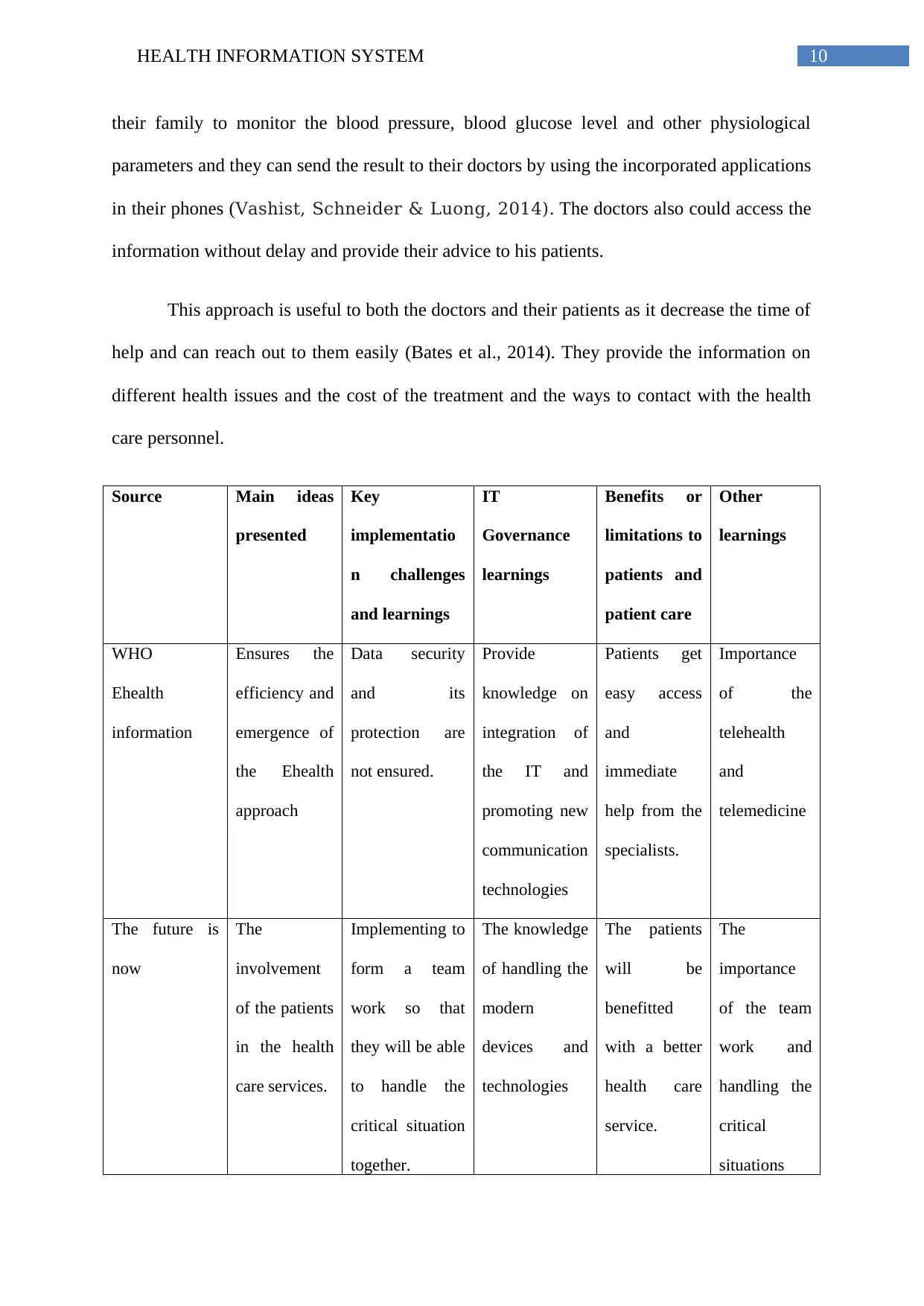
Source Main ideas
presented
Key
implementatio
n challenges
and learnings
IT
Governance
learnings
Benefits or
limitations to
patients and
patient care
Other
learnings
WHO
Ehealth
information
Ensures the
efficiency and
emergence of
the Ehealth
approach
Data security
and its
protection are
not ensured.
Provide
knowledge on
integration of
the IT and
promoting new
communication
technologies
Patients get
easy access
and
immediate
help from the
specialists.
Importance
of the
telehealth
and
telemedicine
The future is
now
The
involvement
of the patients
in the health
care services.
Implementing to
form a team
work so that
they will be able
to handle the
critical situation
together.
The knowledge
of handling the
modern
devices and
technologies
The patients
will be
benefitted
with a better
health care
service.
The
importance
of the team
work and
handling the
critical
situations
their family to monitor the blood pressure, blood glucose level and other physiological
parameters and they can send the result to their doctors by using the incorporated applications
in their phones (Vashist, Schneider & Luong, 2014). The doctors also could access the
information without delay and provide their advice to his patients.
This approach is useful to both the doctors and their patients as it decrease the time of
help and can reach out to them easily (Bates et al., 2014). They provide the information on
different health issues and the cost of the treatment and the ways to contact with the health
care personnel.
Source Main ideas
presented
Key
implementatio
n challenges
and learnings
IT
Governance
learnings
Benefits or
limitations to
patients and
patient care
Other
learnings
WHO
Ehealth
information
Ensures the
efficiency and
emergence of
the Ehealth
approach
Data security
and its
protection are
not ensured.
Provide
knowledge on
integration of
the IT and
promoting new
communication
technologies
Patients get
easy access
and
immediate
help from the
specialists.
Importance
of the
telehealth
and
telemedicine
The future is
now
The
involvement
of the patients
in the health
care services.
Implementing to
form a team
work so that
they will be able
to handle the
critical situation
together.
The knowledge
of handling the
modern
devices and
technologies
The patients
will be
benefitted
with a better
health care
service.
The
importance
of the team
work and
handling the
critical
situations
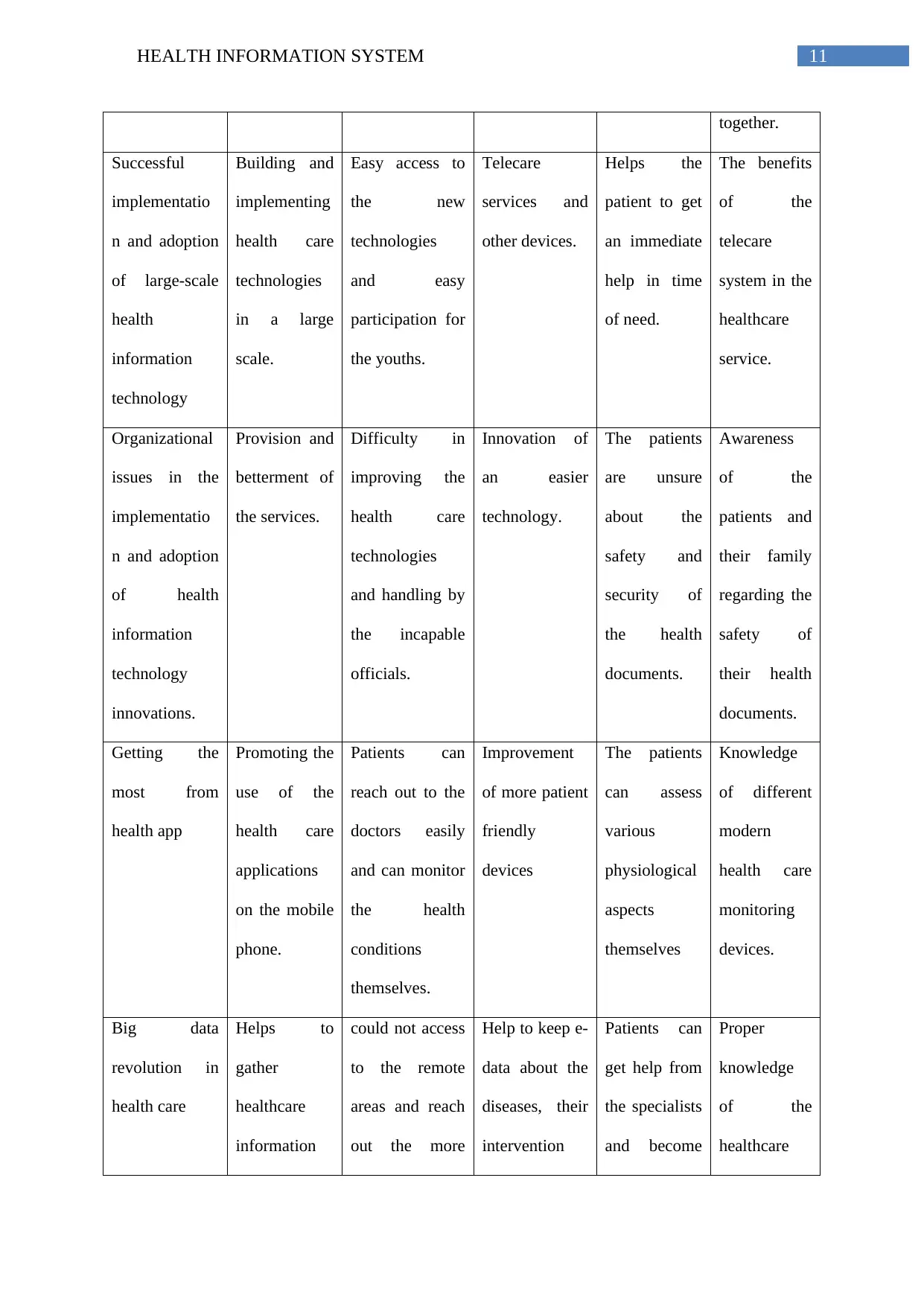
11HEALTH INFORMATION SYSTEM
together.
Successful
implementatio
n and adoption
of large-scale
health
information
technology
Building and
implementing
health care
technologies
in a large
scale.
Easy access to
the new
technologies
and easy
participation for
the youths.
Telecare
services and
other devices.
Helps the
patient to get
an immediate
help in time
of need.
The benefits
of the
telecare
system in the
healthcare
service.
Organizational
issues in the
implementatio
n and adoption
of health
information
technology
innovations.
Provision and
betterment of
the services.
Difficulty in
improving the
health care
technologies
and handling by
the incapable
officials.
Innovation of
an easier
technology.
The patients
are unsure
about the
safety and
security of
the health
documents.
Awareness
of the
patients and
their family
regarding the
safety of
their health
documents.
Getting the
most from
health app
Promoting the
use of the
health care
applications
on the mobile
phone.
Patients can
reach out to the
doctors easily
and can monitor
the health
conditions
themselves.
Improvement
of more patient
friendly
devices
The patients
can assess
various
physiological
aspects
themselves
Knowledge
of different
modern
health care
monitoring
devices.
Big data
revolution in
health care
Helps to
gather
healthcare
information
could not access
to the remote
areas and reach
out the more
Help to keep e-
data about the
diseases, their
intervention
Patients can
get help from
the specialists
and become
Proper
knowledge
of the
healthcare
together.
Successful
implementatio
n and adoption
of large-scale
health
information
technology
Building and
implementing
health care
technologies
in a large
scale.
Easy access to
the new
technologies
and easy
participation for
the youths.
Telecare
services and
other devices.
Helps the
patient to get
an immediate
help in time
of need.
The benefits
of the
telecare
system in the
healthcare
service.
Organizational
issues in the
implementatio
n and adoption
of health
information
technology
innovations.
Provision and
betterment of
the services.
Difficulty in
improving the
health care
technologies
and handling by
the incapable
officials.
Innovation of
an easier
technology.
The patients
are unsure
about the
safety and
security of
the health
documents.
Awareness
of the
patients and
their family
regarding the
safety of
their health
documents.
Getting the
most from
health app
Promoting the
use of the
health care
applications
on the mobile
phone.
Patients can
reach out to the
doctors easily
and can monitor
the health
conditions
themselves.
Improvement
of more patient
friendly
devices
The patients
can assess
various
physiological
aspects
themselves
Knowledge
of different
modern
health care
monitoring
devices.
Big data
revolution in
health care
Helps to
gather
healthcare
information
could not access
to the remote
areas and reach
out the more
Help to keep e-
data about the
diseases, their
intervention
Patients can
get help from
the specialists
and become
Proper
knowledge
of the
healthcare
⊘ This is a preview!⊘
Do you want full access?
Subscribe today to unlock all pages.
Trusted by 1+ million students worldwide

1 out of 18


Related Documents


Your All-in-One AI-Powered Toolkit for Academic Success.
+13062052269
info@desklib.com
Available 24*7 on WhatsApp / Email
![[object Object]](/_next/static/media/star-bottom.7253800d.svg)
Unlock your academic potential
Copyright © 2020–2026 A2Z Services. All Rights Reserved. Developed and managed by ZUCOL.