Health Promotion Evaluation: Worksheet 3, Dying to Know Day Project
VerifiedAdded on 2022/12/23
|5
|1750
|73
Homework Assignment
AI Summary
This assignment evaluates the 'Dying to Know Day' health promotion project, focusing on Worksheet 3. The evaluation includes an analysis of the project's process and summative aspects, identifying evidence used to assess activities and overall success. The assignment explores the project's planning, advertising, data collection, and reflection phases. It also examines barriers to implementation and suggests improvements, such as incorporating counseling services for participants and staff, and adopting culturally sensitive communication strategies. The assignment utilizes the project website to extract relevant information and offers a critical reflection on the project's approach to death literacy, end-of-life care, grief, and bereavement within the community. The author reflects on the project's strengths and limitations, and proposes how to enhance the project if it were implemented in their community. This assignment offers a comprehensive analysis of the project's effectiveness and suggests improvements for future health promotion initiatives.
Health promotion evaluation: Worksheet 3
Dying to know day
URL Link to project: http://www.dyingtoknowday.org/
Instructions
1. Check progress of your group and reflect on what is going well and what is
challenging. Devise strategies to deal with the challenges share these with the group
and come to an agreement.
2. Apply previous instructions to complete this final worksheet.
Time required to complete(remember 6cps = 10 hours per week of student effort)
Worksheet three will take you approximately 2-4 hours to complete your individual
review. Meet with your group to report, review and combine your individual findings
into a single document. Allow at least 2-4 hours for this part. Finally, your group
needs to document its progress, i.e. keep minutes/action sheet.
Learning Outcomes
By the end of this worksheet you should have:
1. identified and documented evidence of process evaluation (activities)
2. identified and documented evidence of summative evaluation (project goal)
3. reflected on what you would do differently if the project was yours for your community
Evidence of success, barriers, process and summative evaluation.
Refer to learning guide in module: Evaluating health promotion
What evidence is provided within the project site that could be used to evaluate the
activities undertaken (process evaluation) (200 words)
Don’t forget to consider evidence of barriers to implementation of the project as well as
evidence of success. Barriers could be attitudinal, knowledge based, behavioural or
environmental.
The information in the website of ‘Dying to Know’ which is indicative of the
evidence base for evaluation of the activities performed, is the section on
‘Planning’ meant for individuals who wish to collaborate with the organization and
host events on enhancing death literacy and response to loss, grief and
bereavement within the community. This section in the website provides key steps
which must hosts must consider, to not only ensure efficient implementation of the
death literacy event, but also combat possible barriers to program administration.
The evidence which can be used to evaluate effectiveness of death literacy
activities undertaken, as mentioned in the website, include: Planning,
Advertisement, Booking, Set up and Preparation, Holding the event, Data
collection and evaluation and Reflection and Debrief (Dying to Know Day, 2019).
This evidence also focuses on mitigation of the attitudinal and behavioural barriers
such as individuals displaying reluctance or displaying feelings of remorse over
discussions pertaining to death, by considering program evaluation and planning
steps like usage of direct, interpersonal communication, establishing contacts with
local community organizations and provision of more comprehensive support
services and not merely discussions for families recently encountering the loss of a
1
Dying to know day
URL Link to project: http://www.dyingtoknowday.org/
Instructions
1. Check progress of your group and reflect on what is going well and what is
challenging. Devise strategies to deal with the challenges share these with the group
and come to an agreement.
2. Apply previous instructions to complete this final worksheet.
Time required to complete(remember 6cps = 10 hours per week of student effort)
Worksheet three will take you approximately 2-4 hours to complete your individual
review. Meet with your group to report, review and combine your individual findings
into a single document. Allow at least 2-4 hours for this part. Finally, your group
needs to document its progress, i.e. keep minutes/action sheet.
Learning Outcomes
By the end of this worksheet you should have:
1. identified and documented evidence of process evaluation (activities)
2. identified and documented evidence of summative evaluation (project goal)
3. reflected on what you would do differently if the project was yours for your community
Evidence of success, barriers, process and summative evaluation.
Refer to learning guide in module: Evaluating health promotion
What evidence is provided within the project site that could be used to evaluate the
activities undertaken (process evaluation) (200 words)
Don’t forget to consider evidence of barriers to implementation of the project as well as
evidence of success. Barriers could be attitudinal, knowledge based, behavioural or
environmental.
The information in the website of ‘Dying to Know’ which is indicative of the
evidence base for evaluation of the activities performed, is the section on
‘Planning’ meant for individuals who wish to collaborate with the organization and
host events on enhancing death literacy and response to loss, grief and
bereavement within the community. This section in the website provides key steps
which must hosts must consider, to not only ensure efficient implementation of the
death literacy event, but also combat possible barriers to program administration.
The evidence which can be used to evaluate effectiveness of death literacy
activities undertaken, as mentioned in the website, include: Planning,
Advertisement, Booking, Set up and Preparation, Holding the event, Data
collection and evaluation and Reflection and Debrief (Dying to Know Day, 2019).
This evidence also focuses on mitigation of the attitudinal and behavioural barriers
such as individuals displaying reluctance or displaying feelings of remorse over
discussions pertaining to death, by considering program evaluation and planning
steps like usage of direct, interpersonal communication, establishing contacts with
local community organizations and provision of more comprehensive support
services and not merely discussions for families recently encountering the loss of a
1
Paraphrase This Document
Need a fresh take? Get an instant paraphrase of this document with our AI Paraphraser

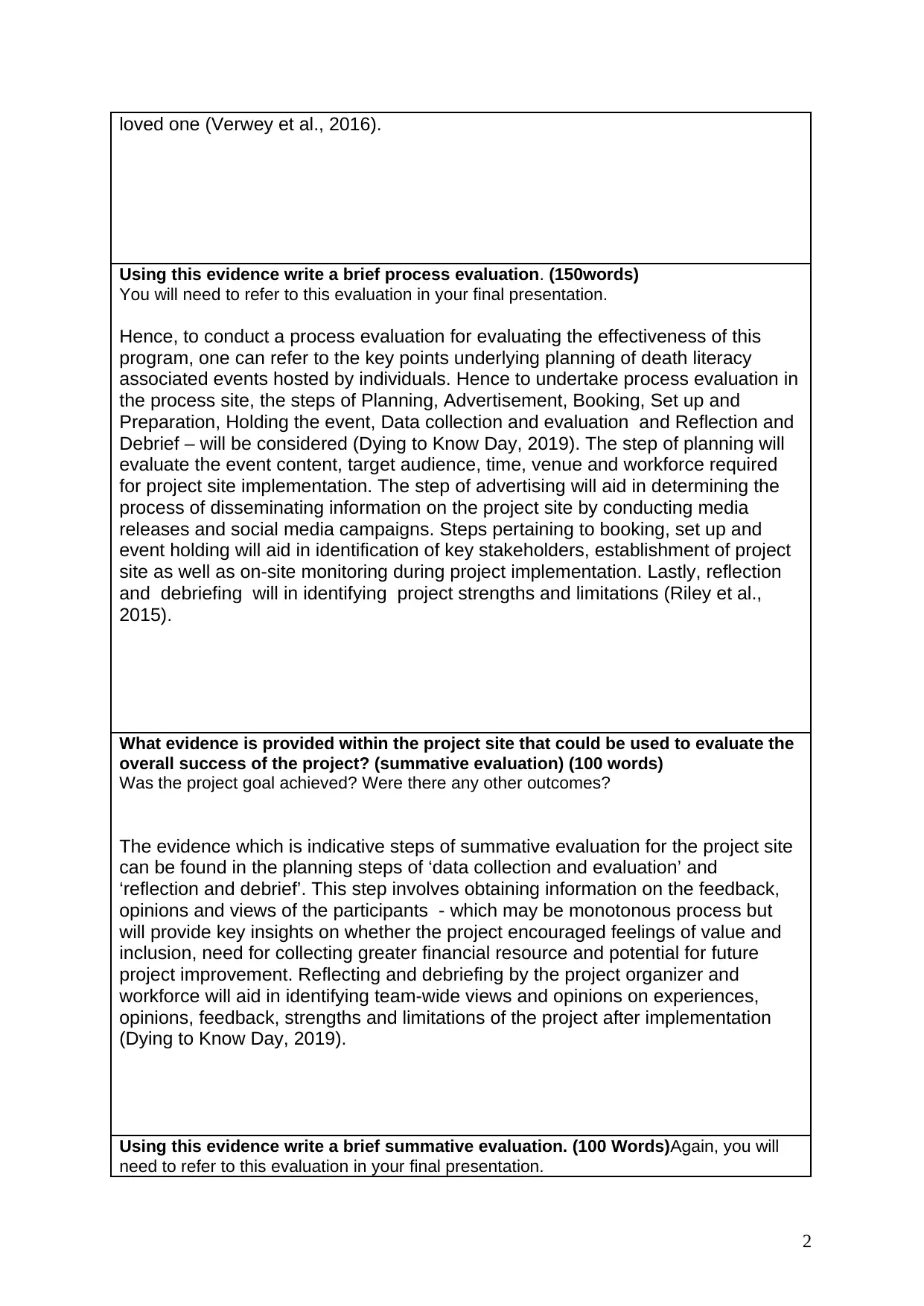
loved one (Verwey et al., 2016).
Using this evidence write a brief process evaluation. (150words)
You will need to refer to this evaluation in your final presentation.
Hence, to conduct a process evaluation for evaluating the effectiveness of this
program, one can refer to the key points underlying planning of death literacy
associated events hosted by individuals. Hence to undertake process evaluation in
the process site, the steps of Planning, Advertisement, Booking, Set up and
Preparation, Holding the event, Data collection and evaluation and Reflection and
Debrief – will be considered (Dying to Know Day, 2019). The step of planning will
evaluate the event content, target audience, time, venue and workforce required
for project site implementation. The step of advertising will aid in determining the
process of disseminating information on the project site by conducting media
releases and social media campaigns. Steps pertaining to booking, set up and
event holding will aid in identification of key stakeholders, establishment of project
site as well as on-site monitoring during project implementation. Lastly, reflection
and debriefing will in identifying project strengths and limitations (Riley et al.,
2015).
What evidence is provided within the project site that could be used to evaluate the
overall success of the project? (summative evaluation) (100 words)
Was the project goal achieved? Were there any other outcomes?
The evidence which is indicative steps of summative evaluation for the project site
can be found in the planning steps of ‘data collection and evaluation’ and
‘reflection and debrief’. This step involves obtaining information on the feedback,
opinions and views of the participants - which may be monotonous process but
will provide key insights on whether the project encouraged feelings of value and
inclusion, need for collecting greater financial resource and potential for future
project improvement. Reflecting and debriefing by the project organizer and
workforce will aid in identifying team-wide views and opinions on experiences,
opinions, feedback, strengths and limitations of the project after implementation
(Dying to Know Day, 2019).
Using this evidence write a brief summative evaluation. (100 Words)Again, you will
need to refer to this evaluation in your final presentation.
2
Using this evidence write a brief process evaluation. (150words)
You will need to refer to this evaluation in your final presentation.
Hence, to conduct a process evaluation for evaluating the effectiveness of this
program, one can refer to the key points underlying planning of death literacy
associated events hosted by individuals. Hence to undertake process evaluation in
the process site, the steps of Planning, Advertisement, Booking, Set up and
Preparation, Holding the event, Data collection and evaluation and Reflection and
Debrief – will be considered (Dying to Know Day, 2019). The step of planning will
evaluate the event content, target audience, time, venue and workforce required
for project site implementation. The step of advertising will aid in determining the
process of disseminating information on the project site by conducting media
releases and social media campaigns. Steps pertaining to booking, set up and
event holding will aid in identification of key stakeholders, establishment of project
site as well as on-site monitoring during project implementation. Lastly, reflection
and debriefing will in identifying project strengths and limitations (Riley et al.,
2015).
What evidence is provided within the project site that could be used to evaluate the
overall success of the project? (summative evaluation) (100 words)
Was the project goal achieved? Were there any other outcomes?
The evidence which is indicative steps of summative evaluation for the project site
can be found in the planning steps of ‘data collection and evaluation’ and
‘reflection and debrief’. This step involves obtaining information on the feedback,
opinions and views of the participants - which may be monotonous process but
will provide key insights on whether the project encouraged feelings of value and
inclusion, need for collecting greater financial resource and potential for future
project improvement. Reflecting and debriefing by the project organizer and
workforce will aid in identifying team-wide views and opinions on experiences,
opinions, feedback, strengths and limitations of the project after implementation
(Dying to Know Day, 2019).
Using this evidence write a brief summative evaluation. (100 Words)Again, you will
need to refer to this evaluation in your final presentation.
2

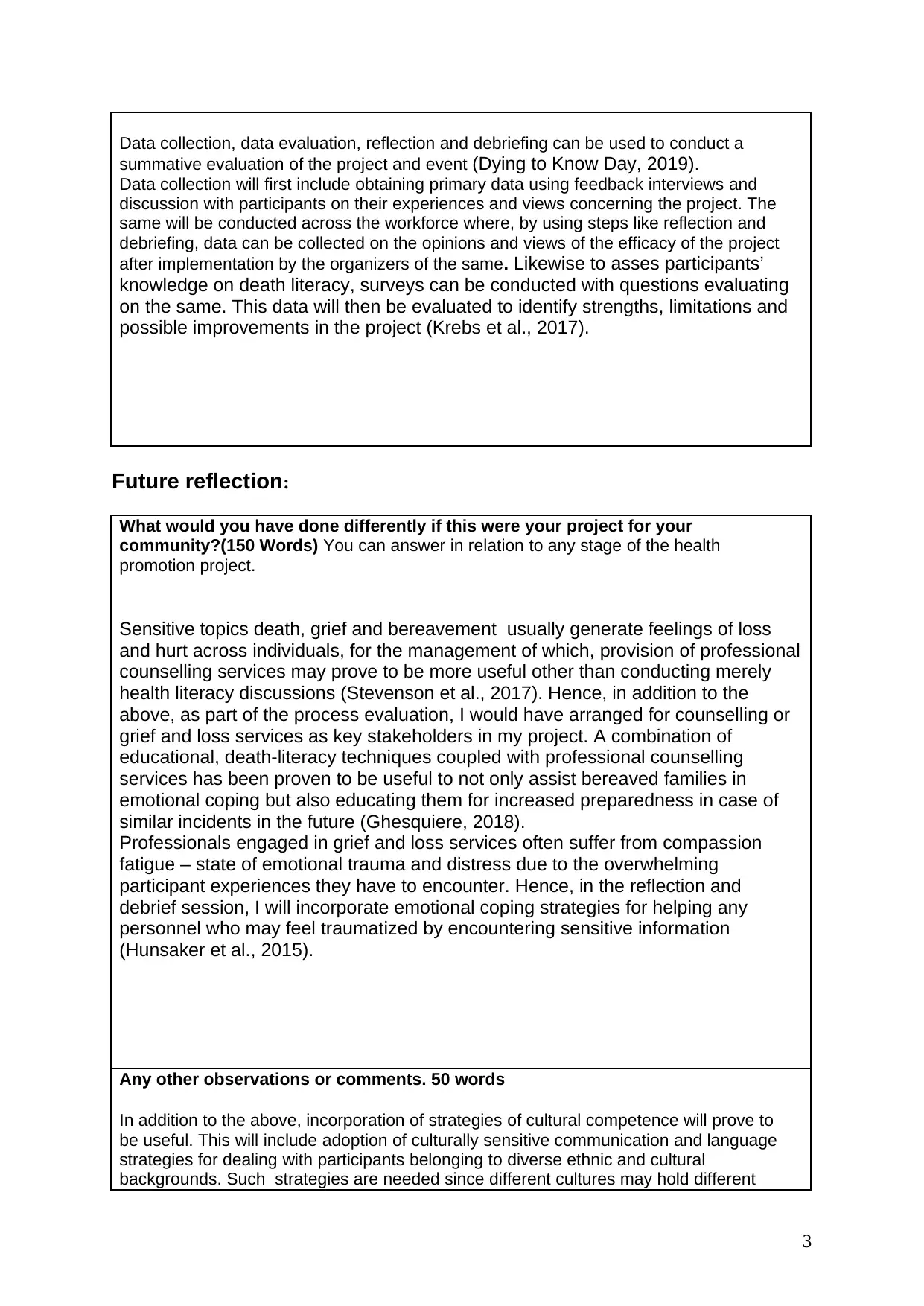
Data collection, data evaluation, reflection and debriefing can be used to conduct a
summative evaluation of the project and event (Dying to Know Day, 2019).
Data collection will first include obtaining primary data using feedback interviews and
discussion with participants on their experiences and views concerning the project. The
same will be conducted across the workforce where, by using steps like reflection and
debriefing, data can be collected on the opinions and views of the efficacy of the project
after implementation by the organizers of the same. Likewise to asses participants’
knowledge on death literacy, surveys can be conducted with questions evaluating
on the same. This data will then be evaluated to identify strengths, limitations and
possible improvements in the project (Krebs et al., 2017).
Future reflection:
What would you have done differently if this were your project for your
community?(150 Words) You can answer in relation to any stage of the health
promotion project.
Sensitive topics death, grief and bereavement usually generate feelings of loss
and hurt across individuals, for the management of which, provision of professional
counselling services may prove to be more useful other than conducting merely
health literacy discussions (Stevenson et al., 2017). Hence, in addition to the
above, as part of the process evaluation, I would have arranged for counselling or
grief and loss services as key stakeholders in my project. A combination of
educational, death-literacy techniques coupled with professional counselling
services has been proven to be useful to not only assist bereaved families in
emotional coping but also educating them for increased preparedness in case of
similar incidents in the future (Ghesquiere, 2018).
Professionals engaged in grief and loss services often suffer from compassion
fatigue – state of emotional trauma and distress due to the overwhelming
participant experiences they have to encounter. Hence, in the reflection and
debrief session, I will incorporate emotional coping strategies for helping any
personnel who may feel traumatized by encountering sensitive information
(Hunsaker et al., 2015).
Any other observations or comments. 50 words
In addition to the above, incorporation of strategies of cultural competence will prove to
be useful. This will include adoption of culturally sensitive communication and language
strategies for dealing with participants belonging to diverse ethnic and cultural
backgrounds. Such strategies are needed since different cultures may hold different
3
summative evaluation of the project and event (Dying to Know Day, 2019).
Data collection will first include obtaining primary data using feedback interviews and
discussion with participants on their experiences and views concerning the project. The
same will be conducted across the workforce where, by using steps like reflection and
debriefing, data can be collected on the opinions and views of the efficacy of the project
after implementation by the organizers of the same. Likewise to asses participants’
knowledge on death literacy, surveys can be conducted with questions evaluating
on the same. This data will then be evaluated to identify strengths, limitations and
possible improvements in the project (Krebs et al., 2017).
Future reflection:
What would you have done differently if this were your project for your
community?(150 Words) You can answer in relation to any stage of the health
promotion project.
Sensitive topics death, grief and bereavement usually generate feelings of loss
and hurt across individuals, for the management of which, provision of professional
counselling services may prove to be more useful other than conducting merely
health literacy discussions (Stevenson et al., 2017). Hence, in addition to the
above, as part of the process evaluation, I would have arranged for counselling or
grief and loss services as key stakeholders in my project. A combination of
educational, death-literacy techniques coupled with professional counselling
services has been proven to be useful to not only assist bereaved families in
emotional coping but also educating them for increased preparedness in case of
similar incidents in the future (Ghesquiere, 2018).
Professionals engaged in grief and loss services often suffer from compassion
fatigue – state of emotional trauma and distress due to the overwhelming
participant experiences they have to encounter. Hence, in the reflection and
debrief session, I will incorporate emotional coping strategies for helping any
personnel who may feel traumatized by encountering sensitive information
(Hunsaker et al., 2015).
Any other observations or comments. 50 words
In addition to the above, incorporation of strategies of cultural competence will prove to
be useful. This will include adoption of culturally sensitive communication and language
strategies for dealing with participants belonging to diverse ethnic and cultural
backgrounds. Such strategies are needed since different cultures may hold different
3
⊘ This is a preview!⊘
Do you want full access?
Subscribe today to unlock all pages.

Trusted by 1+ million students worldwide

meanings of death and loss (Varghese, Quiros & Berger, 2018).
4
4
Paraphrase This Document
Need a fresh take? Get an instant paraphrase of this document with our AI Paraphraser

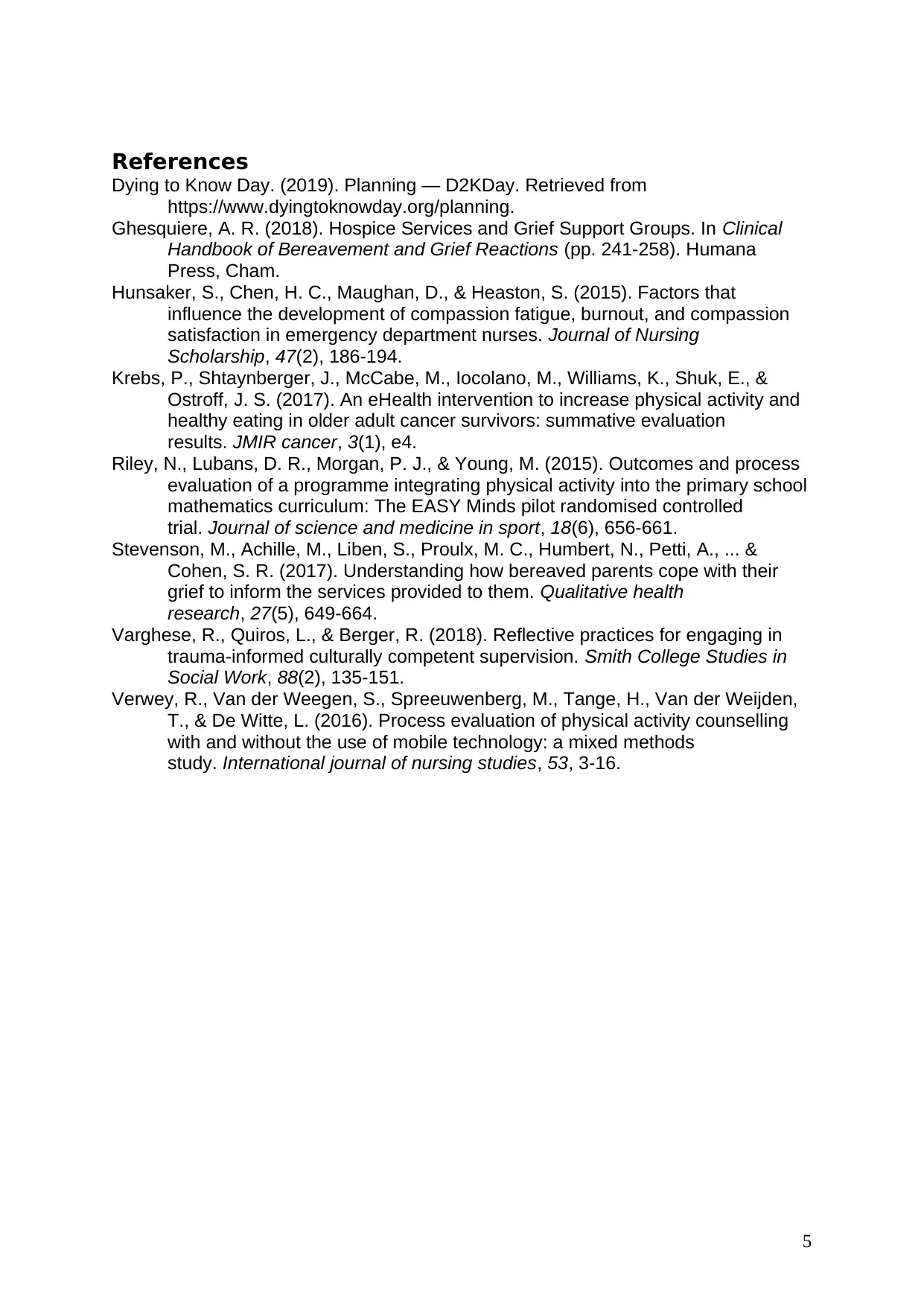
References
Dying to Know Day. (2019). Planning — D2KDay. Retrieved from
https://www.dyingtoknowday.org/planning.
Ghesquiere, A. R. (2018). Hospice Services and Grief Support Groups. In Clinical
Handbook of Bereavement and Grief Reactions (pp. 241-258). Humana
Press, Cham.
Hunsaker, S., Chen, H. C., Maughan, D., & Heaston, S. (2015). Factors that
influence the development of compassion fatigue, burnout, and compassion
satisfaction in emergency department nurses. Journal of Nursing
Scholarship, 47(2), 186-194.
Krebs, P., Shtaynberger, J., McCabe, M., Iocolano, M., Williams, K., Shuk, E., &
Ostroff, J. S. (2017). An eHealth intervention to increase physical activity and
healthy eating in older adult cancer survivors: summative evaluation
results. JMIR cancer, 3(1), e4.
Riley, N., Lubans, D. R., Morgan, P. J., & Young, M. (2015). Outcomes and process
evaluation of a programme integrating physical activity into the primary school
mathematics curriculum: The EASY Minds pilot randomised controlled
trial. Journal of science and medicine in sport, 18(6), 656-661.
Stevenson, M., Achille, M., Liben, S., Proulx, M. C., Humbert, N., Petti, A., ... &
Cohen, S. R. (2017). Understanding how bereaved parents cope with their
grief to inform the services provided to them. Qualitative health
research, 27(5), 649-664.
Varghese, R., Quiros, L., & Berger, R. (2018). Reflective practices for engaging in
trauma-informed culturally competent supervision. Smith College Studies in
Social Work, 88(2), 135-151.
Verwey, R., Van der Weegen, S., Spreeuwenberg, M., Tange, H., Van der Weijden,
T., & De Witte, L. (2016). Process evaluation of physical activity counselling
with and without the use of mobile technology: a mixed methods
study. International journal of nursing studies, 53, 3-16.
5
Dying to Know Day. (2019). Planning — D2KDay. Retrieved from
https://www.dyingtoknowday.org/planning.
Ghesquiere, A. R. (2018). Hospice Services and Grief Support Groups. In Clinical
Handbook of Bereavement and Grief Reactions (pp. 241-258). Humana
Press, Cham.
Hunsaker, S., Chen, H. C., Maughan, D., & Heaston, S. (2015). Factors that
influence the development of compassion fatigue, burnout, and compassion
satisfaction in emergency department nurses. Journal of Nursing
Scholarship, 47(2), 186-194.
Krebs, P., Shtaynberger, J., McCabe, M., Iocolano, M., Williams, K., Shuk, E., &
Ostroff, J. S. (2017). An eHealth intervention to increase physical activity and
healthy eating in older adult cancer survivors: summative evaluation
results. JMIR cancer, 3(1), e4.
Riley, N., Lubans, D. R., Morgan, P. J., & Young, M. (2015). Outcomes and process
evaluation of a programme integrating physical activity into the primary school
mathematics curriculum: The EASY Minds pilot randomised controlled
trial. Journal of science and medicine in sport, 18(6), 656-661.
Stevenson, M., Achille, M., Liben, S., Proulx, M. C., Humbert, N., Petti, A., ... &
Cohen, S. R. (2017). Understanding how bereaved parents cope with their
grief to inform the services provided to them. Qualitative health
research, 27(5), 649-664.
Varghese, R., Quiros, L., & Berger, R. (2018). Reflective practices for engaging in
trauma-informed culturally competent supervision. Smith College Studies in
Social Work, 88(2), 135-151.
Verwey, R., Van der Weegen, S., Spreeuwenberg, M., Tange, H., Van der Weijden,
T., & De Witte, L. (2016). Process evaluation of physical activity counselling
with and without the use of mobile technology: a mixed methods
study. International journal of nursing studies, 53, 3-16.
5
1 out of 5
Related Documents
Your All-in-One AI-Powered Toolkit for Academic Success.
+13062052269
info@desklib.com
Available 24*7 on WhatsApp / Email
Unlock your academic potential
Copyright © 2020–2026 A2Z Services. All Rights Reserved. Developed and managed by ZUCOL.