Analysis of Heat and Mass Transfer During Fry-Drying of Sewage Sludge
VerifiedAdded on 2023/01/13
|13
|2895
|39
Report
AI Summary
This report investigates the fry-drying process for sewage sludge using recycled cooking oil. It examines the heat and mass transfer mechanisms involved, including the impact of oil temperature, initial moisture content, and sample diameter on drying kinetics. The study employs experimental setups, including deep-fat fryers and thermocouples, to monitor temperature and weight changes during the process. The report discusses the differences between food frying and sludge fry-drying, highlighting the significance of internal and external resistances. It also explores the potential of recycled cooking oil as a sustainable frying medium and compares the efficiency of fry-drying with other drying methods. The results highlight the effectiveness of fry-drying for sewage sludge treatment, offering a potential solution for waste management and resource recovery.
HEAT AND MASS TRANSFER DURING FRY-DRYING OF SEWAGE SLUDGE.
By Name
Course
Instructor
Institution
Location
Date
By Name
Course
Instructor
Institution
Location
Date

Paraphrase This Document
Need a fresh take? Get an instant paraphrase of this document with our AI Paraphraser

Abstract
The process of deep frying involves immersion of a wet
material in a large volume of oil at high temperatures. It
presents a method which is easily adaptable for drying due to
its simplicity rather than cooking of materials. Sewage sludge
is one of the best-known materials that is usually undertaken
through this process of dry-frying. This material may be dried
by the use of recycled cooking oil (RCO) as the medium for
frying. One of the benefits of such a process is that both the
materials are prepared for efficient disposal by incineration
method.
This particular term paper examines fry drying of the sewage
sludge obtained from the nearest municipality by use of the
recycled cooking oil. There was monitoring of the sequential
process which occurred during the fry-drying of the sample
including temperature, weight as well as image analysis. Due
to the presence of wetter and thicker materials (sewage sludge)
than the common fried samples of food, the process is
characterized by high residual moisture content. This is evident
once the boiling point has attained or reached the same value of
temperature as at the geometric center of the material under the
study during the heating process. This further suggests that the
process is heat transfer scenario especially at the central point
of the sludge sample. This process is later followed by other
mechanisms which allow the sample to dry completely. In
order to effectively study the impact of the operating boundary
conditions on the kinetic properties of fry drying , various
temperatures of the oil (between 120 to 180°C), and initial
moisture content (4.8 and 5.6 6kg water kg-1 and diameter of
sludge sample between 15 and 25mm were subjected to
investigation.
The process of deep frying involves immersion of a wet
material in a large volume of oil at high temperatures. It
presents a method which is easily adaptable for drying due to
its simplicity rather than cooking of materials. Sewage sludge
is one of the best-known materials that is usually undertaken
through this process of dry-frying. This material may be dried
by the use of recycled cooking oil (RCO) as the medium for
frying. One of the benefits of such a process is that both the
materials are prepared for efficient disposal by incineration
method.
This particular term paper examines fry drying of the sewage
sludge obtained from the nearest municipality by use of the
recycled cooking oil. There was monitoring of the sequential
process which occurred during the fry-drying of the sample
including temperature, weight as well as image analysis. Due
to the presence of wetter and thicker materials (sewage sludge)
than the common fried samples of food, the process is
characterized by high residual moisture content. This is evident
once the boiling point has attained or reached the same value of
temperature as at the geometric center of the material under the
study during the heating process. This further suggests that the
process is heat transfer scenario especially at the central point
of the sludge sample. This process is later followed by other
mechanisms which allow the sample to dry completely. In
order to effectively study the impact of the operating boundary
conditions on the kinetic properties of fry drying , various
temperatures of the oil (between 120 to 180°C), and initial
moisture content (4.8 and 5.6 6kg water kg-1 and diameter of
sludge sample between 15 and 25mm were subjected to
investigation.
⊘ This is a preview!⊘
Do you want full access?
Subscribe today to unlock all pages.

Trusted by 1+ million students worldwide
Introduction
Deep-frying consists of immersion of wet materials in a
relatively large volume of oil that has been heated up.
Apparently, it is regarded as a multifunctional operating unit
for formulating, drying as well as texturing the material. The
reduction of the volume of water in the wet sludge sample
through heating is called drying. When this process is
facilitated through artificial heat induction on a frying surface
then it is called fry-drying. Although this particular technique
is commonly associated with the food industry, there have been
some innovative applications that have been proposed for non-
food materials including sewage sludge and timber handling.
One of the by-products of the wastewater treatment is sewage
sludge and it represents a significant problem in terms of its
volume which is equivalent to about 850000 tons per year in
countries like France(Kondjoyan,Willis, Portanguen and Gros
2013).
The sludge is commonly spread on the land as a
complementary fertilizer in an agricultural sector, disposed as
landfills or used as a co-fuel. Regardless of the chosen route of
the disposal, there is always incorporation of drying as one of
the stages of the sludge treatment. The moisture content of the
sludge is usually reduced by thermal drying after the process of
mechanical dewatering to almost 4 kg water·kg−1 dry matter.
The resultant product has reduced volume but increased
calorific value (energy content increase)Also, the process of
further drying allows the sludge to have fixed volume and
mass especially if the temperature is favorable. Most of the
sludge dryers originate from the standard processes of drying.
It is important to note that adaptations of the technologies that
are currently in existence are never straightforward due to the
fact that sludge is usually characterized by sticky properties.
Deep-frying consists of immersion of wet materials in a
relatively large volume of oil that has been heated up.
Apparently, it is regarded as a multifunctional operating unit
for formulating, drying as well as texturing the material. The
reduction of the volume of water in the wet sludge sample
through heating is called drying. When this process is
facilitated through artificial heat induction on a frying surface
then it is called fry-drying. Although this particular technique
is commonly associated with the food industry, there have been
some innovative applications that have been proposed for non-
food materials including sewage sludge and timber handling.
One of the by-products of the wastewater treatment is sewage
sludge and it represents a significant problem in terms of its
volume which is equivalent to about 850000 tons per year in
countries like France(Kondjoyan,Willis, Portanguen and Gros
2013).
The sludge is commonly spread on the land as a
complementary fertilizer in an agricultural sector, disposed as
landfills or used as a co-fuel. Regardless of the chosen route of
the disposal, there is always incorporation of drying as one of
the stages of the sludge treatment. The moisture content of the
sludge is usually reduced by thermal drying after the process of
mechanical dewatering to almost 4 kg water·kg−1 dry matter.
The resultant product has reduced volume but increased
calorific value (energy content increase)Also, the process of
further drying allows the sludge to have fixed volume and
mass especially if the temperature is favorable. Most of the
sludge dryers originate from the standard processes of drying.
It is important to note that adaptations of the technologies that
are currently in existence are never straightforward due to the
fact that sludge is usually characterized by sticky properties.
Paraphrase This Document
Need a fresh take? Get an instant paraphrase of this document with our AI Paraphraser
The process of dry- frying provides an alternative technique of
the sewage sludge thermal drying.
Literature Review
The first feasibility study which was carried out by the use of
the peanut and sewage sludge indicated that use of the process
of fry-drying allows for the attainment of low moisture content
within a short period. Also, the process showed that oil is
adsorbed on the solid dry matter. The final material obtained is
fry-dried sludge which is easy to handle and has higher
calorific value than the air-dried sludge. Air-drying of sludge
involves a conventional means of exposing sludge to the open
air to allow for evaporation process take place. The
conventional means had entirely relied on the air-dried
mechanism. In order to realize a reduction on the economic
impact of the entire process, there has been a proposal by
various scholars on the use of recycled cooking oil as oil for
frying. Such a proposal produced no meaningful modification
to the drying kinetics. The RCO is a generic name that is used
to refer to the oily phase substance obtained after several
phases of vegetable oil purification (Ning et al.2017).
This includes the greasy water that is found at the outlets of the
restaurants, the food industry as well as agriculture. Getting
proper methods of handling RCO is currently a major concern
to the food industry in various parts of the world. This is
because its use as animal feed had been banned a few years
ago. Prior to the ban, animal feed used to consume over 86% of
this product. An immersion frying is basically a well-
established and widely used technique although little attention
has been paid to the understanding of the mechanism of frying.
Project Scope and Objectives
The main aim of this particular term paper is to properly
analyze as well present sample of the experimental results of
the sewage sludge thermal drying.
Literature Review
The first feasibility study which was carried out by the use of
the peanut and sewage sludge indicated that use of the process
of fry-drying allows for the attainment of low moisture content
within a short period. Also, the process showed that oil is
adsorbed on the solid dry matter. The final material obtained is
fry-dried sludge which is easy to handle and has higher
calorific value than the air-dried sludge. Air-drying of sludge
involves a conventional means of exposing sludge to the open
air to allow for evaporation process take place. The
conventional means had entirely relied on the air-dried
mechanism. In order to realize a reduction on the economic
impact of the entire process, there has been a proposal by
various scholars on the use of recycled cooking oil as oil for
frying. Such a proposal produced no meaningful modification
to the drying kinetics. The RCO is a generic name that is used
to refer to the oily phase substance obtained after several
phases of vegetable oil purification (Ning et al.2017).
This includes the greasy water that is found at the outlets of the
restaurants, the food industry as well as agriculture. Getting
proper methods of handling RCO is currently a major concern
to the food industry in various parts of the world. This is
because its use as animal feed had been banned a few years
ago. Prior to the ban, animal feed used to consume over 86% of
this product. An immersion frying is basically a well-
established and widely used technique although little attention
has been paid to the understanding of the mechanism of frying.
Project Scope and Objectives
The main aim of this particular term paper is to properly
analyze as well present sample of the experimental results of
thermal drying of sludge from the sewage by the use of RCO in
the deep-fat frying as the frying medium. The paper was
limited to the provision of the qualitative description of the
involved mechanisms. Also, the paper aimed to quantify the
effects of the major conditions of the operations on the fry-
drying kinetics. The differences, as well as similarities between
fry-drying applications in the industries and food cooking,
became the basis of this paper evaluation.
Methodology
Experimental setup
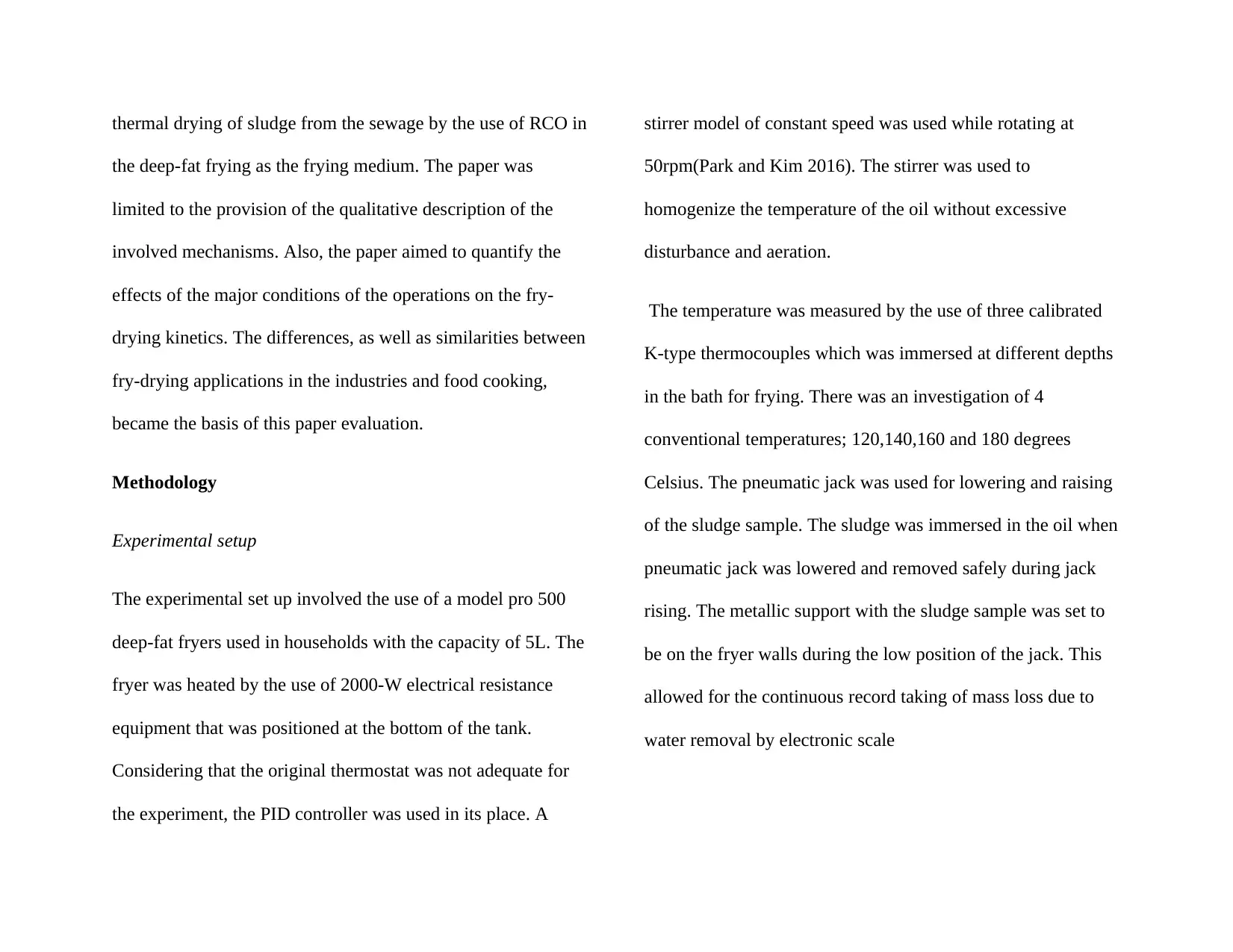
The experimental set up involved the use of a model pro 500
deep-fat fryers used in households with the capacity of 5L. The
fryer was heated by the use of 2000-W electrical resistance
equipment that was positioned at the bottom of the tank.
Considering that the original thermostat was not adequate for
the experiment, the PID controller was used in its place. A
stirrer model of constant speed was used while rotating at
50rpm(Park and Kim 2016). The stirrer was used to
homogenize the temperature of the oil without excessive
disturbance and aeration.
The temperature was measured by the use of three calibrated
K-type thermocouples which was immersed at different depths
in the bath for frying. There was an investigation of 4
conventional temperatures; 120,140,160 and 180 degrees
Celsius. The pneumatic jack was used for lowering and raising
of the sludge sample. The sludge was immersed in the oil when
pneumatic jack was lowered and removed safely during jack
rising. The metallic support with the sludge sample was set to
be on the fryer walls during the low position of the jack. This
allowed for the continuous record taking of mass loss due to
water removal by electronic scale
the deep-fat frying as the frying medium. The paper was
limited to the provision of the qualitative description of the
involved mechanisms. Also, the paper aimed to quantify the
effects of the major conditions of the operations on the fry-
drying kinetics. The differences, as well as similarities between
fry-drying applications in the industries and food cooking,
became the basis of this paper evaluation.
Methodology
Experimental setup
The experimental set up involved the use of a model pro 500
deep-fat fryers used in households with the capacity of 5L. The
fryer was heated by the use of 2000-W electrical resistance
equipment that was positioned at the bottom of the tank.
Considering that the original thermostat was not adequate for
the experiment, the PID controller was used in its place. A
stirrer model of constant speed was used while rotating at
50rpm(Park and Kim 2016). The stirrer was used to
homogenize the temperature of the oil without excessive
disturbance and aeration.
The temperature was measured by the use of three calibrated
K-type thermocouples which was immersed at different depths
in the bath for frying. There was an investigation of 4
conventional temperatures; 120,140,160 and 180 degrees
Celsius. The pneumatic jack was used for lowering and raising
of the sludge sample. The sludge was immersed in the oil when
pneumatic jack was lowered and removed safely during jack
rising. The metallic support with the sludge sample was set to
be on the fryer walls during the low position of the jack. This
allowed for the continuous record taking of mass loss due to
water removal by electronic scale
⊘ This is a preview!⊘
Do you want full access?
Subscribe today to unlock all pages.
Trusted by 1+ million students worldwide
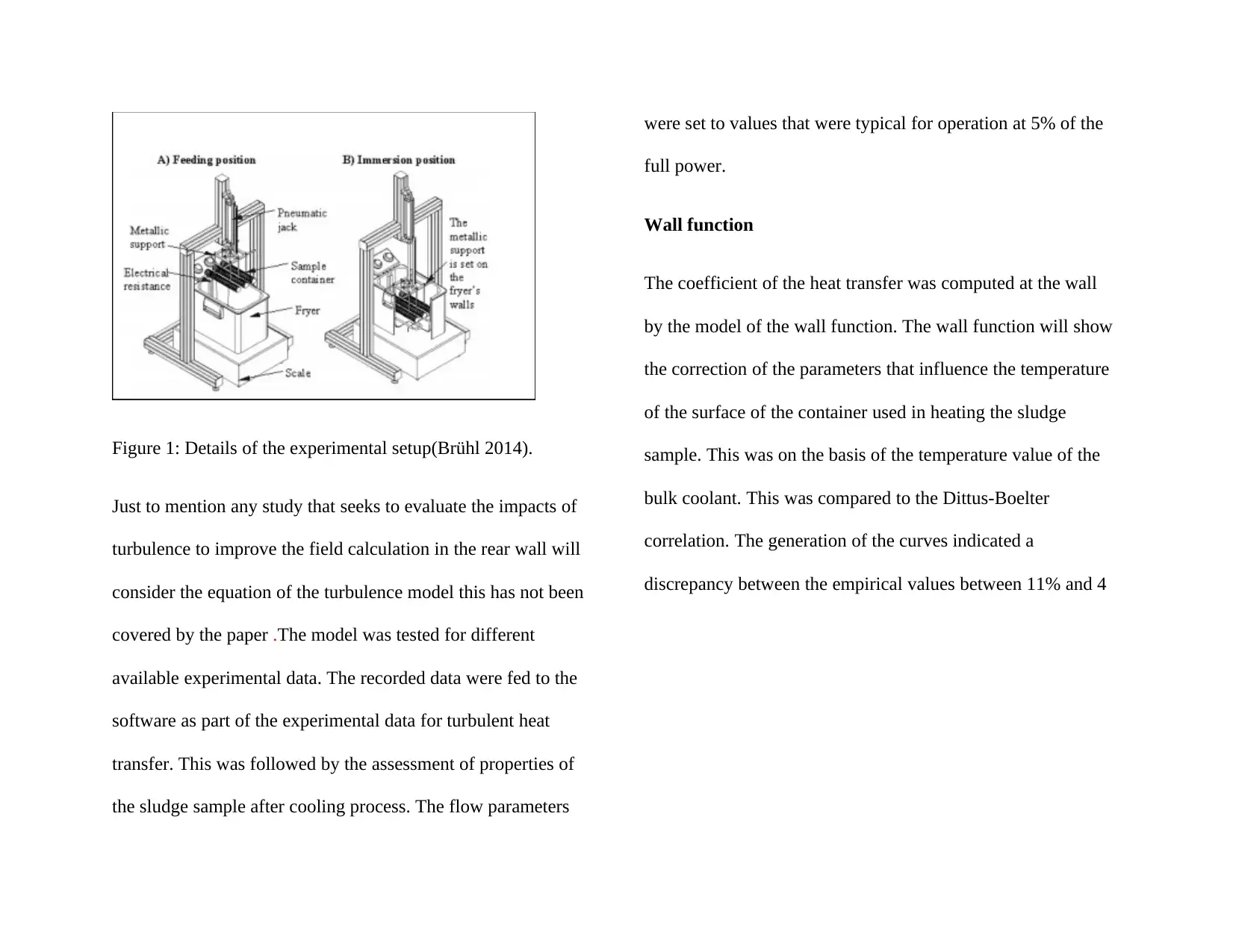
Figure 1: Details of the experimental setup(Brühl 2014).
Just to mention any study that seeks to evaluate the impacts of
turbulence to improve the field calculation in the rear wall will
consider the equation of the turbulence model this has not been
covered by the paper .The model was tested for different
available experimental data. The recorded data were fed to the
software as part of the experimental data for turbulent heat
transfer. This was followed by the assessment of properties of
the sludge sample after cooling process. The flow parameters
were set to values that were typical for operation at 5% of the
full power.
Wall function
The coefficient of the heat transfer was computed at the wall
by the model of the wall function. The wall function will show
the correction of the parameters that influence the temperature
of the surface of the container used in heating the sludge
sample. This was on the basis of the temperature value of the
bulk coolant. This was compared to the Dittus-Boelter
correlation. The generation of the curves indicated a
discrepancy between the empirical values between 11% and 4
Just to mention any study that seeks to evaluate the impacts of
turbulence to improve the field calculation in the rear wall will
consider the equation of the turbulence model this has not been
covered by the paper .The model was tested for different
available experimental data. The recorded data were fed to the
software as part of the experimental data for turbulent heat
transfer. This was followed by the assessment of properties of
the sludge sample after cooling process. The flow parameters
were set to values that were typical for operation at 5% of the
full power.
Wall function
The coefficient of the heat transfer was computed at the wall
by the model of the wall function. The wall function will show
the correction of the parameters that influence the temperature
of the surface of the container used in heating the sludge
sample. This was on the basis of the temperature value of the
bulk coolant. This was compared to the Dittus-Boelter
correlation. The generation of the curves indicated a
discrepancy between the empirical values between 11% and 4
Paraphrase This Document
Need a fresh take? Get an instant paraphrase of this document with our AI Paraphraser
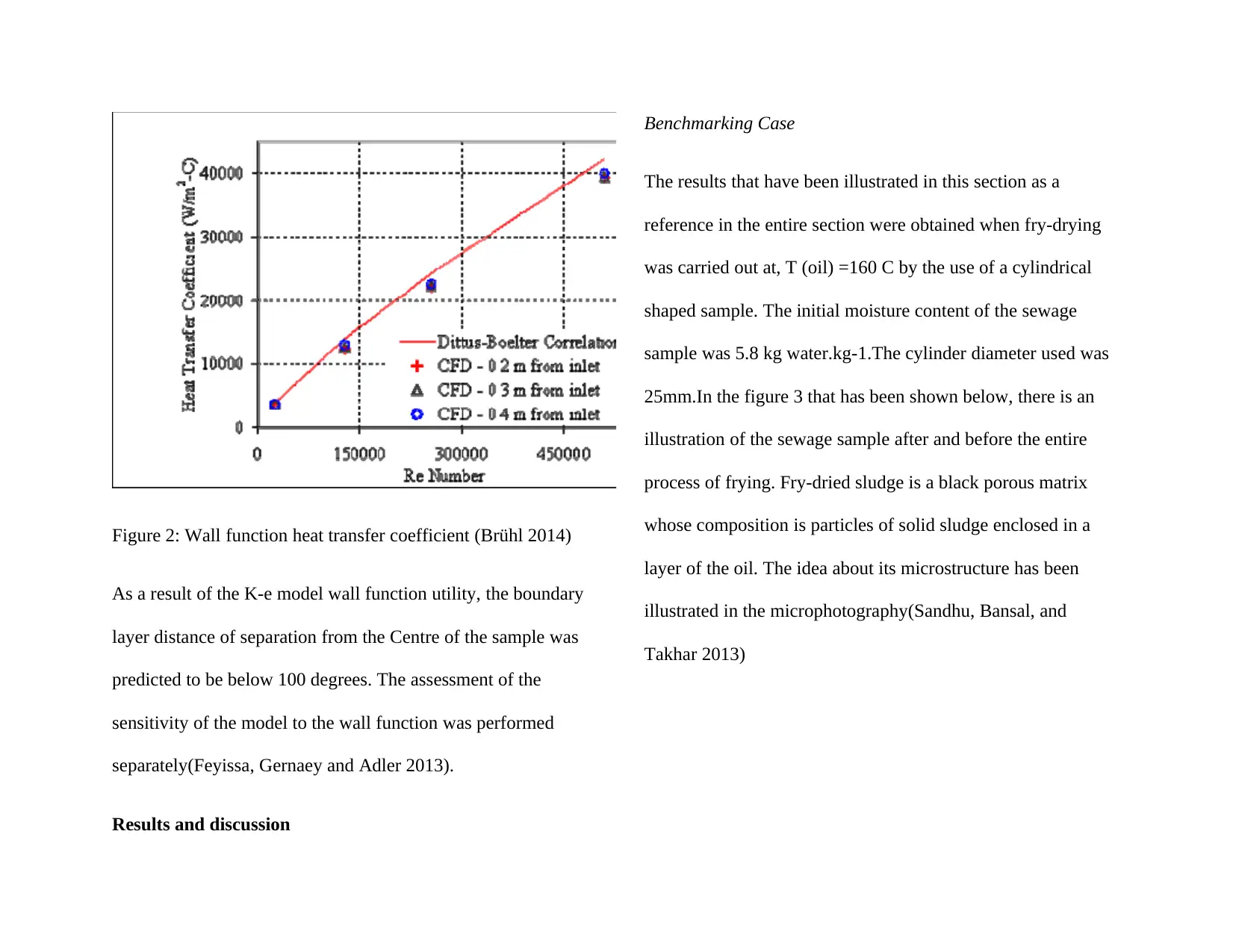
Figure 2: Wall function heat transfer coefficient (Brühl 2014)
As a result of the K-e model wall function utility, the boundary
layer distance of separation from the Centre of the sample was
predicted to be below 100 degrees. The assessment of the
sensitivity of the model to the wall function was performed
separately(Feyissa, Gernaey and Adler 2013).
Results and discussion
Benchmarking Case
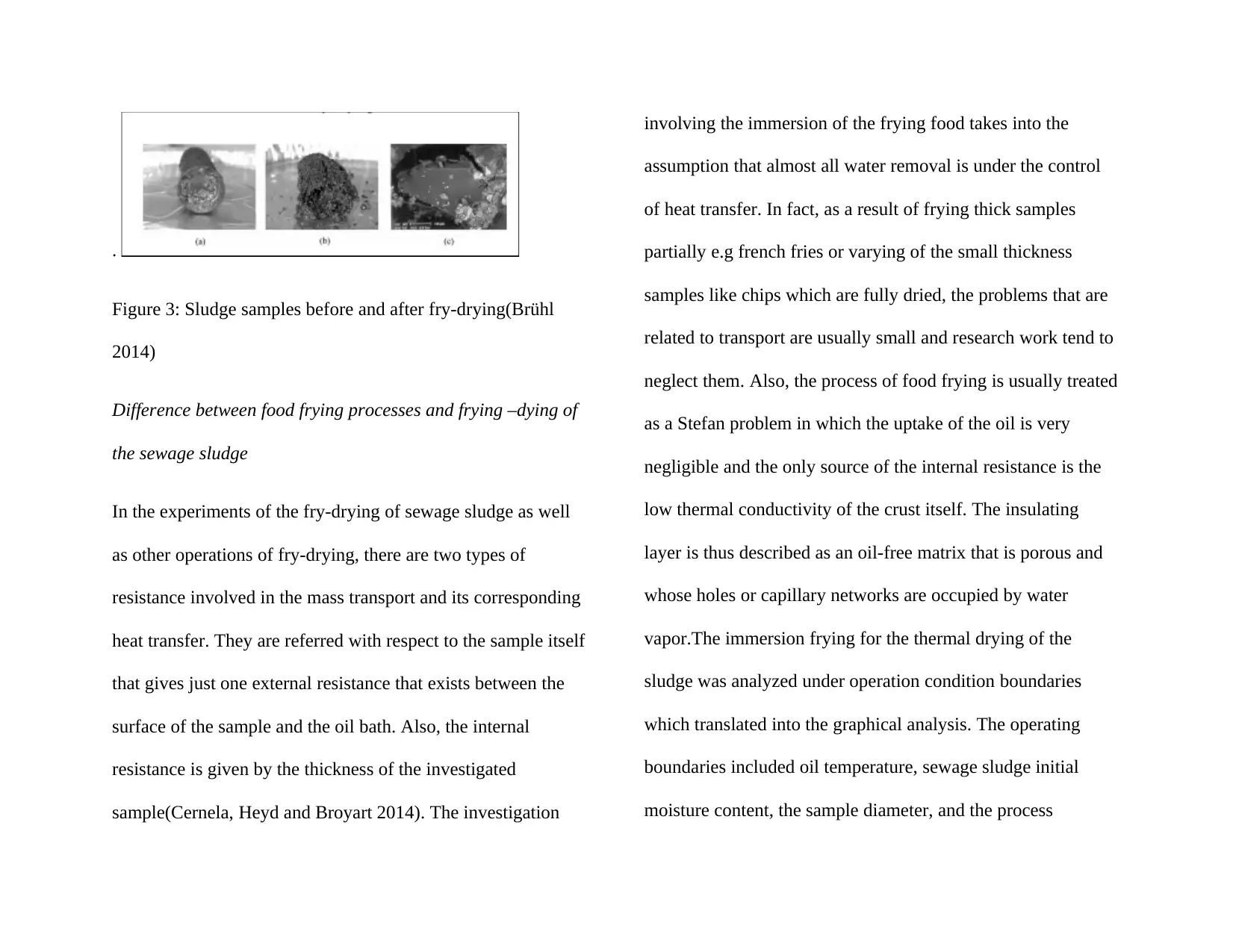
The results that have been illustrated in this section as a
reference in the entire section were obtained when fry-drying
was carried out at, T (oil) =160 C by the use of a cylindrical
shaped sample. The initial moisture content of the sewage
sample was 5.8 kg water.kg-1.The cylinder diameter used was
25mm.In the figure 3 that has been shown below, there is an
illustration of the sewage sample after and before the entire
process of frying. Fry-dried sludge is a black porous matrix
whose composition is particles of solid sludge enclosed in a
layer of the oil. The idea about its microstructure has been
illustrated in the microphotography(Sandhu, Bansal, and
Takhar 2013)
As a result of the K-e model wall function utility, the boundary
layer distance of separation from the Centre of the sample was
predicted to be below 100 degrees. The assessment of the
sensitivity of the model to the wall function was performed
separately(Feyissa, Gernaey and Adler 2013).
Results and discussion
Benchmarking Case
The results that have been illustrated in this section as a
reference in the entire section were obtained when fry-drying
was carried out at, T (oil) =160 C by the use of a cylindrical
shaped sample. The initial moisture content of the sewage
sample was 5.8 kg water.kg-1.The cylinder diameter used was
25mm.In the figure 3 that has been shown below, there is an
illustration of the sewage sample after and before the entire
process of frying. Fry-dried sludge is a black porous matrix
whose composition is particles of solid sludge enclosed in a
layer of the oil. The idea about its microstructure has been
illustrated in the microphotography(Sandhu, Bansal, and
Takhar 2013)
.
Figure 3: Sludge samples before and after fry-drying(Brühl
2014)
Difference between food frying processes and frying –dying of
the sewage sludge
In the experiments of the fry-drying of sewage sludge as well
as other operations of fry-drying, there are two types of
resistance involved in the mass transport and its corresponding
heat transfer. They are referred with respect to the sample itself
that gives just one external resistance that exists between the
surface of the sample and the oil bath. Also, the internal
resistance is given by the thickness of the investigated
sample(Cernela, Heyd and Broyart 2014). The investigation
involving the immersion of the frying food takes into the
assumption that almost all water removal is under the control
of heat transfer. In fact, as a result of frying thick samples
partially e.g french fries or varying of the small thickness
samples like chips which are fully dried, the problems that are
related to transport are usually small and research work tend to
neglect them. Also, the process of food frying is usually treated
as a Stefan problem in which the uptake of the oil is very
negligible and the only source of the internal resistance is the
low thermal conductivity of the crust itself. The insulating
layer is thus described as an oil-free matrix that is porous and
whose holes or capillary networks are occupied by water
vapor.The immersion frying for the thermal drying of the
sludge was analyzed under operation condition boundaries
which translated into the graphical analysis. The operating
boundaries included oil temperature, sewage sludge initial
moisture content, the sample diameter, and the process
Figure 3: Sludge samples before and after fry-drying(Brühl
2014)
Difference between food frying processes and frying –dying of
the sewage sludge
In the experiments of the fry-drying of sewage sludge as well
as other operations of fry-drying, there are two types of
resistance involved in the mass transport and its corresponding
heat transfer. They are referred with respect to the sample itself
that gives just one external resistance that exists between the
surface of the sample and the oil bath. Also, the internal
resistance is given by the thickness of the investigated
sample(Cernela, Heyd and Broyart 2014). The investigation
involving the immersion of the frying food takes into the
assumption that almost all water removal is under the control
of heat transfer. In fact, as a result of frying thick samples
partially e.g french fries or varying of the small thickness
samples like chips which are fully dried, the problems that are
related to transport are usually small and research work tend to
neglect them. Also, the process of food frying is usually treated
as a Stefan problem in which the uptake of the oil is very
negligible and the only source of the internal resistance is the
low thermal conductivity of the crust itself. The insulating
layer is thus described as an oil-free matrix that is porous and
whose holes or capillary networks are occupied by water
vapor.The immersion frying for the thermal drying of the
sludge was analyzed under operation condition boundaries
which translated into the graphical analysis. The operating
boundaries included oil temperature, sewage sludge initial
moisture content, the sample diameter, and the process
⊘ This is a preview!⊘
Do you want full access?
Subscribe today to unlock all pages.
Trusted by 1+ million students worldwide
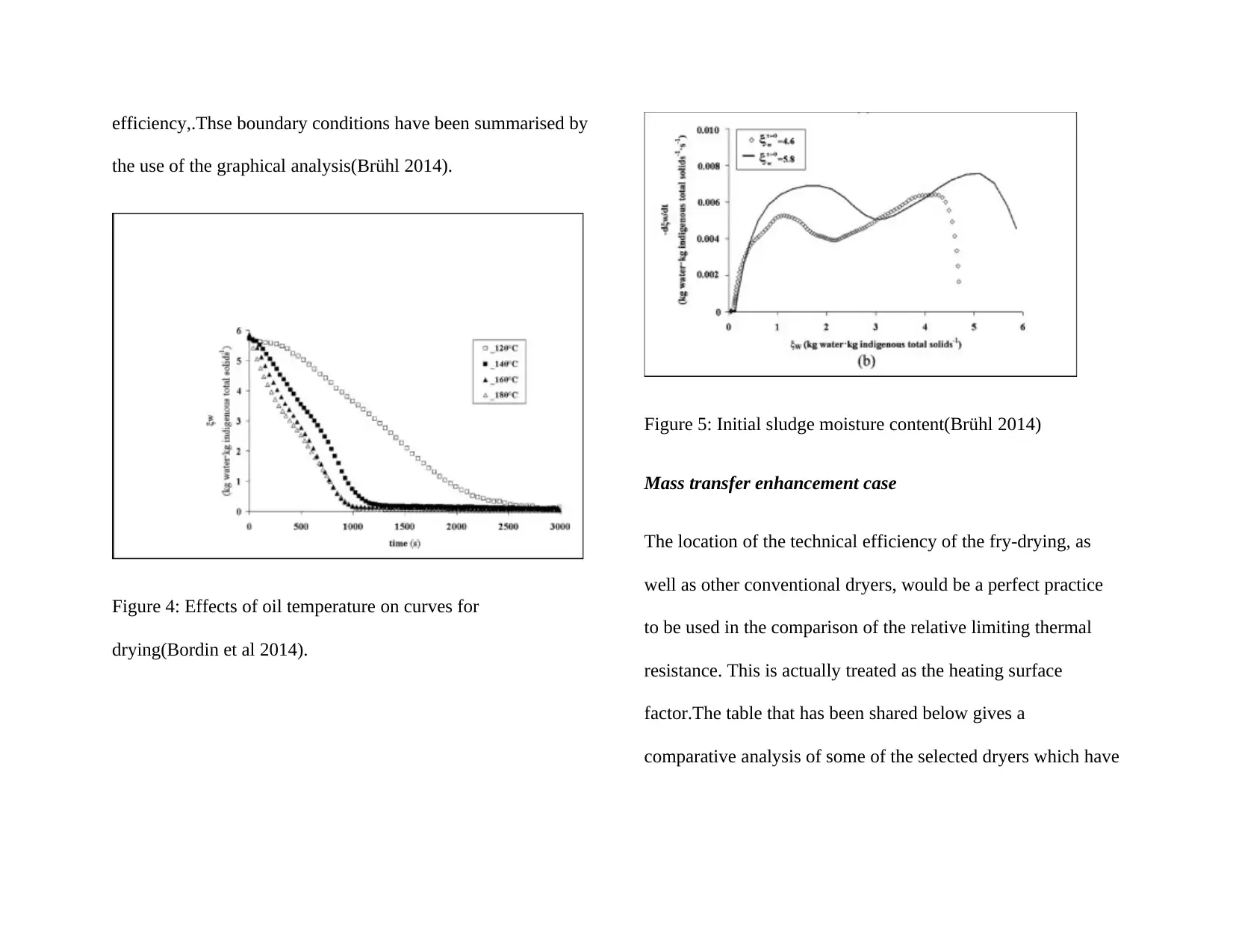
efficiency,.Thse boundary conditions have been summarised by
the use of the graphical analysis(Brühl 2014).
Figure 4: Effects of oil temperature on curves for
drying(Bordin et al 2014).
Figure 5: Initial sludge moisture content(Brühl 2014)
Mass transfer enhancement case
The location of the technical efficiency of the fry-drying, as
well as other conventional dryers, would be a perfect practice
to be used in the comparison of the relative limiting thermal
resistance. This is actually treated as the heating surface
factor.The table that has been shared below gives a
comparative analysis of some of the selected dryers which have
the use of the graphical analysis(Brühl 2014).
Figure 4: Effects of oil temperature on curves for
drying(Bordin et al 2014).
Figure 5: Initial sludge moisture content(Brühl 2014)
Mass transfer enhancement case
The location of the technical efficiency of the fry-drying, as
well as other conventional dryers, would be a perfect practice
to be used in the comparison of the relative limiting thermal
resistance. This is actually treated as the heating surface
factor.The table that has been shared below gives a
comparative analysis of some of the selected dryers which have
Paraphrase This Document
Need a fresh take? Get an instant paraphrase of this document with our AI Paraphraser
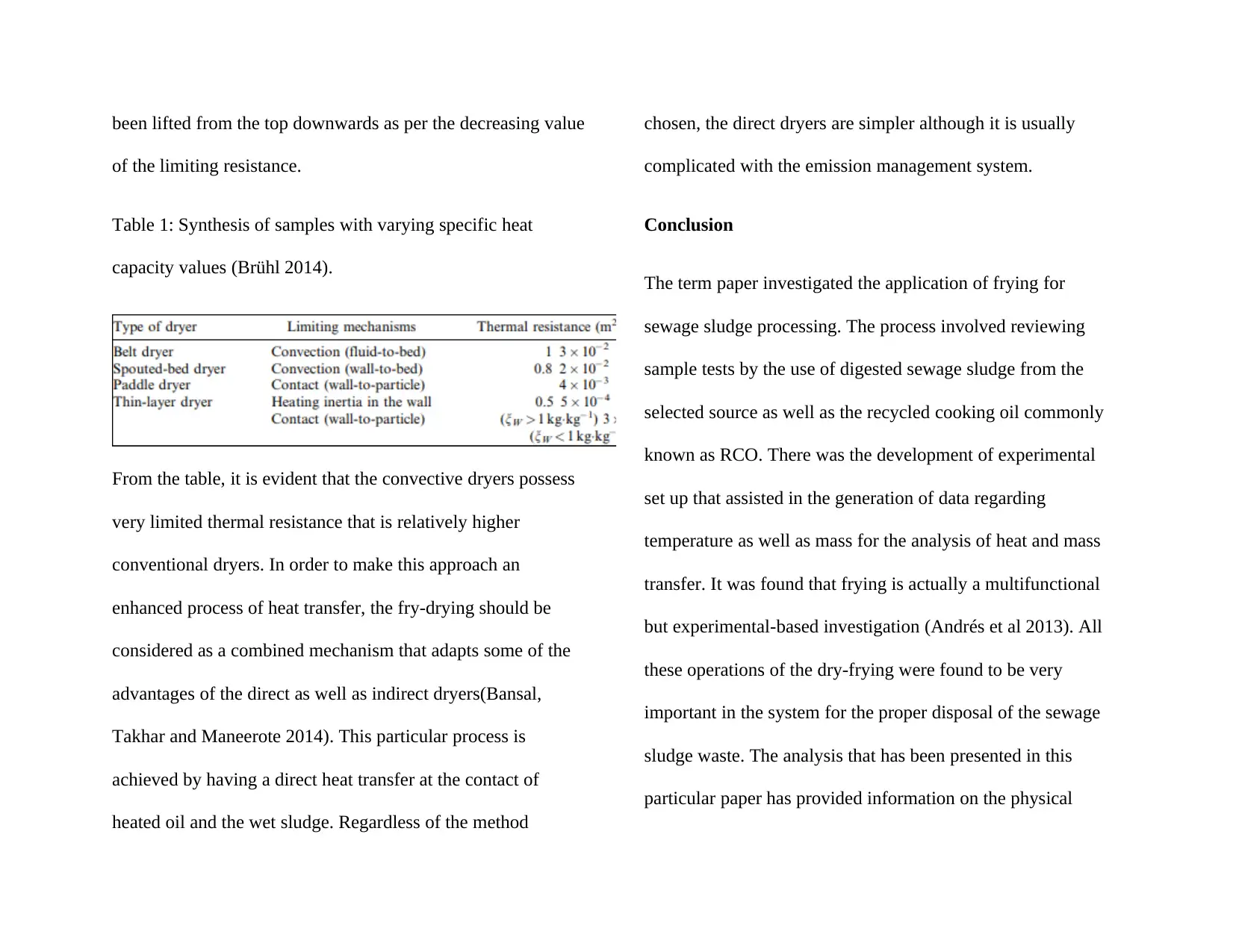
been lifted from the top downwards as per the decreasing value
of the limiting resistance.
Table 1: Synthesis of samples with varying specific heat
capacity values (Brühl 2014).
From the table, it is evident that the convective dryers possess
very limited thermal resistance that is relatively higher
conventional dryers. In order to make this approach an
enhanced process of heat transfer, the fry-drying should be
considered as a combined mechanism that adapts some of the
advantages of the direct as well as indirect dryers(Bansal,
Takhar and Maneerote 2014). This particular process is
achieved by having a direct heat transfer at the contact of
heated oil and the wet sludge. Regardless of the method
chosen, the direct dryers are simpler although it is usually
complicated with the emission management system.
Conclusion
The term paper investigated the application of frying for
sewage sludge processing. The process involved reviewing
sample tests by the use of digested sewage sludge from the
selected source as well as the recycled cooking oil commonly
known as RCO. There was the development of experimental
set up that assisted in the generation of data regarding
temperature as well as mass for the analysis of heat and mass
transfer. It was found that frying is actually a multifunctional
but experimental-based investigation (Andrés et al 2013). All
these operations of the dry-frying were found to be very
important in the system for the proper disposal of the sewage
sludge waste. The analysis that has been presented in this
particular paper has provided information on the physical
of the limiting resistance.
Table 1: Synthesis of samples with varying specific heat
capacity values (Brühl 2014).
From the table, it is evident that the convective dryers possess
very limited thermal resistance that is relatively higher
conventional dryers. In order to make this approach an
enhanced process of heat transfer, the fry-drying should be
considered as a combined mechanism that adapts some of the
advantages of the direct as well as indirect dryers(Bansal,
Takhar and Maneerote 2014). This particular process is
achieved by having a direct heat transfer at the contact of
heated oil and the wet sludge. Regardless of the method
chosen, the direct dryers are simpler although it is usually
complicated with the emission management system.
Conclusion
The term paper investigated the application of frying for
sewage sludge processing. The process involved reviewing
sample tests by the use of digested sewage sludge from the
selected source as well as the recycled cooking oil commonly
known as RCO. There was the development of experimental
set up that assisted in the generation of data regarding
temperature as well as mass for the analysis of heat and mass
transfer. It was found that frying is actually a multifunctional
but experimental-based investigation (Andrés et al 2013). All
these operations of the dry-frying were found to be very
important in the system for the proper disposal of the sewage
sludge waste. The analysis that has been presented in this
particular paper has provided information on the physical
mechanism that is involved in the fry-drying of sewage sludge.
All the discussion about its application to the thermal drying of
sewage sludge has been comprehensively covered. This
particular information is very important for future modeling as
well as large scale implementation of a similar process.
References
Andrés, A., Arguelles, Á., Castelló, M.L. and Heredia, A.,
2013. Mass transfer and volume changes in French fries during
air frying. Food and bioprocess technology, 6(8), pp.1917-
1924.
Bansal, H.S., Takhar, P.S. and Maneerote, J., 2014. Modeling
multiscale transport mechanisms, phase changes, and
thermomechanics during frying. Food research
international, 62, pp.709-717.
Bordin, K., Tomie Kunitake, M., Kazue Aracava, K. and Silvia
Favaro Trindade, C., 2013. Changes in food caused by deep fat
frying-A review. Archivos Latinoamericano de
nutrition, 63(1), pp.5-13.
Brühl, L., 2014. Fatty acid alterations in oils and fats during
heating and frying. European Journal of Lipid Science and
Technology, 116(6), pp.707-715.
All the discussion about its application to the thermal drying of
sewage sludge has been comprehensively covered. This
particular information is very important for future modeling as
well as large scale implementation of a similar process.
References
Andrés, A., Arguelles, Á., Castelló, M.L. and Heredia, A.,
2013. Mass transfer and volume changes in French fries during
air frying. Food and bioprocess technology, 6(8), pp.1917-
1924.
Bansal, H.S., Takhar, P.S. and Maneerote, J., 2014. Modeling
multiscale transport mechanisms, phase changes, and
thermomechanics during frying. Food research
international, 62, pp.709-717.
Bordin, K., Tomie Kunitake, M., Kazue Aracava, K. and Silvia
Favaro Trindade, C., 2013. Changes in food caused by deep fat
frying-A review. Archivos Latinoamericano de
nutrition, 63(1), pp.5-13.
Brühl, L., 2014. Fatty acid alterations in oils and fats during
heating and frying. European Journal of Lipid Science and
Technology, 116(6), pp.707-715.
⊘ This is a preview!⊘
Do you want full access?
Subscribe today to unlock all pages.
Trusted by 1+ million students worldwide

1 out of 13


Your All-in-One AI-Powered Toolkit for Academic Success.
+13062052269
info@desklib.com
Available 24*7 on WhatsApp / Email
![[object Object]](/_next/static/media/star-bottom.7253800d.svg)
Unlock your academic potential
Copyright © 2020–2026 A2Z Services. All Rights Reserved. Developed and managed by ZUCOL.