PROFESSIONAL VOCATIONAL TRAINING: Hippocratic Oath and Ethics Report

Verified

Added on  2022/12/27

|8
|550
|47
Report
AI Summary
This report provides an overview of the Hippocratic Oath, a foundational document in medical history, tracing its origins and development. The report explores the historical context of the oath, including its evolution from ancient Greece to modern times, highlighting key differences between the classic and modern versions. It delves into the core principles of medical ethics, including autonomy, beneficence, non-maleficence, and justice, and examines the impact of declarations such as the Declarations of Geneva, Helsinki, Tokyo, and the International Code of Medical Ethics. The report emphasizes the importance of ethical considerations in medical practice, particularly in light of historical atrocities and the advancements in medical science, concluding with the critical role of ethical values in the medical profession. This assignment is a valuable resource for students studying healthcare and medical ethics, providing a comprehensive understanding of the Hippocratic Oath and its relevance to contemporary medical practice.
Document Page
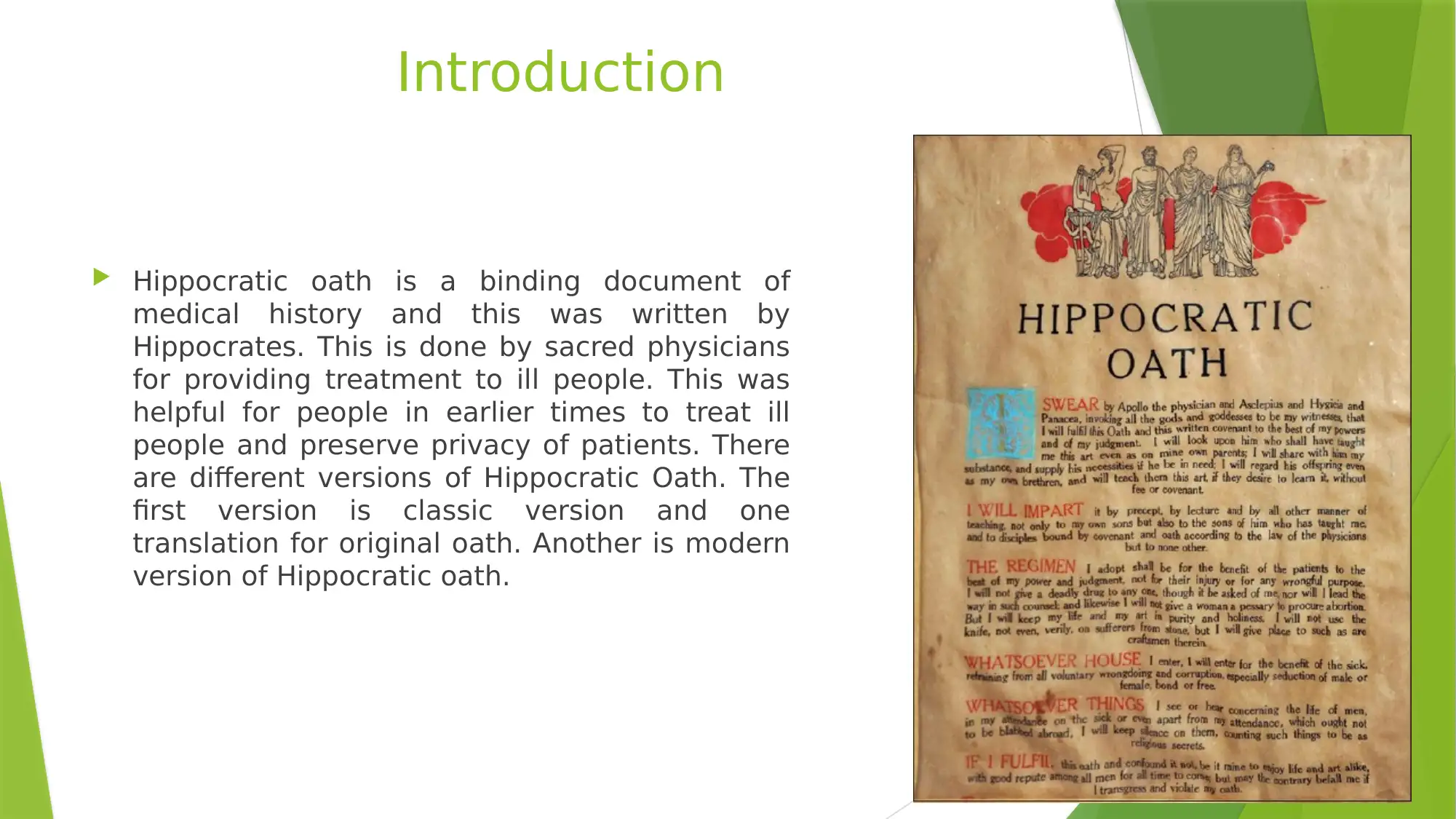
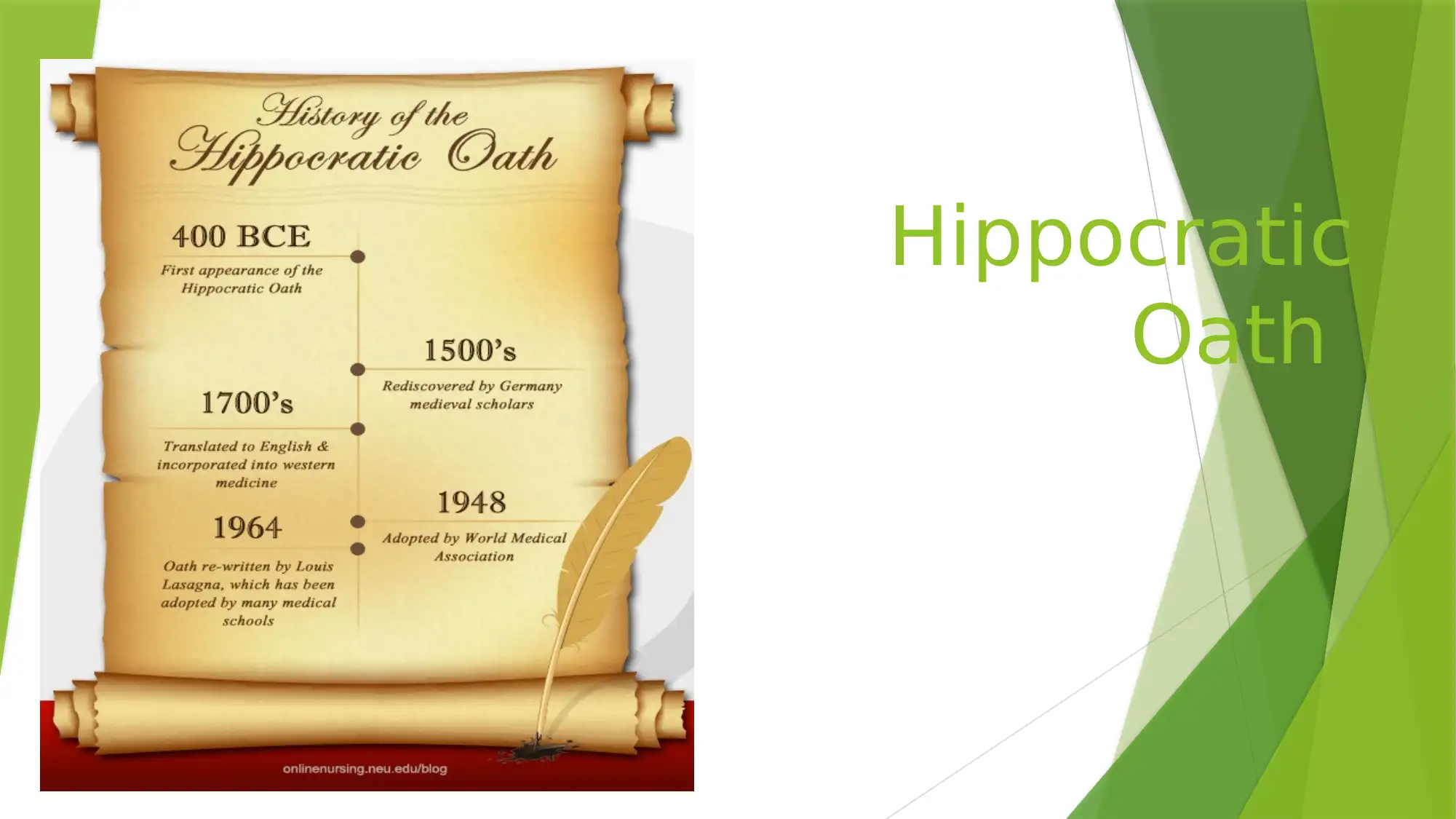
Hippocratic
Oath
tabler-icon-diamond-filled.svg

Paraphrase This Document

Need a fresh take? Get an instant paraphrase of this document with our AI Paraphraser
Document Page
Table of content
Introduction
History
Difference
Document Page
Introduction
Hippocratic oath is a binding document of
medical history and this was written by
Hippocrates. This is done by sacred physicians
for providing treatment to ill people. This was
helpful for people in earlier times to treat ill
people and preserve privacy of patients. There
are different versions of Hippocratic Oath. The
first version is classic version and one
translation for original oath. Another is modern
version of Hippocratic oath.
Document Page
History
The old Hippocratic oath was transformed into new. The old oath was
written in 5th Century BC and it is one of the oldest documents in
history. Hippocrates is considered as father of medicine. This
individual made oath to Gods of healing of Greek pantheon. It
provided help in analysing gravity of different situation and
understanding the point of view of healers. Hippocrates was a
philosopher and physician. According to him, healing is a process that
is used to manage the prism of changing times. In earlier periods,
women were not allowed to become physicians. This is scenario since
long period and it was used to continue since many years. There is
need to improvise and modify new scenarios with time as they help to
manage the present working scenario of the industry and providing
good service to patients and people.
tabler-icon-diamond-filled.svg

Paraphrase This Document

Need a fresh take? Get an instant paraphrase of this document with our AI Paraphraser
Document Page
Difference between old and modern
oath
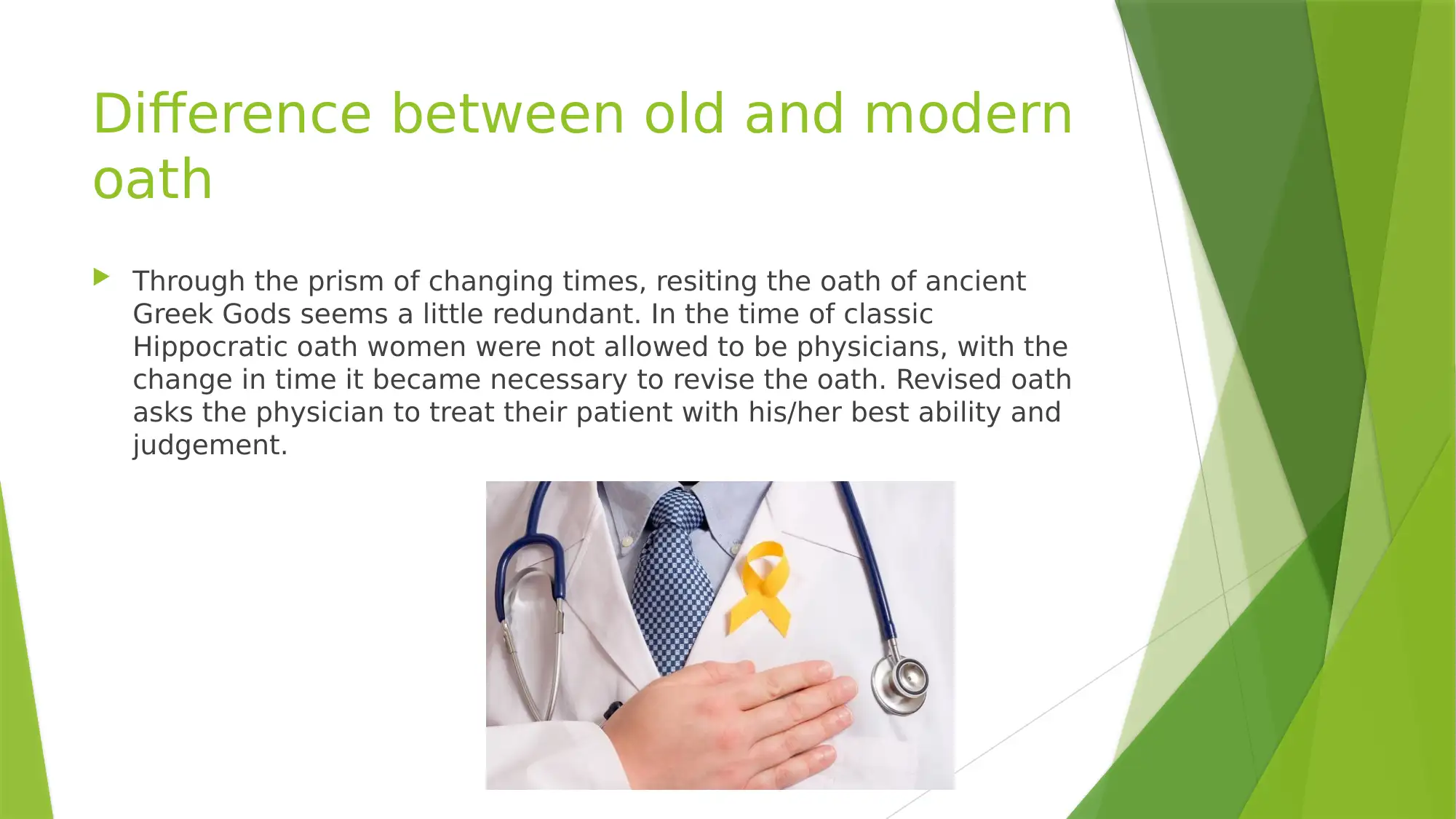
Through the prism of changing times, resiting the oath of ancient
Greek Gods seems a little redundant. In the time of classic
Hippocratic oath women were not allowed to be physicians, with the
change in time it became necessary to revise the oath. Revised oath
asks the physician to treat their patient with his/her best ability and
judgement.
Document Page
Continue…
In the earlier times the people all over the world were having many
different gods and many of them also swear by the name of that God.
the Hippocratic oath is one of the oldest oath and it is also one ofd
the oldest binding document is the history. this oath was produced by
the Hippocrates.
Document Page
Conclusion
From the above report it has been concluded that ethical violation
may be minor punishments or fees but violating law means results in
imprisonments and unreadable mark on career. People who choose
medicines should be declared as strong sense of ethics and higher
purpose. Some of the people take medicines to earn money. As in
relation with medical students who has come for college for strong
sense of ethical values, the oath is spare.
tabler-icon-diamond-filled.svg

Paraphrase This Document

Need a fresh take? Get an instant paraphrase of this document with our AI Paraphraser
Document Page
References
Askitopoulou, H. and Vgontzas, A.N., 2018. The relevance of the
Hippocratic Oath to the ethical and moral values of contemporary
medicine. Part I: The Hippocratic Oath from antiquity to modern
times. European Spine Journal, 27(7), pp.1481-1490.
Dossabhoy, S.S., Feng, J. and Desai, M.S., 2018. The use and
relevance of the Hippocratic Oath in 2015—a survey of US medical
schools. Journal of anesthesia history, 4(2), pp.139-146.
chevron_up_icon
1 out of 8
circle_padding
hide_on_mobile
zoom_out_icon
[object Object]